

What do you think?

Zettels Traum
Vor 40 Jahren veröffentlichte Arno Schmidt sein wichtigstes Werk, Zettel's Traum: 1334 DIN-A-3-Seiten stark, über zehn Kilogramm schwer und als Faksimile vervielfältigt. Schmidts eigene Befürchtung – »Es wird sich nicht mehr setzen lassen« – hatte sich bewahrheitet. Vor dem komplexen Layout des dreispaltigen Romans mit seinen zahlreichen Randglossen kapitulierten Setzerei und Verlag.
Nun endlich erscheint Zettel's Traum, das Werk, das Arno Schmidt auf einen Schlag berühmt machte, als gesetztes Buch. Jahrelange Arbeit von Setzern, Editoren und Korrektoren war nötig, um einen lesefreundlichen Schriftsatz herzustellen, ohne den Charakter des »Überbuchs« (Arno Schmidt) zu verändern und seine Eigenheiten zu glätten.
Mit dieser Ausgabe gilt es, einen Riesenroman neu zu entdecken: Er erzählt die Liebesgeschichte zwischen dem alternden Schriftsteller Daniel Pagenstecher und der sechzehnjährigen Franziska Jacobi und von Leben und Werk Edgar Allan Poes. Er entwirft eine eigene Literaturtheorie in der Nachfolge Sigmund Freuds und entwickelt wie nebenbei eine neue Rechtschreibung, die zum Beispiel die wahren Eigenschaften eines »Pleas'-see=Rocks« enthüllt. In Zettels' Traum finden Arno Schmidts Bemühungen um eine moderne Prosaform und eine angemessene sprachliche Abbildung des menschlichen Bewusstseins ihren vorläufigen Höhepunkt.
Nun endlich erscheint Zettel's Traum, das Werk, das Arno Schmidt auf einen Schlag berühmt machte, als gesetztes Buch. Jahrelange Arbeit von Setzern, Editoren und Korrektoren war nötig, um einen lesefreundlichen Schriftsatz herzustellen, ohne den Charakter des »Überbuchs« (Arno Schmidt) zu verändern und seine Eigenheiten zu glätten.
Mit dieser Ausgabe gilt es, einen Riesenroman neu zu entdecken: Er erzählt die Liebesgeschichte zwischen dem alternden Schriftsteller Daniel Pagenstecher und der sechzehnjährigen Franziska Jacobi und von Leben und Werk Edgar Allan Poes. Er entwirft eine eigene Literaturtheorie in der Nachfolge Sigmund Freuds und entwickelt wie nebenbei eine neue Rechtschreibung, die zum Beispiel die wahren Eigenschaften eines »Pleas'-see=Rocks« enthüllt. In Zettels' Traum finden Arno Schmidts Bemühungen um eine moderne Prosaform und eine angemessene sprachliche Abbildung des menschlichen Bewusstseins ihren vorläufigen Höhepunkt.
1334 pages, Hardcover
First published January 1, 1970
About the author
Arno Schmidt
242 books229 followersArno Schmidt, in full Arno Otto Schmidt, (born January 18, 1914, Hamburg-Hamm, Germany—died June 3, 1979, Celle), novelist, translator, and critic, whose experimental prose established him as the preeminent Modernist of 20th-century German literature.
With roots in both German Romanticism and Expressionism, he attempted to develop modern prose forms that correspond more closely to the workings of the conscious and subconscious mind and to revitalize a literary language that he considered debased by Nazism and war.
The influence of James Joyce and Sigmund Freud are apparent in both a collection of short stories, Kühe in Halbtrauer (1964; Country Matters), and, most especially, in Zettels Traum (1970; Bottom’s Dream)—a three-columned, more than 1,300-page, photo-offset typescript, centring on the mind and works of Poe. It was then that Schmidt developed his theory of “etyms,” the morphemes of language that betray subconscious desires. Two further works on the same grand scale are the “novella-comedy” Die Schule der Atheisten (1972; School for Atheists) and Abend mit Goldrand (1975; Evening Edged in Gold), a dream-scape that has as its focal point Hiëronymus Bosch’s Garden of Earthly Delights and that has come to be regarded as his finest and most mature work.
Schmidt was a man of vast autodidactic learning and Rabelaisian humour. Though complex and sometimes daunting, his works are enriched by inventive language and imbued with a profound commitment to humanity’s intellectual achievements.
With roots in both German Romanticism and Expressionism, he attempted to develop modern prose forms that correspond more closely to the workings of the conscious and subconscious mind and to revitalize a literary language that he considered debased by Nazism and war.
The influence of James Joyce and Sigmund Freud are apparent in both a collection of short stories, Kühe in Halbtrauer (1964; Country Matters), and, most especially, in Zettels Traum (1970; Bottom’s Dream)—a three-columned, more than 1,300-page, photo-offset typescript, centring on the mind and works of Poe. It was then that Schmidt developed his theory of “etyms,” the morphemes of language that betray subconscious desires. Two further works on the same grand scale are the “novella-comedy” Die Schule der Atheisten (1972; School for Atheists) and Abend mit Goldrand (1975; Evening Edged in Gold), a dream-scape that has as its focal point Hiëronymus Bosch’s Garden of Earthly Delights and that has come to be regarded as his finest and most mature work.
Schmidt was a man of vast autodidactic learning and Rabelaisian humour. Though complex and sometimes daunting, his works are enriched by inventive language and imbued with a profound commitment to humanity’s intellectual achievements.
Ratings & Reviews
Friends & Following
Create a free account to discover what your friends think of this book!
Community Reviews
Displaying 1 - 30 of 43 reviews

September 23, 2016
Translation is, as I am wont to say, an impossibility. Every language is unique to itself. So a translator tackles that impossibility anew with every author, with every sentence for that matter.This is one of those works where it really should be impossible for an accurate translation to exist, and yet – after years and years of Woods’ labor – it does exist. As with everything I read in translation, I can only react to the text as given by the translator (as I only speak/read English) and the overall impact of the work as presented; so: I know enough about what Schmidt was doing to at least be able to glimpse what has likely been sacrificed; but I also know enough to recognize what a monumental accomplishment this translation is.
-John E. Woods
I have to wonder: is Woods done? Will we ever see anything else from him again? After Mann and now Schmidt, what else can he tackle (and does he take suggestions)?
Okay, so the book itself. Oh, it’s also about translation. At least, it uses translation – specifically translating Poe into German – as a jumping off point; it is both the reason behind Paul and Wilma Jacobi’s visit to Daniel Pagenstecher (their daughter Franziska has her own motives) and one of the primary focuses of the first book/chapter/section of ZT/BD. The idea of translation and the act of translation is present throughout the work, but Daniel’s Etym Theory quickly takes a place of prominence in the text and becomes by and large the main focus – both as general exploration of language/literature and specific explication of Poe’s oeuvre – of the work as a whole. I’ll get to that in a second, just one more quick note about the plot/narrative of the book:
There really isn’t much to speak of. I don’t mean that dismissively, I mean it more as encouragement: if you go a few hundred pages, pause, and wonder if you’ve missed some sort of plot development, you probably haven’t. ZT/BD is very pointedly uninterested in narrative conventions; it is more a work of theory (etym) and criticism (Poe) but even then it does not bother with the forms or conventions of those either. But, as a cheat guide – without spoiling anything – the main plot points of the book are in Sections I, V, and VIII. And that’s about it. (It’s humorous to me that Schmidt expressed surprise – as noted in Woods’ Afterward – that anyone would read this entire book, when I, IV, VII were quite enough - IV and VII (the Walpurgis sections) are easily the most experimental and etym-wild of the book, and I have to think that Schmidt was both recommending his favorite sections and generally messing with unsuspecting readers in saying this). I enjoyed the narrative portions of the text (there is some really great, insightful, dialogue; presented in distinctly convincing voices); thankfully I enjoyed the other portions just as much (at times more so), for they are considerably more prevalent.
I firmly request that for 1ce you don't piddle=around with the text! [...] By changing the orthography one can produce the wildest verbal tripe, and then interpolate any=old meaning whatever.
So, The Etym Theory – this isn’t just a theory that Dan Pagenstecher has concocted, it is Schmidt’s personal interpretive theory of language (but I repeat myself: Dan is a pretty obvious Schmidt-stand-in); so when people reference this book as Schmidt’s magnum opus, there is some weight behind that (and not just the 13 pounds of the book itself): this really is the culmination of over a decade of Poe scholarship (and within that, translation) – Schmidt did in fact feel that his interpretation of Poe’s work would significantly influence Poe-criticism – and it is Schmidt’s grand demonstration of his Etym Theory. His Etym Theory – to massively dumb it down, but I don’t plan on sitting here typing forever – is basically a deconstructive Freudian interpretation of language, where one can unlock the subconscious meaning behind the text as written through a deep-dive of the etymology of the words utilized (though Schmidt didn’t actually think this applied to all writing, only some authors could be unlocked in this manner). Or, even simpler: everything is about sex, or at least can be made to look that way. If you weren’t aware by now, a (I don’t think I’m exaggerating in saying this) majority of this book is made up of smutty plays-on-words, double entendres, and lecherous sex jokes. Some of it is really funny, some of it is clever in its execution, and some of it is pretty tiring (for instance, his persistence in replacing “con” and “can” with “cun” – typically more than once a page over the course of nearly 1500 pages – quickly stops being funny).
Some stuff that you should read before tackling this behemoth, all Poe:
(in descending order of importance)
The Narrative of Arthur Gordon Pym of Nantucket (if you’re only going to read one thing leading to ZT/BD, make it this, as it is by far the most discussed and cited work throughout the text)
The Journal of Julius Rodman
The Domain of Arnheim
Eureka (full credit to Nick for pointing this out)
The Fall of the House of Usher
Tamerlane
A Tale of the Ragged Mountains
A Descent into the Maelström
(I’m not including Pit and the Pendulum or Rue Morgue here; they are both referenced a number of times, but the small amount you likely already know/remember of them is sufficient. And, if not, see the first item on the next list)
Some stuff that would benefit you to read:
The rest of the Poe stuff (might as well, though not strictly necessary here - I think it would be more necessary when reading in the original German, as Schmidt’s translations of Poe appear throughout the work, but that act of translation is lost in Bottom’s Dream (as Poe is back in English where it began)
Both Faust volumes (Goethe) – at least the two walpurgisnacht sections
Freud – again, not strictly necessary, having a surface level understanding of Freud’s major theories pertaining to the Id, Ego and Superego; as well as his theories around the subconscious is fine.
Ulysses (Joyce, duh) – I know, I know, you’re asking what about Finnegans Wake?; Ulysses is actually referenced pretty frequently throughout the text here, where FW doesn’t really get mentioned that much. Schmidt’s playfulness with language would make it appear at a surface level that FW would be helpful, but Schmidt and Joyce are doing very different things with language in the two books, to vastly different effect (for what it’s worth, FW is considerably better than ZT/BD in my opinion). Understanding that Schmidt was influenced by FW is enough; even Schmidt himself acknowledged he was pursuing a much different avenue than Joyce.
Outside of those items one could basically spend a lifetime trying to read everything alluded to and quoted in this book – it would probably be an interesting (all encompassing) project, but not one that’s really needed or required. On that note, and to that end:
This is a book that will challenge basically any reader; and it’s one where even the most diligent of readers will miss allusions and plays and jokes that Schmidt is making. You would basically need to be Arno Schmidt himself not to. I managed to cram in nearly 60 hours of reading over the last two and half weeks getting through this for the first time, and even then I know that I barely scratched the surface, and that I’ll likely re-visit this a couple more times in my life to explore it further. On one hand, this was not as OMG amazing as I wanted it to be – some of the beauty of Schmidt’s earlier work, as well as some of his singular brilliance in presenting a fluid and real narrative has been lost – but on the other hand this work thrilled me in ways I didn’t expect. While it is smutty and puerile, it is also ferociously intelligent; Schmidt displays an awe-inspiring depth of knowledge not just surrounding Poe, but around literature in general, and he makes leaps and connections that are genuine pleasures to behold. It’s a damned difficult book, but its depths hold treasures and rewards for the dedicated reader. Of course, Schmidt wouldn’t have it any other way.
mústYou; (must We=as=readers), not behold 1 thing 5-10 times until We know it nicely & to our satisfaction; comprehend, understand value it? I'll put it vèry pointedly : A work of art that one needs to see=hear just 1ce in order to 've exhausted its meaning : that would be no work of art!

June 2, 2015
NOTE_ For a real review (AFTER reading the book) click here:
https://www.goodreads.com/review/show...
PRE_READING_REVIEW
OMGIF, OMGIF, OMGIF!!!1!!
Received the book today! And what a book this is!! I never realized how large it is, and heavy too!!!
I guess some photos are in order. When people put videos of unpacking their A*ple products on youtube I can at least snap some photos of this piece of art, can't I?
[the $-bill is not included, I just added it for scale]
[[click on the photos to enlarge]]
The actual book and its slipcase

The first Zettel with text

The edition notice

Collage of the titles
[slipcase; cover; the title-Zettel]
[[ApostropheAficionados will love this]]

Description of the cover picture

A Thumb-through-video
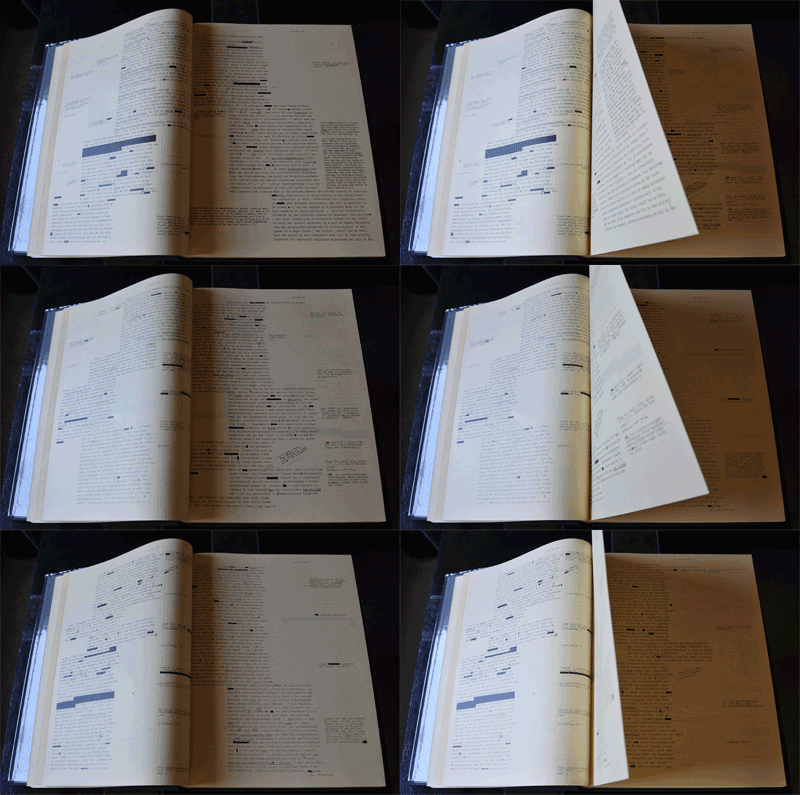
All 1334 Zettels in less than four minutes:
https://youtu.be/fpb9QxrmeGo
__________
Update 9/7/2016 I also ordered a copy of Bottom's Dream.
I wonder if the two tomes are equally big. I will post a photo of both of them.
In the meantime check out Ronald's status pic here:
https://www.goodreads.com/user_status...
__________
Update 1/18/2017
Finished the book today! And feeling pretty much like this right now:


September 23, 2016
So this monster arrives as the Dalkey Archive book to end all Dalkey Archive books. The invaluable independent Dalkey Press has long been known for publishing monstrous and difficult tomes of literature like Miss Macintosh, My Darling and Women and Men (could we get a reprint on this one please?), but this has got to be *the* echt-Dalkey book, 1500 pages containing over a million words in heavily-addled typography, set in anywhere from two to four columns that poke and intrude upon each other.
For all that, it's not as difficult as your typical Dalkey offering, and far easier than Finnegans Wake, which Schmidt at one time intended to translate, and which looms very large as an influence here. Despite the constant puns and wacky punctuation, the language is in relatively clear English, and the overall structure is a lot more easily grasped. A married couple, both translators, go to visit a Poe scholar, there begins a very, very digressive evening on the nature of literature, language, love, meaning, and the like. The couple's teenage daughter is there too, nursing a huge crush on the Poe scholar. (Yes, you may find Schmidt a tad regressive in his gender attitudes.)
I've only made it through the first of the eight chapters, but I gather that Schmidt sticks more or less with the program for the entire book. The program appears to be constant literary allusions, direct references, quotes, and analyses, all tied together and mutilated with a Joycean sense of punning. Unlike with Joyce, Schmidt's agenda is focused more narrowly on literature, leaving aside myth and history. While Finnegans Wake very explicitly claimed the mantle of all of human history, Schmidt is after a sort of shared linguistic unconscious, where "etyms" form a deep structure of language that guides how we interpret reality. The resemblance could be pure coincidence, but the dual structure is uncannily reminiscent of Chomsky's universal grammar in form, though not in content. These are the reference points to which I kept returning:
SUBJECT MATTER: Poe
PRESENTATION: Joyce
MEANING: Freud
THEORY: Chomsky
I don't claim to have any grasp of the motivic movement of the book, so I cannot assemble the allusions to Jean Paul, Goethe, Hoffmann, and thousands of others into a whole beyond the explicit "etym" theory. And I suspect a lot of people won't see Chomsky in it. But that's one of the main communal purposes of a book like this: you can read what you wish into it and people can't just wave you away and say, "That's ridiculous."
Because Schmidt leans heavily on Freud (it's a book about a dream, after all) for The Meaning Of It All, Schmidt's account of deep structure is overwhelmingly sexual, and so dirty puns abound. And not just puns; Schmidt has his own dirty emoticon language, as with this punctuational depiction of sexual intercourse:
-.---. / --: "?" - "." /-: "? ?" -- ". . ." - / : ! ! ! ! ! ! ! ! ! ! ! ! ! ! !
Schmidt was a working-class autodidact who never went to university, and he shared with Joyce the paradox of relying on high culture for an audience while disdaining it for its narrow-minded snobbery and superficial intellect. Both Joyce and Schmidt loved high art and trash alike. Schmidt translated James Fenimore Cooper, Stanley Ellin, and Edward Bulwer-Lytton (yes, THAT Bulwer-Lytton) into German. And both Joyce and Schmidt happened on roughly the same solution to their alienation from high culture: write long and tricky books which it is near-impossible to speak authoritatively about. That's how you dethrone the literati.
As far as I can tell, Schmidt did not intend Bottom's Dream to be his greatest work, just his biggest. He did not devote the majority of his life to it, unlike Robert Musil with The Man Without Qualities or Uwe Johnson with his magnificent, forthcoming-in-translation Anniversaries. The afterword (by Schmidt's long-time and indefatigable translator John E. Woods, who also typeset this thing) even remarks that Schmidt suggested readers stick to chapters 1, 4, and 7, advice which I may yet take. It's hard for me to say that readers would be better served by starting here than Nobodaddy's Children or the currently unavailable School for Atheists. Hell, I would also recommend that Americans in particular read more Edgar Allen Poe before tackling Schmidt, since the background will be useful and because Poe is a vastly more important author whose influence is hidden in subsequent works high and low alike. Thomas Disch called Poe "our embarrassing ancestor," which is exactly what makes him suitable for Schmidt's Freudian take on the unconscious history of literature. Poe is the sort of author and influence a writer will tend to repress out of his or her mind. Poe's erudite violence, filth, and rage make him the perfect raw material for Schmidt's comparatively genteel book. Also, "po" is German slang for "buttocks," as Woods pointed out in an interview.
That leaves this book's attraction for many as a literary fetish object, a handsomely produced yet ungainly monster of indisputable erudition yet highly selective appeal. Schmidt has his followers, yet in a time when literature is desperately striving for social relevance, Schmidt's work stands proud and naked as a work of literature first and cultural politics second, though Schmidt's crabbed leftist elitism is hardly buried. In contrast, the work of Marianne Fritz, which plays far crazier typographical games than Schmidt's, puts those tools to far more explicitly socio-political ends in the portrayal of suffering and oppression. Schmidt may regain ground once the pivot swings back away from politics and back toward the sort of Barthian "everything is a story" hijinks that were popular in the 70s and 80s. For now, this is one seriously unfashionable book. The question in my mind as I read it is whether all the jokes and play will reconnect in some profound way to the living world, or whether they will become a hermetically sealed world of their own, aesthetically stunning but unable to move the human heart. The jury's still out for me, but at the moment this enormous book still *feels* smaller than Finnegans Wake or Gravity's Rainbow.
In sum? An easy five stars for effort and intellect, but by its very nature a mixed bag. I recommend it, but only to those who have read this review and already find themselves interested. It is a book you come to*, not vice versa. Regardless, full plaudits to Woods and to Dalkey for their pursuit of the literary and the obscure in a time of increasing indifference and cultural illiteracy.
*Pun not intended, but I'm sure Schmidt would be delighted.
For all that, it's not as difficult as your typical Dalkey offering, and far easier than Finnegans Wake, which Schmidt at one time intended to translate, and which looms very large as an influence here. Despite the constant puns and wacky punctuation, the language is in relatively clear English, and the overall structure is a lot more easily grasped. A married couple, both translators, go to visit a Poe scholar, there begins a very, very digressive evening on the nature of literature, language, love, meaning, and the like. The couple's teenage daughter is there too, nursing a huge crush on the Poe scholar. (Yes, you may find Schmidt a tad regressive in his gender attitudes.)
I've only made it through the first of the eight chapters, but I gather that Schmidt sticks more or less with the program for the entire book. The program appears to be constant literary allusions, direct references, quotes, and analyses, all tied together and mutilated with a Joycean sense of punning. Unlike with Joyce, Schmidt's agenda is focused more narrowly on literature, leaving aside myth and history. While Finnegans Wake very explicitly claimed the mantle of all of human history, Schmidt is after a sort of shared linguistic unconscious, where "etyms" form a deep structure of language that guides how we interpret reality. The resemblance could be pure coincidence, but the dual structure is uncannily reminiscent of Chomsky's universal grammar in form, though not in content. These are the reference points to which I kept returning:
SUBJECT MATTER: Poe
PRESENTATION: Joyce
MEANING: Freud
THEORY: Chomsky
I don't claim to have any grasp of the motivic movement of the book, so I cannot assemble the allusions to Jean Paul, Goethe, Hoffmann, and thousands of others into a whole beyond the explicit "etym" theory. And I suspect a lot of people won't see Chomsky in it. But that's one of the main communal purposes of a book like this: you can read what you wish into it and people can't just wave you away and say, "That's ridiculous."
Because Schmidt leans heavily on Freud (it's a book about a dream, after all) for The Meaning Of It All, Schmidt's account of deep structure is overwhelmingly sexual, and so dirty puns abound. And not just puns; Schmidt has his own dirty emoticon language, as with this punctuational depiction of sexual intercourse:
-.---. / --: "?" - "." /-: "? ?" -- ". . ." - / : ! ! ! ! ! ! ! ! ! ! ! ! ! ! !
Schmidt was a working-class autodidact who never went to university, and he shared with Joyce the paradox of relying on high culture for an audience while disdaining it for its narrow-minded snobbery and superficial intellect. Both Joyce and Schmidt loved high art and trash alike. Schmidt translated James Fenimore Cooper, Stanley Ellin, and Edward Bulwer-Lytton (yes, THAT Bulwer-Lytton) into German. And both Joyce and Schmidt happened on roughly the same solution to their alienation from high culture: write long and tricky books which it is near-impossible to speak authoritatively about. That's how you dethrone the literati.
As far as I can tell, Schmidt did not intend Bottom's Dream to be his greatest work, just his biggest. He did not devote the majority of his life to it, unlike Robert Musil with The Man Without Qualities or Uwe Johnson with his magnificent, forthcoming-in-translation Anniversaries. The afterword (by Schmidt's long-time and indefatigable translator John E. Woods, who also typeset this thing) even remarks that Schmidt suggested readers stick to chapters 1, 4, and 7, advice which I may yet take. It's hard for me to say that readers would be better served by starting here than Nobodaddy's Children or the currently unavailable School for Atheists. Hell, I would also recommend that Americans in particular read more Edgar Allen Poe before tackling Schmidt, since the background will be useful and because Poe is a vastly more important author whose influence is hidden in subsequent works high and low alike. Thomas Disch called Poe "our embarrassing ancestor," which is exactly what makes him suitable for Schmidt's Freudian take on the unconscious history of literature. Poe is the sort of author and influence a writer will tend to repress out of his or her mind. Poe's erudite violence, filth, and rage make him the perfect raw material for Schmidt's comparatively genteel book. Also, "po" is German slang for "buttocks," as Woods pointed out in an interview.
That leaves this book's attraction for many as a literary fetish object, a handsomely produced yet ungainly monster of indisputable erudition yet highly selective appeal. Schmidt has his followers, yet in a time when literature is desperately striving for social relevance, Schmidt's work stands proud and naked as a work of literature first and cultural politics second, though Schmidt's crabbed leftist elitism is hardly buried. In contrast, the work of Marianne Fritz, which plays far crazier typographical games than Schmidt's, puts those tools to far more explicitly socio-political ends in the portrayal of suffering and oppression. Schmidt may regain ground once the pivot swings back away from politics and back toward the sort of Barthian "everything is a story" hijinks that were popular in the 70s and 80s. For now, this is one seriously unfashionable book. The question in my mind as I read it is whether all the jokes and play will reconnect in some profound way to the living world, or whether they will become a hermetically sealed world of their own, aesthetically stunning but unable to move the human heart. The jury's still out for me, but at the moment this enormous book still *feels* smaller than Finnegans Wake or Gravity's Rainbow.
In sum? An easy five stars for effort and intellect, but by its very nature a mixed bag. I recommend it, but only to those who have read this review and already find themselves interested. It is a book you come to*, not vice versa. Regardless, full plaudits to Woods and to Dalkey for their pursuit of the literary and the obscure in a time of increasing indifference and cultural illiteracy.
*Pun not intended, but I'm sure Schmidt would be delighted.

August 20, 2021
Every page has been read and pondered to a great= or less=er extent. Bottom's Dream is a truly unique experience. Review to come in the next week.
Bottom’s Dream is one of the largest reading projects one can tackle. At 1,496 pages (and oversize pages at that), it is a book that ought not to be rushed. From the time I began in January of 2021 to the time I finished in August, I typically only read about ten pages per day (note that there was a break of nearly two months during which I read Joshua Cohen’s Witz). While there are apparently readers who can get through the entire brick in about two months, they must be readers of the superhuman, hyper-cognitive variety, leaving me in their literary dust.

As with many books of the modernist and/or sui-generis persuasion, plot does not figure as the primary draw. While this statement is too often uttered precociously by the so-called literary elite (sneering down at lesser mortals who read books for plot—scoff!), it is clearly applicable to Bottom’s Dream, whose very type=setting displays a desire for a visual text. Bottom’s Dream is columnar, ranging from one to four throughout the book. The middle column is for the progression of the story (such as it is); the right for authorial asides, literary allusions (excluding Poe), and occasionally to augment the plot itself; finally, the left column is almost exclusively dedicated to Poe references. While Bottom’s Dream breaks all these rules at some time or other, this is a useful framework for the novitiate, and it is generally true.

Though plot is not the driving force of Bottom’s Dream, it bears mentioning. To be brief, it is the tale of Daniel Pagenstecher’s visit with friends Paul & Wilma Jacobi, who bring with them starstruck Francisca (often simply Franz(e)l). As with Ulysses, the book covers only a day; unlike Joyce’s masterwork, Bottom’s Dream also includes a night section. In all, somewhere between 22-24 hours of time are covered by the text—which is incidentally far fewer hours than it takes to read. (I spent somewhere near 200 hours on it.)
Pagenstecher is an established author and stand-in for Schmidt, though only a partial stand-in: Schimdt figures in the book in a disparate capacity. Paul & Wilma are pecuniarily-challenged translators, who have taken on the task of exposing Edgar Poe to a German audience. And their 16-year-old daughter Franzel is along for the ride, completely enamored of Dan (who is 54, nearly 20,000 days). This obsessive crush Francisca is harboring borders on the fantastic, but so do the several Ovidian metamorphoses that pepper the text. I digress.
Bottom’s Dream is in the end about one thing: language. It is the language of EAP that figures most prominently; or rather the subtext of Poe’s writing as interpreted by Dan (hereafter D) and backed by Paul (P). D’s theories of the secondary (perhaps primary), hidden meanings within Poe are often Rabelaisian, deeply offending the prudish Wilma (W). Language takes on a Freudian aspect under the careful tutelage and erudition of D. Poe is revealed to be an exhibitionist, coprophagiac, voyeur and all-around queer fellow. Certain of his favorite words and word-roots are mercilessly scrutinized for all possible meaning by D via “etym spiders” (see pp 584, 871, 920, etc.).
The etym itself is the fulcrum of Schmidt’s study of language within (and outside of) Poe. Briefly defined, it is a small unit of language—often monosyllabic—that packs a wallop of meaning. An exemplar is found on the above-noted p 871: the “ars” etym. Ars can reference classical names like Aristoteles; ursus (i.e., a bear), arsenic, ant=arctic, ass, e(ars)e; Lat. ars, meaning art or artist; earth=tellus; Arthur; airs (musique, poems, airs); arc = arch; heart and so on and so forth. Some of the etyms are best appreciated verbally/aurally, others as visual components of words. Schmidt neatly sketches out his etym spiders: they are more easily followed than the above clunky list.
In addition to the etym concept, Schmidt’s other theoretical concern lies in the realm of psychoanalysis and is termed “the fourth agency.” Freud outlines three separate agencies in his work, specifically The Interpretation of Dreams: the subconscious, the ego, and the superego. Schmidt, being a bold author, decides to tack on a fourth agency of his own. It is hinted at early on within Bottom’s Dream, but not fully fleshed out (“fully” is generous) until much later (see pp 984 ff). The fourth agency occurs sometime during middle age, perhaps around 50. All three agencies as defined by Freud undergo reconstruction. Hit hardest is the superego (SE), against which the fourth agency and ego work in tandem in an effort to reconstruct morality. This may be a butchering of Schmidt’s psy-A theory; if so, I beg forgiveness.
While the last two paragraphs might suggest Bottom’s Dream is a stentorian, pedantic, grim-faced monolith, the obverse holds true more often: that is, Bottom’s Dream can be riotously funny. It’s the breed of book that elicits audible laughter, rather than clandestine sniggers. Take for example W’s description of a specially abhorred friend of Fr on p 1,341:
>>so then I step up to Our loggia=windo : ? - & this meri(no)torious Mistress of Unchastity, simply raised=up her button=hole : ? - : ! - : & FART’iD : !!! – till I thot she’d dis’intergrate! – I’d guarantee the neighbor heard=it, - <<
To the right, the Poe reference is apt: “the air becomes dissonant with wind=instruments! (4 IN 1)).” Reader: You may well accuse me of having a child’s sense of humor, but please remember to accuse Schimdt, too.
A final note on the text: Bottom’s Dream is frequently compared to Finnegans Wake, regularly by people who’ve read neither. Admittedly, Schmidt was heavily inspired by Joyce’s baffling novel. Both make use of the multi-column format, and both are more concerned with style over content (though neither author was a belletrist). That said, Bottom’s Dream is much easier to understand. Schmidt avoids the intentional obfuscation Joyce uses to such effect in the Wake. Though Bottom’s Dream is far from simple, one doesn’t need to be an accomplished linguist to take something away from the text. Critical analysis is unfortunately scarce for the work—Volker Langbehn has a slim volume available from Camden House: Zettel’s Traum: An Analysis. M.A. Orthofer also released a centennial colloquy celebrating the career of Schmidt. There are other critical studies available in German, but the English repertoire is sadly marginal.
Arno Schmidt deserves to be discovered, read and valued. While he is quoted wondering why anyone would possibly be interested in reading all of Bottom’s Dream, it is a hard book to put down—or to pick up, for that matter!
Bottom’s Dream is one of the largest reading projects one can tackle. At 1,496 pages (and oversize pages at that), it is a book that ought not to be rushed. From the time I began in January of 2021 to the time I finished in August, I typically only read about ten pages per day (note that there was a break of nearly two months during which I read Joshua Cohen’s Witz). While there are apparently readers who can get through the entire brick in about two months, they must be readers of the superhuman, hyper-cognitive variety, leaving me in their literary dust.
As with many books of the modernist and/or sui-generis persuasion, plot does not figure as the primary draw. While this statement is too often uttered precociously by the so-called literary elite (sneering down at lesser mortals who read books for plot—scoff!), it is clearly applicable to Bottom’s Dream, whose very type=setting displays a desire for a visual text. Bottom’s Dream is columnar, ranging from one to four throughout the book. The middle column is for the progression of the story (such as it is); the right for authorial asides, literary allusions (excluding Poe), and occasionally to augment the plot itself; finally, the left column is almost exclusively dedicated to Poe references. While Bottom’s Dream breaks all these rules at some time or other, this is a useful framework for the novitiate, and it is generally true.
Though plot is not the driving force of Bottom’s Dream, it bears mentioning. To be brief, it is the tale of Daniel Pagenstecher’s visit with friends Paul & Wilma Jacobi, who bring with them starstruck Francisca (often simply Franz(e)l). As with Ulysses, the book covers only a day; unlike Joyce’s masterwork, Bottom’s Dream also includes a night section. In all, somewhere between 22-24 hours of time are covered by the text—which is incidentally far fewer hours than it takes to read. (I spent somewhere near 200 hours on it.)
Pagenstecher is an established author and stand-in for Schmidt, though only a partial stand-in: Schimdt figures in the book in a disparate capacity. Paul & Wilma are pecuniarily-challenged translators, who have taken on the task of exposing Edgar Poe to a German audience. And their 16-year-old daughter Franzel is along for the ride, completely enamored of Dan (who is 54, nearly 20,000 days). This obsessive crush Francisca is harboring borders on the fantastic, but so do the several Ovidian metamorphoses that pepper the text. I digress.
Bottom’s Dream is in the end about one thing: language. It is the language of EAP that figures most prominently; or rather the subtext of Poe’s writing as interpreted by Dan (hereafter D) and backed by Paul (P). D’s theories of the secondary (perhaps primary), hidden meanings within Poe are often Rabelaisian, deeply offending the prudish Wilma (W). Language takes on a Freudian aspect under the careful tutelage and erudition of D. Poe is revealed to be an exhibitionist, coprophagiac, voyeur and all-around queer fellow. Certain of his favorite words and word-roots are mercilessly scrutinized for all possible meaning by D via “etym spiders” (see pp 584, 871, 920, etc.).
The etym itself is the fulcrum of Schmidt’s study of language within (and outside of) Poe. Briefly defined, it is a small unit of language—often monosyllabic—that packs a wallop of meaning. An exemplar is found on the above-noted p 871: the “ars” etym. Ars can reference classical names like Aristoteles; ursus (i.e., a bear), arsenic, ant=arctic, ass, e(ars)e; Lat. ars, meaning art or artist; earth=tellus; Arthur; airs (musique, poems, airs); arc = arch; heart and so on and so forth. Some of the etyms are best appreciated verbally/aurally, others as visual components of words. Schmidt neatly sketches out his etym spiders: they are more easily followed than the above clunky list.
In addition to the etym concept, Schmidt’s other theoretical concern lies in the realm of psychoanalysis and is termed “the fourth agency.” Freud outlines three separate agencies in his work, specifically The Interpretation of Dreams: the subconscious, the ego, and the superego. Schmidt, being a bold author, decides to tack on a fourth agency of his own. It is hinted at early on within Bottom’s Dream, but not fully fleshed out (“fully” is generous) until much later (see pp 984 ff). The fourth agency occurs sometime during middle age, perhaps around 50. All three agencies as defined by Freud undergo reconstruction. Hit hardest is the superego (SE), against which the fourth agency and ego work in tandem in an effort to reconstruct morality. This may be a butchering of Schmidt’s psy-A theory; if so, I beg forgiveness.
While the last two paragraphs might suggest Bottom’s Dream is a stentorian, pedantic, grim-faced monolith, the obverse holds true more often: that is, Bottom’s Dream can be riotously funny. It’s the breed of book that elicits audible laughter, rather than clandestine sniggers. Take for example W’s description of a specially abhorred friend of Fr on p 1,341:
>>so then I step up to Our loggia=windo : ? - & this meri(no)torious Mistress of Unchastity, simply raised=up her button=hole : ? - : ! - : & FART’iD : !!! – till I thot she’d dis’intergrate! – I’d guarantee the neighbor heard=it, - <<
To the right, the Poe reference is apt: “the air becomes dissonant with wind=instruments! (4 IN 1)).” Reader: You may well accuse me of having a child’s sense of humor, but please remember to accuse Schimdt, too.
A final note on the text: Bottom’s Dream is frequently compared to Finnegans Wake, regularly by people who’ve read neither. Admittedly, Schmidt was heavily inspired by Joyce’s baffling novel. Both make use of the multi-column format, and both are more concerned with style over content (though neither author was a belletrist). That said, Bottom’s Dream is much easier to understand. Schmidt avoids the intentional obfuscation Joyce uses to such effect in the Wake. Though Bottom’s Dream is far from simple, one doesn’t need to be an accomplished linguist to take something away from the text. Critical analysis is unfortunately scarce for the work—Volker Langbehn has a slim volume available from Camden House: Zettel’s Traum: An Analysis. M.A. Orthofer also released a centennial colloquy celebrating the career of Schmidt. There are other critical studies available in German, but the English repertoire is sadly marginal.
Arno Schmidt deserves to be discovered, read and valued. While he is quoted wondering why anyone would possibly be interested in reading all of Bottom’s Dream, it is a hard book to put down—or to pick up, for that matter!
July 28, 2016
ATTN: Due to limitations from GR in displaying formatted text I setup a webpage, so you can read the entire review (including the right=hand=column) here:
http://www.butterweck.de/goodreads/bd...

This work is licensed under a Creative Commons Attribution-NonCommercial-ShareAlike 3.0 Unported License.
http://www.butterweck.de/goodreads/bd...
1st of all I have to cunfess that I didn’t
read the English eddytion BOTTOM’S DREAM (BD)
of Arno SChmidt’s (AS) Magnus opus, butt the   (HIRSCHFELD!
original one in GermAn (ZETTEL’S TRAUM (ZT)).
The translation in BD was cumposed by JohnnE
Woods over the course of several years and     (MAGICK MOUNTAIN Man(n)
published by Dalkey=Archive=Press in Septem-
ber 2016. I mention this because a close tra-
nSlation of AS’s words in general seems very
hard=on any translator, and 1 of ZT almost an
impussybellytee. Mr Woods managed thou. I
POKEd my nose in BD a couple of times & read
perhaps 1 - 2 perScent; and from what I read
I have to say the re=write⊢translation is the
best you pussibly can get. ZT(however)I read   (English readers reJOYCE!
cumpletely – every∘single∘word – an it took
me more thän a hundred days to do so (There
are a few manual corrections by AS in the      (errect; rectum
fucksimile edition I couldn’t decypher).       (aka tEyePoe=script
Moist on=line reviews I found mention the
size & weight of the physical book (so I do    (size⊢sighs matterS
so too). 8==- ZT: 32.7×44.5×7.5cm / 8,1kg //   (¿inches & pounds?
BD: 25.5×34.5×7.8cm / 5,7kg. What’s more
IMPortant is the cuntent.

The entire story is set in the li´l HAMLET
of Ödingen in the Lüneburg Heat(h), which to
German ears sounds like the aPOEtheosiS of a
dull=place. In Ödingen lives Daniel Pagenste-
cher (Dän), the 1st=person narrator. He rec-
eives a visit by the Jacobi family; father
Paul (P), mother Wilma (W) and seir (sweat
liddell) sexteen=yo daugther Franziska (Fr.).
P (with help from W) is working on a transla-
tion of Edgar ALLan Poe into German and came
to Dän to ask for his advice. Dän’s a liter-
airy person ; someone who knows about every-
thing there is to know about letteratour in
general and Poe in purticular (he has read
Poe’s whole øvre prior to the visit). He is
also blessed⊢cursed with a cast=iron memry     (just like AS was
and is therefor able to recite the relevant
passages by heart. The ZT/BD=reader follows
the 4 persons for 24 (w)hours. During that     (+2 more virtual ones
time Dän explains a whole new theory on the
interpretation of Poe and other so called
Dichter=Priests which is based on ETYMs.       (=DP;Dichter=poet
It’s hard to describe in only a few words
what etyms are. Think of them as unconscious   (according to Dän⊢AS
associations you have when you read or hear a  (as in FREUD
particular word or parts thereof. I already⊢    + a 4th instance
deliberatly wrote some words here in their
etymised form; like “impussybellytee” or
“cumpletely”. As you can see those interpreta
tions of words are not nessesarily G=rated.
In fuct most of the etyms that Dän pushes fur-
ward carry a sexual conotation in one form or  (=S
another. With the help of his etym=theory (&
what he calls Extended Mind Game) Dän tries    (=EMG
to convince PW to accept the fuct that Poe
was indeed a boner=fide Voyeur (and much more;
but to x=plane that would be a S=poiler).
While P is more or less eager to follow Dän’s
approach (jotting down notes all the time and
hoping to turn them into valuable S=ays some
day), W is rather opposed to the matter for
different reasons so a certain tension is
buil=ding up –:|:–. To cumplicate things far-
ter Fr. is helplessly in love with Dän ever
since she spent some weeks in Dän’s cottage
when she was a Li’l gîrrl. So in addition to
this quirky literary etymosis we get a love=
story of the older=man=younger=woman kind.     (POE & Varginia

The first pages of the book are rather diffi-
cult to read & cumprehend. It seems like Arno
SChmidt deliberatly makes it Hard for readers
to enter his stories. Almost every (German)
word is mis=spelled and the PUNctuation is
creative and øriginal to say the least.
In ZT/BD there’s an additional obstacle to
overcum, because the text is set moistly in
three columns. The middle⊢main column cont-
ains the actual story – that’s where the
actors are acting, the dialog and the inner
thouhts of Dän. The left column is the POE=
column; discussions & quotes of several⊢many
of his works are here. The right column is
reserved for quotes from other workѕ of lit,
anecdotic S=tuff, more thoughts of Dän & so
on. Sometimes the middle column is divided
further (the hardest parts for me). That’s     (tipp: keep an opaque
when there are parallel actions or conver-      ruler nearbY!
Sations, usually when the characters are
split up into groups.

This book was unlike any other book I ever
read, and I didn’t dare touch it for quite
a while after=purchase. Although I don’t
find it IMPoerative to read the hole
POE=univarse prior to reading ZT (’cept        (POE=Pun-o-rama
maybe PYM & RODMAN; and the others if you
feel you should when you encunter them in
ZT/BD). I strongly suggest you don’t read
IT as your first Arno SChmidt! Start with
some of his earlier⊢shorter works. His No-
vellASS (like LIFE OF FAUN / LEVIATHAN /
POECAHONTAS / DARK MIRROR) will slowly draw
you into reading and pussibly understanding
AS and his way of thinking. At least that’s
how it was for me & it helped me a Græt Dæl.
Since I’m a sucker for the German romanTIECKs
and especially for JEAN PAUL I was delighted
to find gobs of references in here. Other
readers will be pleesed to diScuver mannny
mentions of JOYCE (FW & ULYSSES), and also
SPENCER (FQ), CERVANTES (DQ), BULWER (Z.),
DICKens, STERNE, GOETHE, & & & just about
evryone else from that happy bunch – – not to  (+QUINN
mention SHAKESPEARE whose MIDSUMMERNEITH’S=
DREAM inspired the hole thing. This is A
trou literatour=dē=farce. Readers who are
more well=read than me will probably spot      (nothin’ to it!
myriads more books & aut(w)hor(e)S hinted at   (is there anything
in the text!                                    that’s NOT in ZT/BD?

Be aware though that this book contains a lot
(& I mean a lot) of S=descriptions; discussed
by the various characters or hinted at in the
text itself. This is probably the book with
the highest ratio of S=puns⊢lang per page!     (more than FW? (I dunno.)
There’s a constant S=drumming thrûout and
hardly any topic from the S=coSmoS is left     (S=wHole=Shebang
undisclosed. For me it wasn’t odious or yukky
at all but others might be offended. But it
is literary ; often scholary ; and the Bottom
line is: It’s awfully=funny and will take me
some time to fully diJest.
This work is licensed under a Creative Commons Attribution-NonCommercial-ShareAlike 3.0 Unported License.

Want to Read
September 1, 2016Big Wet Book:
"I have had a dream past the wit of man to say what dream it was: man is but an ass, if he go about to expound this dream," says Bottom. Arno Schmidt might just as well have said, I wrote a Big Book, and a handful of readers in close circles had a Wet Dream about it. Und but so too, bro;;; let it be written::: man is but an ass, if he go about to expand this dream...into 1,496 pages. And a bigger ass to try to read it singlehandedly (but who actually has???). As with other forms of masturbation, the greatest risk factor is that you will end up with a wrist fracture.
Australian Translation of the Title:
"Arsehole's Delight"
A Cretin's Assessment:
"A massive stack of pages."
Gilbert "the Pure" Rile:
"A sex aid for a small circle of book fetishists."
Edwin Turner, Biblioklept:
"...it’s a primal gobbledygook wordmass...For now, my updates from this maelstrom will be sporadic at best."

Experimental as Each Other
Yet more conformist experimentalism for the noddies. Wow, three=columns!!! Didn't they already do this with poetry? What's new? Since when is experimentalism the duplication of past experiments?
Hand=Eye Coordination
You can read this book in two days, if you use both hands.
Pulpit or Pulp It?
[Apologies to Page and Plant]
There's a reader who's sure
That all fat books are gold
If it's a massive stack of pages,
Surely reading it will take ages,
It's even whispered that soon
The piper will call his tune,
So a new day will dawn
For all those who read long,
And the bookshops will
Echo with laughter.
But he doesn't concede
His taste is misgiven,
Because he's building
A stairway to heaven.

Awards:
Helen Warren DeGolyer Award for American Bookbinding 2017
"It had me in stitches!"
William Shakespeare:
"If you desire the spleen, and will laugh yourselves into stitches, follow me."

"If the people have no bread, let them read Schmidt."
SOUNDTRACK:
Circle Jerks - "I Wanna Destroy You"
https://m.youtube.com/watch?v=APgg9LY...
"A pox upon the media
And everything you read."
Radio Birdman - "Descent Into the Maelstrom"
https://youtu.be/dhS7jNaUWoE
Lou Reed - "I Wanna Know (The Pit And The Pendulum)"
https://m.youtube.com/watch?v=_-7Cbhe...
"For certain minds
This is
Absolutely
Irresistible."
POESIE:
Edgar Allan Poe - "That Long Agony" (from "The Pit And The Pendulum")
"I was sick—sick unto death with that long agony; and when they at length unbound me, and I was permitted to sit, I felt that my senses were leaving me. The sentence—the dread sentence of death—was the last of distinct accentuation which reached my ears. After that, the sound of the inquisitorial voices seemed merged in one dreamy indeterminate hum."
Edgar Allan Poe - "Something Damp and Hard" (from "The Pit And The Pendulum")
"So far, I had not opened my eyes. I felt that I lay upon my back, unbound. I reached out my hand, and it fell heavily upon something damp and hard. There I suffered it to remain for many minutes, while I strove to imagine where and what I could be. I longed, yet dared not to employ my vision."
Edgar Allan Poe - To be Read (from "The Man of the Crowd")
"It was well said of a certain German book that 'es lasst sich nicht lesen' - it does not permit itself to be read."
Edgar Allan Poe - Only Complex (from "The Murders in the Rue Morgue")
“What is only complex is mistaken (a not unusual error) for what is profound.”
"I have had a dream past the wit of man to say what dream it was: man is but an ass, if he go about to expound this dream," says Bottom. Arno Schmidt might just as well have said, I wrote a Big Book, and a handful of readers in close circles had a Wet Dream about it. Und but so too, bro;;; let it be written::: man is but an ass, if he go about to expand this dream...into 1,496 pages. And a bigger ass to try to read it singlehandedly (but who actually has???). As with other forms of masturbation, the greatest risk factor is that you will end up with a wrist fracture.
Australian Translation of the Title:
"Arsehole's Delight"
A Cretin's Assessment:
"A massive stack of pages."
Gilbert "the Pure" Rile:
"A sex aid for a small circle of book fetishists."
Edwin Turner, Biblioklept:
"...it’s a primal gobbledygook wordmass...For now, my updates from this maelstrom will be sporadic at best."
Experimental as Each Other
Yet more conformist experimentalism for the noddies. Wow, three=columns!!! Didn't they already do this with poetry? What's new? Since when is experimentalism the duplication of past experiments?
Hand=Eye Coordination
You can read this book in two days, if you use both hands.
Pulpit or Pulp It?
[Apologies to Page and Plant]
There's a reader who's sure
That all fat books are gold
If it's a massive stack of pages,
Surely reading it will take ages,
It's even whispered that soon
The piper will call his tune,
So a new day will dawn
For all those who read long,
And the bookshops will
Echo with laughter.
But he doesn't concede
His taste is misgiven,
Because he's building
A stairway to heaven.
Awards:
Helen Warren DeGolyer Award for American Bookbinding 2017
"It had me in stitches!"
William Shakespeare:
"If you desire the spleen, and will laugh yourselves into stitches, follow me."
"If the people have no bread, let them read Schmidt."
SOUNDTRACK:
Circle Jerks - "I Wanna Destroy You"
https://m.youtube.com/watch?v=APgg9LY...
"A pox upon the media
And everything you read."
Radio Birdman - "Descent Into the Maelstrom"
https://youtu.be/dhS7jNaUWoE
Lou Reed - "I Wanna Know (The Pit And The Pendulum)"
https://m.youtube.com/watch?v=_-7Cbhe...
"For certain minds
This is
Absolutely
Irresistible."
POESIE:
Edgar Allan Poe - "That Long Agony" (from "The Pit And The Pendulum")
"I was sick—sick unto death with that long agony; and when they at length unbound me, and I was permitted to sit, I felt that my senses were leaving me. The sentence—the dread sentence of death—was the last of distinct accentuation which reached my ears. After that, the sound of the inquisitorial voices seemed merged in one dreamy indeterminate hum."
Edgar Allan Poe - "Something Damp and Hard" (from "The Pit And The Pendulum")
"So far, I had not opened my eyes. I felt that I lay upon my back, unbound. I reached out my hand, and it fell heavily upon something damp and hard. There I suffered it to remain for many minutes, while I strove to imagine where and what I could be. I longed, yet dared not to employ my vision."
Edgar Allan Poe - To be Read (from "The Man of the Crowd")
"It was well said of a certain German book that 'es lasst sich nicht lesen' - it does not permit itself to be read."
Edgar Allan Poe - Only Complex (from "The Murders in the Rue Morgue")
“What is only complex is mistaken (a not unusual error) for what is profound.”

Read
August 27, 2018The review got too long for Goodreads. It's here:
http://writingwithimages.com/4-7-arno...
All comments welcome!
PS, I do a reading group on this book every summer; email if you're interested, jelkins@saic.edu
http://writingwithimages.com/4-7-arno...
All comments welcome!
PS, I do a reading group on this book every summer; email if you're interested, jelkins@saic.edu

Currently Reading
May 16, 2014GIF
GIF
GIF
GIF
GIF
GIF
GIF
GIF
GIF
GIF
GIF
GIF
GIF
GIF
GIF
GIF
GIF
GIF
GIF
GIF
GIF
GIF
GIF
GIF
GIF
GIF
GIF
GIF
GIF
GIF
GIF

Currently Reading
May 16, 2014Pre-gawdang-ordered. Check is in the mail. No matter who wins that stoopid general election, this fall is going to belong to Arno Schmidt and John E. Woods. Who's getting a reading group together? We gotta Wake this sumnabitch!

November 17, 2016
The Beast has been slain!
A masterpiece of the highest order. This book will test your reading abilities, patience and endurance to the fullest. Most are not worthy. I pity those who don't relish the challenge.
A masterpiece of the highest order. This book will test your reading abilities, patience and endurance to the fullest. Most are not worthy. I pity those who don't relish the challenge.
i-want-money
October 20, 2012The apostrophe (') belongs. That's the joke, folks.
But the Stiftung was so generous as to post a little Look=Inside of the recently type=set edition of ZT ; includes a few little explicatory things in Blue;Ink and a pair of pages from the original typescript edition. Fazin=ear=Ende.
http://www.arno-schmidt-stiftung.de/c...
Review of the type=set edition of 2010 ; from Frankfurter Allgemeine “Die Welt ist groß genug, dass wir alle darin Unrecht haben können”
http://www.faz.net/aktuell/feuilleton...
_______________
A bevy of links and things concerning this “Roh=Mann=Tick” and his Traum book.
from zinzin we have links with excerpts of those links, plus some cool photos: http://www.zinzin.com/observations/20... And I'll replicate zinzin's links ::
Innovative Fiction Magazine ::
http://www.innovative-fiction-magazin...
The site looks worthwhile for browsers intrigued by the magazine's title.
"Watching TV with Arno Schmidt", an essay/analysis ::
http://web.archive.org/web/2007100917...
A googlebooks excerpt from Arno Schmidt's Zettel's Traum: An Analysis ::
http://books.google.com/books?id=xY8l...
The Arno wikipedia page ::
http://en.wikipedia.org/wiki/Arno_Sch...
The arNO Complete Review page ::
http://www.complete-review.com/author...
A magazine profile of genius translator John E. Woods ::
http://www.thelocal.de/society/201006...
Also ::
For the geek, an Arno Schmidt archival collection ::
https://archives.pdx.edu/archon/?p=co...
The Zettel's Traum page-turning video ::
http://vimeo.com/6422567
A review, auf Deutsche, from Die Zeit, of the 2010 edition of Zettel's Traum (the 1970 edition was offset from the typescript ;; the 2010 edition was in properly set type) :: http://www.zeit.de/2011/06/Leser-Zett...
fictional woods has a discussion thread ::
http://w11.zetaboards.com/thefictiona...
"Arnotations: Arno Schmidt Annotates Finnegans Wake" by Friedhelm Rathjen::
http://www.joycefoundation.ch/An%20Oc...
______________
John E Woods translation forthcoming ; with rumor for a this=year pub-date, but that's a stale rumour and furtherly that it'll be the final bookend of his career which began in the beginning with Evening Edged in Gold, his discovery of which led him to become a translator and produce his masterful transitions into English of Mann's work.
_________________
And you thought Women and Men was expensive.
http://www.abebooks.com/servlet/Searc...
But the Stiftung was so generous as to post a little Look=Inside of the recently type=set edition of ZT ; includes a few little explicatory things in Blue;Ink and a pair of pages from the original typescript edition. Fazin=ear=Ende.
http://www.arno-schmidt-stiftung.de/c...
Review of the type=set edition of 2010 ; from Frankfurter Allgemeine “Die Welt ist groß genug, dass wir alle darin Unrecht haben können”
http://www.faz.net/aktuell/feuilleton...
_______________
A bevy of links and things concerning this “Roh=Mann=Tick” and his Traum book.
from zinzin we have links with excerpts of those links, plus some cool photos: http://www.zinzin.com/observations/20... And I'll replicate zinzin's links ::
Innovative Fiction Magazine ::
http://www.innovative-fiction-magazin...
The site looks worthwhile for browsers intrigued by the magazine's title.
"Watching TV with Arno Schmidt", an essay/analysis ::
http://web.archive.org/web/2007100917...
A googlebooks excerpt from Arno Schmidt's Zettel's Traum: An Analysis ::
http://books.google.com/books?id=xY8l...
The Arno wikipedia page ::
http://en.wikipedia.org/wiki/Arno_Sch...
The arNO Complete Review page ::
http://www.complete-review.com/author...
A magazine profile of genius translator John E. Woods ::
http://www.thelocal.de/society/201006...
Also ::
For the geek, an Arno Schmidt archival collection ::
https://archives.pdx.edu/archon/?p=co...
The Zettel's Traum page-turning video ::
http://vimeo.com/6422567
A review, auf Deutsche, from Die Zeit, of the 2010 edition of Zettel's Traum (the 1970 edition was offset from the typescript ;; the 2010 edition was in properly set type) :: http://www.zeit.de/2011/06/Leser-Zett...
fictional woods has a discussion thread ::
http://w11.zetaboards.com/thefictiona...
"Arnotations: Arno Schmidt Annotates Finnegans Wake" by Friedhelm Rathjen::
http://www.joycefoundation.ch/An%20Oc...
______________
John E Woods translation forthcoming ; with rumor for a this=year pub-date, but that's a stale rumour and furtherly that it'll be the final bookend of his career which began in the beginning with Evening Edged in Gold, his discovery of which led him to become a translator and produce his masterful transitions into English of Mann's work.
_________________
And you thought Women and Men was expensive.
http://www.abebooks.com/servlet/Searc...

Want to Read
May 21, 2014I did it. I pre-ordered this beast of translation as a late-arriving birthday gift to myself, God help me. And God help the Dalkey Archive if they push back the pub date again.

February 12, 2018
And with that, the time has come for me to write about my experience with this book.
I started this having read no Schmidt, and ended having read around half of his English'd works and one more favourite author.
Anybody who has the same curiosity I had on hearing about this book (granted it took me a year and a bit to bring myself to buy a copy) should take the leap and read.
1 page, 1 book (of the 8 contained in this giant), the whole thing... I wholeheartedly recommend it, or any of his other books for that matter.
I'm sure you don't need me to tell you any more to get you to try it. If you were already curious, you probably still want to read it.
The real winner here is literature as a whole. Through this translation, one of the most interesting works I've ever read is available to the whole of the English speaking world (thanks to John E. Woods' incredible work). If there weren't translators who didn't shy away from a project because of terms such as 'untranslatable' and 'impossible', we wouldn't have this and many other works available.
Just this year I've discovered so many incredible books, written in languages not my own, and translated by people who love the work so much as to share it with a whole new audience.
So, not only does this book as a translation get 5 stars from me, the publishers who take the risks releasing these kinds of works get a 5 stars from me. The translators and typesetters (all Woods in this one) get 5 stars from me. The readers who love these books and make them known get 5 stars from me.
This year has been pretty good to me for discovering lit in translation. Check 'em out (they deserve the love and attention that books from huge publishing houses seem to unfairly get by default):
Arno Schmidt & Miklós Szentkuthy
Heimito von Doderer, Mathias Énard, Hans Henny Jahnn, Javier Pedro Zabala (that last one is debatable as to if it qualifies, but worth the read)...
And a big thanks to The Untranslated for the helping hand starting this book via their "Reading Zettel's Traum" posts, and great book recs.
I started this having read no Schmidt, and ended having read around half of his English'd works and one more favourite author.
Anybody who has the same curiosity I had on hearing about this book (granted it took me a year and a bit to bring myself to buy a copy) should take the leap and read.
1 page, 1 book (of the 8 contained in this giant), the whole thing... I wholeheartedly recommend it, or any of his other books for that matter.
I'm sure you don't need me to tell you any more to get you to try it. If you were already curious, you probably still want to read it.
The real winner here is literature as a whole. Through this translation, one of the most interesting works I've ever read is available to the whole of the English speaking world (thanks to John E. Woods' incredible work). If there weren't translators who didn't shy away from a project because of terms such as 'untranslatable' and 'impossible', we wouldn't have this and many other works available.
Just this year I've discovered so many incredible books, written in languages not my own, and translated by people who love the work so much as to share it with a whole new audience.
So, not only does this book as a translation get 5 stars from me, the publishers who take the risks releasing these kinds of works get a 5 stars from me. The translators and typesetters (all Woods in this one) get 5 stars from me. The readers who love these books and make them known get 5 stars from me.
This year has been pretty good to me for discovering lit in translation. Check 'em out (they deserve the love and attention that books from huge publishing houses seem to unfairly get by default):
Arno Schmidt & Miklós Szentkuthy
Heimito von Doderer, Mathias Énard, Hans Henny Jahnn, Javier Pedro Zabala (that last one is debatable as to if it qualifies, but worth the read)...
And a big thanks to The Untranslated for the helping hand starting this book via their "Reading Zettel's Traum" posts, and great book recs.

auf-pause
May 28, 2018Frau Zeh: Da sitzt dieser gut aussehende Typ im ICE und liest Narziss und Goldmund. In einem Akt spontaner Hilfeleistung rate ich ihm, von diesem Machwerk abzulassen. Daraus ergibt sich eine Diskussion über den Sinn und Nutzen von Hermann Hesse und im weiteren eine glückliche Ehe mit vielen Kindern.
JZ: Das ist Ihnen passiert?
Frau Zeh: Hergott, nein! Einen Mann, der in der Öffentlichkeit Hesse liest, würde ich niemals ansprechen.
JZ: Was müsste er lesen?
Frau Zeh: Wenn es Arno Schmidts Zettel´s Traum wäre, wüsste ich, dass er nicht nur literaturbegeistert ist, sondern auch kräftig genug, um Hecken zu schneiden, Bäume zu fällen und Rasen zu mähen.
(Juli Zeh: Lebensverändernde Bücher – eine Sebstbefragung)
JZ: Das ist Ihnen passiert?
Frau Zeh: Hergott, nein! Einen Mann, der in der Öffentlichkeit Hesse liest, würde ich niemals ansprechen.
JZ: Was müsste er lesen?
Frau Zeh: Wenn es Arno Schmidts Zettel´s Traum wäre, wüsste ich, dass er nicht nur literaturbegeistert ist, sondern auch kräftig genug, um Hecken zu schneiden, Bäume zu fällen und Rasen zu mähen.
(Juli Zeh: Lebensverändernde Bücher – eine Sebstbefragung)
Want to Read
August 6, 2020Der erste Raubdruck von 1970, im Format stark reduziert auf etwa A4, eignet sich als Exemplar für die Reisebibliothek (immerhin braucht ZT dann keinen eigenen Koffer).
Die Bilder zeigen den Größenvergleich zwischen dem Original und dem Berliner Raubdruck:



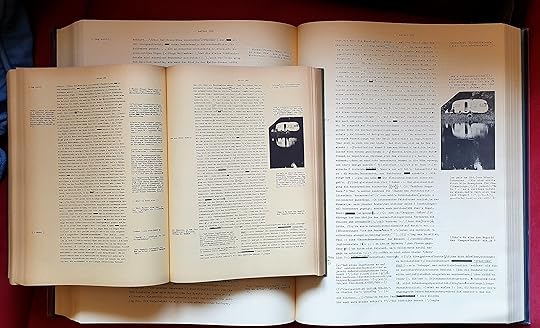
Die Bilder zeigen den Größenvergleich zwischen dem Original und dem Berliner Raubdruck:

April 21, 2014
does an English
translation exist?
or shall I learn German
for the purpose of this
text
the way a Margaret Chardiet
now Pharmakon
learned French
just to read Baudelaire
when we were teenagers
in Manhattan
?
translation exist?
or shall I learn German
for the purpose of this
text
the way a Margaret Chardiet
now Pharmakon
learned French
just to read Baudelaire
when we were teenagers
in Manhattan
?

Want to Read
May 21, 2014

"Ha, Women and Men's a book for ants!"
March 20, 2021
and so draws to close my first time through all of Schmidt’s english’d oeuvre god bless you JW. 72 days in this one took, four or so years to read him all. going to put my notes together and try to write something about this beautiful and unrelenting, without doubt, masterpiece of a book, not sure if book applies, more tower. tower of 20th C literature. singular, sweeping, breathtaking.

June 1, 2026
i read about three hundred and fifty pages of this, which i believe to be sufficiently representative. one has to respect what schmidt was doing here...well, no, one doesn't have to do that (though i do). it's not completely nonsensical, and the columnar format isn't as annoying as some people make it out to be (though it's certainly gimmicky), and it's not (to my eyes) as polyglottal and dense as finnegans wake, the book to which it's compared approximately 100% of the time. it's also not nearly as good as finnegans wake. the jokes are gross old man jokes. the punctuation tricks are corny (gass walked a very fine line in the tunnel with his shaped text; schmidt falls over that line). reading this is not how i want to spend another hundred hours.
massive props to the translator. john woods. an absolute master class in translation of opaque german postmodernism mit heavy use of novel punctuation, should anyone else ever want to do such a thing. john e. woods was awarded some manner of award for this effort, and died pretty much immediately afterwards. they couldn't write "1200 pages of madness" on the death certificate, but yeah.
also, dalkey archive absolutely deserves praise for bringing this book out, getting the translation done, and printing this gigantic artifact. they then sold it at a reasonable, even foolhardy price! but they only printed like eighty copies. who knows, maybe they were losing money on each copy sold; it wouldn't surprise me, having read Steven Moore's delightful Dalkey Days. the end result is that i paid about $800 for the privilege of taking a selfie with the book, then reading a fifth of it. i sold it to an absolutely jacked NYC marketing consultant via ebay for a net loss of about $50, and counted myself lucky. seriously, buyer was swole as fuck. i even noted it in my transaction feedback.
oh one last thing: while the book itself is a formidable and yet beautiful bit of printing, the box they included for no good reason is a piece of dogshit. i designed and 3dprinted a far better one for aforementioned swole buyer using Atomic Filament's Nuclear Nylon, who gave me no money for this endorsement and probably don't know about it. i guess we'll see whether there's a huge overlap between the Arno Schmidt-reading community and thermoplastic enthusiasts.
massive props to the translator. john woods. an absolute master class in translation of opaque german postmodernism mit heavy use of novel punctuation, should anyone else ever want to do such a thing. john e. woods was awarded some manner of award for this effort, and died pretty much immediately afterwards. they couldn't write "1200 pages of madness" on the death certificate, but yeah.
also, dalkey archive absolutely deserves praise for bringing this book out, getting the translation done, and printing this gigantic artifact. they then sold it at a reasonable, even foolhardy price! but they only printed like eighty copies. who knows, maybe they were losing money on each copy sold; it wouldn't surprise me, having read Steven Moore's delightful Dalkey Days. the end result is that i paid about $800 for the privilege of taking a selfie with the book, then reading a fifth of it. i sold it to an absolutely jacked NYC marketing consultant via ebay for a net loss of about $50, and counted myself lucky. seriously, buyer was swole as fuck. i even noted it in my transaction feedback.
oh one last thing: while the book itself is a formidable and yet beautiful bit of printing, the box they included for no good reason is a piece of dogshit. i designed and 3dprinted a far better one for aforementioned swole buyer using Atomic Filament's Nuclear Nylon, who gave me no money for this endorsement and probably don't know about it. i guess we'll see whether there's a huge overlap between the Arno Schmidt-reading community and thermoplastic enthusiasts.

August 21, 2020
Bottom’s Dream.
Well, it took a worldwide pandemic for me to finish this. And still I had to push and push.
It’s as if a power outage has left the electronic lock to the gate at a Mensa club open, allowing me to slip in and observe much bigger brains than my own, and eat some of the cherry pie left out in the lunch room, which through its combination of ingredients and flavours somehow explains a complex theorem that a member is explaining.
Schmidt postulates that our language and thoughts are at most times heavily laced with subconscious reference to sexual desire. However, lucid sentence constructions are only a small fraction of this text. Lengthy sex scenes, especially towards the end (what ends?, !) are drawn out in such complex language they are no longer explicit. Now, I know there are long essays on “the Dream”, but I’ve had my fill for the time being, so I’ll just take a guess at the meaning of this. Could it be that Schmidt is suggesting that sex is somehow also inexorably full of all other areas of one’s life (just as language and thought is subconsciously constant dirty talk?) so that we’re subconsciously communicating the mundane and all else during sex? Does Freudian theory whip back on itself in this way?
- -
Over the months I’ve been asked a number of times if it’s a good story, but the best I can answer is to stammer and reply that that’s not really relevant- which of course comes off pretty odd. Responding: “well the sheer scale of writing is jaw dropping” doesn’t answer the question. Similarly, when I’m asked if it’s a good book, really most times, I haven’t the foggiest how to respond. When I know the person enjoys reading feel good novels to relax, answering “well if you want to slay a big dragon of literature, and feel like you’ve really accomplished something I’d recommend it”. That comes off pretty weird in that situation. At best I might hear “that sounds like a lot of work and not relaxing at all!” Pretty much whatever I say is met with a strange look. Isn’t he strange. Again, when I’m asked what it’s about?, answering the question: “it’s 1500 pages of hammering the point that Poe (and language at large) is just a litany of hidden meaning in word, where almost all the words you say can be traced back to referencing how randy you may be.” Well that doesn’t work either. Why are you reading that Andrew? ... ? I don’t know. I just read stuff like this. I actively seek it out in fact. To what end? Hey. Maybe that’s the clearest answer I’ve come to. Of course that’s never the answer I give.
What you’re getting here is a massive undertaking, demonstrating gymnastics the human mind can do, but also endless obscation. To enjoy it you’ve got to be able be ok with not being in control, not being gratified. Be ok with this okay.
And for all this work I wonder what Schmidt made doing it, I mean financially, or Woods for his long suffering work as translator. At least he had a grant.
Well, it took a worldwide pandemic for me to finish this. And still I had to push and push.
It’s as if a power outage has left the electronic lock to the gate at a Mensa club open, allowing me to slip in and observe much bigger brains than my own, and eat some of the cherry pie left out in the lunch room, which through its combination of ingredients and flavours somehow explains a complex theorem that a member is explaining.
Schmidt postulates that our language and thoughts are at most times heavily laced with subconscious reference to sexual desire. However, lucid sentence constructions are only a small fraction of this text. Lengthy sex scenes, especially towards the end (what ends?, !) are drawn out in such complex language they are no longer explicit. Now, I know there are long essays on “the Dream”, but I’ve had my fill for the time being, so I’ll just take a guess at the meaning of this. Could it be that Schmidt is suggesting that sex is somehow also inexorably full of all other areas of one’s life (just as language and thought is subconsciously constant dirty talk?) so that we’re subconsciously communicating the mundane and all else during sex? Does Freudian theory whip back on itself in this way?
- -
Over the months I’ve been asked a number of times if it’s a good story, but the best I can answer is to stammer and reply that that’s not really relevant- which of course comes off pretty odd. Responding: “well the sheer scale of writing is jaw dropping” doesn’t answer the question. Similarly, when I’m asked if it’s a good book, really most times, I haven’t the foggiest how to respond. When I know the person enjoys reading feel good novels to relax, answering “well if you want to slay a big dragon of literature, and feel like you’ve really accomplished something I’d recommend it”. That comes off pretty weird in that situation. At best I might hear “that sounds like a lot of work and not relaxing at all!” Pretty much whatever I say is met with a strange look. Isn’t he strange. Again, when I’m asked what it’s about?, answering the question: “it’s 1500 pages of hammering the point that Poe (and language at large) is just a litany of hidden meaning in word, where almost all the words you say can be traced back to referencing how randy you may be.” Well that doesn’t work either. Why are you reading that Andrew? ... ? I don’t know. I just read stuff like this. I actively seek it out in fact. To what end? Hey. Maybe that’s the clearest answer I’ve come to. Of course that’s never the answer I give.
What you’re getting here is a massive undertaking, demonstrating gymnastics the human mind can do, but also endless obscation. To enjoy it you’ve got to be able be ok with not being in control, not being gratified. Be ok with this okay.
And for all this work I wonder what Schmidt made doing it, I mean financially, or Woods for his long suffering work as translator. At least he had a grant.
Want to Read
July 21, 2020
ZETTELS TRÄUME
Und was habe ich gelernt? Es gibt nicht nur einen Raubdruck, und wer die kleinere, reisetaugliche Kriminal=Ausgabe sucht, die nur weniges größer als A4 ist, der achte vor dem Bieten bei eBay gefälligst darauf ...
Und irgendwie sieht die doch nach Flokati aus, oder? Ein echter 70er=Klassiker :D
Um sie zu ärgern, werde ich sie Flöckchen rufen.
Ein paar weitere Infos habe ich hier zusammengetragen:
https://www.goodreads.com/user_status...
January 5, 2017
I am still trying to figure out what I've just emerged from. Three months in this world of Schmidt's. Just some random thoughts for now... Reading this book , put me in touch with several, oft ignored , aspects of reading . The physicality of the book and the ritualistic aspects , for instance. Due to the size of the book, I could only read it sitting at my dining room table, with the book on a lectern. This added a scriptural tone. I thought of the several times a day of readings of Marx's Capital at the 2015 Venice Biennale , where the reading aloud of the work was given a religious air. Then there is the work involved in translating/decoding each page. There is the decoding of the sentences but also the pages, which due to their inconsistent structures (2,3,4 columns?) . How to attack the page? Usually, read the middle column first...at times, only reading the middle columns, really. At times, I felt the translated product wanting. The conversations on Poe and literature and culture was a bit dry at times, with the sexual puns not adding much to my understanding of the characters or enjoyment of the experience. However, when the sexual tensions became more overt ( anticipated by the earlier sexual entonyms) , this added to the intensity and power of those passages. As the action withdrew under the current of words again, it added another layer of meaning to the work. The words that fill our lives, over/under/around our actions....As bizarre as it may sound, now I feel like I have to reread it. I won't do it immediately but the day will come....
February 24, 2015
Wunderbar symphonische Lesung ausgewählter Passagen aus ZT, die selbst Schmidt-Hasser und Traum-Ängstliche eines Besseren belehren sollten: der unangestrengte sympathische Vortrag beweist, wie quicklebendig diese Prosa ist, die so oft als artifiziell und der Lesemühe nicht wert verunglimpft wird.
Ich jedenfalls bin begeistert und muss mein Gewissen einmal mehr befragen, wann ich nun endlich ZT einmal ganz & am Stück lesen werde. 2016 wäre doch ein prima Plan...
Ich jedenfalls bin begeistert und muss mein Gewissen einmal mehr befragen, wann ich nun endlich ZT einmal ganz & am Stück lesen werde. 2016 wäre doch ein prima Plan...

February 11, 2016
More linguistic puns than Finnegans Wake, worth the 100 euro used.

March 20, 2025
The greated piece of literature ever composed. After reading the book's 1million words in its entiriety, I can safely say, that this book is a masterpiece. This book contains the most influential and inspirational ideas in human history. No other author could come up with a book so genius, and full of such pure diction and prose. You can wander through a library for hours on end, examining every book, and I honestly believe that you wil not find a better book, a more well written book, and a more breathaking book than this one. It is absoutley proposturous that this book is not displayed in museums around the world, and it is not hung above the King's Throne, and on top of the Holy See in Rome. This book, should have been blessed by Jesus Christ himself, and it would not even be stupid to believe it was composed by the Lord himself. This book contains so many complex themes, I don't even think Einstein could possibly compute the sheer theoretical level of how amazingly influential and creative this book really is.

October 27, 2016
Good Lord.
Have, have not read, likely will not have read, will always be reading but never at any given time.
Stars for length, or weight, but not for love, it will not be loved, it cannot be loved. Stars also for distance, as stars are, having residence behind the eyes. Stars for brittleness, for irremediable fracturing, for exploded polyphony.
Five stars, also no stars at all, the five gold stars plummeting to black for hatefulness, sex-race crassness, hairballs of lit-obsessiveness in which there is still light.
Take it as an interior critical monologue. Take it as a dream that eats literature. More later.
Box Edition. The box is a clear disappointment.
Have, have not read, likely will not have read, will always be reading but never at any given time.
Stars for length, or weight, but not for love, it will not be loved, it cannot be loved. Stars also for distance, as stars are, having residence behind the eyes. Stars for brittleness, for irremediable fracturing, for exploded polyphony.
Five stars, also no stars at all, the five gold stars plummeting to black for hatefulness, sex-race crassness, hairballs of lit-obsessiveness in which there is still light.
Take it as an interior critical monologue. Take it as a dream that eats literature. More later.
Box Edition. The box is a clear disappointment.

Did Not Finish
October 15, 2011Ein Lebenswerk -aber halt auch fuer den Leser

November 11, 2017
Could have trimmed 10-20 pages.

Read
April 16, 2026I'm here just to add this book to my "read-list".
Some books are not meant to be reviewed and rated.
This is one of them.
Some books are not meant to be reviewed and rated.
This is one of them.

Did Not Finish
February 12, 2026Dnf, I'll come back to this 10 years later
Displaying 1 - 30 of 43 reviews