

What do you think?
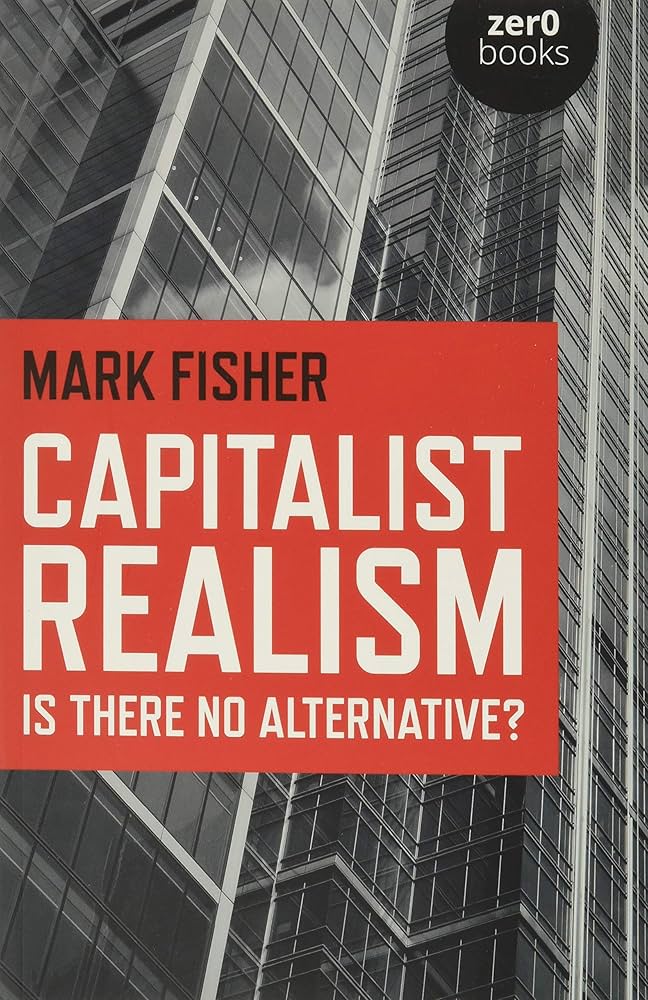
Capitalist Realism: Is There No Alternative?
After 1989, capitalism has presented itself as the only realistic political-economic system. What effects has this “capitalist realism” had on work, culture, education and mental health? Is it possible to imagine an alternative to capitalism that is not some throwback to discredited models of state control?
81 pages, Paperback
First published November 27, 2009
About the author
Mark Fisher
111 books2,233 followersMark Fisher (1968 – 2017) was a co-founder of Zero Books and Repeater Books. His blog, k-punk, defined critical writing for a generation. He wrote three books, Capitalist Realism, Ghosts of My Life and The Weird and the Eerie, and was a Visiting Fellow in the Visual Cultures department at Goldsmiths, University of London.
Librarian’s note: There is more than one author in the Goodreads database with this name.
Librarian’s note: There is more than one author in the Goodreads database with this name.
Ratings & Reviews
Friends & Following
Create a free account to discover what your friends think of this book!
Community Reviews
Displaying 1 - 30 of 5,236 reviews

December 2, 2018
Socialist Realism was an artform. It was conceived as a means to create a new kind of human – often called the new man – the point being to present heroic visions of people engaged in labour that was setting out to build the new and better world. Socialist Realism was pointedly ideological, and the point was to create images of healthy and vibrant people doing whatever it took to make that better world. When we look at Socialist Realism today we see it as all too obviously propaganda. Perhaps that is because it looks too much like western advertising from the 1950s – and we have learnt to be suspicious of perfect little worlds that are a single purchase away.
Capitalist Realism isn’t just an art movement, although it is that too, with advertising being its high art. It is, rather, an all-encompassing way of life. As such it remains mostly invisible to us because it is the air we breathe or perhaps it is the air we don’t notice weighing down upon us at 101 kPa or, shifting metaphor yet again, as Bourdieu liked to say, it is the yes we say in answer even before the question has been asked.
This book starts with the quote from either Zizek or Jameson, that it is easier to imagine the end of the world than the end of capitalism. It also quotes Thatcher’s TINA: There Is No Alternative. The point he is making is that despite the GFC and the near collapse of the world financial system, that is, just when you might have thought capitalism would have been in serious trouble, it barely trembled. The reason given here is that capitalism has proven much better at defining the limits of the real than socialism was ever able to.
Even if we were all to agree that capitalism is killing the planet, is causing almost satirical levels of inequality, is feeding racism, and sexism, and homophobia, and on and on and on, and even after all this, we could even agree that capitalism is failing on its own terms of providing economic growth and financial stability – and still, even so, we don’t seem able or willing to imagine an alternative. Rather, it is almost as if recognising the problems gives us permission to ignore them and go back to being good consumers.
The parts of this book I enjoyed the most were centred around his discussions of various films – films that almost invariably involved the characters being impotent to fundamentally change their world on any level, and so as if to cope with this incapacity, they are involved in various forms of forgetting: think Memento, Eternal Sunshine of the Spotless Mind, or the Bourne Identity films. Or again, films where the dystopian future doesn’t centre on a despotic government forcing its own will upon the people by force of violence (a jack-boot stomping a face for all eternity), but rather the world ending as in Children of Men, where infertility threatens the future and where all of our efforts become essentially pointless and meaningless, although we carry on regardless.
I was interested in his discussion of the difference between ‘realism’ as the ideas we ‘know’ about capitalism – that it is fundamentally opposed to bureaucracy or that it is a system where ‘the customer always comes first’ and how this is daily contradicted by our own experience of the real world of capitalism, and yet this never seems to undermine our notion of ‘capitalist realism’.
The instances given are of workplace performance systems – which he compares to Maoist versions of self-criticism and Stalinist versions of 5 year plans, where this was all more ritual and expected dance, than anything anyone literally believed.
He references this back to a film called ‘Office Space’ from the 1990s where staff were expected to wear seven pieces of ‘flair’ that would display their personality to those around them (think Myers-Briggs and so on). All good. Except one of the staff get into trouble because they are wearing exactly seven pieces of flair, which proves they are only doing the minimum of what is required of them, when they really ought to be trying to go over and above. Having worked in exactly these workplaces, this was all a little too real, barely even exaggerated. Which was also true of his discussion of the performance targets and the cult of management through numbers that, surely, is the essence of a good bureaucracy that most businesses routinely impose on staff.
And as for the truth of capitalist ‘customer service’ I have but two words, which ought to be enough to send a shiver of recognition down the spine of anyone who has had any contact with a business since 1980 – call centre. Who doesn’t feel horror of the abyss when they hear the words ‘your call is important to us’ interrupt the musak while on hold?
I liked this book – it is quite short, but has lots packed into it. He makes the point that if the left is have a future, it will need to create a positive alternative to capitalist realism, which must be utopian in the sense of providing a vision for what the world could become. He says criticism isn’t enough because capitalism criticises itself and still goes on – Wall-E, for instance, shows the impact of a corporate monopoly in destroying both the world and humanity’s ability to even move about other than with mechanical assistance. The film hardly provides a vision splendid, nor does it hide where the blame lies, but as with Bono’s Red Card, we aren’t offered a vision of a new world that threatens (or promises) to change the social structure, but rather we are offered more of the same old consumerism, but this time with a love-heart emoji painted on for good measure and the hope that perhaps this time doing the same as we have always done will produce a different result.
Capitalist Realism isn’t just an art movement, although it is that too, with advertising being its high art. It is, rather, an all-encompassing way of life. As such it remains mostly invisible to us because it is the air we breathe or perhaps it is the air we don’t notice weighing down upon us at 101 kPa or, shifting metaphor yet again, as Bourdieu liked to say, it is the yes we say in answer even before the question has been asked.
This book starts with the quote from either Zizek or Jameson, that it is easier to imagine the end of the world than the end of capitalism. It also quotes Thatcher’s TINA: There Is No Alternative. The point he is making is that despite the GFC and the near collapse of the world financial system, that is, just when you might have thought capitalism would have been in serious trouble, it barely trembled. The reason given here is that capitalism has proven much better at defining the limits of the real than socialism was ever able to.
Even if we were all to agree that capitalism is killing the planet, is causing almost satirical levels of inequality, is feeding racism, and sexism, and homophobia, and on and on and on, and even after all this, we could even agree that capitalism is failing on its own terms of providing economic growth and financial stability – and still, even so, we don’t seem able or willing to imagine an alternative. Rather, it is almost as if recognising the problems gives us permission to ignore them and go back to being good consumers.
The parts of this book I enjoyed the most were centred around his discussions of various films – films that almost invariably involved the characters being impotent to fundamentally change their world on any level, and so as if to cope with this incapacity, they are involved in various forms of forgetting: think Memento, Eternal Sunshine of the Spotless Mind, or the Bourne Identity films. Or again, films where the dystopian future doesn’t centre on a despotic government forcing its own will upon the people by force of violence (a jack-boot stomping a face for all eternity), but rather the world ending as in Children of Men, where infertility threatens the future and where all of our efforts become essentially pointless and meaningless, although we carry on regardless.
I was interested in his discussion of the difference between ‘realism’ as the ideas we ‘know’ about capitalism – that it is fundamentally opposed to bureaucracy or that it is a system where ‘the customer always comes first’ and how this is daily contradicted by our own experience of the real world of capitalism, and yet this never seems to undermine our notion of ‘capitalist realism’.
The instances given are of workplace performance systems – which he compares to Maoist versions of self-criticism and Stalinist versions of 5 year plans, where this was all more ritual and expected dance, than anything anyone literally believed.
He references this back to a film called ‘Office Space’ from the 1990s where staff were expected to wear seven pieces of ‘flair’ that would display their personality to those around them (think Myers-Briggs and so on). All good. Except one of the staff get into trouble because they are wearing exactly seven pieces of flair, which proves they are only doing the minimum of what is required of them, when they really ought to be trying to go over and above. Having worked in exactly these workplaces, this was all a little too real, barely even exaggerated. Which was also true of his discussion of the performance targets and the cult of management through numbers that, surely, is the essence of a good bureaucracy that most businesses routinely impose on staff.
And as for the truth of capitalist ‘customer service’ I have but two words, which ought to be enough to send a shiver of recognition down the spine of anyone who has had any contact with a business since 1980 – call centre. Who doesn’t feel horror of the abyss when they hear the words ‘your call is important to us’ interrupt the musak while on hold?
I liked this book – it is quite short, but has lots packed into it. He makes the point that if the left is have a future, it will need to create a positive alternative to capitalist realism, which must be utopian in the sense of providing a vision for what the world could become. He says criticism isn’t enough because capitalism criticises itself and still goes on – Wall-E, for instance, shows the impact of a corporate monopoly in destroying both the world and humanity’s ability to even move about other than with mechanical assistance. The film hardly provides a vision splendid, nor does it hide where the blame lies, but as with Bono’s Red Card, we aren’t offered a vision of a new world that threatens (or promises) to change the social structure, but rather we are offered more of the same old consumerism, but this time with a love-heart emoji painted on for good measure and the hope that perhaps this time doing the same as we have always done will produce a different result.
November 9, 2020
Pessimism of the intellect, optimism of the will …
Preamble:
--Update: I’m finally making videos, structured like these reviews, where I go step-by-step through my preferred methodologies (with plenty of diagrams!), so check them out: @TheConspiracyIsCapitalism
--Difficult to rate this short work; at first, I was hopeful that it would be accessible, engaging and foundational given its brevity (81 pages), use of pop culture, and title (perhaps most of the blame should be on the publisher and how this book is marketed).
...Engaging it remains. However, Fisher does not explain his brief references to political economy (“logic of Capital”; foundational) and history (ex. USSR), and his use of critical theory seems rather tangential (more like speculative creative writing). The topics are compelling, but I've heard them better developed elsewhere...
--I've had less success with cultural studies, but I do realize the problem with taking too rigid a position on the base (labour/production) vs. superstructure (culture) method of analysis. My struggle has been around applying systems-thinking (esp. synthesizing micro vs. macro behaviors) to cultural theories. Fisher has not alleviated this.
…As a result I am even more appreciative of David Graeber (RIP), who eloquently weaved together political economy with cultural studies (including social imagination for alternatives!):
1) Related to "Capitalist Realism" is Graeber’s Bullshit Jobs: A Theory and The Utopia of Rules: On Technology, Stupidity, and the Secret Joys of Bureaucracy.
2) To remedy the social imagination vacuum, there's Graeber's The Democracy Project: A History, a Crisis, a Movement.
...Note: both Graeber and Fisher fall on the idealist side (focus on human ideologies/imagination, be it uplifting or pessimistic) more than the materialist (starting from real-world conditions). For a materialist critique of idealism/postmodernism, see the foundational “What is Politics?” video series, in particular:
-"6. Political Anthropology: When Communism Works and Why"
-"7. The Origins of Male Dominance and Hierarchy; what David Graeber and Jordan Peterson get wrong"
-"7.1 Material Conditions: Why You Can't Eliminate Sexism or Patriarchy by Changing Culture"
-"8. Materialism vs. Idealism: How Social Change Happens"
--I see Fisher's writing more as creative thought-experiments, where Fisher strings together references ranging from novelist Kafka to Disney’s “WALL-E” in a kaleidoscopic manner that makes it difficult to fully contextualize the original sources.
The Useful:
1) “Capitalist Realism” as the end of social imagination for alternatives:
--Also referred to as “Neoliberalism” (popularized in the Western public by The Shock Doctrine: The Rise of Disaster Capitalism and in Western academia by A Brief History of Neoliberalism), although the birth of Neoliberalism (Reagan/Thatcher) there was still the Soviet bloc whereas Fisher uses “Capitalist Realism” to distinguish the generational changes...
--Performative anti-capitalism can actually facilitate participation in capitalism (another common example is green/ethical consumerism).
--At first, I felt Fisher’s brief mentions of “capital” omits explaining any political economy (i.e. commodification, alienation, accumulation by dispossession, atomization); see:
-intro: Talking to My Daughter About the Economy: or, How Capitalism Works—and How It Fails
-dive: Capital: A Critique of Political Economy, Volume 1
-dive: The Great Transformation: The Political and Economic Origins of Our Time
-dive: Debt: The First 5,000 Years
...I now see this was touched on (to varying degrees) in the main case study Fisher uses (i.e. his job as a professor and his students), which was at least relatable. Still, this kind of academic creative-writing is not what I would start with:
-The Myth of Normal: Trauma, Illness, and Healing in a Toxic Culture
-Lost Connections: Uncovering the Real Causes of Depression - and the Unexpected Solutions
-The Globalization of Addiction: A Study in Poverty of the Spirit
3) Bureaucracy of capitalist realism: anti-production (driven by false representations, i.e. quantification of what cannot be quantified esp. in social services of education/healthcare), internalized surveillance (ex. more “flexible” work, self-reporting), how individual choice (where instantaneous satisfaction is mistaken as freedom) can coexist with political authoritarianism, etc. Once again, see the Graeber recommendations above.
The Contentious:
1) Western-centric anti-communism?
--“Capitalism” is portrayed as a Western, developed-country phenomenon, with a singular modern timeline (esp. post-WWII boom, Cold War binary West vs. Soviet Bloc, Thatcher/Reagan/End of History). With all this apparent pessimism in the so-called developed countries, what space is there for the Global South?
...This is where I turn to Vijay Prashad’s popularization of Global South perspectives:
-intro:
Struggle Makes Us Human: Learning from Movements for Socialism
-dive into history: The Darker Nations: A People's History of the Third World (framing the Cold War from the Global South's struggles for decolonization).
...Related:
-intro: The Divide: A Brief Guide to Global Inequality and its Solutions
-on Red Scare: Blackshirts and Reds: Rational Fascism and the Overthrow of Communism
-dive: Perilous Passage: Mankind and the Global Ascendancy of Capital
-dive: Capital and Imperialism: Theory, History, and the Present
-Global South playlist: https://www.youtube.com/playlist?list...
--Probably the only “joy” in this book are the one-liners bashing communists, with cute inventions like “liberal communists”, “Market Stalinism”, describing neoliberal think-tanks as “Leninist” “intellectual vanguards”, “Maoist confessionalism”, etc. Why bother writing a book when you can join some Leftist internet flame war? See the Vijay recommendations above to escape the bi-polar Western Cold War/Red Scare defeatism.
2) Capitalist spillover too far from solutions?
--One reason I have trouble with this kind of cultural analysis is that many of the observations seem like spillover effects far down-river from the structural origins (Fisher also seems to assume political economic structural origins: “systemic consequences of a logic of Capital”).
...From a systems perspective (Thinking in Systems: A Primer), such spillover effects offer such low leverage points for actual change... I suspect this spillover approach contributes to the under-development of the “solutions” ending of the book (thus, no space for optimism of the will). See the aforementioned "What is Politics?" episodes:
-"7.1 Material Conditions: Why You Can't Eliminate Sexism or Patriarchy by Changing Culture"
-"8. Materialism vs. Idealism: How Social Change Happens"
--I find systems-thinking/materialist analysis so compelling for the desire to make changes closer to the source, which can have profound spillover effects, rather than starting from the end and working backwards against the current. Another analogy would be investing more in preventative healthcare, rather than waiting until people are already so sick that they are hospitalized.
-Examples of systems-thinking applied to political economy:
-macro + micro: Another Now: Dispatches from an Alternative Present
-Doughnut Economics: Seven Ways to Think Like a 21st-Century Economist
-micro: Democracy at Work: A Cure for Capitalism
3) Anti-systematic?:
--On research in psychology and social sciences, particular idealist approaches, I cannot help hearing alarm bells from Ben Goldacre’s critique of systematic biases in research, with psychology/social sciences reaching new heights.
--There's the infamous Sokal hoax and Goldacre's own skepticism of writings like Deleuze and Guattari (authors which Fisher references).
--Goldacre’s “publication bias” point is that positive findings in observational or experimental studies (and papers deemed more interesting in general, esp. feeding our confirmation biases) are more likely published and amplified, creating bias. This is scary in the medical field, where Big Pharma hides negative findings (but this is too systematic for sensationalists to fearmonger), so it's hard to imagine the distortions in social sciences. Just look at the "dismal science" of "economics".
-Bad Science: Quacks, Hacks, and Big Pharma Flacks
-I Think You'll Find it's a Bit More Complicated Than That
...basically, be wary ofsalespeople like Malcolm Gladwell...
Preamble:
--Update: I’m finally making videos, structured like these reviews, where I go step-by-step through my preferred methodologies (with plenty of diagrams!), so check them out: @TheConspiracyIsCapitalism
--Difficult to rate this short work; at first, I was hopeful that it would be accessible, engaging and foundational given its brevity (81 pages), use of pop culture, and title (perhaps most of the blame should be on the publisher and how this book is marketed).
...Engaging it remains. However, Fisher does not explain his brief references to political economy (“logic of Capital”; foundational) and history (ex. USSR), and his use of critical theory seems rather tangential (more like speculative creative writing). The topics are compelling, but I've heard them better developed elsewhere...
--I've had less success with cultural studies, but I do realize the problem with taking too rigid a position on the base (labour/production) vs. superstructure (culture) method of analysis. My struggle has been around applying systems-thinking (esp. synthesizing micro vs. macro behaviors) to cultural theories. Fisher has not alleviated this.
…As a result I am even more appreciative of David Graeber (RIP), who eloquently weaved together political economy with cultural studies (including social imagination for alternatives!):
1) Related to "Capitalist Realism" is Graeber’s Bullshit Jobs: A Theory and The Utopia of Rules: On Technology, Stupidity, and the Secret Joys of Bureaucracy.
2) To remedy the social imagination vacuum, there's Graeber's The Democracy Project: A History, a Crisis, a Movement.
...Note: both Graeber and Fisher fall on the idealist side (focus on human ideologies/imagination, be it uplifting or pessimistic) more than the materialist (starting from real-world conditions). For a materialist critique of idealism/postmodernism, see the foundational “What is Politics?” video series, in particular:
-"6. Political Anthropology: When Communism Works and Why"
-"7. The Origins of Male Dominance and Hierarchy; what David Graeber and Jordan Peterson get wrong"
-"7.1 Material Conditions: Why You Can't Eliminate Sexism or Patriarchy by Changing Culture"
-"8. Materialism vs. Idealism: How Social Change Happens"
--I see Fisher's writing more as creative thought-experiments, where Fisher strings together references ranging from novelist Kafka to Disney’s “WALL-E” in a kaleidoscopic manner that makes it difficult to fully contextualize the original sources.
The Useful:
1) “Capitalist Realism” as the end of social imagination for alternatives:
--Also referred to as “Neoliberalism” (popularized in the Western public by The Shock Doctrine: The Rise of Disaster Capitalism and in Western academia by A Brief History of Neoliberalism), although the birth of Neoliberalism (Reagan/Thatcher) there was still the Soviet bloc whereas Fisher uses “Capitalist Realism” to distinguish the generational changes...
--Performative anti-capitalism can actually facilitate participation in capitalism (another common example is green/ethical consumerism).
--At first, I felt Fisher’s brief mentions of “capital” omits explaining any political economy (i.e. commodification, alienation, accumulation by dispossession, atomization); see:
-intro: Talking to My Daughter About the Economy: or, How Capitalism Works—and How It Fails
-dive: Capital: A Critique of Political Economy, Volume 1
-dive: The Great Transformation: The Political and Economic Origins of Our Time
-dive: Debt: The First 5,000 Years
...I now see this was touched on (to varying degrees) in the main case study Fisher uses (i.e. his job as a professor and his students), which was at least relatable. Still, this kind of academic creative-writing is not what I would start with:
What we are facing here is not just time-honored teenage torpor, but the mismatch between a postliterate ‘New Flesh’ that is ‘too wired to concentrate’ and the confining, concentrational logics of decaying disciplinary systems. To be bored simply means to be removed from the communicative sensation-stimulus matrix of texting, YouTube and fast food; to be denied, for a moment, the constant flow of sugary gratification on demand. Some students want Nietzsche in the same way that they want a hamburger; they fail to grasp – and the logic of the consumer system encourages this misapprehension – that the indigestibility, the difficulty is Nietzsche.2) Mental health crisis of capitalist realism: the need to politicize illness (i.e. depression) as not just individualized, biological issues but a manifestation of socioenvironmental issues (esp. capitalist relations). For more, see:
-The Myth of Normal: Trauma, Illness, and Healing in a Toxic Culture
-Lost Connections: Uncovering the Real Causes of Depression - and the Unexpected Solutions
-The Globalization of Addiction: A Study in Poverty of the Spirit
3) Bureaucracy of capitalist realism: anti-production (driven by false representations, i.e. quantification of what cannot be quantified esp. in social services of education/healthcare), internalized surveillance (ex. more “flexible” work, self-reporting), how individual choice (where instantaneous satisfaction is mistaken as freedom) can coexist with political authoritarianism, etc. Once again, see the Graeber recommendations above.
The Contentious:
1) Western-centric anti-communism?
--“Capitalism” is portrayed as a Western, developed-country phenomenon, with a singular modern timeline (esp. post-WWII boom, Cold War binary West vs. Soviet Bloc, Thatcher/Reagan/End of History). With all this apparent pessimism in the so-called developed countries, what space is there for the Global South?
...This is where I turn to Vijay Prashad’s popularization of Global South perspectives:
-intro:
Struggle Makes Us Human: Learning from Movements for Socialism
-dive into history: The Darker Nations: A People's History of the Third World (framing the Cold War from the Global South's struggles for decolonization).
...Related:
-intro: The Divide: A Brief Guide to Global Inequality and its Solutions
-on Red Scare: Blackshirts and Reds: Rational Fascism and the Overthrow of Communism
-dive: Perilous Passage: Mankind and the Global Ascendancy of Capital
-dive: Capital and Imperialism: Theory, History, and the Present
-Global South playlist: https://www.youtube.com/playlist?list...
--Probably the only “joy” in this book are the one-liners bashing communists, with cute inventions like “liberal communists”, “Market Stalinism”, describing neoliberal think-tanks as “Leninist” “intellectual vanguards”, “Maoist confessionalism”, etc. Why bother writing a book when you can join some Leftist internet flame war? See the Vijay recommendations above to escape the bi-polar Western Cold War/Red Scare defeatism.
2) Capitalist spillover too far from solutions?
--One reason I have trouble with this kind of cultural analysis is that many of the observations seem like spillover effects far down-river from the structural origins (Fisher also seems to assume political economic structural origins: “systemic consequences of a logic of Capital”).
...From a systems perspective (Thinking in Systems: A Primer), such spillover effects offer such low leverage points for actual change... I suspect this spillover approach contributes to the under-development of the “solutions” ending of the book (thus, no space for optimism of the will). See the aforementioned "What is Politics?" episodes:
-"7.1 Material Conditions: Why You Can't Eliminate Sexism or Patriarchy by Changing Culture"
-"8. Materialism vs. Idealism: How Social Change Happens"
--I find systems-thinking/materialist analysis so compelling for the desire to make changes closer to the source, which can have profound spillover effects, rather than starting from the end and working backwards against the current. Another analogy would be investing more in preventative healthcare, rather than waiting until people are already so sick that they are hospitalized.
-Examples of systems-thinking applied to political economy:
-macro + micro: Another Now: Dispatches from an Alternative Present
-Doughnut Economics: Seven Ways to Think Like a 21st-Century Economist
-micro: Democracy at Work: A Cure for Capitalism
3) Anti-systematic?:
--On research in psychology and social sciences, particular idealist approaches, I cannot help hearing alarm bells from Ben Goldacre’s critique of systematic biases in research, with psychology/social sciences reaching new heights.
--There's the infamous Sokal hoax and Goldacre's own skepticism of writings like Deleuze and Guattari (authors which Fisher references).
--Goldacre’s “publication bias” point is that positive findings in observational or experimental studies (and papers deemed more interesting in general, esp. feeding our confirmation biases) are more likely published and amplified, creating bias. This is scary in the medical field, where Big Pharma hides negative findings (but this is too systematic for sensationalists to fearmonger), so it's hard to imagine the distortions in social sciences. Just look at the "dismal science" of "economics".
-Bad Science: Quacks, Hacks, and Big Pharma Flacks
-I Think You'll Find it's a Bit More Complicated Than That
...basically, be wary ofsalespeople like Malcolm Gladwell...

July 24, 2011
So, what do you do about capitalism if you live in a world where, as both Jameson & Žižek have noted, it is easier to imagine the end of the world than the end of capitalism, or as Fisher puts it in the short, engaging, and entertaining book, if there is a "widespread sense that not only is capitalism the only viable political and economic system, but also that it is now impossible even to imagine a coherent alternative to it"?
First up, disagree: I can imagine a viable alternative to capitalism (Alain Badiou's The Communist Hypothesis helped me there). I like to think I am helping to build a viable alternative to capitalism, but I am aware that there are not many people on the construction site with me, and it is I admit really hard to envisage exactly what my imaginary alternative looks like – except it is collectivist, social, equal, democratic (and I don't mean there are electoral rituals that perpetuate the power of a small group, but participatory) and does not require the alienation of humans from their being to work in the service of someone else.
Then, to agree: I don't see my imaginary viable alternative as all that likely, and am acutely aware that Fisher is correct when he argues that the 'reality' of capitalism hides the Real, its actual form, so that to accept capitalism's reality is to miss its essential form and character (he does get a little Lacanian at one stage, I suspect his debt to Žižek). More notably, I am also aware that in my everyday work as an academic and as a university manager I am not only complicit in but actively perpetuate late capitalism's surveillance culture where we control and discipline ourselves.
The analysis here, of mental health as a social disease, of the dyslexia epidemic as post-lexia (the condition of life in a world where reading is unnecessary), of neo-liberalism's love of a specific type of big state – the surveillance state – but hatred of the welfare state as not a paradox but as essential to late capitalism, packs an awful lot into 81 pages. What he doesn't do, and where Fisher shows how bad we have got at imagining not only an alternative to capitalism but also ways to resist it, is suggest anything more meaningful than a call to stop bickering over the past and find ways to, as much as possible, withdraw from doing capitalism's surveillance work for it.
In short, this is a fabulous analysis – but we have plenty of them (notably Jodi Dean's Democracy and Other Neo-Liberal Fantasies, Ellen Meiksins Wood's Empire of Capital, Naomi Klein's The Shock Doctrine): by all means read this and those three titles, but look also for ways to move beyond the analysis – and for me you can't go far past Marta Harnecker's Rebuilding the Left, or in the UK the political project best represented by Red Pepper magazine.
First up, disagree: I can imagine a viable alternative to capitalism (Alain Badiou's The Communist Hypothesis helped me there). I like to think I am helping to build a viable alternative to capitalism, but I am aware that there are not many people on the construction site with me, and it is I admit really hard to envisage exactly what my imaginary alternative looks like – except it is collectivist, social, equal, democratic (and I don't mean there are electoral rituals that perpetuate the power of a small group, but participatory) and does not require the alienation of humans from their being to work in the service of someone else.
Then, to agree: I don't see my imaginary viable alternative as all that likely, and am acutely aware that Fisher is correct when he argues that the 'reality' of capitalism hides the Real, its actual form, so that to accept capitalism's reality is to miss its essential form and character (he does get a little Lacanian at one stage, I suspect his debt to Žižek). More notably, I am also aware that in my everyday work as an academic and as a university manager I am not only complicit in but actively perpetuate late capitalism's surveillance culture where we control and discipline ourselves.
The analysis here, of mental health as a social disease, of the dyslexia epidemic as post-lexia (the condition of life in a world where reading is unnecessary), of neo-liberalism's love of a specific type of big state – the surveillance state – but hatred of the welfare state as not a paradox but as essential to late capitalism, packs an awful lot into 81 pages. What he doesn't do, and where Fisher shows how bad we have got at imagining not only an alternative to capitalism but also ways to resist it, is suggest anything more meaningful than a call to stop bickering over the past and find ways to, as much as possible, withdraw from doing capitalism's surveillance work for it.
In short, this is a fabulous analysis – but we have plenty of them (notably Jodi Dean's Democracy and Other Neo-Liberal Fantasies, Ellen Meiksins Wood's Empire of Capital, Naomi Klein's The Shock Doctrine): by all means read this and those three titles, but look also for ways to move beyond the analysis – and for me you can't go far past Marta Harnecker's Rebuilding the Left, or in the UK the political project best represented by Red Pepper magazine.

March 21, 2023
LO SPIRITO DEL TEMPO

Jon Rafman (l’autore della copertina): Remeber Carthage, 2013.
Perché Realismo capitalista di Mark Fisher è il libro più importante del XXI secolo?
Sì, un giorno - bello o brutto non ricordo, ha poca importanza – mi sono trovato davanti un articolo con questo titolo.
Come potevo resistere, come potevo non procurarmelo e leggerlo? Leggere il libro più importante del XXI secolo! Per giunta di centocinquanta smilze paginette.
Impossibile.
Un libricino che a suo modo è diventato un best seller, o meglio, dovrei probabilmente dire un long seller visti che sono quattordici anni che vende (pubblicato nel 2009, l’anno dopo la crisi finanziaria mondiale).
Un libricino che Slavoj Žižek, forse oggi il filosofo più noto al mondo, descrive come la miglior diagnosi della situazione in cui ci troviamo.
E non è una bella situazione, proprio no. Quindi, qualcuno che riesce a illuminarla, benvenuto, viva, alleluja.

Jon Rafman: Facials.
Parlando di vari aspetti culturali, ma soprattutto di quella popolare, privilegiando cinema e musica, trasversalmente, citando Žižek, Guattari, Foucault, Deleuze, Lacan, Baudrillard, Spinoza, Kant, Nietzsche, Freud, Le Guin, Kafka, Orwell, Asimov, Coppola, Michael Mann, Scorsese, Cuaròn, Jason Bourne il personaggio di Ludlum, interpretando lo spirito del tempo, con linguaggio semplice, si ha l’impressione che Fisher spieghi le cose che non vanno in questo tardo-capitalismo (ma per caso tardo significa che sta per finire?), le incongruenze del realismo capitalista, quello che si considera l’unico modello possibile, quello che sventola lo slogan “non esiste alternativa”, quello che in vari aspetti ricorda il realismo socialista, e i due sistemi dovrebbero essere antitetici e nemici, no? Invece no: c’è anche più di un tocco di stalinismo in questo tardo-capitalismo, nel realismo capitalista. Stalinismo di mercato.

Jon Rafman: Minor Daemon, 2021.
Flessibilità, instabilità, precarietà, ansia, malattia mentale, la collezione di citazioni (a seguire) che mi sono segnato, e prima di lasciarci le ultime paginette aprono il cuore alla speranza (Fisher ci ha lasciato nel 2017, si è suicidato poco prima di compiere cinquant’anni), spargono aria nuova. Fresca.
Nel capitalismo tutto ciò che è solido si dissolve nelle “public relations”. Lo stesso tardo capitalismo è definito dalla sua onnipresente tendenza alla produzione di “relazioni pubbliche” non meno che dall’imposizione dei meccanismi di mercato.
Abbastanza non è più abbastanza. È una sindrome che suonerà familiare a quei tanti lavoratori per i quali una valutazione “sufficiente” delle proprie prestazioni non è più… “sufficiente”.

Jon Rafman: Arbiter of Worlds.
Nonostante le iniziali apparenze e speranze, il realismo capitalista non è stato messo in discussione nemmeno dalla crisi del 2008. Le speculazioni che volevano il capitalismo sull’orlo del collasso si sono rivelate infondate; fu anzi subito chiaro che, anziché essere un segnale dell’imminente fine del capitalismo, il salvataggio delle banche serviva a ribadire nella maniera più manifesta possibile l’assunto fondamentale del realismo capitalista: non c’è alternativa. Per mettere che il sistema bancario si disintegrasse venne considerato “impensabile”, e quella che seguì fu un’imponente emorragia di denaro pubblico in mani private.
Il capitalismo reale è segnato dalla stessa discrasia che caratterizza il socialismo reale: da una parte, una cultura ufficiale in cui imprese e aziende vengono presentate come premurose e socialmente responsabili; dall’altra, la diffusa consapevolezza che queste stesse compagnie sono corrotte e spietate.
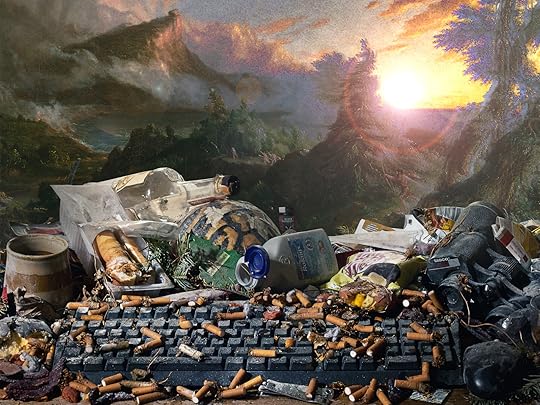
Jon Rafman: Field Vision, 2015 (in copertina).
Jon Rafman (l’autore della copertina): Remeber Carthage, 2013.
Perché Realismo capitalista di Mark Fisher è il libro più importante del XXI secolo?
Sì, un giorno - bello o brutto non ricordo, ha poca importanza – mi sono trovato davanti un articolo con questo titolo.
Come potevo resistere, come potevo non procurarmelo e leggerlo? Leggere il libro più importante del XXI secolo! Per giunta di centocinquanta smilze paginette.
Impossibile.
Un libricino che a suo modo è diventato un best seller, o meglio, dovrei probabilmente dire un long seller visti che sono quattordici anni che vende (pubblicato nel 2009, l’anno dopo la crisi finanziaria mondiale).
Un libricino che Slavoj Žižek, forse oggi il filosofo più noto al mondo, descrive come la miglior diagnosi della situazione in cui ci troviamo.
E non è una bella situazione, proprio no. Quindi, qualcuno che riesce a illuminarla, benvenuto, viva, alleluja.
Jon Rafman: Facials.
Parlando di vari aspetti culturali, ma soprattutto di quella popolare, privilegiando cinema e musica, trasversalmente, citando Žižek, Guattari, Foucault, Deleuze, Lacan, Baudrillard, Spinoza, Kant, Nietzsche, Freud, Le Guin, Kafka, Orwell, Asimov, Coppola, Michael Mann, Scorsese, Cuaròn, Jason Bourne il personaggio di Ludlum, interpretando lo spirito del tempo, con linguaggio semplice, si ha l’impressione che Fisher spieghi le cose che non vanno in questo tardo-capitalismo (ma per caso tardo significa che sta per finire?), le incongruenze del realismo capitalista, quello che si considera l’unico modello possibile, quello che sventola lo slogan “non esiste alternativa”, quello che in vari aspetti ricorda il realismo socialista, e i due sistemi dovrebbero essere antitetici e nemici, no? Invece no: c’è anche più di un tocco di stalinismo in questo tardo-capitalismo, nel realismo capitalista. Stalinismo di mercato.
Jon Rafman: Minor Daemon, 2021.
Flessibilità, instabilità, precarietà, ansia, malattia mentale, la collezione di citazioni (a seguire) che mi sono segnato, e prima di lasciarci le ultime paginette aprono il cuore alla speranza (Fisher ci ha lasciato nel 2017, si è suicidato poco prima di compiere cinquant’anni), spargono aria nuova. Fresca.
Nel capitalismo tutto ciò che è solido si dissolve nelle “public relations”. Lo stesso tardo capitalismo è definito dalla sua onnipresente tendenza alla produzione di “relazioni pubbliche” non meno che dall’imposizione dei meccanismi di mercato.
Abbastanza non è più abbastanza. È una sindrome che suonerà familiare a quei tanti lavoratori per i quali una valutazione “sufficiente” delle proprie prestazioni non è più… “sufficiente”.
Jon Rafman: Arbiter of Worlds.
Nonostante le iniziali apparenze e speranze, il realismo capitalista non è stato messo in discussione nemmeno dalla crisi del 2008. Le speculazioni che volevano il capitalismo sull’orlo del collasso si sono rivelate infondate; fu anzi subito chiaro che, anziché essere un segnale dell’imminente fine del capitalismo, il salvataggio delle banche serviva a ribadire nella maniera più manifesta possibile l’assunto fondamentale del realismo capitalista: non c’è alternativa. Per mettere che il sistema bancario si disintegrasse venne considerato “impensabile”, e quella che seguì fu un’imponente emorragia di denaro pubblico in mani private.
Il capitalismo reale è segnato dalla stessa discrasia che caratterizza il socialismo reale: da una parte, una cultura ufficiale in cui imprese e aziende vengono presentate come premurose e socialmente responsabili; dall’altra, la diffusa consapevolezza che queste stesse compagnie sono corrotte e spietate.
Jon Rafman: Field Vision, 2015 (in copertina).

September 4, 2021
I've been struggling with thinking about climate change. Part of the reason is that the current discourse is severely lacking. But also, given its scope, magnanimity and destructive potential, we seem to be linguistically confused too. Like with all things dealing with death and destruction, we do not have an adequate language for it. Instead, we are just arguing over signifiers and technicalities. What's also problematic is the collective blame - of course we are responsible for it in a way, but some people (read: corporations and CEOs) are much, much more responsible that others. As such, I've been increasingly drawn to Haraway's rejection of the term 'anthropocene.' Instead she proposes 'capitalocene.'
Climate change discourse, when it exists, obviously talks about humanity as a whole both in realtion to cause and effects. And this is very asymmetric, because while it effects everyone, it was caused by the capitalist elite. This to me, is an indicator of how embedded capitalist realism is - the idea that there is no alternative helps in effectively displacing responsibility while simultaneously concentrating power. TINA has numbed us down to a point where we individually just accept our depressive hedonia and sometimes even actively pursue it, while capitalism marches onwards and upwards towards collective destruction. We do not want to encounter the traumatic Real, so instead we accept capitalism which presents itself as reality.
It makes sense that this book was published in the wake of the 2008 crisis, a period of heightened psychological incoherence. The subject since then has been collective. And it made even more sense to me because I read it amidst the covid-19 crisis wherein capitalism has been laid bare again. Here we are, forced to stare at the Real. What's worrisome is that the stare of emergency invoked across various parts of the world to deal with the crisis seems like it's here to stay. I wonder what the post-pandemic world will look like. For now, it seems as though dangerous is the new normal. We live on the edge and we have been trained to passively relish it.
Climate change discourse, when it exists, obviously talks about humanity as a whole both in realtion to cause and effects. And this is very asymmetric, because while it effects everyone, it was caused by the capitalist elite. This to me, is an indicator of how embedded capitalist realism is - the idea that there is no alternative helps in effectively displacing responsibility while simultaneously concentrating power. TINA has numbed us down to a point where we individually just accept our depressive hedonia and sometimes even actively pursue it, while capitalism marches onwards and upwards towards collective destruction. We do not want to encounter the traumatic Real, so instead we accept capitalism which presents itself as reality.
It makes sense that this book was published in the wake of the 2008 crisis, a period of heightened psychological incoherence. The subject since then has been collective. And it made even more sense to me because I read it amidst the covid-19 crisis wherein capitalism has been laid bare again. Here we are, forced to stare at the Real. What's worrisome is that the stare of emergency invoked across various parts of the world to deal with the crisis seems like it's here to stay. I wonder what the post-pandemic world will look like. For now, it seems as though dangerous is the new normal. We live on the edge and we have been trained to passively relish it.

November 1, 2020
So this book leaves me with many unanswered questions. But I loved it. It is the first book I have read by Fisher, and I find it to be a great introduction to what he is about. Politics and culture come together here, and his reading of capitalism through films and fiction is a pretty great guide. You see things in a perceptive way after reading this. I take this: responsibility, which capital culture takes away, so we don't really need to see that everything we do has a consequence. The problem is the structure, this structure based on Capital, where responsibility is not really going towards each person. Definitely recommended.

November 13, 2020
This is definitely worth reading if you have any interest in the subject.
'It is easier to imagine an end to the world than an end to capitalism'
'It is easier to imagine an end to the world than an end to capitalism'

August 6, 2014
Mark Fisher’s Capitalist Realism (2009) is a curmudgeonly and over-determined analysis of late capitalism with little theoretical value. His utter and complete assimilation into the ideological machine of Žižek’s New Left does him an enormous disservice. Because of this, Fisher is precluded from approaching the issues present in late capitalism with the necessary finesse. Rather, for every moment of insight (of which there are a few), there are ten face palm inducing misrepresentations of contemporary culture or sanctimonious condemnations of identity politics.
Beyond the book’s inherent failure as a consequence of Žižek boot-licking, Fisher places a lot of bets that haven’t paid off in the post-2008 political landscape. As Fisher sketches his ideal, vaguely racist and culturally elitist, image of a post-financial crisis progressivism, Fisher dismisses the tendencies that have expanded to the left’s zeitgeist — most crucially the self-determining identity.
Fisher’s text occasionally brings to bear prescient points, but some are borrowed — such as Robert Pfaller’s ‘interpassivity,’ the media’s performance of anti-capitalism which creates a bystander effect in viewers and results in their atrophy. Fisher generates one useful chapter, the fifth, which provides a fruitful analysis of the relationship between mental illness and capitalism. Fisher writes, “the current ruling ontology denies any possibility of a social causation of mental illness. The chemico-biologization of mental illness is of course strictly commensurate with its de-politicization.” He continues, “all mental illnesses are neurologically instantiated, but this says nothing about their causation.” To continue down Fisher’s avenue of inquiry about the relationship between capitalism and mental illness would be enormously fruitful. However, this is the only meaningful contribution Fisher can offer in this text.
The text’s failings are far more numerous. Whether it’s the patronizing pop-culture references that are superfluous and are belied by Fisher’s cultural elitism, his contempt for youth culture, or his attempt to de-emphasize the importance of individual identity, these faults can be attributed to the frequent drawing from the poisoned well of Žižek and Jameson. The most frustrating thing about Fisher’s text is that in a short 81 pages he still manages to pack in criticisms of the priorities and processes of modern post-colonialism. It is baffling how proponents of Neo-Marxism (which departs from Marx on almost every significant point) can miss how self-defeating paternalistic lecturing about tactics and priorities. The New Left conceives of “radical energy” as something finite and thus embarks on a patronizing crusade of telling others how to spend it. If one accepts their premise, how is a leftist condescending to another a good use of said energy? But, the New Left is wrong on both counts. One can be incredibly invested in the analysis of individual experience and cultural epistemology but also be concerned about the greater structures of capitalism. In fact, both interests are necessary rather than mutually exclusive as Fisher would claim.
Reading Fisher’s text, it feels irrelevant. It is a work of political and ideological speculation that is almost uniformly wrong, hampered by bad reasoning and a fractured ideological foundation. The trajectory of post-financial crisis progressivism that Fisher outlines is correct only insofar as the financial crisis represented a sea change. That change, rather than moving outwardly and anonymizing the individual, has shattered the barriers of entry to epistemology and allowed for the inclusion of individual experience. In that tradition, Fisher’s concerns about mental illness and their relationship to capitalism actually fit quite nicely. Fisher is at his best when he discusses these issues and takes aim at Neoliberalism, and his worst when he channels the self-importance of Žižek that includes shades of a bourgeoisie cultural elitism and white supremacy.
Beyond the book’s inherent failure as a consequence of Žižek boot-licking, Fisher places a lot of bets that haven’t paid off in the post-2008 political landscape. As Fisher sketches his ideal, vaguely racist and culturally elitist, image of a post-financial crisis progressivism, Fisher dismisses the tendencies that have expanded to the left’s zeitgeist — most crucially the self-determining identity.
Fisher’s text occasionally brings to bear prescient points, but some are borrowed — such as Robert Pfaller’s ‘interpassivity,’ the media’s performance of anti-capitalism which creates a bystander effect in viewers and results in their atrophy. Fisher generates one useful chapter, the fifth, which provides a fruitful analysis of the relationship between mental illness and capitalism. Fisher writes, “the current ruling ontology denies any possibility of a social causation of mental illness. The chemico-biologization of mental illness is of course strictly commensurate with its de-politicization.” He continues, “all mental illnesses are neurologically instantiated, but this says nothing about their causation.” To continue down Fisher’s avenue of inquiry about the relationship between capitalism and mental illness would be enormously fruitful. However, this is the only meaningful contribution Fisher can offer in this text.
The text’s failings are far more numerous. Whether it’s the patronizing pop-culture references that are superfluous and are belied by Fisher’s cultural elitism, his contempt for youth culture, or his attempt to de-emphasize the importance of individual identity, these faults can be attributed to the frequent drawing from the poisoned well of Žižek and Jameson. The most frustrating thing about Fisher’s text is that in a short 81 pages he still manages to pack in criticisms of the priorities and processes of modern post-colonialism. It is baffling how proponents of Neo-Marxism (which departs from Marx on almost every significant point) can miss how self-defeating paternalistic lecturing about tactics and priorities. The New Left conceives of “radical energy” as something finite and thus embarks on a patronizing crusade of telling others how to spend it. If one accepts their premise, how is a leftist condescending to another a good use of said energy? But, the New Left is wrong on both counts. One can be incredibly invested in the analysis of individual experience and cultural epistemology but also be concerned about the greater structures of capitalism. In fact, both interests are necessary rather than mutually exclusive as Fisher would claim.
Reading Fisher’s text, it feels irrelevant. It is a work of political and ideological speculation that is almost uniformly wrong, hampered by bad reasoning and a fractured ideological foundation. The trajectory of post-financial crisis progressivism that Fisher outlines is correct only insofar as the financial crisis represented a sea change. That change, rather than moving outwardly and anonymizing the individual, has shattered the barriers of entry to epistemology and allowed for the inclusion of individual experience. In that tradition, Fisher’s concerns about mental illness and their relationship to capitalism actually fit quite nicely. Fisher is at his best when he discusses these issues and takes aim at Neoliberalism, and his worst when he channels the self-importance of Žižek that includes shades of a bourgeoisie cultural elitism and white supremacy.

May 18, 2021
So. Quite recently a fellow comrade told me that she just ‘discovered’ Zizek. And I went like (insert resting condescending face) ‘where have you been hiding for the past 20 years?’. Now the same seemed to have happened to me as I just ‘discovered’ cultural theorist Mark Fisher, or rather his 2009 book ‘Capitalist Realism’ (Zero Books). Then I went down the whole YouTube and K-punk blog rabbit hole of and also ‘discovered’ the ‘Vampire Castle’ essay which seem to have divided an entire generation of US left-wingers (identity politics versus materialism) but which I somehow missed although it must have been referenced a million times in my bubble. Anyhow, I just had my Zizek moment.
Regardless, I inhaled this slim book of 80 pages and felt quite little sad at I really would have needed this book (and the Vampire Castle) in the early 2010s when we collectively realized that the global financial crisis was not the end of capitalism (at all!) and again in 2016 during the first Bernie campaign when we also fully, fully understood the commitment of the liberal mainstream (progressive neoliberals) to protecting the capitalist status quo (by 2020, I had learned to deal with it) and how difficult this would make in terms of realizing any progressive political project. I also learned that Mark Fisher, who suffered from depression, took his life in 2017 which makes the subtitle to the book ‘Is there no alterative’ a little horrible.
Here are a few take-aways from ‘Capitalist Realism’ for the five people or so on this planet who haven’t read the book yet. LOL.
The book essentially unpacks what is meant by ‘it’s easier to imagine the end of the world than the end of capitalism’. ‘Capitalism is what is left when beliefs have collapsed at the level of ritual or symbolic elaboration, and all that is left is the consumer-spectator, trudging through the ruins and relics. […] The attitude of ironic distance proper to postmodern capitalism is supposed to immunize us against the seductions of fanaticism. Lowering our expectations, we are told, is a small price to pay to be protected from terror and totalism’.
In other words, the ‘partisans of the established order’ (Badiou) cannot call the status quo, the brutal state of affairs, ideal or wonderful. Instead we are always reminded of the ‘lesser evil’. Yes, democracy is not perfect, but it’s better than dictatorships. Any challenge to the status quo, say, universal healthcare, is not only ‘unrealistic’ (sic), we are told, but also one step closer to the gulag. We have heard it all. The smug reminders that ‘capitalism is not perfect but the best thing available’ told to us by those who are not at the receiving end of a world where all existence is evaluated in terms of money alone.
Speaking of. The corona pandemic has now finally revealed the current state of affairs for the dystopia it is: as the rich folks are being vaccinated on time for the summer holidays, we are seeing quite literally a burning hell in India and elsewhere in the ‘third world’. So while there are vaccines available, ‘we’ are actually debating whether we should waive the patents so we can vaccinate all people. Of course, this would fundamentally threaten the capitalist logic and so we are told it’s better to save the logic of the market (mind you that the research going into these vaccines was mostly publicly funded) because if we now took away the patent rights ‘then the market would never again bless us with innovation and research’ (which should be public anyway, precisely to avoid a world in where the rich have access to vaccines and health care and the poor have not). Everything we are seeing right now is right from the script of a dystopian movie, down to the aesthetics. It is literally easier for people to imagine billions of people going unvaccinated than socializing health care and vaccines. It’s what Fisher calls
Remember what happened when we found out that the whole pretext for going into Iraq – WMD – tuned out to be lie. Nothing. It’s the same when we find out, time and again, that ‘the market’ is fundamentally more important than human lives. We don’t even need any propaganda to belief in this ‘business ontology’, it is inside us and this is the scary part. The whole idea of ‘realism’ is precisely the sterility of imagination beyond the ‘end of history’.
I love how Mark Fisher describes this realism ‘The realism here is analogous to the deflationary perspective of a depressive who believes that any positive state, any hope, is a dangerous illusion’.
On the issue of how capital works at the level of our subconscious, there was a sentence that made me shudder "To reclaim real political agency means first of all accepting our insertion at the level of desire in the remorseless meat-grinder of Capital". A libidinal investment in high capitalism.
There follow some beautiful thoughts, including (and Zizek wrote much on this) how anti-capitalism is already part of capitalism, think about how in capitalism even anti-capitalism has become a commodity, think the whole bullshit of ‘ethical consumerism’. (Reminds me of how progressive neoliberals will ‘cancel’ a company for racist or sexist advertising but not for paying shitty wages or exploiting people and the planet otherwise. But that’s for another time.)
So what’s the way out? Fisher contends that capitalism can only be threatened if it can be shown to be in some way inconsistent and untenable (possibly what others referred to as ‘rupture’), that is to say if capitalism's ostensible 'realism' turns out to be nothing of the sort. The climate apocalypse is one those aporias but what green capitalism seems to have sufficiently sanitized from its progressive potential. Fisher, and this is something I have not spent much through on before, sees mental health (‘the privatization of stress’) as another potential area. Here he mentions the through-the-roof levels of anxiety, depression and other mental health issues in response to and a result of precarious, alienated and fundamentally lonely and atomized life in late capitalism (where we are only ‘labour costs’ and at any moment dispensable, where we are only recognized as consumers etc.) As everything in neoliberal capitalism, mental health is treated as an individual and medicalized problem rather than a political and social issue. However, it's not a dysfunction in you - it's a rational response to a fucked up system. horrible amount of stress. So this is well worth reading and there’s also quite some political organizing around this.
Just earlier this year, as a result of covid and too much time, “Postcapitalist Desire: The Final Lectures”, a collection of transcripts, recording weekly group lectures delivered by Mark Fisher to his students at Goldsmiths, University of London during the 2016/17 academic year was published and it’s among my summer 2021 reading list. So there’ll be more on this. Better late than never.
Regardless, I inhaled this slim book of 80 pages and felt quite little sad at I really would have needed this book (and the Vampire Castle) in the early 2010s when we collectively realized that the global financial crisis was not the end of capitalism (at all!) and again in 2016 during the first Bernie campaign when we also fully, fully understood the commitment of the liberal mainstream (progressive neoliberals) to protecting the capitalist status quo (by 2020, I had learned to deal with it) and how difficult this would make in terms of realizing any progressive political project. I also learned that Mark Fisher, who suffered from depression, took his life in 2017 which makes the subtitle to the book ‘Is there no alterative’ a little horrible.
Here are a few take-aways from ‘Capitalist Realism’ for the five people or so on this planet who haven’t read the book yet. LOL.
The book essentially unpacks what is meant by ‘it’s easier to imagine the end of the world than the end of capitalism’. ‘Capitalism is what is left when beliefs have collapsed at the level of ritual or symbolic elaboration, and all that is left is the consumer-spectator, trudging through the ruins and relics. […] The attitude of ironic distance proper to postmodern capitalism is supposed to immunize us against the seductions of fanaticism. Lowering our expectations, we are told, is a small price to pay to be protected from terror and totalism’.
In other words, the ‘partisans of the established order’ (Badiou) cannot call the status quo, the brutal state of affairs, ideal or wonderful. Instead we are always reminded of the ‘lesser evil’. Yes, democracy is not perfect, but it’s better than dictatorships. Any challenge to the status quo, say, universal healthcare, is not only ‘unrealistic’ (sic), we are told, but also one step closer to the gulag. We have heard it all. The smug reminders that ‘capitalism is not perfect but the best thing available’ told to us by those who are not at the receiving end of a world where all existence is evaluated in terms of money alone.
Speaking of. The corona pandemic has now finally revealed the current state of affairs for the dystopia it is: as the rich folks are being vaccinated on time for the summer holidays, we are seeing quite literally a burning hell in India and elsewhere in the ‘third world’. So while there are vaccines available, ‘we’ are actually debating whether we should waive the patents so we can vaccinate all people. Of course, this would fundamentally threaten the capitalist logic and so we are told it’s better to save the logic of the market (mind you that the research going into these vaccines was mostly publicly funded) because if we now took away the patent rights ‘then the market would never again bless us with innovation and research’ (which should be public anyway, precisely to avoid a world in where the rich have access to vaccines and health care and the poor have not). Everything we are seeing right now is right from the script of a dystopian movie, down to the aesthetics. It is literally easier for people to imagine billions of people going unvaccinated than socializing health care and vaccines. It’s what Fisher calls
Remember what happened when we found out that the whole pretext for going into Iraq – WMD – tuned out to be lie. Nothing. It’s the same when we find out, time and again, that ‘the market’ is fundamentally more important than human lives. We don’t even need any propaganda to belief in this ‘business ontology’, it is inside us and this is the scary part. The whole idea of ‘realism’ is precisely the sterility of imagination beyond the ‘end of history’.
I love how Mark Fisher describes this realism ‘The realism here is analogous to the deflationary perspective of a depressive who believes that any positive state, any hope, is a dangerous illusion’.
On the issue of how capital works at the level of our subconscious, there was a sentence that made me shudder "To reclaim real political agency means first of all accepting our insertion at the level of desire in the remorseless meat-grinder of Capital". A libidinal investment in high capitalism.
There follow some beautiful thoughts, including (and Zizek wrote much on this) how anti-capitalism is already part of capitalism, think about how in capitalism even anti-capitalism has become a commodity, think the whole bullshit of ‘ethical consumerism’. (Reminds me of how progressive neoliberals will ‘cancel’ a company for racist or sexist advertising but not for paying shitty wages or exploiting people and the planet otherwise. But that’s for another time.)
So what’s the way out? Fisher contends that capitalism can only be threatened if it can be shown to be in some way inconsistent and untenable (possibly what others referred to as ‘rupture’), that is to say if capitalism's ostensible 'realism' turns out to be nothing of the sort. The climate apocalypse is one those aporias but what green capitalism seems to have sufficiently sanitized from its progressive potential. Fisher, and this is something I have not spent much through on before, sees mental health (‘the privatization of stress’) as another potential area. Here he mentions the through-the-roof levels of anxiety, depression and other mental health issues in response to and a result of precarious, alienated and fundamentally lonely and atomized life in late capitalism (where we are only ‘labour costs’ and at any moment dispensable, where we are only recognized as consumers etc.) As everything in neoliberal capitalism, mental health is treated as an individual and medicalized problem rather than a political and social issue. However, it's not a dysfunction in you - it's a rational response to a fucked up system. horrible amount of stress. So this is well worth reading and there’s also quite some political organizing around this.
Just earlier this year, as a result of covid and too much time, “Postcapitalist Desire: The Final Lectures”, a collection of transcripts, recording weekly group lectures delivered by Mark Fisher to his students at Goldsmiths, University of London during the 2016/17 academic year was published and it’s among my summer 2021 reading list. So there’ll be more on this. Better late than never.

May 28, 2022
Starting from the fact that it is "Easier to imagine the end of the world than that of the capitalist," the late English theorist, philosopher, and music critic Mark Fisher offered this short book, containing a handful of subtle and often dazzling ideas. It is a deconstruction of the effects of capitalism on our lives, just to put words to the continual suffocation that most of us know well—an essential book.

October 11, 2020
This is, without any degree of overstatement or glib sentimentality, the most important, affirming book I have ever read. Reading it allowed me a vocabulary for so much of what I'd realised over the years but failed to articulate or cohere. It gave a name to the cultural malaise I feel both hyper-aware of and rendered powerless by, and it provided (continues to provide) me with a sense of reassurance that I wasn't going crazy—and that 'craziness', mine and other people's, has causality and roots beyond our own individual psychodrama. I find myself reaching for this book often and think about it all the time, together with all the ways in which it surpassed the author's own expectations and those in which it continues to reinforce and re-inform mine.
I really appreciated the Afterword by Tariq Goddard in the new paperback edition.
Original review from October 2020:
In this succinct exposition on the forceful and all-pervasive ideological apparatus, Mark Fisher uses cultural and political artefacts alongside theories from Žižek and Jameson to analyse and deconstruct the ways in which capitalist realism has managed seemingly to transform Late Capitalism into a system sans alternatives. The following synopsis attempts to explain what makes this book a must-read:
Hook
Whereas socialist realism was primarily an artistic movement set to reflect social reality, Fisher, echoing Nietzsche, defines capitalist realism as the acute fragmentation of reality and ensuing ironic distance brought about by postmodernity, which have replaced involved engagement with desensitisation and detached spectatorialism—both an unwillingness and an inability to take action.
Moreover, by monetising and aestheticising all existing culture (notice how stores have mainstreamed ‘vintage’ and ‘indie’ as fashion staples?), Capitalism has co-opted the performance of criticism, so that the public can continue consuming with impunity. By placing responsibility on individual action, it has erased the idea of systemic change. Having thus eliminated and undermined the political to the extent that people look for solutions in products rather than democratic or subversive action, it is now pre-empting and shaping desire for people (targeted advertising on social media is the simplest example).
Line
These are not novel observations, but that is precisely the point that Fisher makes: it is possible that many of us have made such realisations about the moral decline in the world around us, but we can nevertheless do nothing about it, and even see it as “natural” or simply as “the way the world is,” even though that was not the case merely two decades ago. However, Capitalist Realism points out that the greatest faults in capitalism lie not in its immorality, which we all know of and act oblivious to, but that it is inconsistent with its own promises of stability and freedom.
Although both its neoliberal and neoconservative components are opposed to bureaucracy in favour of privatised decentralisation, in practice capitalist realism involves the normalisation of bureaucracy and the creation of additional and unnecessary labour. Although pyramidal hierarchies are flattened, the increase and establishment of constant communication through technology has led to people at the same level surveilling each other. Moreover, since the security of long-term work has given way to a more 'flexible' (or unpredictable) gig economy, the dominant emotion is not of freedom but of stress and fear, which leads to self-monitoring, conformity, and a tendency towards replicating already successful ideas instead of the creative innovation that capitalism claims to incubate.
Fisher also points that these conditions expose within capitalism the kind of practice it (rightly) criticised Stalinism for: decentralisation leads to an increased focus on auditing, so that eventually the work becomes geared towards generation of messages and representations instead of accomplishing of the task itself—public relations become more important than the actual function being performed; appearances trump essence. This is not all: the 2008 financial crash shows that capitalism isn't really opposed to the presence of the State by establishing a trend where the system requires governments to bail it out in times of crises and take blame for it in the event that something goes wrong. Accountability, therefore, is also a myth.
Sinker
One of the most important features of this book are its spot-on analysis of mental health as a crisis created by (and profitable for) capitalism, and its analysis of capitalism as paradoxically enforcing and loosening discipline at the same time. Additionally, Capitalist Realism: Is There No Alternative? also distinguishes itself from other expositions on the topic by providing not only a critique of late capitalism but also suggestions for development of an effective anti-capitalism that would be a rival to the state and not a mere reaction to it.
Fisher here argues for the Left to let go of its atavistic obsession with historic debates and their failure, and instead to re-organise and modernise the public consciousness towards a future we can believe in. He also talks about the need for re-conceptualising the nature of work, as well as shifting from protests as spectacle to those which specifically affect the managerial classes whom the movement is set to rebel against. There are also some very specific suggestions as to how this can be made possible—to know what they are, read the book!
I really appreciated the Afterword by Tariq Goddard in the new paperback edition.
Original review from October 2020:
In this succinct exposition on the forceful and all-pervasive ideological apparatus, Mark Fisher uses cultural and political artefacts alongside theories from Žižek and Jameson to analyse and deconstruct the ways in which capitalist realism has managed seemingly to transform Late Capitalism into a system sans alternatives. The following synopsis attempts to explain what makes this book a must-read:
Hook
Whereas socialist realism was primarily an artistic movement set to reflect social reality, Fisher, echoing Nietzsche, defines capitalist realism as the acute fragmentation of reality and ensuing ironic distance brought about by postmodernity, which have replaced involved engagement with desensitisation and detached spectatorialism—both an unwillingness and an inability to take action.
Moreover, by monetising and aestheticising all existing culture (notice how stores have mainstreamed ‘vintage’ and ‘indie’ as fashion staples?), Capitalism has co-opted the performance of criticism, so that the public can continue consuming with impunity. By placing responsibility on individual action, it has erased the idea of systemic change. Having thus eliminated and undermined the political to the extent that people look for solutions in products rather than democratic or subversive action, it is now pre-empting and shaping desire for people (targeted advertising on social media is the simplest example).
Line
These are not novel observations, but that is precisely the point that Fisher makes: it is possible that many of us have made such realisations about the moral decline in the world around us, but we can nevertheless do nothing about it, and even see it as “natural” or simply as “the way the world is,” even though that was not the case merely two decades ago. However, Capitalist Realism points out that the greatest faults in capitalism lie not in its immorality, which we all know of and act oblivious to, but that it is inconsistent with its own promises of stability and freedom.
Although both its neoliberal and neoconservative components are opposed to bureaucracy in favour of privatised decentralisation, in practice capitalist realism involves the normalisation of bureaucracy and the creation of additional and unnecessary labour. Although pyramidal hierarchies are flattened, the increase and establishment of constant communication through technology has led to people at the same level surveilling each other. Moreover, since the security of long-term work has given way to a more 'flexible' (or unpredictable) gig economy, the dominant emotion is not of freedom but of stress and fear, which leads to self-monitoring, conformity, and a tendency towards replicating already successful ideas instead of the creative innovation that capitalism claims to incubate.
Fisher also points that these conditions expose within capitalism the kind of practice it (rightly) criticised Stalinism for: decentralisation leads to an increased focus on auditing, so that eventually the work becomes geared towards generation of messages and representations instead of accomplishing of the task itself—public relations become more important than the actual function being performed; appearances trump essence. This is not all: the 2008 financial crash shows that capitalism isn't really opposed to the presence of the State by establishing a trend where the system requires governments to bail it out in times of crises and take blame for it in the event that something goes wrong. Accountability, therefore, is also a myth.
Sinker
One of the most important features of this book are its spot-on analysis of mental health as a crisis created by (and profitable for) capitalism, and its analysis of capitalism as paradoxically enforcing and loosening discipline at the same time. Additionally, Capitalist Realism: Is There No Alternative? also distinguishes itself from other expositions on the topic by providing not only a critique of late capitalism but also suggestions for development of an effective anti-capitalism that would be a rival to the state and not a mere reaction to it.
Fisher here argues for the Left to let go of its atavistic obsession with historic debates and their failure, and instead to re-organise and modernise the public consciousness towards a future we can believe in. He also talks about the need for re-conceptualising the nature of work, as well as shifting from protests as spectacle to those which specifically affect the managerial classes whom the movement is set to rebel against. There are also some very specific suggestions as to how this can be made possible—to know what they are, read the book!

March 28, 2021
Sono scappato dal mio profilo "bookstagram" perché esserci mi dava malessere. Contribuiva ad accentuare il mio preesistente disagio psicologico, poiché mi obbligava a un confronto costante con vite idilliache e lettori instancabili. Mi avvertivo contemporaneamente come un "produttore" incapace - poiché fallivo miseramente nel paragonarmi con altri blogger più solerti e puntuali di me nel recensire libri a ritmi estenuanti e nel riuscire a circoscriverne la lettura a un'esperienza in qualche modo estranea, priva di eccessivi attaccamenti alla loro vita "off-social", cosa che a me risultava impossibile - e un "prodotto" scadente - poiché assistevo continuamente alla maggiore rendita di profili dai contenuti meno curati ma esteticamente più appaganti, in un'associazione che inevitabilmente si rifaceva a costrutti sociali che dalla "vita vera" sono stati trapiantati negli algoritmi in modi spesso inimmaginabili. Anche su Instagram, sebbene si parlasse di un argomento in cui mi ritenevo preparato, ero quello discretamente intelligente ma brutto, e quindi dimenticabile. Mi sono quindi ritrovato, a un certo punto, ad aver messo su quel profilo tutto ciò che potevo riversarvi - spogliandomi, esponendomi, probabilmente vendendo la mia intimità per un paio di interazioni - e a dover realizzare che questo non era abbastanza: per restare appetibile il fattore discriminante era la quantità dei contenuti, non la loro qualità. Come risorsa, mi sono esaurito: il capitalismo, incarnato da Instagram e di cui questo è un'incarnazione, mi è passato sopra senza fare una piega.
La mia soluzione è stata una recisione netta: ho abbandonato il mio profilo, sebbene vi fossi attaccato visceralmente proprio perché per anni vi avevo riversato così tanto di me.
Nel farlo ho dovuto rinunciare anche a elementi positivi, senza le quali oggi non potrei fare questa riflessione. Mi resta da capire, in futuro, se passare per questa sofferenza per approdare dove sono ora, è valso qualcosa. Al momento, mi sembra che una più sana estraneità non possa che essere auspicabile.
È il taglio netto, però, che mi spaventa. Questo Antagonista è filtrato in modo così endemico nei tessuti della nostra società, da non essere sempre riconoscibile. Riconoscerlo richiede fatica: spesso si deve sfruttare il passaggio - doloroso - attraverso cicatrici personali su cui, per la natura stessa di questo materiale (ricucito alla meno peggio, slabbrato e ostico), non ha più radici. La prospettiva resta comunque sconsolante.
Continuo su questa metafora "corporale", che credo renda bene l'idea, associandovi una malattia sulla cui concezione si è già scritto tanto e che citare mi attirerebbe un'occhiataccia da Susan Sontag: il capitalismo è un cancro. Persino individuato, risulta impossibile agirvi con precisione tale da salvare le cellule sane da quelle cancerogene, e per estrometterlo, almeno temporaneamente, è necessario ricorrere a terapie distruttive. Privazioni non conservative che, comunque, non garantiscono la sopravvivenza, ma solo una quiescenza temporanea.
Questo vorrei dire a Fisher, adesso. Siamo oltre l'immobilità: siamo arrivati all'inadeguatezza, all'impossibilità di esistere in questo ecosistema disumanizzante, in cui l'avanzamento tecnologico sta invadendo anche la nostra stessa identità, lasciandoci ferite pari a quelle che infierisce all'ambiente che ci circonda. È tanto, l'egocentrismo umano, da averci spinto a credere di essere in qualche modo separati dalla Natura, quando in realtà siamo soltanto una delle sue propaggini: una delle più elaborate, capace di creare a sua volta un parassita distruttivo, ma inevitabilmente legata a chi ci ha generato.
E quindi questo: se mondarci passa per amputazioni così nette, è la morte, taglio cauterizzante, l'unica via percorribile per la liberazione assoluta?
Forse l'unico atto politico veramente anticapitalista è il suicidio. Mi chiedo se Fisher non stesse pensando proprio questo, quando si è ammazzato.
O è invece la proclamazione assoluta del capitalismo? È riconoscersi come prodotti difettati, inadatti al sistema e contribuire alla sua proliferazione?
Non lo so.
So che mi sento soffocare. Quando mi sveglio la mattina, quando cerco di addormentarmi la sera, quando riesco a staccarmi dal lavoro che è l'unico garante della mia stabilità mentale.
A tal punto mi scorre nelle vene il capitalismo.
La mia soluzione è stata una recisione netta: ho abbandonato il mio profilo, sebbene vi fossi attaccato visceralmente proprio perché per anni vi avevo riversato così tanto di me.
Nel farlo ho dovuto rinunciare anche a elementi positivi, senza le quali oggi non potrei fare questa riflessione. Mi resta da capire, in futuro, se passare per questa sofferenza per approdare dove sono ora, è valso qualcosa. Al momento, mi sembra che una più sana estraneità non possa che essere auspicabile.
È il taglio netto, però, che mi spaventa. Questo Antagonista è filtrato in modo così endemico nei tessuti della nostra società, da non essere sempre riconoscibile. Riconoscerlo richiede fatica: spesso si deve sfruttare il passaggio - doloroso - attraverso cicatrici personali su cui, per la natura stessa di questo materiale (ricucito alla meno peggio, slabbrato e ostico), non ha più radici. La prospettiva resta comunque sconsolante.
Continuo su questa metafora "corporale", che credo renda bene l'idea, associandovi una malattia sulla cui concezione si è già scritto tanto e che citare mi attirerebbe un'occhiataccia da Susan Sontag: il capitalismo è un cancro. Persino individuato, risulta impossibile agirvi con precisione tale da salvare le cellule sane da quelle cancerogene, e per estrometterlo, almeno temporaneamente, è necessario ricorrere a terapie distruttive. Privazioni non conservative che, comunque, non garantiscono la sopravvivenza, ma solo una quiescenza temporanea.
Questo vorrei dire a Fisher, adesso. Siamo oltre l'immobilità: siamo arrivati all'inadeguatezza, all'impossibilità di esistere in questo ecosistema disumanizzante, in cui l'avanzamento tecnologico sta invadendo anche la nostra stessa identità, lasciandoci ferite pari a quelle che infierisce all'ambiente che ci circonda. È tanto, l'egocentrismo umano, da averci spinto a credere di essere in qualche modo separati dalla Natura, quando in realtà siamo soltanto una delle sue propaggini: una delle più elaborate, capace di creare a sua volta un parassita distruttivo, ma inevitabilmente legata a chi ci ha generato.
E quindi questo: se mondarci passa per amputazioni così nette, è la morte, taglio cauterizzante, l'unica via percorribile per la liberazione assoluta?
Forse l'unico atto politico veramente anticapitalista è il suicidio. Mi chiedo se Fisher non stesse pensando proprio questo, quando si è ammazzato.
O è invece la proclamazione assoluta del capitalismo? È riconoscersi come prodotti difettati, inadatti al sistema e contribuire alla sua proliferazione?
Non lo so.
So che mi sento soffocare. Quando mi sveglio la mattina, quando cerco di addormentarmi la sera, quando riesco a staccarmi dal lavoro che è l'unico garante della mia stabilità mentale.
A tal punto mi scorre nelle vene il capitalismo.

October 24, 2019
While reading this if I didn't feel confused, I felt depressed.

January 30, 2023
واقع گرایی سرمایه کتاب سخت خوانی ایست از مارک فیشر ، نویسنده و وبلاگ نویس انگلیسی که بیشتر به سبب عقاید چپگرانه خود شناخته می شود . او با بیانی نامفهوم و نه چندان روشن تلاش کرده برای خوانده این سوال را طرح کند که آیا واقعا جایگزینی برای سرمایه داری نیست ؟
از نگاه فیشر نداشتن بدیلی برای سرمایه داری سبب فرسودگی آینده شده است . در حقیقت رابطه میان امر متعارف و امر نو یعنی که امر نو خود را در پاسخ به آنچه از پیش تثبیت و مستقر شده تعریف می کند و در عین حال امر تثبیت شده نیز باید در پاسخ خود را از نوبسازد .بنابراین هنگامی که امر نو برای سرمایه داری وجود ندارد دلیلی هم برای نو آوری و خلاقیت و یا به روز شدن سرمایه داری وجود ندارد . به همین ترتیب فیشر تعریف واقع بینی به معنای کنار آمدن با واقعیتی ثابت را با تعریف واقع گرایی سرمایه دارانه متفاوت می داند زیرا واقع گرایی سرمایه دارانه به معنای تسلیم در برابر واقعیتی بی نهایت تغییر پذیر است .
فیشربیان می کند که در خطر قرار نداشتن سرمایه داری سبب پذیرفته شدن آن به عنوان یک اصل و حقیقت شده است و بنابراین فقر ، قحطی و جنگ بخشی گریز ناپذیر از واقعیت شده اند و امید به از بین بردن آن ها کم کم تبدیل به نوعی آرمانگرایی ساده لوحانه شده است . فیشر شرح می دهد که ماهیت سرمایه داری تنها زمانی در خطر قرار می گیرد که معلوم شود دارای تاقضی درونی به گونه ای باشد که نتوان از آن دفاع کرد .
به عقیده فیشر تناقضات و چالش های سرمایه داری هم اکنون مهیاست ، او تغییرات اقلیمی ، اپیدمی بیماری های روانی و گسترش بوروکراسی را چالش های اساسی سرمایه داری می داند . در این میان اپیدمی بیماری های روانی مانند افسردگی یا اختلال دو قطبی و حتی انواع وسواس شاید برای ما به عنوان قربانیان سرمایه داری ملموس تر باشد . از نگاه فیشر شیوع این بیماری ها ناشی از بی ثباتی شرایط اقتصادی ، نامشخص بودن آینده و یا فشارهای اقتصادی ایست که سرمایه داری وارد می کند .او کار و زندگی را از یکدیگر تفکیک ناپذیر می داند : سرمایه در خواب و رویا هم رهایمان نمی کند ، همه ما جزیی از فرآیند تولید به موقعیم که باید در هر لحظه توان پاسخ به رویدادهای پیش بینی نشده را داشته باشیم ، باید یاد بگیریم که در شرایط کاملا ناپایدار ، در میان چرخه تکراری دوره های کاری و بی کاری زندگی کنیم . بنابراین واقع گرایی سرمایه دارانه بدون روان آشفتگی یا افسردگی های اقتصادی نمی تواند عمل کند . فیشراز مجموع این پدیده ها این گونه نتیجه می گیرد که سرمایه داری ذاتا ناکارآمد است .
کتاب سخت خوان فیشر با حمله به اصولی که امروزه به سادگی پذیرفته شده اند در حالی به پایان می رسد که نویسنده هیچ راه حلی برای جایگزین کردن سرمایه داری با نظمی دیگر ارائه نکرده . کتاب او دید و نگاه انتقادی و شاید افراطی نسبت به سرمایه داری دارد و ویژگی های مثبت آنرا به کلی نادیده گرفته است .
از نگاه فیشر نداشتن بدیلی برای سرمایه داری سبب فرسودگی آینده شده است . در حقیقت رابطه میان امر متعارف و امر نو یعنی که امر نو خود را در پاسخ به آنچه از پیش تثبیت و مستقر شده تعریف می کند و در عین حال امر تثبیت شده نیز باید در پاسخ خود را از نوبسازد .بنابراین هنگامی که امر نو برای سرمایه داری وجود ندارد دلیلی هم برای نو آوری و خلاقیت و یا به روز شدن سرمایه داری وجود ندارد . به همین ترتیب فیشر تعریف واقع بینی به معنای کنار آمدن با واقعیتی ثابت را با تعریف واقع گرایی سرمایه دارانه متفاوت می داند زیرا واقع گرایی سرمایه دارانه به معنای تسلیم در برابر واقعیتی بی نهایت تغییر پذیر است .
فیشربیان می کند که در خطر قرار نداشتن سرمایه داری سبب پذیرفته شدن آن به عنوان یک اصل و حقیقت شده است و بنابراین فقر ، قحطی و جنگ بخشی گریز ناپذیر از واقعیت شده اند و امید به از بین بردن آن ها کم کم تبدیل به نوعی آرمانگرایی ساده لوحانه شده است . فیشر شرح می دهد که ماهیت سرمایه داری تنها زمانی در خطر قرار می گیرد که معلوم شود دارای تاقضی درونی به گونه ای باشد که نتوان از آن دفاع کرد .
به عقیده فیشر تناقضات و چالش های سرمایه داری هم اکنون مهیاست ، او تغییرات اقلیمی ، اپیدمی بیماری های روانی و گسترش بوروکراسی را چالش های اساسی سرمایه داری می داند . در این میان اپیدمی بیماری های روانی مانند افسردگی یا اختلال دو قطبی و حتی انواع وسواس شاید برای ما به عنوان قربانیان سرمایه داری ملموس تر باشد . از نگاه فیشر شیوع این بیماری ها ناشی از بی ثباتی شرایط اقتصادی ، نامشخص بودن آینده و یا فشارهای اقتصادی ایست که سرمایه داری وارد می کند .او کار و زندگی را از یکدیگر تفکیک ناپذیر می داند : سرمایه در خواب و رویا هم رهایمان نمی کند ، همه ما جزیی از فرآیند تولید به موقعیم که باید در هر لحظه توان پاسخ به رویدادهای پیش بینی نشده را داشته باشیم ، باید یاد بگیریم که در شرایط کاملا ناپایدار ، در میان چرخه تکراری دوره های کاری و بی کاری زندگی کنیم . بنابراین واقع گرایی سرمایه دارانه بدون روان آشفتگی یا افسردگی های اقتصادی نمی تواند عمل کند . فیشراز مجموع این پدیده ها این گونه نتیجه می گیرد که سرمایه داری ذاتا ناکارآمد است .
کتاب سخت خوان فیشر با حمله به اصولی که امروزه به سادگی پذیرفته شده اند در حالی به پایان می رسد که نویسنده هیچ راه حلی برای جایگزین کردن سرمایه داری با نظمی دیگر ارائه نکرده . کتاب او دید و نگاه انتقادی و شاید افراطی نسبت به سرمایه داری دارد و ویژگی های مثبت آنرا به کلی نادیده گرفته است .
January 28, 2021
The ideas put forth in this book are really interesting. I wholeheartedly recommend reading summaries of it or other people's interpretations of its contents. But the writing itself is a dense morass of name dropping and unnecessarily and bizarrely highfalutin wordsmithing that makes the book incomprehensible. So go look up what the book says, but don't read the book itself.

June 9, 2020
"Market Stalinism", "postmodern capitalist version of maoist confessionalism", "fascism or Stalinism". You can smell that Fisher hated the previous socialist experiments, so much that he grounds his entire critique of capitalism on anti-socialist jargon.
You find plenty of Deleuze, Lacan, Zizek, of course Kafka, plenty of psychologising and references to the popular movies. And a brilliant policy plan for a post-capitalist state: Broadcasting avant garde movies and documentaries to "perplex and delight" the audience.
The spirit of the heartbroken postmodern humanities of the early 2000s, with its literary heroes, popular movies, its passion for mental disease metaphors, its anti-Sovietism which is on par with its anti-capitalism...
Please be aware of scholars who are posing as political radicals. Consult to your nearest revolutionary movement if you see someone quoting large blocks of texts from avant garde novels to "analyse" the dynamics of capitalist societies.
You find plenty of Deleuze, Lacan, Zizek, of course Kafka, plenty of psychologising and references to the popular movies. And a brilliant policy plan for a post-capitalist state: Broadcasting avant garde movies and documentaries to "perplex and delight" the audience.
The spirit of the heartbroken postmodern humanities of the early 2000s, with its literary heroes, popular movies, its passion for mental disease metaphors, its anti-Sovietism which is on par with its anti-capitalism...
Please be aware of scholars who are posing as political radicals. Consult to your nearest revolutionary movement if you see someone quoting large blocks of texts from avant garde novels to "analyse" the dynamics of capitalist societies.

September 20, 2023
Old man Anarchist is at it again.
Imagine you sit down with an older conservative gentleman over a beer and getting an hour long joyless monologue about "kids these days don't want to work", a pathological catastrophizing of every aspect of human culture blamed squarely on leftist ideology all with him reasoning with nothing more than vague platitudes, lazy generalizations and heavily referencing movies and current pop culture to prove his point.
That is what this book is except it's a leftist on the ideological screed.
Now don't get me wrong, Fisher is clearly a smart guy but I think the ways he conveys his thoughts is extremely opaque, alienating and miserable. He thinks the reader is in on the big joke of the catastrophe of capitalism and he's here to doom scroll with you with his cynicism and nihilism. That's his expected audience. If that's you, then this book is for you. As for me, while I agree with his overall assessment of the cultural and environmental atomization wrought by a growth obsessed multi-national corporatism, I was expecting something a little more nuanced and not a neck-breaking polemic by a smug academic. I was absolutely rolling my eyes as he ranted about college students just wanting to put on their headphones rather than listen to him lecture. (psst it may not be capitalism, it might be you). He is also quite off the mark about mental health. You can't blame entire swathes of people with mental health issues on neoliberalism. That's extremely blunt and lazy.
Anyway, I'm just not the audience for this book not because I totally disagree but because his unbalanced presentation and pathological cynicism.
Imagine you sit down with an older conservative gentleman over a beer and getting an hour long joyless monologue about "kids these days don't want to work", a pathological catastrophizing of every aspect of human culture blamed squarely on leftist ideology all with him reasoning with nothing more than vague platitudes, lazy generalizations and heavily referencing movies and current pop culture to prove his point.
That is what this book is except it's a leftist on the ideological screed.
Now don't get me wrong, Fisher is clearly a smart guy but I think the ways he conveys his thoughts is extremely opaque, alienating and miserable. He thinks the reader is in on the big joke of the catastrophe of capitalism and he's here to doom scroll with you with his cynicism and nihilism. That's his expected audience. If that's you, then this book is for you. As for me, while I agree with his overall assessment of the cultural and environmental atomization wrought by a growth obsessed multi-national corporatism, I was expecting something a little more nuanced and not a neck-breaking polemic by a smug academic. I was absolutely rolling my eyes as he ranted about college students just wanting to put on their headphones rather than listen to him lecture. (psst it may not be capitalism, it might be you). He is also quite off the mark about mental health. You can't blame entire swathes of people with mental health issues on neoliberalism. That's extremely blunt and lazy.
Anyway, I'm just not the audience for this book not because I totally disagree but because his unbalanced presentation and pathological cynicism.

August 28, 2021
This was okay. Very Žižekian, if we may coin a new style. The great thing about a Žižekian work is that you get the fireworks. There is no shortage of insights, zingers, and bon mots to go around. In the audio version, Russell Brand lets out an audible laugh when he reads the line that Blair had little trouble adjusting to neoliberalism because he had no previous beliefs to dispose of. And the show is fun for the whole Oedipal family, if you are already versed in the inside baseball of cultural criticism running from Deleuze & Guattari to Fredric Jameson to Žižek. In a sense, it's a late entry into the old debates about postmodernism and the "end of history." One main thrust of the argument is levied against the "end of history" and the saying that neoliberal capitalism represents the only way with "no alternative" (Thatcher) as were the common refrains right after the Berlin Wall fell. Perhaps the most interesting analysis is on the logic of postmodernism. Combining Adorno and Jameson, Fisher sees the once revolutionary formal energies of modernism turning in on themselves (Adorno) and now becoming subject to the almost immediate cooption by capital (Jameson) rather than projecting out towards discovery and the future, as was their (once believed) potential. As compared to the student and civil rights protests of the 60s, the purveyors of modern culture and their products serve as revenue streams and pose no real threat to the people and companies promoting them: think of Live Aid, rap music at its most Darwinian and opportunistic moments, and much of modern art becoming big money, with their underlying protests (if they have any) being embraced and receiving a bearhug by the system. The problem with this work, though, as with Žižekian works at their weakest, is that Fisher goes for the fireworks displays at the expense of analysis and depth. The depth of the arguments where it enters into the picture comes from Adorno, Deleuze & Guattari, and Jameson. Fisher digests them, popularizes their critiques, and updates their insights to the 2010s in England, France, and the US. Like structuralism, poststructuralism seemed to run into a dead-end methodologically. While there continues to be value added from their arguments, it seems necessary to recognize agency at a lower level of generality than the structures or systems. Fisher in the last analysis was not able to depict an alternative to postmodernism, late-stage capitalism, or capitalist realism as he calls it. Perhaps though we should not just be looking for alternatives, but also ways to ameliorate and mitigate the most deleterious effects, for example by learning from and adapting and adopting Scandinavian style social reforms; anyway that is food for thought.

September 14, 2021
The occasional burst of insight or powerful restatement of a position which I usually already held was thoroughly mired in masturbatory academia, incessant paraphrasing or quoting of the work of Zizek & the others on whose shoulders this book stands, and most distractingly just interminable pop culture references.
Example of the opening of a chapter:
> Nothing could be a clearer illustration of what Zizek has identified as the failure of the Father function, the crisis of the paternal superego in late capitalism, than a typical edition of Supernanny. The program offers what amounts to a relentless, although of course implicit, attack on postmodernity's permissive hedonism. Supernanny is a Spinozist insofar as, like Spinoza, she takes it for granted that children are in a state of abjection.
I've really struggled with how to rate this as there are the occasional redeeming phrases and ideas, but they are thoroughly crowded out by... Well, the sort of language above.
Clearly I am in the minority from the esteem this book holds, but I really think that despite agreeing on some fundamental principles, a higher rating would not reflect the frustrations I had with the book itself.
Example of the opening of a chapter:
> Nothing could be a clearer illustration of what Zizek has identified as the failure of the Father function, the crisis of the paternal superego in late capitalism, than a typical edition of Supernanny. The program offers what amounts to a relentless, although of course implicit, attack on postmodernity's permissive hedonism. Supernanny is a Spinozist insofar as, like Spinoza, she takes it for granted that children are in a state of abjection.
I've really struggled with how to rate this as there are the occasional redeeming phrases and ideas, but they are thoroughly crowded out by... Well, the sort of language above.
Clearly I am in the minority from the esteem this book holds, but I really think that despite agreeing on some fundamental principles, a higher rating would not reflect the frustrations I had with the book itself.

May 26, 2020
Capital, capital, everywhere,
And all the will to live did shrink;
Capital, capital, everywhere,
In an ideological rubble we sink.
And all the will to live did shrink;
Capital, capital, everywhere,
In an ideological rubble we sink.

August 13, 2014
I don't read many books about politics these days: it doesn't change things, I'd rather use reading for distraction and I've enough tsundoku. Mark Fisher's Capitalist Realism, however, is only 100 pages and had been well reviewed by a number of people online whose opinions I respect. Some are on Goodreads; another is in this blog post. Moreover, it was on Scribd, and in the aftermath of the election, I was particularly gloomy about being caught between necessary polite small talk with Tories and UKIPpers IRL, and the effort of refraining from argument about minutiae with online social justice warriors on the computer [love this], with only a handful of like-minded friends in between.
I must have highlighted about a fifth of the book. Going through the notes would have made an arduously long review, so I've ignored them and am writing this off the top of my head a week later.
The starting point (courtesy of Slavoj Zizek & Frederic Jameson) is that in Britain and many other countries, it's nowadays almost impossible to imagine any alternatives to capitalist neoliberalism. The obviousness of this and the rarity with which it's stated - at least anywhere I look at - is what interested me in the book. I have a pessimistically adaptive side, and if it hadn't been for two or three friends who have regularly reminded me of other ways - believers in the Citizen's Income, and someone living in a Scandinavian social democracy - I too would now probably be somewhat bewildered by trying to imagine anything else.
Fisher does a lot of stating the obvious, but as above, it's an obvious that isn't heard enough, and about the big things like how the economy and the country run (not the rabid twitterstorms about some minor celebrity's accidental possibly slightly racist utterance that too often pass for left wing discussion on the internet), and it was good to hear as reinforcement.
Fisher is a lecturer in FE colleges and many of his examples come from his observations at work. About targets culture and the time-wasting and pointless treadmill it puts people on. About capitalism and the effects of its demands on mental health, via impossible demands for productivity and ever greater availability, increased debt for education and consumer goods without which life is made increasingly inconvenient, and a culture of job insecurity increasing depression and anxiety. There are more ostensibly conservative points about declining educational standards among disadvantaged young people who've been left to bring themselves up using the internet, and the concept of the 'hedonic treadmill' of easy screen-based distractions - which are likely to rankle with those of the relevant age group (NB he's not talking about the sort of teenagers who use Goodreads or who fret about narrowly missing an A*) yet which even slightly older generations will recognise. (The 2011 riots would have been worth citing re. some of the points about consumer culture, but they hadn't happened yet.)
I was glad to find the book never hints at the violent revolutionary angle. I've occasionally been made to feel quite conservative around far left types, because I'm opposed to the disruption and damage of full on revolutions and smashing shit up: for one, that sort of thing makes life even more difficult for vulnerable people whom they say they want to help by disrupting food, medicine, care etc. And it makes life more difficult for all the ordinary people who have to clear things up.
Down sides:
- I'm not sure Fisher is always sufficiently critical of mental health criteria when looking at increased numbers of sufferers. One survey cited looks at reported symptoms over decades and looks highly valid and relevant, but there may be other instances where criteria created for the American health insurance industry are labelling people as having problems who wouldn't have been 20-40 years ago.
- There are intimations of a socially (rather than economically) collectivist ideal of society. This sort of thing is always a turn-off to me as there are a lot of circumstances where I consider individualism a good thing. However, one of the rallying cries at the end is that the left needs to formulate and push for a less bureaucratic society, which sounds promising and definitely not like the New Labour 'database state'. Nor like the talking-to-no-end that has characterised the handful of political meetings (from New labour to Green to Trots) I've attended in the past with friends who were heavily involved in these things. One of Fisher's suggestions is for strikes in which workers do the actual substance of their work but reject target monitoring and similar bureaucratic form filling tasks. This sounds like something that the public and priggishly productive workers would approve of. (I once worked somewhere that held a couple of strikes, but had no respect for the action as most of the strikers routinely spent half their working days on personal calls, whilst temps like myself did the actual work and didn't racially discriminate against certain service users either.)
The BIG problem with this book isn't its fault, it's just out of date. It was written in 2009. Just after the crash (so it acknowledges how neoliberal capitalism suddenly becomes a fan the state when it's useful - i.e. to prop up the banks.) But before the Tory coalition, before austerity and death by a thousand cuts; before even fewer people had anywhere near enough to live on; before dying and severely disabled people were routinely found "fit for work"; before the massive increases in food bank usage; before rapid increases in the gap between rich and poor and a London increasingly stuffed with international super rich who can toss away a spare million on hideous tacky jewellery as fast as blinking; and before a lot of reasonable people started saying that the 1970s were pretty damn good actually, and not the decade that time forgot, because society was at its most equal then*. There's not a great deal wrong with what's in this little book, it just doesn't go so much into the issues of poverty and inequality, for some life-and-death issues, which are the most urgent now.
*[The last two bits are from a BBC documentary season on the super-rich shown earlier this year.]
I must have highlighted about a fifth of the book. Going through the notes would have made an arduously long review, so I've ignored them and am writing this off the top of my head a week later.
The starting point (courtesy of Slavoj Zizek & Frederic Jameson) is that in Britain and many other countries, it's nowadays almost impossible to imagine any alternatives to capitalist neoliberalism. The obviousness of this and the rarity with which it's stated - at least anywhere I look at - is what interested me in the book. I have a pessimistically adaptive side, and if it hadn't been for two or three friends who have regularly reminded me of other ways - believers in the Citizen's Income, and someone living in a Scandinavian social democracy - I too would now probably be somewhat bewildered by trying to imagine anything else.
Fisher does a lot of stating the obvious, but as above, it's an obvious that isn't heard enough, and about the big things like how the economy and the country run (not the rabid twitterstorms about some minor celebrity's accidental possibly slightly racist utterance that too often pass for left wing discussion on the internet), and it was good to hear as reinforcement.
Fisher is a lecturer in FE colleges and many of his examples come from his observations at work. About targets culture and the time-wasting and pointless treadmill it puts people on. About capitalism and the effects of its demands on mental health, via impossible demands for productivity and ever greater availability, increased debt for education and consumer goods without which life is made increasingly inconvenient, and a culture of job insecurity increasing depression and anxiety. There are more ostensibly conservative points about declining educational standards among disadvantaged young people who've been left to bring themselves up using the internet, and the concept of the 'hedonic treadmill' of easy screen-based distractions - which are likely to rankle with those of the relevant age group (NB he's not talking about the sort of teenagers who use Goodreads or who fret about narrowly missing an A*) yet which even slightly older generations will recognise. (The 2011 riots would have been worth citing re. some of the points about consumer culture, but they hadn't happened yet.)
I was glad to find the book never hints at the violent revolutionary angle. I've occasionally been made to feel quite conservative around far left types, because I'm opposed to the disruption and damage of full on revolutions and smashing shit up: for one, that sort of thing makes life even more difficult for vulnerable people whom they say they want to help by disrupting food, medicine, care etc. And it makes life more difficult for all the ordinary people who have to clear things up.
Down sides:
- I'm not sure Fisher is always sufficiently critical of mental health criteria when looking at increased numbers of sufferers. One survey cited looks at reported symptoms over decades and looks highly valid and relevant, but there may be other instances where criteria created for the American health insurance industry are labelling people as having problems who wouldn't have been 20-40 years ago.
- There are intimations of a socially (rather than economically) collectivist ideal of society. This sort of thing is always a turn-off to me as there are a lot of circumstances where I consider individualism a good thing. However, one of the rallying cries at the end is that the left needs to formulate and push for a less bureaucratic society, which sounds promising and definitely not like the New Labour 'database state'. Nor like the talking-to-no-end that has characterised the handful of political meetings (from New labour to Green to Trots) I've attended in the past with friends who were heavily involved in these things. One of Fisher's suggestions is for strikes in which workers do the actual substance of their work but reject target monitoring and similar bureaucratic form filling tasks. This sounds like something that the public and priggishly productive workers would approve of. (I once worked somewhere that held a couple of strikes, but had no respect for the action as most of the strikers routinely spent half their working days on personal calls, whilst temps like myself did the actual work and didn't racially discriminate against certain service users either.)
The BIG problem with this book isn't its fault, it's just out of date. It was written in 2009. Just after the crash (so it acknowledges how neoliberal capitalism suddenly becomes a fan the state when it's useful - i.e. to prop up the banks.) But before the Tory coalition, before austerity and death by a thousand cuts; before even fewer people had anywhere near enough to live on; before dying and severely disabled people were routinely found "fit for work"; before the massive increases in food bank usage; before rapid increases in the gap between rich and poor and a London increasingly stuffed with international super rich who can toss away a spare million on hideous tacky jewellery as fast as blinking; and before a lot of reasonable people started saying that the 1970s were pretty damn good actually, and not the decade that time forgot, because society was at its most equal then*. There's not a great deal wrong with what's in this little book, it just doesn't go so much into the issues of poverty and inequality, for some life-and-death issues, which are the most urgent now.
*[The last two bits are from a BBC documentary season on the super-rich shown earlier this year.]

October 18, 2018
I sogni degli Altri
“Ogni attività è talmente concentrata sulla produzione del profitto da non essere nemmeno più in grado di venderti niente”.
Mark Fisher presenta con questo testo un discorso fondamentale e penetrante sulla teoria culturale e sociopolitica nell'attualità del sistema globale nel quale viviamo. In linea con le visioni poetiche di T.S. Eliot, l'esaurimento del futuro al quale stiamo assistendo comporta restare anche senza passato, infatti non c'è cultura che possa durare limitandosi a preservare se stessa. Fisher si concentra su tre prodotti del capitale nell'era postfordista, la catastrofe ambientale, la malattia mentale e la burocrazia. Nello specifico sulla depressione, Fisher afferma che l'ontologia dominante nega alla malattia mentale ogni possibile origine di natura sociale. L'autore stesso visse in gioventù acute sofferenze e nella sua tragica fine sono evidenti le tracce di questa soggettività frammentata. Fisher vede in Kafka e nei suoi testi un simbolo concreto e immaginario del potere cibernetico e diffuso che domina la società, con l'impossibilità dell'innocenza e i due esiti paradossali dell'assoluzione apparente o del rinvio permanente. Fisher è influenzato dal pensiero di Slavoj Zizek, in particolare dall'idea che la realtà si costituisca reprimendo il reale e lasciando un numeroso lascito di vuoti traumatici. Un concetto centrale nella sua riflessione è l'interpassività, ovvero la condizione o lo stato che porta il singolo individuo a essere complice dell'oppressione del potere (che agisce a livello del desiderio), poiché questo ha una struttura impersonale e iperastratta e richiede cooperazione in termini di vigilanza e controllo. Insomma di fronte agli iperoggetti di cui tutti ci prendiamo cura non esiste un soggetto collettivo responsabile e l'unica e massima causa sistemica è un soggetto che non è, il Capitale. Meritevoli sono i riferimenti cinematografici e musicali: tra i primi, I Figli dell'uomo, Heat, Perché un assassinio, The Bourne Identity, Memento, The Eternal sunshine of a Spotless mind e The Truman Show. Fisher offre uno spazio significativo al concetto lacaniano di Grande Altro: la finzione collettiva e simbolica che presuppone il campo sociale; il Grande Altro è l'attore delle pubbliche relazioni e della comunicazione virtuale. Colui al quale ci viene chiesto di credere; ecco che, smascherata l'illusione che l'Altro non sappia, la struttura immateriale che tiene insieme i soggetti si disintegra. Come può un'informazione data da un funzionario del Castello essere senza importanza? In una collettività dove ha valore l'esatta equazione tra desideri e interessi, il concetto paterno di dovere si sovrappone all'imperativo materno al piacere, con esiti nefasti, contraddizioni lesive e coesistenze inconciliabili. Il capitalismo globale, con la sua negativa assenza di centro, produce la scissione tra memoria narrativa e memoria formale, creando disturbi e crisi all'interno della salute pubblica e delle relazioni umane; secondo Fisher, è comunicando che la gente lavora, quindi l'egoismo di mercato è inseparabile dalla svalutazione del privato. La fine del simbolico ha portato all'iperrealtà, all'assuefazione e alla dipendenza dall'intrattenimento e all'impossibilità di emancipare la volontà generale verso una sensata speranza.
“Senza il nuovo, quanto può durare una cultura? Cosa succede se i giovani non sono più in grado di suscitare stupore? [...]Nulla può accadere, tutto torna possibile”.
“Ogni attività è talmente concentrata sulla produzione del profitto da non essere nemmeno più in grado di venderti niente”.
Mark Fisher presenta con questo testo un discorso fondamentale e penetrante sulla teoria culturale e sociopolitica nell'attualità del sistema globale nel quale viviamo. In linea con le visioni poetiche di T.S. Eliot, l'esaurimento del futuro al quale stiamo assistendo comporta restare anche senza passato, infatti non c'è cultura che possa durare limitandosi a preservare se stessa. Fisher si concentra su tre prodotti del capitale nell'era postfordista, la catastrofe ambientale, la malattia mentale e la burocrazia. Nello specifico sulla depressione, Fisher afferma che l'ontologia dominante nega alla malattia mentale ogni possibile origine di natura sociale. L'autore stesso visse in gioventù acute sofferenze e nella sua tragica fine sono evidenti le tracce di questa soggettività frammentata. Fisher vede in Kafka e nei suoi testi un simbolo concreto e immaginario del potere cibernetico e diffuso che domina la società, con l'impossibilità dell'innocenza e i due esiti paradossali dell'assoluzione apparente o del rinvio permanente. Fisher è influenzato dal pensiero di Slavoj Zizek, in particolare dall'idea che la realtà si costituisca reprimendo il reale e lasciando un numeroso lascito di vuoti traumatici. Un concetto centrale nella sua riflessione è l'interpassività, ovvero la condizione o lo stato che porta il singolo individuo a essere complice dell'oppressione del potere (che agisce a livello del desiderio), poiché questo ha una struttura impersonale e iperastratta e richiede cooperazione in termini di vigilanza e controllo. Insomma di fronte agli iperoggetti di cui tutti ci prendiamo cura non esiste un soggetto collettivo responsabile e l'unica e massima causa sistemica è un soggetto che non è, il Capitale. Meritevoli sono i riferimenti cinematografici e musicali: tra i primi, I Figli dell'uomo, Heat, Perché un assassinio, The Bourne Identity, Memento, The Eternal sunshine of a Spotless mind e The Truman Show. Fisher offre uno spazio significativo al concetto lacaniano di Grande Altro: la finzione collettiva e simbolica che presuppone il campo sociale; il Grande Altro è l'attore delle pubbliche relazioni e della comunicazione virtuale. Colui al quale ci viene chiesto di credere; ecco che, smascherata l'illusione che l'Altro non sappia, la struttura immateriale che tiene insieme i soggetti si disintegra. Come può un'informazione data da un funzionario del Castello essere senza importanza? In una collettività dove ha valore l'esatta equazione tra desideri e interessi, il concetto paterno di dovere si sovrappone all'imperativo materno al piacere, con esiti nefasti, contraddizioni lesive e coesistenze inconciliabili. Il capitalismo globale, con la sua negativa assenza di centro, produce la scissione tra memoria narrativa e memoria formale, creando disturbi e crisi all'interno della salute pubblica e delle relazioni umane; secondo Fisher, è comunicando che la gente lavora, quindi l'egoismo di mercato è inseparabile dalla svalutazione del privato. La fine del simbolico ha portato all'iperrealtà, all'assuefazione e alla dipendenza dall'intrattenimento e all'impossibilità di emancipare la volontà generale verso una sensata speranza.
“Senza il nuovo, quanto può durare una cultura? Cosa succede se i giovani non sono più in grado di suscitare stupore? [...]Nulla può accadere, tutto torna possibile”.

November 6, 2012
I could've done without the "the wired society is killing us, get off my lawn" vibe of the chapter on young people and depression -- fisher basically needs to not talk about hip-hop ever, my god, that was cringeworthy. but overall it was good: succinct, super readable, thought-provoking, helpful in organising my thought around a lot of other stuff, and convincing w/r/t its key thesis (though I retain significant reservations about the specifics of fisher's revolutionary program). thanks, max!

July 23, 2020
The characteristic of a truly successful ideology is that it makes those under its spell unable to even conceive of a universe without it. For a long time religion filled this role. But the advent of secularism seems to have shattered its self-assurance forever among the masses. Today the system that truly reigns as universal and natural is capitalism in various different forms. To put it another way, as others have, today, "it is easier to imagine the end of the world than to imagine the end of capitalism." This sentiment is what led to the questions in this book, grappling from a Marxist perspective about whether we now find ourselves trapped in an inevitable situation, following the crushing victory won by Capital over Labor last century.
I'm not sure whether our situation is inevitable or not and Fisher doesn't seem to know either. But his book is packed with incisive and haunting reflections on the nature of life under capitalism which help "disenchant" us from its seemingly totalizing spell. One of the wonders of capitalism is how it manages to subsume every other mode of existence or possibility into itself, including various forms of anti-capitalist rebellion that it is capable of absorbing and repackaging as more capitalism. Religion, nationalism, family – everything can be fundamentally drained of meaning and the husks used as raw materials for the system. What is left over in the wake of all this destruction is simply irony, which happens to be one of the last potent coins of political language today.
Even the obvious ill-effects of exploitative capitalism are capable of being turned into more grist for the mill. Fisher argues that the “realist” culture of rap and gangster movies promoted by capitalism actually seeks to normalize the harsh conditions of neoliberal capitalism in peoples minds. It normalizes the image of a certain type of anthropological product, the gangster. But this person could not in fact exist outside the economic system that gave rise to them. In that sense our images of humanity are manufactured for us, and we inevitably come to imitate these cultural products created by capitalism as well. The circle is completely closed.
The 1960s modes of liberal revolt against the system were based on the subconscious image of a distant, malevolent father, (literally: "The Man") who had access to unlimited resources and could solve everyone's problems but for some insensible reason won't do it. Our modern protests, periodic carnivals which are in fact a part of the system rather than deviations from it, continue to express this underlying sentiment. They're not about organizing alternate structures or communities as much as continuing to out in anger against the malevolent father, usually making hysterical demands that no one seems to actually expect will be met. The sentiments behind them are often just but given the wholesale eradication of intermediate institutions under neoliberalism they emerge in inchoate forms and dissipate once again. Corporate charity is even worse, very quickly subsuming itself in the system from which it emerged.
Power under capitalism somehow lacks a center, an experience that Fisher hauntingly compares to the centerless nature of a call center. There is no one who can actually help, no one truly knows where help resides, and those on both sides of the system are struck in a frustrating relationship structured by a remote bureaucracy of which both are victims. As someone who, like almost all of us, lives under capitalism but also worked a considerable time in an actual call center I absolutely understand where Fisher is coming from. If only there were really "The Man" somewhere that people could yell at and get help from! But the nature of power and conspiracy in capitalism, like Capital itself, is much more amorphous. No one knows for sure the address where power lies. It's not even clear if there is one.
You can say a lot in a short book. I noted Fisher's connection between how rising rates of mental illness are characterized under capitalism as personal events rather than structural ones caused by the nature of our society. Given his later tragic death by his own hand, after a lifetime of battling depression, this reflection was even more poignant. A great book by the author of the amazing essay on social media politics, "Exiting the Vampire Castle."
I'm not sure whether our situation is inevitable or not and Fisher doesn't seem to know either. But his book is packed with incisive and haunting reflections on the nature of life under capitalism which help "disenchant" us from its seemingly totalizing spell. One of the wonders of capitalism is how it manages to subsume every other mode of existence or possibility into itself, including various forms of anti-capitalist rebellion that it is capable of absorbing and repackaging as more capitalism. Religion, nationalism, family – everything can be fundamentally drained of meaning and the husks used as raw materials for the system. What is left over in the wake of all this destruction is simply irony, which happens to be one of the last potent coins of political language today.
Even the obvious ill-effects of exploitative capitalism are capable of being turned into more grist for the mill. Fisher argues that the “realist” culture of rap and gangster movies promoted by capitalism actually seeks to normalize the harsh conditions of neoliberal capitalism in peoples minds. It normalizes the image of a certain type of anthropological product, the gangster. But this person could not in fact exist outside the economic system that gave rise to them. In that sense our images of humanity are manufactured for us, and we inevitably come to imitate these cultural products created by capitalism as well. The circle is completely closed.
The 1960s modes of liberal revolt against the system were based on the subconscious image of a distant, malevolent father, (literally: "The Man") who had access to unlimited resources and could solve everyone's problems but for some insensible reason won't do it. Our modern protests, periodic carnivals which are in fact a part of the system rather than deviations from it, continue to express this underlying sentiment. They're not about organizing alternate structures or communities as much as continuing to out in anger against the malevolent father, usually making hysterical demands that no one seems to actually expect will be met. The sentiments behind them are often just but given the wholesale eradication of intermediate institutions under neoliberalism they emerge in inchoate forms and dissipate once again. Corporate charity is even worse, very quickly subsuming itself in the system from which it emerged.
Power under capitalism somehow lacks a center, an experience that Fisher hauntingly compares to the centerless nature of a call center. There is no one who can actually help, no one truly knows where help resides, and those on both sides of the system are struck in a frustrating relationship structured by a remote bureaucracy of which both are victims. As someone who, like almost all of us, lives under capitalism but also worked a considerable time in an actual call center I absolutely understand where Fisher is coming from. If only there were really "The Man" somewhere that people could yell at and get help from! But the nature of power and conspiracy in capitalism, like Capital itself, is much more amorphous. No one knows for sure the address where power lies. It's not even clear if there is one.
You can say a lot in a short book. I noted Fisher's connection between how rising rates of mental illness are characterized under capitalism as personal events rather than structural ones caused by the nature of our society. Given his later tragic death by his own hand, after a lifetime of battling depression, this reflection was even more poignant. A great book by the author of the amazing essay on social media politics, "Exiting the Vampire Castle."

May 17, 2017
Excellent. This is 8 years old now so I'd love to see an updated version with an essay reflecting on the exacerbation since original publication.
Highly recommended.
Highly recommended.

October 11, 2016
I’ve been meaning to read 'Capitalist Realism' for years, but only now that I’ve moved to Scotland do I find a library that has a copy. The University Library in Cambridge did not, outrageously enough. I’ve come across references to it in various other books criticising capitalism, plus it is only 81 pages long, so inevitably there wasn’t a great deal in it that felt new to me. Instead, I’d call it an impressively concise synthesis. Fisher picks certain bits of Žižek to interpret (ie make comprehensible), as well as drawing on Jameson and various older theorists. His discussion of bureaucracy brought to mind The Utopia of Rules: On Technology, Stupidity, and the Secret Joys of Bureaucracy, which examines a similar thesis in considerably greater depth, and Present Shock: When Everything Happens Now, which focuses on the eternal now in which we find ourselves. The personal anecdotes about working in higher education made me think that perhaps I was too harsh on Deschooling Society.
In short, I was reminded of many things I’d already read without necessarily coming across anything strikingly novel. The nearest to that was the chapter titled ‘All that is solid melts into PR’, which talks about corporate language and the ‘hidden expectations behind official standards’. These certainly seem to be prevalent in academia: a clear expectation that you should work unpaid overtime, in pursuit of a more senior job that will require even more unpaid overtime. Ugh, why should I bother. The mere prospect leaches any career ambition out of my body (cf How to Be Idle and The Freedom Manifesto).
Fisher shares Žižek’s habit of referencing a fairly eclectic set of films, novels, and TV, which made for an enjoyable, readable non-fiction-equivalent-of-a-novella on anticapitalist critical theory. However, such eclecticism tends to result in somewhat uninspiring concluding chapters, and so it was here. Fisher suggests revitalising the Left by fighting bureaucracy, without articulating this nearly as well as Graeber in The Utopia of Rules: On Technology, Stupidity, and the Secret Joys of Bureaucracy. I’m also unsure what he can mean by, ‘We must convert widespread mental health problems from medicalised conditions into effective antagonisms’. I’m all for carbon rationing, though, which is also mentioned. Although it was worth reading, ‘Capitalist Realism’ already feels slightly dated to me. The book I think best captures the systemic weakness of current capitalism is still Postcapitalism: A Guide to Our Future.
In short, I was reminded of many things I’d already read without necessarily coming across anything strikingly novel. The nearest to that was the chapter titled ‘All that is solid melts into PR’, which talks about corporate language and the ‘hidden expectations behind official standards’. These certainly seem to be prevalent in academia: a clear expectation that you should work unpaid overtime, in pursuit of a more senior job that will require even more unpaid overtime. Ugh, why should I bother. The mere prospect leaches any career ambition out of my body (cf How to Be Idle and The Freedom Manifesto).
Fisher shares Žižek’s habit of referencing a fairly eclectic set of films, novels, and TV, which made for an enjoyable, readable non-fiction-equivalent-of-a-novella on anticapitalist critical theory. However, such eclecticism tends to result in somewhat uninspiring concluding chapters, and so it was here. Fisher suggests revitalising the Left by fighting bureaucracy, without articulating this nearly as well as Graeber in The Utopia of Rules: On Technology, Stupidity, and the Secret Joys of Bureaucracy. I’m also unsure what he can mean by, ‘We must convert widespread mental health problems from medicalised conditions into effective antagonisms’. I’m all for carbon rationing, though, which is also mentioned. Although it was worth reading, ‘Capitalist Realism’ already feels slightly dated to me. The book I think best captures the systemic weakness of current capitalism is still Postcapitalism: A Guide to Our Future.

July 2, 2022
آن نکته ها که مارک فیشر باز می گوید و تا اندازه ای که مجال هست شرح می دهد؛ بسیار نزدیک است به آنچه از سر گذرانده ایم و می گذرانیم
خواندن این مرجع کوچک رهیافتِ دقیقی به وضعیتی است که گویی هنوز باورش نمی داریم بس که دشوار است
بی گمان رستگاری در ناامیدی محض است؛ امیدواری خیانتِ همه ی روزهاست
دهم تیرادِ چهارده-هیچ یک
سپاس از زربخش نازنین که پیشنهاد خواندم داد
خواندن این مرجع کوچک رهیافتِ دقیقی به وضعیتی است که گویی هنوز باورش نمی داریم بس که دشوار است
بی گمان رستگاری در ناامیدی محض است؛ امیدواری خیانتِ همه ی روزهاست
دهم تیرادِ چهارده-هیچ یک
سپاس از زربخش نازنین که پیشنهاد خواندم داد

February 1, 2018
Such an interesting book - in spite of its 80 pages it took me three days to read it, there is a lot to digest and think about. I'm pretty sure I underlined half the book, and what's the point of underlining so much?
Living in 2018 it is hard, if not impossible, to imagine an alternative system to capitalism. This feeling, this sense, is what the term 'capitalist realism' is about. Capitalism engulfs anything and makes it its own ('Witness, for instance, the establishment of settled ‘alternative’ or ‘independent’ cultural zones, which endlessly repeat older gestures of rebellion and contestation as if for the first time. ‘Alternative’ and ‘independent’ don’t designate something outside mainstream culture; rather, they are styles, in fact the dominant styles, within the mainstream.'), so how are you supposed to protest this?
Fisher learned from Zizek to use items of current pop culture, especially movies, to make his points., which makes this so readable.
He doesn't stop at a 'simple' critique of capitalism, he delves into mental illness (I'm again reminded of Fromm's The Sane Society, which Fisher doesn't cite - was he aware of it? Likely!), Fisher suffered from depression so it makes sense that he looks at late capitalism as a causative agent of mental illness (to him, the chemical and structural changes in the brain are (of course) real and can be 'solved' with medication, but does having to live in an insane system cause these changes? Fromm again!)
Fisher looks at the counter-intuitive proliferation of bureaucracy in organisations and how almost magical it seems. Nobody knows what is required, the directives make no sense, so entirely new structures come into being, there is no final authority to appeal to anymore, workers have to become their own auditors and stress increases manifold, while nobody 'outside' cares about the auditing results.
This thought of a visible system, impossible to understand, with nebulous interests, with no overall controllers or rules, that's what makes this book so interesting to read, the 'centerlessness of global capitalism'. Fisher has this neat example where, during the 2008 bank crisis, people complained about the privatising government but not about the bungling companies, he interprets that as a coping mechanism. It's easier to blame a few politicians than an incredibly complex system nobody has oversight over, and nobody understands, and nobody can map. The disavowal [of the government] happens in part because the centerlessness of global capitalism is radically unthinkable.
Here comes my favorite quote in this context:
At the end Fisher begins to map out how a 'new left' could react to and work with late capitalism. New ascesis could be needed, since unlimited freedom breeds only misery. The bank crisis has discredited neoliberalism so now there is an ideological hole that can be filled. Bring back the idea of the 'general will' and take back the public space from the state. The 'new left' can start by working with the desires that neoliberalism has generated, such as a reduced bureaucracy, by starting a 'new struggle over work and who controls it'. Mental illnesses should be transformed 'outward', into antagonisms against Capital.
Overall extremely interesting, lots of food for thought, highly recommended if you like to think about our entire system of being.
Sadly Fisher never got to develop these ideas into a full framework, he took his own life one year ago.
P.S.:
Now this book is a little bit older, by now Elon Musk's Tesla has perfected this approach: make a ton of PR, sell very little, miss production targets. His popularity alone somehow makes everyone ignore horrible working conditions as well as firing workers for trying to unionize. Edit 8th Feb 2018: Musk shot a car into space to the great elation of everybody, it was mostly ignored that his company quietly announced its biggest quarterly loss ever a day later.
P.P.S.:
Does he predict the rise of the current garbage neo-reactionaries/alt-right? Maybe, but it also goes without saying that uncertain times breed nationalism and xenophobia, we've had that a few times in history now.
Living in 2018 it is hard, if not impossible, to imagine an alternative system to capitalism. This feeling, this sense, is what the term 'capitalist realism' is about. Capitalism engulfs anything and makes it its own ('Witness, for instance, the establishment of settled ‘alternative’ or ‘independent’ cultural zones, which endlessly repeat older gestures of rebellion and contestation as if for the first time. ‘Alternative’ and ‘independent’ don’t designate something outside mainstream culture; rather, they are styles, in fact the dominant styles, within the mainstream.'), so how are you supposed to protest this?
Antagonism is not now located externally, in the face-off between class blocs, but internally, in the psychology of the worker, who, as a worker, is interested in old-style class conflict, but, as someone with a pension fund, is also interested in maximizing the yield from his or her investments. There is no longer an identifiable external enemy. The consequence is, Marazzi argues, that post-Fordist workers are like the Old Testament Jews after they left the ‘house of slavery’: liberated from a bondage to which they have no wish to return but also abandoned, stranded in the desert, confused about the way forward.
Fisher learned from Zizek to use items of current pop culture, especially movies, to make his points., which makes this so readable.
He doesn't stop at a 'simple' critique of capitalism, he delves into mental illness (I'm again reminded of Fromm's The Sane Society, which Fisher doesn't cite - was he aware of it? Likely!), Fisher suffered from depression so it makes sense that he looks at late capitalism as a causative agent of mental illness (to him, the chemical and structural changes in the brain are (of course) real and can be 'solved' with medication, but does having to live in an insane system cause these changes? Fromm again!)
Fisher looks at the counter-intuitive proliferation of bureaucracy in organisations and how almost magical it seems. Nobody knows what is required, the directives make no sense, so entirely new structures come into being, there is no final authority to appeal to anymore, workers have to become their own auditors and stress increases manifold, while nobody 'outside' cares about the auditing results.
This thought of a visible system, impossible to understand, with nebulous interests, with no overall controllers or rules, that's what makes this book so interesting to read, the 'centerlessness of global capitalism'. Fisher has this neat example where, during the 2008 bank crisis, people complained about the privatising government but not about the bungling companies, he interprets that as a coping mechanism. It's easier to blame a few politicians than an incredibly complex system nobody has oversight over, and nobody understands, and nobody can map. The disavowal [of the government] happens in part because the centerlessness of global capitalism is radically unthinkable.
Here comes my favorite quote in this context:
The closest that most of us come to a direct experience of the centerlessness of capitalism is an encounter with the call center. As a consumer in late capitalism, you increasingly exist in two, distinct realities: the one in which the services are provided without hitch, and another reality entirely, the crazed Kafkaesque labyrinth of call centers, a world without memory, where cause and effect connect together in mysterious, unfathomable ways, where it is a miracle that anything ever happens, and you lose hope of ever passing back over to the other side, where things seem to function smoothly. What exemplifies the failure of the neoliberal world to live up to its own PR better than the call center? Even so, the universality of bad experiences with call centers does nothing to unsettle the operating assumption that capitalism is inherently efficient, as if the problems with call centers weren’t the systemic consequences of a logic of Capital which means organizations are so fixated on making profits that they can’t actually sell you anything.
At the end Fisher begins to map out how a 'new left' could react to and work with late capitalism. New ascesis could be needed, since unlimited freedom breeds only misery. The bank crisis has discredited neoliberalism so now there is an ideological hole that can be filled. Bring back the idea of the 'general will' and take back the public space from the state. The 'new left' can start by working with the desires that neoliberalism has generated, such as a reduced bureaucracy, by starting a 'new struggle over work and who controls it'. Mental illnesses should be transformed 'outward', into antagonisms against Capital.
Overall extremely interesting, lots of food for thought, highly recommended if you like to think about our entire system of being.
Sadly Fisher never got to develop these ideas into a full framework, he took his own life one year ago.
P.S.:
The way value is generated on the stock exchange depends of course less on what a company ‘really does’, and more on perceptions of, and beliefs about, its (future) performance. In capitalism, that is to say, all that is solid melts into PR, and late capitalism is defined at least as much by this ubiquitous tendency towards PR-production as it is by the imposition of market mechanisms.
Now this book is a little bit older, by now Elon Musk's Tesla has perfected this approach: make a ton of PR, sell very little, miss production targets. His popularity alone somehow makes everyone ignore horrible working conditions as well as firing workers for trying to unionize. Edit 8th Feb 2018: Musk shot a car into space to the great elation of everybody, it was mostly ignored that his company quietly announced its biggest quarterly loss ever a day later.
P.P.S.:
It wouldn’t be surprising if profound social and economic instability resulted in a craving for familiar cultural forms, to which we return in the same way that Bourne reverts to his core reflexes.
Does he predict the rise of the current garbage neo-reactionaries/alt-right? Maybe, but it also goes without saying that uncertain times breed nationalism and xenophobia, we've had that a few times in history now.

January 19, 2021
A kapitalizmus, elvtársak, ott van mindenütt. Ott van a „mentálpestisben”: a kiégésben, a depresszióban, a társadalmi passzivitásban. A „piacsztálinizmusban”, vagyis a minden leuraló bürokráciában és menedzser-szemléletben, ami lassan csak önmaga reprezentálásában érdekelt, de értéket létre nem hoz*. Tetten érjük a call centerek kafkai útvesztőjében, amely mintha csak azért született volna, hogy elvesszen benne az ember. Rábukkanunk az örökkévalóvá vált jelenidejűségben, ahol a hosszú távú tervezés értelmét és hitelét vesztette. Ott van a vásárlói hedonizmusban, ami feladta a gondolatot, helyette az érzésre esküszik. Megbújik a kapitalizmusellenes műalkotásokban, mesterien alakítva át őket termékké, vagyis saját lényének részévé. Ott van a neoliberális nagymenők jótékonykodásában, akik felületileg kezelnének egyes sebeket, hátha nem tűnik fel, hogy az egész struktúra hibás. És ott van a posztmodernben, a „nagy elbeszélések iránti bizalmatlanságban”, ami megakadályozza az új „izmusok” születését, amelyek alternatívát jelenthetnének vele szemben.
Mert hát így belegondolva: nem is az a fő baj, hogy mindenütt ott van. Hanem hogy el se tudjuk képzelni, hogy ne legyen ott. Nincs ötletünk, mi lehetne helyette. Minden kapitalizmuskritika visszapattan a falról, hogy „nem reális”. Mintha nem is lenne más lehetséges valóság, mint az, ami most van. Mintha eleve el lenne rendelve, hogy örökké tartson. Be vagyunk zárva egy rajzolt kockába, és a kapitalizmus minden erejével azon van, hogy ne jusson eszünkbe a vonalon kívülre lépni.

Persze nyilván az a kérdés, hogy tényleg lehet-e a vonalon kívül élni. Magyarán: meg tudja-e villantani a szerző azt a híres-nevezetes „másik alternatívát”. Enélkül ugyanis ő sem lesz több, mint az általa bírált kapitalizmus egyik eleme, amit az erre fogékony speciális piaci célcsoport (a fogyasztói társadalom értelmiségi bírálója) vásárol és olvas borzongva, majd az olvasást befejezvén megnyugodva hátradől: no lám, ma is tettem valamit a világért. (Ezt nevezzük interpasszivitásnak.) Fischer e téren, mondjuk, közepesen teljesít. Abból indul ki, hogy a fogyasztói („posztfordi”) világból nem térhetünk vissza a régmúltba, hanem előre kell menekülnünk. Egyfajta „apa nélküli paternalizmust” képzel el, amiben a kultúra és a tudás újra közkinccsé válik, a televíziók például megtalálják az elveszített nívót, a minőségi viták pedig újra a mindennapok részévé válnak – ez, ha szemernyit naivnak és körvonalazatlannak is tűnik (hisz nem tárgyalja, miképp kéne rávenni az aktorokat, hogy felhagyjanak az eddigi jövedelmező gyakorlattal), de szimpatikus elképzelés. Ugyanakkor karakteres megoldási javaslatot ne várjunk, Fischer inkább csak rögzíti a problémát, jelzi, honnan kell kiindulni, de hogy pontosan mit is tegyünk, homályban marad. Ilyen értelemben pedig munkája éppúgy nem váltja meg a világot, mint a hasonló munkák általában.
Ezzel együtt inspiratív és lendületes, erős metaforákkal, világos fogalmakkal és közérthető példákkal operáló szöveg. Van benne valami hév, vágy, hogy megértesse velünk: a minket körbevevő világ diszkrepanciája nem szükségszerű. Ha olyan sárkány is a neoliberális-neokonzervatív kapitalizmus, aminek ezer feje van (vagy nincs egy feje sem – az ugyanolyan tanácstalanná teszi a lovagot), azért a királylány kiszabadítására törekedni kell.
* Graeber Bullshit munkák c. könyve köbö ugyanezt a problémát elemezte. Bár olyan logikusan, letisztultan és összeszedetten tette volna, mint Fischer.
Mert hát így belegondolva: nem is az a fő baj, hogy mindenütt ott van. Hanem hogy el se tudjuk képzelni, hogy ne legyen ott. Nincs ötletünk, mi lehetne helyette. Minden kapitalizmuskritika visszapattan a falról, hogy „nem reális”. Mintha nem is lenne más lehetséges valóság, mint az, ami most van. Mintha eleve el lenne rendelve, hogy örökké tartson. Be vagyunk zárva egy rajzolt kockába, és a kapitalizmus minden erejével azon van, hogy ne jusson eszünkbe a vonalon kívülre lépni.
Persze nyilván az a kérdés, hogy tényleg lehet-e a vonalon kívül élni. Magyarán: meg tudja-e villantani a szerző azt a híres-nevezetes „másik alternatívát”. Enélkül ugyanis ő sem lesz több, mint az általa bírált kapitalizmus egyik eleme, amit az erre fogékony speciális piaci célcsoport (a fogyasztói társadalom értelmiségi bírálója) vásárol és olvas borzongva, majd az olvasást befejezvén megnyugodva hátradől: no lám, ma is tettem valamit a világért. (Ezt nevezzük interpasszivitásnak.) Fischer e téren, mondjuk, közepesen teljesít. Abból indul ki, hogy a fogyasztói („posztfordi”) világból nem térhetünk vissza a régmúltba, hanem előre kell menekülnünk. Egyfajta „apa nélküli paternalizmust” képzel el, amiben a kultúra és a tudás újra közkinccsé válik, a televíziók például megtalálják az elveszített nívót, a minőségi viták pedig újra a mindennapok részévé válnak – ez, ha szemernyit naivnak és körvonalazatlannak is tűnik (hisz nem tárgyalja, miképp kéne rávenni az aktorokat, hogy felhagyjanak az eddigi jövedelmező gyakorlattal), de szimpatikus elképzelés. Ugyanakkor karakteres megoldási javaslatot ne várjunk, Fischer inkább csak rögzíti a problémát, jelzi, honnan kell kiindulni, de hogy pontosan mit is tegyünk, homályban marad. Ilyen értelemben pedig munkája éppúgy nem váltja meg a világot, mint a hasonló munkák általában.
Ezzel együtt inspiratív és lendületes, erős metaforákkal, világos fogalmakkal és közérthető példákkal operáló szöveg. Van benne valami hév, vágy, hogy megértesse velünk: a minket körbevevő világ diszkrepanciája nem szükségszerű. Ha olyan sárkány is a neoliberális-neokonzervatív kapitalizmus, aminek ezer feje van (vagy nincs egy feje sem – az ugyanolyan tanácstalanná teszi a lovagot), azért a királylány kiszabadítására törekedni kell.
* Graeber Bullshit munkák c. könyve köbö ugyanezt a problémát elemezte. Bár olyan logikusan, letisztultan és összeszedetten tette volna, mint Fischer.

December 29, 2021
As I previously noted, Fisher was preaching to the converted here. Nevertheless, it was a stimulating read.
Fisher draws a useful parallel between socialist realism, upon which the title is a play, and the "reality" to be found under capitalism. Under communism there was a reality gap between the official version of "actually existing socialism" and life/reality as people actually experienced it. Fisher eloquently demonstrates that the same reality gap exists under capitalism, between the efficient ideal and the broken system that operates in reality. The subtitle plays with Thatcher's mantra, "there is no alternative" - no alternative to her inhuman, neoliberal dogma. What a lovely thought. The analysis here has universal relevance throughout the Western world where the neoliberal "experiment" has been applied to a greater or lesser extent and where the same arguments have played out.
Drawing on the ideas of Foucault, Jameson, and Deleuze and Guattari, Fisher skewers some of the absurdities of capitalist realism. One is that capitalism/the market will abolish the bureaucracy associated with socialism and the state. The bureaucracy generated under capitalism is described by my favourite term in the book, "market Stalinism". This applies particularly in the public sector under neoliberalism where the auditing culture keeps health workers, police officers and teachers/lecturers away from their actual jobs and busily employed with utterly pointless paperwork. Fisher also looks at the idiocy of call centres, a phenomenon he considers a metonym for neoliberal capitalism. He notes the similarities between the torments suffered by K. in Kafka's 'The Castle' and those experienced by the capitalist consumer trying to get sense on the other end of the line to one of those centres. Writing in 2009, he points out that the representatives of capitalism were perfectly happy for the state to play a huge role in saving the banking system, despite their supposed disdain for it. Might there be a slight parallel with 2020 here? It's all very acute.
Another of the Iron Witch's rallying cries was "there's no such thing as society". Fisher also explores the privatisation of personal life and the impact of neoliberalism on family life and mental health (from the increase in hours worked, job/housing insecurity, etc.). It calls to mind the irony of post-Credit Crunch PM Cameron, declaring that he was going to fix the "broken society", which the very policies he espoused had helped to foster in the first place. Needless to say, Cameron fixed nothing, merely turbocharging the neoliberalisation of the UK.
In the grand tradition of left wing critique, this book is very good at pointing out what's wrong with capitalist society but not so good at suggesting what should replace it, what the alternative is. A further objection is that the lexis deployed requires a level of literacy that will inevitably prove beyond many of those who might benefit from reading it. Nevertheless, it has gifted me a term I shall be making much use of. Market Stalinism - ha ha!
Fisher draws a useful parallel between socialist realism, upon which the title is a play, and the "reality" to be found under capitalism. Under communism there was a reality gap between the official version of "actually existing socialism" and life/reality as people actually experienced it. Fisher eloquently demonstrates that the same reality gap exists under capitalism, between the efficient ideal and the broken system that operates in reality. The subtitle plays with Thatcher's mantra, "there is no alternative" - no alternative to her inhuman, neoliberal dogma. What a lovely thought. The analysis here has universal relevance throughout the Western world where the neoliberal "experiment" has been applied to a greater or lesser extent and where the same arguments have played out.
Drawing on the ideas of Foucault, Jameson, and Deleuze and Guattari, Fisher skewers some of the absurdities of capitalist realism. One is that capitalism/the market will abolish the bureaucracy associated with socialism and the state. The bureaucracy generated under capitalism is described by my favourite term in the book, "market Stalinism". This applies particularly in the public sector under neoliberalism where the auditing culture keeps health workers, police officers and teachers/lecturers away from their actual jobs and busily employed with utterly pointless paperwork. Fisher also looks at the idiocy of call centres, a phenomenon he considers a metonym for neoliberal capitalism. He notes the similarities between the torments suffered by K. in Kafka's 'The Castle' and those experienced by the capitalist consumer trying to get sense on the other end of the line to one of those centres. Writing in 2009, he points out that the representatives of capitalism were perfectly happy for the state to play a huge role in saving the banking system, despite their supposed disdain for it. Might there be a slight parallel with 2020 here? It's all very acute.
Another of the Iron Witch's rallying cries was "there's no such thing as society". Fisher also explores the privatisation of personal life and the impact of neoliberalism on family life and mental health (from the increase in hours worked, job/housing insecurity, etc.). It calls to mind the irony of post-Credit Crunch PM Cameron, declaring that he was going to fix the "broken society", which the very policies he espoused had helped to foster in the first place. Needless to say, Cameron fixed nothing, merely turbocharging the neoliberalisation of the UK.
In the grand tradition of left wing critique, this book is very good at pointing out what's wrong with capitalist society but not so good at suggesting what should replace it, what the alternative is. A further objection is that the lexis deployed requires a level of literacy that will inevitably prove beyond many of those who might benefit from reading it. Nevertheless, it has gifted me a term I shall be making much use of. Market Stalinism - ha ha!
Displaying 1 - 30 of 5,236 reviews