Jump to ratings and reviews
Rate this book

Birchwood

Rate this book
An early classic from the Man Booker-prize winning author of The Sea.

I am therefore I think. So starts John Banville’s 1973 novel Birchwood, a novel that centers around Gabriel Godkin and his return to his dilapidated family estate. After years away, Gabriel returns to a house filled with memories and despair. Delving deep into family secrets—a cold father, a tortured mother, an insane grandmother—Gabriel also recalls his first encounters with love and loss. At once a novel of a family, of isolation, and of a blighted Ireland, Birchwood is a remarkable and complex story about the end of innocence for one boy and his country, told in the brilliantly styled prose of one of our most essential writers.

176 pages, Paperback

First published January 1, 1973

64 people are currently reading
2731 people want to read

About the author

John Banville

133 books2,387 followers
William John Banville is an Irish novelist, short story writer, adapter of dramas and screenwriter. Though he has been described as "the heir to Proust, via Nabokov", Banville himself maintains that W.B. Yeats and Henry James are the two real influences on his work.
Banville has won the 1976 James Tait Black Memorial Prize, the 2003 International Nonino Prize, the 2005 Booker Prize, the 2011 Franz Kafka Prize, the 2013 Austrian State Prize for European Literature and the 2014 Prince of Asturias Award for Literature. He was elected a Fellow of the Royal Society of Literature in 2007. Italy made him a Cavaliere of the Ordine della Stella d'Italia (essentially a knighthood) in 2017. He is a former member of Aosdána, having voluntarily relinquished the financial stipend in 2001 to another, more impoverished, writer.
Banville was born and grew up in Wexford town in south-east Ireland. He published his first novel, Nightspawn, in 1971. A second, Birchwood, followed two years later. "The Revolutions Trilogy", published between 1976 and 1982, comprises three works, each named in reference to a renowned scientist: Doctor Copernicus, Kepler and The Newton Letter. His next work, Mefisto, had a mathematical theme. His 1989 novel The Book of Evidence, shortlisted for the Booker Prize and winner of that year's Guinness Peat Aviation award, heralded a second trilogy, three works which deal in common with the work of art. "The Frames Trilogy" is completed by Ghosts and Athena, both published during the 1990s. Banville's thirteenth novel, The Sea, won the Booker Prize in 2005. In addition, he publishes crime novels as Benjamin Black — most of these feature the character of Quirke, an Irish pathologist based in Dublin.
Banville is considered a contender for the Nobel Prize in Literature. He lives in Dublin.

Ratings & Reviews

What do you think?
Rate this book

Friends & Following

Create a free account to discover what your friends think of this book!

Community Reviews

5 stars
156 (20%)
4 stars
291 (38%)
3 stars
234 (30%)
2 stars
57 (7%)
1 star
17 (2%)
Displaying 1 - 30 of 82 reviews
Profile Image for Ian "Marvin" Graye.
948 reviews2,783 followers
September 17, 2021
CRITIQUE:

"Poring Over My Memories"

"Birchwood" is John Banville's second novel. It has received less popular and critical attention than the three novels that followed it and constituted "The Revolutions Trilogy". However, it clearly signals Banville's stylishness and the subject matter (such as memory) which continued to interest him in his later works.

The plot of "Birchwood" circles around a decaying mansion in the Irish countryside, in a way that recalls the circularity of "Finnegans Wake".

Young Gabriel Godkin returns to his childhood home after a period away. He is supposed to have gone off to boarding school, but he escapes and joins a travelling circus ("Prospero's Magic Circus"), which carries him toward its (and his) goal "by some mysterious magnetism."

His ostensible goal is to find his lost sister (a girl he has only seen in a photo), but the writing of the fiction actually helps him to construct the true (?) history of his family and Birchwood. He discovers competitions and contests, wins and losses that he hadn't previously dreamed of.

Gabriel writes in order, partly, to make sense of his life to date:

"At night I write, when Sirius rises in icy silence."

"In this lawless (1) house I spend the nights poring over my memories, fingering them, like an impotent casanova his old love letters, sniffing the scent of violets."


"Bits and Scraps from the Womb to the Tomb"

Banville alludes to "Tristram Shandy", when Gabriel remarks, "since all thinking is in a sense remembering, what, for instance, did I do in the womb, swimming there in those dim red waters with my past time still all before me?"

Banville seems to be suggesting that Gabriel cannot imagine what his life was like in his mother's womb, because he didn't yet have any memories to remember (and therefore to think). From his current perspective, all of his memories were still in the future.

Gabriel is just as interested in the nature of memory as Marcel Proust:

"Forgetting all I know, I try to describe these things, and only then do I realise, yet again, that the past is incommunicable...

"We imagine that we remember things as they were, while in fact all we carry into the future are fragments which reconstruct a wholly illusory past."
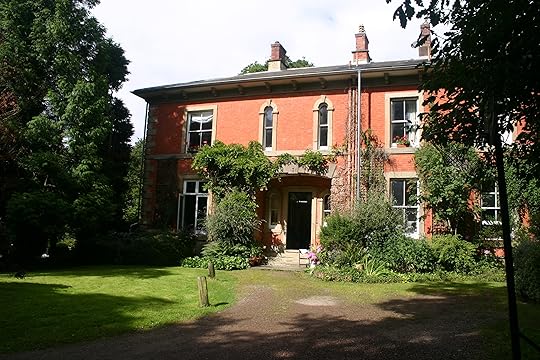

So Banville's narrator intimates that what is to follow, the novel, is an imaginary work, an illusory fiction, "a dream of Birchwood, woven out of bits and scraps..."

The fiction is what he communicates when the past is truly incommunicable.

description
Source: Birchwood Community

"Sleight of Hand and Dark Laughter"

Banville bookends his novel with quotes, of sorts, from Descartes (whose most famous maxim is reversed - "I am, therefore I think") and Wittgenstein ("Whereof one cannot speak, thereof one must be silent."). (2) Paradoxically, Gabriel writes of what he does not know or recall, rather than remain silent. He must imagine, invent or fabricate the details of his life, in order to establish or prove his own existence.

The first section of the novel starts as a rural creation in the style of Thomas Hardy:

"Violets and cowshit, my life has been ever thus."

By the second and third of the three sections (when Gabriel is embraced by the circus group, then returns home to his "broken kingdom"), its style is more of a fabulation that resembles the dark humour of "Tristram Shandy" ("we played with exaggeration as a means of keeping reality at bay"), the absurdity of "Don Quixote" (at one point, Gabriel describes himself as a "crazed filthy creature perched on a starved nag"), the bawdiness of Rabelais, a Dickensian dispute over an inheritance, and the mythical play-acting and mimicry of John Barth (without the maximalist folly).

There is a missing twin sister (supposedly stolen, if not merely lost), an undisclosed twin brother, an incestuous relationship between Gabriel's father and his aunt (his father's sister), a grandmother who dies by spontaneous combustion, a farm girl with "a furry warm haven", and twin sisters with the Nabokovian names Ada and Ida. In Gabriel's words, it's all a "fabulous tale", "always mockery, never contempt"), and a "perfect delayed-action joke":

"I thought that at last I had discovered a form which would contain and order all my losses. I was wrong...

"It may not have been like that, any of it. I invent, necessarily."

"There is no form, no order, only echoes and coincidences, sleight of hand, dark laughter. I accept it..."


As readers, we, too, can accept it. Which I do gladly and gratefully.


FOOTNOTES:

(1) The Lawless family is one of the families battling for ownership of Birchwood.

(2) See the metaphysical poetry below.


METAPHYSICAL POETRY

Contra Descartes and Wittgenstein

Whereof I cannot be silent,
I must necessarily invent.
If I think that I am a being,
Then I have invented my existence.


SOUNDTRACK:
Profile Image for D.
526 reviews84 followers
June 27, 2020
A great story set in early 19th century Ireland. Well written. Apparently this is the author’s first novel. I’m looking forward to read more of his works.
Profile Image for Christin.
195 reviews10 followers
February 9, 2012
"Violets and cowshit, my life has ever been thus."


I just finished John Banville’s Birchwood , which tells the family saga of the title’s Big House and the inter-marriages/feuding between the Lawlesses and the Godkins. Our protagonist, Gabriel Godkin, has returned to the crumbling family manse and seems fixated on the past which he claims to remember with crystalline clarity and which has more resonance for him than the nebulous, unmentioned present. His memories of his grandmother depict her as a(n albeit fertile) version of Miss Havisham or Mrs. Bates, endeavoring to emotionally manipulate her children and control the household. His father is the distant young heir, and his mother, who goes mad, appears in fleeting images, as if she were no more substantial than “vapour.”

He witnesses his parents having sex in the wood, and the dark and mysterious landscape metonymically represents their act. His frail mother is subsequently embodied by damaged blue butterflies and bruised primroses. Young Gabriel even fantasizes about destroying the butterflies, even though he does not. These images foreshadow his problematic relationships with women and his fantasy of a sweet twin sister (instead of a wicked twin brother). Femininity is an appealing mystery but also fundamentally a deformity, a weakness, as he describes the first vagina he ever saw of young love, Rosie, as a “wound”—the same way he later describes the genitals of a local farm girl he encounters, Mag. He only remembers Rosie bodily and insists, showing his misogyny and egocentrism: “Try as I will, I cannot see her face. Her other parts, or some of them, I vividly recall, naturally….Our affair then was founded on mutual astonishment at the intricacy of things, my brain, her cunt, things like that."

When Gabriel flees his family and joins the circus, women are the repositories of the trauma and grief the nation experiences as a result of the Potato Blight, specifically the aptly named Sibyl, one of the circus performers. Another female performer, Ida, one of the novel’s many sets of twins, is raped and beaten to death by British soldiers. The baby daughter of a circus couple disappears after the caravan is besieged by peelers who want to drive the circus out of town. Gabriel narrowly escapes after the clown saves him and is fatally wounded, only to wander starving and astray through the countryside like Lear or Sweeney. When he reunites with the circus, the fat lady Angel, who has cooked for all the performers, dies too in the skirmishes with the Lawlesses, Cotter the squatter, who has previously maimed and eventually killed the family patriarch, Granda Godkin, by beating him in the head with a pheasant; and the Molly Maguires over the Birchwood estate.
His mother, too, most of all, is presented as the walking wounded, always fragile, at the mercy of the whims and entirely subject to the approval or rages of her tempestuous spouse and irate mother-in-law, undone by the deterioration of the house, the selling of the estate, the family’s penury in the face of the Fenian rebellions, and as we discover at the novel’s end her shameful secret that she claimed Gabriel as her own child, despite the fact that he was the product of her husband’s incestuous relationship with his sister, a secret that drives her to send that sister-in-law Martha to her death in a burning building in search of her Gabriel’s cousin/evil twin, Michael, and that causes Granny Godkin to spontaneously combust.

The revelation that Michael is Gabriel’s twin and not his cousin is anticipated by Gabriel’s unreliability as a narrator. As he narrates, he frequently claims paradoxically to remember the past perfectly but not to have understood various fraught family encounters at the time they occurred, to have been in denial regarding his relation to Michael, to have invented the quest for a missing female twin to avoid the horror of the truth. The past is both pristine yet “incommunicable.” Even at the novel’s conclusion, when Gabriel is alone in the shell of Birchwood House, he disavows the entire story, “It may not be like that, any of it. I invent, necessarily….Intimations abound, but they are felt only, and words fail to transfix them.” Gabriel argues for the failure of language in the face of a history of both personal and national horror. There are no words for the utter abjection of the Hunger, or for his own individual hunger for love and acceptance that is never sufficiently sated.

Linda Hutcheon claims in The Poetics of Postmodernism , in true Derridean fashion, that there is never a single capital-T Truth, but multiple truths, based on the individual perceptions and needs of a narrator—verisimilitude and multifocal perspectives, rather than so-called “authenticity.” Gabriel, named after God’s own storyteller, the Archangel of the Annunciation, narrates, but the truth, like his memories of his mother, is the stuff of “vapour.” Unlike his seraphimic namesake, his words are not a performative utterance—they are not the Word—they do not become flesh; even though they do so for the reader, for Gabriel, they are fundamentally unable reconstitute the numerous material bodies of friends and family who have fallen in the wake of his lifetime. They cannot bear the weight of his monumental losses nor manage to contain the atrocities he has witnessed and endured.

I think the novel provides an interesting counterpoint to other pomo novels that rely on unreliable narrators: The Blind Assassin, The French Lieutenant's Woman, The Moor's Last Sigh, Atonement, and even my most recent read, The Gathering .
This entire review has been hidden because of spoilers.
Profile Image for Coos Burton.
913 reviews1,571 followers
February 28, 2018
Antes que nada, quisiera agradecerte a la editorial Penguin Random House por el ejemplar.

-

Fuera de mis recuerdos, este silencio y esta armonía, este brillo que encuentro de nuevo en ese segundo mundo silencioso existe, de manera independiente, regido por leyes desconocidas, en las profundidades de los espejos.

3,5

Lo más destacable a mi parecer es la prosa de Banville. Te hechiza, es una pluma casi tan poética como la de Bradbury. De hecho, a partir de la mitad de esta historia se empieza a sentir una vibra muy "La feria de las tinieblas". Y no es el único aspecto que comparte con el autor, sino también descripciones que te sumergen en una inexplicable dualidad nostálgica e inquietante, donde todo se ve desde un velo gris y gastado, entre grietas y recuerdos.

La historia es un constante flashback de la vida del protagonista que ayuda a generar un matiz melancólico. A pesar de estar bellamente escrito y conservar un estilo bastante gótico, creo que a la historia le falta un buen empuje para hacerla más fluida. Estar retrotrayéndote constantemente es interesante para sostener algunos eventos futuros, pero si esos recuerdos pecan de ser un mero aditivo para generar atmósfera llega un momento en el que ya se torna monótono y cansino. No estoy segura de querer saber cada detalle del protagonista, a no ser que esos detalles le aporten algo más que un plus estético a la novela.

No sé si sería un libro que recomendaría a todo el mundo. Me gustó, y me alegro de haberla leído. Pero tampoco pasó de ser una lectura entretenida, esperaba otra cosa. Aun así, seguiré intentando con el autor. Su pluma me cautivó, así que definitivamente voy a ir por más.
Profile Image for Eva.
Author 1 book
October 3, 2011
Birchwood by John Banville is a lovely book that gets off to a ponderous, pretentious start. First line? “I am, therefore I think.” The second paragraph starts with “The name is Godkin, Gabriel.” The book came out in 1973 when Banville was under twenty so I’ll forgive him such pretensions, but the first few chapters are overwrought reminiscences that foreshadow all the events of the story set in Ireland. The people he describes as mad are not very mad by literary standards, but the story builds to a grimly devastating ending. The inclusion of spontaneous combustion dates the tale, since this was a popular topic back in the early 1970s. The first section drags, populated as it is with stereotypes from fading aristocracy, but the story takes off in Part II, “Air and Angels”, is alive with interesting characters and a circus. Irish politics and famine transport this from the expected runaway tale into something darker. The end brings us tidily back to the beginning.

Gorgeous language fills the book. Listen to the lovely rhythms of this sentence from page 106 “His splendid scowl never faltered though the whirling rings got tangled on his wrists and the Indian clubs cracked together like skulls, and his hot eyes only burned more fiercely the more hopelessly his act went askew.”

I recommend this book if you are in the mood for a literary read. Be patient with the beginning and the rest will reward you.
Profile Image for Caroline.
113 reviews
January 8, 2009
Birchwood, John Banville. Extraoridnary writer. His language and talent is wonderful. The journey of Gabriel Godkin from his boyhood home, in flight, through the circus of the area, during the potato famine, back to his childhood home and the revelations of his parentage, father, mother sister of his father, inheritance struggles with his cousin, read brother Michael, and all the deaths both of the tenants of the area and the dreams of everyone is a sad and awesome tale. I can’t say I loved it but I can say it is one of the best books.

He is the author of The Sea, a Very Very good book.

Profile Image for Joe Shoenfeld.
319 reviews
February 4, 2018
Loved it. Felt like a long rich broad novel though only 175 pages long. What began as a book centered on a place ends as a book as a journey. And somehow historical and superhistorical/supernatural at the same time. Dreamlike.
Profile Image for Rimsha Hasan.
4 reviews2 followers
June 8, 2017
"Listen, listen, if I know my world, which is doubtful, but if I do, I know it is chaotic, mean and vicious, with laws cast in the wrong moulds, a fair conception gone awry, in short an awful place, and yet, and yet a place capable of glory in those rare moments when a little light breaks forth, and something is not explained, not forgiven, but merely illuminated."


An Irish Novel combining both Gothic and Romantic elements, 'BIrchwood' by John Banville tells the tale of the journey of Gabriel Godkin from innocence to experience. After watching his family estate crumble and his family fall apart, he runs away in search of a long lost sister whom he has no clue about except a very old photograph. He joins a travelling circus thinking that they may know about Prospero, a mysterious figure whom he believes holds the answer to all his questions. The novel becomes fast paced as the great Potato Blight strikes the countryside and Ireland collapses into ruination.

What is remarkable about the novel is not so much the story but the style of expression. 
Profile Image for Hamish.
545 reviews235 followers
May 29, 2017
Reads like a Southern Gothic novel, only set in Ireland; there's incest and decaying gentry and foreboding mansions and shotguns. The first half, set in Birchwood, has a similar tone and feel to Banville's later work and has much of the same magic that those novels have. The second half, when Gabriel joins the circus, borders on self-parody and reminds me more than a little of Nick Cave's first novel, And the Ass Saw the Angel (or his song The Carny). The ending is particularly convoluted. The prose is strong and is immediately recognizable as Banville's, but doesn't quite pop the way his later work would. A promising but flawed work that's more interesting as a dry run for his later, better novels.
Profile Image for Jennifer  Sciolino-Moore.
252 reviews7 followers
March 15, 2016
Is it possible to appreciate someone's writing and not care at all for their novel? That's the case here, with Banville and Birchwood and me. Banville is clearly talented and his prose is striking, but I just could not get into this novel. It is purposefully cloudy and obtuse and the first half of it had me wanting to put it down. The second half drew my attention, but the conclusion was anything but enlightening.

I just plain didn't like it.
Profile Image for J..
225 reviews12 followers
February 14, 2013
Banville called Birchwood his ‘Irish novel’. Set in the time of the famine Gabriel Godkin is the young heir to the Godkin family estate. The house is falling to pieces around him reflecting the unraveling lives of his family. Gabriel runs away to join a traveling circus and look for his lost twin sister. Like most of Banville’s characters the protagonist is on a quest for meaning. This novella is very dark and gothic. I enjoyed the character of Granny Godkin. Banville is Ireland's greatest living author.

‘In their architecture and in their style, his books are like baroque cathedrals, filled with elaborate passages and sometimes overwhelming to the casual tourist.’ -Paris Review.
Profile Image for Jim.
3,097 reviews155 followers
December 18, 2017
beautiful prose, as always, from this short, odd, visceral, and sensual novel... Banville is a master at the where-did-that-come-from phrasing and perfectly apt word... a bit of an oddball tale, a threadbare coming-of-age travel... as usual, family and its unrepentant issues, is center stage and wonderfully done... funny, hard, fumbling eroticism, anger, madness... an early example of brilliance-to-come...
Profile Image for J R.
63 reviews1 follower
February 4, 2016
Slim novel. Thrilling read. Plot was enthralling, but the prose won the day.
Profile Image for Marg Casey.
43 reviews12 followers
January 12, 2023
a very knowing and very political novel about the rotten and rotting Irish gentry. Banville's first novel and one of his most accessible ones (well, accessible by Banville standards)
Profile Image for George.
3,258 reviews
March 28, 2025
3.5 stars. A short, well written, odd novel about protagonist, Gabriel Godwin, a young boy who is to inherit Birchwood, a rundown manor house. It has turned into a baroque madhouse for its ruined inhabitants. Gabriel’s aunt Martha and her son Michael come to stay after a long absence. Martha is to be Gabriel’s private teacher.
In the second half of the novel Gabriel joins a traveling circus, aiming to find his lost twin sister.

A novel about the end of a boy’s innocence and a wealthy family’s decline.

This book was first published in 1973. This is John Banville’s second novel, his first published novel was ‘Nightspawn’, published in 1971.
Profile Image for Trisha.
805 reviews69 followers
July 1, 2015
John Banville is one of my favorite contemporary authors, and his books are proof that there’s more to a really good book than simply a compelling plot. This one is set in 19th century Ireland at a time when the potato famine was raging and the Molly Malones were destroying property and terrifying the landed gentry.

It’s narrated by its protagonist (Gabriel Godkin) who has returned to the broken down country estate he has inherited after having left it some years earlier to escape the chaos of living in a family that - like the estate itself - was slowly disintegrating. The story unravels in two parts, as Gabriel tells his story by trying to recapture his memories of what happened before and after he ran away. An unreliable narrator, he admits at the outset that “we imagine that we remember things as they were, while in fact all we carry into the future are fragments which reconstruct a wholly illusory past.” And as he moves from memory to memory to piece together his past he tells us that he is not entirely sure his memories are all that accurate. Nevertheless, we learn that his childhood was a chaotic one, surrounded by relatives who were emotionally unstable (if not downright crazy.) He’s obsessed with the idea that he has a missing sister, and he’s driven by a sense of mystery about his birth which took place on the same day and in the same house as his cousin’s. After witnessing a particularly horrifying incident between his mother and his aunt, Gabriel runs away and joins a travelling band of questionable circus performers who are even more dysfunctional than the family he left behind and who are constantly being pursued by the police.

While the plot is interesting in its own right, it’s Banville’s writing that makes this a book a pleasure to read slowly and carefully in order to appreciate his way with words and the meanings they convey. Here’s an example: “She laughed softly under her breath, and smiled hazily, mysteriously past us, clawing a napkin asunder under the table, the damp torn pieces falling to the floor like shreds of her own anguish.” Sentences like that beg to be read over again just to savor them. It’s why it’s definitely not a good idea to try reading John Banville’s books in a hurry.
Profile Image for Andrew.
Author 8 books136 followers
October 10, 2009
This book has very clear echoes of Proust, both in the writing style and in the sense of nostalgia that pervades the story of aristocratic decline. The references are clear and deliberate - in the very first chapter, Banville's narrator refers to his fragments of memory as "madeleines" and talks of his "search for time misplaced."

None of this boded very well for the novel - I had Proust on my night-table for ages, but every time I read it I fell asleep so quickly that I seemed to go backwards as much as forwards. And aristocratic decline strikes me as generally a good thing, so I often struggle to feel much sympathy for the lords and ladies forced to survive in only two houses instead of five.

Birchwood, though, I thoroughly enjoyed. While the writing style is reminiscent of Proust in its dreamy beauty, it clips along at a much faster pace, as does the sometimes bizarre plot of childhood resentments, exploding grandmothers, running off to join the circus, searching for a long-lost sister, etc. Also there's a detachment from the destruction that comes to Birchwood, a sense that it's inevitable and even deserved, a strong context of the social unrest in Ireland at the time.

The writing was brilliant from the first page to the last, and made me want to read a lot more of Banville's work. Here's the first paragraph:

"I am, therefore I think. That seems inescapable. In this lawless house I spend the nights poring over my memories, fingering them, like an impotent casanova his old love letters, sniffing the dusty scent of violets. Some of these memories are in a language which I do not understand, the ones that could be headed, the beginning of the old life. They tell the story which I intend to copy here, all of it, if not its meaning, the story of the fall and rise of Birchwood, and of the part Sabatier and I played in the last battle."
3 reviews
October 29, 2013
John Banville one of the best novels writer and I think I could not read his novels in a hurry, and he wrote this novel in his twenties from 1973 with his poetic and careful chosen phrases . Firstly, I was think about "what does the title mean"; birch-wood or (birch tree) means slender fast growing tree that has thin bark and bears catkins.He has put that name on an estate in Ireland.

Gabriel Godkin in the story is a man who returned to his disintegrating family and the reality of his family and his country and within enlarge flash back, and he is striving with his cold father and crazy mother and grandmother. All moving side to side on the edges of an extreme foolishness and shows that Gabriel acknowledges runs in his blood. In the main time, the famine potato led Irish people suffered and specially for gentry lose their high positions in the society, Gbriel find his way in traveling and savouring circus.The author make Gabriel exploring the idea of family, that with whom we are connected by blood and for ever or we born into this family. The author is a professional at developing the personalities and searching for their interior landscapes as well as the exterior ones. I released , that banville provide to the reader a series of small enjoyments while he giving details and appearing interesting people and places.
Profile Image for Paul O'Leary.
190 reviews27 followers
January 9, 2017
This book entranced me, I must admit. Banville, master of the worded atmosphere, is an author with that ability, and this early work creates a haunting mood that is almost cinematic in its literary pictorial totality. Mostly a triumph of form over function, Banville's prowess with language is enviable. His offered world envelopes its reader through lush and skilled paragraphs, if his shaky plot of the decline of an Irish family in the.nineteenth century fails to mesmerize. Banville is an imaginative creator, though a bit of an irascible personage according to legend. Reading Birchwood reminded me a little of Midnight's Children, Rushdie's awesome novel written years after Birchwood's publication. Unfortunately, the two authors have fell out over a slighting remark allegedly made by Banville, though I think the former might have drawn something useful from the latter.
My only negative reference to this work emerged rather tangentially from it. Banville uses the old "unreliable narrator" ploy against a fairly surreal story background. This is not the first example of such tactics I've encountered in my travels, yet this time it prompted me to ponder how unartful a dodge this choice can be. As most dodges, no matter how elegantly executed, are....
Profile Image for Shawn.
708 reviews18 followers
April 20, 2015
No one writes more beautifully than Banville, who is a master of the elegiac prose poem. If this sample hits home for you, you'll love this book:
“We climbed the steps, into the hall, and Mama, pressing a hand to her forehead, dropped a bunch of primroses on a chair and swept away to her room. The cluster of bruised flowers came slowly asunder, one fell, another, and then half of them tumbled in a flurry to the carpet, and behind me the tall clock creaked and clicked, and struck a sonorous bronze chord. Listen, listen, if I know my world, which is doubtful, but if I do, I know it is chaotic, mean and vicious, with laws cast in the wrong moulds, a fair conception gone awry, in short an awful place, and yet, and yet a place capable of glory in those rare moments when a little light breaks forth, and something is not explained, not forgiven, but merely illuminated.”

The only reason I didn't give it five stars was that I found some elements of the story just a bit too bizarre and too tidily wrapped up.
Profile Image for Konstantin R..
775 reviews22 followers
August 3, 2016
[rating = B]
One of John Banville's earlier works, portions of it can be recognized in his latter works. This story is about a family and its fall. Gabriel Godkin (the name itself somewhat portent) is the last heir and goes about telling of his childhood fraught with death and deception. He learns a secret; he leaves to discover its true meaning. And then when he returns nothing is the same. Banville has written here a kind of Irish-Gothic book in the vein of Faulkner, though the style is quite different. This younger Banville does not yet have the excess of archaic words nor the multitude of descriptive images. He , it seems, instead to rely on a more story-telling technique to illustrate this tale. But that is not to say that it is vapid and prosaic; they're are certainly moments when a line hits with beauty and power. The character's are quirky and delightful; Banville has written something special that is at once allusive and reminiscent.
Author 32 books4 followers
December 8, 2012
Birchwood is Banville at his best. It is a book about a man who comes home after being away for many years. The estate is run down and the place is filled with eccentric souls in strange situations. His grandmother is insane, his mother unhappy, and his father always treated him badly. The story is interesting, humorous, and once again, told in Banville's inimitable eloquent style. The description of the house and characters is incredible. The plot is well thought out and credible. In a way, Birchwood is a reminder of all families, I would think. Don't we all have a nutcase or two running around at family reunions? And, of course, there is the uncle locked in the cellar. Birchwood is an enjoyable read. I read it again after I'd completed reading it. I highly recommend it. (Of course, I like Banville. I wish I could write like him.)
Profile Image for Tori.
1,122 reviews104 followers
October 22, 2010
It took me a long time to get past the first few pages, and I skimmed bits near the end. So I feel like I haven't completely read it, really. But I really enjoyed what I got. There's a focus on the dreamy unreality of memory and time which appeals to me. And the remembering-a-ruined-estate which to me evokes Rebecca. And it was kind of feminist-y, what with the narrator's preoccupation with vaginas and sympathy for women and love toward female figures when the males were all kind of violent and ucky. The violent uckiness was kind of what I skimmed, though. I liked the ending and the overall feel of it. This is probably very incoherent. Good times.
Profile Image for Steve Petherbridge.
101 reviews6 followers
June 8, 2014
Written by the now eminent John Banville in 1973.

Set around the 1840's, referencing the Great Famine and the British Occupation, Banville's novel centre's around the decline of a family in the "big house" caused by the madness, in-fighting and ineptitude of it's inhabitants.

As has now become his trademark, the literature is well crafted prose with John Banville displaying his awesome talent for creating interestingly and richly descriptive off-beat characters, no matter what the genre. I look forward to exploring more of the work of Ireland's probably most revered living author of modern English literature.
Profile Image for Tracey.
37 reviews3 followers
November 30, 2014
Before reading anything by Edna O'Brien or John Banville, I kept hearing about them as huge contributors to Irish writing. Last year, I read O'Brien's 'House of Splendid Isolation' and loved it - for its, well, hard-to-explain Irishness. Banville's 'Birchwood' also has elements of that same writing, but includes Gothic characters and Irish history - it is so gorgeously written, I spent time re-reading sentences and paragraphs to glean as much as I possibly could out of them. I can't wait to read 'The Sea'.
922 reviews10 followers
July 23, 2007
at the risk of being reductive, the irish not only possess the gift of gab and hospitality, but also the ability to place poetic language against big ideas, great pain and unbridled passion. banville's a beaut. his powerful short novel not only thinks deeply about time, loss, family and various associated unmentionables, but even incorporates the potato famine without melodrama.
163 reviews
November 16, 2011
Written in his succulent prose, this is one of Banville's earliest works (1973) and my favourite of 3 read to date. It is a harsh, bleak tale of land and inheritance set against the horrors of Ireland before and during the Great Hunger.

Drenched in madness, violence and carnality it is a thoroughly rewarding read.
Profile Image for Rob.
566 reviews11 followers
April 23, 2015
With prose not as fine as some of his later works (but still quite excellent), this early Banville presents a world and cast of characters of Gormenghast-like quality. Beyond the picaresque facade, I'll have to ruminate for a while to see if any lessons on loyalty and the dissolution of a family can be extracted.
2,310 reviews22 followers
April 4, 2014
This is a coming of age story written by Banville early in his publishing career when he was still in his twenties. It is a sad dark tale of a boy trying to establish a relevant and meaningful story about his mysterious family.

After years away, Gabriel Godkin has just returned to the dilapidated estate he has inherited and tries to remember and recount memories from his youth. Growing up, he recalls being a sensitive boy trying to cope with a complicated family that included an aloof and drunken father, an overbearing long suffering mother and a mad grandmother who tried to manipulate and rule over them all. Their home had at one time been a grand house called Birchwood, but it was beginning to crumble as his father ignored the necessary repairs and mismanaged the lands that comprised the estate. Many of the tenant farmers at that time were restless and angry, plotting quietly to retrieve what they felt they had lost at some forgotten time in the past. Poaching was a problem as well, and that led to rifle shots being fired intermittently in the woods. Either the poachers were killing the game, or his father was trying to kill the poachers.

The estate had a confusing history, exchanging hands between two families, the Godkins and the Lawlesses who intermarried and feuded between themselves so that the estate was constantly changing hands among its disgruntled owners. And then unexpectedly, with this family already teetering on the edge, Gabriel’s Aunt Martha and her strange and remote son Michael came to live with the family. As they moved in, they brought more secrets and chaos to this home that was already hanging on the brink of collapse. Despite their different personalities, the two boys develop a strange and reluctant intimacy, but they never became friends and stayed distant and wary of each other.

Gabriel was determined to escape this mad household which day by day threated to topple over into insanity. So when the opportunity came, he ran away to join a travelling circus. He had also convinced himself that he had somehow lost his sister and was desperate to find her. He took on a role in a travelling caravan and began to experience a new sense of freedom as an adopted member of this tag-a-long loosely associated group. But as time went on, he soon discovered that even the members of his new family were not always who they said they were or even who they seemed to be. As the merry band roamed the countryside playing in small towns and villages they were continually harassed and sometimes beaten by marauding soldiers.

And then the great famine gripped the country. The circus players roamed the countryside eating wild berries, stewed crab apples and the stray rabbit. As they pushed their way through the barren country side they were haunted by rumours of starving children reduced to eating mouthfuls of clay, grass and the bark of trees. They witnessed mass burials where there was not enough wood for coffins and bodies were unceremoniously dropped into the ground. When the caravans were attacked once more by soldiers, Gabriel ran off, setting out on his own through the countryside. Wandering blindly he experienced the pangs of biting hunger and thought he might be descending into madness, a tendency he realized was already flowing in his blood because of his family history.

Gabriel’s travels takes him full circle back to his former home where starving, battered and bruised, he finds the house he has now inherited in bleak circumstances. Some of his relatives have met brutal deaths and his father lies dead in the summerhouse where his grandmother died a mysterious death years ago. He meets up with Michael once more and during their reunion Gabriel experiences more trauma before Michael walks off and disappears. Gabriel then moves into the old house and begins to write his account of the rise and fall of his family’s estate. Although filled with unsettling memories and despair, he tries to reconstruct his past and find his way back to whatever truths he can discover. He wants to reconstruct and write the story of his childhood and he also wants to understand how the past has led him to his present state of isolation and confusion. He admits he will have great difficulty recalling his past honestly.

Although not everyone will enjoy the plot, the story does move along at a good pace and carries you easily to the conclusion. But the real reason to read this book (and you should read it), is the wonderful writing. Banville’s prose is packed with images and rhythm. He has an ability to put so much in one sentence that you become unaware of its weight and complexity. Some sentences and paragraphs are so beautiful they deserve to be reread slowly and out loud. This author has always believed that the prose is more important than the plot, the characters or the story and he tries to make the words, sentences and paragraphs the focus of his writing. In this he has succeeded.

Yes, this is a sad dark story of a warped and crazy family during the historical realities of 1860s Ireland, but it is well worth the time to appreciate the author’s perfectly crafted style and his beautiful, beautiful language.

A literary novel that deserves your attention.


This entire review has been hidden because of spoilers.
Profile Image for Gemma entre lecturas.
811 reviews58 followers
February 8, 2023
«Los fragmentos que permanecen de los primeros años los guardo con un celo que se vuelven más frenéticos conforme me hago mayor».
 
John Banville es el nombre real de Benjamin Black, un escritor afamado que dijo que cada mañana se presentaba ante el folio blanco con pánico. Como escritor de novela negra tiene un estilo depurado y cuidado que usa la trama para hablar de debilidades humanas, maldades y prejuicios dentro de la Historia, con una ironía sutil que acompaña, por lo general, la atmosfera que crea de acuerdo con la época. Es la primera novela que leo de él con su nombre real y dentro del género de literatura contemporánea de ficción.
 
«El pasado es inconmutable».
 
                La primera parte de la novela, casi la mitad de ella, es una novela gótica. Narra una saga familiar cuya vida gira en torno a una mansión, Birchwood, que se la disputan los Godking y los Lawless. Al decir gótica nos podemos imaginar el estado de la casa y el carácter deprimente no solo del edificio sino también de los que habitan en ella, personajes de tintes grises.
                Gabriel Godking, el protagonista de esta historia, va creciendo y la casa con cada año que él cumple se desmorona perdiendo su esplendor. La atmósfera se tensa con la llegada de la hermana y su hijo, después van relatándose la muerte del abuelo, la venta de las tierras, la ruina de la familia, la muerte de la abuela…
 
«Todas las muertes ocurren escandalosamente a destiempo. La gente no vive los suficiente. Llegan y se van, efímeros, sombras que menguan hacia un mediodía vacío y azul».
 
                Sí, la primera parte de la obra tiene un carácter bastante melancólico. Pero la novela da un giro que me deja sorprendida. Gabriel decide unirse a un circo y salir en busca de su hermana. Para mí es un giro insólito. Cambia la novela y los personajes, estos tienen diferentes matices, aunque el mismo poso amargo. Lo más novedoso es que el autor mete una idea, en la caravana hay algo malévolo, y me pica la curiosidad. Aunque confieso que no superó mis pequeñas expectativas. Los personajes son interesantes, bien perfilados, pero la trama, no comprendo el hilo, de una saga, da un giro poco creíble y nos presenta una aventura atropellada con regusto histórico que sí me engancho, la hambruna y la patata, pero no el circo.

                Es un maestro del lenguaje, aunque me sorprendió: espada de honor roma, ¿sabéis a qué se refiere?
Displaying 1 - 30 of 82 reviews

Can't find what you're looking for?

Get help and learn more about the design.