"What if they just stopped?What if in a grand, scruffy stab at corporate disobedience, teenagers en masse simply stopped spending their money on the cynical crap that’s relentlessly mainlined to the addictive and deadly cigarettes, the hateful music, the crude and desensitizing videos and movies?What if they stopped buying that $#!%―just to cause trouble?That’s the radical notion behind Like We Care, a biting, clever, and hilarious satire in which two endearingly subversive high school seniors set out to monkey wrench the recording industry, the cigarette industry, the junk food industry―indeed, much of the American money machine. Marrying the internet to corporate America’s own schemes and weapons, they slowly, reluctantly launch a grassroots campaign, with racial, political, and cultural implications, that harnesses the awesome, untapped power of teenagers flush with cash and inflamed by adult hypocrisy."
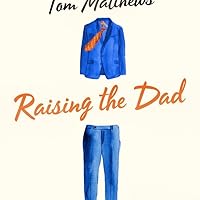
Tom Matthews’ new novel Raising The Dad (coming April 2018) is a moving and brashly funny family saga about a dysfunctional clan whose patriarch returns in a most astounding way imaginable.
States Booklist: In this touching story of a father and son reconnecting in an extremely unconventional way, Matthews provokes tough questions surrounding death and confronts the complicated choice to either end or sustain a loved one’s life. Delivered with humility and humor, a seemingly unbelievable scenario becomes very real and brings a family at the brink of falling apart back together.
Matthews's first novel Like We Care was published in 2004. Novelist Tom Perrotta (The Leftovers, Election) called Like We Care “a fearless, angry, brutally funny poke in the eye of the American music machine and pop culture industry. Tom Matthews’ memorable, highly readable first novel is that rare literary artifact – a satire with teeth.”
Matthews’ began his career as a screenwriter, writing the 1997 film Mad City starring Dustin Hoffman, John Travolta and Alan Alda, and directed by Costa-Gavras. Critic F.X. Feeney wrote of the dark examination of broadcast journalism: “Mad City has intelligence and power… Writer Tom Matthews and director Costa-Gavras have done their homework.”
Matthews also wrote scripts for 20th Century Fox, Walt Disney Pictures, Warner Bros. and New Line Cinema, working with such filmmakers as Steven Soderbergh (Oceans 11, sex, lies and videotape), Steve Tisch (Forrest Gump) and Lynda Obst (Interstellar, Sleepless in Seattle).
As a journalist , feature writer and social commentator, he has been published in newspapers across the country. His freelance writing for Milwaukee Magazine earned him Wisconsin’s highest press honors for long form feature writing in 2013 and 2014.
Matthews lives in Wauwatosa, WI, with his wife Pam. He is a grant writer for the Well Community programs of Aurora Health Care.
Three stars is perhaps a little generous. The idea was fun, but the writing was decidedly mediocre. Older writers should not try to write "authentic" dialogue for today's young people. You're the man now, dog, indeed.
I'll toss it an extra star for making me laugh a couple of times.
Let me just say that I hate advertising. It uses us and exploits our emotions--oftentimes without our even knowing it--just to make a quick buck. Like We Care really fueled this hate-fire. (You know that part in The Perks of Being a Wallflower at the very beginning where that one girl said "Sometimes I think about killing myself when the commercials come on."? That is the epitome of my feelings.)
I'm digressing here. In Like We Care Matthews does a brilliant job combining an oddball cast of characters with smart prose to tell this story of American teens kicking back at corporations who, they realize, are just using them for their money. The irony here is that the other half of the characters, R2Rev, are a teen-targeted entertainment industry who decide to bring light to the aforementioned teens' cause and broadcast it across young America. They are -- this boycott because it is the hot topic of the minute and they can garner attention and ad revenue from these kids who are trying to take a stand against just this.
I'm rambling now. Point is, this is a very political book and it makes me hate marketers and advertisers etc. more than I already do. Like We Care also shines a big light on racism, but at the same time I feel like it's kind of just there, pointed out and mentioned, but not really confronted. It's like in the context of this story racial issues take a backseat to the teens boycotting. This makes sense to me.
I also will note that there is very flippant use of the term 'gay', using it to refer to any behaviors or spoken ideas that could be thought of as empathetic or intelligent. (Remember that this is set in the early 2000's.) Again, this doesn't bother me personally because it's right for the demographic and timeframe of the narrative, but it may bother other readers.
Lastly, and a huge reason that I enjoyed this book, there is talk of The Man, lots of stickin' it to The Man. Heck yes, m'dudes! Rock on!
******Spoiler alert***** Joel overcame his addiction although it was a struggle, and because of this He and his friends went after greedy industries that only cared about their pockets and if they were full. While reading this book I got past the 50th page and I had no clue where exactly it was going but as soon as it mentioned these greedy old rich people I had to have known what was coming next yet I didn't. This Author did great with not letting you know when the corner would turn or what was going to happen next. I also believe that the author did a great job at making the characters of teen adolescents feel very realistic about how actual teens act in reality. For example, as Joel was coming to the realization that all these people want is our money,” Millionaires, every damned one of ‘em. From picking our pockets. If we grew a brain, they’d all be eating outta dumpsters.” (Matthews 85) Or as the example continues, “ This is what I didn't spend at the Happy Snack while my mouth was fucked up. This is my money now. Mine, not that fucking towelhead’s.” (Matthews 89) When I dubbed this book as a young adult genre. I thought that it would be more of an adult trying to depict what a teenager acts like and being completely off. But it is quite the inverse in that it's almost like a teenager wrote this book from his point of view. The realistic situations that these kids went through seemed almost as if it came out of a teenager's autobiography. If you enjoy some realism and young adult hypocrisy you should try this book out, I think that Joel could surprise you.
No less than a manifesto and instruction manual for teenagers to use their numbers and newly inflamed passion to wreak real havoc on the politicians and corporate giants that exploit them for cash.
The fact that I wrote this book may have me a bit biased. But just a bit.
Reviewed by Mark Frye, author and reviewer for TeensReadToo.com
A small group of teens, a school teacher, and a TV producer shake the foundations of the corporate world in LIKE WE CARE, the debut novel from screenwriter Tom Matthews. What begins as a small protest between friends and hangers-on snowballs into a cross-country, grass roots protest movement with more at stake than mere dollars. With witty dialogue and perfect comedic timing, LIKE WE CARE is that rare adult novel that is not only suitable for teens but is highly recommended.
Joel and Todd were best friends growing up but grew apart with the onset of adolescence -- and Joel's ascendance to the role of alpha-male jock on campus. But after a severe injury in a baseball game, they renew their friendship. As a result, Todd helps Joel take a closer look at his inane lifestyle and his sheep-like followers, particularly concerning their smoking and spending habits. As Joel fully understands how badly the local convenience store - and the advertising world in general - is manipulating him and his peers for their money, he uses his charisma to organize a boycott. Eventually, the protest garners the attention of a TV executive desperate for stories of substance for R2Rev, the music video channel in which she works. Joel's charisma and Todd's message soon resonates across America, influencing impromptu boycotts and small-town elections. But the movement begins to unravel on all fronts as they grow in fame and success and their opponents begin to see what's at stake. Yet Todd refuses to surrender and has a few tricks up his sleeve that provides for a sweet victory when defeat looks certain.
Although satirical in many facets, LIKE WE CARE rings true on all fronts: the high school cliques, the fan-bashing rap stars, the exploitative TV executives, and the price-gouging store owners. This is laugh-out-loud funny but also inspiring.
I finished reading this book a little while ago. I think that my favorite par was how the story lines all came together in the end. It really gives the reader satisfaction for knowing that all the hard work of remembering what is going on in each characters life payed off in the end. I think that the books biggest downfall is all the swearing. It's true that teenagers and some adults swear a lot, but not as much as Mr. Matthews depicted. By toning his choice of his character's words he could have appealed to a wider variety of readers. I liked Matthews idea of the movement not just being about boycotting stores but politics, and more adult like topics. It really makes the characters seem like they've matured over the course of the book. Overall I think that Matthews was very descriptive in his writing , but I don't think all the swear words were necessary. I would only recommend this book to a friend who was serious about reading and wanted the challenge of multiple story lines.
Okay, when I first started this book, I hated it. The story is about a bunch of rich and popular suburban kids rebelling against normal teenage crapola. It seemed to say 'And look you can make a difference too!'. This annoyed me. The only reason they were actually able to make some sort of difference was because the guy who started it (who was actually given the idea by a 'lesser than') had tons of brainless cronies. Honestly, I only stuck around for Frank Kolak, the teacher. But then I realised that it really wasn't about that at all. It was about the way the big guy always screws over the little guy and takes the credit. It's about how fucked up everything in the system is and how incredibly shitty teenagers are. It's about how you can't win no matter what you try to do about it, but that we still need to pay attention. I think I may be thinking too hard about it, but even so, it's got some pretty good lines, so I'd say its worth it.
Just finished this book, was not as good as expected, but still worth reading, essentially is the story of youth culture taking on big business, rather than be controlled and directed, let's boycott companies and make them understand that the (ethernal) youth of today are not pushovers.
The book takes a good 100 pages before it gets going, but then it starts to come alive, while the plot is a bit paint by numbers in that you can see what is coming and and where, it is a good read (apologies for pun) and worth investing some hours in...
With the aid of a good editor it could have been better and more cutting, but for a bit of general escapism and a laugh at (and with) teen and kidult culture as well as the 60s believers it is a welcome relief from the daily drudge...
Well, honestly I pick up the book because of the cover. I thought it was really long. The story line is really good. It's about kids who stop buying stuff from the store in their small town. To get back at the store owner for treating them all crumby. Then it turns out to have a bigger meaning once it gets on T.V. Kids all around the world realize that major companies and media are brainwashing them. They get pissed. Their slogan is "were not buying this shit!" I'm not going to criticize the author. Although I will say it's a lengthy and very informative book. The idea behind it is great.
Annie works for rock cable music station, she finds Kyle believes he and his protest(friends) would played well on Tv station that they revelled from the past. So as to I thought this book was really good because they wanted to make a big difference for their life and others. They were organized and believe they would have plenty of economic and political. I recommend this book to someone who wants to make a big difference for someone.
Interesting premise that teens CAN think rationally and find a way to stop -- or at least slow doen the manipulation from business (aka music) that fills their life.
Once past the language and the references, the plot was standard but the premise held my attention.
This is one of the few books I'd rate so highly that also uses the f-word in every chapter. The main character and his friend, with the help of a disgruntled minor media director, expose and take down a major media corporation, in retaliation for its blatant exploitation of their demographic.
I was instrumental in getting this book published. I helped edit it and am credited in the Acknowledgements. I can't be impartial, but this book will always have a place in my heart.
The saying has always been “When life gives you lemons, you learn how to make lemonade”. Tom Matthews’ fictional novel Like We Care says “why settle for lemonade when there is an orange tree?” . In the setting of…. we meet hotheaded passionate Joel Kasten and calm calculating Todd Noland who, while could not be any more different, work together to boycott not only the music industry but the cigarette and junk food industries as well with the help of an executive for a music video network and their social studies teacher.
In the novel, after a baseball incident involving Joel having his jaw broken, Joel finds himself and a group of friends being treated like garbage from the manager of a convenience store. This leads to the boycott against the main points of what essentially makes an American : junk food, cigarettes, and lewd/crude music/music videos. Both Joel and Todd, though teens, are both sharp,witty, and rebellious that they take it in their hands to show their generation that the mainstream trends are not all that it’s cracked up to be. They also show adults that teens are capable of thinking of ways to go against the current even if such teens may not show it in their test scores.
My opinion of this novel was that in the beginning, it was boring. While the first chapter was interesting (it was about how Joel got into the baseball accident requiring his jaw to be wired shut) it soon became a drag to read the following chapters. I took breaks in between to focus on other school activities such as homework from other classes and came back to the book periodically. The first few chapters are definitely a drag but necessary for the plot to make sense and the chapters introduce all the characters; once you get over that, the rest of the book is actually very insightful and it connects with me on how the teens ‘stick it to the man’. The novel has some dark themes but the author makes light of those situations and you can definitely tell that this book has some heavy themes but it’s written in a way that those heavy themes are seen as comedy. The audience intended for the novel would be young adults and teenagers since that is what the book is mainly about: the rebellion of the youth.