Jump to ratings and reviews
Rate this book

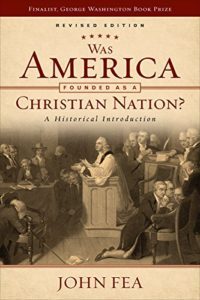
Was America Founded as a Christian Nation? Revised Edition Lib/E

Rate this book
Fea offers an even-handed primer on whether America was founded to be a Christian nation, as many evangelicals assert, or a secular state, as others contend. He approaches the title's question from a historical perspective, helping readers see past the emotional rhetoric of today to the recorded facts of our past. Readers on both sides of the issues will appreciate that this book occupies a middle ground, noting the good points and the less-nuanced arguments of both sides and leading us always back to the primary sources that our shared American history comprises.

Audio CD

First published February 16, 2011

91 people are currently reading
705 people want to read

About the author

John Fea

15 books56 followers
John Fea (PhD, State University of New York at Stony Brook) is associate professor of American history and chair of the history department at Messiah College in Mechanicsburg, Pennsylvania. He is the author of Was America Founded as a Christian Nation? and writes a popular daily blog, The Way of Improvement Leads Home.

Ratings & Reviews

What do you think?
Rate this book

Friends & Following

Create a free account to discover what your friends think of this book!

Community Reviews

5 stars
159 (38%)
4 stars
186 (44%)
3 stars
58 (13%)
2 stars
9 (2%)
1 star
4 (<1%)
Displaying 1 - 30 of 72 reviews
Profile Image for JR Smith.
18 reviews1 follower
February 17, 2012
This book presents a really interesting and balanced look at early American history. The author takes the question about whether America is a Christian nation and parses it out into smaller questions. First, what do you mean by America -- are you referring to the Puritan colonial period, the Revolutionary War period, the early national period? "America" meant something different in all three of those times, and the answer to the book's title question would change accordingly. And even more importantly, what do you mean by "Christian"? Is that a Patrick Henry thing that today's evangelicals would recognize as being really Christ-centered, or a Jeffersonian Enlightened moralism that today's evangelical Christians would reject?

My favorite part of the book is part 3, where the author goes founder by founder through the biggies -- Washington, Adams, Jefferson, etc. -- as well as some of the minor players like Samuel Adams to see where they each stood on the question of whether America was founded to be a Christian nation. Not only did they not all agree with each other, sometimes they didn't even agree with themselves; John Adams changed his opinion on the question pretty dramatically.

A very good book that people ought to read before they go spouting off that America was or was not intended to be a Christian nation. I've recommended this to a lot of people.
Profile Image for George P..
560 reviews63 followers
April 16, 2023
John Fea, Was America Founded as a Christian Nation? A Historical Introduction, rev. ed. (Louisville, KY: Westminster John Knox, 2016).

Few questions in American politics generate as much controversy as the relationship between church and state. On one side are Christian nationalists who contend that the nation was founded on religious principles. On the other side are secularists who argue it was founded on Enlightenment principles. The controversy between them is evident, most obviously, in the seemingly endless First Amendment cases brought before our nation’s courts to determine whether that amendment’s “establishment” and/or “free exercise” clauses have been violated. But behind the evident legal controversy lies the latent historical controversy, in which the same contending parties dispute the facts and significance of the Founding Era.

Was America Founded as a Christian Nation? by John Fea is an excellent introduction to that question and should be read by both Christian nationalists and secularists alike, for it corrects the historical errors both sides commit and draws a balanced portrait of the role religion did (and did not) play in the American Founding.

In the Introduction to the book, Fea—an evangelical historian at Messiah College in Grantham, Pennsylvania—explains why the question the title of his book asks is so controversial, namely, because both sides to the Mo controversy are seeking a “usable past” to buttress their side in contemporary political debates. Historians, he goes on to argue, should avoid such present-mindedness and seek to understand the past on its own, often complex terms.

Fea then unfolds his argument in three parts:

Part One examines the history of the idea of Christian nationalism from the ratification of the Constitution (1789) to the present day. Chapter 1 examines the dominance of evangelical Christianity in America from 1789 to the end of the Civil War. Chapter 2 surveys the different concepts of Christian nationalism at play in post-bellum society until the Scopes Monkey Trial (1925). Chapter 3 continues the story until 1980, focusing especially on how Christian nationalism affected mainline Protestantism, American Catholicism, Cold War religious unity, the Civil Rights Movement, and the emerging Religious Right. Chapter 4 looks closely at that last group, noting the resurgence of conservative, evangelical Christian nationalism since 1980.

Part Two answers a question: “Was the American Revolution a Christian event?” Chapter 5 shows that both Virginia and Massachusetts colonies were explicitly, legally, and institutionally Christian communities with established churches, but that the nature of their establishments varied widely and their actual practice often fell well short of Christian ethical norms (as, for example, the practice of African slavery and ill treatment of the aboriginal populations). Chapter 6 argues that the intellectual underpinnings of and justifications for the American Revolution were based more on secular Enlightenment ideas than biblical principles. Chapter 7 extends this argument by showing how pro-revolution clergy often read those Enlightenment ideas into their preaching of the Bible, rather than deriving their preachments from biblical principles.

Chapters 8, 9, and 10 examine the form of religion that influenced the Declaration of Independence, Articles of Confederation, and Constitution, respectively, and note the controversies over religious freedom that gripped the colonies during these years. The God of the Declaration (“nature’s God”) is ambivalent, capable of being recognized by both Christians and Enlightenment theists alike. (For an excellent study of the common theological ground between these two groups during the Founding, see God of Liberty: A Religious History of the American Revolution by Thomas S. Kidd.) The Articles of Confederation left the establishment or disestablishment of religion in state hands, with Massachusetts retaining its established Congregationalism (until 1833) and Virginia disestablishing its Anglicanism through the yeoman efforts of Thomas Jefferson and James Madison, against the contrary efforts of Christian nationalists such as Patrick Henry. Regarding the Constitution, Fea notes the irony that leading Christian nationalists—such as Patrick Henry, again—were anti-Federalists in the ratification debates precisely because the Constitution did not acknowledge the nation’s Christian heritage. And he concludes by discussing what Jefferson’s “wall of separation” did and did not mean at the time.

Part Three investigates the religious beliefs of George Washington (Chapter 11), John Adams (Chapter 12), Thomas Jefferson (Chapter 13), Benjamin Franklin (Chapter 14), and John Witherspoon, John Jay, and Samuel Adams (Chapter 15). Of these, only the last three can be considered “orthodox” in Christian doctrine and practice. Fea describes Washington as a latitudinarian Anglican more interested in religion’s social utility than in Christian doctrine or practice. Adams is a “devout Unitarian,” Jefferson a “follower of Jesus” who separated the supernatural husk from the moral kernel of Jesus’ life and teaching, and Franklin as an “ambitious moralist.” They disagreed on doctrine but agreed on one thing: “religion was necessary in order to sustain and ordered and virtuous republic” (a point which Kidd also argues in God of Liberty).

I highly recommend Was America Founded as a Christian Nation? to all readers, but especially to those interested in the debates surrounding the role of religion in our nation’s history and the contentious issues of church-state separation. It is clearly organized, well written, thorough in its research, and judicious in its conclusions. It will—or should!—complexify the simplistic historical interpretations of both Christian nationalists and their secularist opponents. Such complexification, I hope, will tamp down the fires of contention and lead to greater cooperation as both religious and secular Americans see their stake in our collaborative national experiment.

The revised edition of Was America Founded as a Christian Nation? features a new cover, corrects mistakes in the previous edition, updates the bibliographies at the end of each section, and includes an Epilogue that discusses new developments since the 2011 publication of the first edition. Otherwise, the text is the same as the first edition.

_____

P.S. If you found my review helpful, please vote “Yes” on my Amazon.com review page.

P.P.S. Check out my Influence Podcast with John Fea on the book.

P.P.S. This review is cross-posted at InfluenceMagazine.com.
Profile Image for Yibbie.
1,394 reviews53 followers
October 2, 2016
It’s a very well done history book. The author does a very good job of being an impartial chronicler and avoiding the temptation to editorialize on the subject. Every once in a while that frustrated me. I wanted him to draw a conclusion, to tie it all up nice and neat, and end all the argument around the subject. Now I’m thankful he didn’t. I can appreciate the need for more books like this. Facts are facts and it is refreshing to read a clear recounting of them without the author trying to use them for his own agenda.
Fea does a good job of laying out the controversy in its historic and modern forms. He did that in the first section of the book. There you will find the most opinions, but they are not the authors. They are the opinions of those on both sides of the issue. Mostly he lays out the opinions of those who support the idea of America being founded as a Christian Nation as he is tracing that concept from the days of the Revolution to the present.
The rest of the book is a close look at what the Founders said and did. Their writings that both support and undermine the idea that they were trying to found a uniquely Christian Nation were extensively quoted. The definitions of the words they used and ideas they espoused are explained as they would have understood them in their day. Their actions, again both private and public, are also held up for inspection. He doesn’t shy away from even their most controversial actions such as owning slaves or denying religious freedom to Catholics. That more than anything adds to the credibility of this book.
He does point out how their beliefs and actions differ or even contradict Biblical or Evangelical Christianity. I appreciated that comparison. It’s very well done. Not preachy, but very clear.
The conclusion isn’t included to resolve the conflict, but to end the book and supply a few more details about the whole controversy. He also calls out by name those he believes to be warping history for their own ends.
The only thing it didn’t do, that I thought it might, is compare the claims of there being such a thing as a ‘Christian ‘nation to what the Bible says on the subject.
It’s well worth reading. If you don’t know the underlying facts, all the opinions in the world don’t carry any weight.
Thanks to NetGalley and Westminster Knox Press for the free copy to review.
Profile Image for Joel Wentz.
1,329 reviews192 followers
July 31, 2018
There are a few specific reasons I loved this book, and I absolutely think more evangelicals should read this. Here is what I loved:

1) Fea is incredibly balanced and even-handed. The one-sentence answer to the title of the book is, "Well, it's complicated." And that is certainly going to frustrate people who want a clear, black-and-white answer, but I find it remarkably refreshing and intellectually honest. He acknowledges the prominent place that a Christian framework for morality impacted the formation of the US and the writing of many of our key documents. He also acknowledges the moral failures and clearly unorthodox beliefs of many of the "founders," and the very un-Christian ethical practices of some of our country's founding institutions. In short, Fea isn't afraid to sit in the complicated gray areas of history, but the book is so much more helpful for that.

2) Fea intimately knows and understands the conservative-Evangelical mindset about America's so-called 'Christian roots' (think Falwell, Lahaye, Franklin Graham, etc.). The reader should know he is quite critical of this paradigm, but in a thoughtful way, and without portraying caricatures or straw-men. His one-chapter overview of how the "Christian Nation" historians revise history is alone worth the price of admission.

3) He strikes that difficult balance of being thoughtful, nuanced, academic, and also accessible. The book is actually easy to read, and he smartly includes a short primer on 'why' and 'how' to do history responsibly (something I wish more popular-level historical studies would do).

4) Lastly, Fea smartly includes profiles on the faith and beliefs of several key figures (Washington, Adams, Jefferson and Franklin). He dives into what we can glean from their personal writings, in an effort to capture a fulsome view of what they actually believed (or didn't believe). This was a crucial inclusion, as these individuals are so frequently used as cheap talking points for both sides, and the reality is that they cannot be neatly categorized.

If you aren't afraid of diving into the 'fuzzy' gray areas of our country's history as it relates to Christian thought, then this book is a rich and rewarding read.
Profile Image for MKMyrdal.
22 reviews
September 11, 2024
I first started this book several years ago but only barely. I'm glad I went back to finish it! The last section of the book was probably my favorite. It gives a survey of the views and religious lives of a number of founding fathers across the spectrum. Worth the read for sure!
Profile Image for David .
1,349 reviews195 followers
December 17, 2013
This book tackles a debate that consistently goes on in our country. What debate? The title makes it obvious - was America founded as a Christian nation? If you listen to some evangelical Christians, especially those who are followers of David Barton, the answer is an unequivocal yes. Likewise, those on the other side respond with an equally unequivocal no.

This reveals part of the problem and challenge - this historical debate plays out in contemporary politics. What happened then is used to pitch ideas on what ought to happen now. Sadly, people want to use and manipulate history to get their own point across.

This is why John Fea's book is so important. It is a thorough, well-researched but also easy to read study of the history surrounding this question. Fea is a historian and spends an early chapter talking about what historians do. History is not just reporting what happened, as some think. Instead history is interested in causality, why things happened as they did. And history is incredibly complex. Further, historical evidence is not the same as legal evidence. Here Fea uses Barton as an example, as someone who says we ought to let the Founders speak in accordance with the legal rules of evidence. Fea points out the problem - lawyers are only interested in evidence as it builds their case (as is Barton and others like him). History does not work this way. One example of how it is different is simply that contexts change - words mean different things in different times and thus it is hard work to know what people meant when they spoke. Or at least, it is not as simple as just hearing their unedited words.

Following this, the first part of the book is an overview of the history of Christian America, part two examines whether the American Revolution was a religious act, and part three examines specific Revolutionary era figures.

So is America a Christian nation? Fea's answer is complex, like history. For example, in federal documents there is no endorsement of a religion, so some could answer no, America was not founded as a Christian nation. Yet when state constitutions are examined, many did have an official state religion, which could lead to a yes answer. In the end Fea does not really give an answer. When looking at the reasons for revolution given by the leaders of the revolution in the decade leading up to it, it is clear they were not driven by Christian values Yet ministers did use the Bible to support revolution. Of course, when their Biblical interpretation is examined it is seen to not rest on any sort of Christian tradition, instead it appears they bought into the ideas of the day, the idea of revolution, and built whatever biblical case they found around it.

Perhaps what was most interesting was Fea's examination of various founders. Today these long-dead men are propped up to support one side (Washington was a Christian!) or another (Jefferson was a deist!). Fea shows their religions were more complex then that. For example, it is anachronistic to project our religion onto them. Washington was a lifelong, involved member of his church. But he was so in the context of his day, he was no 21st century conservative evangelical. Just as today, there were a wide variety of religions as there are a wide variety of people.

Overall, this is a fantastic book and a must-read for any who want to enter the "was America founded as a Christian nation?" debate.

Profile Image for Sarah.
293 reviews8 followers
November 18, 2020
Fea discusses the nuances and even more deeply held beliefs by Americans about the founding of the American nation. He doesn't give a yes or no answer, but he does give a balanced view from all sides. He points out that the Constitution is a godless document, while at the same time, the Declaration of Independence was signed by individuals who acknowledged at least at one point, that there was a God out there who created human rights.

He proves some Christian nation arguments wrong, but he acts equally and disproves other arguments against America not being founded as a Christian nation. Personally, his in-depth portions on certain individuals I found to be very insightful, particularly his chapter debunking Washington's famous prayer at Valley Forge.

This book isn't supposed to be used to fit certain views into one's theological or historical perspective, but rather should be read to better understand American origins and just how those origins impact America today.
Profile Image for Emilija.
1,882 reviews31 followers
August 26, 2017
Thank you to the publishers for providing an ARC of the book through NetGalley.

I found this really interesting - it examines the myth that America was founded as a Christian nation.
It does this by examining different questions; 1. What is America? This looks into different periods of American history where America means something different.
2. What does Christian mean? This looks at different states and different denominations.
3. Were the American founders Christians? This looks at different founders, notably George Washington, Thomas Jefferson and John Adams but there are others.

I found this book really interesting. I never knew that this was a major question in America, but it became obvious by the introduction. Fea was really good and dissects each part of the book.
Profile Image for Blaine Welgraven.
257 reviews12 followers
August 4, 2018
Readable, well-researched, and carefully organized, Fea's work would mesh nicely with a reading of Gregg Frazer's "The Religious Beliefs of America's Founders: Reason, Revelation, Revolution." The final section of Fea's work, entitled "The Religious Beliefs of the Founders", acts as a direct preview of what Frazer analyzes throughout the entirety of his work, i.e., that the "actual belief systems and approaches to belief" exemplified by the key founding fathers reflected a complex mix of shifting theological views that had been shaped to support specific Enlightenment political philosophies. Taken together, Fea and Frazer's works will force you to lay aside your preconceived 21st century biases and think historically about complex men in a revolutionary age.
Profile Image for Chipper Adams.
22 reviews2 followers
June 30, 2021
History is complex. In three parts, Fea traces the waxing and waning of Christian nationalism as an ideology in American history, examines the motives and justifications of the framers as they declared their independence and constructed a new nation, and compared the religious beliefs of prominent founding fathers—in both doctrine and practice—to historical and contemporary norms. He lets the history speak for itself, allowing the reader to perceive it in all its complexity and nuance, neither downplaying nor overstating the role of Christianity in the founding of this country. An interesting and refreshing read.
Profile Image for Lis Carey.
2,213 reviews138 followers
November 13, 2011
Whether or not America was founded as a "Christian nation" is a touchy political topic right now, and figures in other touchy political topics as well. John Fea gives us a very thorough and thoughtful discussion of the matter, and arrives at the conclusion most historians not involved in the political world would give: It's Complicated.

In the first part of the book, Fea looks at the substantial body of evidence, going back to the early 19th century, that the idea of America as a Christian nation is not a new idea of the political far right. It didn't start in the 80s with Ronald Reagan any more than it started in the Noughties with George W. Bush. It is an idea that has been prominently presented by politicians of the right and, maybe surprising to many not old enough to remember the 60s, of the left, as well, persistently throughout our history. Fea presents examples from politicians, ministers, and activists of all stripes in demonstrating this.
But that doesn't address the question of whether America was founded as a Christian nation, and Mr. Fea proceeds to address that question in the subsequent sections. The complications begin with the question itself. What do we mean by "founded"? What do we mean by "Christian nation"? What, even, do we mean by "America"? As John Fea explains and demonstrates quite clearly, these are all multiple choice questions. Was America "founded" in 1776, with the Declaration of Independence? In 1787, with the Constitutional Convention? In 1789, when the Constitution went into effect? Or are all those dates too late, and America was "founded" when the first colonies were founded?

Even more complex is "Christian nation." Much of the history, with quotes and examples, offered by those who are deeply invested in the "Christian nation" idea are in fact deeply ahistorical -- taking quotes out of context, ignoring other statements by the same people, ignoring or not understanding what certain words, phrases, and expressions meant in the 18th century to the people who said and wrote them. In other cases, eloquent expressions of the Christian importance of the Revolution are clearly polemical in intent, and interpret the Biblical passages in question in ways directly opposite of how they had been used throughout Christian history and the history of the American colonies to that point, claiming them as support for Revolution when they had for nearly two millennia been understood as support for obeying lawfully constituted government even when its actions were deeply unjust. There are also determined efforts to ignore, deny, or argue away the fact that a number of critical figures in the the Revolution and the writing and adoption of the Constitution either weren't Christians at all, or were lukewarm, not at all devout Christians. Those who were, were nevertheless strongly influenced by Enlightenment thought and ideals that many who espouse the "Christian nation" position find reprehensible.

It means ignoring the fact that the Declaration of Independence mentions God only a few times, in conventional and unspecific ways. It means ignoring the more important fact that the Declaration as conceived by its writers and signers was not intended as a founding document or a statement of core American beliefs at all, but as a foreign policy document, "a decent respect for the opinions of Mankind," aimed at justifying the Revolution to foreign governments in the hope of getting recognition and support.

It means ignoring the fact that the Constitution doesn't mention God at all, and mentions religion only to exclude it as a test for office, and the First Amendment adds to that only the exclusion of any possibility of a national established church, and protection of the right of free expression of religion, with no qualifications on those rights at all.

Does this mean John Fea is a firm adherent of the idea that America was not founded as a Christian nation? No.

Those who categorically reject the idea that America was founded as a Christian nation are making their own historical errors and misrepresentations. Most of the Founders were Christians, and the overwhelming majority of the population of the American colonies were Christians. The Founders who were not Christians nevertheless believed that religion in some form was a necessary part of peaceful and orderly society, and had no quarrel with the fact that most of their compatriots were Christians. None of the Founders understood the Constitutional ban on religious tests for office, or the First Amendment ban on established churches, as applying to the states, most of which had both until well into the first half of the 19th century. It was important to many of the founding generation to justify the Revolution in Christian terms because Christianity was a basic, guiding moral framework for them.

As I said at the beginning of this review, It's Complicated. This excellent book will allow no thoughtful reader the comfort of their own unexamined certainties.

Highly recommended.

I received a free electronic galley of this book from the publisher via NetGalley.
Profile Image for Angela.
139 reviews8 followers
February 27, 2019
So many thoughts about this book. I'm going to need to contemplate and come back for a more thoughtful review.
67 reviews
February 28, 2023
Even-handed and nuanced. Enjoyable read.
10.6k reviews35 followers
January 29, 2024
A HISTORICAL LOOK AT THIS QUESTION FROM AN AMERICAN HISTORY PROFESSOR

John Fea wrote in the Preface to this 2011 book, “Many well-meaning Christians… believe that America was founded as a uniquely Christian nation. These evangelicals have used this historical claim to justify policy on a host of moral and cultural issues facing the United States today. The study of the past, they argue, has been held hostage by secularists who have rejected the notion that the American founders sought to forge a country that was Christian… Was America founded as a Christian nation?... I have found that many average churchgoers are confused about this topic… We live in a sound-bite culture that makes it difficult to have any sustained dialogue on these historical issues.

“It is easy for [some evangelicals]… to appear on radio or television programs, quote from one of the founders or … the nation’s founding documents, and sway people to their positions. These kinds of arguments … do nothing to help us unravel a very complicated historical puzzle about the relationship between Christianity and America’s founding. It is not just the secularists and Christians who disagree. Evangelicals have legitimate differences over these issues as well…. Mark A. Noll… a scholar of American religious history at the University of Notre Dame… has spent a good portion of his career attempting to debunk… the notion that America is a Christian nation… I have written this book for the historically minded and thoughtful reader who is looking for help in sorting it all out.” (Pg. xiv-xv)

He reports in the first chapter, “The idea that the United States was a ‘Christian nation’ was central to American identity in the years between the Revolution and the Civil War… Americans who believed… made their case in at least three different ways. First, they appealed to divine providence. The United States had a special place in God’s plan for the world. The success of the American Revolution confirmed it. Second, they argued that the founders were Christians and thus set out to create a nation that reflected their personal beliefs. Third, they made the case that the U.S. government and the documents upon which it was founded were rooted in Christian ideas.” (Pg. 4)

He notes that John Adams [who was elected President over Jefferson in 1800] was a Unitarian… he rejected many essential Christian doctrines… Jefferson was not a Christian. He was skeptical about doctrines such as the Trinity, the resurrection of Jesus Christ, and the divine inspiration of the Bible. He was not the kind of godly [presence] that many New England Federalists thought should be leading a Christian nation.” (Pg. 6)

In the Civil War, “The people of the Confederated States of America believed they were citizens of a Christian nation precisely BECAUSE they upheld the institution of slavery… [They argued that] Christian slave masters did more to benefit slaves than any abolitionist ever would. Through their regular attendance at Christian churches… slaves learned how to be obedient to the Bible’s teachings on slavery and were thus able to live in a manner that was pleasing to God… If the Bible supported slavery, as the South believed that it did, then the people of a truly Christian nation must support it too.” (Pg. 20-21)

He recounts that a ‘group of ministers … known as the National Reform Association (NRA)… In 1864 its leaders brought their proposal for a Christian amendment to the White House… A prominent concern of the NRA was the place of the Bible in education. Some states were considering laws to prohibit the reading of the Bible in public schools… The movement to add a Christian amendment to the Constitution failed. If Lincoln did endorse the idea, as the NRA claimed he did, his assassination ended any further hope of presidential support… the amendment … had little support in the House and the Senate.” (Pg. 25)

He recalls, “As the people of the United States entered the twentieth century, they never abandoned their commitment… to the proposition that the United States was a Christian nation… Liberal Protestants, perhaps the most ardent of the Christian nationalists in this period, envisioned a nation… that would usher in the second coming of Christ. All of these nationalists got a boost from the Supreme Court when it declared [in 1885] the United States to be a ‘Christian nation.’” (Pg. 42)

In the 20th century, “In 1954 Congress approved an act to add the words ‘under God’ to the Pledge of Allegiance… it was important during the Cold War for the United States to define itself as a God-fearing nation…. In 1955 this connection between God and the United States was further strengthened when Congress opted to put the words ‘In God We Trust’ on all United States coins and currency. The following year it changed the national motto from ‘E Pluribus unum’ to ‘In God We Trust.’ … If the United States was not a distinctively ‘Christian’ nation in the 1950s, it was certainly a Judeo-Christian nation.” (Pg. 51)

He summarizes, “Was the American Revolution a Christian event? … it is clear that the political leaders who … served as delegates to the Continental Congress between 1765 and 1774 seldom explained their views in religious terms. The most important documents… focused more on Enlightenment political theory … than an any Christian or biblical reason[s]… Yet we should not dismiss the lack of religious language too quickly. Though references to God seldom found their way into the formal doctrines… the Bible and Christian themes were often used in their private writings… Such themes were also used by those who opposed the American Revolution. And … the Continental Congress did not hesitate to invoke the Almighty on behalf of its cause.” (Pg. 107)

He also notes, “In the end, today’s Christians who are interested in understanding the relationship between Romans 13 and 1 Peter 2 and the American Revolution must come to grips with the fact that many patriotic clergy may have been more influenced in their political positions by John Locke than the Bible.” (Pg. 119)

He argues, “many Christian commentators … tend to focus their interpretation of the Declaration of Independence on the document's four references to God… the ‘Law of Nature and Nature’s God'… ‘unalienable rights … are endowed by the Creator’; the appeal to ‘the Supreme Judge…’ and the closing reference to ‘divine Providence.’ Focusing too heavily on these passages, however… misses the ‘original intent’ of the document... there has been little effort to understand the meaning and purpose of the Declaration … as the founders intended it.” (Pg. 128) He adds, “the original intent of the founders was not to write a theological document, a system of government… or even declare that human rights come from God. The ‘original intent’ … was… to announce the birth of the United States to the world.” (Pg. 130) He continues, “Deists, freethinkers, and Enlightenment liberals such as Jefferson would have no problem affirming the idea that natural rights came from God.” (Pg. 131) He points out, “with the exception of the mention in Article VII of the ‘Year of our Lord,’ a common eighteenth century way of referring to the date, the Constitution never refers to God.” (Pg. 150)

He suggests, “the defenders of Christian America today cannot have it both ways. If they continue to defend the Constitution as a Christian document, they must be willing to part ways with some of the eighteenth-century defenders of a Christian America, the Anti-Federalists… they might find some strong allies in the Anti-Federalists. But this would mean that they would have to be a lot more skeptical and critical of the framers of the Constitution.” (Pg. 160) He states, “The First Amendment … forbids the national government from inhibiting the ‘free exercise’ of religion. It protects individuals from government intrusion into their religious practices… It was not meant as a means of protecting government from the religious beliefs of its citizens.” (Pg. 163)

He summarizes, “Is the U.S. Constitution a ‘godless’ document? If we define ‘godless’ as the absence of any reference to God or the Christian religion… the answer would be an unqualified yes… Yet it is also important to remember that the framers of the Constitution did not exclude God because they wanted to establish a completely secular society devoid of any religion. Rather, they realized that the role of religion and the government should be decided … among the individuals who made up the states… one could make a legitimate argument, based on the explicitly Christian statements in most state constitutions, that the people of the United States did privilege Christianity over other religions…” (Pg. 167) He concludes, “Christianity was present at the time of the American founding, but it often merged with other ideas that were compatible with, but not necessarily influenced by, Christianity.” (Pg. 242)

This book will be of great interest for those studying these issues.
482 reviews6 followers
April 16, 2015
I have been intrigued by the questionable extent of America's Christian heritage for a few years now. I took a Christian America as a given as a young adult; I was probably almost "brainwashed" with the idea in the culture in which I grew up. And then I worked for a Christian publisher in its history department, which approached the founding of America with a Christian viewpoint. It was during those years when I first wondered if Christians could condone the rebellious and violent acts that were by nature a part of the Revolutionary war, and the conflict this question presented with the idea of a Christian nation and the hope of preserving its foundational, Christian ideals. These questions also form the basis of Fea's exploration of the historiography of a "Christian America," the Christian ideals (or lack thereof) in her founding documents, and the religious views of prominent American founders. Fea's straightforward, fair-minded approach to this charged subject helped me better think through my own opinions on the subject and cut through all of the rhetoric thrown around by those wanting to preserve a "Christian America" and by those on the other side of the debate, who would claim a secular state (or a justified move in that direction).

After asking "Was America Founded as a Christian Nation?" Fea does not truly provide an answer. But as he explains in his introduction, historians should allow history to be messy, complex, grey--there is no real answer out there. Those who study the past and its people must approach it with understanding and compassion, seeking to look fairly at all of the evidence available. What readers CAN know after reading the book, however, is that by and large Americans of the founding era WERE Protestant with Judeo-Christian ideals and morals and did believe themselves to be citizens of a Christian nation. And--with that in mind, the idea of America as a Christian nation is nothing new--it has passed down from generation to generation. But the motivations behind the Revolution were not and cannot justifiably be called Christian. And America's founding documents are remarkably silent on God or religion. The case for a Christian founding cannot be made by examining our federal documents. (The case can be made that the federal government left all religious matters to the states--the early state constitutions are far more "religious.") Neither can the case be made by looking at the most prominent founders. Most of them were moral, religious men, but they were not orthodox Christians (in that they did not claim Jesus Christ as their hope of salvation). They extolled the values of religion and morality in maintaining a healthy republic, but advocates of "Christian founders" would have a hard time claiming them today if they approached these men with honesty. In sum, advocates of a Christian America must tread carefully when using the past to justify their political positions in the present. America does not have a clear Christian foundation.

This book merits a second read for me. I do not agree with every word in it; for example, I believe one can look at events in history and point to the providence of God in allowing good to happen to Christian Americans (an idea I'm not sure Fea would espouse from the impressions I received while reading) without endorsing the idea that God intended america as a Christian nation. But overall, I wholeheartedly recommend this book to anyone looking for wisdom on the topic and who wants to discuss it intelligently.
Profile Image for David Santos.
Author 12 books64 followers
January 19, 2012
Boy, talk about a history lesson. I learned more about Americas history in the past few hours than I did in those 12 years in school! This is a great book if you want to learn about the history of Christianity in the US of A. However, I wasn't looking for a history lesson, I was looking for the answer to the question "Was America Founded as a Christian nation?" The author near the end (in the conclusion) says that its not an answer that can be given a yes or a no. Fine, I'll answer it. Answer is no, but it was referred to as a Christian nation, because most citizens were believers (more or less the A.D.D. version of what I read)

There were so many believers, that the first schoolbooks were Christian related! Yes Christian related.

"American history schoolbooks confirm that authors used providential language to teach students how to be good citizens of a Christian nation.- Pg 9"

There are many quotes from Presidents and other government officials from history mentioning God and a "Christian America". Abraham Lincoln even quoted the Bible in a speech. It's outstanding how much this country cared and focused on God! Now I need to read another book that answers the question: What the heck happened? On page 23 we see how things started to go bad.

It bothers me even more after reading this book how un-believers react to Godly things. I posted an earlier blog about a girl suing a school for having a christian mural and there are other lawsuits that go unnoticed. I keep asking myself "Do these people not know what country they're in?" 6 of the 9 Patriotic songs mention God. While this country may not have been born Christian, it was raised Christian. Stop the complaining and get over it!

Funny isn't it? We first had Creation possibly being taught in schools to now, whatever new "discovery" the non believers come up with being taught. Sad, how far this country has drifted. Anyways the book goes into great great detail of the history of the country, the Christian history. Even talks about the Jefferson Bible, oh that story got me upset, but anyways this is a great book for Christians. Its a long book (some 244 pages) but is a book I feel every christian should have, to know and understand the Christian history the US has. Good stuff.
Profile Image for Tom.
185 reviews58 followers
September 2, 2016
Helpful, balanced analysis of the role of the Christian faith in the shaping and development of our nation. Fea cuts through the myths of both the right and the left:
1) That America was founded AS a Christian nation
2) That the Founders were mostly unorthodox deists who founded a secular society intended to be free from the influence of religion.

Three clear sections of the book cover the basics of this complex question.
1) An overview of the "Christian America" question as it has been debated from Colonial through modern times
2) An analysis of our founding documents and common revolutionary era understandings of the role of Providence in the establishment of an independent America, and the role of religion in sustaining the new republic.
3) A closer analysis of the Christian orthodoxy (right belief) and orthopraxy (right practice) of Franklin, Washington, Adams, Jefferson, plus Jay/Witherspoon/Sam Adams.

This is an accesible, dispassionate take on a hugely relevant question for our time.
Profile Image for Jay.
Author 1 book14 followers
November 19, 2017
A controversial subject and title to be sure, yet Fea handles the subject with aplomb. Whereas many Americans are split into extreme "yes" or "no" camps, Fea starts with the premise "it's complicated". Fea examines what one might mean by "America" by "Christian" and by "Nation" as we understand it today, as it has been understood through American history, and as it might have been understood by the Founders. He then compares those ideas to both the words and deeds of the founders, comparing them to "Christian standards" of both 2017 and 1776 (give or take a few years). He asks hard questions and gives some answers, though ultimately "it's complicated" wins the day. Our founders were neither the devout fundamentalist Christians many on the Right would have them be, nor were they the wholly the enlightened secularists many on the Left would hold up. Being men of their time and not of ours, they do not fit into our present societal molds. Fea urges us to be honest with history and with men, something to which we call all aspire. 
10 reviews3 followers
June 8, 2012
Accessible introduction to the issues involved in answering the title question. This is the first book I would recommend to someone who is interested in exploring the influences of Christianity on America's founding.
Profile Image for Adam Shields.
1,859 reviews121 followers
November 10, 2021

Was America Founded as a Christian Nation? Revised Edition: A Historical Introduction cover imageSummary: Historical questions are often much more complicated than we would like to present.


I have listened to John Fea's podcast for years now. And I have read his book on the issues that lead to Evangelicals voting for Trump. But I have not read Was American Founded as a Christian Nation or his more traditional history books. Part of what moved me to pick this up and read it after having owned the book for a couple of years was a desire to understand the rhetoric that has come to be known as Christian Nationalism. Fea uses the language of Christian Nationalism, although he uses it slightly differently than the sociologists like Perry and Whitehead use it. Fea is using Christian Nationalism as a descriptor of people who sought to make the country into an explicitly Christian nation. These two subtly different meanings are compatible but they reflect the different fields of study. Fea is a historian who is grounding his work on the historical events, people, and writing or speeches, while Whitehead and Perry are working with survey data. Both are trying to get at the mythology (in the sense of origin story) of America.  (Although Fea wrote this originally in 2011 and revised the book in 2015, so his use of the language of Christian Nationalism is prior to the Trump-influenced investigation of it.)


John Fea is trying to complicate the historical story and counter all of the different myths of the origin of the US in regard to its relationship to Christianity. He traces the ways that there have been many that have sought to make the US into a Christian nation and how the type of rhetorical Christian Nationalism that we see today is very old. He also traces the ways that there has never been a solely Christian Nationalistic movement. The founders were not all pietistic Christians seeking after God, nor were they all Deists that tried to remove a more fundamentalist Christianity from the public role.


Was Ameria Founded as A Christian Nation plays several important roles for me. First, it grounds our current movement historically. Christian Nationalism is not a new concept, either in its modern idea (the Religious Right was also very explicitly grounded in a type of Christian Nationalism) or historically. Many politicians throughout US history have pointed to concepts of the US being a specially chosen nation or different from all other countries in God's plan. In addition, the concept of Christian Nationalism as a type of exclusionary force is not new. Fea's Believe Me book talked explicitly about the historical role of anti-immigrant, especially immigrants that were not white protestants, played in not just recent Christian political movements, but also in earlier America First movements.


Willie James Jennings in discussing the theological rise of the concept of race speaks about theoretically, Christians should be inclusive, not exclusive in their orientation toward others. Christians are mostly gentiles that were grafted into the story of Isreal and should ideally, invite others to join them in also being grafted into the story of God's kingdom on earth. But instead, what has mostly happened is an exclusionary stance, that points to our own high status and views others as less than. Similarly, NT Wright has written well in his biography of Paul about the importance of a radical boundary-crossing as being essential to the rise of the early church.


I think we need much more orientation toward complicated history and less toward meme-friendly simplifications. If we can communicate history in the form of a meme, it is likely inaccurate history. I think this is particularly important for Christian who understand the impact that sin has on both individuals and institutions. Nothing is simply good or bad, even though there are clearly some things that are worse than others. I am not going to try to figure out what good things we may learn from Nazi Germany or chattel slavery. But I do think that part of rebalancing our historical sources means that we need to investigate areas where we have undervalued people and systems and sources so that we can have a more healthy understanding of the ways that our history continues to impact our present.


Profile Image for Michael Philliber.
Author 5 books69 followers
August 17, 2024
John Fea is a professor of history at Messiah University in Mechanicsburg, PA. A university founded in 1909 by the Brethren in Christ Church. He originally published "Was America Founded as a Christian Nation? A Historical Introduction" in 2011, and it was revised in 2016. This 328-page paperback is packed full with Colonial and American history, drawing from original sources to answer that question. It is a book written "for the historically minded and thoughtful reader who is looking for help in sorting" out this question, avoiding polemics (xix). Since we live in a sound-bite culture, Fea recognizes that it is difficult to have a sustained dialogue on this topic, but he makes a valiant effort toward having that sustained dialogue. The book reads fairly straightforward, and doesn't seem to get bogged down in the contentious mudpuddles or bogs.

In the end, Fea seems to get his point across. To answer the reigning question if America was founded as a Christian nation, he shows how that answer is complicated. As he points out, a good chunk of American history lands on the "yes" side of this question. And yet as one examines the religious beliefs of many of the prominent founders they will find them to have been an eclectic group who were not necessarily orthodox Christians, but were most concerned with the Republic's wellbeing. Into this mix, the author also looks at official pronouncements, attempted legislation and ventured Constitutional amendments, and more. History is complex, and the answer to the main question is a tangle of 'yes, sort of, but not necessarily.'

The one thing that stuck out to me through the book is to ask: "What do you mean by Christian Nation?" The voices of the past answered that question in several different ways. Some meant orthodox Christian doctrine was to guide and rule the nation. Others meant Christian morality was the best and what should direct our national life. And several meant Protestant Christians make up the majority of the populace. I find that this is the question to ask those who assert that America was founded as a Christian nation. Their answer will guide the conversation. Just as in the past, some will mean that the nation is to be theologically and biblically Christian. That had early support from some, but not all - maybe not even a majority. And, most likely will now gain very little support. Others will mean that America should have the morality of Christianity. This had huge support even from the beginning and even by most of the founders. This, I think is what most people mean by America being a Christian nation in the present. Finally, several will likely mean that the country was numerically Protestant Christian. This was assumed and affirmed by the vast majority of our forbearers. But it will likely not be affirmed in the 21st Century. The way I have been answering the main question - and I think Fea proves - is that this country that I love deeply was not necessarily a Christian nation (theologically and biblically), but a very Christianized nation (it's overall morality and jurisprudence).

To bring this to a conclusion, Fea can be anachronistic at times - judging the national founders by today's standards and not in their historical moment. But over all the book is historically valuable and can aid readers in coming to a larger answer to the main question, "Was America Founded as a Christian Nation?" It is a worthwhile book.
Profile Image for Matthew.
Author 1 book5 followers
August 18, 2024
This is a helpful book to give context to the question of whether America was founded as a Christian nation. The answer to that question is complicated and really depends on the criteria you are using.

State governments unquestionably viewed themselves as Christian bodies and privileged Protestant Christianity. Yet the Federal government (where attention is usually focused) was more secular, but probably assumed states had latitude to make decisions for themselves. Yet those establishments in the states eventually faded.

The faith of the founders is more complicated. The way I have understood many of them is what I would call "providential rationalists." Many were unorthodox or nominal (perhaps including Washington), and we should be careful of making sweeping statements. Even the most orthodox were influenced by the rationalist spirit of the age.

At times, I felt Fea protested too much. I appreciated that he attempted to weigh claims on the basis of orthodoxy and orthopraxy, but I felt that his orthopraxy sometimes assumed our modern context too much. For example, calling into question whether something should be called Christian because of the presence of slavery. Yes, that factor should give us pause as to whether we should say something is authentically Christian, but we don't want to employ that criteria in a way that could lead to a No True Scotsman fallacy (not saying he fully went there, but he could be used that way).

My own answer to the question "was America founded as a Christian nation?" is somewhere along the lines of no, but the Western Christian tradition was certainly a massive influence. The Enlightenment principles were very prevalent, but those very principles were informed by Christianity. Ultimately, though, we have to ask what it really matters one way or the other whether America was founded as a Christian nation or whether Washington and others were orthodox. We need to address history honestly, not use it as a tool for our own causes in the present.
Profile Image for Fred.
494 reviews10 followers
July 2, 2022
John Fea's has given us a balanced, readable thoroughly research examination of a question that has been with America since its founding. Was America founded as a Christian Nation? Fea's answer is, "It's complicated." He refuses to limit the evidence to prejudice either those who wants to believe America is uniquely blessed and called to be a City on a Hill, or those who assert that American was meant to be a secular state. The history is complicated because in many ways America was a Christian nation in that its culture was informed by Christianity, particularly by the Protestant faith. On the other hand America has never, on the national level, required a religious test to hold office, or used Christian theology as a part of its founding documents. When religion is mentioned the words are vague and undefined. Many of the founders saw the importance of religion and believed that without public virtue the republic would fail. But that is very different from being an orthodox Christian believer. The early founders were deeply religious; some were evangelical Christian. But all of them fused cultural convictions with their faith in defending and defining the new nation. Those who were deeply Christian often held anti-Catholic and sometimes racist beliefs that no one today would espouse. Fea lets the founders speak for themselves and this is the triumph of the book. It should be required reading for anyone wondering about the question that gives the book its name.
Profile Image for Colleen Loftus.
19 reviews6 followers
September 15, 2023
Bait and Switch
The Title Was America Founded as a Christian Nation would lead you to believe that that is the subject of the book.
The material instead covers the well known then critiqued Christianity of the founding fathers.
As barely a footnote it mentions separation of church and state.
Not really covered, the multitude of religious beliefs ( beyond the occasional jew and multiple flavors of Christianity)
The years of warfare and bloodshed in Europe over religion ( being the impedius) for religious freedom wasn't even mentioned.
I was very disappointed.

The book reseached but the title was wrong and completely misleading

The correct title should read "Was America founded by founding fathers who were primarily a variety of protestant Christians?"

And to top it all off he sees himself as a Christian and a Trumper
Trump the Twice impeached 91 indictments found liable of sexual assault and who tried to overthrow our government. Who defrauded NY state, defrauded banks, defrauded students cheated craftmens and vendors
The authors decision making abilities are deeply flawed
His epilogue is a xenophic rant
Profile Image for Mary Allison.
34 reviews5 followers
Read
March 16, 2021
Fea provides interesting discussions of American Christianity in some chapters, and he offers readers a decent sense of familiarity with the issues. In other chapters, however, he either evades theological depth (perhaps for the lack of space in this book) or seems unable to admit his own opinions on topics (perhaps in an attempt to produce a more objective discussion). Both his lack of a clear definition of Christianity doctrinally and his tendency to evaluate Christian communities based on practice (at times more readily than to evaluate their professed beliefs) lead to some confusion as to the what he means by "Christian" or "Christian nation." I at times felt his misunderstanding or, at least, flippancy toward some theological staples in this argument. This book is effective as an introduction to a complex and controversial topic, but it doesn't give enough theological context to accomplish for readers a thorough and satisfying answer to the question "Was America founded as a Christian nation?"
Profile Image for Rhys.
5 reviews
December 24, 2021
I want to give this book more stars. I know this is designed as a sort of primer to the subject, but I really think it could have been longer. Some discussions felt rushed or abbreviated. There's a lot of talking about what happened or what was believed, but it lacks a cohesive sense of why or cause and effect at times.

I didn't care for some of Fea's quips, that reek of elitism, such as how The Light and the Glory is "for many evangelicals the only history book they have ever read".

I think it is also bold to continually assert that the "Divine Governor" or "Creator of the Universe" or "Providence" acknowledged by some of the founding fathers is not obviously the God of Christianity given their upbringing, context, and the culture of eighteenth century America.

Regardless, I learned a lot from this book and was particularly enlightened by the pervasive anti-Catholic rhetoric in early America. I'd recommend it to anyone interested in this subject despite my misgivings about some of Fea's choices.
Profile Image for Chris Leroux.
302 reviews5 followers
December 27, 2020
Fea’s extensive overview will frustrate some readers as he never definitively answers his own question presented in the title. But his lack of a sound-byte answer is the point he’s trying to make: certain historical subjects like this one are too complex to easily shoehorn into one neat takeaway. By challenging the readers to do thorough research and not take dismissive summaries at face value (as well as to avoid presumptuously accepting whatever viewpoint cultural and political talking heads are supporting), he manages to both illuminate the subject at hand and provide a framework for how to approach historical subjects. His answer is essentially "it's complicated", which seems like a reasonable answer for nearly all complex subjects.
Profile Image for Benjamin Murray.
136 reviews1 follower
December 6, 2021
This book meets the intersection of much of the last 5 year's debates in the right wing. Are we a Christian nation, what are Christians, what is America? This book will not answer all of these questions, or might not even answer any of these to one's satisfaction. But it does give a whole lot more historical depth to a lot of the culture war conversations. John Fea writes without avarice. It is evident that this book is a thoughtful and charitable endeavor. If you like American history-- then read it.

technical note: the book is actually 292 pages, with only around 260 without the end notes and appendix.
Profile Image for Dan Stanley.
58 reviews
May 18, 2022
I was expecting a partisan examination of the question asked in the title. I was expecting either a vehement "YES!" or an impassioned "NO!". Instead, what I got was a humble admission that the answer is too complex for simplistic answers. What followed was a brilliant examination of the question, the current situation, and a deeply researched exploration of the context of the men, the words, and the times of the founding of the United States. My favorite part was an examination of the faith of several of our founding fathers. I would love a whole book just on an examination of the faith of our first three presidents.
Profile Image for Kai Van.
789 reviews22 followers
March 5, 2023
3.5/5☆~ CW: racism, homophobia, xenophobia, slavery, war, sexism

I very informative look at the history of Christianity in America. it goes quite in depth about the 'founding fathers' & the documents they penned (constitution, declaration of independence, etc) to attempt to answer the title question.

being as Fea is a theologian, he is extremely detailed & gives a lot of insight into a whole bunch of aspects of the history of America & how religion fits into all its crevices since its founding. the revised edition adds a couple extra thoughts in the beginning & end of the book itself.

it's a bit heavy on the textbook type info, but was still a worthwhile read overall.
Displaying 1 - 30 of 72 reviews

Can't find what you're looking for?

Get help and learn more about the design.