

What do you think?
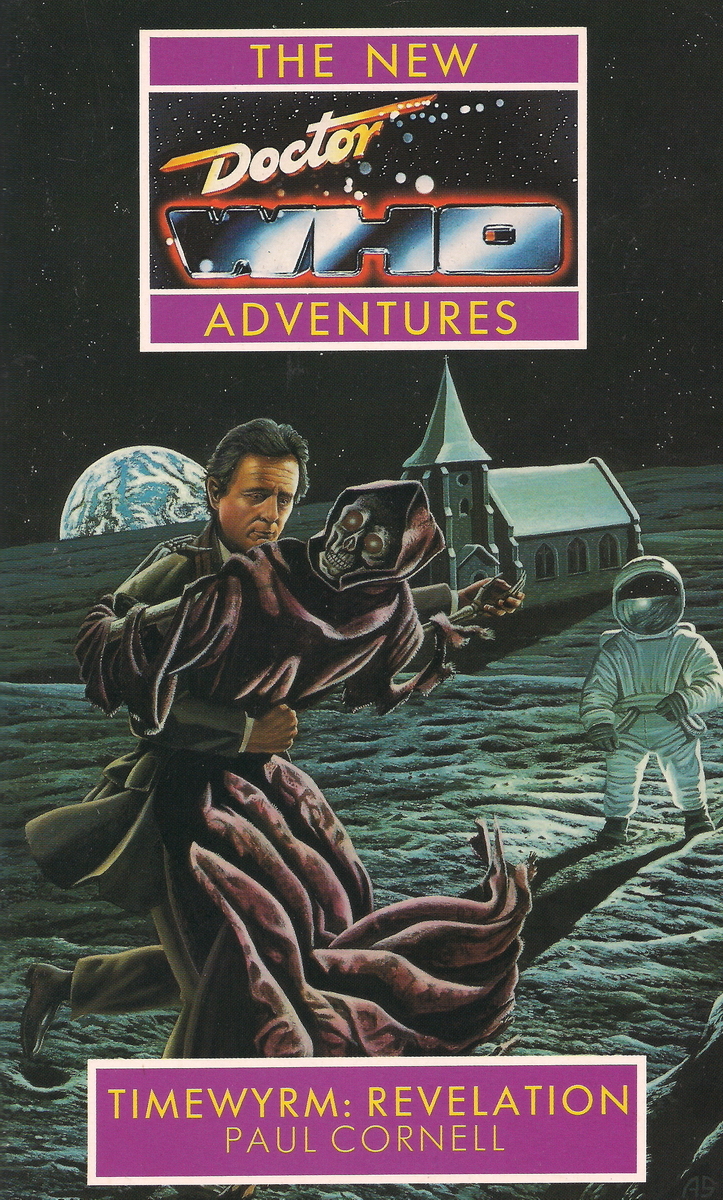
Doctor Who: Virgin New Adventures #4
Doctor Who: Timewyrm - Revelation
Fourth and final book in the Timewyrm series.
The parishioners of Cheldon Bonniface walk to church on the Sunday before Christmas, 1992. Snow is in the air, or is it the threat of something else? The Reverend Trelaw has a premonition too, and discusses it with the spirit that inhabits his church. Perhaps the Doctor is about to visit them again?
Some years earlier, in a playground in Perivale, Chad Boyle picks up a half-brick. He's going to get that creepy kid Dorothy who says she wants to be an astronaut. The weapon falls, splitting Dorothy's skull. She dies instantly.
The Doctor pursued the Timewyrm from prehistoric Mesopotamia to Nazi Germany, and then tot he end of the universe. He has tracked down the creature again: but what transtemporal trap has the Timewyrm prepared for their final confrontation?
An original Doctor Who novel. Full length science fiction novels; stories too broad and too deep for the small screen.
The parishioners of Cheldon Bonniface walk to church on the Sunday before Christmas, 1992. Snow is in the air, or is it the threat of something else? The Reverend Trelaw has a premonition too, and discusses it with the spirit that inhabits his church. Perhaps the Doctor is about to visit them again?
Some years earlier, in a playground in Perivale, Chad Boyle picks up a half-brick. He's going to get that creepy kid Dorothy who says she wants to be an astronaut. The weapon falls, splitting Dorothy's skull. She dies instantly.
The Doctor pursued the Timewyrm from prehistoric Mesopotamia to Nazi Germany, and then tot he end of the universe. He has tracked down the creature again: but what transtemporal trap has the Timewyrm prepared for their final confrontation?
An original Doctor Who novel. Full length science fiction novels; stories too broad and too deep for the small screen.
220 pages, Mass Market Paperback
First published December 5, 1991
About the author
Paul Cornell
624 books1,523 followersPaul Cornell is a British writer of science fiction and fantasy prose, comics and television. He's been Hugo Award-nominated for all three media, and has won the BSFA Award for his short fiction, and the Eagle Award for his comics. He's the writer of Saucer Country for Vertigo, Demon Knights for DC, and has written for the Doctor Who TV series. His new urban fantasy novel is London Falling, out from Tor on December 6th.
via Wikipedia @ http://en.wikipedia.org/wiki/Paul_Cor...
via Wikipedia @ http://en.wikipedia.org/wiki/Paul_Cor...
Ratings & Reviews
Friends & Following
Create a free account to discover what your friends think of this book!
Community Reviews
Displaying 1 - 30 of 81 reviews

September 15, 2008
It's almost impossible to write about the impact this book had on Doctor Who fandom when it first came out. Paul Cornell was already known as an insightful commentator within the fan community, and I think quite a lot of people knew that when he came to write a novel it would challenge your expectations. But I don't think anyone thought it would do so quite as radically as this.
As I don't want to include serious spoilers in my reviews of these books, it's rather difficult to discuss exactly what is going on, so I shall talk about other things.
Essentially what makes this special is that it isn't far off being a "proper" novel, rather than just a Doctor Who story. Whereas the previous three titles in the series were relatively simply written and with pretty straight-forward plots, albeit trying to push boundaries, Revelation assumes that the reader can keep up with the dizzying changes of perspective and setting, a complex juggling act in which Cornell manages to keep half-a-dozen balls in the air at once without dropping any.
The other big point about this book is that it has been written by a fan. Whereas Peel and Dicks are much more professional writers, and you always feel that they are merely doing a job of work, this is suffused with a deep and abiding love and understanding of the history of Doctor Who; in one sense the Timewyrm story is only really a sideshow, allowing Cornell to indulge in some brilliant retconning and to develop some areas of the mythos in exciting ways.
The only real weak point is the big reveal about the main setting, which is used as a "cliffhanger" ending to a chapter but I would imagine that most readers will have figured out what is going on already. And the loose-ends chapter is slightly unsatisfying in the way it resolves certain plotlines. But they are minor gripes.
You could read this without reading the previous Timewyrm stories, and it would stand out as an excellent Who adventure. You could even read this without knowing anything about Doctor Who and it would work as a rather good (if at times mystifying) novel. It's not the best novel Cornell contributed to the NA range, but it probably still deserves the acclaim it received when it first appeared.
Next up: Cat's Cradle: Time's Crucible. And if you thought Revelation made you head spin, you ain't seen nothing yet...
As I don't want to include serious spoilers in my reviews of these books, it's rather difficult to discuss exactly what is going on, so I shall talk about other things.
Essentially what makes this special is that it isn't far off being a "proper" novel, rather than just a Doctor Who story. Whereas the previous three titles in the series were relatively simply written and with pretty straight-forward plots, albeit trying to push boundaries, Revelation assumes that the reader can keep up with the dizzying changes of perspective and setting, a complex juggling act in which Cornell manages to keep half-a-dozen balls in the air at once without dropping any.
The other big point about this book is that it has been written by a fan. Whereas Peel and Dicks are much more professional writers, and you always feel that they are merely doing a job of work, this is suffused with a deep and abiding love and understanding of the history of Doctor Who; in one sense the Timewyrm story is only really a sideshow, allowing Cornell to indulge in some brilliant retconning and to develop some areas of the mythos in exciting ways.
The only real weak point is the big reveal about the main setting, which is used as a "cliffhanger" ending to a chapter but I would imagine that most readers will have figured out what is going on already. And the loose-ends chapter is slightly unsatisfying in the way it resolves certain plotlines. But they are minor gripes.
You could read this without reading the previous Timewyrm stories, and it would stand out as an excellent Who adventure. You could even read this without knowing anything about Doctor Who and it would work as a rather good (if at times mystifying) novel. It's not the best novel Cornell contributed to the NA range, but it probably still deserves the acclaim it received when it first appeared.
Next up: Cat's Cradle: Time's Crucible. And if you thought Revelation made you head spin, you ain't seen nothing yet...

December 15, 2016
The Timewyrm series as a whole is a distinctly variable beast. Half of the books aren’t much good, tonally the four are all over the place, and there doesn’t seem to be much in the way of a consistent idea as to what the Timewyrm actually is or does. It does however end on a definite bang, for Paul Cornell’s ‘Timewyrm Revelation’ is absolutely superb.
It’s a book with so much crammed into it. At various points both The Doctor and Ace are dead, large parts of it seem to take place in one of the most rundown visions of heaven ever put into print, and then a version of hell which eschews pitchforks and horns to be generally terrifying. To make it sound like a metaphysical journey for our two leads doesn’t do it justice though. It is that, but so much more. There’s ruminations on childhood fears, religion and complex mathematics. But maybe that makes it sound heavier than it is. ‘Timewyrm Revelation’ is actually a witty, nimble and light on its feet. There’s a line of dialogue: “You’re on the moon, inside a sentient church, waiting to see if you have any part to play in the rescue of a woman’s soul from the clutches of a near omnipotent being. Broaden your mind.” which in many ways sums up this book (and has a pleasing whiff of Douglas Adams to it). A line of dialogue which proves that even at its darkest and most serious, this book isn’t going to be that dark or that serious. There are also more contemporary pop lyrics here than you can shake some maracas at. And that’s the advantage over having Paul Cornell write this as opposed to the three previous – more senior – authors. They’re not going to know who The Stone Roses are, let alone make a sex symbol out of Ian Brown.
It’s been a somewhat disappointing experience reading these four books. Too many misses and only one dead-centre hit. But if I had read this in 1991, even after a couple of dodgy books that had gone before, I’d close ‘Timewyrm Revelation’ and know that Doctor Who was heading in a good direction.
If you get chance, please visit my blog for book, TV and film reviews - as well as whatever else takes my fancy - at frjameson.com
LIke my Facebook page
Or follow me on Twitter or Instagram: @frjameson.
It’s a book with so much crammed into it. At various points both The Doctor and Ace are dead, large parts of it seem to take place in one of the most rundown visions of heaven ever put into print, and then a version of hell which eschews pitchforks and horns to be generally terrifying. To make it sound like a metaphysical journey for our two leads doesn’t do it justice though. It is that, but so much more. There’s ruminations on childhood fears, religion and complex mathematics. But maybe that makes it sound heavier than it is. ‘Timewyrm Revelation’ is actually a witty, nimble and light on its feet. There’s a line of dialogue: “You’re on the moon, inside a sentient church, waiting to see if you have any part to play in the rescue of a woman’s soul from the clutches of a near omnipotent being. Broaden your mind.” which in many ways sums up this book (and has a pleasing whiff of Douglas Adams to it). A line of dialogue which proves that even at its darkest and most serious, this book isn’t going to be that dark or that serious. There are also more contemporary pop lyrics here than you can shake some maracas at. And that’s the advantage over having Paul Cornell write this as opposed to the three previous – more senior – authors. They’re not going to know who The Stone Roses are, let alone make a sex symbol out of Ian Brown.
It’s been a somewhat disappointing experience reading these four books. Too many misses and only one dead-centre hit. But if I had read this in 1991, even after a couple of dodgy books that had gone before, I’d close ‘Timewyrm Revelation’ and know that Doctor Who was heading in a good direction.
If you get chance, please visit my blog for book, TV and film reviews - as well as whatever else takes my fancy - at frjameson.com
LIke my Facebook page
Or follow me on Twitter or Instagram: @frjameson.

March 2, 2018
The final instalment of the 'Timewyrm' series.
In total an 885 page series with (Genesys, Exodus, Apocalypse & Revelation)
Re-cap
Timewyrm Genesys: One of the biggest pieces of crap ever published. Rushed due to the author trying to get the first original Doctor Who novel. It fails because of the author's incompetence and his own personal satisfaction. I don't know for the life of me how that garbage was published in the condition it was in. How????
Timewyrm Exodus: A fantastic what if World War 2 story by Terrance Dicks. A solid 9/10 story. The best from the series.
Timewyrm Apocalypse: Filler. You can easily skip it and go from Exodus to Revelation and won't have a problem at all.
Now, what about Revelation? A praised book by the prolific 'Paul Cornell'
Is it highly original and shows fantastic imagination? - YES!
Is it one of the best Doctor Who books ever published? Simple answer - no.
I am a bit unsure on a rating. I am thinking: What the hell I just read???
I was warned about the novel being a mindfuck of a novel.
Funny thing is: I was told Cat's Cradle: Time's Crucible is on a bigger level of a mindfuck than Revelation. That should be fun.
It's not a bad book, I think its a good book. However, due to its very high level of originality and the fact I've never read anything like it before, it's a style and a formula I wasn't really a fan of. I give a big amount of respect to 'Paul Cornell' for taking a risk and showcasing a formula not delivered before.
How would I describe the genre? It's like a Paradoxical/ambiguous mystery novel. The writing is very equivocal. It's pretty vague and keeps throwing you questions after questions of events that transpire. It gets pretty overwhelming. It's pretty difficult to piece together because there was little to no context at times on what was happening in the novel.
The plot is very straightforward. The Timewyrm has set a trap for The Doctor and Ace. The Doctor has to stop the Timewyrm. Pretty much it.
The creativity doesn't come from the premise. It comes from the world building, the ambiguous nature of the story and the environment built by Cornell. It's abnormal, psychedelic and something that couldn't work on TV at all. (Personal opinion) I don't think the mysterious ambiguous atmosphere couldn't be captured within visuals. It works as a book. I would say the same thing as an Big Finish audio. Sadly, that won't happen.
Some teased plot strands from Exodus are answered in Revelation and I was satisfied with that. Including the Coda section at the end of Exodus. Apocalypse was filler in-between.
The less said about this novel the better because it can be easily spoiled.
Is it worth it? Yeah its worth a read but the praise I don't agree with. I do have respect for the novel and the author and happy it got published. Something like this I could see easily being rejected by publishers from left to right just like 'Campaign' by Jim Mortimore. I feel the BBC would reject this book if it was planned to be published by them instead of Virgin Publishing.
I have a YouTube review coming soon and it will be coming out on TJ Productions:
Saturday 17th March 2018.
Overall, a novel I've got respect for because of its originality and formula. It was good but at times it was a little too jarring to read, inconsistent in the structuring and I felt the Timewyrm was less threatening personally when compared to Exodus and even Genesys.
My guess was correct. Exodus did turn out my favourite out of the four. The Timewyrm series was very mixed. One shit novel (Genesys) One amazing novel (Exodus) One forgettable filler novel (Apocalypse) and one experimental novel that wasn't as good as its reputation (Revelation)
I need some time to think/work on the rating. I am thinking a 6 to a 7/10.
I will leave it at four stars for now, that might change.
NOTE
I will be doing a overview video in March on The Timewyrm series. Stay tuned for that on TJ Productions. (YouTube Channel)
In total an 885 page series with (Genesys, Exodus, Apocalypse & Revelation)
Re-cap
Timewyrm Genesys: One of the biggest pieces of crap ever published. Rushed due to the author trying to get the first original Doctor Who novel. It fails because of the author's incompetence and his own personal satisfaction. I don't know for the life of me how that garbage was published in the condition it was in. How????
Timewyrm Exodus: A fantastic what if World War 2 story by Terrance Dicks. A solid 9/10 story. The best from the series.
Timewyrm Apocalypse: Filler. You can easily skip it and go from Exodus to Revelation and won't have a problem at all.
Now, what about Revelation? A praised book by the prolific 'Paul Cornell'
Is it highly original and shows fantastic imagination? - YES!
Is it one of the best Doctor Who books ever published? Simple answer - no.
I am a bit unsure on a rating. I am thinking: What the hell I just read???
I was warned about the novel being a mindfuck of a novel.
Funny thing is: I was told Cat's Cradle: Time's Crucible is on a bigger level of a mindfuck than Revelation. That should be fun.
It's not a bad book, I think its a good book. However, due to its very high level of originality and the fact I've never read anything like it before, it's a style and a formula I wasn't really a fan of. I give a big amount of respect to 'Paul Cornell' for taking a risk and showcasing a formula not delivered before.
How would I describe the genre? It's like a Paradoxical/ambiguous mystery novel. The writing is very equivocal. It's pretty vague and keeps throwing you questions after questions of events that transpire. It gets pretty overwhelming. It's pretty difficult to piece together because there was little to no context at times on what was happening in the novel.
The plot is very straightforward. The Timewyrm has set a trap for The Doctor and Ace. The Doctor has to stop the Timewyrm. Pretty much it.
The creativity doesn't come from the premise. It comes from the world building, the ambiguous nature of the story and the environment built by Cornell. It's abnormal, psychedelic and something that couldn't work on TV at all. (Personal opinion) I don't think the mysterious ambiguous atmosphere couldn't be captured within visuals. It works as a book. I would say the same thing as an Big Finish audio. Sadly, that won't happen.
Some teased plot strands from Exodus are answered in Revelation and I was satisfied with that. Including the Coda section at the end of Exodus. Apocalypse was filler in-between.
The less said about this novel the better because it can be easily spoiled.
Is it worth it? Yeah its worth a read but the praise I don't agree with. I do have respect for the novel and the author and happy it got published. Something like this I could see easily being rejected by publishers from left to right just like 'Campaign' by Jim Mortimore. I feel the BBC would reject this book if it was planned to be published by them instead of Virgin Publishing.
I have a YouTube review coming soon and it will be coming out on TJ Productions:
Saturday 17th March 2018.
Overall, a novel I've got respect for because of its originality and formula. It was good but at times it was a little too jarring to read, inconsistent in the structuring and I felt the Timewyrm was less threatening personally when compared to Exodus and even Genesys.
My guess was correct. Exodus did turn out my favourite out of the four. The Timewyrm series was very mixed. One shit novel (Genesys) One amazing novel (Exodus) One forgettable filler novel (Apocalypse) and one experimental novel that wasn't as good as its reputation (Revelation)
I need some time to think/work on the rating. I am thinking a 6 to a 7/10.
I will leave it at four stars for now, that might change.
NOTE
I will be doing a overview video in March on The Timewyrm series. Stay tuned for that on TJ Productions. (YouTube Channel)

January 21, 2026
Doctor Who: Timewyrm - Revelation by Paul Cornell
In Doctor Who: Timewyrm - Revelation, the Seventh Doctor and Ace chase the enigmatic Timewyrm through a labyrinth of time and reality, culminating in a surreal confrontation that takes place partly within the Doctor’s own mind and partly in a sentient church transported to the moon. The story pulls threads from past encounters, even bringing echoes of previous incarnations of the Doctor into the fray, and forces both he and Ace to face the deepest parts of themselves while wrestling with loss, memory, and identity.
I found this novel both exhilarating and bewildering in equal measure, as the emotional exploration of Ace’s trauma and the Doctor’s conscience was rich and affecting but sometimes obscured by sprawling, sometimes chaotic plotting. The portrayal of Ace’s inner strength and vulnerability felt genuinely heartfelt, and moments of strange beauty and dread lingered with me long after I put the book down.
Rating: 3 out of 5
A brave and ambitious finale that often touches something profound but occasionally loses its way.
In Doctor Who: Timewyrm - Revelation, the Seventh Doctor and Ace chase the enigmatic Timewyrm through a labyrinth of time and reality, culminating in a surreal confrontation that takes place partly within the Doctor’s own mind and partly in a sentient church transported to the moon. The story pulls threads from past encounters, even bringing echoes of previous incarnations of the Doctor into the fray, and forces both he and Ace to face the deepest parts of themselves while wrestling with loss, memory, and identity.
I found this novel both exhilarating and bewildering in equal measure, as the emotional exploration of Ace’s trauma and the Doctor’s conscience was rich and affecting but sometimes obscured by sprawling, sometimes chaotic plotting. The portrayal of Ace’s inner strength and vulnerability felt genuinely heartfelt, and moments of strange beauty and dread lingered with me long after I put the book down.
Rating: 3 out of 5
A brave and ambitious finale that often touches something profound but occasionally loses its way.

July 25, 2011
It's hard to imagine that twenty years ago the idea of original Doctor Who novels was just getting going. With four novels, Virgin launched a continuation of the then canceled TV series with four novels connected by the title villain called the Timewyrm. The first three books had their hits (Timewyrm: Exodus) and misses (Timewyrm Genesys and Timewyrm: Apocalypse). It was with the fourth novel, Revelation, written by newcomer Paul Cornell, that the New Adventures really got their start. And what a beginning it turned out to be as Timewyrm Revelation would prove not only to be the end of the Timewyrm saga but the true beginning of the New Adventure stories.
One of the strongest attributes of the novel is in its characterization of its lead characters the seventh Doctor and Ace. While the previous novels had been very much off on the characterization and a good reproduction of them at best, Revelation (for the first time) really pushed these two characters to their limit. For the first time we are given insight into the seventh Doctor, the grand manipulator, who we all thought we knew so well. The seventh Doctor isn't just the grand manipulator he is a man haunted by his past and by what he may have to do not only in the present but in the future as well. For the first time the Doctor isn't just a mysterious time traveler but an actual person and it is this insight into the Doctor that makes the novel so revealing. Cornell also takes Ace to her limit as well as she faces threats not only from her past (in the form of a childhood bully) and present but from the Doctor himself. Yet it is Ace who brings out what is best in the Doctor in the end in one of the most dramatic pieces of Doctor Who writing ever. Yet despite all this new material the characters fell and even sound like they are continuations of the characters as played by Sylvester McCoy and Sophie Aldred which makes the illusion complete so to speak.
The characterization of other characters fares well for the most part too. At last the Timewyrm comes into her own as villain and it is far from the almost cliché writing of some of the previous novels. The Timewyrm is at last a genuine threat and ahs considerable presence within the pages she occupies. Cornell takes us inside the mind of a child bully whose thoughts are taken to horrific extremes by the Timewyrm. Cornell also manages to bring back a character from Exodus who gets a fine exit not to mention a nice bit of fleshing out as well. While all this is good Cornell then brings us some ordinary people thrust into extraordinary circumstances in the forms of Emily Hutchings, her husband Peter and the Reverend Trelawn. Even more surprising is how well Cornell makes a truly odd character work in the form of the sentient church Saul. While some of these characters do very little for much of the novel (true especially in the case of Emily and Peter) they each get a moment to shine and Cornell doesn't waste it.
Cornell also handles two of the biggest problems of the previous novels very well and turns them into pluses: previous Doctors and continuity references. While these two items had caused considerable problems previously here they are put to fantastic use. The revelation of the title also refers to the previous Doctors as well and especially the third Doctor (which will make you watch Inferno in a different light to be sure) and the fifth Doctor. Cornell takes the series mythology (as it was in the early 90's) and creates some truly chilling sequences including one where the Doctor faces those who have died because of his actions. Cornell doesn't litter the novel with references but when he makes one he sues it for maximum effect. Cornell even manages to slip in a reference to The Other who would later on play an intriguing role in the Doctor's history as the New Adventures went on. Combined together the results are truly amazing for a fan of the series to behold as things that had previously weighed down novels lift this one up in ways truly unexpected.
If the previous Timewyrm novels were conventional stories, Revelation goes as far in the opposite direction as possible. It is a surreal story where nothing is quite what it seems and the line between reality and fantasy becomes increasingly blurred until the final pages. Much of this is down to the novels' two major settings: the church on the Moon and the twisted landscape that the Doctor and Ace find themselves in (which will come as something as a shock if you aren't all ready aware of it). The novel also gets off to an start which leaves the reader guessing as a major character dies off TWICE in short succession. Yet despite all this Cornell never loses sight of his characters though there is some rather odd naming of characters after fellow fans and writers (some more obvious then others). Or to put it all another way: Revelation is a page-turner and paced very quickly.
While it does have some minor faults Timewyrm Revelation is still a fantastic read. It also represents a rather historic moment in Doctor Who fiction as well. For the first time the story's lead characters had been pushed there limits and given some major development along the way. It also very much set the tone for which other more experimental novels were to follow in the years to come. It also represents the first "official" piece of Doctor Who writing by Paul Cornell whose reputation as a writer on the series should speak for itself. But above Timewyrm Revelation represents one thing: the place where the New Adventures really began.
One of the strongest attributes of the novel is in its characterization of its lead characters the seventh Doctor and Ace. While the previous novels had been very much off on the characterization and a good reproduction of them at best, Revelation (for the first time) really pushed these two characters to their limit. For the first time we are given insight into the seventh Doctor, the grand manipulator, who we all thought we knew so well. The seventh Doctor isn't just the grand manipulator he is a man haunted by his past and by what he may have to do not only in the present but in the future as well. For the first time the Doctor isn't just a mysterious time traveler but an actual person and it is this insight into the Doctor that makes the novel so revealing. Cornell also takes Ace to her limit as well as she faces threats not only from her past (in the form of a childhood bully) and present but from the Doctor himself. Yet it is Ace who brings out what is best in the Doctor in the end in one of the most dramatic pieces of Doctor Who writing ever. Yet despite all this new material the characters fell and even sound like they are continuations of the characters as played by Sylvester McCoy and Sophie Aldred which makes the illusion complete so to speak.
The characterization of other characters fares well for the most part too. At last the Timewyrm comes into her own as villain and it is far from the almost cliché writing of some of the previous novels. The Timewyrm is at last a genuine threat and ahs considerable presence within the pages she occupies. Cornell takes us inside the mind of a child bully whose thoughts are taken to horrific extremes by the Timewyrm. Cornell also manages to bring back a character from Exodus who gets a fine exit not to mention a nice bit of fleshing out as well. While all this is good Cornell then brings us some ordinary people thrust into extraordinary circumstances in the forms of Emily Hutchings, her husband Peter and the Reverend Trelawn. Even more surprising is how well Cornell makes a truly odd character work in the form of the sentient church Saul. While some of these characters do very little for much of the novel (true especially in the case of Emily and Peter) they each get a moment to shine and Cornell doesn't waste it.
Cornell also handles two of the biggest problems of the previous novels very well and turns them into pluses: previous Doctors and continuity references. While these two items had caused considerable problems previously here they are put to fantastic use. The revelation of the title also refers to the previous Doctors as well and especially the third Doctor (which will make you watch Inferno in a different light to be sure) and the fifth Doctor. Cornell takes the series mythology (as it was in the early 90's) and creates some truly chilling sequences including one where the Doctor faces those who have died because of his actions. Cornell doesn't litter the novel with references but when he makes one he sues it for maximum effect. Cornell even manages to slip in a reference to The Other who would later on play an intriguing role in the Doctor's history as the New Adventures went on. Combined together the results are truly amazing for a fan of the series to behold as things that had previously weighed down novels lift this one up in ways truly unexpected.
If the previous Timewyrm novels were conventional stories, Revelation goes as far in the opposite direction as possible. It is a surreal story where nothing is quite what it seems and the line between reality and fantasy becomes increasingly blurred until the final pages. Much of this is down to the novels' two major settings: the church on the Moon and the twisted landscape that the Doctor and Ace find themselves in (which will come as something as a shock if you aren't all ready aware of it). The novel also gets off to an start which leaves the reader guessing as a major character dies off TWICE in short succession. Yet despite all this Cornell never loses sight of his characters though there is some rather odd naming of characters after fellow fans and writers (some more obvious then others). Or to put it all another way: Revelation is a page-turner and paced very quickly.
While it does have some minor faults Timewyrm Revelation is still a fantastic read. It also represents a rather historic moment in Doctor Who fiction as well. For the first time the story's lead characters had been pushed there limits and given some major development along the way. It also very much set the tone for which other more experimental novels were to follow in the years to come. It also represents the first "official" piece of Doctor Who writing by Paul Cornell whose reputation as a writer on the series should speak for itself. But above Timewyrm Revelation represents one thing: the place where the New Adventures really began.

Read
August 13, 2013It starts off so promisingly.
Having plodded my way through the first three disappointing books in the New Adventures range, I couldn't wait to get going on this one, the first book by the justly admired Paul Cornell, one of the few genuinely brilliant writers to have penned Dr Who fiction.
And it lived up to my expectations. For a chapter or so. For a start, the writing is confident and fluent, a refreshing contrast to the clumsy efforts in at least two of the previous books. The ideas are fresh and exciting, the stakes are high, the characters are well drawn. It is science fantasy rather than science fiction, and all the richer for it - a classy start to what feels like a definite four star read.
Then we get stuck inside the Doctor's mind - oh, spoiler alert, I suppose, since two thirds of the way through the book it is 'revealed' that it's the Doctor's mind in a cliffhanger chapter ending, but it's so obvious from the start that I can't imagine any fan not getting it straight away. I also can't imagine any non-fan reading any further: all of the fanwankery that marred the previous books' attempts to launch the seventh Doctor in his own written series is writ large here, as we go on a self-indulgent journey through the Doctor's psyche - references to the TV series crowd together with fantasy so pretentious and desperately quirky that any sense of narrative or even what the hell is going on is buried under the weight of the concept. The density of the prose, so enjoyable at first, becomes its weakness: it is simply a horrific slog to get through. After a few chapters, the question 'what the hell is going on?' is replaced by 'who cares?' and by the time the Timewyrm is defeated (spoiler alert, the Doctor wins) it hardly matters that it's all done by nonsense and magic, it's such a relief to get to the end of it.
It needn't have been like this: the epilogue is an absolute joy, written with a lightness of touch and a literary deftness that shows all the potential for a beautiful read that Cornell would later fulfil in spades.
I embarked on the first four New Adventures with a feeling of real excitement and going through the series from the beginning, starting off on a journey I had previously only dipped into. Having read them, I feel exhausted. It is such a misguided start to a series it's a wonder it ever continued - thankfully, both the New Adventures and Paul Cornell had much, much better in store. But my advice to new readers: don't start here.
Having plodded my way through the first three disappointing books in the New Adventures range, I couldn't wait to get going on this one, the first book by the justly admired Paul Cornell, one of the few genuinely brilliant writers to have penned Dr Who fiction.
And it lived up to my expectations. For a chapter or so. For a start, the writing is confident and fluent, a refreshing contrast to the clumsy efforts in at least two of the previous books. The ideas are fresh and exciting, the stakes are high, the characters are well drawn. It is science fantasy rather than science fiction, and all the richer for it - a classy start to what feels like a definite four star read.
Then we get stuck inside the Doctor's mind - oh, spoiler alert, I suppose, since two thirds of the way through the book it is 'revealed' that it's the Doctor's mind in a cliffhanger chapter ending, but it's so obvious from the start that I can't imagine any fan not getting it straight away. I also can't imagine any non-fan reading any further: all of the fanwankery that marred the previous books' attempts to launch the seventh Doctor in his own written series is writ large here, as we go on a self-indulgent journey through the Doctor's psyche - references to the TV series crowd together with fantasy so pretentious and desperately quirky that any sense of narrative or even what the hell is going on is buried under the weight of the concept. The density of the prose, so enjoyable at first, becomes its weakness: it is simply a horrific slog to get through. After a few chapters, the question 'what the hell is going on?' is replaced by 'who cares?' and by the time the Timewyrm is defeated (spoiler alert, the Doctor wins) it hardly matters that it's all done by nonsense and magic, it's such a relief to get to the end of it.
It needn't have been like this: the epilogue is an absolute joy, written with a lightness of touch and a literary deftness that shows all the potential for a beautiful read that Cornell would later fulfil in spades.
I embarked on the first four New Adventures with a feeling of real excitement and going through the series from the beginning, starting off on a journey I had previously only dipped into. Having read them, I feel exhausted. It is such a misguided start to a series it's a wonder it ever continued - thankfully, both the New Adventures and Paul Cornell had much, much better in store. But my advice to new readers: don't start here.

August 6, 2024
"Yes." The Doctor glanced across at her, his eyes dark and half-closed. "You live in paradise, you start to wonder who empties the bins. I made the same move long ago."

January 19, 2026
This the finale of the Timewyrm Doctor Who quadrology of books is the pinnacle of those collected works. Ace and the seventh Doctor get put through ordeal after ordeal in their battle against the Timewyrm in this one. A surreal tale that encapsulates what a great Doctor Who story should. Excitement, terror and a feeling that will this be his final fight. A daring exploration into themes of religiosity are also explored too. It feels like the Doctor and Ace are plunged into Hell, but the truth is much more surprising. A deft masterpiece that throws punch after punch even into its amazing conclusion. 5 stars a must read.

February 7, 2012
The final part of the Timewyrm tetralogy has a lot to do: it must tie up all the loose ends – Hemmings disappearance into a second TARDIS near the end of Timewyrm: Exodus for one – and see The Doctor defeat the villainous creature he created. Before I began this novel I was thinking how one would best top the previous three adventures which have seen respectively: ancient earth history, alternative earth history and an alien planet. If I were Paul Cornell, the man given the task of completing this novel sequence, I would want to do something strange and dramatic. Thank God Paul Cornell thinks like me.
Timewyrm: Revelation opens with something of a kicker: Ace being murdered by her school bully, while still a child. The church at Cheldon Bonniface is alive, and its visitors are yanked from the face of the earth to the surface of the moon. The Doctor is gives a baby to the visitors in the church, but by isn’t it crying or smiling? Hemmings is somehow behind it all, with the Timewyrm and one of Ace’s school bullies. And Ace… Ace is stuck between this life and the next.
Timewyrm: Revelation sings with an abundance of strange imagery. It is a testament to the skill of Paul Cornell that the surrealist nature of the opening of this novel doesn’t overwhelm or distract. It’s alienness is appropriate – in fact it heightens the tension admirably. We have an appearance from Death himself, and from some past Doctors (revealing that all the previous appearances of past Doctors and companions in the previous volumes did have a purpose after all), and the landscape this final journey takes place in: the Doctor’s mind. Yes, the final twist is that hell or purgatory is in the mind of this cosmic traveller – and that leads to some great biblical imagery, and reveals a very human and guilty corner of The Doctor’s soul.
This then was more than a satisfactory ending to the Timewyrm saga: it may even be the strongest entry. What I hope for this series of novels is that they learn from the lessons Paul Cornell has sown – that this literary Doctor Who can be dark, and bleak, and that not all endings have to be happy. This one leaves us with a bittersweet taste – and is entirely appropriate. Fans of Doctor Who know how good a writer Paul Cornell is: this simply proves it.
Timewyrm: Revelation opens with something of a kicker: Ace being murdered by her school bully, while still a child. The church at Cheldon Bonniface is alive, and its visitors are yanked from the face of the earth to the surface of the moon. The Doctor is gives a baby to the visitors in the church, but by isn’t it crying or smiling? Hemmings is somehow behind it all, with the Timewyrm and one of Ace’s school bullies. And Ace… Ace is stuck between this life and the next.
Timewyrm: Revelation sings with an abundance of strange imagery. It is a testament to the skill of Paul Cornell that the surrealist nature of the opening of this novel doesn’t overwhelm or distract. It’s alienness is appropriate – in fact it heightens the tension admirably. We have an appearance from Death himself, and from some past Doctors (revealing that all the previous appearances of past Doctors and companions in the previous volumes did have a purpose after all), and the landscape this final journey takes place in: the Doctor’s mind. Yes, the final twist is that hell or purgatory is in the mind of this cosmic traveller – and that leads to some great biblical imagery, and reveals a very human and guilty corner of The Doctor’s soul.
This then was more than a satisfactory ending to the Timewyrm saga: it may even be the strongest entry. What I hope for this series of novels is that they learn from the lessons Paul Cornell has sown – that this literary Doctor Who can be dark, and bleak, and that not all endings have to be happy. This one leaves us with a bittersweet taste – and is entirely appropriate. Fans of Doctor Who know how good a writer Paul Cornell is: this simply proves it.

November 16, 2024
Tries a bit too hard, but easily the first VNA to actually meet the "too broad and too deep for the small screen" concept.

September 7, 2020
Wow.
Just wow.
I've been wanting to read this book for... ten years? The core concept (let's say the one that involves the tree?) is something I've been aware of that entire time, but I never thought it would happen. But here I am, finally getting to it because it's (apparently) one of the core pieces of Doctor Who that explains how the show went from "Survival" to "Rose".
But holy hell this was incredible. Like, truly. This was a RIDE and one of the best pieces of Doctor Who I've ever had the pleasure of experiencing. I knew that Cornell was a great and visionary writer, but this dude basically completely remakes the entire show in a new image, one based on the history of the show and that really does change how Doctor Who works. It's hard to explain without spoiling all the pieces of this, and even with my admittedly limited spoilers I wouldn't dream of ruining this for people, but Apocalypse is a seminal work, the sort of thing that every single Doctor Who fan, all the ones who watched the classic series, who watch the new stuff... Everyone needs to read this.
Not only that, but somehow while telling this big, massive Doctor Who story that can *only* be a book (legitimately would not work in any other medium) he also manages to do Eternal Sunshine of the Spotless Mind like ten years before that movie even started shooting.
I can't. Guys. This was transcendent. Seriously, as important a piece of Doctor Who as Power of the Daleks, Carnival of Monsters, Remembrance of the Daleks... God. It was so good.
Doctor Who Ranking
1. Timewyrm: Revelation
2. Timewyrm: Exodus
3. Timewyrm: Apocalypse
4. Timewyrm: Genesys
Just wow.
I've been wanting to read this book for... ten years? The core concept (let's say the one that involves the tree?) is something I've been aware of that entire time, but I never thought it would happen. But here I am, finally getting to it because it's (apparently) one of the core pieces of Doctor Who that explains how the show went from "Survival" to "Rose".
But holy hell this was incredible. Like, truly. This was a RIDE and one of the best pieces of Doctor Who I've ever had the pleasure of experiencing. I knew that Cornell was a great and visionary writer, but this dude basically completely remakes the entire show in a new image, one based on the history of the show and that really does change how Doctor Who works. It's hard to explain without spoiling all the pieces of this, and even with my admittedly limited spoilers I wouldn't dream of ruining this for people, but Apocalypse is a seminal work, the sort of thing that every single Doctor Who fan, all the ones who watched the classic series, who watch the new stuff... Everyone needs to read this.
Not only that, but somehow while telling this big, massive Doctor Who story that can *only* be a book (legitimately would not work in any other medium) he also manages to do Eternal Sunshine of the Spotless Mind like ten years before that movie even started shooting.
I can't. Guys. This was transcendent. Seriously, as important a piece of Doctor Who as Power of the Daleks, Carnival of Monsters, Remembrance of the Daleks... God. It was so good.
Doctor Who Ranking
1. Timewyrm: Revelation
2. Timewyrm: Exodus
3. Timewyrm: Apocalypse
4. Timewyrm: Genesys

October 15, 2024
This book was interesting and entertaining throughout, but like the first three Timewyrm books, it's still just missing something.
I absolutely loved the deep dive on Ace. I feel this is the first time we've actually examined her as a character, and the different names for different versions of her throughout her life was so sick. We also saw the Doctor in a bit of a darker light, where he has literally taken the physical manifestation of his conscious and tied it to a tree, like a Christ-like figure. I know Ace and the Doctor have issues going forward and I think their dynamics in this book really add to what will be coming soon.
However, we're also introduced to a number of just really pointless characters. Trelaw, Emily, Saul, etc. At first I thought they must be from a classic series episode that I haven't seen, apparently not. Were introduced to these people like we're meant to know them, then they do nothing for 90% of the book except look around confused at each other. It wasn't the most engaging reading.
I absolutely loved the deep dive on Ace. I feel this is the first time we've actually examined her as a character, and the different names for different versions of her throughout her life was so sick. We also saw the Doctor in a bit of a darker light, where he has literally taken the physical manifestation of his conscious and tied it to a tree, like a Christ-like figure. I know Ace and the Doctor have issues going forward and I think their dynamics in this book really add to what will be coming soon.
However, we're also introduced to a number of just really pointless characters. Trelaw, Emily, Saul, etc. At first I thought they must be from a classic series episode that I haven't seen, apparently not. Were introduced to these people like we're meant to know them, then they do nothing for 90% of the book except look around confused at each other. It wasn't the most engaging reading.

February 11, 2025
Ending the Timewyrm quadrilogy in a satisfying and purposeful way seemed an impossible task. Yet, author Paul Cornell infuses Timewyrm: Revelation with such tremendous heart, terror, and authenticity to its characters that he nearly manages to salvage the series as a whole. A near-impossible feat owing to its foul beginning in Timewyrm: Genesys and lacklustre part three, Timewyrm: Apocalypse. The only other writer thus far who has demonstrated their keen understanding of the characters and tone of this strange new venture for the Who series was Terrance Dicks. His adventure into alternate Nazi England in Timewyrm Exodus gave Ace and the Doctor a chance to be themselves and thwart some Nazi schemes. But Cornell goes one step further and directly grapples with the writhing ball of anger and chaos that is the Timewyrm. He utilizes this absurd character with finesse, and a distinct charming, twisted strain of creativity. And, without sidestepping the problem entirely as Dicks did. Was his execution perfect? Admittedly, no. But this wyrmy chalice was poisoned from the beginning, and Cornell’s willingness to take the Doctor, Ace, and the timewyrm into such strange, dark, and introspective places is admirable.
Revelation establishes a new bar for the VNAs to clear, and firmly establishes the range’s tone and voice. Although I must confess I am doubtful that this tone will endure, for I am aware of the series’ notorious inconsistency. It is a deeply mature, thoughtful, and admittedly dark and edgy book. But its darkness is finely balanced with good humour and depth. To be clear, Ace and the Doctor are brutally punished throughout the novel - more-so than ever before. Their relationship is pushed until breaking point, but crucially, the bitterness and pain they feel serve a purpose. One which takes shape toward the final act to produce a legitimately heartfelt and compelling climatic resolution. Across the Whoniverse, there are very few stories which portray the Doctor and Ace’s bond this compellingly, let alone actually develop it in any significant way. And this marvellous freedom is a clear and distinct advantage the VNAs possess over something like Big Finish dramas which are often forever stuck in character limbo.
Revelation’s story is deceptively simple in concept, but it thrives in its deliberately disorienting, ethereal, and nightmarish narrative structure. Naturally, there are all sorts of bizarre sci-fi bells and whistles like curly-haired long-scarfed librarians, headless nazis, and space-faring childhood-bullies. And yes, the doctor does dance with death on the surface of the moon outside a sentient church named Saul, and yes, it is fantastic. But, importantly, Revelation successfully juggles all of its elements owing to Cornell’s tight grip on the story’s pacing and his utterly authentic reproductions of the Doctor and Ace. The book’s narrative composition oozes with flair and style, clearly manifested through its transient, drifting perspectives and its haunting, surreal settings. At times, the balance falters when the point of view shifts too abruptly between Ace and the Doctor every few sentences, effectively disrupting the pace and pressing readers to read the same lines over and over again. Thankfully, these instances were uncommon and for the most part the story structure effectively reinforces the cascading terror of the nightmare-dreamscape that Timewyrm: Revelation takes place in.
At its core, Revelation’s plot is a gauntlet of duels. It is an intensely introspective, vicious and confronting battle between the enemies, friends, and themselves. Of course, the Doctor and the Timewrym’s battle takes precedence, spanning the entire book from beginning to end. The pair encounter each other time and again and their dynamic is finally, thoroughly engaging as the wyrm chips away at the Doctor’s armor and begins to grasp just who this mysterious adversary of hers really is. For the first time Timewyrm feels like a legitimate threat to the Doctor, Ace, and Earth’s safety. Cornell harnesses her cybernetic, AI-like consciousness to produce an exponential threat of relentless hate, granting her the power to directly battle the Doctor at a psychic level. The timewyrm takes the Doctor and Ace into several visceral, disorienting, and familiar dream-like environments that manifest their worst nightmares and most crushing guilt before them.
Unfortunately, the wyrm's poor characterisation and introduction in the earlier books comes back to bite Cornell in a complex resolution that hinges on precarious established character-work that never really existed. While he successfully casts the Timewyrm as an effective and oppressive villain to match up to the Doctor, Ishtar, the human(-like alien) that birthed the monster was never clearly defined. As a result, her sudden manifestation toward the end of the book was jarring, leading toward an underwhelming anti-climax. Had the character of Ishtar been better defined, her interactions with an empathetic Doctor would have resounded more effectively. Although the book’s narrative-based resolution struggles to hit home, Cornell’s brilliant recontextualization of the wyrm into an omnipresent reality-bending artificial intelligent-like construct that draws from the Doctor’s own mind is delightfully devilish. Ultimately, the timewyrm is best utilised as an omnipotent, reality-bending force to pit the Doctor and Ace against their true greatest foes: themselves.
Just as the Doctor must face his past, Ace must face hers too. And while the Doctor’s history must be clouded in mystery as a result of his obscured alien ancestry, Ace’s is painfully human. And representing her turbulent, anarchic past is a twisted rendition of her childhood bully Chad Boyle. Boyle is a surprisingly terrifying and compelling character, integral to Ace’s character arc. In fact, Timewyrm: Revelations opens with the young bully bludgeoning a young Ace over the head with a brick, killing her instantly… Thankfully this act doesn’t eject Ace from the story, but it introduces an uncomfortable and gripping temporal wrinkle; a wrinkle further complicated by Boyle’s reappearance in the present, prowling the lunar surface in a replica astronaut spacesuit. Ace and Boyle continually battle with each other throughout the story, Boyle, disturbingly frozen in time as a vengeful, vindictive boy, and Ace, manifesting as different versions of herself through time. Quite simply, as a murderous vicious child, Boyle is a thoroughly disturbing presence. Altogether, Boyle and Ace’s relationship is deeply engaging and Ace’s evolving responses to this vindictive, psychopathic little boy provided her strong platform for her to demonstrate both her rebellious nature as well as the lessons she has learned from the Doctor.
Briefly, I must highlight a particularly profound chapter in which Ace is presented with an alternate life in Perivale, where she occupies the role of a popular, ‘normal’ teenager. In it, for the first time we are introduced to Ace’s childhood friend Manisha, albeit from the discomforting point of view of her racist, complicit tormentors. While I won’t delve into any specifics, I can confidently assert that Ace’s battle with complacency, bigotry, and passivity was immensely cathartic and wholly reflective of the brilliant strength her character possesses.
Aside from Ace, the Doctor, Chad Boyle, and a few returning characters from the previous Timewyrm novels, Cornell also introduces a handful of original supporting characters that exist predominantly outside of the Timewyrm’s domain in the small village town of Cheldon Bonniface. Featuring Saul, the affable sentient church; reverend Ernest Trelaw, a vicar and friend of Saul’s; and Peter and Emily Hutchings, two new churchgoers with considerable intellect and creativity, the Bonniface collective offer a reprieve from the dimension rending madness of the Doctor and Ace’s wyrmy adventures. Not too disconnected of course, but the closest they get to the action is a brief jaunt out to the lunar surface for a quick fetch quest for the decapitated head of a nazi. Nothing too crazy. Although the group were likeable and it is always fun to watch regular humans come to terms with the bizarre nature of the Doctor’s escapades, the Bonniface crew always felt disconnected from the plot at a deeper level. They served a predominantly plot-driven role, seeded intentionally throughout the story such that when certain Doctorish revelations and schemes come into play, one may point toward the intentional foreshadowing secured in place by Cornell. Unfortunately, the character’s themselves never successfully overcome the lingering sense of anticipation for some deeper, expertly hidden form of interconnectedness that was never fulfilled. Especially in regard to Saul, whose existence would normally warrant a whole story on its own. While the Bonniface brigade provides a measure of stability in the novel’s pace and structure, their poor integration into the ongoing Timewyrm plot remains distracting.
Overall, Timewyrm: Revelation is the New Adventures’ most exciting and creative entry yet. Paul Cornell directly grapples with mature themes such as sacrifice, revenge, acceptance, and the concept of an intrinsic evil - that is, if there really could be such a thing. Unsurprisingly, Ace is the shining star of the novel and the insights gained about her childhood are thoroughly stark and beautiful. For the first time in a while, the Doctor’s weaknesses, guilt, and emotional complexes are out on display, and he feels both more human and more alien than ever before. Further, we’re privy to a deeper look into the weight of the sacrifices his past companions have made for the Doctor as well as the sacrifices he has made for them, culminating in a stunningly heartfelt and upsetting climax that forces Ace and the Doctor to reassess their relationship in circumstances of life and death. Of course, not everything is profound or well balanced, the novel has its fair share of contrivances and weaknesses, but, the overwhelming majority of the book rises above these flaws. Timewyrm: Revelation finally marks the arrival of a new, strange, wonderful, and new era of 90s Doctor Who.
Revelation establishes a new bar for the VNAs to clear, and firmly establishes the range’s tone and voice. Although I must confess I am doubtful that this tone will endure, for I am aware of the series’ notorious inconsistency. It is a deeply mature, thoughtful, and admittedly dark and edgy book. But its darkness is finely balanced with good humour and depth. To be clear, Ace and the Doctor are brutally punished throughout the novel - more-so than ever before. Their relationship is pushed until breaking point, but crucially, the bitterness and pain they feel serve a purpose. One which takes shape toward the final act to produce a legitimately heartfelt and compelling climatic resolution. Across the Whoniverse, there are very few stories which portray the Doctor and Ace’s bond this compellingly, let alone actually develop it in any significant way. And this marvellous freedom is a clear and distinct advantage the VNAs possess over something like Big Finish dramas which are often forever stuck in character limbo.
Revelation’s story is deceptively simple in concept, but it thrives in its deliberately disorienting, ethereal, and nightmarish narrative structure. Naturally, there are all sorts of bizarre sci-fi bells and whistles like curly-haired long-scarfed librarians, headless nazis, and space-faring childhood-bullies. And yes, the doctor does dance with death on the surface of the moon outside a sentient church named Saul, and yes, it is fantastic. But, importantly, Revelation successfully juggles all of its elements owing to Cornell’s tight grip on the story’s pacing and his utterly authentic reproductions of the Doctor and Ace. The book’s narrative composition oozes with flair and style, clearly manifested through its transient, drifting perspectives and its haunting, surreal settings. At times, the balance falters when the point of view shifts too abruptly between Ace and the Doctor every few sentences, effectively disrupting the pace and pressing readers to read the same lines over and over again. Thankfully, these instances were uncommon and for the most part the story structure effectively reinforces the cascading terror of the nightmare-dreamscape that Timewyrm: Revelation takes place in.
At its core, Revelation’s plot is a gauntlet of duels. It is an intensely introspective, vicious and confronting battle between the enemies, friends, and themselves. Of course, the Doctor and the Timewrym’s battle takes precedence, spanning the entire book from beginning to end. The pair encounter each other time and again and their dynamic is finally, thoroughly engaging as the wyrm chips away at the Doctor’s armor and begins to grasp just who this mysterious adversary of hers really is. For the first time Timewyrm feels like a legitimate threat to the Doctor, Ace, and Earth’s safety. Cornell harnesses her cybernetic, AI-like consciousness to produce an exponential threat of relentless hate, granting her the power to directly battle the Doctor at a psychic level. The timewyrm takes the Doctor and Ace into several visceral, disorienting, and familiar dream-like environments that manifest their worst nightmares and most crushing guilt before them.
Unfortunately, the wyrm's poor characterisation and introduction in the earlier books comes back to bite Cornell in a complex resolution that hinges on precarious established character-work that never really existed. While he successfully casts the Timewyrm as an effective and oppressive villain to match up to the Doctor, Ishtar, the human(-like alien) that birthed the monster was never clearly defined. As a result, her sudden manifestation toward the end of the book was jarring, leading toward an underwhelming anti-climax. Had the character of Ishtar been better defined, her interactions with an empathetic Doctor would have resounded more effectively. Although the book’s narrative-based resolution struggles to hit home, Cornell’s brilliant recontextualization of the wyrm into an omnipresent reality-bending artificial intelligent-like construct that draws from the Doctor’s own mind is delightfully devilish. Ultimately, the timewyrm is best utilised as an omnipotent, reality-bending force to pit the Doctor and Ace against their true greatest foes: themselves.
Just as the Doctor must face his past, Ace must face hers too. And while the Doctor’s history must be clouded in mystery as a result of his obscured alien ancestry, Ace’s is painfully human. And representing her turbulent, anarchic past is a twisted rendition of her childhood bully Chad Boyle. Boyle is a surprisingly terrifying and compelling character, integral to Ace’s character arc. In fact, Timewyrm: Revelations opens with the young bully bludgeoning a young Ace over the head with a brick, killing her instantly… Thankfully this act doesn’t eject Ace from the story, but it introduces an uncomfortable and gripping temporal wrinkle; a wrinkle further complicated by Boyle’s reappearance in the present, prowling the lunar surface in a replica astronaut spacesuit. Ace and Boyle continually battle with each other throughout the story, Boyle, disturbingly frozen in time as a vengeful, vindictive boy, and Ace, manifesting as different versions of herself through time. Quite simply, as a murderous vicious child, Boyle is a thoroughly disturbing presence. Altogether, Boyle and Ace’s relationship is deeply engaging and Ace’s evolving responses to this vindictive, psychopathic little boy provided her strong platform for her to demonstrate both her rebellious nature as well as the lessons she has learned from the Doctor.
Briefly, I must highlight a particularly profound chapter in which Ace is presented with an alternate life in Perivale, where she occupies the role of a popular, ‘normal’ teenager. In it, for the first time we are introduced to Ace’s childhood friend Manisha, albeit from the discomforting point of view of her racist, complicit tormentors. While I won’t delve into any specifics, I can confidently assert that Ace’s battle with complacency, bigotry, and passivity was immensely cathartic and wholly reflective of the brilliant strength her character possesses.
Aside from Ace, the Doctor, Chad Boyle, and a few returning characters from the previous Timewyrm novels, Cornell also introduces a handful of original supporting characters that exist predominantly outside of the Timewyrm’s domain in the small village town of Cheldon Bonniface. Featuring Saul, the affable sentient church; reverend Ernest Trelaw, a vicar and friend of Saul’s; and Peter and Emily Hutchings, two new churchgoers with considerable intellect and creativity, the Bonniface collective offer a reprieve from the dimension rending madness of the Doctor and Ace’s wyrmy adventures. Not too disconnected of course, but the closest they get to the action is a brief jaunt out to the lunar surface for a quick fetch quest for the decapitated head of a nazi. Nothing too crazy. Although the group were likeable and it is always fun to watch regular humans come to terms with the bizarre nature of the Doctor’s escapades, the Bonniface crew always felt disconnected from the plot at a deeper level. They served a predominantly plot-driven role, seeded intentionally throughout the story such that when certain Doctorish revelations and schemes come into play, one may point toward the intentional foreshadowing secured in place by Cornell. Unfortunately, the character’s themselves never successfully overcome the lingering sense of anticipation for some deeper, expertly hidden form of interconnectedness that was never fulfilled. Especially in regard to Saul, whose existence would normally warrant a whole story on its own. While the Bonniface brigade provides a measure of stability in the novel’s pace and structure, their poor integration into the ongoing Timewyrm plot remains distracting.
Overall, Timewyrm: Revelation is the New Adventures’ most exciting and creative entry yet. Paul Cornell directly grapples with mature themes such as sacrifice, revenge, acceptance, and the concept of an intrinsic evil - that is, if there really could be such a thing. Unsurprisingly, Ace is the shining star of the novel and the insights gained about her childhood are thoroughly stark and beautiful. For the first time in a while, the Doctor’s weaknesses, guilt, and emotional complexes are out on display, and he feels both more human and more alien than ever before. Further, we’re privy to a deeper look into the weight of the sacrifices his past companions have made for the Doctor as well as the sacrifices he has made for them, culminating in a stunningly heartfelt and upsetting climax that forces Ace and the Doctor to reassess their relationship in circumstances of life and death. Of course, not everything is profound or well balanced, the novel has its fair share of contrivances and weaknesses, but, the overwhelming majority of the book rises above these flaws. Timewyrm: Revelation finally marks the arrival of a new, strange, wonderful, and new era of 90s Doctor Who.

November 27, 2013
The Doctor Diefied
Cornell's conclusion to the timewyrm story elevates the narrative to archetypal proportions and very nearly carries off a complicated sci-fi story that is more emotion than logic, more Being John Malcovich than The Matrix.
When a bully kills preadolescent Ace in the past, she and the Doctor are catapulted into a battle with their ancient (well, three novels ancient) enemies that rattles the universe to its foundations. Before the end, almost all the previous doctors are embroiled in the conflict which pushes the character to his limits, both as a personality and as a concept.
The final battle is indescribable without spoiling but the sheer scale of it is ambitious in the extreme. Where Apocalypse aimed too low, Revelation aims perhaps too high in elevating the Doctor from a character embroiled in an archetypal struggle to an archetype unto himself. It recalls Neil Gaiman's Sandman in representing a conceptual battle but is not as successful.
Where Cornell shines is in how he plays the wax and wane of the Ace's relationship with the Doctor. If there is an overarching plot to the Timewyrm story, it is the weakening of the Dr/Companion dynamic to the breaking point. Cornell invests this arm of the story with remarkable pathos; the payoff is truly cathartic.
Unlike previous Timewyrm stories, Revelation is symbolic and emotional. The anchorage provided by the characters is effective if the reader has a working knowledge of the BBC television series. If not, the story may came off a bit incoherent; the climactic battle rides dangerously close to this edge either way. I'm not fan enough to accept the Doctor as the archetype Cornell makes him out to be, however, the author is bold in fleshing out the psychological structure of a Time Lord and builds a series of memorable emotional beats that outshine any lack of causality in the plot.
As good or better than any novel in the series and quality sci-fi.
Cornell's conclusion to the timewyrm story elevates the narrative to archetypal proportions and very nearly carries off a complicated sci-fi story that is more emotion than logic, more Being John Malcovich than The Matrix.
When a bully kills preadolescent Ace in the past, she and the Doctor are catapulted into a battle with their ancient (well, three novels ancient) enemies that rattles the universe to its foundations. Before the end, almost all the previous doctors are embroiled in the conflict which pushes the character to his limits, both as a personality and as a concept.
The final battle is indescribable without spoiling but the sheer scale of it is ambitious in the extreme. Where Apocalypse aimed too low, Revelation aims perhaps too high in elevating the Doctor from a character embroiled in an archetypal struggle to an archetype unto himself. It recalls Neil Gaiman's Sandman in representing a conceptual battle but is not as successful.
Where Cornell shines is in how he plays the wax and wane of the Ace's relationship with the Doctor. If there is an overarching plot to the Timewyrm story, it is the weakening of the Dr/Companion dynamic to the breaking point. Cornell invests this arm of the story with remarkable pathos; the payoff is truly cathartic.
Unlike previous Timewyrm stories, Revelation is symbolic and emotional. The anchorage provided by the characters is effective if the reader has a working knowledge of the BBC television series. If not, the story may came off a bit incoherent; the climactic battle rides dangerously close to this edge either way. I'm not fan enough to accept the Doctor as the archetype Cornell makes him out to be, however, the author is bold in fleshing out the psychological structure of a Time Lord and builds a series of memorable emotional beats that outshine any lack of causality in the plot.
As good or better than any novel in the series and quality sci-fi.

October 26, 2015
Regardless of how much anyone would/could enjoy Revelation, objectively Who fans would have to realize just how exciting a novel like this was. Paul Cornell, in his first novel of any kind, drastically altered the scope of expectations from Doctor Who narrative.
Nothing in this novel should work.
Cornell is attempting ground-breaking material here - something that no one could blame him for if the result hadn't worked. However, concepts grounded in a narrative that exist entirely in the Doctor's mind (as the rest of the onlookers are in a church on the moon) may sound too avant-garde, but Cornell's execution is more of a revelation for long-suffering Doctor Who fans.
In 1991, those die-hards were anxiously waiting month-to-month for new Doctor Who adventures - even if they were in novelized form. Fans had suffered through Genysis and Apocalypse - and here, finally, was a story that didn't treat them like idiots. Or insufferable fanboys(girls).
Paul Cornell had given the fans something they've waited for:
legitimate art.
Nothing in this novel should work.
Cornell is attempting ground-breaking material here - something that no one could blame him for if the result hadn't worked. However, concepts grounded in a narrative that exist entirely in the Doctor's mind (as the rest of the onlookers are in a church on the moon) may sound too avant-garde, but Cornell's execution is more of a revelation for long-suffering Doctor Who fans.
In 1991, those die-hards were anxiously waiting month-to-month for new Doctor Who adventures - even if they were in novelized form. Fans had suffered through Genysis and Apocalypse - and here, finally, was a story that didn't treat them like idiots. Or insufferable fanboys(girls).
Paul Cornell had given the fans something they've waited for:
legitimate art.

March 20, 2017
Reread on 22/07/2019
Read as part of the reading rush challenge read a book with the colour purple on the cover.
Rereading this book a second time really made me appreciate it a lot more. There are so many good moments in this book and a lot of twisted ones but Paul has a wonderful way of writing.
-
This book was a wild ride.
Literally.
It took a while to get into this book which is strange because I highly enjoy Paul Cornell writing, especially his Love and War.
But Revelation took some time getting in as it was so dark and bleak.
I loved how Paul uses a lot of quotes like "Fear makes companions of us all." Which Moffat later uses in Listen episode and other quotes as Moffat and Cornell are quite good friends in real life so that was lovely to see.
The ending of the Timewyrm itself was slightly odd after everything Ishtar has done and her pure evilness but in a way, fitting she should be put inside that of a baby to give her a second chance of life as it is something the Doctor will do.
Brutal, brutal book.
Read as part of the reading rush challenge read a book with the colour purple on the cover.
Rereading this book a second time really made me appreciate it a lot more. There are so many good moments in this book and a lot of twisted ones but Paul has a wonderful way of writing.
-
This book was a wild ride.
Literally.
It took a while to get into this book which is strange because I highly enjoy Paul Cornell writing, especially his Love and War.
But Revelation took some time getting in as it was so dark and bleak.
I loved how Paul uses a lot of quotes like "Fear makes companions of us all." Which Moffat later uses in Listen episode and other quotes as Moffat and Cornell are quite good friends in real life so that was lovely to see.
The ending of the Timewyrm itself was slightly odd after everything Ishtar has done and her pure evilness but in a way, fitting she should be put inside that of a baby to give her a second chance of life as it is something the Doctor will do.
Brutal, brutal book.

March 14, 2012
This novel is the perfect conclusion to the Timewyrm series. At first I was concerned because it started off being very surreal and difficult to follow, but I soon realized that it was intentional. One of the major themes of this story was the need to establish a context to understand what's happening to you and that's exactly how Paul Cornell constructed the narrative. In the beginning you have no context so the story seems strange and random but as you read on you are given a context and everything begins to make sense. It was a bold and brilliant choice by Cornell. A lesser writer would not be able to pull that off.
Cornell also manages to pull elements from the previous Timewyrm novels to make the series as a whole seem more cohesive. He also shows how previous incarnations of the Doctor live on within his psyche, which appeals to long time Whovians.
Cornell also manages to pull elements from the previous Timewyrm novels to make the series as a whole seem more cohesive. He also shows how previous incarnations of the Doctor live on within his psyche, which appeals to long time Whovians.

November 23, 2017
Timewyrm: Revelation is the fourth and final volume in the opening "Timewyrm" series to Virgin Publishing's Doctor Who New Adventures. Unfortunately, the story spends most of it's time in a strange dreamscape where both anything can happen and there are no consequences. So the story doesn't really work - it's unrelatable, and there's no sense of jeopardy - if nothing is real in the characters world, it doesn't matter. This is sad, as this is the final volume of the series, and it's written by one of my more favorite Doctor Who authors.
The story opens in 1922, in the small village of Cheldon Bonniface, a village the Doctor has visited many times and in many of his regenerations. The local church is inhabited by Saul, a friendly spirit. And yes, Saul really is a friendly spirit. Older than the church itself, Saul's presence means the area has been scared to everyone, going back to the ancient Celts and beyond. The Doctor and Ace arrive, only for things to immediately get weird. It should be Christmas Eve, but the people in the village pub are constructs created by the Timewyrm. The local village church blasts off to the moon, and the explosion destroys the entire village and quite a lot of the surrounding area. Once arriving on the moon, a young couple, the vicar, and Saul are charged with protecting the barely alive, comatose bodies of Ace and the Doctor. At one point the Doctor arrives, thrusts a female baby into the young woman's hands, then leaves with no explanation. Saul and in-universe magic keep a bubble of breathable air inside the church (not to mention normal gravity).
Meanwhile, the Doctor and Ace have been drawn into a dreamscape similar to the Time Lords' Matrix as seen in the aired episodes, "The Deadly Assassin" and "Trial of a Time Lord". Also present is a bully from Ace's past, who, in an alternate reality made possible by the Timewyrm, killed Ace with a brick, and the British Nazi soldier from the alternate future in Timewyrm: Exodus. The Doctor and Ace literally must confront their demons in the dream world.
Unfortunately, in a very similar manner to previous aired episodes featuring the Time Lord Matrix, the vast majority of the book is spent in the dreamspace. Some chapters or sections of chapters flash back to the church, which is on the moon - and those chapters are more interesting taking place in the "real" world. Though at the same time, there's two issues - first, it doesn't make a whole lot of logical sense that a church would be successfully transplanted to the moon and the people inside survive, and second, everyone is literally stuck inside a relatively small building. There isn't much they can do but talk. Saul and company, however, are, eventually instrumental in helping the Doctor and Ace to escape their dream prison.
In the dreamscape, the Doctor and Ace, separately, and together literally confront their demons. Ace shows just how much she has grown-up, especially by the end of the book. The Doctor doesn't fair so well, especially when confronting his guilt over the deaths of his previous companions. But in the end, one of the people in the church, the young woman, has some latent psychic ability, between that and a medallion hidden by the Doctor in a previous incarnation, she and her mathematician husband, are able to enter the dreamscape to pull the Doctor and Ace out. At first, they seem successful in rescuing the Doctor at least - but without Ace, the Timewyrm, now possessing the Doctor, will win. The Doctor re-enters the dreamscape. Ace finds the Fifth Doctor, tied to the Doctor's Knowledge Tree, where he has been since the Time War - when he objected to fighting at all. Freeing the Fifth Doctor allows the Seventh Doctor to confront and overcome the Timewyrm, who it turns out, is a natural part of the universe. The Timewyrm is more-or-less, as best as I could figure out, the goddess of cosmic karma, encircling the universe, eating her tail, and responsible for beginnings and endings. The Doctor takes her out of his head where she was hiding and moved her into the body of a clone baby (with no mind of it's own) to be raised by the childless couple in the church who had desperately wanted a child in the first place.
The church is returned to where it came from. The destruction of the village is reversed. The Timewyrm's time travel to urge the bully to kill Ace is also undone. The guy from the alternate future does not exist because Ace and the Doctor reversed it previously. In other words, pretty much everything is returned to status quo.
Overall, the first two books in the Timewyrm series were better than I remembered. Well, okay, technically, I think I only read one of them before when the series was published, not sure which one, but still - at the time I hated it. I disliked the third book, intensely. The last book seems to be obviously checking off items on an outline that "must be handled" as this is an on-going series of tie-in novels. So the author was probably constrained in what he could do (I've read a lot of other stuff by Cornell - he's usually much better than this), but at the same time, having the vast majority of the book taking place in the Doctor's head (literally) but in a dreamspace controlled by the Timewyrm, the enemy and "Big Bad" of the four books didn't really work - I like having the Doctor in charge.
in terms of recommendations, if you're going to read any of the Timewyrm series, read all four books, but overall, it's a bit disappointing.
The story opens in 1922, in the small village of Cheldon Bonniface, a village the Doctor has visited many times and in many of his regenerations. The local church is inhabited by Saul, a friendly spirit. And yes, Saul really is a friendly spirit. Older than the church itself, Saul's presence means the area has been scared to everyone, going back to the ancient Celts and beyond. The Doctor and Ace arrive, only for things to immediately get weird. It should be Christmas Eve, but the people in the village pub are constructs created by the Timewyrm. The local village church blasts off to the moon, and the explosion destroys the entire village and quite a lot of the surrounding area. Once arriving on the moon, a young couple, the vicar, and Saul are charged with protecting the barely alive, comatose bodies of Ace and the Doctor. At one point the Doctor arrives, thrusts a female baby into the young woman's hands, then leaves with no explanation. Saul and in-universe magic keep a bubble of breathable air inside the church (not to mention normal gravity).
Meanwhile, the Doctor and Ace have been drawn into a dreamscape similar to the Time Lords' Matrix as seen in the aired episodes, "The Deadly Assassin" and "Trial of a Time Lord". Also present is a bully from Ace's past, who, in an alternate reality made possible by the Timewyrm, killed Ace with a brick, and the British Nazi soldier from the alternate future in Timewyrm: Exodus. The Doctor and Ace literally must confront their demons in the dream world.
Unfortunately, in a very similar manner to previous aired episodes featuring the Time Lord Matrix, the vast majority of the book is spent in the dreamspace. Some chapters or sections of chapters flash back to the church, which is on the moon - and those chapters are more interesting taking place in the "real" world. Though at the same time, there's two issues - first, it doesn't make a whole lot of logical sense that a church would be successfully transplanted to the moon and the people inside survive, and second, everyone is literally stuck inside a relatively small building. There isn't much they can do but talk. Saul and company, however, are, eventually instrumental in helping the Doctor and Ace to escape their dream prison.
In the dreamscape, the Doctor and Ace, separately, and together literally confront their demons. Ace shows just how much she has grown-up, especially by the end of the book. The Doctor doesn't fair so well, especially when confronting his guilt over the deaths of his previous companions. But in the end, one of the people in the church, the young woman, has some latent psychic ability, between that and a medallion hidden by the Doctor in a previous incarnation, she and her mathematician husband, are able to enter the dreamscape to pull the Doctor and Ace out. At first, they seem successful in rescuing the Doctor at least - but without Ace, the Timewyrm, now possessing the Doctor, will win. The Doctor re-enters the dreamscape. Ace finds the Fifth Doctor, tied to the Doctor's Knowledge Tree, where he has been since the Time War - when he objected to fighting at all. Freeing the Fifth Doctor allows the Seventh Doctor to confront and overcome the Timewyrm, who it turns out, is a natural part of the universe. The Timewyrm is more-or-less, as best as I could figure out, the goddess of cosmic karma, encircling the universe, eating her tail, and responsible for beginnings and endings. The Doctor takes her out of his head where she was hiding and moved her into the body of a clone baby (with no mind of it's own) to be raised by the childless couple in the church who had desperately wanted a child in the first place.
The church is returned to where it came from. The destruction of the village is reversed. The Timewyrm's time travel to urge the bully to kill Ace is also undone. The guy from the alternate future does not exist because Ace and the Doctor reversed it previously. In other words, pretty much everything is returned to status quo.
Overall, the first two books in the Timewyrm series were better than I remembered. Well, okay, technically, I think I only read one of them before when the series was published, not sure which one, but still - at the time I hated it. I disliked the third book, intensely. The last book seems to be obviously checking off items on an outline that "must be handled" as this is an on-going series of tie-in novels. So the author was probably constrained in what he could do (I've read a lot of other stuff by Cornell - he's usually much better than this), but at the same time, having the vast majority of the book taking place in the Doctor's head (literally) but in a dreamspace controlled by the Timewyrm, the enemy and "Big Bad" of the four books didn't really work - I like having the Doctor in charge.
in terms of recommendations, if you're going to read any of the Timewyrm series, read all four books, but overall, it's a bit disappointing.
This entire review has been hidden because of spoilers.

April 23, 2011
Absolutely fantastic to it's very core. It made me a fan of the 7th Doctor instantly, and was an amazing ending to my first Doctor Who story-arch. As always the Doctor is brilliant and Cornell captures him and Ace perfectly. Understandable why this is so iconic in the Who-niverse, a must read along with it's 4 predecessors.
June 28, 2026
And so, we reach the end of the Timewrym novels, and what an excellent finale it is. I think it's rather well known that Cornell's Revelation makes the other three Timewrym novels worth reading in full, as, whilst I have partly enjoyed the previous novels, they aren't very indicative of what "stories too broad and too deep for the small screen", as is proudly written on the back of each book, could be. I think Revelation gets it right, though. There is a certain sense of maturity running through this novel, and it's strange to me that this is only the fourth novel of the New Adventures, as the depictions of the Doctor here feel more in line with a Doctor far removed from the television series, which stories like Lungbarrow tend to head towards.
To get this out of the way here, my hesitation to give this novel five stars is that this is still part of the Timewyrm arc, and because of that, the novel tends to tie up the loose ends of the previous novels. It's great that Cornell took the time to do that, but when there are so many spinning plates of Cornell's doing (which he keeps upright right the way through to the end), it's slightly jarring to have our attention drawn to a plate of Peel's that's been abandoned, and in pieces that are trying to be glued back together. I do wonder whether this novel is better when being read on its own, unaware of the shortcomings that came before, and to enjoy Revelation for what it is.
And what is Timewyrm: Revelation? Well, it's a deconstruction of the Doctor first and foremost. Set almost entirely within the Doctor's mind, we see his greatest fears and doubts appear in the flesh as he is tormented by the Timewyrm, whilst his friendship with Ace is put to the test, as she battles a demon of her own. The characterisation here was on point; the way the Doctor presents himself, you could easily imagine Sylvester McCoy on the surface of the moon, dancing the waltz with Death herself, and I could hear his voice countless times whilst reading. It would be incredible to see this story adapted for an audio.
I was quite surprised by how much of Ace's childhood we got here. To my knowledge, a lot of it was created for this novel, as the show only gave us fleeting glimpses into how Dorothy became Ace, and it was superbly done. As much as I enjoyed the Doctor's part to play here, everything going on with Ace and Chad Boyle in his youth was very interesting to read. I'd never thought much about her childhood, but it was quite sad, bittersweet. A girl forcing herself to fit in, to look the other way when others are in distress, for fear it would disrupt the thin friendships she has. Over the course of this novel, Ace regresses to her younger self, Dotty, and back again as her primary school bully, Chad, is taken by the Timewyrm, leading to a split reality where Chad murdered Dorothy in her childhood. To take Ace, usually a force to be reckoned with, with her Nitro-9 somewhere on her person, and revert her to a time of innocence was fascinating to see, and then to watch her reclaim her present, her memories and experiences through her own will as a child was incredible, that the Ace we know was there all along inside her younger self.
I effectively read this novel in one day, 96% of it today. Doctor Who novels, especially good ones, are ever-so easy to read. They can be convoluted and confusing at times, but when you have such strong characters as The Doctor and, in this instance, Ace to keep you company, time flies by, and before you know it, it's 10 pm. You've reached the epilogues and haven't managed to do half the things you wanted to do this evening, but it's okay because of how bloody good the book is.
To get this out of the way here, my hesitation to give this novel five stars is that this is still part of the Timewyrm arc, and because of that, the novel tends to tie up the loose ends of the previous novels. It's great that Cornell took the time to do that, but when there are so many spinning plates of Cornell's doing (which he keeps upright right the way through to the end), it's slightly jarring to have our attention drawn to a plate of Peel's that's been abandoned, and in pieces that are trying to be glued back together. I do wonder whether this novel is better when being read on its own, unaware of the shortcomings that came before, and to enjoy Revelation for what it is.
And what is Timewyrm: Revelation? Well, it's a deconstruction of the Doctor first and foremost. Set almost entirely within the Doctor's mind, we see his greatest fears and doubts appear in the flesh as he is tormented by the Timewyrm, whilst his friendship with Ace is put to the test, as she battles a demon of her own. The characterisation here was on point; the way the Doctor presents himself, you could easily imagine Sylvester McCoy on the surface of the moon, dancing the waltz with Death herself, and I could hear his voice countless times whilst reading. It would be incredible to see this story adapted for an audio.
I was quite surprised by how much of Ace's childhood we got here. To my knowledge, a lot of it was created for this novel, as the show only gave us fleeting glimpses into how Dorothy became Ace, and it was superbly done. As much as I enjoyed the Doctor's part to play here, everything going on with Ace and Chad Boyle in his youth was very interesting to read. I'd never thought much about her childhood, but it was quite sad, bittersweet. A girl forcing herself to fit in, to look the other way when others are in distress, for fear it would disrupt the thin friendships she has. Over the course of this novel, Ace regresses to her younger self, Dotty, and back again as her primary school bully, Chad, is taken by the Timewyrm, leading to a split reality where Chad murdered Dorothy in her childhood. To take Ace, usually a force to be reckoned with, with her Nitro-9 somewhere on her person, and revert her to a time of innocence was fascinating to see, and then to watch her reclaim her present, her memories and experiences through her own will as a child was incredible, that the Ace we know was there all along inside her younger self.
I effectively read this novel in one day, 96% of it today. Doctor Who novels, especially good ones, are ever-so easy to read. They can be convoluted and confusing at times, but when you have such strong characters as The Doctor and, in this instance, Ace to keep you company, time flies by, and before you know it, it's 10 pm. You've reached the epilogues and haven't managed to do half the things you wanted to do this evening, but it's okay because of how bloody good the book is.

September 29, 2022
So, maybe i'm just crazy, but after looking at all the positive reviews from this book, i can honestly say....i don't get it. i don't get the love for this book.
Having read the previous 3 of the timewyrm quadrilogy in a pretty quick succession, i can say that this one was easily the worst one. Why? Because it was nonsense cerebral ridiculousness.
While the first three books, while having their varying degrees of how good they were, i can at least say, that all three stories made sense. They had a plot, stuff happened, they resolved the plot, the end. This book was trying to have 15 thousand kinds of fanservice but at the same time making your head hurt from all the nonsensicalness they threw your way.
The weird thing about this book, is that it's broken up into mainly 5 points of view.
Doc, Ace, Hemming (bad guy from 2nd book), doyle (some annoying kid the timewyrm took over) and a gathering of random ass people at a church named Emily and Peter. And maybe this is just me being stupid, but there was a character named Saul, and i thought he was a dude in the church. However after a while, i realized that Saul WAS the church. like, a talking church.
(tardis wiki: Saul or Saul Church was an "intelligence" within St Christopher's Church "
I mean....sure? not really sure...WHY the church could talk. i read his article in tardis wiki and it didn't help.
I hated every part that took place in the church. i didn't care about Emily, or peter, or whatever, whenever we cut back to their parts talking to each other watching over the doc and Ace's unconscious body. it was annoying filler at its finest.
Without giving away spoilers, i'll say that the novelist tries to justify their existence by having them do something in the last 40 pages of the book, but for the rest of the time it's them going "duhhh what do we do?" "i don't know, what do we do?" for about 160 pages.
On the doctor's side there was a lot of the timewyrm going "the doctor's not who he seems" and ace going "nuuuuuuuu" which got old extremely fast. as the timewyrm traps their minds, so basically everything that happens in this novel happens to their minds, and not their bodies specifically.
There's a lot of callbacks to previous incarnations (except for 6 who gets left out. no love for 6 in this one) and previous companions who died. It was...interesting to see them, (especially seeing Adric on fire. I can always get behind seeing Adric on fire) but they added little to the story other than "make the doctor feel guilty."
I get this was supposed to be a novel that dug deep into 7's psyche, but it was too cerebral and out there for me.
All in all, i'm glad the book is done as it got to be quite the schlog towards the middle.
this book, i would give a 2.5 out of 5 rounded down to a 2. It had a few cool moments, but not near enough to save this one and i REALLY don't understand the love for this one.
Ranking the Quadrilogy i would go best to worst
Exodus, Genesys, Apocalypse, Revelation (aka 2,1,3,4)
Sadly, yeah this is the worst one. Just tell a fun story. Don't try to mindscrew your readers. Terrance Dicks proved you can make a fun story without the complications. Calm down there Cornell.
2.5 out of 5 rounded down to a 2.
Having read the previous 3 of the timewyrm quadrilogy in a pretty quick succession, i can say that this one was easily the worst one. Why? Because it was nonsense cerebral ridiculousness.
While the first three books, while having their varying degrees of how good they were, i can at least say, that all three stories made sense. They had a plot, stuff happened, they resolved the plot, the end. This book was trying to have 15 thousand kinds of fanservice but at the same time making your head hurt from all the nonsensicalness they threw your way.
The weird thing about this book, is that it's broken up into mainly 5 points of view.
Doc, Ace, Hemming (bad guy from 2nd book), doyle (some annoying kid the timewyrm took over) and a gathering of random ass people at a church named Emily and Peter. And maybe this is just me being stupid, but there was a character named Saul, and i thought he was a dude in the church. However after a while, i realized that Saul WAS the church. like, a talking church.
(tardis wiki: Saul or Saul Church was an "intelligence" within St Christopher's Church "
I mean....sure? not really sure...WHY the church could talk. i read his article in tardis wiki and it didn't help.
I hated every part that took place in the church. i didn't care about Emily, or peter, or whatever, whenever we cut back to their parts talking to each other watching over the doc and Ace's unconscious body. it was annoying filler at its finest.
Without giving away spoilers, i'll say that the novelist tries to justify their existence by having them do something in the last 40 pages of the book, but for the rest of the time it's them going "duhhh what do we do?" "i don't know, what do we do?" for about 160 pages.
On the doctor's side there was a lot of the timewyrm going "the doctor's not who he seems" and ace going "nuuuuuuuu" which got old extremely fast. as the timewyrm traps their minds, so basically everything that happens in this novel happens to their minds, and not their bodies specifically.
There's a lot of callbacks to previous incarnations (except for 6 who gets left out. no love for 6 in this one) and previous companions who died. It was...interesting to see them, (especially seeing Adric on fire. I can always get behind seeing Adric on fire) but they added little to the story other than "make the doctor feel guilty."
I get this was supposed to be a novel that dug deep into 7's psyche, but it was too cerebral and out there for me.
All in all, i'm glad the book is done as it got to be quite the schlog towards the middle.
this book, i would give a 2.5 out of 5 rounded down to a 2. It had a few cool moments, but not near enough to save this one and i REALLY don't understand the love for this one.
Ranking the Quadrilogy i would go best to worst
Exodus, Genesys, Apocalypse, Revelation (aka 2,1,3,4)
Sadly, yeah this is the worst one. Just tell a fun story. Don't try to mindscrew your readers. Terrance Dicks proved you can make a fun story without the complications. Calm down there Cornell.
2.5 out of 5 rounded down to a 2.

June 25, 2024
This was considerably more like it, despite the extremely 90s-Image-Comics title, presumably forced on author Paul Cornell since he was finishing the opening sequence of New Adventures novels. One of the most fun things about Timewyrm: Revelation is that the cover looks at first glance entirely symbolic - the Doctor waltzing with Death on the moon, in front of an old church, with an astronaut looking on. But of course exactly this happens in the novel, and is roughly in the middle of the strange things that do.
Revelation is Cornell's first book (it shows a bit, but not as much as you might expect) and it has a stellar reputation among fans because it's a whole new idea of what Doctor Who is, while remaining absolutely faithful to what it was. And this made it, in turn, very influential on what it would become. Ace here, for instance, is recognisable both as the corny, earnest, try-hard character she was on screen and as the prototype for a new series companion - an ordinary person whose desires*, fears and unresolved stories drive the action along. Cornell lands on a holistic conception of her as a lonely young woman who's retreated into a pastiche of streetwise toughness to deal with it, and she feels a lot more vivid for it.
Ace is very much the protagonist of a book whose subject is the Doctor, and Revelation is probably most famous for introducing a workable concept of the interiority of the Doctor - how his previous incarnations intersect with his current one, and the kind of person he is at this stage in his seventh life. The bulk of the book involves Ace's travels in a surreal dimension which she at first suspects is Hell but reveals itself as the Doctor's mind - he's both dead and infected by an alien parasite (the book is more complicated than it possibly needs to be about all this) and Ace is instrumental in his elaborate and long-range plan to do something about this situation. But her interactions with the Doctor's past selves take both man and plan in a different direction.
There is no possible summary of Timewyrm: Revelation which doesn't make it sound like a kind of fan service, and yes, you probably do have to be fairly deep in the weeds of Doctor Who to get the most out of it, though there is strong, surreal, dreamy imagery throughout which makes the book engrossing and beguiling even if you're not up to your elbows in lore. Cornell knows his Time Monsters and his Dalek Master Plans, but he also knows his Dark Is Risings and his Elidors, and Revelation is in that tradition of haunted English portal fantasy as much as it's a Doctor Who novel.
Besides, "fan service" is way too small a word for what the book is doing. Revelation treats Doctor Who - the show that ran from 1963-1989 and the character who starred in it - as a meaningful whole, in a similar way to what Grant Morrison did later when they took over Batman. It's exactly the kind of closure that show needed, and at the same time it builds a platform to do new things with it right up to the present day.
*though no scientific detail from a bygone SF novel has dated as poorly as Ace's insistence on the shaggability of Ian Brown
Revelation is Cornell's first book (it shows a bit, but not as much as you might expect) and it has a stellar reputation among fans because it's a whole new idea of what Doctor Who is, while remaining absolutely faithful to what it was. And this made it, in turn, very influential on what it would become. Ace here, for instance, is recognisable both as the corny, earnest, try-hard character she was on screen and as the prototype for a new series companion - an ordinary person whose desires*, fears and unresolved stories drive the action along. Cornell lands on a holistic conception of her as a lonely young woman who's retreated into a pastiche of streetwise toughness to deal with it, and she feels a lot more vivid for it.
Ace is very much the protagonist of a book whose subject is the Doctor, and Revelation is probably most famous for introducing a workable concept of the interiority of the Doctor - how his previous incarnations intersect with his current one, and the kind of person he is at this stage in his seventh life. The bulk of the book involves Ace's travels in a surreal dimension which she at first suspects is Hell but reveals itself as the Doctor's mind - he's both dead and infected by an alien parasite (the book is more complicated than it possibly needs to be about all this) and Ace is instrumental in his elaborate and long-range plan to do something about this situation. But her interactions with the Doctor's past selves take both man and plan in a different direction.
There is no possible summary of Timewyrm: Revelation which doesn't make it sound like a kind of fan service, and yes, you probably do have to be fairly deep in the weeds of Doctor Who to get the most out of it, though there is strong, surreal, dreamy imagery throughout which makes the book engrossing and beguiling even if you're not up to your elbows in lore. Cornell knows his Time Monsters and his Dalek Master Plans, but he also knows his Dark Is Risings and his Elidors, and Revelation is in that tradition of haunted English portal fantasy as much as it's a Doctor Who novel.
Besides, "fan service" is way too small a word for what the book is doing. Revelation treats Doctor Who - the show that ran from 1963-1989 and the character who starred in it - as a meaningful whole, in a similar way to what Grant Morrison did later when they took over Batman. It's exactly the kind of closure that show needed, and at the same time it builds a platform to do new things with it right up to the present day.
*though no scientific detail from a bygone SF novel has dated as poorly as Ace's insistence on the shaggability of Ian Brown

April 10, 2025
The year is 1991, and the newly-canceled Doctor Who -- what we now call "Classic" Who, to distinguish it from the post-2005 version -- has been limping on in the form of these licensed novels continuing the story of the Seventh Doctor and his companion Ace. The first four installments of the series constitute a loose plot arc, although in practice they've been as discrete as the program's own attempts at such larger narratives like The Key to Time in season 16 or The Trial of a Time Lord in season 23. They've also been of variable quality, but at their best moments have lived up to the presumed mission statement here to produce recognizable Whovian adventures almost like missing scripts that just happened to never get filmed.
All of that changes with Timewyrm: Revelation, which not only resolves that titular universal threat but pushes the franchise forward into strange and unsettling new territory. This is a deeply interior novel, taking place partly on the moon but primarily in the weird landscape of the Doctor's own mind, riddled with manifestations of his prior selves and his guilt over fallen friends. The previous books have all had their cheeky fanservice easter eggs, but this one asks us to really reckon with what it means for the Time Lord to have gone on after losing someone like Adric or Sara Kingdom. It's also a kind of afterlife: the characters have to pretty much die for their consciousnesses to reach it, and while the villain is in control, the setting is bluntly described as a hell where Ace is threatened with torture and tormented by an old childhood bully after being regressed to a young girl herself. In fact, it's even more sinister than that, as he's been brought over from an alternate timeline where he murdered her on the playground with a brick to her head.
Not all of this works, to be clear. Although the imagery is striking, in execution the action can sometimes feel bafflingly unexplained, and author Paul Cornell throws out bizarre concepts like a sentient church back on Earth without much justification or build-up. But it all comes together in the end, and would prove influential with both the following releases in this line and ultimately the modern TV revival too. The protagonists are challenged as never before, and the trust between them stretches nearly to a fraying point, with the Doctor stepping more firmly into the manipulative chessmaster characterization that had been established in the final years of the show. It brings an energy that the New Adventures had been sorely lacking, and leaves me genuinely excited to read on and see where the concept goes next.
[Content warning for gun violence, Nazis, racism, and gore.]
Like this review?
--Throw me a quick one-time donation here!
https://ko-fi.com/lesserjoke
--Subscribe here to support my writing and weigh in on what I read next!
https://patreon.com/lesserjoke
--Follow along on Goodreads here!
https://www.goodreads.com/user/show/6...
--Or click here to browse through all my reviews!
https://lesserjoke.home.blog
All of that changes with Timewyrm: Revelation, which not only resolves that titular universal threat but pushes the franchise forward into strange and unsettling new territory. This is a deeply interior novel, taking place partly on the moon but primarily in the weird landscape of the Doctor's own mind, riddled with manifestations of his prior selves and his guilt over fallen friends. The previous books have all had their cheeky fanservice easter eggs, but this one asks us to really reckon with what it means for the Time Lord to have gone on after losing someone like Adric or Sara Kingdom. It's also a kind of afterlife: the characters have to pretty much die for their consciousnesses to reach it, and while the villain is in control, the setting is bluntly described as a hell where Ace is threatened with torture and tormented by an old childhood bully after being regressed to a young girl herself. In fact, it's even more sinister than that, as he's been brought over from an alternate timeline where he murdered her on the playground with a brick to her head.
Not all of this works, to be clear. Although the imagery is striking, in execution the action can sometimes feel bafflingly unexplained, and author Paul Cornell throws out bizarre concepts like a sentient church back on Earth without much justification or build-up. But it all comes together in the end, and would prove influential with both the following releases in this line and ultimately the modern TV revival too. The protagonists are challenged as never before, and the trust between them stretches nearly to a fraying point, with the Doctor stepping more firmly into the manipulative chessmaster characterization that had been established in the final years of the show. It brings an energy that the New Adventures had been sorely lacking, and leaves me genuinely excited to read on and see where the concept goes next.
[Content warning for gun violence, Nazis, racism, and gore.]
Like this review?
--Throw me a quick one-time donation here!
https://ko-fi.com/lesserjoke
--Subscribe here to support my writing and weigh in on what I read next!
https://patreon.com/lesserjoke
--Follow along on Goodreads here!
https://www.goodreads.com/user/show/6...
--Or click here to browse through all my reviews!
https://lesserjoke.home.blog
August 3, 2022
Paul Cornell's first novel is, to put it bluntly, a bit of a mess. At least this is the first of the four Timewyrm novels in which the Timewyrm actually has significance to the plot. So, Cornell got the brief to write the Grande Finale of the Timewyrm series. He decided on what amounts to a pitched battle in fantasy space, just as in "The Deadly Assassin" and "The Ultimate Foe," except that in this novel fantasy space is not the Matrix, but the Doctor's subconscious. The change in source really makes no difference because the way the story moves is mostly the same. The villain has control of fantasy space and throws all kinds of guilt trip scenarios at The Doctor to break him down. Problem #1 for me emerges when Cornell decides that outer reality should be almost as weird as fantasy space. Thus, we get a psychic church, the powers of which are very poorly explained. Yes, a psychic church, a building that talks. What is the point of that? How does the fact of a talking church contribute to the plot in any way that a talking person could not do? These questions never get answered. Cornell does not realize that uncanny nature of fantasy space works only if there is a solid reality space, a normal that is very normal, to work as contrast. If there is no functional difference between fantasy and reality, then any dichotomy the writer tries to make fails. Problem #2 is what turns out to be typical in Cornell's Doctor Who writing: the villain is super-powerful, godlike, able to take over people and manipulate their behavior at will, to change reality on a whim, to destroy worlds without any real effort. If the villain is that powerful, why does it bother with all this nonsense of creating fantasy space and elaborate plots, and debating with companions, and so on? Problem #3 is the HUGE amount of fan-candy flung about in the novel, references to all sorts of Doctor Who esoterica without much need for any of it to be there. To give Cornell some credit, he knows how to build to cliff hangers. He also does well in laying out the pieces of the plot early in places where he can pick them up again as needed, thus giving the story a general thread the holds all the wild elements and keeps them from flying off entirely. Additionally, Cornell describes all the weird and surprise elements in clear and concrete detail, so that the reader is not confused about picturing the scene. My final assessment is that Cornell in this novel is trying too hard to impress.

February 27, 2025
8Pity the authors who had to come after this book. Pity the authors before who, upon reading even one chapter, must have hit themselves in realising how broad in scope, phenomenal in ideas, gorgeous in imagery and freeing in narrative structure one could go when one finally embraced the nature of the medium and stops feeling as if you're writing novellisations of tv stories.
In only 4 books we've gone from some of the worst Who writing ever done in Timewyrm: Genesis (a dull, dreary, pedestrian, generic, wholly formulaic, sexist and uninspired retread of classic Who formulaes) to this piece of surreal, humanistic art. Cornellz real genius here to turn the struggle against the Timewyrm (a never particularly well established or conceived villian, oftentimes arbitrarily revelevent to whatever actual story the authors are writing, which Cornell manages to give a kind of tragic logic, amazingly) into an internal one. Literally.
Taking place into the huge imaginary wonderland of the doctors mind, it enables Cornell to explore the doctors mental state in extraordinary visual imagery and dazzling feats of creative brilliance (it isn't healthy, to say the least, with the ghosts of killed companions preserved in their deathly state haunting the doctor) and continue on Aces personal growth only dabbled with in the show to enormous success. It allows depths of character development and growth the likes of which unimaginable without this kind if narrative structure.
It ends with the Doctor sacrificing himself and in the process transcends his own consciousness to become a universe, where the battle between the Timewyrm becomes a mythic Jungian struggle embedded into the structure of eternity, ultimately forgiving his enemy and allowing it to be reincarnated as a baby (Boom Town anyone?) and allowing the personal avatar of his own consciousness to be liberated into a kinder, better world, healing himself and forgoving himself the sins of the past. I mean...beat that other authors.
If Doctor Who had a finale, this would be a fitting end. It's phenomenal, beautifully written and has more ideas in 1 book than alot of these managed in 10.
In only 4 books we've gone from some of the worst Who writing ever done in Timewyrm: Genesis (a dull, dreary, pedestrian, generic, wholly formulaic, sexist and uninspired retread of classic Who formulaes) to this piece of surreal, humanistic art. Cornellz real genius here to turn the struggle against the Timewyrm (a never particularly well established or conceived villian, oftentimes arbitrarily revelevent to whatever actual story the authors are writing, which Cornell manages to give a kind of tragic logic, amazingly) into an internal one. Literally.
Taking place into the huge imaginary wonderland of the doctors mind, it enables Cornell to explore the doctors mental state in extraordinary visual imagery and dazzling feats of creative brilliance (it isn't healthy, to say the least, with the ghosts of killed companions preserved in their deathly state haunting the doctor) and continue on Aces personal growth only dabbled with in the show to enormous success. It allows depths of character development and growth the likes of which unimaginable without this kind if narrative structure.
It ends with the Doctor sacrificing himself and in the process transcends his own consciousness to become a universe, where the battle between the Timewyrm becomes a mythic Jungian struggle embedded into the structure of eternity, ultimately forgiving his enemy and allowing it to be reincarnated as a baby (Boom Town anyone?) and allowing the personal avatar of his own consciousness to be liberated into a kinder, better world, healing himself and forgoving himself the sins of the past. I mean...beat that other authors.
If Doctor Who had a finale, this would be a fitting end. It's phenomenal, beautifully written and has more ideas in 1 book than alot of these managed in 10.
This entire review has been hidden because of spoilers.

January 22, 2026
What an enchanting book!
The imagery conjured by this was insane!!! I’m a sucker for dream sequences so I was well fed.
The plot had me lost. Why was there a talking church? A baby? A couple of humans caught in the cross fire? Idk but I’m glad they were there (I enjoyed them) and I’m certain Mr Cornell was inspired by the Doom Patrol series’ talking street for Saul the church.
The best of this book is everything to do with Ace and the Doctor. Her journey through childhood bullying from Chad Boyle, and her friendship with Manisha being ripped from her memory. To the conclusion where her memories are returned, she is at peace with her life so far and she even considers leaving the doctor and calling her mother. But she can’t, not yet.
The Doctor being lost in a labyrinth of his mind. Where his past incarnations live. The hilarious 4 trapped as a punter and the 5th being strapped to a tree because the 7th didn’t trust him to go against the plans. I also love the Hermit and his Daisy (I’ve written a short story about them before so was happy to see their inclusion). All the dreams of his dead companions and enemies come to haunt him. The women of his feminine side who he silences - the maiden, the crow and the woman? I loved it. I truly feel like he has learned his lesson after this book about playing games and using people as pawns! If he regenerated here and Ace left it would’ve been a great finale.
I’m glad there is more, but from what I’ve heard it will basically ignore the developments of them here and return the Doctor to his trickster ways. We’ll see if I’m happy about it!
The imagery conjured by this was insane!!! I’m a sucker for dream sequences so I was well fed.
The plot had me lost. Why was there a talking church? A baby? A couple of humans caught in the cross fire? Idk but I’m glad they were there (I enjoyed them) and I’m certain Mr Cornell was inspired by the Doom Patrol series’ talking street for Saul the church.
The best of this book is everything to do with Ace and the Doctor. Her journey through childhood bullying from Chad Boyle, and her friendship with Manisha being ripped from her memory. To the conclusion where her memories are returned, she is at peace with her life so far and she even considers leaving the doctor and calling her mother. But she can’t, not yet.
The Doctor being lost in a labyrinth of his mind. Where his past incarnations live. The hilarious 4 trapped as a punter and the 5th being strapped to a tree because the 7th didn’t trust him to go against the plans. I also love the Hermit and his Daisy (I’ve written a short story about them before so was happy to see their inclusion). All the dreams of his dead companions and enemies come to haunt him. The women of his feminine side who he silences - the maiden, the crow and the woman? I loved it. I truly feel like he has learned his lesson after this book about playing games and using people as pawns! If he regenerated here and Ace left it would’ve been a great finale.
I’m glad there is more, but from what I’ve heard it will basically ignore the developments of them here and return the Doctor to his trickster ways. We’ll see if I’m happy about it!
This entire review has been hidden because of spoilers.

September 22, 2018
Das war wirklich ein mieses Buch. Wäre es kein Teil der NAs gewesen, hätte ich es garantiert nicht bis zum Ende gelesen. Selten so einen Mist gelesen. Ich hasse dieses pseudo hochtrabende Geschwafel und diesen völlig überladenen Schreibstil. Das ganze erinnert mich bisher leider sehr stark an die letzten Gaiman Werke, in denen auch krampfhaft versucht wird so viele Ideen wie möglich auf eine Seite zu zwängen. Weniger ist für mich halt manchmal mehr. Dazu haben mich vor allem noch die Nebenfiguren gestört, deren Motive so überhaupt nicht nachvollziehbar waren. Bei Boyle war das noch okay, aber vor allem die Gruppe in der Kirche war doch nur dazu da, ein Deus Ex Machina nach dem anderen aus dem Hut zu zaubern. Hemmings war wohl auch nur in dem Buch, weil man ihn noch irgendwie unterbringen musste. Er hatte zwar noch einen Zweck, aber dieser wirkte so extrem konstruiert, dass es eigentlich schade um die Figur war.
"Fast noch Fanfiction", hat mal jemand darüber gesagt, auch von der Qualität her. Wobei bei den wenigen Fanfictions die ich tatsächlich komplett gelesen habe viele dabei waren, die um Längen besser waren als dieses Machwerk. Wie das überhaupt durchgewunken werden konnte bleibt mir ein Rätsel. Auch dass man Cornell danach noch hat schreiben lassen wäre mir aus damaliger Sicht rätselhaft geblieben, im Nachhinein, wegen Benny, aber natürlich ein Glücksfall. Dieses Buch werde ich jedenfalls als eins der schlechtesten Bücher in Erinnerung behalten, welche ich jemals freiwillig bis zum Ende gelesen habe.
"Fast noch Fanfiction", hat mal jemand darüber gesagt, auch von der Qualität her. Wobei bei den wenigen Fanfictions die ich tatsächlich komplett gelesen habe viele dabei waren, die um Längen besser waren als dieses Machwerk. Wie das überhaupt durchgewunken werden konnte bleibt mir ein Rätsel. Auch dass man Cornell danach noch hat schreiben lassen wäre mir aus damaliger Sicht rätselhaft geblieben, im Nachhinein, wegen Benny, aber natürlich ein Glücksfall. Dieses Buch werde ich jedenfalls als eins der schlechtesten Bücher in Erinnerung behalten, welche ich jemals freiwillig bis zum Ende gelesen habe.

March 20, 2019
The New Adventures properly land with Paul Cornell’s impressive debut novel. This is full of captivating imagery (see front cover) and charming ideas (such as a priest who befriends the spirit in his church), and the story manages to round off the wobbly Timewyrm arc *and* say some interesting stuff about the Seventh Doctor and Ace.
If you want to read stories that continue the characterisation from their last year on TV, Revelation is for you: the Doctor is a potentially dangerous game-player, Ace’s issues drive who she is. By the end it creeps a little too close to fannish, with a significant chunk taking place in the Doctor’s mind; however, it strives to say something about it all rather than just scoring geek points, which is where most continuity references fall down.
It’s a quick read, buoyed by creativity. New Who owes it a fair amount, in some places literally. (You saw a building transported to the moon in Smith And Jones.) Cornell gets perhaps too excited by the end, throwing out ideas so quickly it becomes a bit of an ice cream headache. It still manages to craft a very satisfying ending to the saga, and has probably one of the loveliest final passages I’ve read in a Who book.
Brilliant.
8/10
If you want to read stories that continue the characterisation from their last year on TV, Revelation is for you: the Doctor is a potentially dangerous game-player, Ace’s issues drive who she is. By the end it creeps a little too close to fannish, with a significant chunk taking place in the Doctor’s mind; however, it strives to say something about it all rather than just scoring geek points, which is where most continuity references fall down.
It’s a quick read, buoyed by creativity. New Who owes it a fair amount, in some places literally. (You saw a building transported to the moon in Smith And Jones.) Cornell gets perhaps too excited by the end, throwing out ideas so quickly it becomes a bit of an ice cream headache. It still manages to craft a very satisfying ending to the saga, and has probably one of the loveliest final passages I’ve read in a Who book.
Brilliant.
8/10

August 8, 2019
The conclusion to the Timewyrm series feels like a real novel rather than a TV episode. In this story the Doctor and the Timewyrm finally face off for a dramatic conclusion in a somewhat phantasmagoric storyline. I was a bit surprised, but also quite satisfied, with the ending, which I won't reveal.
I think part of the key to enjoying the NA's is to remember that they're not high literature. The NA's are spinoffs from a TV series and aren't intended to be groundbreaking, high concept SF like Dune, 2001 or Solaris. The show could sometimes could be wacky and laughable (I'm looking at you Meglos!), but could also be highly creative and thoughtful (like Genesis of the Daleks). Although a few of the stories were almost unwatchable, even the weaker ones, like Meglos, generally had some fun ideas and were enjoyable. So it is with the NA's. There are a few that were truly AWFUL, but for the most part I found if you go in expecting a Dr. Who adventure in the vein of the series, you'll have fun, share in some imaginative adventures, and it will be worth the read.
For me, I found Timewyrm - Revelation to be a good wrap up to a good opening series of NA books!
4/5 Stars
I think part of the key to enjoying the NA's is to remember that they're not high literature. The NA's are spinoffs from a TV series and aren't intended to be groundbreaking, high concept SF like Dune, 2001 or Solaris. The show could sometimes could be wacky and laughable (I'm looking at you Meglos!), but could also be highly creative and thoughtful (like Genesis of the Daleks). Although a few of the stories were almost unwatchable, even the weaker ones, like Meglos, generally had some fun ideas and were enjoyable. So it is with the NA's. There are a few that were truly AWFUL, but for the most part I found if you go in expecting a Dr. Who adventure in the vein of the series, you'll have fun, share in some imaginative adventures, and it will be worth the read.
For me, I found Timewyrm - Revelation to be a good wrap up to a good opening series of NA books!
4/5 Stars

April 8, 2020
This book leaves me conflicted. The first third of the book, I just couldn't get into it. It didn't make sense, it was disjointed and the characters were annoying, even the doctor. When I was debating whether or not I could continue, it started to get easier going until finally, I was finding it hard to put down. Looking back from the end of the book, the beginning was still not very good. And if I reason too much, the end was probably a bit silly, but I still enjoyed it. If I were to try to explain the plot, I would probably make a hash of it. Let's just say that this book finishes off the Timewyrm series. The doctor must face his demons. Ace must decide who she wants to be. There's a vicar, a middle aged couple from academia, a baby, a displaced Nazi, a school bully and a possessed ancient church. Plus, many shades from the Doctor's past. So if you are reading this book and finding it hard, give it a chance. It turns out alright in the end.
Displaying 1 - 30 of 81 reviews