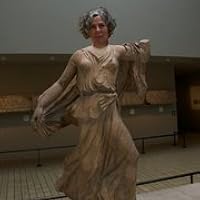
Eminent Australian poet. A rare proponent of the verse novel. Winner of The Age Book of the Year for poetry, and the National Book Council Award, for her verse novel The Monkey's Mask. She was awarded the Christopher Brennan Award for lifetime achievement in poetry in 2001. Died of breast cancer, 2008.
A beautiful body of work, my favourites were The Ninth Hour, Spears and Tophet. I must add personal praise for the entire Jerusalem section- wonderful observation and consideration, simply lovely to read.
I think it's strange how few Melbourne-based poets I have read from. And to find this collection, published posthumously, it's a kind of sadness that is evoked. You want to learn more and find community and solace, especially as another poet.
"I hold in my hand the greedy, bleeding pen that has always gorged itself" (19).
'The Bee Hut' is a really bold collection of poems that Porter wrote before her death. In the collection you can taste her stubbornness and her love for the world around her as she writes of varying places, of Egypt, of Jerusalem. This collection feels like it is trying to capture every last memory before it is forgotten. It's almost painful, I felt I could sense her death - as a reader you knew it was coming even if you were unaware of her history.
"time is melting everything I remember into a soft silt shifting under the mud-mangrove smell of the bay" (74).
There are a number of powerful poems in this, and it's very clear you are lucky to read them. Encouraged to adventure into those small spaces that have brought you hope and love, even those as simple as a bee hut.
My favourites include: Blackberries (19) The Enchanted Ass (21) II. What a Plunge! (28) The Ninth Hour (37) Lucky (133).
I'm not big on poetry. I haven't read much and don't know enough about it to have an opinion on whether it is technically good or not, but I can safely say I quite liked this. I appreciated Porter's quick and insightful wit. There were some poems that really resonated with me, like NumbersMultiplex which were terribly clever, and The Bluebird of Death which was just a little bit too real and raw for me. The rest I didn't like as much, and I think this is largely because I have never really enjoyed poetry. That said, the subject matter was still interesting to me. I might get more out of it after a second reading.
Egypt A Walk in Kensington Gardens What a Plunge! Bluebottles Things The Ninth Hour Early Morning At the Mercy The Bee Hut Smelling Tigers Not the Same The Horsehead Nebula Waterview Street Early Morning Balloons Over Melbourne Fossil Ferns Last Aria From The Eternity Man
Oh, this was wonderful. Vivid and full of life and wonder and joy and questions of death and the beauty of things and places and love. Truly a fantastic read.
Hard to rate this as I know she’s a fantastic poet and I liked some of the poems but I just couldn’t relate to most of them and didn’t get many of the references.
I've previously reviewed poetry – some books, some poets – en masse but they were books and poets that I knew and loved. This is the first time I have chosen to read and review a book of poetry by a poet and with poems I’m not familiar with. Reading poetry can be very hit and miss. Something that speaks in whispers to one person might speak to another in a scream or not speak to them at all. For the most part, this book was like a recording that needed the volume turned up. Sometimes I could make out what was being said but mostly it was too quiet.
Dorothy Porter died in 2008 and The Bee Hut was published after her death, bringing together poems from the last five years of her life. Because it was published after her death, I wondered if part of the reason why I couldn’t find as much magic in these poems as I want to find in poetry is because she never had a chance to review, to revise, to change her mind, to exclude, to re-order the poems, that maybe they were simply abandoned rather than finished through no fault of her own. I could only find one whole poem of brilliance, which this extract was taken from:
and any gay, determined to make their own way, will tell you straight – blood is no reliable home nor fix against intolerance. From “Sister-in-Law”
The rest of the poems had a sense of almost rhymes (something that drives me bananas) and felt like an endless exercise in name dropping – of other poets Porter will never be in same league as and countries around the world she extensively travelled to – but there are moments of brilliance:
We were never married, Dido. Believe me, I’m sad too that you can’t sweeten me and I can’t comfort you. From “Aeneas Remembers Domestic Bliss”
Every poet wants to write the poem that penetrates with the ice-cold shock of the Devil’s prick. The poem that will fuck you awake or kill you. From “Three Sonnets”
I am not here silent and alone Do you hear the fighting hiss of this geyser in me? I stand my ground in the undaunted spray and company of my own words. From “The Ninth Hour”
It heartbreakingly ends with the last poem Porter wrote from her hospital room before her death and confirms that despite her challenges, she was more often than not happy, satisfied and aware of her general good fortune:
Something in me despite everything can’t believe my luck. From “View from 417”
It’s the nature of poems that once we know the subtext, they often get better but without that knowledge, the meaning and the poignancy can elude us. They have eluded me a little here. But there were enough small moments to save The Bee Hut from me not liking it at all.
I quietly debated if I should write about a poetry collection. I am a novice when it comes to poetry reading but I know what I like. I have a love-hate relationship with poetry. I get frustrated with poets who seem to go to great lengths to make their poetry incomprehensible to anyone but themselves. There is poetry I would love to learn to understand such as David Malouf’s poems but he alludes me for the time being. His novels are far more pleasant for me to digest right now. I dislike performance poetry but swoon over a good concrete poem.
One of the first collections I bought was The Bee Hut by Dorothy Porter. It was my first experience of Porter’s work and I have yet to go back to her earlier works (but the good intentions are there). This collection happens to be the last she wrote before she died of breast cancer in 2008. There is a brief but touching forward by her partner, Andrea Goldsmith. Andrea states that Porter would weekend at a friend’s farm during the time she was undergoing treatment and was fascinated by an old hut on the property that had become home to a colony of bees. The title poem speaks of the strange attraction she has to the bees in The Bee Hut:
Entranced my bare hand wants to plunge through a hole - now a buzzing lethal highway - in the shed wall. Some poems are easier to read than others. My mythology is not up to scratch so anything that references the gods goes over my head but they are still beautiful to read. There are poems that reflect her deepest, melodic thoughts of everyday things such as Early Morning Balloons Over Melbourne:
Unearthly in the chill blue they hang, silent coldly lovely until there’s that lurching belch of gas fire and suddenly they’re everything I’m afraid of - heights, ice, other people in rocking space, my own helpless helpless fragility. There are poems about her travels to places like London and Africa, poems inspired by other poets and finally poems that speak of death.
The last poem is called View from 417, one written in her hospital room two weeks before shed died. This poem is surprisingly positive. She writes of the lovely buildings she can see from her window:
exorbitantly flamboyant for a hospital room landscape Something in me despite everything can’t believe my luck."
Dorothy Porter a well known Melbourne writer and poet died in 2006 after a long battle with cancer. This collection of her poems was written during her last two years while she mixed period of stay at the Mercy Hospital with a last travel overseas to some of her favourite places in the Mediterranean and the middle east.
In all her published work Dot was a gritty and formidable writer who faced life’s central issues unflinchingly. Each of her final poems are like diamonds of the most brutal simplicity.
One of my favourites is Egypt. It has an extraordinary simplicity reflexing on the passage of time and the constancy of the inner self. Read it for yourself.
The most powerful presence is absence. When the pyramid dissolves you will keep its shadow, its deep rich space in you.
For connoisseurs of Australian poetry, this is the finest work of its type in the last 5 to 10 years and will undoubtedly win a slew of literary awards.
This is the first book of poetry that I've ever read as an adult. Well unless you count Yertle the Turtle, and The Lorax. But then most people probably won't. I'm not a poetry reader, it must be said. I don't understand it. I don't see the point of it a lot of the time, and I don't think I'm capable of changing. I realise that the fault is mine and not the poets, but I don't think I'm up to it. Still, I did enjoy the act of reading this book. I'm glad I read it. I don't know that I learnt anything. Again, the fault lies with me, not the author. I did enjoy some individual poems. I can tell that the author is clever, she is learned and insightful. But somehow the form makes it rather inaccessible to me. If the same sentiments were written in prose, I suspect that I'd think she was brilliant. There were a lot of arcane (to me) references. I did most like a poem called Wine, which ends
Even the gibbering homicidal troll under every life's bridge can be stalled with drink.
Modern Australian poet. Focus on mortality. Not surprising given it was written between diagnosis and treatment for cancer(successful) and her death 5 years later. I have to admit I am not a fan of most modern poetry and this is not an exception. I pity the kids who have it as a school text. Many references to classical poets , which I feel cannot be appreciated without also reading their work (Keats, Blake, Wordsworth to name a few). I some times got the impression that the occasional profanity was put in deliberately to "shock". It feels like it doesn't actually fit. Writers seem to forget that those words are no longer shocking they just come across as crass and out of sync. I gave an extra star because the poems were short. I like short poetry.
I was privileged to launch this book at the Melbourne Writers Festival. In my speech I called the poems 'Incandescent with and vitality so intense, so stubborn, and so erotic in the broadest sense of the word that the lines almost quiver on the page... The sense of danger embedded in joy and freedom, the almost carnal temptation of risk is a theme that runs through a number of these poems including the one that gives its name to the collection.' Vale Dot. We miss you.
The bee hut poem itself is my favourite. Its simplicity, believability or just the feeling that it is a little window on life is appealing. Some of the poems are just litle clever and contrived for me.
I enjoyed the poetry in this book. Some sections I preferred more than others. I particularly enjoyed 'The Enchanted Ass' section. Dorothy Porter's poetry can be a little too complex at times but it is worth the read. She is a master of words. I give this book 3 and a half stars.
The Bee Hut is a book of poetry that first inspired me to want to write poetry. The sensory descriptions are beyond amazing and immerse you in Dorothy Porter's world. I loved her use of words that take you away to another world. Inspiring!