Kathryn Lasky Knight (born June 24, 1944) is an American children's writer who also writes for adults under the names Kathryn Lasky Knight and E. L. Swann. Her children's books include several Dear America books, The Royal Diaries books, Sugaring Time, The Night Journey, Wolves of the Beyond, and the Guardians of Ga'Hoole series. Knight grew up in Indianapolis, and is married to Christopher Knight, with whom she lives in Cambridge, Massachusetts. She received a bachelor’s degree in English from the University of Michigan and a master’s degree in early childhood education from Wheelock College.[1] She is also a non-fiction writer of other books.
Well, as an abridged version of the original, it's probably more readable, but it's still pretty... eh. I mean, it's one of the most illustrated books I've seen that's not a graphic novel and is more than 48 pages long, but...
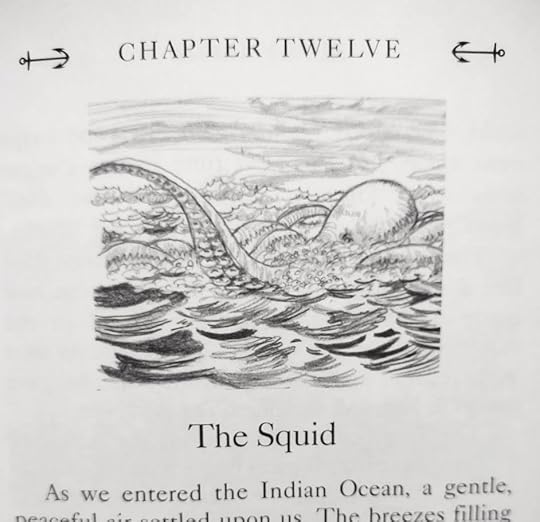
I know Ishmael makes this big stink about "I refuse to believe anything that lives its entire life in the water is not a fish" (so, I guess, crabs, sponges, "squids"... ALL FISH), but I think even HE knew the difference between a squid and an octopus? Especially since the whole crew called it a squid? (I still strongly dislike when the artist has a disconnect with the text.)
Like, I understand how it's a "classic"—no doubt it's one of the best books from the time period and accurately representative of the whaling industry at the time. It just put me to sleep is the thing, besides the racist portrayal of Queequeg and, to a lesser extent, Tashtego (mostly as Tashtego has significantly fewer lines). There are ways to write accents without stereotyping, especially since Queequeg and Ishmael become such close friends that one would expect him to be treated more respectfully!
Also, this version apparently modifies at least a few things to make it a "children's classic"—Ahab breaks his pegleg and needs another, yet in the original, Ahab took some rather specific damage that isn't mentioned in the children's version. No doubt there are countless other such details in the *700+ page* version that the editorial staff for this version said, "Yeah, we can cut that." I mean, really, the book could reasonably reduce to "Man hates whale for eating his leg and wants revenge but dies trying to get it"... (spoiler, haha... if you didn't know that, I don't know how you managed to avoid it in English Literature class)
Probably the actual whaling parts are the most interesting bits of the book, where they process the whale much like in Drifting Dragons (probably a strange reference, but it's the series I'm more familiar with showing the dissection and breakdown of large hunted animals). I guess the greater the divide between the upper and lower classes I see in real life, the more interesting "just go out and survive in the wild" becomes to me, haha. (Ha.)
Recommended as a cheat to get the gist of Moby Dick for English Literature tests, I guess.
A young man named Ishmael decides that he wants to work on a whaling ship. Ishmael signs up to hunt whales on the ship "Pequod". The ship's captain, Ahab, has had a previous encounter with a giant white sperm whale known as Moby Dick. Captain Ahab is totally intent mentally with the capture and killing of Moby Dick. Ishmael sailed for two years before Captain Ahab encounters Moby Dick. This classic was condensed and adapted for the reader ages 9 to 12. This particular edition has very vivid illustrations to accompany the classic storyline.