Jump to ratings and reviews
Rate this book

The Oxford History of the United States #5

What Hath God Wrought: The Transformation of America, 1815-1848

Rate this book
The Oxford History of the United States is by far the most respected multi-volume history of our nation. In this Pulitzer prize-winning, critically acclaimed addition to the series, historian Daniel Walker Howe illuminates the period from the battle of New Orleans to the end of the Mexican-American War, an era when the United States expanded to the Pacific and won control over the richest part of the North American continent.

A panoramic narrative, What Hath God Wrought portrays revolutionary improvements in transportation and communications that accelerated the extension of the American empire. Railroads, canals, newspapers, and the telegraph dramatically lowered travel times and spurred the spread of information. These innovations prompted the emergence of mass political parties and stimulated America's economic development from an overwhelmingly rural country to a diversified economy in which commerce and industry took their place alongside agriculture. In his story, the author weaves together political and military events with social, economic, and cultural history. Howe examines the rise of Andrew Jackson and his Democratic party, but contends that John Quincy Adams and other Whigs--advocates of public education and economic integration, defenders of the rights of Indians, women, and African-Americans--were the true prophets of America's future. In addition, Howe reveals the power of religion to shape
many aspects of American life during this period, including slavery and antislavery, women's rights and other reform movements, politics, education, and literature. Howe's story of American expansion culminates in the bitterly controversial but brilliantly executed war waged against Mexico to gain California and Texas for the United States.

Winner of the New-York Historical Society American History Book Prize

Finalist, 2007 National Book Critics Circle Award for Nonfiction

The Oxford History of the United States
The Oxford History of the United States is the most respected multi-volume history of our nation. The series includes three Pulitzer Prize winners, a New York Times bestseller, and winners of the Bancroft and Parkman Prizes. The Atlantic Monthly has praised it as "the most distinguished series in American historical scholarship," a series that "synthesizes a generation's worth of historical inquiry and knowledge into one literally state-of-the-art book." Conceived under the general editorship of C. Vann Woodward and Richard Hofstadter, and now under the editorship of David M. Kennedy, this renowned series blends social, political, economic, cultural, diplomatic, and military history into coherent and vividly written narrative.

928 pages, Paperback

First published October 29, 2007

691 people are currently reading
11567 people want to read

About the author

Daniel Walker Howe

14 books69 followers
Daniel Walker Howe is a historian of the early national period of American history and specializes in the intellectual and religious history of the United States. He is Rhodes Professor of American History Emeritus at Oxford University in England and Professor of History Emeritus at the University of California, Los Angeles. He received the Pulitzer Prize for History for What Hath God Wrought, his most famous book. He was president of the Society for Historians of the Early American Republic in 2001 and is a Fellow of the Royal Historical Society.

Howe graduated from East High School (Denver, Colorado), and received his Bachelor of Arts at Harvard University, magna cum laude in American History and Literature in 1959, and his Ph.D. at University of California, Berkeley in 1966. Currently he resides in Sherman Oaks, California and is married with three grown children.

Howe's connection with Oxford University began when he matriculated at Magdalen College to read Modern History in 1960; he took his M.A. in 1965. In 1989–1990, he was Harmsworth Visiting Professor of American History at Oxford and a Fellow of Queen's College. In 1992, he became a permanent member of the Oxford History Faculty and a Fellow of St Catherine's College, Oxford until his retirement in 2002. Brasenose College elected him an Honorary Member of their Senior Common Room.

Ratings & Reviews

What do you think?
Rate this book

Friends & Following

Create a free account to discover what your friends think of this book!

Community Reviews

5 stars
4,038 (46%)
4 stars
2,844 (32%)
3 stars
1,270 (14%)
2 stars
388 (4%)
1 star
188 (2%)
Displaying 1 - 30 of 507 reviews
Profile Image for Michael.
1,094 reviews1,969 followers
November 26, 2015
This is not a popular history, but a scholarly treatment consistent with it being a component of “The Oxford History of the United States”. Thus, there is more here than an average reader can comfortably digest. It’s written well enough to flow well, and the author keeps touching base with the big picture and with themes and angles on key events and people that mark his own contribution. In such a well-trod arena he does a good job standing of the shoulders of giants while keeping all the scaffolding out of sight as copious references. It fulfilled a need for me to get a handle on my ignorance of a 30-plus year gap between the War of 1812 through the Mexican-American War (1846-48). As bookends to this period I have read a significant number of books about the American Revolution and its aftermath and a whole lot of fiction and non-fiction about the Civil War and the American West in the last half of the century. My reading from the period has almost entirely been about either the Napoleanic Wars in the fiction of O’Brian and Cornwell or tales of pioneers, explorers, and mountain men by Guthrie and McMurtry (“The Big Sky”, “The Berrybinder Narratives”).

A lot happened in this 30-plus year gap, things that take the tarnish off my pride with the pioneers and Founding Fathers. Especially notable was the deadly removals of most of the Indians east of the Mississippi (think “Trail of Tears”) and the acquisition most of the American southwest and California from Mexico as the spoils of a war we started. How did we get to such a virtual genocide and imperialist takeover when we started out collaborating pretty well with the Indians and threw off the reins of British monarchy while harnessing ourselves to the noble words of “inalienable rights” and “all men are created equal”? In Philbrick’s “Mayflower” I learned of peaceful relations with the Indians for about 100 years, and in Ambrose’s “Undaunted Courage”, I was left amazed how the Lewis and Clarke explorations in the Louisiana Purchase was welcomed by many tribes and was almost entirely violence-free. The hopeful prospects of peaceful coexistence were dashed pretty well to hell in this period. The birth of hemispheric hubris had its birth in this period with the formulation of the Monroe Doctrine in 1823, which asserted that no new European colonies in the New World would be countenanced. The other tarnish on our plucky little republic I sought to remove in this read concerns the mystery of why it took so shamefully long to end slavery and whether there wasn’t some chance to do it without the Civil War.

What I learned is that there is some sort of inevitability to history, that in the words of a David Mitchell character “the weak are meat the strong do eat”. But I was refreshed that there was always an undercurrent to adverse tides that flow toward the good. I also treasured was certain villains I could have every right to curse and on heroes I could root for. Andrew Jackson, the one most responsibly for the Indian removals, and James Polk, the mastermind for the great Mexican ripoff, make for great bad guys for my personalized narrative (unfortunately nicknamed for my favorite tree, “Old Hickory” and “Young Hickory”). For heroes who sought to stem the flood and moral fallout of Manifest Destiny I could cheer for John Quincy Adams and Henry Clay. The fertile chorus is sung by the likes of abolitionist Frederick Douglass, the father of Transcendentalism Emerson, and the early journalist and feminist Margaret Fuller. The first Chief Justice of the Supreme Court, John Marshall, also blazed bright on some key cases that carved out legitimate independent role for the judiciary as a check to abuses of the power of executive and legislative branches.


Jackson and Polk, my new targets for shame

Jackson is admired by many due to his ideals of individual sovereignty against the tyranny of the majority and corrupt power of the elite, core elements of the Democratic Party he founded. But ultimately he was a hypocrite and a demagogue. He got his juice from as a kickass military hero, though he was particularly brutal in his part in the Indian wars and overblown as a winner of the Battle of New Orleans. He got away with illegally invading Spanish Florida and executed prisoners. The engagement of the British in New Orleans in the War of 1812 turned out to be of limited import coming as it did after a peace treaty was already set in London. For public aggrandizement he successfully painted a picture as leading a brotherhood of crackshot Kentucky volunteers to victory, when in fact their militia bolted at a critical fight along a canal and were the subject of his official censure. His successes came from superior artillery and steady combat by local volunteers that included freed blacks, mixed Creoles, slaves, and French pirates. He reneged on his promise to repay the free blacks for fighting with land. He kept New Orleans unreasonably long under martial law and imprisoned a judge who declared it illegal. Such chicanery and disregard for law marked his presidency. His effort to kill the National Bank by removal of all federal funds and disbursement to “pet” banks without legislative approval earned him a formal censure by Congress, but he could scoff at that. It was his policies to encourage southern states to put the Indians under their laws and powers and to allow federal minions to force unfair agreements with the Indians and carry out poorly planned removal actions that led to the travesty and tragedy that resulted.


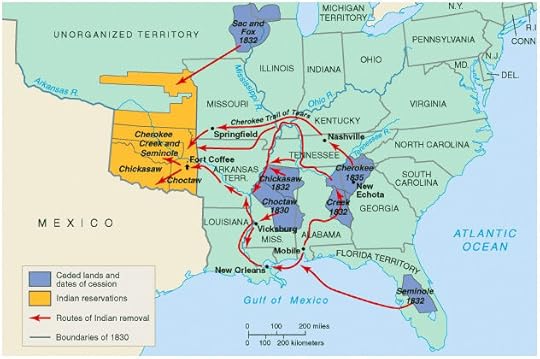
Indian removals involving about 46,000 people between 1830 and 1835

The forced travel of the Cherokees from Georgia to Oklahoma cost about 4,000 lives out of 12,000. The Creeks in Alabama wangled a deal for some to get land allotments and stay behind, but when whites took over these lands, the Creeks fought back. Between the heavy military response and their own trip to Oklahoma led to about a 50% mortality. The Chickasaws of Alabama agreed quickly to go, but they learned no space was secured for them when they arrived, so they had to buy a small reserve from the Choctaws. The Seminoles in Florida hid and fought back valiantly, but to no avail. The cost of the U.S. war with them was ten times more than what the whole cost of all the removals was supposed to be. In terms of decimation, the Sac and Fox tribe was decimated the most. Out of about 2,000 only 150 survived when their efforts to get away from enemy Sioux by slipping into Illinois was taken as hostile and worthy of a massacre. In all the U.S. got 100 million acres from the Indians, including a lot of rich farmland, in exchange for 50 million acres of poor land in Oklahoma and total expenses of $70 million. Quite a bill for a party which wanted small government and taxes as invisible as possible. But happy for voters to be able to get cheap land for tobacco and cotton plantations.

Polk came into office with the goal of expanding U.S. territory to the Pacific Coast. He wanted the Brits out of much of the Oregon Territory, which was under common occupation. He also had a secret mission to acquire California from Spain somehow. The cheap deal to take Florida in 1819 made a precedent to strip Spain of its holdings. Texas declaring independence soon after Mexico gained independence itself from Spain provided Polk with annexation of the region as a state. Rather than accept the Nueces River as the southern boundary of Texas, he made a claim for the Rio Grande for the boundary and sent troops there. The expected skirmishes with Mexicans who saw them as invaders kicked off a war that Polk planned in advance to take advantage of. Despite having no standing army, it took only a surprisingly modest number troops and volunteers to New Mexico and California to defeat the meager military outposts Mexico had in place. The young Mexican government was poor and unstable, but they refused to submit to a forced sale of the vast regions under our occupation.

Polk chose well when he picked Winfield Scott to mount an assault on the capital to force a defeat. His amphibious invasion at Vera Cruz is admired by all military historians, a scale of attack not seen again by the U.S. until D-Day. While Gen. Zachery Taylor bogged down while driving down from Texas, Scott was effective in following the path of the Conquistadors in taking Mexico City, with little pillaging or bombings of the civilian population. I got a kick out of the role of Robert E. Lee as an engineer who devised brilliant ways to sneak the army across lava fields and around well-defended chokepoints (a story portrayed wonderfully in Michael Shaara’s “Gone for Soldiers”). I was pleased to learn how much public and political outcry there was against the war. The Whig Party couldn’t get muck traction from the voters however. Politically, Polk balanced conciliatory negotiations with the Brits in the northwest, i.e. letting them have British Columbia over the “54-40 or fight” crowd, against the favorable outcome of the Mexican War. The acquisition of future states of New Mexico, Arizona, Utah, Nevada, and California for about $18 million was a bounty that fed into the sea-to-sea Manifest Destiny conception that moralistic opponents could not reverse. Polk showed a bit of slime by treating his winning generals poorly and by giving his ambassador Nicholas Trist the boot for taking the unauthorized initiative to pull off the treaty and for not including even more territory, specifically Baja California. in the cession. Another black mark for me is that he mouthed the words of deploring slavery but even while in office quietly acquired a bunch for his Kentucky plantation


The new lands and new states being formed out of the Louisiana Purchase made the whole conflict over slavery worse as political forces wrangled over how many would be slave states or free, which affected the balance of power in Congress. For a long time a “gag rule” was applied that permitted no petitions or bills affecting slavery in existing states to even be introduced in the legislature. The post office won the right to block mailing of abolitionist literature to the south. The Democrats could keep a strong coalition of southern slave holding planters and northern working class voters who feared competition for jobs from freed slaves. To be a national party the Whigs had to rein in the antislavery sentiments of their northern more middle class constituents and push for gradual compensated emancipation to placate southern voters. The absurd scheme of making a homeland for freed slaves was another serious dream pushed by politicians as far back as Monroe. A few cases of violent resistance among blacks to their status (e.g. Nat Turner’s Revolt) were subject to massive retaliation and permanent paranoia of a slave revolution as seen in Haiti or the British West Indies. Slavery was just too much of an economic benefit to give up. Combined with the high horse of states’ rights, it was unlikely that any federal legislation or Supreme Court decision could hold any sway. South Carolina and other southern states kept trying to exercise the right of states to nullify any federal law they deemed unconstitutional, so the seeds were sown for a crisis of secession over any federal constraint on slavery. The Civil War seems to have been inevitable. Still, it was uplifting to see the ferment of many people and factions to end slavery.

Other warm feelings from this history come from many elements explored in its 800 plus pages. Innovations like the telegraph, canals, railroads, mass printing, and key manufacturing processes. A renaissance among writers and journalists. Experiments in utopian communities. The amazing diversity in religious movements provided support both for white supremacy among some groups and for universal rights among others. Overall, the author finds millennial thinking affected most of the populace and fed into the conception of America as a proving ground for humanity to usher in the Second Coming or to create the heaven on earth. The white Protestant dominion soon had to accommodate a lot of Irish Catholic immigrants after the potato famine and Hispanics residing in the new acquisitions. The God Rush in California drew polyglot, multicultural populations to our shores that helped raise the concept of the U.S. as a fertile melting pot. The revolution in public education saw more women expanding their minds and ambition through school. The book ends with a meeting of early feminists at Seneca Falls New York to forge a revised Declaration of Independence, one with women added to “all men are created equal” and assertion of their rights to work, own property, and vote.

All in all a solid read that helped dispel much ignorance on my part. Personally, having grown up in Oklahoma, I can better appreciate the sad story of how so many tribes got corralled there. As a former resident of Texas, I can appreciate how a Republic of Texas came about and then got annexed. As a current resident of Maine, I can better understand how it came to pass it was occupied by the British in the War of 1812 and later played a part in the manufacturing revolution linked to the water power of its rivers. And as an American citizen, I have gained a clearer narrative for heroes and villains in its evolution toward becoming a powerful nation, one with a lot of blood woven into its tapestry but full of inspiring and colorful threads.
Profile Image for Dmitri.
250 reviews244 followers
May 4, 2025
“Our country! In her intercourse with foreign nations may she always be in the right, but our country, right or wrong.” - Commodore Decatur, 1815 after his defeat of the Barbary Corsairs

“Beware how you give a fatal sanction in our republic to military insubordination. Greece had her Alexander, Rome her Caesar, England her Cromwell, France her Bonaparte and if we would escape the rock they split we must avoid their errors.” - Henry Clay, 1819 in a Congressional debate after Andrew Jackson attacked Spanish forts in Florida against presidential orders

“This question, like a fire bell in the night, awakened and filled me with terror. I considered it at once as the knell of the Union. It is hushed for the moment but this is a reprieve only, not a final sentence. My only consolation is that I will live not to weep over it.“ - Thomas Jefferson, 1820 in his support of the compromise extending slavery to Missouri

“Do they think that I am such a damned fool as to think myself fit for President of the United States? No sir, I know what I am fit for. I can command a body of men in a rough way, but I am not fit to be President.” - Andrew Jackson, 1821

“The occasion has been judged proper for asserting, as a principle in which the rights and interests of the United States are involved, that the American continents, by the free and independent condition which they have assumed and maintain, are henceforth not to be considered as the subjects for future colonization by any European powers.” James Monroe, 1823

************

Daniel Walker Howe begins this Pulitzer Prize winning history on New Years Day in 1815 with Andrew Jackson leading US troops to victory over the British, unaware that the war was over and a treaty signed. His theme is that a communications and transportation revolution occurred leading up to the Mexican-American war, most significantly in the telegraph, railroad and steamboat. By 1848 the US had reached the Pacific after the conquest of Texas, New Mexico and California. Along the way Native American populations declined drastically, mostly from imported European and African diseases, but also from the assimilation or removal policies of Jackson and Jefferson before him. The conditions made land abundantly available.

Americans - Thomas Jefferson 1801-09
The Americans who farmed were plantation owners in the south but individual farming families in the expanding west. The lure of land motivated many who came to escape lives as tenant farmers in Europe, and new customs and thinking evolved. The typical landowner produced crops for personal use as well as for trade, and egalitarian ideas of Locke and Jefferson circulated. Large families were the norm, with the work divided between offspring. Free of social classes, their main adversary was nature: drought, pestilence and disease. For this the predominantly Protestant people turned to faith in God. In the second decade of the 1800’s religious revivals swept the country espousing a stern morality and focus on study of the Bible.

British - James Madison 1809-17
With the War of 1812 underway the typical tensions between Republican slave owners in the south and Federalist business owners in the north continued. When the British routed the American militia and set fire to Washington DC government buildings Federalists met in Connecticut to debate whether to secede from the Union and make a separate peace. Jackson became celebrated for defeating the British at New Orleans. News of the peace reached the government after news of his triumph and it was assumed he had won the war. Ships at sea were still at war six months after it ended in places as far flung as Java. It was agreed to cease fighting but resolved none of the issues: sea trade, sailor impressment and the boundaries with Canada.

Native Americans - James Madison 1809-17
With peace came prosperity. Napoleon defeated, trade with Europe resumed. Native Americans could no longer play off the US against the French and British. Tecumseh’s Indian Confederacy was routed in Ontario and Alabama putting an end to the native military power. Howe sees both wars as a program to establish US supremacy, not only over natives but a diverse multicultural society in the southwest. In 1815 the US sent a fleet to the Mediterranean and finished off the Barbary corsair pirates preying on American ships. President James Madison, ‘The Father of the Constitution’, argued to develop American industry by linking the country together with roads and canals, with infrastructure badly needed, and setting tariffs on imported goods.

Expansions - James Monroe 1817-25
Madison ultimately vetoed the development bill and he was succeeded by James Monroe in 1817. The war with Britain concluded, the US turned its attention to the land east of New Orleans, then a Spanish colony known as East Florida. It was a haven for escaped slaves and Native Americans driven off their lands by settlers. In 1818 it was invaded by Jackson and the US Army during the First Seminole war. Under the pretense of an Indian reprisal, Jackson marched along the Gulf Coast and burned villages, captured Spanish forts and occupied the panhandle. Spain’s presence was so weak that it ceded all of Florida in 1821. As the Secretary of State, John Quincy Adams negotiated the treaty and became the 6th President in 1825.

Foreign Policies - James Monroe 1817-25
In 1822 the US recognized independence of Mexico, formerly New Spain, and Gran Columbia (Columbia, Panama, Ecuador and Venezuela). Spain fought hard to retain its colonies but lost during the revolutions. In 1823 Monroe articulated what would become the ‘Monroe Doctrine’, that the US opposed ‘foreign’ interference in the Western Hemisphere, mostly written by Adams. Russia got into the game, claiming land from Alaska to Oregon, but was deterred by Monroe and Adams. Teddy Roosevelt later claimed American leadership in Latin America, backed the secession of Panama from Columbia, and began 36 years of banana wars. Eisenhower used the CIA to overthrow Guatemala, Kennedy tried in Cuba and Reagan in Nicaragua.

Developments - John Quincy Adams 1825-29
The Erie Canal connected the Great Lakes region to New York City in 1825 and made it the fastest growing center of US business, able to rival New Orleans with its waterways to the Midwest. Cotton production and slavery migrated from the east coast to Mississippi and Alabama. Importation of slaves was illegal before 1810 but was replaced by US born African-Americans. Between 1820-1840 cotton grew from 40-60% of US exports, rising to nearly 70% of the world supply in 1850. Most cotton was sold to Britain, but by 1815 textile factories were built in Maine and Massachusetts. The Panic of 1819, from a collapse in cotton prices, was the first US depression. The Missouri controversy over extending slavery threatened a civil war the same year.

Divisions - John Quincy Adams 1825-29
The Missouri Compromise set the 36th parallel as boundary to future slave states and was a precursor to the north-south conflict that would nearly end the union forty years later. Even Jefferson, against slavery in theory but a slave owner himself, sided with those who wanted to extend it. Missouri while north of the division was allowed slavery as part of the compromise. Religion was yet another point of contention. Although the Bill of Rights separated church and state in 1791 it was on a federal level. Established religion lived on until as late as 1833 in the northeastern states. As religion was disestablished it led to a revival and reform movements which argued for temperance, womens suffrage and slavery abolition by traveling preachers.

Indian Wars - Andrew Jackson 1829-37
Adams out of office in 1829, Jackson, the ‘hero’ of the War of 1812 and Florida conquest, became 7th president. He owed his victory to the three-fifths clause, which gave slave states added electoral votes and representatives in the proportion of the enslaved population. Both a slave owner and trader, Jackson had earlier been a frontiersman and Indian fighter, in addition to a general and politician. He ratified the 1830 Indian Removal Act banishing the natives of the southeast to territories west of the Mississippi. Having run on an anti-corruption campaign he packed federal offices with cronies, purging any who didn’t support him. An authoritarian who brooked no disloyalty, he is reminiscent of a recent president who has claimed to admire him.

Depression - Martin Van Buren 1837-41, John Tyler 1841-45
Secretary of State Martin Van Buren cast doubts in Jackson’s mind about the Vice President’s loyalty, to sideline him, and later won Jackson’s endorsement to become 8th President. The Panic of 1837 from land speculation and a cotton price crash led to a bank run and depression until the mid 1840’s ruining his re-election chances. The crisis was exacerbated by Jackson’s refusal to extend the central bank’s charter. Van Buren was succeeded by John Tyler after W. H. Harrison died a month into his term from a flu caught at his inauguration. Another Virginia slaver, Tyler still refused to reinstate the national bank. He annexed Texas in 1845 and later sided with the secession, serving in the Confederacy.

Mexican War - James K. Polk 1845-49
With President Polk in office, Jacksonian Democracy once again became the political philosophy of the day. Texas was now in the Union and manifest destiny was back in play. Polk successfully negotiated the border between British Canada and American Oregon Territory, making the US officially reach from sea to shining sea. Polk fixed his sights on Mexico where he sent army expeditions to the Rio Grande and Santa Fe, and sent the Navy to the Gulf of Mexico and Los Angeles. Repatriating Santa Anna from exile in Cuba to overthrow the Mexican government, Polk was promptly double crossed. Frustrated, he sent the US army towards Mexico City to negotiate the purchase of California and New Mexico at the point of a gun.

While this book helped fill in my personal gaps of American history and layed a foundation for future reading it wasn’t a joy to read. In some ways the issues are familiar and in other ways surprising. They still resonate in the US today: south against north, state rights against federal government. The legacy of Republicans and Federalists is not yet resolved. Half of Americans argue the primacy of state laws, the other that a national government should arbitrate disputes. After 235 years the oldest living democratic constitution still bears the contradictions and dissensions of an earlier age. Thomas Jefferson asserted the Constitution should be rewritten every twenty years, or each generation, an idea that was abhorrent to its author James Madison.
Profile Image for Tony.
1,030 reviews1,912 followers
January 15, 2016
"In America I saw more than America," Tocqueville explained; "I sought there the image of democracy itself, with its inclinations, its character, its prejudices, and its passions, in order to learn what we have to fear or to hope from its progress."

Tocqueville is quoted here, in this marvelous work of history, a statement made contemporaneous to the time examined (1815-1848), but one that would serve a look-around today. The quote also serves as a reflection of this very meticulous, insightful book.

There are Heroes and Villains aplenty here, and Daniel Howe doesn't waffle on who is which. He paints Andrew Jackson starkly, as a racist and bully cloaked in a tapestry of manners and custom. Yet, as Thomas Hart Benton warned, "I tell you, Hayne, when Jackson begins to talk about hanging, they can begin to look for ropes." But far worse was James Polk, impervious to the truth. This made me feel like shyly knocking on the door of the Mexican government and asking if we could give a few states back. Shame on us.

By sharp contrast is the portrait of John Quincy Adams, who continues to grow in my estimation. Adams appears and re-appears in this narrative, as if to assure us that America, in spite of it all, has a conscience and a beating heart. I was so taken with this book that about two-thirds of the way through I went back to check the dedication because who would Howe dedicate this lifework to. I found this: To the Memory of John Quincy Adams. That made me smile, and makes me smile now just thinking about it.

This is a period of American history of which I have read a fair amount. If that matters. Howe writes with certainty and some necessary cynicism, but also with humor. I think he gets it right.

_____ _____ _____ _____ _____

A book of this sort does its job, maybe, if it makes you want to read additional referenced books. This did. I will eventually read the rest of the 'Oxford History' series (this is my third), but there are also more books on Adams and Polk which now seem essential. And how could I resist 'Anne Royall's 1829 Trial as a Common Scold' by Elizabeth Clapp. I've TBRed A Notorious Woman: Anne Royall in Jacksonian America, but I wish for the discontinued title.

_____ _____ _____ _____ _____

I wonder if Vollmann intends to write about the Trail of Tears.

_____ _____ _____ _____ _____

Did you know that there were no 'cops' before 1844?

_____ _____ _____ _____ _____

Some of these I knew; some of these I didn't. But Taney is taw-ney; Quincy (as in John Quincy Adams) is quinzy; Santa Anna is san-TAH-na; and, he says, Thoreau was called THAW-roe. Really.

_____ _____ _____ _____ _____

Andrew Jackson arrived in Washington in 1829 in a carriage and left eight years later on a train. It's not just personalities here, but transportation, and banking, and religion (a lot), and the beginnings of feminism.

_____ _____ _____ _____ _____

Polk's war on Mexico, John Quincy Adams believed, reduced the Constitution to "a menstrous [sic] rag." He has to learn to say what he really thinks.

_____ _____ _____ _____ _____

I already had this and would have read it anyhow, but thanks to Michael and Caroline for the nudges. This is highly recommended.

Profile Image for Matt.
1,052 reviews31.1k followers
April 27, 2016
Imagine a vegetable that tastes pretty good (maybe you can do this, I can't). You eat this pretty-good-tasting vegetable and feel both satisfied and healthy.

Such was my experience reading What Hath God Wrought

(The title comes from Samuel F.B. Morris's famous line which he sent over the telegraph; as author Daniel Howe points out, the line was not in the form of a question).

This is a doorstop of a book, at 860 pages of text. It's part of the well-received Oxford History of the United States, of which I've only read MacPherson's Battle Cry of Freedom. It's a history of the US from 1815 (the battle of New Orleans and the end of the War of 1812) to 1848 (the end of the Mexican-American War).

The book is informative, lucidly written, and briskly paced. Due to its enormous scope, Howe paints with broad strokes. In the first part of the book, Howe argues that this period in America constituted a "communication revolution," which is a thread he never fully develops, choosing instead to pick it up and drop it off at various points. At the end of the book, he states he didn't set out to argue a thesis - which I'd disagree with; he set out to argue, he just failed - but rather he set out to write a narrative. Again, I disagree - this is not a narrative history, in the sense it tells a flowing, forward-moving story. Instead, it is a diverse analysis of various events, people, movements, and inventions. He talks about women, religion, slaves, literature, the theater, medicine, politics, the economy, with a little bit of fighting tossed in here and there. Howe devotes entire chapters to some of these subjects, with the result that there are chronological leaps (hence my contention this is not a narrative; or perhaps it is a series of small narratives). For instance, Howe has a chapter called "The Awakenings of Religion." In this chapter, he talks about revivals, millennial movements, the great preachers, e.g., Lyman Beecher, and the evolution of various religious sects. This calls for a separate timeline than the rest of the book; that is, he'll talk about religion during the presidencies of John Quincy Adams through James Polk, then in the next chapter, you'll be back in the presidency of Adams.

The book is exhausting in its determination to tell of this period of American history from all viewpoints. By which I mean the stories of women and blacks, usually relegated to special college courses, are thoroughly told. But don't worry, if you care about the travails of dead white men, they're all here.

At times, the breadth becomes too much, and you just want the book to focus. For instance, during the chapter on the Mexican War, Howe devotes several paragraphs to the role of women in the war. The brevity of the reference leads one to the assumption there wasn't much of a story to tell, aside from a probably-apochyphal story about a Mexican-War Molly Pitcher. All it does it break the flow of the story and forces Howe to toe the line between being a responsible historian and being politically correct.

The trouble with any book with academic pretensions is that it tends to come untethered from humanity. Howe avoids this pitfall by starting each chapater with vignettes of average people living during these periods, and by quoting freely from diaries. He also does a respectable job of giving thumbnail biographies of the "great" personages of his day. I especially liked his take on James K. Polk, which was quite even-handed. He showed him as one of our hardest working, most efficient presidents (in one term, he acquired more land for the US than any other president, including TJ's Louisiana purchase and Andy Johnson's purhcase of Alaska); but he also described Polk's petty, vindictive side, such as his conniving with southern racist/militia general Gideon Pillow to discredit Winfield Scott.

One of the great services of this book is tearing Andrew Jackson down from his pedestal and putting him in the pig pen where he deserves. For whatever reason, it's lately become okay to respect him. I don't understand this. The fact he's on the $20 is an insult. Thankfully, due to the economy, I don't have to look at his ugly, stinking, horse-like face. Howe shows Jackson for what he was: a barely-educated twit; a possible sociopath (the executions of Arbuthnot and Ambrister; his countless duels); a hypocritic adulterer; and an unreconstituted racist. I am convinced Jackson destroyed the Second Bank of the United States because he was too dumb to understand finance. The crowning achievement of Jackson's presidency was the Indian Removal Act, which led to the Cherokee Indians - who had developed white customs, a written language, and started farming, like we told them to - being forced to march to Oklahoma. This was the Trail of Tears. Thousands died. When he left office, Jackson said the greatest danger to America were abolitionists. He appointed Roger Taney, author of Dred Scott v. Sandford, to the Supreme Court. Dear Andy Jackson, thanks for your age of Democracy. Jerk.

Howe also does much to rehabilitate the reputation of John Quincy Adams. Here, Howe goes a bit overboard (he overplays his hand by dedicating the book to JQA). I suppose, though, it's understandable, since Howe wrote a book on the Whigs. John Adam's son was certainly a witty man. When it came to slavery, he called the Constitution a "menstruous rag." Indeed! Howe shrewdly positions JQA, and the Whig party, as the forebears of abolition and women's rights. Indeed, one young Whig named Lincoln went on to do pretty well with the Republican party.

Winfield Scott is also rescued from the dustbin of history and repositioned as perhaps the greatest American general of all time. Howe makes a decent case, though Scott was a Whig so Howe was probably biased. It is interesting, though, that Robert E. Lee, Virginian, who betrayed his country and helped lead an unconstitutional revolt against the Federal Government, is today revered and counted among our heroes, while Winfield Scott, Virginian, who stayed loyal to his country and created the Anaconda Plan that Lincoln used to strangle the South during the Civil War, is mostly forgotten.

The lasting achievement of this book is taking a long, hard, critical look at a mostly forgotten gap in American history. Now, I hope that Oxford will fill in the period between 1848 and 1861.

Profile Image for Anthony.
375 reviews153 followers
October 9, 2025
Uncomfortable Times

Author Daniel Walker Howe’s What Hath God Wrought focuses on America in its transformative years between 1815 and 1848. The book is an expansive and richly detailed exploration of one of the most dynamic periods in American history. Winner of the Pulitzer Prize for History in 2008, the book starts in the aftermath of the War of 1812 with the United Kingdom and ends with the Mexican-American War, emphasising the profound social, political, and technological changes that shaped the young republic during this period.

Howe challenges traditional narratives that view this period primarily through the lens of Andrew Jackson’s populist presidency. Instead, he offers a broader perspective, focusing on the rise of democratic ideals, market capitalism, and technological advancements, such as the telegraph (which inspired the book’s title). One of Howe’s most compelling contributions is his emphasis on the ‘communications revolution’ and its role in uniting a sprawling nation. Innovations like the telegraph, steamboats, and improved printing technologies not only transformed commerce and politics but also facilitated the spread of ideas, including those of reform movements like abolitionism, temperance, and women’s rights.

What Hath God Wrought also highlights the tensions that arose from these changes. Howe critically examines the contradictions of a society expanding westward while perpetuating the injustices of slavery and the dispossession of Native American peoples. His treatment of the Jacksonian era is particularly striking: while recognising Jackson’s role in expanding suffrage for white men, Howe is unsparing in his critique of Jackson’s policies, particularly the Indian Removal Act and his disregard for constitutional restraints.

What Hath God Wrought to me is essential reading for several reasons. Its scope is mesmerising as Howe weaves together political, cultural, economic, and technological history, creating a multifaceted portrait of a nation in transition. His perspective is also refreshingly balanced. Unlike works that glorify Jacksonian democracy, Howe provides a more nuanced view that includes the voices of reformers, intellectuals, and marginalised groups. This was of course a time is slavery, expansion west and war with all non white American groups on the continent. Furthermore, despite its length (over 900 reading pages), the book is accessible, with vivid descriptions and insightful analysis that bring the era to life.

However, it isn’t without its drawbacks. What Hath God Wrought’s dense and exhaustive approach can be overwhelming and by the end I felt that there was too much to take in. Therefore, if you are unfamiliar with the period you may feel like you may need a more concise narrative. Furthermore, while Howe incorporates diverse perspectives, critics have stated that there is a need for a deeper exploration of nonwhite and non-elite voices.

In the end, What Hath God Wrought is a masterful synthesis of scholarship that illuminates the profound changes shaping America during the early 19th century. Howe’s analysis is both critical and empathetic, offering a balanced and richly textured account of a complex era. For anyone seeking to understand the roots of modern America, this book is an essential read. Its exploration of technological innovation, social reform, and political transformation resonates deeply, making it not only a history of the past but also a reflection on the challenges and opportunities of societal change.
Profile Image for Christopher Saunders.
1,048 reviews958 followers
August 10, 2022
Even by the Oxford History of the United States’ standards, What Hath God Wrought is an impressive work of history. Daniel Walker Howe covers the period between the War of 1812 and the Mexican War, thirty-three years in which America experienced its most pronounced growing pains. During this time, the United States transformed from a small, struggling, largely agrarian country ruled by elites to a continental power, increasingly urban and industrialized, tentatively democratic - and riven, as ever, with racism, class differences and political discord. The era’s “internal improvements,” from canals and railroads to the telegraph, conquer the “tyranny of distance” in ways the Founding Fathers could scarcely have imagined. And with technological expansion came territorial ambitions, with American gaining land through diplomacy, expulsion of natives and wars with Britain and Mexican. Thus a small, fragile coalition of coastal states becomes a continental power in a remarkably short time.

Howe, the author of works on the Whig Party and 19th Century evangelical movements, allows those fields of study to influence his narrative. He praises Henry Clay, John Quincy Adams and other Whig leaders as the true visionaries of America, with their emphasis on national development and social betterment (their elitism and often antidemocratic tendencies are heavily downplayed). Meanwhile he demotes Andrew Jackson to an autocratic, racist rabble rouser posing as a populist democrat, channeling America’s worst impulses into government. It’s hard not to share Howe’s conviction in passages highlighting Jackson’s imperious personality, autocratic governing style, crooked cronyism, violent rhetoric towards his opponents and support for slavery and Indian Removal. The Jackson Administration, in short, serves as a perfect (and unsettlingly familiar) encapsulation of demagogy disguised as democracy. Of course, it was much easier for Democrats, with their appeals to the mob, to win elections than the Whigs, a fragmented coalition of anti-Jacksonians whose only two elected presidents died in office.

Perhaps Howe overstates his thesis in a few particulars, and he has a tendency to overemphasize religion even in contexts where it’s little warranted (especially when he proclaims, in a singularly bizarre fillip, that the conquest of California was part of God’s plan to defeat Japan in World War II!!!). This broad approach does, however, allow Howe to explore subjects often relegated the historical margins: unorthodox religious movements from Mormonism to the Unitarians, utopian communities and political eccentrics, development of African-American culture both in and outside of slavery, reactions of Native Americans to waxing settler power, riots at home and filibustering abroad. Particularly interesting is the emergence of a broad-based progressive movement: abolitionists and egalitarians, feminists and opponents of imperialism informed, Howe argues, by the Whiggish politics and religious liberalism he celebrates. Howe brilliantly ties together all these disparate threads, creating a muscular portrait of early America: a country as ambitious, sprawling, divided and certain of its own Manifest Destiny as ever it was.
Profile Image for robin friedman.
1,945 reviews415 followers
May 23, 2024
Daniel Walker Howe On The Transformation Of America

In "What Hath God Wrought" historian Daniel Walker Howe offers a learned and judicious overview of the political and cultural history of the United States between 1815 -- 1848 which he aptly describes as "The Transformation of America". The book covers the history of the United States beginning with Andrew Jackson's triumph at the Battle of New Orleans and concludes with the War with Mexico. I came to this book after reading a similarly through study of this period of American history by Sean Wilenz, "The Rise of American Democracy" (2005) Howe and Wilenz offer different perspectives on this transformative period of American history, and it is fascinating to compare the two.

Wilenz's book focuses on Andrew Jackson and on what is commonly called "Jacksonian America". Wilenz sees the transformative aspects of the 1815 -- 1848 period as rooted in the extension of sovereignty at both the national and state levels. For Wilenz, the Jacksonian era, for all its excesses and inconsistencies, marked a transformation from a United States based upon elitism, property and privilege to one based on Jeffersonian democracy to include all white males. Democracy is at the heart of Wilenz's narrative, and he shows how it was unable to keep the United States from falling into sectionalism and Civil War.

Howe takes a different approach to the nature of American transformation than does Wilenz. Howe rejects the term "Jacksonian America" or "Jacksonian Democracy" as covering this period. (p. 4) America was not "Jacksonian" in that Jackson's program was always controversial. Furthermore, the age was not "democratic" as witnessed by the policy of Indian removal, the expansion of slavery, and "the exclusion of women and most nonwhites from the suffrage and equality before the law." (p. 4) The expansion of the suffrage, for Howe, was limited to white males,and, in any event had began well before Jacksonian times. Thus, Howe has a major difference in perspective, in this way among others, from Wilenz. Late in his book, Howe summarizes the factors leading to the transformation of America as: 1. the growth of the market economy, facilitated by improvements in transportation; 2. the increasing vigor of Protestant churches and other voluntary associations; 3. the emergency of mass political parties offering options to the electorate. The communications revolution multiplied the effects of these factors. (p. 849)

Howe's political heroes are opponents of Jackson and the Jacksonian democrats, especially John Quincy Adams, to whose memory the book is dedicated, and, as it seems to me, Henry Clay.

Howe emphasizes the revolution in communication and transportation as leading to a strong, expansive United States and as changing radically the character of the nation. His key figure in epitomizing the new era is Samuel Morse, the inventor of the telegraph. The title of this book is taken from Morse's first message on the telegraph sent from Washington, D.C. to Baltimore on May 24, 1844. The Biblical phrase "What Hath God Wrought" shows, for Howe, a certain ambiguity. Taken as concluding with an explanation mark (!) it reads as a celebration of American expansion. But with a question mark at the end (?), as Morse subsequently recounted his initial message, it "unintentionally turned the phrase from an affirmation of the Chosen People's destiny to a questioning of it." (p.7) Howe's book shows an admirable mixture of celebration and questioning.

Howe frequently describes the contrast between Jacksonians and their opponents as involving a difference between quantitative and qualitative expansion. The Jacksonians expanded the franchise and individualism while they pushed the boundaries of the United States by removing the Indians, acquiring the Oregon territory from Britain, and making war with Mexico. For Howe, the Whigs and other cultural opponents of Jackson stressed a qualitative transformation of America. Their political-cultural program included internal improvements, (Clay's American system), educational and scientific advancement, moral and religious growth, and an attempt to capture American unity as opposed to the strife of party. Howe argues that America owes a great deal to the opponents of Jackson -- including the figure of Abraham Lincoln.

There is a great deal in Howe's book about religion as transforming America in what is known as the "Second Great Awakening." Howe emphasizes the role religion played in the abolitionist movement, in opposing the mistreatment of the Indians, in crusades for temperance, and in the development of the movement for women's rights. (In the concluding section of his book, Howe spends a great deal of space praising the 1848 convention for Women's Rights in Seneca Falls, New York.)

Howe's book shows an extraordinary amount of thought and learning, with extensive footnotes on every page and a detailed bibliographical essay at the conclusion. Of the many subjects he addresses, I thought his treatment of the War with Mexico particularly insightful. Howe is deeply critical of the expansionist, aggressive character of this war and of the president, James. K. Polk, who fomented it. Yet he recognizes that in "the long run of history" in some respects the seizure of California from Mexico worked for "the general interests of mankind." For Howe, "God moves in mysterious ways, and He is certainly capable of bringing good out of evil." (p. 811)

Howe's book, especially taken with Wilenz's impressive study, offers much for learning and for thought about the United States, its past, and its future. As Howe concludes: " Like the people of 1848, we look with both awe and uncertainty at what God hath wrought in the United States of America." (p. 855)

Robin Friedman
Profile Image for Max.
359 reviews536 followers
July 17, 2015
Howe takes us through America’s transition from a rural nation of family farmers to one in the throes of industrialization, urbanization, the communications and transportation revolution, increasingly diverse immigration, emerging religious plurality, millennialism, the birth of the women’s rights movement, powerful political parties and intense divisive politics, ethnic cleansing, imperialism, dependence on king cotton and slavery, and disingenuous self-serving presidents. By 1848, America had already become a nation the founding fathers could not have envisioned. Howe’s detailed and comprehensive recounting of US history from 1815 to 1848 digs into the cultural and social issues as well as the economic and political. Two themes stood out to me: (1) greed as a primary driver of slavery, ethnic cleansing, imperialism and political divisiveness; (2) the impact of the Second Great Awakening and the transportation and communication revolutions on social values.

Slavery became firmly entrenched due to the immense profitability of cotton under the plantation system. Prior to this the evil nature of slavery and the idea of eventual emancipation were more widely accepted in America. But greed changes everything. It led to the virulent defense of slavery using the rationalization that blacks lacked the capacity to prosper on their own and that slavery was white paternalism. It led to the divisive politics that fought against the national bank and all government programs aimed at economic development, least the bank or government become powerful enough to challenge the slave owners. Those who would profit from more land to grow cotton, from breeding and selling slaves and from land speculation found their advocate in Andrew Jackson who fulfilled their wishes by taking that land from the Indians who were brutally removed. Later the need to expand slavery to protect the profits of plantation owners would empower James Polk to instigate a war with Mexico resulting in the deaths of tens of thousands and displacing most of the Mexicans in the captured territory.

The importance to the South of keeping the federal government small created deep political divisions. A polarized electorate made Jackson president in 1828 in what Howe called the dirtiest election in American history. The Jacksonian Democratic Party believed private enterprise and the sates alone were responsible for economic investment. Thus Jackson gutted the national bank which would not be authorized again until the South seceded. In opposition the defeated president John Quincey Adams and others who believed in federal government investment in America formed the Whig Party. The Whig’s were strongest in the industrializing North where businessmen believed the federal government should be an instrument of progress. The Democrats were strongest in the agrarian South where plantation owners saw the federal government as a disruptive force that could only damage their fortunes. This argument about the role of the federal government is just as divisive today as it was then.

Industrialization led to profound social change. Textile mills to process Southern cotton began sprouting up in New England employing young “mill girls”. While working long hours for low wages, this was still an opportunity for independence for women that had never existed before. The industrial revolution was accelerated by the transportation revolution. Canals such as the Erie Canal completed in 1825 and the railroads beginning in1829 made feasible production for distant markets. Factories began to displace family and village businesses leading to the creation of the middle class and the role of the housewife when women no longer were co-workers in the family farm or craft. Then the communications revolution took off with the telegraph in 1844 enabling a robust market economy connecting buyers and sellers instantaneously. The telegraph facilitated the formation of mass political parties and the rapid growth of social movements now that they could get their message out quickly. The country was launched on a trajectory of ever accelerating change.

The Protestant religious revival known as The Second Great Awakening began addressing social issues in order to prepare for the millennium when Christ would return. This reform movement provided an opening for free blacks and slaves to demand freedom and led to the founding of the African Methodist Episcopal church, the first denomination formed by African-Americans. Protestantism’s advocacy of Bible reading had significantly increased literacy, especially among women who now could take important roles in reformist churches and as authors advocating women’s issues. This led to the beginning of the women’s suffrage movement in 1848. That year the Seneca Falls convention began the struggle for woman’s suffrage. Nineteen year old Charlotte Woodward drove a wagon from her farm to attend. She would be the only original signer of the convention’s Declaration of Sentiments who would survive to vote in the 1920 election.

1848 was a watershed year in other ways as well. The addition of Mexican territories brought to a head national division over slavery beginning with the Wilmot Proviso and ending in the Civil War. A third event was the Irish potato famine which brought huge numbers of Catholics to Protestant America resulting in nativism, gang warfare and deep ethnic political polarization that also contributed to the war. Fourthly, the discovery of gold in California led to rapid development of the West and the first significant Asian immigration.

The old fights over federal government investment in “improvements” and tariffs to support industrialization fell by the wayside. Territorial expansion made slavery the dominant issue. The Whigs would give way to the Republicans. John Quincy Adams died in 1848 collapsing on the floor of the House where he was serving with fellow Whig first term Congressman Abraham Lincoln, symbolizing the transition into a new period in American history.
Profile Image for Tim.
1,232 reviews
May 24, 2014
October 2013 - Second reading - remarkable entry into the history of the time, full of details, synthesis and well-considered opinion.

I took a seminar with Howe and it was the finest classroom experience I have ever had. He is a wise and good man. The book provides a remarkable overview of the time between 1815 and 1848. Central to Howe's argument are the changes made to transport and communications that hastened all the other changes to American life during the time period: "The America of 1848 had been transformed in many ways: by the growth of cities, by the extension of the United States sovereignty across the continent, by increasing ethnic and religious diversity as a result of both immigration and conquest - as well as by expanding overseas and national markets, and by the intergration of this vast and varied empire through dramatic and sudden improvements in communications." (5)

What is not central to his argument is the creation of some new kind of democracy during this time. He is not a fan of Andrew Jackson and the "democracy" historians have claimed he created. For Howe, Jackson's opponents the Whigs were not aristocrats and agents of social control, but those interested in managing improvement, both to the self and to the nation. He finds them much more important to American thought and development (economic) than Jacksonian white supremacists.

In the end his account is put slightly off-balance by his dislike for Jackson, but it feels appropriate and right as a counterbalance to Schlesinger, Sellers, and Wilentz. I could wish for a little more criticism of the market and of the new capitalism, but that has been done elsewhere (especially, and maybe excessively, by the men already noted). Howe's distaste is evident in his writing about Jackson and Van Buren, where the writing remains engaged, if slightly less lively, as if he were completing a dirty job. But Howe is remarkable with intellectual life, cultural developments, the nature of Whig political thought, and the details and contours of religious life. If the book is not as breezy as the McDougall I finished earlier this year, its intellectual richness, depth of detail, and clear and well-thought writing is more than enough to keep my memories of the class with Howe alive. If I did not laugh out loud quite as much as with McDougall, there were many more intellectual amens with Howe. It is over eight hundred pages, but I look forward to sitting down and reading it again, very soon.
Profile Image for CoachJim.
233 reviews176 followers
July 1, 2020
What Hath God Wrought: The Transformation of America, 1815-1848
by Daniel Walker Howe

The invention of electric telegraphy, coming near the close of the period treated here, represented a climactic moment in the widespread revolution of communications. Other features of this revolution included improvements in printing and paper manufacturing; the multiplication of newspapers, magazines, and books; and the expansion of the postal system (which mostly carried newspapers and commercial business, to personal letters). Closely related to these developments occurred a simultaneous revolution in transportation; the introduction of steamboats, canals, turnpikes, and railroads, shortening travel times and dramatically lowering shipping costs. How these twin revolutions transformed American life will be the story told here. (Page 2)


“What Hath God Wrought” the title of this book refers to the first transmission by telegraph by Samuel Morse in 1844. The theme of this book is that the improvements in communications and transportation had major benefits to the development of the country.

This is a very dynamic time in the history of our country. Slavery was the pandemic of the times, white supremacy was rampant, religious furor was probably at its peak, the bitter partisanship of our political system took root, and we read about the birth of the Democratic party. This at a time when the literacy rate for the people of the United States was the highest in the world. Where the United States was the only place in the world where the literacy rate for women equaled that of men. These developments served the American nationalism and continental ambitions which are described here.

In this book we are introduced to Abraham Lincoln. Here the book keeps with its theme of improvements in transportation and communications. Lincoln first left home for a job clerking in the tiny town of New Salam. With no connection to any transportation the town ended a ghost town. This experience turns him into an ardent supporter of internal improvements.

The revolution in communication and transportation also helped the antislavery movement. The mass production of printed material made more people aware of the horrible existence of slavery in the United States. Also improved transportation allowed speakers to travel widely spreading their views.

There is a chapter about religions in the United States that I found a little boring, but I drudged through and found a couple of interesting points. One was that the various religious sects may have contributed some to the various divisions in the country. The other was some observations by visiting Europeans (Francis Trollope, Harriet Martineau, Francis Wright, Alexis de Tocqueville and Charles Dickens) that Americans seemed to be obsessed with the pursuit of the “Almighty Dollar”. This was at the expense of enjoying conversations or meals. (See Page 310)

Another chapter about religion revealed the way religion affected education. Public education was established in the New England states but not in the south. In some cases, early in the period, the education system was financed by government, but this was a protestant effort. With the increase in Catholic immigrants Catholic schools also looked for financing by the government, but the government refused the same aid to Catholic schools so they eliminated all financing for any religious institution.

A reader once mentioned that reading History frequently led to opening new avenues of interest. In my case this journey into early American history has introduced me to some interesting biographies. This book introduced Supreme Court Chief Justice John Marshall.

And then there was Andrew Jackson. I felt like I was reading a primer for the Trump presidency. My ignorance of this period is readily apparent in that I had no idea what this president was like or that he founded the Democratic Party. In a time of widespread protest over the killing of George Floyd in Minneapolis I read that this period had the removal of Native Americans from their historic lands in the Southern United States, and rabid White Supremacy. The importance of the Supreme Court goes without saying, but Jackson packed the Supreme Court with like-minded people thus perpetuating his ideas of State Sovereignty for years. I am not sure the writers of the Constitution saw that coming.

This book became very hard for me to read. The descriptions of and treatment of slaves and Native Americans, and just the overall description of white supremacy is not something I need to read again and again. Even some descriptions of the Abolitionist movement included the fact that the North did not advocate for emancipation because they were afraid of the Africans Americans moving north and taking their jobs. Likewise it is mentioned that the new territories resisted the introduction of slavery because of the competition for jobs and wages, and the Southern States were against the annexation or capturing of Mexico because they did not want all the Mexican people populating their country.

An interesting chapter describes an American Renaissance. The highlight here was a description of a Concord Massachusetts sect that included Emerson and Thoreau. For those with a religious bent it describes Emerson in a graduation speech at Harvard taking on John Locke. He challenged Locke’s philosophy when he said that religious faith came before, not after, any belief in the miracles described in the bible. “To aim to convert a man by miracles is a profanation of the soul.” (page 621)

This section is concluded with the statement:

The writings of the Transcendentialists affirm some of the best qualities characteristic of American civilization: self-reliance, a willingness to question authority, a quest for spiritual nourishment. Their writings, even today, urge us to independent reflection in the face of fads, conformity, blind partisanship, and mindless consumerism. (Page 626)


There are parts of that statement which seemed contradictory, but the last sentence stood out for me.

The chapter also includes a description of the early libraries. In a statement that should warm the hearts of any GoodReads members it says “by the 1840s, perhaps sooner, the United States possessed the largest literate public of any nation in the world history.” (page 627)

This is the third volume of the Oxford History of the United States I have read this year covering the late 18th and 19th centuries. This is the best of those 3, but it is a difficult book to review. I generally like historical surveys of periods I am unfamiliar with — it gives me a ten thousand foot view of the period. This book covered a lot of years and a lot of topics. Several of the topics were covered in depth which made for a long read. I picked some of the highlights that I found particularly interesting, but there were several that deserve more attention. Andrew Jackson’s defense of New Orleans, the annexation of Florida, the building of the Erie Canal, the Indian Removal program of Jackson’s, the annexation of Texas where we can relive the Disney version of Davy Crockett and the Alamo, and the War with Mexico which is describes as a rehearsal for the Civil War. There is an interesting detailed section at the end on the birth of the Women’s Suffrage movement.

The author ends with a summary that the aggressive imperialism of Americans was a result of their concern for the future. They wanted new land for the expanding population. But the desire was not just expansion of land it also included improvements in the quality of life. Dealing with the institution of slavery would have to wait.

History is made both from the bottom up and from the top down, and historians must take account of both in telling their stories. (page 853)
Profile Image for James Thane.
Author 10 books7,069 followers
May 21, 2013
This is the fifth volume in the excellent Oxford History of the United States, and the lengthy description of the book above provides a good overall view of the work; there's no real need to repeat all of that here. Howe has thoroughly mastered the literature of the period and he writes a compelling account of the nation's development during these critical years.

Howe's emphasis on the importance of the revolution in transportation and communications during the period seems spot-on. But in his sanctification of John Quincy Adams and his criticisms of Andrew Jackson, James K. Polk and their respective supporters, he seems a bit too willing to read back into the past the values of twenty-first century America.

There is no doubt of the fact that many early Nineteenth century Americans, if not the majority of them, often thought and acted in ways that would now be deemed politically incorrect if not downright shameful. But placed in the context of their own times rather than our ours, they may perhaps deserve at least a little more sympathy or at least a little more understanding than Howe is willing to allow them.
Profile Image for Jonathan.
222 reviews
February 21, 2008
This is a true cultural history, not merely a political or economic history as so much of the literature on Jacksonian America is. Daniel Walker Howe takes ideas and mediated experience seriously, and he has an especially good ear for religion, which is indispensable to a study of the period's politics (as Lee Benson showed many years ago).

Howe is an unabashed admirer of the Whigs. In fact, he rejects the term "Jacksonian America" -- rightly, in my opinion -- and even dedicates this book to the memory of John Quincy Adams. He pulls no punches in documenting the Jackson Democrats' contempt for the rights of women, blacks, foreigners, and Native Americans. Neither does he shirk from pointing out Andrew Jackson's self-absorption, rejection of the rule of law, and disastrous notions about economics.

(Howe is, though, less attentive to the ideas of some Democratic journalists and theorists than I would like. For that, I recommend Liberty and Power: The Politics of Jacksonian America by Harry L. Watson.)

This is a long book, but well-written. In many respects, I see it as a love letter to America -- not to a mythical America of virtuous subsistence farmers, pious orthodox Christians, or contented Negroes and dastardly Indians, but rather to the unpredictable, deeply flawed America that always has been -- and most of all, to the better and freer America that has always existed in the dreams of its citizens.
Profile Image for Susanna - Censored by GoodReads.
547 reviews703 followers
August 10, 2010
Very interesting. Certainly a different take on the time than Sean Wilentz' The Rise of American Democracy. The Presidents can be summed up suchly:

Madison & Monroe: intentionally opaque
Adams: high-minded
Jackson: authoritarian
van Buren: political fixer
Harrison: (fatally) long-winded
Tyler: WiNO (Whig in Name Only)
Polk: suspicious, acquisitive paranoid plotter

Howe is as nasty to Jackson as Wilentz was sweet; President Jackson only comes off well during the Nullification Crisis.

He also devotes a lot of coverage to religion in America; very important to an understanding of the time.
Profile Image for Richard.
225 reviews49 followers
March 10, 2012
This book covers about thirty three years between the end of the War of 1812 until the aftermath of our war with Mexico, in 1848. These years are sometimes considered by those with shallow historical knowledge to be merely the time which transpired from the early nineteenth century until the beginnings of the Civil War, but in fact it was a time of fundamental change in the country. Howe's work is sweeping in scope and minute in detail in its descriptions of the epic political and economic changes of the time, and always authoritative.

The primary driving forces of Howe's narrative are the twin revolutions which occurred in transportation and communications. Steam power led to the invention of the locomotive and the beginning of the end of the need for wind to propel ships. The invention of the electric telegraph decoupled communication from transportation; that is, communication speed was no longer limited by how fast an object could be physically transported. The book's title is taken from the message sent by Samuel F.B. Morse, a world class painter who dabbled as an inventor and put the telegraph to commercial use, in his message from Washington D.C. to Baltimore on May 24, 1844. Howe demonstrates that Morse's lifting of a quote from the Biblical book of Numbers was not an accident, as it reflected the opinions of many Americans who saw the huge expansion of the nation's territory by that date as the fulfillment of a providential (or heavenly) destiny. In practice, the telegraph lowered the cost of business transactions by providing an efficient alternative to what we would now call "snail mail"; enabled farmers and planters to sell their products in far-off markets; gave the new railroads an ability to schedule trains effectively; and facilitated the growth of newspapers, which in turn enabled the growth of political parties. Howe ascribes an importance to this development to be on a par with the internet revolution of the following century. American society was liberated from the "tyranny of distance" which plagued civilization for thousands of years.

This era is sometimes described as the "Age of Jackson", in recognition of the figure who dominated political thought, and, with his friend Martin Van Buren, built a political machinery which won, and held control of the presidency most of those years. Howe bristles at typical references to "Jacksonian Democracy", concerning the power of the popular vote in choosing a president for the first time, and the channeling of ideology into two dominant political parties. As Howe states, there was no democracy for the huge number of slaves, or for the great majority of free blacks living in the country; neither were women given the chance to participate in democratic elections. Howe early, and often, ascribes the focus of Andrew Jackson's presidency, reflected later in the administration of James Polk, as a dedication to the preservation and extension of African American slavery, and expropriation of Native Americans and Mexicans.

Andrew Jackson's primary goal at the start of his presidency was removal of the Indians living in the then American Southwest, that is, the Southern states east of the Mississippi River. Before the end of his two terms, he would use the powers of the U.S. government to dispossess about 46,000 members of a racial minority who he considered an impediment to national growth. His successor, Van Buren would expel a like number of natives; in return, they would gain 100 million acres of prime farmland for land speculators to sell to white settlers.

The fascinating rise of Jackson's political career is covered in detail in the early part of the book. Jackson became an instant celebrity for his defeat of a seasoned British armed force at the Battle of New Orleans in 1815. The War of 1812 was economically devastating for the Americans. There were some notable American naval victories against the British, but most land campaigns were failures, culminating with the humiliating loss and destruction of Washington D.C. to the Brits. Small wonder, then, that the public latched upon the general who won the greatest battle as the hero of the war. Jackson would eventually ride his popularity, as Washington had before, all the way to the White House; his accomplishment would be copied in the scope of this book, by William Henry Harrison, the hero of Battle of the Thames and Tippecanoe, and Zachary Taylor, the hero of Buena Vista.

Political alignments were in flux in the country when Jackson ran for the Presidency. The old two-party system of Hamiltonian Federalists and Jefferson Republicans had broken down. The Federalists had made a bad judgement in their opposition to the War of 1812 and had dissolved. After the War, James Monroe had enjoyed governing in the political vacuum of the Era of Good Feelings. His successor, John Quincy Adams, wanted to continue to govern by consensus, as Washington and Monroe had enjoyed, but his inability to rise to the challenges of his growing opposition ensured he would not be reelected. Jackson, running for the office in 1828, had no qualms about declaring warfare against those who stood in the way of his programs.

Essentially, what occurred was a division of the one political party, the Republicans, into factions by the time Adams left office. Defenders of his administration referred to themselves as "National Republicans", representing the continuing nationalism that arose from the experience of the War of 1812. By the time that war had ended, there were many, and Adams was their leader, who saw the shortcomings in the nation's transportation and manufacturing infrastructure as damaging to the country's war effort and impediments to future economic progress. The John Quincy Adams/Henry Clay faction was opposed by those who followed the banner of Jackson/Van Buren/John C. Calhoun, the pro-slavery Democratic Republicans, who believed in continuing the old state-rights tradition of the Old Republicans. By 1834, defections would occur in Jackson's now-named Democratic Party in response to the president's placing of the government's political power into the hands of his close friends, nicknamed the "kitchen cabinet", and his placing of the old National Bank's funds into the hands of bankers friendly to his administration. The political opposition to Jackson, with the addition of the disaffected Democrats, would adopt the name "Whigs", for the traditional term for critics of executive usurpations. As Howe states, the Whigs and Democrats would constitute the nation's two major political parties for the next twenty years.

The most spectacular expansion of American territory under the guise of Manifest Destiny occurred during James Polk's administration. Howe calls Polk the most successful President ever, due to his attainment of all of the ambitious objectives he established before his inauguration. He would ultimately successfully settle the Oregon question with Great Britain, establishing the present northwestern boundary between the United States and Canada; reduce the Tariff to a revenue basis; complete the permanent establishment of an Independent Treasury; and acquire California. The last goal was not even announced prior to the 1844 election. Polk was a master at keeping key points of his policies close to his vest. He masterfully carried on high-stakes diplomacy simultaneously with Great Britain and Mexico on the Oregon/Texas boundary issues and perfectly timed a settlement on Oregon to coincide with his invasion of Mexico. America would have a whole new Southwest by the end of Polk's first term, but his accomplishments would sink his presidency and make the Civil War inevitable. The very war which fulfilled the imperial ambitions of Polk and his Democrats created dissension in his own party; he was replaced by a Whig general, (Taylor), who had become a public hero. The acquisition of California would become a rallying point for the growing uproar over introducing slavery into new territories/states.

Howe's contention is that the Democrats dominated American policy during these years, but America's future was represented by the lineage of Whigs from John Quincy Adams to Abraham Lincoln, who favored a strong national government and economic modernization. The Whig tradition would also be the basis of more humane laws, provide more access to education, end the expansion of slavery and begin the process of greater equality for women.

The advances in transportation and communications, as Howe shows, greatly aided the spread of the religious revivalist movement we call the "Second Great Awakening". A result was a fundamental increase in the percentage of Americans who belonged to churches, and also to a reawakening of conscience among those who saw slavery as evil; the antislavery movement then fostered the women's movement. What seems obvious now was not even envisioned by the beginning of the nineteenth century. However, religion can push for conservative thinking as well as progressivism, and that is what happened in America in the wake of the great wave of Christian revivalism. The same dichotomy applies to political reform. The rise of mass political parties and popular voting for presidential electors broadened democracy, among those allowed to vote, but allowed white male supremacy to remain entrenched across the country. We can make change happen, but we cannot always know what will grow from it. Howe reminds us that history works on a long time scale.


Profile Image for Steve.
899 reviews274 followers
January 31, 2010
Couldn't finish it. It's one of those books that you can learn a lot from, but the author's bias, somewhere around page 400, really started to eat at me. Jackson is a controversial character, one who did some bad things, but when I'm reading about those bad things, I'd like the writer to stay on a tighter leash. After a while, Howe, when on the subject of Jackson, begins to sound shrill, especially so when he sets up Adams as some sort of gleaming counterpoint to Jackson's backwoods Sauron. Whatever, we all have our favorites. Jackson aside, I also think the scope of the book is just too great. It's a huge chunk of history to cover, and Howe means to cover it all. I think I'd like to read shorter books with smaller focus on particular events and people. But that's me.
Profile Image for Cindy.
304 reviews285 followers
August 3, 2011
33 years
855 pages (not including index)
9 presidents
12 states admitted to the Union
13.58 million people added to US
1563 references to slave/s
173 references to Mormon/s/ism
30,000 soldiers killed in the Mexican-American War (approx.)
1 month of reading
20 chapters
1 preface
1 afterword
200+ footnotes (approximately)
19 glorious maps

This is one huge historical review article about a period in U.S. history I knew little about.

I sadly have to downgrade this a star after my initial assessment. I talked it over with friends who are also reading this, and I think Howe gets overly repetitious in parts. My theory: he mentions in the footnotes that he reuses parts from his own previously published articles. Perhaps after the cut & paste, add in some more text, he wasn't as good at seeing those repetitions? I'm being kind of harsh, I guess. It wasn't that bad. But to ask a reader to slog through 900-ish pages, terseness is a virtue.
Profile Image for Athens.
76 reviews29 followers
June 29, 2016
In many ways, this is a very strong and well-written book. Howe's command of the subject and his capacity for work are not to be underestimated; not many could keep up with him in these areas.

His structured approach is strong and his use of language is above reproach, as it really must be to occupy any professorship at this level.

Those points made, I have some problems with this particular book.

PROBLEM ONE

My moment-to-moment quibble with Howe is that he does not appear to be actually writing anything.

Copious notes point exclusively to the works of other historians, never to an original source.

It is not much of a leap to conclude that this is a book extracted from a lot of other people's books, a gigantic college paper or encyclopedia article.

If you can accept this context, which I do now with reservations as noted, it is still worth the time to read, but in my view not a work of authorship.

Look at David Glantz some day. He is much more significant because he brings new light to his topics. There is no comparison.

----------------------------------------------------------------

PROBLEM TWO

Further in, I have another beef with the author, he seems to be addressing an audience of Chris Hedges and Amy Goodman followers. He does not address them exclusively nor constantly, but at every important opportunity, he seems to write: "see, I am the embodiment of doctrinal purity for a modern leftist".

At one point he writes: "When Andrew Jackson visited Lowell, Massachusetts, he admired the technology of the textile mills and showed no concern over the social consequences of industrialization. Perhaps his unconcern reflected the fact that the proletariat being created there was female."

Holy hell, what is this ax-grinding, spin-doctoring, rhetoric? Rarely has an author gotten so much leftist ass-kissing into so few words.

As another of many hundreds of examples: "Responding to the killing of two American merchant sailors by a gang of thieves on Sumatra, Jackson dispatched the USS Potomac to the scene with 260 marines."

I suggest you take some time and go look that up, the First Sumatran Expedition of 1832 was done in retaliation for the killing of many more than two Americans. Even if that fact is in controversy, he should at least have the respect to state that reputable accounts differ from his "America as heartless evil bad-guys" approach.

No doubt that Howe is a bright guy, and given his depth of knowledge I suspect that few could lock horns with him and come out victor in a technical argument. That said, I tire of his persistence in this regard.

-------------------------------------------------------------------


Profile Image for Paul.
95 reviews
August 4, 2008
This is a very well-written, thoughtful narrative history of American political, economic, and social development during a period of extraordinary change and national expansion. While Howe demurs that "this book tells a story; it does not argue a thesis" (p. 849), it is nevertheless fair to say that the story he tells argues the thesis that "the most important forces that had made American democracy meaningful during the years since 1815 were three. First, the growth of the market economy ... Second, the awakened vigor of democratically organized Protestant churches and other voluntary associations. Third, the emergence of mass political parties offering rival programs for the electorate to choose." Howe describes these forces engagingly through the events that embodied them. Anyone interested in how the American economy, American churches, or American politics developed - and why they are the way they are today - will find much useful knowledge in these pages.

From the book:
"This book is a narrative history of the American republic between 1815 and 1848, that is, from the end of the War of 1812 to the end of the war with Mexico. ... The most common name for the years this book treats is 'Jacksonian America.' ... Andrew Jackson was a controversial figure and his political movement bitterly divided the American people. ... The Jacksonian movement in politics, although it took the name of the Democratic Party, fought so hard in favor of slavery and white supremacy, and opposed the inclusion of non-whites and women within the American civil polity so resolutely, that it makes the term 'Jacksonian Democracy' all the more inappropriate... Another term that has sometimes been applied to this period ... is 'the market revolution.' ... [A] market economy already existed in the eighteenth-century American colonies. To be sure, markets expanded vastly in the years after the end of the War of 1812, but their expansion partook more of the nature of a continuing evolution than a sudden revolution. ... Accordingly, I provide an alternative interpretation of the early nineteenth century as a time of a 'communication revolution.' ... During the thirty-three years that began in 1815, there would be greater strides in the improvement of communication than had taken place in all previous centuries. ... The early national period witnessed new and controversial ideas being formulated, publicized, and even in many cases implemented. The history of the young American republic is above all a history of battles over public opinion."

Howe incorporates the crucial insight that early America's economy was in fact a conscious extension of the British imperial economy. The PBS documentary, "Andrew Jackson," also explores its implications (http://www.pbs.org/kcet/andrewjackson...). The wars Jackson fought against the Native American people in the American south were intended to seize prime cotton growing land - cotton had long been a mainstay of the British imperial economy, and Britain was the South's largest customer - and that new land was bought mostly by the largest plantation owners. Howe employs the South's dependency on empire to shed light on the wider field of American political, economic and social development.

By emphasizing the revolution in communications and the increasing role of public opinion, Howe provides a link between American and European history in this period. The period from the end of the War of 1812 to the end of the Mexican War is also the period from the fall of Napoleon to the revolutions of 1848, and starting with the Congress of Vienna Europe's politicians also had to learn how to take into account public opinion made volatile by the transmission of the extraordinary radicalism unleashed by the French Revolution to all the peoples of Europe. (Adam Zamoyski's "The Rites of Peace" touches on this aspect of the deliberations of the Congress of Vienna.)
Profile Image for Manray9.
391 reviews121 followers
March 19, 2013
Daniel Walker Howe’s Pulitzer Prize-winning “The Transformation of America, 1815-1848” is an instructive volume. It reinforces a changed outlook on America that I have developed over a number of years. With age and wider reading, I have moved from feelings of naïve, even childish, patriotism into an outlook of deep cynicism. Despite our overblown rhetoric, much of U.S. history is a deplorable epic of greed and exploitation. Howe exposes this disappointing reality in detail. Our 19th century was one of “Indian removal” policies, imperialist aggression against Mexico and Spain, slavery and intolerance – religious, ethnic, and racial. The prevailing ethos of the era was one of white supremacy shrouded in patriotic jingoism and religious rationalization. With this background, we as a nation should be less belligerent and self-centered and more humble and reflective -- dare I say, more “Christian?” Howe’s “The Transformation of America, 1815-1848” is thought-provoking and certainly worth reading.
190 reviews41 followers
December 1, 2008
You won’t find a better history book, but beware, this is a strict history book and not an author trying to prove a thesis. I would compare it to a text book, only if a text book were well written, interesting, and focused solely on a 30ish year period (1815-1848) in American History.

Howe does a tremendous job of making the Jacksonian/Antebellum period of American History accessible, fascinating, exhaustive, and easy to follow. This period in American History is probably one of the most crucial and yet I am guessing 98% of the population knows almost nothing about it as most schools focus on the Pilgrims, the American Revolution, the Civil War, the Industrial Revolution, the Great Depression, the New Deal, World War II, Kennedy, and Vietnam in their history classes and completely skip the Antebellum/Jacksonian age (along with Reconstruction and the Teddy Roosevelt progressive periods).

In the 30ish years that Howe focuses on, the constitution was tested, at least 2 wars were waged (The War of 1812, the Mexican War, and depending on your definition, several wars against Native Americans), more territory was claimed by the US whose borders expanded further than in any other time period, two major financial panics occurred, the first political parties formed, and the issue of slavery continued to weigh on the politics of Washington.

I highly recommend this book to anyone interested in American history as Howe’s research is so comprehensive that you might never need to read another book about the period from 1815-1848 again (additionally reading this book should be required for every politician as the parallels between the Bush years and those of Jackson, Van Buren, and later Polk have many similarities).

This is truly a definitive book on the time period and not just in terms of the politics, but also in terms of the changing culture, commerce, and attitudes of the newly formed republic. While the book may double as a door stop due to it being 850ish pages long, there is no reason not to read it.
Profile Image for Jessi.
26 reviews5 followers
January 16, 2017
Incredible! I can't believe how often what I was reading came up in everyday conversation. My views of presidents was shaped and altered. My heart broke all over again for the awfulness of slavery and the cowardly acts that allowed it to remain in place for too long. I especially enjoyed sections/chapters on religious history, immigration, and women's suffrage. I'm an amateur history enthusiast, therefore there were characters and events that went over my head, but all in all the story was easy to read and very thorough.
Profile Image for Corey Woodcock.
317 reviews53 followers
December 24, 2022
Wow!

I can’t believe I’m done with this book, it was starting to feel like a permanent fixture in my life, but not in a bad way. It’s an absolute beast of a book, and it isn’t exactly fast reading. This book is so jammed with information, so much of which was completely new to me, I really did enjoy every page.

First off—this is not a pop history book. Sure I read those from time to time as they’re usually entertaining and easy to read, but oftentimes don’t contain tons of new info. This book is absolutely packed and it is a dense read. That said, the writing is still very good, and it reads well. I totally understand why it won the Pulitzer.

Highly recommended
Profile Image for Michael Austin.
Author 138 books301 followers
December 27, 2012
This is the third volume of the Oxford History of the United States that I have read, and it is probably my favorite of the three, though all of them have been astoundingly good. _What Hath God Wrought_ bridges the gap between the much more studied periods before and after it, and which are the other two volumes that I have read: the Early Republic (Empire of Liberty: A History of the Early Republic, 1789-1815) and the Civil War (Battle Cry of Freedom: The Civil War Era). Somewhat more than the other two authors, I think, Daniel Walker Howe achieves just the right balance between presenting a basic chronology and analyzing deep historical forces. The result is a genuine masterpiece fully deserving of the Pulitzer Prize that it won.

Howe has received some criticism for appearing to take sides in some of the debates of the era. Andrew Jackson and, to a lesser extent, James K. Polk come off as the villains of the piece. Howe portrays Jackson as a white supremacist an authoritarian leader who was firmly committed to a policy of ethnic cleansing towards the American Indians and to the protection and expansion of African-American slavery. Polk, on the other hand, comes off as a scheming war monger who tricked the country into a war of conquest with Mexico in order to justify more territorial expansion than most people were willing to pursue. I do not find these portrayals problematic. They do not go beyond the two presidents' stated goals before they took office or their persistent boasts after they left. To portray them otherwise would be to whitewash the plain historical record.

I am a little bit more skeptical of Howe's protagonists. His view of John Quincy Adams, as both a president and, later, as a congressman from Massachusetts, boarders on hero worship. Henry Clay, also, comes off very well, and, perhaps, as a little bit less willing to accommodate slave power than he in fact was. Walker's views of John Calhoun and Daniel Webster are very nuanced and, generally, respectful, but his disdain for Martin Van Buren as a Jackson protegee cause him to understate Van Buren's later career as a free-soiler. Finally, the young Abraham Lincoln receives much more commentary in the text than we would expect from a one-term congressman from Illinois. Clearly this is in anticipation of his presidency, but it probably distorts Lincoln's actual importance to the history that Howe is presenting.

These are all minor quibbles, though, in what is really a magnificent work of history. Howe's scope is breathtaking. He analyzes pretty much the whole of what historians call the "Second Party System" (Democrats vs Whigs) in a way that really gets to the heart of what made the parties different. He is good at bringing in the religious, scientific, cultural, and intellectual movements of the time and showing how they interacted with the actions of the major political players. He traces the debates between pro- and anti-slavery forces clearly, without over-representing this element of the political debates of the day. And he shows very clearly how thirteen colonies on the Eastern Seaboard became the transcontinental United States of America.

My greatest complaint with the volume--and this is really more of a complaint with the Oxford editors--is that, by ending it in 1848 and not starting the next volume until (roughly) 1860, the series leaves out 12 very crucial years of American history. My personal solution to this problem has been to confer "Honorary Oxfordness" on David Potter's equally excellent Pulitzer Prizewinning The Impending Crisis: America Before the Civil War, 1848-1861, which covers the period from 1848-1861, making it just the right time period to plug the hole between the two Oxford volumes.
Profile Image for Stacie.
465 reviews
September 5, 2011
Wow! That was quite the ride through 33 years of American history. I found this book quite educational and interesting...it truly amazes me what we aren't taught in school (or maybe what I wasn't paying attention to). Howe takes the reader on a great journey...sometimes he tells the same story in a differnt way, reminding me of my Gran who always told me the same stories over and over again, but I learned to nod my head in agreement because for both of them, they were repeating the story because they believed it that important.

Overall, this was a great book that was well researched and written - I am so looking forward to reading the others in the series, and I hope those are as engaging as this one.
Profile Image for Larry Bassett.
1,633 reviews341 followers
March 5, 2020
I think I am being somewhat generous in giving this book four stars. As many books that cover historical periods rely on political history, this book does likewise. But it does cover non-political history much better than many.

It talks about the fact that transportation and communication improved greatly during this 33 year period of history. And I suppose from the title it might not be surprising that there is considerable focus on religion and churches and their impact during this time. Although I am not a religious person and do not have particularly positive view of religion in history, I did not find this regular reference to the role of churches to be a particularly negative aspect of the book. The author would claim that the role of religion and churches was simply a reality of the era.

It is interesting that the historical event that occurred in 1848 was the Seneca Falls women’s conference. The author puts considerable emphasis on that event and the historic role of women. He describes anti-slavery and women’s rights as the two major moral issues of the era.

The imperialistic expansion of the country west and the overrunning of native Americans and Mexicans is a major part of the story of this period of time. The Mexican war is typically under covered in history and this is really the first history book that I have read that goes into it in depth.
Profile Image for Darren.
900 reviews9 followers
September 10, 2024
The very beginning and last 20% of the book were fascinating. I found major parts of the rest pretty dull. (as can be seen that it took me almost 3 months to listen to this, because I kept pausing to listen to other more interesting books)

Note: the audiobook is terrible. Very choppy, lots of obvious edits, a couple times when sentences are repeated.
Profile Image for Caroline.
910 reviews310 followers
February 7, 2013
This is a truly outstanding book of history and is a perceptive analysis of the transformation of American politics, culture, technology, and social relations from 1812 to 1848. Howe covers every aspect of life in America, weaving the strands in and out of the changing fabric. He makes many complex political machinations at state and national levels comprehensible. Most valuable, Howe explains how so many of the substantive, regional, and interest group positions and blocs arose in early America and became embedded in the platforms of Democratica and Whig parties.

His deep analysis and no doubt his own background mean that Howe comes down clearly on the side of the Whigs, arguing that the Democrats commitment to defending slavery, via insistance on state's rights, as well as their opposition to federally coordinated internal improvements, a national bank, and similar programs aimed at strengthening the nation as a whole led to Civil War and caused much hardship. He makes strong cases for Henry Clay and John Quincy Adams as the true heroes of the age. But he does balance this with intermittant summings up of the narrowly-defined strengths of Democratic presidents and congressional leaders, as in Andrew Jackson's resistance to nullification.

The book does not just treat pure politics and traditional historical topics, but also gives thorough coverage to the rise of myriad religious groups, transcendentalism, abolitionist and early women's rights steps, the post office, telegraph and railroad, and other important topics. His treatment is nuanced, avoidng simplistic explanations of character, regions, or relationships.

The only shortcoming, in my opinion, is a historian's fall into exhaustive miliatary history in the chapters on the Mexican American War. There is no need for logistical and strategic detail at this level to move the overall narrative forward.

I wish many more Americans could read this book--more than a few would be surprised at events and opinions during that age.
Profile Image for Katy.
2,172 reviews220 followers
December 18, 2015
This is a big book that covers a very busy period in American History.
Very well written, one of the top books of all time that I have read.
I learned so much and enjoyed this book immensely.
Howe does have his biases, but I agree with him on the atrocities that our country committed during this time period in the name of the white male.
Profile Image for Matthias.
186 reviews77 followers
Read
December 28, 2020
This is a great work of history in all senses - nearly a thousand pages, but it flies by. Though it is part of the Official-sounding series Oxford History of the United States, it is emancipated from any staid textbook flatness by Howe's skills as a storyteller, and, even more so, by the frankness of his ideological convictions and opinions. But even as it is emancipated by its ideology, it is hamstrung by its partisanship.

A prefatory word, then, on the distinction between the ideologue and the partisan. Everyone is an ideologue, possessing a model of the world and moral judgments for evaluating it; it's just that some, like Howe, have enough self-awareness to know it and enough to honesty to admit it. The partisan is there to convince you of a particular arrangement of good guys and bad guys, and if any coherence is to be found in their argument, it's in some kind of ideological vision. One is not a stronger version of the other - in fact, ideological "extremism" most typically means accepting the same ideological premises of the partisan and using them to rage at the cowardice, lack of principle, and altogether uselessness of those the partisan labels good guys, even when they agree on the badness of the bad.

"This book tells a story; it does not argue a thesis," says Howe. "For that reason, it does not end with a summary of an argument." Two sentences later, he usefully summarizes the arguments of the book's thesis:

The most important forces that had made American democracy meaningful during the years since 1815 were three. First, the growth of the market economy, facilitated by dramatic improvements in transportation, broadening the consumer and vocational choices available to most people. Second, the awakened vigor of democratically organized Protestant churches and other voluntary associations. Third, the emergence of mass political parties offering rival programs for the electorate to choose. The impact of all three of these forces had been multiplied by new developments in communications...

Historians have often pointed out the evil consequences of industrialization—the pollution, the slums, the monotony of factory labor. We should not forget that economic development brought benefits as well, and not only in material ways. Improved transportation and communications, promoting economic diversification, widened people's horizons, encouraged greater equality within family relationships, and fostered the kind of commitments to education and the rule of law exemplified by Abraham Lincoln. Accordingly, economic development did not undercut American democracy but broadened and enhanced it—which is reassuring for developing countries today. Perhaps, with aid from the federal government, economic development might also have helped alleviate the oppression of African Americans. If Henry Clay and John Quincy Adams had had their way, a program of economic modernization might have undercut the appeal of slavery in the upper South and border states.


What Hath God Wrought is Whiggish history in three distinct senses: it celebrates progress, especially of a sort of Woke Capitalist sort; it sees this progress as flowing inexorably from the economic base to the cultural superstructure; and it celebrates the American Whig Party as the political manifestation of this good and inevitable progress. Howe's desire to celebrate Whigs sadly sometimes gets in the way of his Whiggery, and even of his manifest narrative talents, especially for the drawing of character.

Where partisanship and ideology coincide in their goals - most namely, the drawing of the sharply defined, memorable, hateable villains - is where the book sings most loudly and sweetly. Its rouges' gallery constitutes a bevy of blood-drenched white supremacists that appear to have ambled off the platform of the Globe Theatre: the conniving, principleless Martin Van Buren; the dissolute, deluded egomaniac John Tyler; the soulless ambition machine and realpolitik psychopath James Polk; the Old Testament prophet who had received his commission and ironclad moral clarity not from God but Satan, John C. Calhoun; and the flame that cast the shadows of them all, enemy to Indian life and Anglo law, Andrew Jackson, a sort of American Antichrist. Easing Howe's task in regard is reality: multiply the fact that heads of powerful states are generally terrible human beings by the Democratic Party's genuine commitment to white supremacy, and there you go. One leaves longing to see Howe's portraits of Pierce, Buchanan, and Johnson, and the feeling that Justice Taney, another of the villains of the narrative, must have been a pretty boring fellow not to have gotten the same treatment.

By the same token, Whig leaders get drawn with far less verve. We get no recurring heroes, at least at the center of political life, aside from John Quincey Adams, a sort of New Soviet Man of New England post-Puritanism, who wins every intellectual and moral battle and loses every political one. Abraham Lincoln is of course featured whenever possible - inevitably in stories structured to have an ending like "...and that young politician's name... was Abraham Lincoln!" - but this is before his time. Henry Clay, a bit Van Buren-like himself, acts often and is dwelt on little; when he does so, Howe curiously portrays this slaveholder as an advocate of antislavery who was too radical for the racist electorate; most implausibly, his line that he "would rather be right than be President" is taken at face value rather than as marketing (and in defense, no less - which Howe admits - of an attempt to establish his racist bona fides for Southern voters.) Daniel Webster, another famously oily character, and a "Cotton" rather than "Conscience Whig" despite being one of the world's most talented orators sealed up in the safety of Massachusetts, barely appears. The book conveniently ends just before the Compromise of 1850. The bisectional nature of the Whig Party is acknowledged, voting by region and party is often cross-tabulated, and we are assured that within each region the Whig Party was the less racist one - but Southern Whigs are never examined in the way the Southern Democrats or (at least among activists and intellectuals) Northern Whigs. We know little about their world.

As above, so below... but reversed. If in high politics, we have sharply drawn Democratic villains and their (John Quincey aside) forgettable Whig antagonists, in the social history - told with just as much skill and detail as the high-political one - we have sharply drawn Whiggish heroes (who sometimes, the author's seemingly annoyance, occasionally are Democrats in fact, often noted with a line like "strangely, this young feminist voted with the Democratic Party") and on the other side a... sort of repulsively drawn mass straight from the imagination of a Poe, Lovecraft, or Le Bon. The phrase "working-class" or "poor" is almost always followed with "male," this almost always all-male tribe is almost always drunk, and if they ever have any political motivation beyond racism or the desire to get rich quick, it's typically an ambient desire to smash things.

If from the first group we get a loving and sympathetic account of temperance, evangelicalism, protectionist economics, anti-Masonry, and of course the civil rights struggles we are quickest to identify with for the second we get a seeming attempt to debunk an account that poor white men had any material basis for their attachment to scoundrels like Jackson and his ilk: being a subsistence farmer sucked, a hardworking and clever mechanic would become a modest captain of industry in short order, and uh the period was associated with decreasing lifespan for industrial workers but don't pay attention to that it's probably just germs flowing up from canals, which are Good. It's mentioned in a highly abstract way that Whigs were "comfortable with social hierarchy," but this - or indeed any social hierarchies other than those of race and paterfamilias embraced by Democrats - is never looked at in much detail. If all of this - the celebration of a sort of woke capitalism against a faceless mass of oafs led by racist demagogues - seems a bit on-the-nose for discourse at the tail end of 2020, it's (checks publication date) prophetic rather than presentist, but I kind of hope it ceases to be. This read was never a great one on the present, even it if gets at many partial truths, and I'm less sanguine than Howe that it is for the past, either.

What Hath God Wrought is ultimately an optimistic and patriotic history even if the most lovingly detailed parts are about the "crimes, follies, and misfortunes of mankind" and the United States in particular. So too with this review. I've mostly focused on what I find deficient in this book, but what I said at the very beginning stands: this is great history that makes nearly a thousand pages fly by.
Profile Image for Jeremy Perron.
158 reviews26 followers
July 25, 2012
What Hath God Wrought is the third book in Oxford History of the United States series. The author, David Walker Howe, covers the remarkable transformation of nation not only in a political sense but in an entire physical and technological sense. The work begins with the story of the first official telegraph being sent by Samuel Morse in the chambers of the Supreme Court of the United States in an attempt to let his prestigious audience see the wonders of this new technology and learn of the the result of the Democratic National Convention.

As the historical narrative begins we see a nation coming to terms with the end of War of 1812, the founding generation is still the generation in charge but soon history turns and the Republic comes to the hands of statesmen of the second American generation. Men such as John Quincy Adams, Henry Clay, Andrew Jackson, Daniel Webster, and John C. Calhoun will play the dominant leadership roles in the shaping of the nation's destiny.

As in the two previous volumes in the Oxford history series, the focus often shifts from top to the bottom. Howe focuses on not just the statesmen but the world and society that they operate in. Also there is a strong focus not only on the major players but on the minor actors and activists who perform smaller deeds but help bring about the changing of the world.

As the Madison Administration comes to an end, the Monroe Administration, the last with a president from the Founding generation, comes to power with a cabinet dominated by second generation American leaders. The shape of the cabinet sets the stage for the 'corrupt bargain' of Henry Clay giving John Quincy Adams the presidency over Andrew Jackson. As Howe points out, there was probably no actual 'deal' but the appearance of it hurt the second Adams Administration.

Entering the 'Age of Jackson'--a term the author despises --the country goes though many changes. Among these changes are: the infamous Indian removal, the bank veto--which can disputed as good or bad--, and, the most positive change, President Jackson's handling of the Nullification crisis.

Economic factors such as the Crisis of 1819 and 1837 seriously affected the outcome of the nation's history in many ways. The former helped turn the public against banks and made President Jackson's bank war much easier. The later hurt President Van Buren's reelection chances, against William Henry Harrison and the Whig Party.

"Under the Federalists and the Jeffersonian Republicans, the American administrative system had served as an example of honesty and efficiency to would-be administrative reformers in Britain. However, in the years after 1829, the quality of British administration gradually improved while that of the U.S. Federal government declined, until by the 1880s, American civil service reformers opposing the spoils system took Britain as their model."p.334

This book also looks at how modern politics started to form with the wide acceptance of political parties as becoming part of the nation's governing reality. One of the major changes that comes along with the nation's first politician president, Martin Van Buren, is the establishment of national nominating conventions to choose a parties presidential and vice presidential nominees as opposed to the strongly rejected congressional caucus method.

The end of the book focuses on the Mexican-American War that takes place under the most expansionist president we had, James K. Polk. Polk sends Generals Winfield Scott and Zachary Taylor, both of whom would turn out to support Polk's political opponents, down to conquer Mexico and come out with a good chunk of it.

Howe also discusses how the Revolutions of 1848 affected this country, the nation was encouraged by the what went on in Europe but were almost blind to the nation's own faults. Howe ends the book looking at the infant feminist movement that was just getting organized at the Seneca Falls Convention.

Some of the reviews of this book that I have read have criticized it for being overly critical of Andrew Jackson, accusing the author of being revisionist--in the negative sense. I do admit this book does have some clear bias but it is different than most people think. Howe clearly has strong preference for the Whig Party, for example, while most authors dedicate their books to the spouses, parents, or children, Howe dedicates this book to the memory of John Quincy Adams.

"It may seem fitting that Adam's last word in Congress should have been 'No!' The former president had resisted the tide in many ways: against the popular Jackson, against mass political parties, against the extension of slavery across space and time, and most recently against waging an aggressive war. Yet Adam's vision was predominantly positive, not negative. He had stood in favor of public education, freedom of expression, government support for science, industry, and transportation, nonpartisanship in federal employment, justice to the Native Americans, legal rights for women and blacks, cordial relations with the Latin American Republics, and, undoubtedly, a firm foreign policy that protected the national interest."p.812

Howe's conclusion that the Whigs were the party America's future while the Democrats were the party of the nation's white supremacist present--despite the fact the Democrats are still here and there are no Whigs--is a conclusion I have to disagree with.

In the previous volume Empire of Liberty: A History of the Early Republic, 1789-1815 (Oxford History of the United States), the reader is informed of the founding generation and the early battles between Alexander Hamilton and Thomas Jefferson, the author, Gordon Wood, clearly is a fan of Jefferson. However, I have always found that it is not that Jefferson was right and Hamilton was wrong or vice verse, but that they were both right and both wrong about different things. Hamilton was right about the need for a strong government and assumption, while Jefferson was right to have a healthy criticism of central government and that government giving bankers too much power over the average people is not a good thing. I take the same stand with this second generation struggle, it is not so much Jackson and the Democrats were wrong and Clay and the Whigs were right but that they were both right and wrong about different things. The Jacksonians were right about getting the 'common people' involved in government and their distrust of powerful corporate banking interests. The Whigs were right about internal improvements and right to oppose Indian Removal.

Howe, while hailing the Whigs of the party of tomorrow, forgets that they existed just to oppose Andrew Jackson--just as the Democrats existed to support him. In this sense the term Jacksonian Era really does fit. While some of the Whigs, like Henry Clay, had principled positions, most of the Whigs were just to there to oppose Jackson and his followers. But Howe sees the various anti-Jackson people as the party being 'open' to various opinions despite in the Whigs' victorious elections they did not even have a party platform.

Nevertheless, this book is a very detailed look into the one of more amazing eras in the history of nation. When Andrew Jackson went to take the oath of office he went by horse and buggy, and when he left office he went home on a train.
Displaying 1 - 30 of 507 reviews

Can't find what you're looking for?

Get help and learn more about the design.