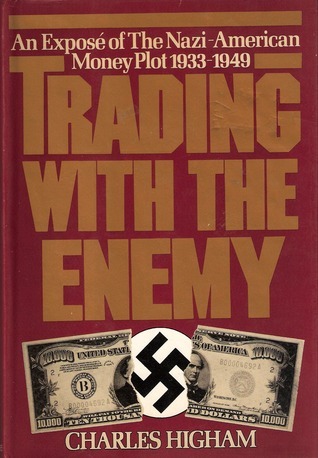
If you want to go really crazy read a book called Trading with the Enemy by Charles Higham. It will take your breath away.
It's one of those books that sat on my shelf since the mid-80s for some reason. Every notable industry -- General Motors, Shell, Standard Oil, Ford, Chase, ITT, National City Bank, DuPont etc, etc., were all feathering their monetary nests and shipping vital arms and machinery of war to Nazi Germany while the Axis powers killed our soldiers and the US state department and Roosevelt turned a blind eye.
Ball bearings, without which airplanes could not fly and tanks could not run, were sent to Germany in a round about way while the US military waited and fewer of our planes could fly for lack of them. There was a ball bearing company in Sweden that shipped their bearings to Germany. The Norwegians thought this was a bad idea and, one night, destroyed their factory. You can add them to the short list of who your friends are.
Commodities were sent to Germany while Americans stood in line, counted their ration stamps and saved all material possible to help with the war effort.
Money was funneled from many nations through Swiss banks. The Bank for International Settlements in Switzerland was supposedly to finance war-torn countries after the war. Money was also sent to Germany to finance the war during the war. Germany sent money to its account and then sent tons of jewelry and gold teeth. If you guessed that last came from the concentration camps, you would be right.
There was very little done to make corrections in this banking and industrial world known as The Fraternity.
It seems to me that if this kind of thing was happening in World War I and World War II, that it never quit. I wonder who we are funding and selling arms to today and how many of our soldiers died and still die from allied-made bullets shot and bombs detonated by enemy powers.
The one thing that seems to be a mystery, at least to me, is that most of Higham books are biographies of movie stars. Only one other book, American Swastika, published in 1985, had a political theme.