

What do you think?

Starry Messenger: Galileo Galilei
"If they had seen what we see, they would have judged as we judge." -- Galileo Galilei
In every age there are courageous people who break with tradition to explore new ideas and challenge accepted truths. Galileo Galilei was just such a man--a genius--and the first to turn the telescope to the skies to map the heavens. In doing so, he offered objective evidence that the earth was not the fixed center of the universe but that it and all the other planets revolved around the sun. Galileo kept careful notes and made beautiful drawings of all that he observed. Through his telescope he brought the starts down to earth for everyone to see.
By changing the way people saw the galaxy, Galileo was also changing the way they saw themselves and their place in the universe. This was very exciting, but to some to some it was deeply disturbing. Galileo has upset the harmonious view of heaven and earth that had been accepted since ancient times. He had turned the world upside down.
In this amazing new book, Peter Sís employs the artist's lens to give us an extraordinary view of the life of Galileo Galilei. Sís tells his story in language as simple as a fairy tale, in pictures as rich and tightly woven as a tapestry, and in Galileo's own words, written more than 350 years ago and still resonant with truth. This title has Common Core connections.
Starry Messenger is a 1997 Caldecott Honor Book.
In every age there are courageous people who break with tradition to explore new ideas and challenge accepted truths. Galileo Galilei was just such a man--a genius--and the first to turn the telescope to the skies to map the heavens. In doing so, he offered objective evidence that the earth was not the fixed center of the universe but that it and all the other planets revolved around the sun. Galileo kept careful notes and made beautiful drawings of all that he observed. Through his telescope he brought the starts down to earth for everyone to see.
By changing the way people saw the galaxy, Galileo was also changing the way they saw themselves and their place in the universe. This was very exciting, but to some to some it was deeply disturbing. Galileo has upset the harmonious view of heaven and earth that had been accepted since ancient times. He had turned the world upside down.
In this amazing new book, Peter Sís employs the artist's lens to give us an extraordinary view of the life of Galileo Galilei. Sís tells his story in language as simple as a fairy tale, in pictures as rich and tightly woven as a tapestry, and in Galileo's own words, written more than 350 years ago and still resonant with truth. This title has Common Core connections.
Starry Messenger is a 1997 Caldecott Honor Book.
40 pages, Paperback
First published January 1, 1996
About the author
Peter Sís
98 books234 followersPETER SÍS is an internationally acclaimed illustrator, filmmaker, painter and author. Born in 1949 in Brno, Czechoslovakia, and grew up in Prague. He studied painting and filmmaking at the Academy of Applied Arts in Prague and the Royal College of Art in London. His animated work is in the permanent collection of the Museum of Modern Art. He came to America in 1982, and now lives in New York's Hudson Valley with his family. Peter Sís is the first children's book artist to be named a MacArthur Fellow. In 2012 he won The Hans Christian Andersen Award.
His many distinguished books include Starry Messenger: Galileo Galilei, Tibet: Through the Red Box, Madlenka, Rainbow Rhino, The Tree of Life: Charles Darwin, The Wall: Growing Up Behind the Iron Curtain, and The Conference of the Birds.
His many distinguished books include Starry Messenger: Galileo Galilei, Tibet: Through the Red Box, Madlenka, Rainbow Rhino, The Tree of Life: Charles Darwin, The Wall: Growing Up Behind the Iron Curtain, and The Conference of the Birds.
Ratings & Reviews
Friends & Following
Create a free account to discover what your friends think of this book!
Community Reviews
Displaying 1 - 30 of 259 reviews

December 4, 2018
Very poetic with beautiful quotes and pictures to look at, Starry Messenger touches on Galileo's highs of his scientific mind, career and discovery as well as his dark demise under the persecution of the church for his thinking.
From an adult perspective, this book is rather a work of art then a bio of this brilliant man. Just a gentle intro for children to ask for more. Visually stunning, the quotes are a bit more difficult to comprehend by the intended audience, but they hold true and mostly persevere through today.
This would make a beautiful gift and serves a welcome touch to a more serious in depth study of the history of science.
Pictures on my blog:
https://scarlettreadzandrunz.com/clas...
Enjoy :)
From an adult perspective, this book is rather a work of art then a bio of this brilliant man. Just a gentle intro for children to ask for more. Visually stunning, the quotes are a bit more difficult to comprehend by the intended audience, but they hold true and mostly persevere through today.
This would make a beautiful gift and serves a welcome touch to a more serious in depth study of the history of science.
Pictures on my blog:
https://scarlettreadzandrunz.com/clas...
Enjoy :)

November 4, 2016
Now as much as I enjoy (and even love) Peter Sis' glorious illustrations (they are bright, descriptive, detailed, and with a sense of the imaginative that I believe even Galileo himself would have appreciated), the accompanying text of Starry Messenger: Galileo Galilei (well, actually it is more how the latter is presented, how it printed on the page) is simply much too vexing and frustrating for me to give Starry Messenger: Galileo Galilei more than two stars (and yes, those two stars are ABSOLUTELY ONLY for the Peter Sis' pictures, and while I might feel a bit guilty about this, I do firmly stand by my rating). For aside from the fact that this type of non fiction picture book simply screams for a bibliography, for a list of suggestions for further reading, I am actually and patently physically UNABLE to decipher ANY of the information, any of the narrative that is presented in cursive script (not only due to its cursiveness and shapes, but also and more to the point because it is just too minuscule to read with any ease even WITH my strongest reading glasses).
I have thus (and with much annoyance and frustration) basically given up on Starry Messenger: Galileo Galilei. For while the main narrative of Peter Sis' narrative is indeed mildly interesting and informative (and also presented in a decently sized and spaced textual display), it really only tells a very small part of Galileo's life and achievements as a whole, the supplemental information presented of which I have unfortunately NOT been able to even consider perusing (due to my above mentioned textual and scriptive visual issues with the cursive font of the additional featured details and facts). And that rather massive frustration is so irritating, is so large and all encompassing, that on an emotional and personal level I can and will ONLY consider a maximum of two (and indeed very grudging stars) stars for Starry Messenger: Galileo Galilei, the brilliance of the illustrations, the fact that the book won Peter Sis a Caldecott Honour Medal and even my own personal and academic interest in the subject matter quite notwithstanding (which is rather sad, as I was actually much looking forward to Starry Messenger: Galileo Galilei, and perhaps this is also a reason for my massive and major disappointment).
I have thus (and with much annoyance and frustration) basically given up on Starry Messenger: Galileo Galilei. For while the main narrative of Peter Sis' narrative is indeed mildly interesting and informative (and also presented in a decently sized and spaced textual display), it really only tells a very small part of Galileo's life and achievements as a whole, the supplemental information presented of which I have unfortunately NOT been able to even consider perusing (due to my above mentioned textual and scriptive visual issues with the cursive font of the additional featured details and facts). And that rather massive frustration is so irritating, is so large and all encompassing, that on an emotional and personal level I can and will ONLY consider a maximum of two (and indeed very grudging stars) stars for Starry Messenger: Galileo Galilei, the brilliance of the illustrations, the fact that the book won Peter Sis a Caldecott Honour Medal and even my own personal and academic interest in the subject matter quite notwithstanding (which is rather sad, as I was actually much looking forward to Starry Messenger: Galileo Galilei, and perhaps this is also a reason for my massive and major disappointment).

April 21, 2018
Wonderful art. It's a big book that give panoramic views of the sky. It also uses old maps and pictures they had to show the sky. It tells the simple story of Galileo and how he went about church doctrine to tell what he saw. He was declared a heretic for his work, but left to live in his home. It took the church 350 years to admit that he was right - which is sad.
There are his quotes around the book, but some of them are higgaldy piggaldy and it is difficult to read which annoyed me. Still it was a good story.
The kids were sort of into this story and sort of not.
There are his quotes around the book, but some of them are higgaldy piggaldy and it is difficult to read which annoyed me. Still it was a good story.
The kids were sort of into this story and sort of not.

April 6, 2009
We love quite a few Peter Sis books (I dare you to find a better little boy's book than FIRE TRUCK!), but Starry Messenger was not one of them. I had to do quite a bit of live-editing while reading this one to my son (my fault -- I should have previewed it first). Weird cursive writing is abundant and hard to read. But perhaps making the script sigmoid and sideways made "The streets were open sewers. Disease was common, and thousands died from typhus and from the bubonic plague," seem jaunty somehow, I don't know.
On the page with this text "Galileo was afraid. He knew that people had suffered terrible torture and punishment for not following tradition. It could happen to him." there's a large (about a page and a quarter) illustration of a hellish torture chamber with Galileo standing small in the middle, looking forlorn, surrounded by an impossibly long snake. The room has a gigantic armless, shackled man, blindfolded and hung from a wall, evil-looking gryphons and dragon-things scowling at him, ghastly faces coming from flames, a skull and various disembodied heads on the walls, a bound and screaming man on a rack, seemingly with spikes going through him. Yadda yadda yadda. On the next page, Gaileo is on trial, standing on an island in a moat of the grim reaper, multiple devils, a scorpion(?) and other crazy stuff surrounding him.
Well, thank goodness it has a happy ending... "Finally, more than three hundred years later, the leaders of the very Church that had punished Galileo Galilei pardoned him, and they admitted that he was probably -- in fact, surely and absolutely -- right." Unfortunately, that won't keep your kid from having nightmares.
The problem I have with this book is that it is presented as though it's for an 8 year old, but the text style and content and the illustrations were just not appropriate for that age group. If you want to expose your child to some significant historical science, try The Librarian Who Measured the Earth by Kathryn Lasky, and illustrated by Kevin Hawkes. It's a longer book, but it is still heavy on the pictures and appropriate for ages 7-12.
On the page with this text "Galileo was afraid. He knew that people had suffered terrible torture and punishment for not following tradition. It could happen to him." there's a large (about a page and a quarter) illustration of a hellish torture chamber with Galileo standing small in the middle, looking forlorn, surrounded by an impossibly long snake. The room has a gigantic armless, shackled man, blindfolded and hung from a wall, evil-looking gryphons and dragon-things scowling at him, ghastly faces coming from flames, a skull and various disembodied heads on the walls, a bound and screaming man on a rack, seemingly with spikes going through him. Yadda yadda yadda. On the next page, Gaileo is on trial, standing on an island in a moat of the grim reaper, multiple devils, a scorpion(?) and other crazy stuff surrounding him.
Well, thank goodness it has a happy ending... "Finally, more than three hundred years later, the leaders of the very Church that had punished Galileo Galilei pardoned him, and they admitted that he was probably -- in fact, surely and absolutely -- right." Unfortunately, that won't keep your kid from having nightmares.
The problem I have with this book is that it is presented as though it's for an 8 year old, but the text style and content and the illustrations were just not appropriate for that age group. If you want to expose your child to some significant historical science, try The Librarian Who Measured the Earth by Kathryn Lasky, and illustrated by Kevin Hawkes. It's a longer book, but it is still heavy on the pictures and appropriate for ages 7-12.

November 23, 2014
Pretty, but not good. Too much writing to be a picture book and in fairly difficult to read script. And not enough writing to be a good science or biography book. And the level of the writing also doesn't fit well - too high and yet not enough. And then it is always interesting to see statements about who and how many thought the Sun revolved around the Earth rather than the Earth around the sun. The first line in the book held promise - "... most people thought the earth was the center of the universe ..." sufficiently nebulous to be truthful. But it didn't keep this tack. This could have been two or three much better books.

August 5, 2011
This book offers a fascinating look at the life and work of Galileo Galilei. It provides historical background information about the various theories of the universe, leading up to his discovery that the Earth was not indeed the center of it.
The illustrations are wonderful and the additional information and quotes that are artistically woven (sometimes in sprials) throughout the pages are good for deepening our understanding the man, his thoughts, and his tribulations with the church. They can be read together with the text or separately or not at all.
While I know that the extra detail is common with Peter Sis's books, sometimes it seemed to detract from the main story. I found that our girls tired of the extra information about halfway through the book, so I chose carefully what to read aloud and what to read silently.
April 2013 update: we read this book again and I was able to read the entire text, but our oldest fell asleep in the middle of it. Our youngest thought it was an interesting tale, although neither of us remembered reading it before, so I suppose it's not destined to be a favorite.
This book was selected as one of the books for the November 2016- Caldecott Honor discussion at the Picture-Book Club in the Children's Books Group here at Goodreads.
The illustrations are wonderful and the additional information and quotes that are artistically woven (sometimes in sprials) throughout the pages are good for deepening our understanding the man, his thoughts, and his tribulations with the church. They can be read together with the text or separately or not at all.
While I know that the extra detail is common with Peter Sis's books, sometimes it seemed to detract from the main story. I found that our girls tired of the extra information about halfway through the book, so I chose carefully what to read aloud and what to read silently.
April 2013 update: we read this book again and I was able to read the entire text, but our oldest fell asleep in the middle of it. Our youngest thought it was an interesting tale, although neither of us remembered reading it before, so I suppose it's not destined to be a favorite.
This book was selected as one of the books for the November 2016- Caldecott Honor discussion at the Picture-Book Club in the Children's Books Group here at Goodreads.

November 19, 2018
Sis' books are so promising and then they end up being so frustrating! What audience is he targeting? Has he read any of these with kids? I doubt that they'd learn much from this book. And why the tiny cursive type which travels in odd directions on a page? It's hard to read, and many kids aren't taught cursive.
I suppose if I knew more about Galileo, I'd get more out of the book. But is that the purpose?
Some of the pages are inviting, but much of the art is too obscure to mean much to a child (or to adults).
My 2-star rating reflects my frustrations. If Sis' purpose were truly to convey info to a young audience, this book would look very different.
Aside: When I bought this book, the clerk asked if this were about Jesus, confusing Galileo with the Galilee. Then I commented that Galileo had studied the night sky and Earth's place in the solar system. She nodded wisely and said that people were always arguing about whether the "earth was flat or round." I was stunned. Where does she hear those 'arguments'?
I suppose if I knew more about Galileo, I'd get more out of the book. But is that the purpose?
Some of the pages are inviting, but much of the art is too obscure to mean much to a child (or to adults).
My 2-star rating reflects my frustrations. If Sis' purpose were truly to convey info to a young audience, this book would look very different.
Aside: When I bought this book, the clerk asked if this were about Jesus, confusing Galileo with the Galilee. Then I commented that Galileo had studied the night sky and Earth's place in the solar system. She nodded wisely and said that people were always arguing about whether the "earth was flat or round." I was stunned. Where does she hear those 'arguments'?

April 20, 2009
Unlike most children's book illustrators, Sis favors subtle pastels and complex, detailed drawings over bold colors and images. There's always a lot going on in every image, if kids slow down enough to look at them. The level of illustrative detail makes this book best for one-on-one reading. The book can be read on two levels; short, simple biographical statements target younger children while small, cursive passages highlight book excerpts and quotes from Galileo. This handwritten text adds a lot to the narrative, but, unfortunately, it can be difficult to read, especially when printed sideways or in circles. The book is also marred by a lack of cited sources or author's note, despite the use of Galileo's quotes.

March 18, 2025
A very articulate and informative read for younger readers as Sís’ book about Galileo and his discoveries about the universe above the stars. The art is just so largely detailed and magical. There’s also plenty of facts and history, half of which are in cursive. Yet, it does aim for the stars. A- (91%/Excellent)

November 9, 2016
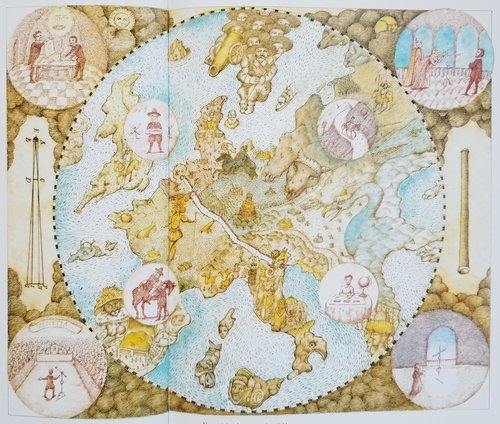
1997 Caldecott Honor - Favorite Illustration: The map of the Italian city-states. That was kind of fun to see how Italy was put together at the time of Galileo.
While I like the concept of this book, the layout itself is confusing a frustrating. I wish that a better font had been used, as the cursive is difficult to read at times. I wish that instead of the timeline being presented throughout the book in random shapes or sometimes as the border of the pictures itself, there was a timeline that ran along the top or bottom of each page. As it is, it is difficult to find everything and see what happened when. It was also annoying that some of the quotes were by Galileo and some were about him, but all had the same handwriting. The small facts that were presented in regular print would make for a boring book, if not supplemented by the quotes and timelines. However, due to their weird placement and printing, it would be easy to overlook them or to not be able to read them at all.
While I like the concept of this book, the layout itself is confusing a frustrating. I wish that a better font had been used, as the cursive is difficult to read at times. I wish that instead of the timeline being presented throughout the book in random shapes or sometimes as the border of the pictures itself, there was a timeline that ran along the top or bottom of each page. As it is, it is difficult to find everything and see what happened when. It was also annoying that some of the quotes were by Galileo and some were about him, but all had the same handwriting. The small facts that were presented in regular print would make for a boring book, if not supplemented by the quotes and timelines. However, due to their weird placement and printing, it would be easy to overlook them or to not be able to read them at all.

October 6, 2012
The cursive font used as part of this book’s illustrations is nearly impossible to read, but if you can get past that, there is a lot to learn from the text and illustrations combined. Because the text and illustrations convey different levels of detail, kids can return to this book again and again as they age and take away something different each time. My favorite image in this one is of the courtyard where all the children play. It is reminiscent of Sendak’s drawings for Ruth Krauss’s books, and of Martin Handford’s Where’s Waldo. I especially appreciated the child-like way Sis drew the courtyard enclosure - I think every kid draws walls as though the spaces they surround are big square boxes.

May 21, 2013
I wavered between 3 and 4 on this one. I love that it's about Galileo, but all the script in the art makes it a bit cluttered for my liking. It is a fine first book on Galileo. I think it should be in everyone's home library. Also, my understanding was that while the church pardoned him, they never actually admitted that he was right all along. Guess I need to pick up a biography of Galileo for adults and check it out (I'm going by my hazy memory of Carl Sagan's show Cosmos and goodness knows it's been a seriously long time since that show aired.

December 30, 2016
While interesting and informative, this book is challenging to read. Much of the text is written in small cursive in interesting patterns (curves, spirals, etc.). It makes it interesting visually but challenging to read. I feel like I would need to practice it several times in order to be able to use it as a read aloud in my classroom...and even then, I would most likely need to hold the book toward me to read and then show the pictures rather than holding it so the pictures could be seen by students while I am reading. And the illustrations are okay but not a personal favorite.
November 10, 2011
The illustrations are beautiful, and the inclusion of text from Galileo's journals, observations, etc, were interesting. However, most of the content is what I remember learning about Galileo in school, in no more detail. I was also frustrated by reading the parts of the text that were in the script font--the letters are tiny and close together, and the words form shapes on the page, causing me to turn the book in all different directions. Kind of cool, but it made reading it tedious for me.

April 3, 2013
I totally love this book.
I read his graphic autobiography in ed grad school but hadn't read any of his other stuff. Just ordered this with a specific student in mind, she is going to FLIP OUT when she sees it.
Beautiful art, lovely storytelling. Main text is big font and simple enough -- additional notes and observations in a decorative cursive on the sides (like built-in extensions for higher readers). So much to see.
I read his graphic autobiography in ed grad school but hadn't read any of his other stuff. Just ordered this with a specific student in mind, she is going to FLIP OUT when she sees it.
Beautiful art, lovely storytelling. Main text is big font and simple enough -- additional notes and observations in a decorative cursive on the sides (like built-in extensions for higher readers). So much to see.

June 3, 2015
This was an interesting, brief biography of Galileo. I did not have the problem others had with reading the cursive script, but I was annoyed when it wound in a spiral, or was written in waves, instead of just in straight lines. These cursive bits added interesting information to the bio, but they would have been easier to read if they had been typed instead of handwritten. Possibly Sis was trying for a 17th-century look by using the cursive.

February 15, 2012
In this picture book biography, we learn about the life of Galileo. Sis places his discoveries in time by explaining previous beliefs about the solar system and shows the effect of Galileo's evidence of the sun as its center on the cultural/religious beliefs of the time. This is such a lovely book, but I wish the information written in the sidebars was more legible.

May 17, 2012
A picture book bio about Galileo. Looks like a scrapbook with simple text on each page that tells Galileo's life story accompanied by cursive writing from his papers and art that illustrates key moments in his timeline. Well done.
August 30, 2012
This is a beautifully illustrated and written children's book. It includes important historical facts and dates and many lovely quotes. If you have little ones this is a much share.

November 12, 2017
An entertaining , relaxing and informative book with superior illustrations . Probably a two-hour read four hours if you study the illustrations .

January 11, 2021
2.5 out of 5
The GOOD: Starry Messenger: Galileo Galilei is a picturebook biography about a fascinating historical figure, Galileo Galilei, a famous 16th-17th century scientist, mathematician, astronomer, philosopher, physicist, and all-around genius who was proclaimed as a heretic by the Church for his discoveries. Spoiler alert: in 1992, 350 years after his death, he was pardoned.
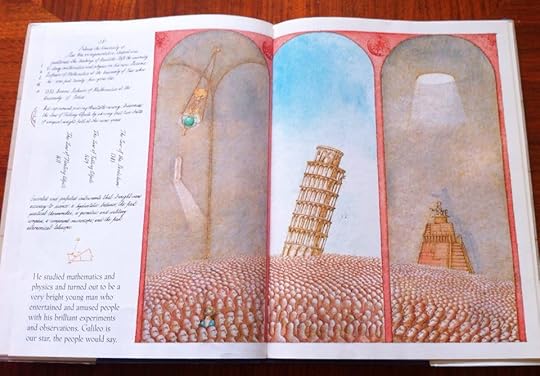
The OKAY: Although not my favorite personally, Peter Sís' intricate illustrations are very period-fitting. There's a lot to peruse, over and over again:
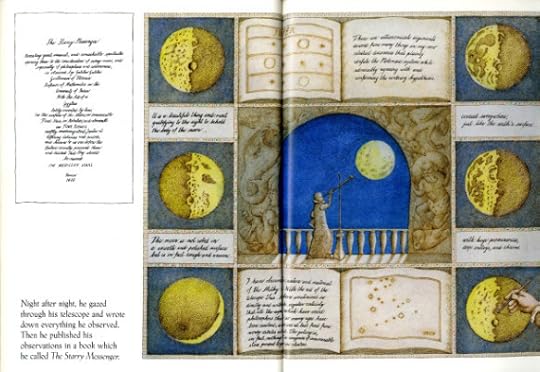
Also, the main narrative is beautifully written, but it alone barely scratches the surface.
The BAD: The most annoying book design EVER. Starry Messenger doesn't have any back matter (no additional information, historical context, suggested readings, etc.). Instead, all the said additional information -- historical context, facts, dates, quotes, etc. -- is written in a tiny, hard-to-read cursive script in all directions (yes, even sideways and in a circle) next to or even inside the illustrations. Luckily, the main narrative is easy to read, but if you skip all the additional information, the story becomes quite bland.
The GOOD: Starry Messenger: Galileo Galilei is a picturebook biography about a fascinating historical figure, Galileo Galilei, a famous 16th-17th century scientist, mathematician, astronomer, philosopher, physicist, and all-around genius who was proclaimed as a heretic by the Church for his discoveries. Spoiler alert: in 1992, 350 years after his death, he was pardoned.
The OKAY: Although not my favorite personally, Peter Sís' intricate illustrations are very period-fitting. There's a lot to peruse, over and over again:
Also, the main narrative is beautifully written, but it alone barely scratches the surface.
The BAD: The most annoying book design EVER. Starry Messenger doesn't have any back matter (no additional information, historical context, suggested readings, etc.). Instead, all the said additional information -- historical context, facts, dates, quotes, etc. -- is written in a tiny, hard-to-read cursive script in all directions (yes, even sideways and in a circle) next to or even inside the illustrations. Luckily, the main narrative is easy to read, but if you skip all the additional information, the story becomes quite bland.

August 11, 2024
Peter Sis's books seem to have a theme of busyness and chaos. He uses different fonts running in different directions. The art sometimes distracts from the story. The book as a whole is still beautiful, but not one I'd read again.

January 10, 2014
On the inside cover of the front and back of "Starry Messenger: Galileo Galilei," there is a beautiful illustration by author Peter Sis. It shows an ancient Italian city at night, the battlements and spires of the buildings are saturated in a deep inky blue, with stars glimmering in the sky. The city itself is dark except for an arched window that glows yellow with light and inspiration. A small, distant figure appears to be peering through a telescope, which is pointed toward the heavens.
That figure, of course, is Galileo, the visionary who discovered that the earth was not the center of the universe, but rather revolved around the sun. It was one finding among many that would bring him great fame and ultimately the ire of the Catholic Church, which declared him a heretic. The book eloquently discusses that heartbreaking injustice, but also explores Galileo's formative years.
Mr. Sis adds details that put Galileo's life in the context of his times, using small cursive script (there is also text written in a more readable font). The Catholic Church, he writes, was the unifying force in Italy because each city-state had its own government. One fact that I find interesting is that Galileo was born the same year as William Shakespeare - 1564. That's quite a year! Other bits of knowledge are not so lovely, though. Diseases such as typhus and the bubonic plague were a scourge then. We're lucky he survived infancy!
Also in the slanted cursive are further descriptions of his accomplishments and beliefs. For instance, one passage shows how keen Galileo's intelligence was. "1581: Entered the University of Pisa. Was an argumentative student and questioned the teachings of Aristotle. Left the university to study mathematics and physics on his own. Became Professor of Mathematics at the University of Pisa when he was just twenty-five years old."
Still when Mr. Sis quotes Galileo himself,again in that handwritten style, the story is at its most heartrending. When the astronomer is brought before the papal court on heresy charges, he writes, "I do not feel obliged to believe that the same God who has endowed us with senses, reason, and intellect has intended to forgo their use...He would not require us to deny sense and reason in physical matters which are set before our eyes and minds by direct experience or necessary demonstrations." To not use one's mind to advance science, Galileo so movingly explains, would be a denial of God's gift.
You'd have to assume that Galileo would be thrilled his story was in a children's book, reaching curious, young seekers, like himself, centuries later. The drawings and some of the text, while recalling the great thinker's time, are so detailed and small it can be hard to read them (one paragraph disappears into the binding), but it is worth the effort. One should always strive to learn more, as Galileo did.
That figure, of course, is Galileo, the visionary who discovered that the earth was not the center of the universe, but rather revolved around the sun. It was one finding among many that would bring him great fame and ultimately the ire of the Catholic Church, which declared him a heretic. The book eloquently discusses that heartbreaking injustice, but also explores Galileo's formative years.
Mr. Sis adds details that put Galileo's life in the context of his times, using small cursive script (there is also text written in a more readable font). The Catholic Church, he writes, was the unifying force in Italy because each city-state had its own government. One fact that I find interesting is that Galileo was born the same year as William Shakespeare - 1564. That's quite a year! Other bits of knowledge are not so lovely, though. Diseases such as typhus and the bubonic plague were a scourge then. We're lucky he survived infancy!
Also in the slanted cursive are further descriptions of his accomplishments and beliefs. For instance, one passage shows how keen Galileo's intelligence was. "1581: Entered the University of Pisa. Was an argumentative student and questioned the teachings of Aristotle. Left the university to study mathematics and physics on his own. Became Professor of Mathematics at the University of Pisa when he was just twenty-five years old."
Still when Mr. Sis quotes Galileo himself,again in that handwritten style, the story is at its most heartrending. When the astronomer is brought before the papal court on heresy charges, he writes, "I do not feel obliged to believe that the same God who has endowed us with senses, reason, and intellect has intended to forgo their use...He would not require us to deny sense and reason in physical matters which are set before our eyes and minds by direct experience or necessary demonstrations." To not use one's mind to advance science, Galileo so movingly explains, would be a denial of God's gift.
You'd have to assume that Galileo would be thrilled his story was in a children's book, reaching curious, young seekers, like himself, centuries later. The drawings and some of the text, while recalling the great thinker's time, are so detailed and small it can be hard to read them (one paragraph disappears into the binding), but it is worth the effort. One should always strive to learn more, as Galileo did.
September 30, 2014
The story of Galileo, mathematician, philosopher, and astronomer has been told by Peter Sis in this book by capturing in quotes the philosopher's ideas and beliefs that are just as important today as they were hundreds of years ago. The details of the frame surrounding the illustrations are important in chronicling the settings, dates, and narration of what the reader is seeing. Ghastly drawings of grim reapers, devils, and half-human-like creatures makes you wonder if the images were derived from the teachings of the church which was the most powerful influence across many disciplines of study. The end pages sets the stage for what will be the rise and eventual fall of one of the greatest minds the world has seen. A quick summary of Galileo's position is given at the beginning and from there we see the point of view of the church as they wanted everyone else to see it their way in the first illustration where the earth is considered to be the center of the universe and all suns and planets revolve around it.
Again, the framing of the illustrations capture the lay of the land and zoom in on our subject as his curiosity grows more advance to the point where he now spares neither labor or expense to construct his own spyglasses. Readers will notice how the author's text in the lower left corner compliments the drawings of Galileo's life while the cursive writing in quotes connects us directly to the philosopher as if he were speaking to us and explaining his position.
Even in his most fragile of states as a man locked in his house for the rest of his life, he still holds faith in his ideas and discoveries that made him famous hundreds of years later. The final pages quote Galileo's belief in the authority of science versus the thousands of opinions of people who do not know and understand what he saw and discovered during his lifetime.
I liked how Peter Sis illustrated the story of Galileo in each frame as if the ideas of the philosopher or the church revolved around the settings in and around Italy. The quote's are difficult to read and much smaller than the author's text but are an important element to the story, discoveries, and teaching's of Galileo. This book about a renaissance man and his teachings are fascinating and should capture older readers interest of Galileo’s important contribution to science.
Again, the framing of the illustrations capture the lay of the land and zoom in on our subject as his curiosity grows more advance to the point where he now spares neither labor or expense to construct his own spyglasses. Readers will notice how the author's text in the lower left corner compliments the drawings of Galileo's life while the cursive writing in quotes connects us directly to the philosopher as if he were speaking to us and explaining his position.
Even in his most fragile of states as a man locked in his house for the rest of his life, he still holds faith in his ideas and discoveries that made him famous hundreds of years later. The final pages quote Galileo's belief in the authority of science versus the thousands of opinions of people who do not know and understand what he saw and discovered during his lifetime.
I liked how Peter Sis illustrated the story of Galileo in each frame as if the ideas of the philosopher or the church revolved around the settings in and around Italy. The quote's are difficult to read and much smaller than the author's text but are an important element to the story, discoveries, and teaching's of Galileo. This book about a renaissance man and his teachings are fascinating and should capture older readers interest of Galileo’s important contribution to science.

February 2, 2015
Starry Messenger, a Caldecott Honor book, would be a great way to tie in science, history and literature. The concepts of theory as well as the underlying moral message of breaking out against traditional norms would make this a wonderful introduction to the challenges of science, discovery as well as critical thinking and how these elements have shaped our history. Galileo's discoveries and publications went against how people had viewed the universe with heaven and earth and the beliefs of the church. He was persecuted for his ideas that didn't conform to societal tradition and later pardoned for his actions because they realized he had been right. This book would be a great way to lead into class discussions on such moralistic issues and character analysis of the traits Galileo possessed that ended up changing our perspective and knowledge of the world.
The illustrations are beautiful and it contains wonderful historical background information as well as quotes that are artistically woven through the pages. This requires the teacher to extensively prepare for how she will structure this read aloud and what extra information she will include and how she will include it without detracting from the story. I would recommend a sticky note with a copied quote for the teacher to read aloud with the quotes that are in shapes or harder to decipher. Galileo's philosophical quotes embedded within the book make this biography relevant and captivating to the audience and add to the overall perspective.
Great book on a topic that isn't normally emphasized in curriculum. Could lead to many expansion activities and lessons, but teacher must be properly prepared in order to effectively incorporate this read aloud. She could adjust which segments included based on the grade level but I would recommend fourth grade!
The illustrations are beautiful and it contains wonderful historical background information as well as quotes that are artistically woven through the pages. This requires the teacher to extensively prepare for how she will structure this read aloud and what extra information she will include and how she will include it without detracting from the story. I would recommend a sticky note with a copied quote for the teacher to read aloud with the quotes that are in shapes or harder to decipher. Galileo's philosophical quotes embedded within the book make this biography relevant and captivating to the audience and add to the overall perspective.
Great book on a topic that isn't normally emphasized in curriculum. Could lead to many expansion activities and lessons, but teacher must be properly prepared in order to effectively incorporate this read aloud. She could adjust which segments included based on the grade level but I would recommend fourth grade!

February 16, 2015
The story tells the life and accomplishments of Galileo, a philosopher and great astronomer that's been appreciated by many. I like that this book can educate children, but I think the children would have to be 10 or older to understand. If a parent reads this to their 7-year-old child, the parent wouldn't be comfortable reading, "Galileo was going to be punished. He went against the church." The kid would constantly question, and the parents would have a hard time.
I wanted to give it a 3.5, but I gave it a four because of the artwork. I liked all the pictures, especially the page with all the babies and what they would be when they grew up drawn on their blankets. Galileo stood out because his blanket had stars on it. The pastel colors used for the illustrations were very warm and gave off a nostalgic feeling. Many of the images looked like they were based on maps.
I didn't enjoy the text because it was difficult to read. I understand that having the text in spirals and even in the shape of an eye makes it appealing, but I got tired of constantly turning the book sideways.
In conclusion, I think older children would appreciate this more. If they read this during 5th grade or so, once they go to high school, in an astronomy or physics class, they would think, "Oh yeah, I read a book on Galileo back in elementary school." They can learn a lot about how people aren't always going to accept their ideas, and they can choose whether to go along with those norms or continue to embrace their ideas. Galileo didn't get all of his works recognized until 300 years later, but I think students can understand more about how people react to different ideas after reading this book.
I wanted to give it a 3.5, but I gave it a four because of the artwork. I liked all the pictures, especially the page with all the babies and what they would be when they grew up drawn on their blankets. Galileo stood out because his blanket had stars on it. The pastel colors used for the illustrations were very warm and gave off a nostalgic feeling. Many of the images looked like they were based on maps.
I didn't enjoy the text because it was difficult to read. I understand that having the text in spirals and even in the shape of an eye makes it appealing, but I got tired of constantly turning the book sideways.
In conclusion, I think older children would appreciate this more. If they read this during 5th grade or so, once they go to high school, in an astronomy or physics class, they would think, "Oh yeah, I read a book on Galileo back in elementary school." They can learn a lot about how people aren't always going to accept their ideas, and they can choose whether to go along with those norms or continue to embrace their ideas. Galileo didn't get all of his works recognized until 300 years later, but I think students can understand more about how people react to different ideas after reading this book.

July 12, 2012
Peter Sis documents the life of Galileo Galilei in this Caldecott Honor biography. He tells the complicated story of the astronomer and does a fantastic job of laying out the cultural/social/political/historical context that impacted Galileo's work. The illustrations are so detailed and are accompanied by additional information written in beautiful script that are truly pieces of art themselves. My favorite illustration is when Galileo is called to the Papal court to be tried for heresy. The creatures swimming around him remind me of the scene from the movie "What Dreams May Come" when the mom is entering hell. This scene from the movie was inspired by Dante's "Inferno."
This book would be a nice complement to a science unit on stars and constellations with historical/social studies connections to the 1500-1600s. One multimedia application/exploration that might be interesting to try out would be to use this resource I found on http://www.thinkfinity.org. It directed me to http://sciencenetlinks.com/tools/star... and the interactive tool here "could be used when discussing the earth’s revolution around the sun and how that causes the seasons, since it plainly shows how one’s perspective of the sky changes depending on what time of the year it’s being examined." It might be interesting, too, to identify the constellations and discuss how they change from season to season.
This book is a 830 Lexile/GR level P. Appropriate for read aloud K+ (although I think K students would have a hard time attending to this in a whole group setting) and for independent reading by the middle of 3rd grade.
This book would be a nice complement to a science unit on stars and constellations with historical/social studies connections to the 1500-1600s. One multimedia application/exploration that might be interesting to try out would be to use this resource I found on http://www.thinkfinity.org. It directed me to http://sciencenetlinks.com/tools/star... and the interactive tool here "could be used when discussing the earth’s revolution around the sun and how that causes the seasons, since it plainly shows how one’s perspective of the sky changes depending on what time of the year it’s being examined." It might be interesting, too, to identify the constellations and discuss how they change from season to season.
This book is a 830 Lexile/GR level P. Appropriate for read aloud K+ (although I think K students would have a hard time attending to this in a whole group setting) and for independent reading by the middle of 3rd grade.

March 7, 2011
I chose Starry Messenger: Galileo Galilei by Peter Sís for my astronomy materials for children ages 5 to 8 project. One of our requirements was to include a biography relevant to the topic. Starry Messenger was the most interesting of the books on hand that fit the project.
The title comes from the notebook Galileo Galilei kept for most of his life. He worked with then cutting edge technology, the telescope, to make observations supporting Copernicus's theory that the earth and planets revolve around the sun.
Peter Sís's text focus mostly on Galileo's life and less on his work in astronomy, mathematics or physics. It does though mention his trial for heresy and eventual house arrest. Sís's pen and ink drawings mimic Renaissance sketches, fitting perfectly with the time period of Galileo's life.
The sidebar includes further information about the astronomer's life and research but is written in the style of Galileo's own handwriting, making it difficult to read at the same time the story is being read aloud to students. Those sidebars should be read ahead of time and notes taken that can be referred to as the book is being presented. By including information on Galileo's trial, children learn that scientific study can involve risks but is still worth the effort, even if the pardon comes after one's death.
The title comes from the notebook Galileo Galilei kept for most of his life. He worked with then cutting edge technology, the telescope, to make observations supporting Copernicus's theory that the earth and planets revolve around the sun.
Peter Sís's text focus mostly on Galileo's life and less on his work in astronomy, mathematics or physics. It does though mention his trial for heresy and eventual house arrest. Sís's pen and ink drawings mimic Renaissance sketches, fitting perfectly with the time period of Galileo's life.
The sidebar includes further information about the astronomer's life and research but is written in the style of Galileo's own handwriting, making it difficult to read at the same time the story is being read aloud to students. Those sidebars should be read ahead of time and notes taken that can be referred to as the book is being presented. By including information on Galileo's trial, children learn that scientific study can involve risks but is still worth the effort, even if the pardon comes after one's death.

September 28, 2013
This post-modern picture book tells the biography of Galileo Galilei twice at the same time. On each page there is text that is in simple language and easy for children to read and understand, and there is also text actually written in Galileo's own words written more than 350 years ago. .
This book is illustrated beautifully and in a way that relates back to Galileo's time. On the cover page, the illustrator positions Galileo in the middle of the page looking through a telescope out at night sky. The balcony he is standing by, is framed with old, Italian looking walls. Both end pages are the same with the town being dark except from a light coming out of one balcony where Galileo is standing looking out at the stars. The cover page seems to be a close-up view of Galileo from inside his home, and the end pages show the view of Galileo doing the same thing from a distance outside of town. Looking through the book, each page is set up the same with a bordered illustration and the 2 texts written separately in white space. This separates text from image. I also noticed a from of symbolism throughout the story which is that Galileo always seemed to be surrounded by a circular ring which must represent the orbit the Earth takes around the sun.
This book was very informative and very unique in the aspect of biographies.
This book is illustrated beautifully and in a way that relates back to Galileo's time. On the cover page, the illustrator positions Galileo in the middle of the page looking through a telescope out at night sky. The balcony he is standing by, is framed with old, Italian looking walls. Both end pages are the same with the town being dark except from a light coming out of one balcony where Galileo is standing looking out at the stars. The cover page seems to be a close-up view of Galileo from inside his home, and the end pages show the view of Galileo doing the same thing from a distance outside of town. Looking through the book, each page is set up the same with a bordered illustration and the 2 texts written separately in white space. This separates text from image. I also noticed a from of symbolism throughout the story which is that Galileo always seemed to be surrounded by a circular ring which must represent the orbit the Earth takes around the sun.
This book was very informative and very unique in the aspect of biographies.

February 7, 2014
See full review @ The Indigo Quill: http://theindigoquill.blogspot.com/20...
This is an educational book about one of the world's first astronomer's, Galileo Galilei. It can easily be used as a tool to teach your child (or children) and be interactive with little extras and things. There is also a Teacher's Guide available HERE.
I'll note that this is the Caldecott Winner for the year 1997. That being said, I didn't particularly enjoy this Children's book compared to others I've reviewed. I did not feel like the artwork and the text complimented each other very well, and the illustrations weren't fitting for the audience this book is intended for.
Although the artwork itself is beautiful and innovative, the scripting was extremely difficult to read and the pages are almost so busy that it's distracting and the eye cannot locate the focal point.
There were some parts where the text generally did not make sense (Particularly the final page). The wording was off and the illustrations were difficult to interpret.
I don't think this would be my first choice in teaching my child about Galileo. I think there are better picture books out there that I could find much more suited and well-rounded for a young audience. The idea of this book is nice, I just think it's unsuitable.
This is an educational book about one of the world's first astronomer's, Galileo Galilei. It can easily be used as a tool to teach your child (or children) and be interactive with little extras and things. There is also a Teacher's Guide available HERE.
I'll note that this is the Caldecott Winner for the year 1997. That being said, I didn't particularly enjoy this Children's book compared to others I've reviewed. I did not feel like the artwork and the text complimented each other very well, and the illustrations weren't fitting for the audience this book is intended for.
Although the artwork itself is beautiful and innovative, the scripting was extremely difficult to read and the pages are almost so busy that it's distracting and the eye cannot locate the focal point.
There were some parts where the text generally did not make sense (Particularly the final page). The wording was off and the illustrations were difficult to interpret.
I don't think this would be my first choice in teaching my child about Galileo. I think there are better picture books out there that I could find much more suited and well-rounded for a young audience. The idea of this book is nice, I just think it's unsuitable.
Displaying 1 - 30 of 259 reviews