

What do you think?
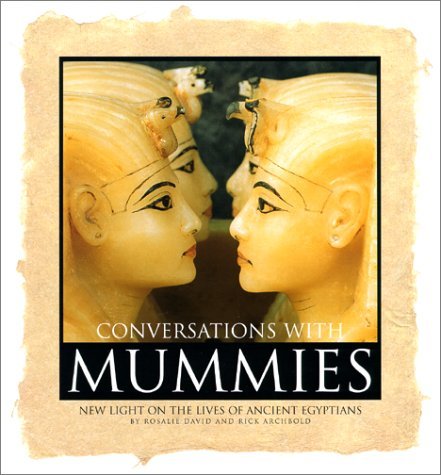
Conversations With Mummies: New Light on the Lives of Ancient Egyptians
An illustrated look at Egyptian mummies explains how information on the process of mummification and daily life in ancient Egypt can be gleaned from the ancient, preserved bodies. 50,000 first printing.
191 pages, Hardcover
First published January 1, 2000
About the author
Rosalie David
32 books19 followersFrom Ancient Egypt Magazine:
PROFESSOR ROSALIE DAVID OBE has achieved world renown for her pioneering work in investigating mummies using non-destructive techniques. She is Director of the KNH Centre for Biological and Forensic Studies in Egyptology at The University of Manchester. For over 25 years her Certificate Course in Egyptology has been consistently oversubscribed. The Distance Learning Course in Egyptology has proved equally popular.
Prof David was the former Keeper of Egyptology at the Manchester Museum, and is Director of the International Mummy Database and Director of the Schistosomiasis Investigation Project. Her research work into this disease, a scourge in the ancient as well as the modern world, was recognised recently with a prestigious award from the Anglo-French Medical Society. Prof David is the author of numerous books and articles on mummies and the religious practices of the ancient Egyptians, a presenter of TV and radio programmes, and an extremely popular lecturer all over the world.
Rosalie David was the first woman professor in Egyptology in Britain, and the first to receive an OBE in recognition of her services in Egyptology.
PROFESSOR ROSALIE DAVID OBE has achieved world renown for her pioneering work in investigating mummies using non-destructive techniques. She is Director of the KNH Centre for Biological and Forensic Studies in Egyptology at The University of Manchester. For over 25 years her Certificate Course in Egyptology has been consistently oversubscribed. The Distance Learning Course in Egyptology has proved equally popular.
Prof David was the former Keeper of Egyptology at the Manchester Museum, and is Director of the International Mummy Database and Director of the Schistosomiasis Investigation Project. Her research work into this disease, a scourge in the ancient as well as the modern world, was recognised recently with a prestigious award from the Anglo-French Medical Society. Prof David is the author of numerous books and articles on mummies and the religious practices of the ancient Egyptians, a presenter of TV and radio programmes, and an extremely popular lecturer all over the world.
Rosalie David was the first woman professor in Egyptology in Britain, and the first to receive an OBE in recognition of her services in Egyptology.
Ratings & Reviews
Friends & Following
Create a free account to discover what your friends think of this book!
Community Reviews
Displaying 1 - 20 of 20 reviews

February 20, 2011
This was a very quick and interesting read. It had a nice balance to it, addressing Paleopathology, Archaeology and Egyptology in a way that is both compelling while still being available to the average reader. The fact that the book has so many wonderful photographs really lets you see into the world of both ancient Egypt and the fascinating science that is attempting to delve into aspects of lives not accounted for by written records. It takes a captivating look at the health of ancient Egyptians from the lowly weaver to the Pharos themselves. I would highly recommend this book.

September 14, 2020
Since this book was published in 2000, it’s a bit out of date. There has been quite a bit of progress both on the use of medical techniques to study Egyptian mummies and a few important discoveries that altered our understanding of ancient Egypt. Perhaps most important for the scope of this book is the 2010 DNA study and the subsequent discoveries/fallout that have echoed through Egyptology; however, since this book is mostly a survey of the history mummy studies combined with brief case studies of individual mummies, it’s still absolutely worth the read.
Keep in mind that there have been advancements since this book was published, but enjoy the historical overview of paleopathology!
Keep in mind that there have been advancements since this book was published, but enjoy the historical overview of paleopathology!

September 26, 2008
Very basic introduction to the work of paleopathologists on Egyptian mummies. Interesting stuff, but not much depth. Probably in part because the field is relatively new. The main finding so far is that ancient Egyptians were infested with parasites and most died painful deaths from chronic illnesses and infections. Many also suffered from chronic malnutrition and anemia. Basically, if you could take a time-machine back to the ancient world and only bring them one amazing new technology—take penicillin. Really, it's way better than a computer.

August 12, 2008
gift from my friend Carol!

September 11, 2010
This is a great book for research and study and it has gorgeous pictures

June 20, 2017
Overall, it was fairly entertaining. The book was written in 2000 and definitely shows its' age re. Dna testing and other scientific techniques (It speculates that perhaps they might be used someday to fill in the gaps in the Pharaonic family trees, which they've done a great deal of now particularly in regards to the 18th Dynasty.
I was particularly intrigued reading the bits about the mummies in the Royal Ontario Museum, which I've visited many times and really would like to go again now an look more closely at. It always filled me with a strange sad feeling to see them, now it almost feels like I know Nakht and Jed.
I was particularly intrigued reading the bits about the mummies in the Royal Ontario Museum, which I've visited many times and really would like to go again now an look more closely at. It always filled me with a strange sad feeling to see them, now it almost feels like I know Nakht and Jed.

April 1, 2019
An interesting book describing the latest scientific methods being used to discover the secrets of ancient Egyptian mummies. It covers quite a wide field encompassing archeology, anthropology and paleopathology, as well as Egyptology. The illustrations are beautiful and the text well-researched, making this book a fascinating and pleasurable read.
I enjoyed the stories being uncovered of the daily lives and health issues of individual mummies through the study of tissue samples and DNA. My knowledge of ancient Egypt has been expanded.
I enjoyed the stories being uncovered of the daily lives and health issues of individual mummies through the study of tissue samples and DNA. My knowledge of ancient Egypt has been expanded.

June 7, 2022
A good study of both the history and current science of studying Egyptian mummies. Could use a new edition to encompass the latest findings and technology.
April 12, 2024
Fun overview of the history of mummy examinations and the importance of the field.

March 13, 2017
This was a very interesting but wordy book on ancient Egypt. There were lots of good pictures of creepy mummies. Thumbs up.
January 22, 2023
I want to be Rosalie David when I grow up. She takes you through such a fascinating journey of Egyptology and paleopathology. If you love mummies, get it!
August 2, 2009
This was one remarkable book. I didn't think that I would like it as I don't generally enjoy non-fiction, but how wrong I was. Discussed in the book were to mention a few: how the mummies were found, the mummification process, how the mummies were explored to find the age, sex, and identity of the mummy. The book was written in a way that the average person could understand. What an amazing piece of history this book explored.
July 30, 2012
A union of modern medical science and Egyptology seeks to speak to the dead by examining their mummies and discovering what can be found wrapped in the bandages of the dead. A wonderful beginning at the science of modern mummies.

November 11, 2012
A riveting, informal novel on the ancient egyptians and their mummy-making ways! For thrill seekers and chill seekers alike! I recommend this book to people who like to eat cereal on Saturday mornings.

November 29, 2007
well illustrated and interesting reading.

April 27, 2008
One word: awesome.

Read
August 7, 2011Just another book on mummies
May 18, 2016
Superb and interesting case studies of Egyptian mummies. It was invaluable reference for a book I edited.

December 19, 2016
Interesting enough, great pictures. Definitely learned things I didn't know before. Worth the read and fairly short, which was nice.
January 21, 2008
I've finished it. Quite good education!! Hmmm!
Displaying 1 - 20 of 20 reviews