

What do you think?

The Journey
Here is “a rich and lyrical masterpiece”–notes Peter Constantine–the first translation of a lost treasure by acclaimed author H. G. Adler, a survivor of Theresienstadt and Auschwitz. Written in 1950, after Adler’s emigration to England, The Journey was ignored by large publishing houses after the war and not released in Germany until 1962. Depicting the Holocaust in a unique and deeply moving way, and avoiding specific mention of country or camps–even of Nazis and Jews–The Journey is a poetic nightmare of a family’s ordeal and one member’s survival. Led by the doctor patriarch Leopold, the Lustig family finds itself “forbidden” to live, enduring in a world in which “everyone was crazy, and once they finally recognized what was happening it was too late.” Linked by its innovative style to the work of James Joyce and Virginia Woolf, The Journey portrays the unimaginable in a way that anyone interested in recent history and modern literature must read.
336 pages, Paperback
First published January 1, 1962
Ratings & Reviews
Friends & Following
Create a free account to discover what your friends think of this book!
Community Reviews
Displaying 1 - 19 of 19 reviews

January 30, 2015
This is a rare gem of a book, not for the faint hearted or casual reader. Sebald aficionados will see where W.G. got his flair for the art of insinuation and the use of parable, as well as his inclination for crystal clear prose.
H.G.Adler, a survivor of two concentration camps, has managed to fictionalize the experience of persecution and displacement, making it resonate for all historical periods, times, circumstances, people. This is a deeply humane expression of literature, a significant and demanding read that will stay with the reader and hit a nerve, hopefully teaching us to do our best never to repeat these dark times again.
H.G.Adler, a survivor of two concentration camps, has managed to fictionalize the experience of persecution and displacement, making it resonate for all historical periods, times, circumstances, people. This is a deeply humane expression of literature, a significant and demanding read that will stay with the reader and hit a nerve, hopefully teaching us to do our best never to repeat these dark times again.

June 19, 2015
Prose is lyrical, story is powerful, at times it is profound. However, there is a disconnection between the reader and characters. Still, a must read for those interested in Holocaust literature.

lookedinto-decidedagainst
December 16, 2012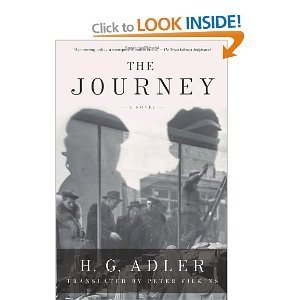
Blurb: A major literary event: the first-ever English translation of a lost masterpiece of Holocaust literature by acclaimed author and survivor H. G. Adler
The story behind the story of The Journey is remarkable in itself: Award-winning translator Peter Filkins discovered an obscure German novel in a Harvard Square bookstore and, reading it, realized that it was a treasure unavailable to English speakers. It was the most powerful book by the late H. G. Adler, a survivor of Theresienstadt and Auschwitz, a writer whose work had been praised by authors from Elias Canetti to Heinrich Böll and yet remained unknown to international audiences.
Written in 1950 after Adler’s emigration to England, The Journey was not released in Germany until 1962. After the war, larger publishing houses stayed away from novels about the Holocaust, feeling that the tragedy could not be fictionalized and that any metaphorical interpretation was obscene. Only a small publisher was in those days willing to take on The Journey.
Hardcover: 292 pages
Publisher: Random House (NY); 1 edition (4 Nov 2008)
Language: English
ISBN-10: 1400066735
ISBN-13: 978-1400066735
Product Dimensions: 16.1 x 2.8 x 24.2 cm

May 15, 2016
Life and Death as Limbo
Written in 1950, published in Germany in 1962 (overcoming orchestrated opposition from the German publishing establishment), but appearing in English only in 2008, The Journey occupies an important and unique place in Holocaust literature. According to the translator, Peter Filkins, it is one of only four books of fiction written in German by Jewish survivors of the camps. And among the hundreds of Holocaust novels published since, it must be the only one with its particular point of view, located neither in time nor place (the word "Auschwitz," for instance, never appears), but in a kind of bird's eye view from above, as a continuous journey of the soul unmarked by obvious way-stages, even that of ultimate extinction. In his brilliant introduction, which is essential reading before attempting the book, Filkins cites Hölderlin speaking of a "synoptic view across the barrier of death," a slow-motion Totentanz that defies time.
At one point, Adler evokes the image of a line of prisoners, hands on the shoulders of the one in front, shuffling along day and night, a "mute ghost train in no need of tracks to run on." Were this to be taken to its conclusion, he says, "time would be erased. The journey would have only a direction, but no destination. It would continue and yet lead nowhere. Senseless would be the question about where you were born, for the day of your death could come long before the day of your conception." Where other Holocaust writers portray Hell, Adler concentrates on Limbo. Such story as there is in the book is a thin fictionalization of his own family history, spending much of the war in Theresienstadt,* the so-called "safe community" for Jews, in which they were kept in suspended animation for several years before the inevitable transportation to Auschwitz. Adler's father, an elderly physician, died of starvation, as does his alter ego in the book, Dr. Leopold Lustig. His mother, sister, and aunt went to the gas chamber; their fictional equivalents merely disappear in a cloud of metaphor. Paul Lustig (Adler himself) is the sole survivor.
The writing ranges from the abstrusely philosophical to the a Kafkaesque surrealism or Orwellian doublespeak:
The camp gates open almost unnoticed, and there are still 100 pages to go. Paul drags himself along the road to another Limbo: this time, one of rubble, where Aryans and Jews alike are victims. Adler calls it Unkenburg—literally Toad City, but with overtones of deception or unknowing. It is a place where nobody recognizes anybody or anything, nobody knows the future, nobody fully acknowledges the past. A housewife, enclosed in her still-intact apartment, asks him: "Was it really so horrible? There have been so many lies. Indeed, no offense, but at the very least it doesn't appear that respectable people were taken away." Captain Dudley, the American officer in charge of refugees, is too busy trading cigarettes for old medals to give Paul the time of day. But Paul does meet at least one Good Samaritan, a Herr Brantel, who asks him "to just remember that in the country whose people had robbed him of everything precious and dear there were still decent people." And Paul/Adler does remember, as a ray of light even in this nightmare record of the death of the soul.
======
*
Here called deceptively Ruhenthal or "Vale of Rest."
**
Try deciphering a few sentences like this: "For indeed, we are our own creation; whether we are denied or accepted at our final end, when one must answer for oneself, much more depends, namely the flourishing of a world that, out of its deepest despair and highest aspirations, is called upon to form its own, in a certain sense, eternal countenance amid the destruction of our only meaningful yet impalpable achievement, one accomplished in and for itself without the participation and help of the world at large."
Written in 1950, published in Germany in 1962 (overcoming orchestrated opposition from the German publishing establishment), but appearing in English only in 2008, The Journey occupies an important and unique place in Holocaust literature. According to the translator, Peter Filkins, it is one of only four books of fiction written in German by Jewish survivors of the camps. And among the hundreds of Holocaust novels published since, it must be the only one with its particular point of view, located neither in time nor place (the word "Auschwitz," for instance, never appears), but in a kind of bird's eye view from above, as a continuous journey of the soul unmarked by obvious way-stages, even that of ultimate extinction. In his brilliant introduction, which is essential reading before attempting the book, Filkins cites Hölderlin speaking of a "synoptic view across the barrier of death," a slow-motion Totentanz that defies time.
At one point, Adler evokes the image of a line of prisoners, hands on the shoulders of the one in front, shuffling along day and night, a "mute ghost train in no need of tracks to run on." Were this to be taken to its conclusion, he says, "time would be erased. The journey would have only a direction, but no destination. It would continue and yet lead nowhere. Senseless would be the question about where you were born, for the day of your death could come long before the day of your conception." Where other Holocaust writers portray Hell, Adler concentrates on Limbo. Such story as there is in the book is a thin fictionalization of his own family history, spending much of the war in Theresienstadt,* the so-called "safe community" for Jews, in which they were kept in suspended animation for several years before the inevitable transportation to Auschwitz. Adler's father, an elderly physician, died of starvation, as does his alter ego in the book, Dr. Leopold Lustig. His mother, sister, and aunt went to the gas chamber; their fictional equivalents merely disappear in a cloud of metaphor. Paul Lustig (Adler himself) is the sole survivor.
The writing ranges from the abstrusely philosophical to the a Kafkaesque surrealism or Orwellian doublespeak:
The forbidden is at last behind you for good, and now eternal freedom is waving you on. […] We wish we had the chance to share your lot, but unfortunately that has been denied us. With us lies the responsibility to worry about your well-being, and then to worry about your brothers who are also awaiting the journey.The voice here is presumably that of the dispatching railroad officials in Prague, but Adler jumps around so freely that you soon no longer know whether this is the language of the oppressors, or the oppressed buying into it. This is not a normal novel by any standards, an intensely difficult book to read** (hence only 4 stars), but its difficulty is necessary to the subject.
The camp gates open almost unnoticed, and there are still 100 pages to go. Paul drags himself along the road to another Limbo: this time, one of rubble, where Aryans and Jews alike are victims. Adler calls it Unkenburg—literally Toad City, but with overtones of deception or unknowing. It is a place where nobody recognizes anybody or anything, nobody knows the future, nobody fully acknowledges the past. A housewife, enclosed in her still-intact apartment, asks him: "Was it really so horrible? There have been so many lies. Indeed, no offense, but at the very least it doesn't appear that respectable people were taken away." Captain Dudley, the American officer in charge of refugees, is too busy trading cigarettes for old medals to give Paul the time of day. But Paul does meet at least one Good Samaritan, a Herr Brantel, who asks him "to just remember that in the country whose people had robbed him of everything precious and dear there were still decent people." And Paul/Adler does remember, as a ray of light even in this nightmare record of the death of the soul.
======
*
Here called deceptively Ruhenthal or "Vale of Rest."
**
Try deciphering a few sentences like this: "For indeed, we are our own creation; whether we are denied or accepted at our final end, when one must answer for oneself, much more depends, namely the flourishing of a world that, out of its deepest despair and highest aspirations, is called upon to form its own, in a certain sense, eternal countenance amid the destruction of our only meaningful yet impalpable achievement, one accomplished in and for itself without the participation and help of the world at large."

March 9, 2014
I really do appreciate Adler's poetic, deep, profound novel about the Holocaust.
But to be quite frank (maybe I'm Candor, haha), I just couldn't understand it. It was too hard for me to read for school, and when I was asked to write a little report on it, I wrote a more general idea because the book was just too difficult to interpret in detail.
No spoilers, but I read the entire book and he made no mention of the Nazis, Jews, or the actual word "Holocaust". I'm sorta the type of person who you have to shout it and put it blatantly in my face for me to get it, so with this novel, let's just say it was really painful. Believe me, I tried so hard and I really wanted to understand it and be enlightened, but it was hard to visualize. The death of the characters in books like The Boy in the Striped PJs or like "the Book Thief" were easy to understand - the Nazis caused it. I absolutely adored the strength of all these survivors and the powerful message all these WW2 books contain, but The Journey was just too difficult to read for me. Sorry. I hope one day I can read it and actually get it. But this time just wasn't it. ):
- The bookworm <4
But to be quite frank (maybe I'm Candor, haha), I just couldn't understand it. It was too hard for me to read for school, and when I was asked to write a little report on it, I wrote a more general idea because the book was just too difficult to interpret in detail.
No spoilers, but I read the entire book and he made no mention of the Nazis, Jews, or the actual word "Holocaust". I'm sorta the type of person who you have to shout it and put it blatantly in my face for me to get it, so with this novel, let's just say it was really painful. Believe me, I tried so hard and I really wanted to understand it and be enlightened, but it was hard to visualize. The death of the characters in books like The Boy in the Striped PJs or like "the Book Thief" were easy to understand - the Nazis caused it. I absolutely adored the strength of all these survivors and the powerful message all these WW2 books contain, but The Journey was just too difficult to read for me. Sorry. I hope one day I can read it and actually get it. But this time just wasn't it. ):
- The bookworm <4

Want to Read
February 4, 2011 The New Yorker , January 31, 2011, published an excellent article, The Long View , by Ruth Franklin, which discussed this author, HG Adler. He was a survivor of several concentration camps, but managed to view his experiences in manner which allowed him to "produce a quantity and diversity of writings about the Holocaust that seem to have been equalled by no other survivor". This novel is only one of many. If others read nothing by him, those who are interested in this genre should seek out this article.
Although this is the genre which I like to read, at this point I am finding this story too depressing to continue. I am sure that I will return to it in the future.
Although this is the genre which I like to read, at this point I am finding this story too depressing to continue. I am sure that I will return to it in the future.

July 29, 2014
It takes a while to understand this poetic and surrealist style of writing. At times it's even lyrical. The horror emerges and then dissipates. The terror of the main characters is revealed as partially numbed as the days pass. There are impressions rather than specific explanations. I actually preferred this book to Night. I was partially dissociated from the characters though, perhaps because it was too real for me to create protection from the story. This was terribly unsettling to read but necessary for any student of the Holocaust.

Read
April 20, 2015A very powerful Holocaust novel, one that rivals Night. Alder, a Holocaust survivor, wrote a book of the Holocaust without using the words Nazi, Jew, concentration camp, or any associated. An amazing, horrifying book of life and memory.

September 28, 2009
I just can't read anymore of this. On page 53 and I have to quit

Read
November 17, 2019"Passando, si raccoglie questo e quello e si porta su, in superficie, dopo di che è simbolo in mezzo a un'adunanza di suoi pari, si delineano nessi, l'inaspettato prende coscienza di sé e trova conferma nel fatto che esiste anche altro. Le misure si trovano da sole non appena le capacità s'infiammano sulle effigi e la fiamma del movimento le incita a un'azione progressiva. Ma universi interi possono andare a fondo - cosa che i pensatori sanno - il pensiero non è altro che ricordo, perciò il ricordo è qualcosa che ritorna in mente, e il suo contenuto è sempre già superato, solo il suo desiderio si fa presente, avvolto in una trama fitta il pensiero si spinge nella visione del possibile che preme verso l'infinito, ma di tutto questo, in fondo, non ci si accorge nemmeno, perchè ciò che è stato pensato per l'appunto è già passato, il regno esistente è già finito, è il passato sconvolgente, è il regno dei tanti avanzi, dei desideri fluiti nella realtà per poi cristallizzarsi nel mondo che adesso sono diventati, se non che nel divenire hanno perso la loro essenza e anche la loro verità."

October 29, 2021
Originally written in 1950 but not published in Germany until 1962. Translated and published in English in 2008.
----------------------------------------
Well, I couldn't make out heads or tails about what the author was trying to portray. It's one thing when it's a book of big words that require you to pause and look up their meanings for better understanding, but it's a whole different ballgame when the author's writing is nothing but riddles, talking in circles and full of repetitive sentences with underlying meanings. Forget the fact that I couldn't even decide who was talking or what exactly they were doing.
I really wanted to try and appreciate this guys writing because of his experience and survival through the holocaust, but the structure of the novel was all over the place. Still, I did give it my very best shot and read through page 100 and would have finished regardless, if only I understood even a little bit.
Although a novel, Adler's real life is supposedly portrayed in the character of Paul Lustig, the only surviving member of his family.
----------------------------------------
Well, I couldn't make out heads or tails about what the author was trying to portray. It's one thing when it's a book of big words that require you to pause and look up their meanings for better understanding, but it's a whole different ballgame when the author's writing is nothing but riddles, talking in circles and full of repetitive sentences with underlying meanings. Forget the fact that I couldn't even decide who was talking or what exactly they were doing.
I really wanted to try and appreciate this guys writing because of his experience and survival through the holocaust, but the structure of the novel was all over the place. Still, I did give it my very best shot and read through page 100 and would have finished regardless, if only I understood even a little bit.
Although a novel, Adler's real life is supposedly portrayed in the character of Paul Lustig, the only surviving member of his family.
Read
December 26, 2025This is a really interesting book and has a lot of truly beautiful and inspired passages, but it's also very difficult, slow and, at times, hard to keep yourself involved in. It's a real shame that it's been so forgotten as I think it'd be very interesting to study alongside works by writers like Virginia Woolf and Franz Kafka (the latter of whom I thought of constantly with this book's dream-like confusion).

December 22, 2018
If you have read quite a few books about the Holocaust, you will probably find this one interesting. But if you're coming for the first time to reading about how people experienced, and sometimes survived, the horrors of the WWII death camps, you may find that there is not enough background information in this novel to give you a full picture.
December 21, 2017
Endless in its journey.....

March 20, 2011
In English, this book, translated from German, is called 'The Journey.' If you want to know how the Jewish people felt about their journey to the concentration camps, beginning with how hard it was to leave their homes and possessions, this is the book for you. It's fiction, but is based on the author's experience. He was taken to Auschwitz where his wife and her mother was put to death. He wrote this in 1950, but it didn't get published in Germany until 1962. There is an article about H. G. Alder and his works in The New Yorker, Jan. 31, 2011.
July 20, 2011
Een heel bjzonder boek over de holocaust, waarin echter nergens woorden als nazi, Duitsers, Joden, kamp etc. genoemd worden. De schrijver (die zelf als Tsechische jood vanuit Praag in drie kampen heeft gezeten en het als een van de weinigen van zjn familie heeft overleefd)schrijft een bijna abstract verhaal over de gebeurtenissen. Daardoor maakt het naar mijn idee meer indruk dan al de getuigenissen met bijna grafische bechrijvingen van wat er in die kampen is gebeurd.
Vooral het stuk over hoe het gaat als je "vrij" komt en hoe daar door anderen op wordt gereageerd, vond ik erg aangrijpend.
Vooral het stuk over hoe het gaat als je "vrij" komt en hoe daar door anderen op wordt gereageerd, vond ik erg aangrijpend.
December 16, 2014
Strange and dreamlike at times. Hard to fathom that one could write a book about WWII concentration camps and never use the words German, Jew, Nazi, concentration camp, Hitler ...
November 9, 2021
Superb

Read
October 29, 2017Couldn't understand what I read. Giving up after a couple of pages.
Displaying 1 - 19 of 19 reviews