Written by 40 of the most notable Jungian psychoanalysts — spanning 11 countries, and boasting decades of study and expertise — Jungian Psychoanalysis represents the pinnacle of Jungian thought. This handbook brings up to date the perspectives in the field of clinically applied analytical psychology, centering on five areas of the fundamental goals of Jungian psychoanalysis, the methods of treatment used in pursuit of these goals, reflections on the analytic process, the training of future analysts, and special issues, such as working with trauma victims, handicapped patients, or children and adolescents, and emergent religious and spiritual issues. Discussing not only the history of Jungian analysis but its present and future applications, this book marks a major contribution to the worldwide study of psychoanalysis.
Not to be confused with other Analytical/Jungian Psychologist Murray Stein
Jungian psychoanalyst, author, lecturer
Murray Stein, Ph.D.is a training analyst at the International School for Analytical Psychology in Zurich, Switzerland. His most recent publications include The Principle of Individuation, Jung’s Map of the Soul, and The Edinburgh International Encyclopaedia of Psychoanalysis (Editor of the Jungian sections, with Ross Skelton as General Editor). He lectures internationally on topics related to Analytical Psychology and its applications in the contemporary world.
Dr. Stein is a graduate of Yale University (B.A. and M.Div.), the University of Chicago (Ph.D., in Religion and Psychological Studies), and the C.G. Jung Institut-Zurich. He is a founding member of the Inter-Regional Society of Jungian Analysts and Chicago Society of Jungian Analysts. He has been the president of the International Association for Analytical Psychology (2001-4), and is presently a member of the Swiss Society for Analytical Psychology and President of the International School of Analytical Psychology, Zurich.
[27th November, 2017] Maybe I was drawn to this book by watching Austrians celebrating a X'mas season with agitated Krampus* figures taking to the streets. Childhood fears are immediately evoked, when facing those masks. Something in the collective psyche gets stirred and disturbed.
Jung was truly a citizen of the world. His theories encompassed multiple world-visions and cultures, not only a western standpoint. I'm glad the book, which gathers personalities from 11 countries, who devote their lives to this discipline -Jungian Analysis-started in Symbols of Transformation.
The book is vast in its scope, but the spirit throughout remains Jungian, a very distinct current of thought, say, from Freud's or Adler's. Method and Process, training/supervision, Change and Subject, Culture and Research are some of the organizers of the book chapters.
(Unconscious dynamics in a man with a cultural complex; case reported by Catherine Kaplinsky)
The chapter of Catharine Kaplinsky on cultural complexes is quite interesting. It starts with one man named Joe Henderson who had written a letter to Jung, on his intention to write down a book called “The Protestant Man”. Joe died in 2007 and he never wrote the book, but he tried to define the “complex” expression, one Jung had come up out of his “word association “experiments.
Indeed, a theory of complexes. It required, from Jung, a (premature) foray into such (polemic) topics such as the “German Psyche” and “national character”. [Mind you of the WWI]. Henderson spoke of “an area of HISTORICAL memory” (something as the author says: “not politically correct”); and the case Katherine chooses to expose a “cultural complex” is about racism.
The case at stake is about a South African man living in Europe who had dreams that puzzled him. He felt the stress and conflict, while as university professor. One of the conclusions stemming from the analysis is that he was “subject to a strong racist conditioning” in early childhood and while in school. That would explain his (unconscious) complexes and puzzling dreams.
One of the most interesting chapters I’ve found was the one by Joseph Cambray. Departing from a client’s dream (a man, about to change his career, who saw “a [zodiac] constellation never seen before”), Cambray blends reflection on science with Indian and Buddhist philosophy to state his own view: the (new) self as emerging for that man, implies a “greater differentiation” and a certain “break of the symmetry”. One could easily deduce, those changes occur in science too. So, from Newton to Einstein, from Faraday to Maxwell, Cambray approaches the "new paradigm" emerging, and Jung’s view on the self as a “form of field theory” ; his corresponding diagrams are (spatially) tantalizing to behold .
Yet there’s another Jungian analyst who advanced a similar idea, replacing archetypes by “fields”. He’s Michael Conforti.
*(from Wiki) "In Austro-Bavarian Alpine folklore, Krampus is a horned, anthropomorphic figure described as "half-goat, half-demon", who, during the Christmas season, punishes children who have misbehaved, in contrast with Saint Nicholas, who rewards the well-behaved with gifts."
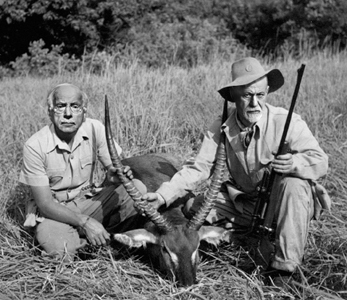
Still, speaking about Krampus and horned creatures..., I hope you can identify each of the next (three) characters in the photo.
This is a collection of articles on various subjects concerning Jungian psychoanalysis written by psychoanalysts worldwide. That being the case, the 4 stars here awarded are unfairly low to some authors and quite high to others.
The goodness (and badness) of the articles were directly related to their clarity or lack thereof. Articles with simple language and vignettes were the best, and easily contrasted with the confusing jargon-laden unnecessarily dense ones. I couldn't help but to feel this was due to the difference between confident professionals and professionals who hide behind verbosity.
All in all a good read. I got both the audio version and the written one, which I recommended for checking out the images some articles contain.
It's not ALL bad, but there are a lot of problematic or atrocious essays included in this collection. Its poorly edited—the editor requested new essays from the 37 authors with complete freedom in what they write, accepting whatever they submitted—and is clearly intended for practicing Jungian analysts.
There's a recurring (though certainly not universal!) discomfort with science and scientific research in these essays and the Jungian tradition more generally. This is acknowledged in Verena Kast's essay 'Research', which pleads with Jungian analysts to incorporate scientific research into their traditions. It is perhaps ironic then that so many essays included in this same collection fall short in that regard. There's very little scientific research cited, most citations are to Jung and members of his school.
There's a lot of problematic phrasing and perspectives scattered around. Perhaps especially Singer and Kaplinky's "storehouse of self-affirming ancestral memories" or "desription of groups of classes as filtered through the psyches of generations of ancestors". Gender binarism is ubiquitious and there's a lot of mystification as well.
Some essays were better than other, most were very good, and the ones I enjoyed the most were by Warren Colman (Dream Interpretation and the Creation of Symbolic Meaning), Mary Dougherty (On Making and Making Use of Images in Analysis), Angela M. Connolly (Analyzing Projections, Fantasies, and Defenses), and Paul W. Ashton (Beginnings and Endings). Also— John Dourley’s article (Religion & Jungian Psychoanalysis). Contemporary essays about Jungian analysis— good stuff that doesn’t neglect the art, poetry, and soul of the human psyche.