"A street entertainer earned a lot of money with his dancing monkey. One day when the monkey refused to dance the entertainer killed a live chicken in front of the monkey. And then the monkey resumed dancing." - An Old Chinese Fable
"Zhao Gao was contemplating treason but was afraid other officials would not heed his commands. He brought a deer and presented it to them, but called it a horse. Some were silent while some, hoping to ingratiate themselves, said it was a horse, and others said it was a deer. Zhao Gao had all those who said it was a deer executed. The officials were terrified and Zhao Gao gained power." - Sima Qian 'The Records of the Grand Historian', Han Dynasty 100 BC
************
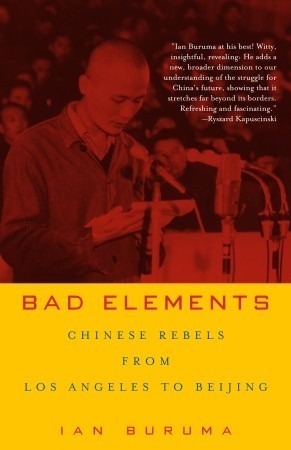
Before becoming a NYRB editor and professor at Bard, Ian Buruma was a writer and critic in Tokyo, Hong Kong and greater east Asia. In this 2001 book he visits Chinese exiles and expatriates who left the People's Republic at various times from it's founding in 1949 to the Tiananmen protests of 1989. He traveled the foreign diaspora and inside China for five years to try to understand. Would China continue under authoritarian rule or someday be governed as a free society? Buruma has a degree in Chinese literature from Leiden and is well versed in China's history and culture.
After the June 4 massacre in Beijing, student leaders were jailed or escaped, many now living in the US or EU. Chai Ling, a Nobel Peace Prize nominee, studied at Princeton and Harvard and is a CEO of a software company. Her deputy leader Li Lu earned triple economics, MBA and law degrees simultaneously in 1996, a first in Columbia's history. He has managed a hedge fund and may lead Berkshire Hathaway. Some like Wu'er Kaixi became media figures and politicians in Taiwan and Hong Kong, others studied religion in the US and France. Those who succeeded are denounced by peers.
Liu Binyan, an influential writer and loyal communist, was arrested in 1957 in the 100 Flowers Campaign, where Mao urged criticism of the Party. He was persecuted in 1967 in the Cultural Revolution and purged in 1987 for revealing Party corruption. In the US, after expulsion from China, he faults the 1989 leaders for selfishness and materialism. A theme from some emigres is China's 'spiritual vacuum' that needs a religion to teach love. Yuan Zhiming, a refugee who wrote the film 'River Elegy' comparing the Party to previous dynasties, travels inside of America preaching the gospel.
Fang Lizhi was a physicist and professor who, among other things, developed China's atomic bomb. He was victimized in the 1956 and 1966 purges. Allowed to visit Europe in 1979 he reflected on Galileo's censure by the Church. Heaven was the purview of religion, not of science. He inspired students to rebel in 1989 and was given asylum at the US embassy in Beijing. Xiao Qiang, an ex-student of Fang and a democracy advocate in New York meets Buruma. He teaches in Berkeley now and researches AI-powered state surveillance in China. For many Beijing science students Einstein was a hero.
Wei Jingshen, a former Red Guard who posted a manifesto on the 1978 Democracy Wall in Beijing, spent 18 years in jail before being deported to the US. Fang sent an open letter to Deng Xiaoping in 1989 asking for Wei's release which helped spark the protests. After his exile Fang taught astrophysics in Cambridge, Princeton and Tucson. Wei was spared from execution when leaked tapes of his trial caused international outrage. He went on to become a leader for human rights in Washington D.C. Buruma discusses rivalry for recognition and funding among activist groups in the United States.
Chia Thye Poh, a former political prisoner in Singapore meets with Buruma. Leader Lee Kuan Yew envisioned a civilization surrounded by barbarians, a Chinese enclave transplanted to the jungles of SE Asia, where communists instead of counter-revolutionaries were repressed. Chia, a parliament member, was jailed in 1963 for 23 years. Running against the ruling party a lawyer loses his license, a scientist his savings. Church officials accused of Marxism are tortured and coerced to confess. Lee once said without 80% Chinese Singapore's political conformism would not have worked.
Many who had fled Taiwan and worked overseas to advance rights returned in 1996. After the Japanese retreat in 1945 Chiang Kai-shek's nationalists invaded from the mainland ruling with an iron fist. Imaginary communists disappeared in the night, arrests and killings leading to 30,000 deaths over 40 years. Chiang's son Ching-kuo lifted martial law in 1987 under US pressure. Buruma traces a turn to democracy in 1996 to the 1979 protests challenging Kuomintang power monopoly. Elections were held as Beijing fired missiles into the straight and candidates returned from prison or exile.
Buruma visits Hong Kong during the 1997 hand over and reports on the pageantry and propaganda of power transfer. Protests were reserved, unlike mass demonstrations twenty years later when central party control was exerted. As the island retained its capitalist role the right leaning business owners became pro-Beijing and the left wing pro-British in a reversal of political stance. Along with economic reforms Deng had decided to crush movements for democracy in the 80's. Hong Kongers who went to the mainland to support protests spent the prior decade in prisons and labor camps.
The Special Economic Zone of Shenzhen lies directly across a canal bordering Hong Kong. An indigent lawyer takes in maimed factory workers dismissed without compensation for injuries. He and an economist reflect without democratic rule law has no legitimacy. In Guangzhou Buruma meets a co-author of the 1974 Li Yi Zhe manifesto that launched the democracy movement in the wake of the Cultural Revolution. He believes Christianity laid the foundation for science by raising questions about the nature of the universe. Buruma argues Greek logic was the root and the Church a roadblock.
A 1999 protest for religious freedom by Falun Gong revealed they were 100 million strong, with more members than the communist party, so they were immediately banned as an evil cult. Within three days 25,000 were arrested and 10,000 jailed. Buruma compares them to apocalyptic movements like the Yellow Turbans, Taiping and Boxers who challenged earlier despotic rule. They were styled as proto-socialist by Mao in an ironic twist of history. Falun Gong itself preaches withdrawal from worldly affairs. Sent down to the country a follower finds villagers still kept traditional spiritual beliefs.
Traveling with a friend to a village in Sichuan Baruma meets a rural Christian mother who is hassled by local authorities and harangued by her family. Corrupt officials squeeze the peasants for money, directed by a remote unelected central government. In Lhasa Tibet modernization, the mantra of all colonial powers, replaced class struggle as the main goal of Beijing. Two Tibetans argue if science replaced religion, one saying that without Buddhism there is no Tibet. Language is fading as schools and jobs speak Mandarin. Buruma ends in Beijing on the 10th anniversary of Tiananmen protests.
I first visited China in the 90's and have been back every two years. I found a warm and welcoming country, a diverse and interesting people and culture. In tensions over Taiwan and trade, covid and climate, Trump and Xi are all disturbing. Traveling Tibet and Xinjiang I saw surveillance and security. Buruma looks at the decade during Deng and repression of dissent. In many of the interviews a religious renaissance or westernization is thought to be needed. I'm not convinced it would resolve the issue of authoritarian control. As seen in the west a slide backward in civil rights is a possibility too.