

What do you think?
Der Untergang des Abendlandes #1
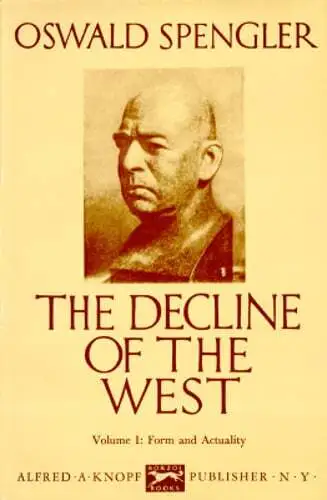
The Decline of the West, Vol 1: Form and Actuality
Oswald Spengler was born in 1880 at Blankenburg, Germany. He studied mathematics, philosophy, and history at Munich and Berlin. Except for his doctor's thesis on Heraclitus, he published nothing before the first volume of The Decline of the West, which appeared when he was thirty-eight. The Agadir crisis of 1911 provided the immediate incentive for his exhaustive investigations of the background and origins of our civilization. He chose his main title in 1912, finished the first draft of "Form and Actuality" ("Gestalt und Wirklichkeit") two years later, and published the volume in 1918. The second, extensively revised edition, from which the present translation was made, appeared in 1923. The concluding volume, "Perspectives of World-History" ("Welthistorische Perspektiven"), was published in 1922. The Decline of the West was first published in this country in 1906 (Vol. I) and 1928 (Vol. II).
For many years Spengler lived quietly in his home in Munich. thinking, writing, and pursuing his hobbies - the collecting of pictures and primitive weapons, listening to Beethoven quartets, reading the comedies of Shakespeare and Moliere, and taking occasional trips to the Harz Mountains and to Italy. He died suddenly of a heart attack in Munich three weeks before his fifty-sixth birthday.
For many years Spengler lived quietly in his home in Munich. thinking, writing, and pursuing his hobbies - the collecting of pictures and primitive weapons, listening to Beethoven quartets, reading the comedies of Shakespeare and Moliere, and taking occasional trips to the Harz Mountains and to Italy. He died suddenly of a heart attack in Munich three weeks before his fifty-sixth birthday.
428 pages, Hardcover
First published January 1, 1918
About the author
Oswald Spengler
99 books678 followersOswald Spengler was born in 1880 in Blankenburg (then in the Duchy of Brunswick, German Empire) at the foot of the Harz mountains, the eldest of four children, and the only boy. His family was conservative German of the petite bourgeoisie. His father, originally a mining technician, who came from a long line of mineworkers, was a post office bureaucrat. His childhood home was emotionally reserved, and the young Spengler turned to books and the great cultural personalities for succor. He had imperfect health, and suffered throughout his life from migraine headaches and from an anxiety complex.
At the age of ten, his family moved to the university city of Halle. Here Spengler received a classical education at the local Gymnasium (academically oriented secondary school), studying Greek, Latin, mathematics and natural sciences. Here, too, he developed his affinity for the arts—especially poetry, drama, and music—and came under the influence of the ideas of Goethe and Nietzsche. He even experimented with a few artistic creations, some of which still survive.
After his father's death in 1901 Spengler attended several universities (Munich, Berlin, and Halle) as a private scholar, taking courses in a wide range of subjects: history, philosophy, mathematics, natural science, literature, the classics, music, and fine arts. His private studies were undirected. In 1903, he failed his doctoral thesis on Heraclitus because of insufficient references, which effectively ended his chances of an academic career. In 1904 he received his Ph.D., and in 1905 suffered a nervous breakdown.
Scholars[which?] remark that his life seemed rather uneventful. He briefly served as a teacher in Saarbrücken and then in Düsseldorf. From 1908 to 1911 he worked at a grammar school (Realgymnasium) in Hamburg, where he taught science, German history, and mathematics.
In 1911, following his mother's death, he moved to Munich, where he would live until his death in 1936. He lived as a cloistered scholar, supported by his modest inheritance. Spengler survived on very limited means and was marked by loneliness. He owned no books, and took jobs as a tutor or wrote for magazines to earn additional income.
He began work on the first volume of Decline of the West intending at first to focus on Germany within Europe, but the Agadir Crisis affected him deeply, and he widened the scope of his study. Spengler was inspired by Otto Seeck's work The Decline of Antiquity in naming his own effort. The book was completed in 1914, but publishing was delayed by World War I. Due to a congenital heart problem, he was not called up for military service. During the war, however, his inheritance was largely useless because it was invested overseas; thus Spengler lived in genuine poverty for this period.
At the age of ten, his family moved to the university city of Halle. Here Spengler received a classical education at the local Gymnasium (academically oriented secondary school), studying Greek, Latin, mathematics and natural sciences. Here, too, he developed his affinity for the arts—especially poetry, drama, and music—and came under the influence of the ideas of Goethe and Nietzsche. He even experimented with a few artistic creations, some of which still survive.
After his father's death in 1901 Spengler attended several universities (Munich, Berlin, and Halle) as a private scholar, taking courses in a wide range of subjects: history, philosophy, mathematics, natural science, literature, the classics, music, and fine arts. His private studies were undirected. In 1903, he failed his doctoral thesis on Heraclitus because of insufficient references, which effectively ended his chances of an academic career. In 1904 he received his Ph.D., and in 1905 suffered a nervous breakdown.
Scholars[which?] remark that his life seemed rather uneventful. He briefly served as a teacher in Saarbrücken and then in Düsseldorf. From 1908 to 1911 he worked at a grammar school (Realgymnasium) in Hamburg, where he taught science, German history, and mathematics.
In 1911, following his mother's death, he moved to Munich, where he would live until his death in 1936. He lived as a cloistered scholar, supported by his modest inheritance. Spengler survived on very limited means and was marked by loneliness. He owned no books, and took jobs as a tutor or wrote for magazines to earn additional income.
He began work on the first volume of Decline of the West intending at first to focus on Germany within Europe, but the Agadir Crisis affected him deeply, and he widened the scope of his study. Spengler was inspired by Otto Seeck's work The Decline of Antiquity in naming his own effort. The book was completed in 1914, but publishing was delayed by World War I. Due to a congenital heart problem, he was not called up for military service. During the war, however, his inheritance was largely useless because it was invested overseas; thus Spengler lived in genuine poverty for this period.
Ratings & Reviews
Friends & Following
Create a free account to discover what your friends think of this book!
Community Reviews
Displaying 1 - 30 of 94 reviews

April 28, 2011
At a casual glance Oswald Spengler is smarter than me. He comes across encyclopedic in his knowledge, and has very strong opinions on lots of topics, but after a while, as he moves through all different areas of knowledge and you (well me, the reader) finally starts to be confronted with works that he (because this is me I'm not very coyly talking about in the third person) knows something about that you (well me again) realize, that's not actually accurate, hmmm I wonder how many more things I'm just nodding along with aren't really that accurate, reductionist, or just twisted so out of shape that only a zealot would mindlessly nod-along in agreement.
I started off enjoying this book, I got bored with the book so I stopped reading it in favor of more fun books, the library demanded I return the book so I grudgingly went back to reading it, I enjoyed it some more and then I came to the realization that I'm just reading a logically more difficult and erudite version of Glenn Beck.
Yep I said it. The author that Henry Miller jizzes over in Tropic ofwhicheveroneitwas, and who is held up as a beacon of awesome pessimism is about as interesting as that douche bag distorter of history on the AM frequencies. But where Mr. Mormon-pants pitches a tent in his trousers at the mere mention of founding fathers, Mr. Grumpy-faced gets similarly excited over Goethe and other 'classical' early Moderns.
Like Beck, there is a certain amount of truth to what Spengler says. Both will rightly point out that there is something rotten in the world, and they can even pretty correctly point out where some of the rottenness lies, and point to some historical areas where things could have gone better, of where things started to take a turn for the worse, but on the strength of hitting a few warm up lobs out of the park (that seriously were pitches anyone could hit if they tried) they start to think they are Ted motherfucking Williams, and think that they can pretty much do no wrong at the plate.
I'm going to drop the very frayed metaphors now, and I'm realizing that going through and taking apart Spengler is going to be quite a bit of work, at least more work than I feel like doing. Oh if only it were cooler (I mean temperature wise, not hip wise, I'm sure it's always cool, as in hip, to dismantle turgid German writers), maybe I wouldn't have my recent attention span of a gnat when it comes to writing anything.
Instead a few quick notes and you can believe or not believe my Spengler as Beck argument based on blind faith in my intellectual abilities, or read this un-abridged version of Part 1 of Decline of the West for yourself and then tell me how stupid I am.
One. Everytime Spengler is going to say something really outrageous and pretty much intellectually indefensible he'll writ something like, "We can now say without any hesitation", or "It should come as no surprise that". Actually anytime he uses the first person plural I think he is trying to pull a con where he is trying to make the reader an accomplice with him. Actually reading the last fifty pages or so of this book, especially the section on Atheism is a treat in how to write deceitfully. Or deceitful rhetoric. Beck take note!
Two. I can promise you some brilliant work thoughts here if I weren't so fucking lazy. Instead I'm just going to say that Spengler is guilty of what philosophers like to call, "Having your cake and eating it too". Case in point, after spending about a hundred pages bashing the Greeks for their shallowness and stupidity he then turns to them as beholders of all scientific wisdom (if the greeks didn't have a word for it it's not necessary). He also bashed all the post-Kantian philosophers for being un-Mathematical and then whined about scientists being too mathey and not Goethe dreamy-esque enough in their pursuits.
Two. B. When it suits Spengler he is quite the iconoclast, but he has no problem using 'traditional' views that one would think he doesn't believe in (because he said so) when it suits him. This is very similar to the way AM talk radio hosts work!
Three. His whole anti-contemporary science rant at the end. Oh man. This is probably where a good number of the targets Skoal attacks got some of their background in science from.
Four. Do you know the basic gist of the book? The thesis? Well it's that all Cultures have a lifespan. They are born, they grow up, they have golden ages and they decline and die. According to Spengler, we (we'll early 20th Century people, and us) are in the decline of Northern Western Society, AKA Faustian Culture. There isn't anything you or I can do about it, it's just the way things are, we happen to be in the old decrepit age of a once great Culture. We can't fight against it. We aren't going to have a revival. No new Goethe, or Bach, or Wagner is going to rise up from our culturally arthritic civilization (we have lost the right to be a Culture). Our writers are hacks. Our thinkers are dolts ever since Nietzsche. Everything great was made already, and now we just produce popular schlock (except of course when Spengler gets all populist on the reader and cries that science is wrong because the man on the street can't get it anymore (see point three)). Blah blah blah. But you know what you learn in the very last section of the last chapter at the end of Part 1? That (you'll never see this coming), the Faustian Age still has one more slot open for genius, that we are drying as a culture but ol'Spengler's morphology is the last remaining piece of brilliance, the crown jewel on the Faustian understanding of the world. Everyone else who thinks he or she is doing something worthwhile intellectually is a deluded fucknut, but Ozzie he's undeluded, he sees the truth and knows that the world really really really needs his writing. Then we can all fuck off and die. Culturally.
Oh, I almost forgot this. At one point in the book he says that Otto Weininger's delusionally entertaining misogynistic and anti-Semitic book is the only serious attempt to revive Kant (which would be a good thing in the Spengler-verse). Really? That was Kantian?
I started off enjoying this book, I got bored with the book so I stopped reading it in favor of more fun books, the library demanded I return the book so I grudgingly went back to reading it, I enjoyed it some more and then I came to the realization that I'm just reading a logically more difficult and erudite version of Glenn Beck.
Yep I said it. The author that Henry Miller jizzes over in Tropic ofwhicheveroneitwas, and who is held up as a beacon of awesome pessimism is about as interesting as that douche bag distorter of history on the AM frequencies. But where Mr. Mormon-pants pitches a tent in his trousers at the mere mention of founding fathers, Mr. Grumpy-faced gets similarly excited over Goethe and other 'classical' early Moderns.
Like Beck, there is a certain amount of truth to what Spengler says. Both will rightly point out that there is something rotten in the world, and they can even pretty correctly point out where some of the rottenness lies, and point to some historical areas where things could have gone better, of where things started to take a turn for the worse, but on the strength of hitting a few warm up lobs out of the park (that seriously were pitches anyone could hit if they tried) they start to think they are Ted motherfucking Williams, and think that they can pretty much do no wrong at the plate.
I'm going to drop the very frayed metaphors now, and I'm realizing that going through and taking apart Spengler is going to be quite a bit of work, at least more work than I feel like doing. Oh if only it were cooler (I mean temperature wise, not hip wise, I'm sure it's always cool, as in hip, to dismantle turgid German writers), maybe I wouldn't have my recent attention span of a gnat when it comes to writing anything.
Instead a few quick notes and you can believe or not believe my Spengler as Beck argument based on blind faith in my intellectual abilities, or read this un-abridged version of Part 1 of Decline of the West for yourself and then tell me how stupid I am.
One. Everytime Spengler is going to say something really outrageous and pretty much intellectually indefensible he'll writ something like, "We can now say without any hesitation", or "It should come as no surprise that". Actually anytime he uses the first person plural I think he is trying to pull a con where he is trying to make the reader an accomplice with him. Actually reading the last fifty pages or so of this book, especially the section on Atheism is a treat in how to write deceitfully. Or deceitful rhetoric. Beck take note!
Two. I can promise you some brilliant work thoughts here if I weren't so fucking lazy. Instead I'm just going to say that Spengler is guilty of what philosophers like to call, "Having your cake and eating it too". Case in point, after spending about a hundred pages bashing the Greeks for their shallowness and stupidity he then turns to them as beholders of all scientific wisdom (if the greeks didn't have a word for it it's not necessary). He also bashed all the post-Kantian philosophers for being un-Mathematical and then whined about scientists being too mathey and not Goethe dreamy-esque enough in their pursuits.
Two. B. When it suits Spengler he is quite the iconoclast, but he has no problem using 'traditional' views that one would think he doesn't believe in (because he said so) when it suits him. This is very similar to the way AM talk radio hosts work!
Three. His whole anti-contemporary science rant at the end. Oh man. This is probably where a good number of the targets Skoal attacks got some of their background in science from.
Four. Do you know the basic gist of the book? The thesis? Well it's that all Cultures have a lifespan. They are born, they grow up, they have golden ages and they decline and die. According to Spengler, we (we'll early 20th Century people, and us) are in the decline of Northern Western Society, AKA Faustian Culture. There isn't anything you or I can do about it, it's just the way things are, we happen to be in the old decrepit age of a once great Culture. We can't fight against it. We aren't going to have a revival. No new Goethe, or Bach, or Wagner is going to rise up from our culturally arthritic civilization (we have lost the right to be a Culture). Our writers are hacks. Our thinkers are dolts ever since Nietzsche. Everything great was made already, and now we just produce popular schlock (except of course when Spengler gets all populist on the reader and cries that science is wrong because the man on the street can't get it anymore (see point three)). Blah blah blah. But you know what you learn in the very last section of the last chapter at the end of Part 1? That (you'll never see this coming), the Faustian Age still has one more slot open for genius, that we are drying as a culture but ol'Spengler's morphology is the last remaining piece of brilliance, the crown jewel on the Faustian understanding of the world. Everyone else who thinks he or she is doing something worthwhile intellectually is a deluded fucknut, but Ozzie he's undeluded, he sees the truth and knows that the world really really really needs his writing. Then we can all fuck off and die. Culturally.
Oh, I almost forgot this. At one point in the book he says that Otto Weininger's delusionally entertaining misogynistic and anti-Semitic book is the only serious attempt to revive Kant (which would be a good thing in the Spengler-verse). Really? That was Kantian?

December 26, 2020
10/10.
History, as taught by our bleating academics and our government-derived education, is a compilation of facts — facts often "showing" how the West is the nasty creation of fair-skinned people. History — oh how sad! — is just one big line of inequality, so we should go and fix that. I say: No! History is making connections between disparate facts and civilizations to reach larger trends — cycles — which reveal the inner workings of a larger process at play. Anyone who has realized that modernity is not the pinnacle of history should be open to the finding that history is cyclical. If modernity — with its great creations like toilets as visual art, smut as literature, unintelligible words as philosophy, and anti-European hatred as history — is not so good after all, then what have we lost? Were great civilizations before us better? Are we just part of a larger trend, the end of a macro-cycle of history?
Spengler answers this question with the most deep and wide knowledge I have ever seen. He finds that History (i.e. the actual important parts) runs in discrete Cultures/Civilizations. Each Culture has four seasons — spring, summer, fall, and winter. These seasons will always run in parallel with each other, no matter how disparate Cultures are. Yet, despite this similarity, each Culture will have a reigning Idea: some metaphysical unity which distinguishes it from every other Culture.
For example, the West — beginning in the Christian-pagan fusion in Northwestern Europe which created a strong and mighty Christianity — has a Faustian spirit. This means that it is characterized by a striving towards infinity. One can see this in every single aspect of its culture. Its first great artworks were cathedrals, with their spires pointing up towards infinity (the sky). Western Man was already trying to perfect himself to be like God (live in a Godly way). Then look at mathematics: it is the West that founds multi-dimensional geometry and Calculus. Calculus is premised upon using the limit definition (i.e. going to infinitely small lengths), and multi-dimensional geometry breaks the human mind from its three-dimensional limits to explore as much dimensions as it wants.
Then when the West's Culture transforms into what Spengler calls a Civilization (i.e. when its accomplishments materialize), we still see this drive for infinity. Think of the European explorers — Columbus, Vasco De Gama, Magellan — going out onto the sea, into the unknown. "What will come before me?" they may have thought. Yet they travelled on! They spatially conquered the world. Then we have Europeans using their great technology (once again a strive to truly master the world) going upwards to infinity with the Space Race. What's the point in going to space or to the moon? To go where no man has gone before — to conquer the unknown. Only a Faustian spirit would want that!
The facts I have provided you may seem sparse, but that is simply due to the limitations of any review. I have never seen so many proper nouns, so densely packed, as in Spengler's book. Yet these are not "just the facts", but are used in an inductive manner to understand history as a whole. In this aspect, Spengler leaps ahead of his peers. He delineates the essence of Classical civilization (Greece/Rome), Western civilization, "Magian" civilization (essentially Arabic), Chinese civilization, Indian civilization, and Egyptian civilization. With his erudite mind combined with its metaphysical bent he reveals the mystery of history in an awe-inspiring work. He shows that modernity's urbanization, its gross commercialization, and its individualistic atomization are not new phenomena, but happen at the end of all civilizations. They are the essence of its seasonal winter. But after winter . . . what? Look at Gibbon's work on Rome and you will find a clue: "The Decline and Fall . . ." When looking at the West, we ask: "Decline"? — certainly. "Fall?" — it is to come. The barbarians have made it through the gates and they hate us. It is best to hold fast to what you love dearly — your family, children, heritage, and culture — and prepare for what is next. Trends tell much about history; the historical trend of today will give us clues about the future. When looking at the trend of modernity, even the legally blind observer can see The Decline of the West. Prepare for the ride.
History, as taught by our bleating academics and our government-derived education, is a compilation of facts — facts often "showing" how the West is the nasty creation of fair-skinned people. History — oh how sad! — is just one big line of inequality, so we should go and fix that. I say: No! History is making connections between disparate facts and civilizations to reach larger trends — cycles — which reveal the inner workings of a larger process at play. Anyone who has realized that modernity is not the pinnacle of history should be open to the finding that history is cyclical. If modernity — with its great creations like toilets as visual art, smut as literature, unintelligible words as philosophy, and anti-European hatred as history — is not so good after all, then what have we lost? Were great civilizations before us better? Are we just part of a larger trend, the end of a macro-cycle of history?
Spengler answers this question with the most deep and wide knowledge I have ever seen. He finds that History (i.e. the actual important parts) runs in discrete Cultures/Civilizations. Each Culture has four seasons — spring, summer, fall, and winter. These seasons will always run in parallel with each other, no matter how disparate Cultures are. Yet, despite this similarity, each Culture will have a reigning Idea: some metaphysical unity which distinguishes it from every other Culture.
For example, the West — beginning in the Christian-pagan fusion in Northwestern Europe which created a strong and mighty Christianity — has a Faustian spirit. This means that it is characterized by a striving towards infinity. One can see this in every single aspect of its culture. Its first great artworks were cathedrals, with their spires pointing up towards infinity (the sky). Western Man was already trying to perfect himself to be like God (live in a Godly way). Then look at mathematics: it is the West that founds multi-dimensional geometry and Calculus. Calculus is premised upon using the limit definition (i.e. going to infinitely small lengths), and multi-dimensional geometry breaks the human mind from its three-dimensional limits to explore as much dimensions as it wants.
Then when the West's Culture transforms into what Spengler calls a Civilization (i.e. when its accomplishments materialize), we still see this drive for infinity. Think of the European explorers — Columbus, Vasco De Gama, Magellan — going out onto the sea, into the unknown. "What will come before me?" they may have thought. Yet they travelled on! They spatially conquered the world. Then we have Europeans using their great technology (once again a strive to truly master the world) going upwards to infinity with the Space Race. What's the point in going to space or to the moon? To go where no man has gone before — to conquer the unknown. Only a Faustian spirit would want that!
The facts I have provided you may seem sparse, but that is simply due to the limitations of any review. I have never seen so many proper nouns, so densely packed, as in Spengler's book. Yet these are not "just the facts", but are used in an inductive manner to understand history as a whole. In this aspect, Spengler leaps ahead of his peers. He delineates the essence of Classical civilization (Greece/Rome), Western civilization, "Magian" civilization (essentially Arabic), Chinese civilization, Indian civilization, and Egyptian civilization. With his erudite mind combined with its metaphysical bent he reveals the mystery of history in an awe-inspiring work. He shows that modernity's urbanization, its gross commercialization, and its individualistic atomization are not new phenomena, but happen at the end of all civilizations. They are the essence of its seasonal winter. But after winter . . . what? Look at Gibbon's work on Rome and you will find a clue: "The Decline and Fall . . ." When looking at the West, we ask: "Decline"? — certainly. "Fall?" — it is to come. The barbarians have made it through the gates and they hate us. It is best to hold fast to what you love dearly — your family, children, heritage, and culture — and prepare for what is next. Trends tell much about history; the historical trend of today will give us clues about the future. When looking at the trend of modernity, even the legally blind observer can see The Decline of the West. Prepare for the ride.

July 13, 2024
Reduktionistisch-detrimentale Geschichtsbetrachtung mit symbolisch-hermeneutischem Mehrwert: Pluralitäten des Weltgeschehens dechiffriert.
Oswald Spenglers Der Untergang des Abendlandes hat sich schnell, ein wenig wie Albert Einsteins Relativitätstheorien, zu einer Art geflügelten Schlagwort ohne inhaltliche Unterfütterung entwickelt, das bar inhaltlicher Rezeption angeführt wird, um vertretene Weltbilder eine gewisse intellektuelle Lauterkeit zu verleihen. Von dem politischen Schlagabtausch abgesehen, bieten sie jedoch formale, ja terminologische Experimentalanordnungen feil, die methodisch Zugang zu einem anderweitig fast unüberschaubaren Stoff gewähren, hier: der Weltgeschichte:
Es gibt aufblühende und alternde Kulturen, Völker, Sprachen, Wahrheiten, Götter, Landschaften, wie es junge und alte Eichen und Pinien, Blüten, Zweige und Blätter gibt, aber es gibt keine alternde »Menschheit«. Jede Kultur hat ihre neuen Möglichkeiten des Ausdrucks, die erscheinen, reifen, verwelken und nie wiederkehren. Es gibt viele, im tiefsten Wesen völlig voneinander verschiedene Plastiken, Malereien, Mathematiken, Physiken […] Ich sehe in der Weltgeschichte das Bild einer ewigen Gestaltung und Umgestaltung, eines wunderbaren Werdens und Vergehens organischer Formen.
Was zeichnet Spenglers Geschichtsbegriff aus: eine inhaltsgesättigte, morphologische Gesamtsicht auf kulturelle Ausbreitungsräume. Er unterscheidet im wesentlichen zwischen apollinisch, magisch und faustisch, also zwischen dem Altgriechischen, Arabischen, und Abendländischen. Für diese drei Formen gibt es Ursymbole, die Art der Ausgedehntheit: der festumgrenzte Körper; die Höhle; der unendliche Raum. Mit dieser Setzung (als Chiffre) kodiert Spengler alle kulturellen Ereignisse dieser Kulturen, die Musik, die Gemälde, die Architektur, die Poetiken, die Wissenschaften. Was er also in Band 1: „Gestalt und Wirklichkeit“ vorlegt, lässt sich als Grundkurs in hermeneutisch-strukturalistischer Datenverarbeitung verstehen, um dezente Ordnung in das wildwuchernde Chaos zu bringen:
Bedeuten aber die identischen Merkmale der Ausdehnung, Grenze und Kausalität eine Beschwörung und Bannung der fremden Mächte durch das eigne Seelentum – Goethe spricht einmal von »dem Prinzip verständiger Ordnung, das wir in uns tragen, das wir als Siegel unserer Macht auf alles prägen möchten, was uns berührt« –, ist alles Gesetz eine Fessel, welche die Weltangst dem zudrängenden Sinnlichen anlegt, eine tiefe Notwehr des Lebens, so ist die Konzeption [auch …] ein Versuch, das quälende innere Rätsel, doppelt quälend für den zur Herrschaft gelangten Verstand, dem es widerspricht, durch die Kraft des Begriffes zu bannen.
Hierin besteht das Dynamische von Spenglers Morphologie der Weltgeschichte. Sie bringt Ereignisse, Fakten, Daten zum Leuchten, indem sie Verhältnisse, Beziehungen, Wechselwirkungen nahelegt. Spengler durchschreitet die Weltgeschichte mittels sich ihm anbietenden Begriffen, Chiffren und Codes. Sein Wühlen bleibt lebendig, sein Interesse überbordend, seine Wucht gleichsam atemlos, die im Versucht besteht, Vielfalt und Pluralität, die Besonderheit sehen zu lernen, indem sie von Mustern geschieden werden.
Das gehört zur Vollständigkeit einer Philosophie der Zukunft. Das erst heißt die Formensprache der Geschichte, der lebendigen Welt verstehen. Es gibt hier nichts Bleibendes und Allgemeines. Man rede nicht mehr von den Formen des Denkens, dem Prinzip des Tragischen, der Aufgabe des Staates. Allgemeingültigkeit ist immer der Fehlschluß von sich auf andere.
Die Story Spenglers mag nun überzeugen oder nicht – der Umstand alleine, dass er eine konsistente durchhält, kann begeistern. Sein Der Untergang des Abendlandes: Band 1 steht kurz vor der Kybernetik, eine Systemtheorie avant la lettre, würde er die Technologie, die Infrastrukturen der materiellen Reproduktion beachten, das Medium der Kommunikation selbst, die Verdichtung, Kondensation von Information im Gegensatz zum Rauschen, aber das bleibt aus. Nichtsdestotrotz eine äußerst gewinnbringende Lektüre im Vorgang und Nachgang zu Niklas Luhmanns Die Gesellschaft der Gesellschaft und Gotthard Günther und trotz des Titels sehr optimistischem Kommentar zu Spengler Die amerikanische Apokalypse.
Oswald Spenglers Der Untergang des Abendlandes hat sich schnell, ein wenig wie Albert Einsteins Relativitätstheorien, zu einer Art geflügelten Schlagwort ohne inhaltliche Unterfütterung entwickelt, das bar inhaltlicher Rezeption angeführt wird, um vertretene Weltbilder eine gewisse intellektuelle Lauterkeit zu verleihen. Von dem politischen Schlagabtausch abgesehen, bieten sie jedoch formale, ja terminologische Experimentalanordnungen feil, die methodisch Zugang zu einem anderweitig fast unüberschaubaren Stoff gewähren, hier: der Weltgeschichte:
Es gibt aufblühende und alternde Kulturen, Völker, Sprachen, Wahrheiten, Götter, Landschaften, wie es junge und alte Eichen und Pinien, Blüten, Zweige und Blätter gibt, aber es gibt keine alternde »Menschheit«. Jede Kultur hat ihre neuen Möglichkeiten des Ausdrucks, die erscheinen, reifen, verwelken und nie wiederkehren. Es gibt viele, im tiefsten Wesen völlig voneinander verschiedene Plastiken, Malereien, Mathematiken, Physiken […] Ich sehe in der Weltgeschichte das Bild einer ewigen Gestaltung und Umgestaltung, eines wunderbaren Werdens und Vergehens organischer Formen.
Was zeichnet Spenglers Geschichtsbegriff aus: eine inhaltsgesättigte, morphologische Gesamtsicht auf kulturelle Ausbreitungsräume. Er unterscheidet im wesentlichen zwischen apollinisch, magisch und faustisch, also zwischen dem Altgriechischen, Arabischen, und Abendländischen. Für diese drei Formen gibt es Ursymbole, die Art der Ausgedehntheit: der festumgrenzte Körper; die Höhle; der unendliche Raum. Mit dieser Setzung (als Chiffre) kodiert Spengler alle kulturellen Ereignisse dieser Kulturen, die Musik, die Gemälde, die Architektur, die Poetiken, die Wissenschaften. Was er also in Band 1: „Gestalt und Wirklichkeit“ vorlegt, lässt sich als Grundkurs in hermeneutisch-strukturalistischer Datenverarbeitung verstehen, um dezente Ordnung in das wildwuchernde Chaos zu bringen:
Bedeuten aber die identischen Merkmale der Ausdehnung, Grenze und Kausalität eine Beschwörung und Bannung der fremden Mächte durch das eigne Seelentum – Goethe spricht einmal von »dem Prinzip verständiger Ordnung, das wir in uns tragen, das wir als Siegel unserer Macht auf alles prägen möchten, was uns berührt« –, ist alles Gesetz eine Fessel, welche die Weltangst dem zudrängenden Sinnlichen anlegt, eine tiefe Notwehr des Lebens, so ist die Konzeption [auch …] ein Versuch, das quälende innere Rätsel, doppelt quälend für den zur Herrschaft gelangten Verstand, dem es widerspricht, durch die Kraft des Begriffes zu bannen.
Hierin besteht das Dynamische von Spenglers Morphologie der Weltgeschichte. Sie bringt Ereignisse, Fakten, Daten zum Leuchten, indem sie Verhältnisse, Beziehungen, Wechselwirkungen nahelegt. Spengler durchschreitet die Weltgeschichte mittels sich ihm anbietenden Begriffen, Chiffren und Codes. Sein Wühlen bleibt lebendig, sein Interesse überbordend, seine Wucht gleichsam atemlos, die im Versucht besteht, Vielfalt und Pluralität, die Besonderheit sehen zu lernen, indem sie von Mustern geschieden werden.
Das gehört zur Vollständigkeit einer Philosophie der Zukunft. Das erst heißt die Formensprache der Geschichte, der lebendigen Welt verstehen. Es gibt hier nichts Bleibendes und Allgemeines. Man rede nicht mehr von den Formen des Denkens, dem Prinzip des Tragischen, der Aufgabe des Staates. Allgemeingültigkeit ist immer der Fehlschluß von sich auf andere.
Die Story Spenglers mag nun überzeugen oder nicht – der Umstand alleine, dass er eine konsistente durchhält, kann begeistern. Sein Der Untergang des Abendlandes: Band 1 steht kurz vor der Kybernetik, eine Systemtheorie avant la lettre, würde er die Technologie, die Infrastrukturen der materiellen Reproduktion beachten, das Medium der Kommunikation selbst, die Verdichtung, Kondensation von Information im Gegensatz zum Rauschen, aber das bleibt aus. Nichtsdestotrotz eine äußerst gewinnbringende Lektüre im Vorgang und Nachgang zu Niklas Luhmanns Die Gesellschaft der Gesellschaft und Gotthard Günther und trotz des Titels sehr optimistischem Kommentar zu Spengler Die amerikanische Apokalypse.

October 28, 2024
Prvi deo dvotomnog remek-dela Osvalda Špenglera objavljen je 1918. godine, dakle pre više od stotinu godina i danas je uzbudljivo i aktuelno čitanje. Sam prevod naslova sa nemačkog na srpski je pomalo sporan. U originalu Der Untergang des Abendlandes je prevedeno kao Propast Zapada, no "der Untergang" je tačnije prevesti kao opadanje ili pad, a u smislu samog rada, adekvatniji, a slobodniji prevod bi bio i - Smrt. Naime, srpski prevod koji se odomaćio Vas može navesti da očekujete neku dramatičnu, maltene biblijsku, profetsku najavu smaka Zapadnog sveta, no sam Špengler zapravo predviđa dosadno, na nekoliko vekova razvučeno truljenje i odumiranje Zapadne civilizacije, koja je sve svoje potencijale već ispunila ili je na pojedinim poljima jako blizu da to ostvari (na primer, velika umetnost je završena, filozofija ima možda još samo jednu etapu, moglo bi se reći da najavljuje post-modernu na neki način, nauka je manje-više završena, ostalo je da se sređuje i sistematizuje dostignuto).
Za Špenglera kultura, odnosno civilizacija kao njena završena, već umorna faza postojanja, jeste nalik živom organizmu. Kultura, odnosno duša koja nastaje u određenom vremenskom periodu, u narodu ili grupi više naroda, sraslih sa određenom teritorijom (Sredozemlje, Arapsko poluostvrvo, dolina reke Nila, šume severa i zapada Evrope, Indija...) ima svoje faze - maglovitu, mitsku mladost, odnosno buđenje same duše, njeno odrastanje, zrelost, umornu starost i sasvim neumitnu, konačnu, sigurnu - smrt. Za njega je to maksima, pravilo. Kultura može delovati živa gledano sa strane, no da ona zaista to nije već vekovima, čak i mnogo duže od toga- poput Indijske ili Kineske, koje su odavno sve svoje limite ispunile, a da ništa značajno novo nije došlo na njihovo mesto. Da sve što postoji jeste teška duševna gerijatrija, okamenjenost, degeneracija i gutanje uticaja spoljnih, vitalnijih kultura. Najbolji primer za ovu poznu fazu post-životnosti jedne kulture jeste pozna istorija Rima. Špengler ispravno iscrtava poslednje dane nekada moćne države i kulture, Rim kao poslednji izdanak Antičke, Grčke civilizacije, zapravo to nije bio nekoliko vekova pre onoga što je u zapadnoj istoriografiji označeno kao njegov pad. Čak u doba i pre definitivne pobede Hrišćanstva, Rim je ništa drugo do religijska provincija Sirije i raznih istočnjačkih kultova (Izide, Mitre...), dok je Antika već gotovo sasvim mrtva... Špengler odbija ideju o jednoj istoriji sveta ili jednoj umetnosti, nauci, filozofiji, matematici. Svaka kultura ima svoju filozofiju, nauku, matematiku, umetnost, filozofiju, religiju i u manjoj ili većoj meri, u zavisnosti od same kulture i spoljnih faktora, ispunjava pun kapacitet svih tih stremljenja. Nauka jedne kulture retko je kada razumljiva ili upotrebljiva u drugoj kulturi - alhemija magijske ili arabljanske civilizacije je nama neprobojna i nerazumljiva, kao što bi njima to bila naša matematika. Takođe, on u manjoj ili većoj meri daje primere za istovetnost etapa i pojava diljem kultura - neki događaji, pojava određenih ličnosti je nužan, neminovan. On daje parnjake među kulturama - Ruso i Sokrat, Marks i Buda. Egipat je imao svoju modernu, francuska revolucija nije morala da se odvije u Francuskoj, na taj način, no njen najdublji smisao je morao da se desi na zapadu - prelazak sa organskog sela na neorganski grad. To je prag kulture i civilizacije, prag nakon koga je još malo šta ostalo da se uradi pre neminovnog opadanja.
Špengler bivajući zapadnjak, sa najvećom sigurnošću pored same zapadne kulture - koju još naziva faustovskom, germanskom, infinitezimalnom, poznaje grčku - apolonijsku, euklodovsku kultura. Uporno i ubedljivo odb‚ja ideju da je Zapad nekakav nastavak Antike, da u vreme buđenjea faustovske duše (oko 900. godine posle Hrista), sve antičko je odavno mrtvo i neupotrebljivo za čoveka severnih šuma. Čak i samu Renesansu čita kao možda u najboljem slučaju svesni neuspeh ponavljanja Antike, da su sami akteri nesvesno stvarali samo novu etapu u razvoju Zapadne kulture, koja je u svakom smislu anti-Antička. Dobar deo knjige je iznošenje argumenayta o toj različitosti. Antika je kultura tačke, Zapad je duž. Apolonijska duša je konačnih oblika, tela, klaustrofobična, duša malih Polisa, Faustovska duša je gladna beskraja, novih daljina, krajnjih granica. Grk je aistoričan do srži, do toga da u zrelom i poznom dobu gradi samo od drveta, da spaljuje svoje mrtve, dok je čovek Okcidenta sav utopljen u Istoriju i u tome smislu daleko bliži Kinezu ili stanovniku drevnog Egipta, dok apolonijski Grk svog pandana može naći u slično aistorijskom Indusu. Kada priča o matematici, Špengler priča o dve matematike - našoj modernoj i antičkoj, a usput pominje i matematike drugih kultura. Sam broj za nas i grke nije isto - za njih je to konačan, racionalan, pozitivan, ceo broj koji označava samo i isključivo količinu nečega, na Zapadu takav pogled na brojeve imaju još deca u najnižim razredima osnovnog školovanja. Za Zapadnjaka broj je apstrakcija - negaitvan broj, nula, pi. Apolonijska duša je mehanička statika, čulni kultovi, olimpijski bogovi, figura nagog čoveka, Edip, falus... Faustoivska koja je procvetala u 10. veku pojavom romanskog stila jeste galilejevska dinamika, katoličko-protestantska dogmatika, velike dinastije... Najdublji prasimbol duše se ogleda na celokupnu kulturu. Egipatski simbol puta jeste težnja ka jedinoj daljini koju ta duša poznaje - Smrt. Ona je arhitektonska do samog svog kraja, nema velike muzike, slobodnog slikarstva, biste. Egipatska duša je hrabra i bira uvek ono što je najteže. Kamen. Piramide. Grčka je duša opozitna, lenja, neambiciozna, utopljena u uživanje, lepo, pojedinačno i konačno. Odvojena tela koja su tek primorana da postoje u istom prostoru. To se ogleda i u njihovim Polisima. vrlo brzo iscrpljuju arhitekturu i sve što je ostalo je ponavljanje istih oblika, nagomilavanje istih. Takva je i grčka poezija. Faustovska duša je drugačija, ona uvek stremi novom - novim prostorima, novim oblicima.
Sudbinsko u istoriji, nauci, umetnosti za Špenglera je izvesno. Odbija ideju da pojedinci stvaraju nove stilove, revolucije na polju umetnosti na primer. Stil je prasimbol kao i kultura sama. Stil stvara umetnika, ne obrnuto. Svu reakcionarnost, buntovništvo umetnika Zapada on odbija kao nekakve revolucije, kao nove stilove, koliko su to tek faze jednog istog stila, jedne iste duše koja se izražava kroz arhitekturu, slikarstvo, muziku. Gotika je mladost, a barok starost zapadnog stila.
Faustovska kultura je simbol beskrajnog prostora. Njutna, Lajbnica, infitezimalnog računa, gudačkog kvarteta i violinijskih sonata. Možemo primetiti kako antičko slikarstvo ne koristi plavu, zelenu, plavo-zelenu boju, kako ih se kloni sa religijskom strogošću, dok je infinitezimalno slikarstvo faustovske duše okupano istim. To su boje atmosfere, daljina, prostornosti... Takođe, u slikarstvu simboli letenja i uzdizanja - Isusa, svetaca., anđela ili pada su tako česti, tako strani Vizantu na primer. Nije čudno što je Grk odbijao da pronađe parni brod, što je veslao iako je bio čovek mora. Nije čudno što je baš zapadnjak došao do Amerike (i to u dva navrata) i pronašao put do Indije. Što je izašao na globalnu pozornicu, postao prvom svetskom dušom. Što je konstruisao avion. Poleteo. U decenijama nakon Špenglera, čak, napustio i svoj svet i bar zakoračio beskrajem Svemira. U beskraju se gubi i lik samog Boga. Bog gotičkih katedrala i poznog zapada nije isti. Kod Lutera i Lojole rastapa se božanski lik oca, staratelja rane faustovske duše, i Bog postaje nešto nedefinisano, nelično... Slikarstvo 18. veka već nema šta o Bogu da kaže, jedino ga još muzika može dočarati - pandan tome je ikonoborstvo u arabljanskoj kulturu, kod muslimana i u Vizantu. Romantični povratak prirodi kao ideja je već jesen života jedne duše, radovanje kraju, povratku tamo odakle se i došlo. Taj sentimentalni, nostalgični jecaj je poslednji put da kultura živi. Mocart i Hajdn. Nakon toga sve što ostaje je još atrofirani klasicizam - igranje već mrtvim, nasleđenim oblicima čiji se smisao gubi u daljini. Vizant oko 900. godine po Hristu.
Još jedan trzaj umiruće duše jeste izvrtanje osnovnih vrednosti. Izvrtanje prasimbola, temelja kulture u očajničkom pokušaju da se pobegne od neizbežnog. U indiji je to Budizam - u duši tako stopljenoj sa Božanskim, negira se Bog, čak i duša sama. U Antici je to stoicizam - duša tako divno i bezbrižno uronjena u lepo i telesno, siluje se da prihvata najteže. Na zapadu je to pojava socijalizma - katoličko-protestanstko hrišćanstvo je sve samo ne mirno, sirotinjsko, ponizno, saosećajno hrišćanstvo samog Isusa, koje se još donekle zadržalo na istoku, u post-Vizantskim zemljama i u Rusiji. Socijalizam pokušava to biti Zapadnjaku, pa nije ni čudno što se bolje primao upravo na istoku hrišćanskog sveta... Zanimljivo je kako su na umornom Zapadu poslednjih decenija stoicizam i budizam dobili na popularnosti. No, nemojmo se zavarati, u svojoj dubini i socijalizam sadržui sve osnove vikinškog, krstaškog, faustovskog.
Smrt jedne duše ogleda se u smrti velike umetnosti, velikog stila, visokih stremljenja. Nakon što sve forme dosegnu svoj vrhunac, ostaje kompilacijski rad, kao što rekosmo klasicizam ili nekakva post-moderna. Infantilno igranje, trikovi šarlatana - kada nema velike književnosti i velikih književnika, imate vašarski trik koji Vas tera da čitate knjigu s kraja na početak, da dopišete svoj kraj i tome slično. Sav se pogled iz ptičije, spušta u žablju perspektivu. Kao i u budizmu, tom umoru Indisjke kulture, i danas se na Zapadu raspravlja o alkoholizmu i vegetarijanstvu, temama koje bi za vedanstke Induse, orfičke Grke, magijsko-Hrišćanstvo Isusa ili crkvu faustovskih, tevtonskih krstaša bile ispod svakog nivoa interesovanja. Na posletku, dolazi do fizičke smrti. Gubitka želje za životom. Za rađanjem. Fenomen na Zapadu još neosetan u doba Špenglera, no istorija pamti takve pojave u Kini, Rimu, na kraju Vizanta bela kuga je dosezala neverovatne razmere... Odmurinaje Zapada ni u tom smislu nije ništa novo.
Špengler za mene stoji u ličnom kanonu onoga što zovem pseudi-filozofima. Ljudi koji su stajali na margini, na granici filozofije glavnog toka, odnosno njihova misao je nečim štrčala. Čersto su to mislioci koji nisu zanatski filozofi, koji ne barataju žargonom najbolje, čiji su argumenti ili način iznošenja istih pomalo banalni, često su to ljudi koji nisu u samim akademskim krugovima prihvaćeni, no u široj populaciji daleko cenjeniji. Niče, Genon, Jung, Karl Jaspers, Bela Hamvaš, na posletku i Špengler su u toj grupi, ljudi koji su poput pesnika naslućivali novo doba mnogo bolje od nekih za filozofsko mišljenje školovanijih ljudi.
Za Špenglera kultura, odnosno civilizacija kao njena završena, već umorna faza postojanja, jeste nalik živom organizmu. Kultura, odnosno duša koja nastaje u određenom vremenskom periodu, u narodu ili grupi više naroda, sraslih sa određenom teritorijom (Sredozemlje, Arapsko poluostvrvo, dolina reke Nila, šume severa i zapada Evrope, Indija...) ima svoje faze - maglovitu, mitsku mladost, odnosno buđenje same duše, njeno odrastanje, zrelost, umornu starost i sasvim neumitnu, konačnu, sigurnu - smrt. Za njega je to maksima, pravilo. Kultura može delovati živa gledano sa strane, no da ona zaista to nije već vekovima, čak i mnogo duže od toga- poput Indijske ili Kineske, koje su odavno sve svoje limite ispunile, a da ništa značajno novo nije došlo na njihovo mesto. Da sve što postoji jeste teška duševna gerijatrija, okamenjenost, degeneracija i gutanje uticaja spoljnih, vitalnijih kultura. Najbolji primer za ovu poznu fazu post-životnosti jedne kulture jeste pozna istorija Rima. Špengler ispravno iscrtava poslednje dane nekada moćne države i kulture, Rim kao poslednji izdanak Antičke, Grčke civilizacije, zapravo to nije bio nekoliko vekova pre onoga što je u zapadnoj istoriografiji označeno kao njegov pad. Čak u doba i pre definitivne pobede Hrišćanstva, Rim je ništa drugo do religijska provincija Sirije i raznih istočnjačkih kultova (Izide, Mitre...), dok je Antika već gotovo sasvim mrtva... Špengler odbija ideju o jednoj istoriji sveta ili jednoj umetnosti, nauci, filozofiji, matematici. Svaka kultura ima svoju filozofiju, nauku, matematiku, umetnost, filozofiju, religiju i u manjoj ili većoj meri, u zavisnosti od same kulture i spoljnih faktora, ispunjava pun kapacitet svih tih stremljenja. Nauka jedne kulture retko je kada razumljiva ili upotrebljiva u drugoj kulturi - alhemija magijske ili arabljanske civilizacije je nama neprobojna i nerazumljiva, kao što bi njima to bila naša matematika. Takođe, on u manjoj ili većoj meri daje primere za istovetnost etapa i pojava diljem kultura - neki događaji, pojava određenih ličnosti je nužan, neminovan. On daje parnjake među kulturama - Ruso i Sokrat, Marks i Buda. Egipat je imao svoju modernu, francuska revolucija nije morala da se odvije u Francuskoj, na taj način, no njen najdublji smisao je morao da se desi na zapadu - prelazak sa organskog sela na neorganski grad. To je prag kulture i civilizacije, prag nakon koga je još malo šta ostalo da se uradi pre neminovnog opadanja.
Špengler bivajući zapadnjak, sa najvećom sigurnošću pored same zapadne kulture - koju još naziva faustovskom, germanskom, infinitezimalnom, poznaje grčku - apolonijsku, euklodovsku kultura. Uporno i ubedljivo odb‚ja ideju da je Zapad nekakav nastavak Antike, da u vreme buđenjea faustovske duše (oko 900. godine posle Hrista), sve antičko je odavno mrtvo i neupotrebljivo za čoveka severnih šuma. Čak i samu Renesansu čita kao možda u najboljem slučaju svesni neuspeh ponavljanja Antike, da su sami akteri nesvesno stvarali samo novu etapu u razvoju Zapadne kulture, koja je u svakom smislu anti-Antička. Dobar deo knjige je iznošenje argumenayta o toj različitosti. Antika je kultura tačke, Zapad je duž. Apolonijska duša je konačnih oblika, tela, klaustrofobična, duša malih Polisa, Faustovska duša je gladna beskraja, novih daljina, krajnjih granica. Grk je aistoričan do srži, do toga da u zrelom i poznom dobu gradi samo od drveta, da spaljuje svoje mrtve, dok je čovek Okcidenta sav utopljen u Istoriju i u tome smislu daleko bliži Kinezu ili stanovniku drevnog Egipta, dok apolonijski Grk svog pandana može naći u slično aistorijskom Indusu. Kada priča o matematici, Špengler priča o dve matematike - našoj modernoj i antičkoj, a usput pominje i matematike drugih kultura. Sam broj za nas i grke nije isto - za njih je to konačan, racionalan, pozitivan, ceo broj koji označava samo i isključivo količinu nečega, na Zapadu takav pogled na brojeve imaju još deca u najnižim razredima osnovnog školovanja. Za Zapadnjaka broj je apstrakcija - negaitvan broj, nula, pi. Apolonijska duša je mehanička statika, čulni kultovi, olimpijski bogovi, figura nagog čoveka, Edip, falus... Faustoivska koja je procvetala u 10. veku pojavom romanskog stila jeste galilejevska dinamika, katoličko-protestantska dogmatika, velike dinastije... Najdublji prasimbol duše se ogleda na celokupnu kulturu. Egipatski simbol puta jeste težnja ka jedinoj daljini koju ta duša poznaje - Smrt. Ona je arhitektonska do samog svog kraja, nema velike muzike, slobodnog slikarstva, biste. Egipatska duša je hrabra i bira uvek ono što je najteže. Kamen. Piramide. Grčka je duša opozitna, lenja, neambiciozna, utopljena u uživanje, lepo, pojedinačno i konačno. Odvojena tela koja su tek primorana da postoje u istom prostoru. To se ogleda i u njihovim Polisima. vrlo brzo iscrpljuju arhitekturu i sve što je ostalo je ponavljanje istih oblika, nagomilavanje istih. Takva je i grčka poezija. Faustovska duša je drugačija, ona uvek stremi novom - novim prostorima, novim oblicima.
Sudbinsko u istoriji, nauci, umetnosti za Špenglera je izvesno. Odbija ideju da pojedinci stvaraju nove stilove, revolucije na polju umetnosti na primer. Stil je prasimbol kao i kultura sama. Stil stvara umetnika, ne obrnuto. Svu reakcionarnost, buntovništvo umetnika Zapada on odbija kao nekakve revolucije, kao nove stilove, koliko su to tek faze jednog istog stila, jedne iste duše koja se izražava kroz arhitekturu, slikarstvo, muziku. Gotika je mladost, a barok starost zapadnog stila.
Faustovska kultura je simbol beskrajnog prostora. Njutna, Lajbnica, infitezimalnog računa, gudačkog kvarteta i violinijskih sonata. Možemo primetiti kako antičko slikarstvo ne koristi plavu, zelenu, plavo-zelenu boju, kako ih se kloni sa religijskom strogošću, dok je infinitezimalno slikarstvo faustovske duše okupano istim. To su boje atmosfere, daljina, prostornosti... Takođe, u slikarstvu simboli letenja i uzdizanja - Isusa, svetaca., anđela ili pada su tako česti, tako strani Vizantu na primer. Nije čudno što je Grk odbijao da pronađe parni brod, što je veslao iako je bio čovek mora. Nije čudno što je baš zapadnjak došao do Amerike (i to u dva navrata) i pronašao put do Indije. Što je izašao na globalnu pozornicu, postao prvom svetskom dušom. Što je konstruisao avion. Poleteo. U decenijama nakon Špenglera, čak, napustio i svoj svet i bar zakoračio beskrajem Svemira. U beskraju se gubi i lik samog Boga. Bog gotičkih katedrala i poznog zapada nije isti. Kod Lutera i Lojole rastapa se božanski lik oca, staratelja rane faustovske duše, i Bog postaje nešto nedefinisano, nelično... Slikarstvo 18. veka već nema šta o Bogu da kaže, jedino ga još muzika može dočarati - pandan tome je ikonoborstvo u arabljanskoj kulturu, kod muslimana i u Vizantu. Romantični povratak prirodi kao ideja je već jesen života jedne duše, radovanje kraju, povratku tamo odakle se i došlo. Taj sentimentalni, nostalgični jecaj je poslednji put da kultura živi. Mocart i Hajdn. Nakon toga sve što ostaje je još atrofirani klasicizam - igranje već mrtvim, nasleđenim oblicima čiji se smisao gubi u daljini. Vizant oko 900. godine po Hristu.
Još jedan trzaj umiruće duše jeste izvrtanje osnovnih vrednosti. Izvrtanje prasimbola, temelja kulture u očajničkom pokušaju da se pobegne od neizbežnog. U indiji je to Budizam - u duši tako stopljenoj sa Božanskim, negira se Bog, čak i duša sama. U Antici je to stoicizam - duša tako divno i bezbrižno uronjena u lepo i telesno, siluje se da prihvata najteže. Na zapadu je to pojava socijalizma - katoličko-protestanstko hrišćanstvo je sve samo ne mirno, sirotinjsko, ponizno, saosećajno hrišćanstvo samog Isusa, koje se još donekle zadržalo na istoku, u post-Vizantskim zemljama i u Rusiji. Socijalizam pokušava to biti Zapadnjaku, pa nije ni čudno što se bolje primao upravo na istoku hrišćanskog sveta... Zanimljivo je kako su na umornom Zapadu poslednjih decenija stoicizam i budizam dobili na popularnosti. No, nemojmo se zavarati, u svojoj dubini i socijalizam sadržui sve osnove vikinškog, krstaškog, faustovskog.
Smrt jedne duše ogleda se u smrti velike umetnosti, velikog stila, visokih stremljenja. Nakon što sve forme dosegnu svoj vrhunac, ostaje kompilacijski rad, kao što rekosmo klasicizam ili nekakva post-moderna. Infantilno igranje, trikovi šarlatana - kada nema velike književnosti i velikih književnika, imate vašarski trik koji Vas tera da čitate knjigu s kraja na početak, da dopišete svoj kraj i tome slično. Sav se pogled iz ptičije, spušta u žablju perspektivu. Kao i u budizmu, tom umoru Indisjke kulture, i danas se na Zapadu raspravlja o alkoholizmu i vegetarijanstvu, temama koje bi za vedanstke Induse, orfičke Grke, magijsko-Hrišćanstvo Isusa ili crkvu faustovskih, tevtonskih krstaša bile ispod svakog nivoa interesovanja. Na posletku, dolazi do fizičke smrti. Gubitka želje za životom. Za rađanjem. Fenomen na Zapadu još neosetan u doba Špenglera, no istorija pamti takve pojave u Kini, Rimu, na kraju Vizanta bela kuga je dosezala neverovatne razmere... Odmurinaje Zapada ni u tom smislu nije ništa novo.
Špengler za mene stoji u ličnom kanonu onoga što zovem pseudi-filozofima. Ljudi koji su stajali na margini, na granici filozofije glavnog toka, odnosno njihova misao je nečim štrčala. Čersto su to mislioci koji nisu zanatski filozofi, koji ne barataju žargonom najbolje, čiji su argumenti ili način iznošenja istih pomalo banalni, često su to ljudi koji nisu u samim akademskim krugovima prihvaćeni, no u široj populaciji daleko cenjeniji. Niče, Genon, Jung, Karl Jaspers, Bela Hamvaš, na posletku i Špengler su u toj grupi, ljudi koji su poput pesnika naslućivali novo doba mnogo bolje od nekih za filozofsko mišljenje školovanijih ljudi.

April 15, 2011
A four volume book. It's hard to start reading, but once you do it's hard to put down. I don't agree with all of Spengler's philosophy, but after reading this Four Volume Set, you will never look at history and society the same way. It explains what is wrong with our culture.

October 6, 2018
En un tiempo lejano, alguien escribió con cierto dejo de altivez y medida soberbia, que al hombre le bastaba con examinar aquellos libros que hubiesen sido escritos un siglo antes de ser leídos. Bajo dicha premisa me embarqué en la ciclópea tarea de leer uno de libros más importantes del siglo XX, enmarcado bajo el pretexto del cumpleaños número cien desde la publicación en 1918 del primer volumen de “La Decadencia de Occidente” del alemán Oswald Spengler.
Pero más hercúleo que llevar sobre los hombros la tarea de emprender una lectura juiciosa de tan magna obra, resulta la labor de pretender hacer una reseña que le guarde justicia. “La decadencia de Occidente” no es un libro de historia o de filosofía en el sentido tradicional. No es el simple relato lineal de acontecimientos, fechas, personajes, batallas y sucesos decisivos. Es por el contrario, un universo lleno de información, un baúl contentivo de historia, matemática, física, arquitectura, pintura, química, botánica, filosofía e ideas políticas, que lo convierten en un documento único y casi imposible de abarcar en su totalidad en una primera lectura. Acercarse a este libro en busca de análisis históricos o geopolíticos de principios del siglo XX o pretender transpolar su contenido a la realidad actual, supone de entrada, equivocar el rumbo.
Spengler no intenta explicar la historia de acuerdo con sus convicciones políticas o religiosas (como por ejemplo hizo Marx), sino más bien, utilizar la historia, los conceptos matemáticos, los estilos arquitectónicos, las corrientes artísticas y los hitos religiosos y filosóficos, para ingresar en el río histórico y prever su curso y desembocadura. A través del concepto de “cultura” como un organismo viviente y de su estudio morfológico, se plantea la hipótesis que toda civilización atraviesa por estados naturales de nacimiento, desarrollo, cenit y decadencia. A través de analogías y semejanzas en hitos históricos, artísticos, arquitectónicos y literarios – dejando siempre claro que todos los grandes imperios han caído-, el autor nos plantea que no importa quienes sean los protagonistas –griegos clásicos, emperadores romanos, califas, gobernantes chinos, líderes espirituales indios- el guión seguirá siendo el mismo, regido por el sino morfológico de la decadencia de las civilizaciones. La experiencia histórica puede permitirle al hombre comprender su pasado y prever el futuro, pero nunca alterar su desenlace.
Pueden criticarse las hipótesis de Spengler y revaluarlas bajo la óptica de estudios historiográficos modernos de la segunda mitad del siglo XX. Puede el lector no estar de acuerdo con ninguna de las premisas que plantea el autor. Pero es innegable que tal como ocurre con la “Historia de la Decadencia y Caída del Imperio Romano” de Edward Gibbon (curiosamente, ambos libros sobre declives y ocasos históricos), la narrativa, la prosa elegante, la información y toda la sapiencia y erudición contenida en sus páginas (En un mismo capítulo el lector puede encontrarse con alusiones a Heródoto, Sócrates, saltando a Copérnico, Kant, Newton, Wagner y Goethe, pasando por las columnas dóricas y jónicas, Rembrandt y Monet, rematando con Nietzsche y Bernard Shaw); son dignas de los más sabios prohombres de nuestra historia. Tanto así que una figura del ilustrado talante de Borges se refirió de la siguiente manera a esta obra: .“Spengler, en su libro [La decadencia de Occidente, Viena, 1918], se propuso demostrar que la historia podía ser algo más que una mera y chismosa enumeración de hechos particulares. Quiso determinar sus leyes, echar las bases de una morfología de las culturas. Sus varoniles páginas, redactadas en el tiempo que va de 1912 a 1917, no se contaminaron nunca del odio peculiar de esos años. Su concepto biológico de la historia se podrá discutir; no su espléndido estilo”
"La antigüedad murió sin saber que moría, creyendo en una realidad eterna. Vivió sus últimos días con una felicidad sin reservas, gustado cada hora como un don de los dioses. Nosotros, empero, conocemos nuestra historia. Una última crisis espiritual nos aguarda, una crisis que conmoverá al mundo europeo y americano. La tiranía del intelecto, que nosotros no sentimos porque representamos la cumbre del ejercicio intelectual, constituye en cada cultura una época entre la virilidad y la senectud"
Pero más hercúleo que llevar sobre los hombros la tarea de emprender una lectura juiciosa de tan magna obra, resulta la labor de pretender hacer una reseña que le guarde justicia. “La decadencia de Occidente” no es un libro de historia o de filosofía en el sentido tradicional. No es el simple relato lineal de acontecimientos, fechas, personajes, batallas y sucesos decisivos. Es por el contrario, un universo lleno de información, un baúl contentivo de historia, matemática, física, arquitectura, pintura, química, botánica, filosofía e ideas políticas, que lo convierten en un documento único y casi imposible de abarcar en su totalidad en una primera lectura. Acercarse a este libro en busca de análisis históricos o geopolíticos de principios del siglo XX o pretender transpolar su contenido a la realidad actual, supone de entrada, equivocar el rumbo.
Spengler no intenta explicar la historia de acuerdo con sus convicciones políticas o religiosas (como por ejemplo hizo Marx), sino más bien, utilizar la historia, los conceptos matemáticos, los estilos arquitectónicos, las corrientes artísticas y los hitos religiosos y filosóficos, para ingresar en el río histórico y prever su curso y desembocadura. A través del concepto de “cultura” como un organismo viviente y de su estudio morfológico, se plantea la hipótesis que toda civilización atraviesa por estados naturales de nacimiento, desarrollo, cenit y decadencia. A través de analogías y semejanzas en hitos históricos, artísticos, arquitectónicos y literarios – dejando siempre claro que todos los grandes imperios han caído-, el autor nos plantea que no importa quienes sean los protagonistas –griegos clásicos, emperadores romanos, califas, gobernantes chinos, líderes espirituales indios- el guión seguirá siendo el mismo, regido por el sino morfológico de la decadencia de las civilizaciones. La experiencia histórica puede permitirle al hombre comprender su pasado y prever el futuro, pero nunca alterar su desenlace.
Pueden criticarse las hipótesis de Spengler y revaluarlas bajo la óptica de estudios historiográficos modernos de la segunda mitad del siglo XX. Puede el lector no estar de acuerdo con ninguna de las premisas que plantea el autor. Pero es innegable que tal como ocurre con la “Historia de la Decadencia y Caída del Imperio Romano” de Edward Gibbon (curiosamente, ambos libros sobre declives y ocasos históricos), la narrativa, la prosa elegante, la información y toda la sapiencia y erudición contenida en sus páginas (En un mismo capítulo el lector puede encontrarse con alusiones a Heródoto, Sócrates, saltando a Copérnico, Kant, Newton, Wagner y Goethe, pasando por las columnas dóricas y jónicas, Rembrandt y Monet, rematando con Nietzsche y Bernard Shaw); son dignas de los más sabios prohombres de nuestra historia. Tanto así que una figura del ilustrado talante de Borges se refirió de la siguiente manera a esta obra: .“Spengler, en su libro [La decadencia de Occidente, Viena, 1918], se propuso demostrar que la historia podía ser algo más que una mera y chismosa enumeración de hechos particulares. Quiso determinar sus leyes, echar las bases de una morfología de las culturas. Sus varoniles páginas, redactadas en el tiempo que va de 1912 a 1917, no se contaminaron nunca del odio peculiar de esos años. Su concepto biológico de la historia se podrá discutir; no su espléndido estilo”
"La antigüedad murió sin saber que moría, creyendo en una realidad eterna. Vivió sus últimos días con una felicidad sin reservas, gustado cada hora como un don de los dioses. Nosotros, empero, conocemos nuestra historia. Una última crisis espiritual nos aguarda, una crisis que conmoverá al mundo europeo y americano. La tiranía del intelecto, que nosotros no sentimos porque representamos la cumbre del ejercicio intelectual, constituye en cada cultura una época entre la virilidad y la senectud"

July 7, 2010
Having enjoyed the columns of the Online writer who goes by the nom de plume of Spengler, I decided to read the original works of the man himself. This is volume one of his masterwork The Decline of the West, and I am moving directly on to volume two.
Spengler's thesis is that a Culture is an organic growth--it comes into being, it flourishes, and eventually it dies. On the way to oblivion it passes through a phase as a Civilization--an organized, ossified construct that is the inheritor of the Living Culture, but has lost its soul and remains only a being of intellect. The Culture is informed by one Idea, and that Idea is reflected in its Arts, its Mathematics, its Religion, and even its Science.
Spengler surveys many world cultures, including the Chinese, Egyptian, and Arabian, but the focus is mostly on the two cultures best known to moderns: our own Western Culture, and the Classical Culture of Greece. Spengler quite convincingly contrasts the two, and illustrates how they are actually in opposition in their fundamental ideas. For the Western civilization the prime idea is Infinite Space, typified by our Calculus, our Symphonic Music, our Landscape painting, and our Deist God.
Spengler also describes the Civilization phase in detail, for this is the phase in which he says the West now is, and I am inclined to agree with his evidence. In the Civilization phase, the Culture has become centered on a small number of "world-cities", or Megalopolises. See Rome and Alexandria for the Classic examples. In our day these would be New York, Los Angeles, London and perhaps Paris, Tokyo and some others. The megalopolis need not even sit in the heart of the old culture: note that neither Alexandria nor Rome was in Greece, and that our world-cities are mostly not in the cradle of our culture, Western Europe, but rather removed to America. Also, the Megalopolitan disdains the "provincials"--the backwards people who do not agree with his "free intellect". See the disdain of our East and West Coasters for us in flyover country. The Civilization phase is also marked by a drastic downturn in fertility: the urge for life, for continuation, is itself brought into question by the mighty intellect, and the Megalopolitans cease to have children. See Western (and that includes Japanese) society today.
Not an easy book to read. Spengler assumes that his reader has a wide and deep knowledge of art and history, casually throwing off references to everything from Attic Greek statuary to Baroque painters, and even more obscure topics. But his thesis and ideas certainly deserve contemplation. It is rather sad to think that the best of Western Culture is behind us, but who can really dispute that no modern art, architecture or music can come close to Shakespeare, Rembrandt, Bach, and the Cathedrals?
Spengler's thesis is that a Culture is an organic growth--it comes into being, it flourishes, and eventually it dies. On the way to oblivion it passes through a phase as a Civilization--an organized, ossified construct that is the inheritor of the Living Culture, but has lost its soul and remains only a being of intellect. The Culture is informed by one Idea, and that Idea is reflected in its Arts, its Mathematics, its Religion, and even its Science.
Spengler surveys many world cultures, including the Chinese, Egyptian, and Arabian, but the focus is mostly on the two cultures best known to moderns: our own Western Culture, and the Classical Culture of Greece. Spengler quite convincingly contrasts the two, and illustrates how they are actually in opposition in their fundamental ideas. For the Western civilization the prime idea is Infinite Space, typified by our Calculus, our Symphonic Music, our Landscape painting, and our Deist God.
Spengler also describes the Civilization phase in detail, for this is the phase in which he says the West now is, and I am inclined to agree with his evidence. In the Civilization phase, the Culture has become centered on a small number of "world-cities", or Megalopolises. See Rome and Alexandria for the Classic examples. In our day these would be New York, Los Angeles, London and perhaps Paris, Tokyo and some others. The megalopolis need not even sit in the heart of the old culture: note that neither Alexandria nor Rome was in Greece, and that our world-cities are mostly not in the cradle of our culture, Western Europe, but rather removed to America. Also, the Megalopolitan disdains the "provincials"--the backwards people who do not agree with his "free intellect". See the disdain of our East and West Coasters for us in flyover country. The Civilization phase is also marked by a drastic downturn in fertility: the urge for life, for continuation, is itself brought into question by the mighty intellect, and the Megalopolitans cease to have children. See Western (and that includes Japanese) society today.
Not an easy book to read. Spengler assumes that his reader has a wide and deep knowledge of art and history, casually throwing off references to everything from Attic Greek statuary to Baroque painters, and even more obscure topics. But his thesis and ideas certainly deserve contemplation. It is rather sad to think that the best of Western Culture is behind us, but who can really dispute that no modern art, architecture or music can come close to Shakespeare, Rembrandt, Bach, and the Cathedrals?

April 1, 2019
Was interested in his civilization theories and did not realize until too late that he saves most of that for volume 2!

Did Not Finish
May 15, 2015I organized a reading group this summer at St. John's College in Annapolis to tackle the first volume of Spengler's 'Decline of the West'. The group is called The Summer of Spengler. We read and discuss one chapter per week. I'll try to write chapter reviews as I read.
I went into this pretty blind. Spengler is the sort of author who is mentioned but rarely read. Pretty much the only thing I knew about him going in was his improbable list of fans (Adorno, Heidegger, Kissinger, the Beat poets, Wittgenstein, random Nazi officials, etc).
Reflections on the chapters:
Chapter 1: an introduction to the full work.
Thank heavens! The book is not just interesting, it's incredible! I haven't felt this excited about a book's introduction since reading Tocqueville.
Spengler's project, as I understand it, is to figure out a way to study history and predict the future. He criticizes eurocentric historical models (like the ancient/medieval/modern split) as "Ptolemaic" history. He wants to achieve a "Copernican" revolution in history by removing the arbitrary European center. There is also a lot of Nietzschean stuff about preparing for the civilization of the future. (Spengler's love of Nietzsche is overshadowed only by his devotion to Goethe.)
He also rejects the idea that there is continuity between Greek and Roman antiquity and the West. He goes so far as to say that no two Cultures have been further apart than the West (Faustian) and Greece/Roman (Apollinian). Two of the biggest differences are 1) the Apollinian culture was not historical (some of his evidence for this is very funny) AND 2) the deep differences between the mathematic of each culture.
A lot more to say, but it's a great introduction that challenged a lot of my naive ideas about history I picked up as a classicist and a fellow traveler to the Mickey Strauss Club. For Spengler, classical Greece and Rome are far more foreign and alien than classical India or Egypt.
Chapter 2: the Meaning of Numbers!
The second chapter jumps right into the differences between Faustian and Apollinian mathematics. Spengler rejects the possibility of 'universal mathematics': each conception of number is an expression of the Culture in which it arises.
Because, see, Spengler is a historicist and a relativist and all those bad words that someone is not supposed to be.
His arguments about the Greek understanding of number are interesting reading after getting through the first half of Jacob Klein's Greek Mathematical Thought and the Origin of Algebra. Klein's account and Spengler's account clash in some ways, but I think they would agree with each other about the fundamental point: that what we mean by number is not the same as what Euclid or Plato meant.
Chapters 3-6:
I haven't kept up with writing about this here, but I am still enjoying Spengler immensely. The density of facts can be overwhelming, especially concerning fields that I know very little about (e.g. architecture). I don't have the knowledge to accept or reject a lot of his claims, but many of them strike me as at least reasonable. Many seem true and compelling.
One weakness of the book, so far, is the relative lack of ecclesiastical history. Part of this is Spengler's attempt to write a new sort of history that overturns the standard story about the west (ancient Greece/Rome -> Dark Ages -> Renaissance -> Enlightenment -> Modernity). He is not interested in the Church or its doctrinal development or splits. He is interested in Cathedral construction and Church music but not the institution itself.
I also get the impression that when he says the West, he means Germany...
Chapter 7:
This chapter is about art. He argues against classifying art by medium (i.e. sculpture, music, painting, etc) and in favor of classifying art by epoch. There is some neat stuff about the appearance of the horizon line in painting.
But the most interesting argument in the chapter is about the Renaissance. He convinced me that the Renaissance is NOT a revival of Classical culture. Rather, it is a response to the Gothic and had very little to do with classical Greece or Rome. (In fact, when we imagine classical G&R, what we are really imagining is Renaissance Florence.) One need only to look at the painting and listen the music from that period and compare it with Greek vase painting. Same with architecture.
I went into this pretty blind. Spengler is the sort of author who is mentioned but rarely read. Pretty much the only thing I knew about him going in was his improbable list of fans (Adorno, Heidegger, Kissinger, the Beat poets, Wittgenstein, random Nazi officials, etc).
Reflections on the chapters:
Chapter 1: an introduction to the full work.
Thank heavens! The book is not just interesting, it's incredible! I haven't felt this excited about a book's introduction since reading Tocqueville.
Spengler's project, as I understand it, is to figure out a way to study history and predict the future. He criticizes eurocentric historical models (like the ancient/medieval/modern split) as "Ptolemaic" history. He wants to achieve a "Copernican" revolution in history by removing the arbitrary European center. There is also a lot of Nietzschean stuff about preparing for the civilization of the future. (Spengler's love of Nietzsche is overshadowed only by his devotion to Goethe.)
He also rejects the idea that there is continuity between Greek and Roman antiquity and the West. He goes so far as to say that no two Cultures have been further apart than the West (Faustian) and Greece/Roman (Apollinian). Two of the biggest differences are 1) the Apollinian culture was not historical (some of his evidence for this is very funny) AND 2) the deep differences between the mathematic of each culture.
A lot more to say, but it's a great introduction that challenged a lot of my naive ideas about history I picked up as a classicist and a fellow traveler to the Mickey Strauss Club. For Spengler, classical Greece and Rome are far more foreign and alien than classical India or Egypt.
Chapter 2: the Meaning of Numbers!
The second chapter jumps right into the differences between Faustian and Apollinian mathematics. Spengler rejects the possibility of 'universal mathematics': each conception of number is an expression of the Culture in which it arises.
Because, see, Spengler is a historicist and a relativist and all those bad words that someone is not supposed to be.
His arguments about the Greek understanding of number are interesting reading after getting through the first half of Jacob Klein's Greek Mathematical Thought and the Origin of Algebra. Klein's account and Spengler's account clash in some ways, but I think they would agree with each other about the fundamental point: that what we mean by number is not the same as what Euclid or Plato meant.
Chapters 3-6:
I haven't kept up with writing about this here, but I am still enjoying Spengler immensely. The density of facts can be overwhelming, especially concerning fields that I know very little about (e.g. architecture). I don't have the knowledge to accept or reject a lot of his claims, but many of them strike me as at least reasonable. Many seem true and compelling.
One weakness of the book, so far, is the relative lack of ecclesiastical history. Part of this is Spengler's attempt to write a new sort of history that overturns the standard story about the west (ancient Greece/Rome -> Dark Ages -> Renaissance -> Enlightenment -> Modernity). He is not interested in the Church or its doctrinal development or splits. He is interested in Cathedral construction and Church music but not the institution itself.
I also get the impression that when he says the West, he means Germany...
Chapter 7:
This chapter is about art. He argues against classifying art by medium (i.e. sculpture, music, painting, etc) and in favor of classifying art by epoch. There is some neat stuff about the appearance of the horizon line in painting.
But the most interesting argument in the chapter is about the Renaissance. He convinced me that the Renaissance is NOT a revival of Classical culture. Rather, it is a response to the Gothic and had very little to do with classical Greece or Rome. (In fact, when we imagine classical G&R, what we are really imagining is Renaissance Florence.) One need only to look at the painting and listen the music from that period and compare it with Greek vase painting. Same with architecture.

May 8, 2017
Masterpiece. One of the best works the West has ever made or will make. Unmatched in its scope and vision it's a force to read. Disorganized in every chapter, information comes at you from all angles but it slowly renders itself comprehensible and remains absolutely convincing. Spengler has observed truly how the cultures are birthed and take shape and through this observation everything begins to make sense. All these weird peculiarities cultures share in specific stages are now elucidated. The myth of progress becomes objectified and in a sense the future of cultures is predictable. On top of this Spengler maintains an absurdly high level of skepticism, tearing every notion from cause-and-effect to stasis to 'depth' apart. Also it reads like an epic poem.
Highly recommended.
Highly recommended.

July 2, 2018
الجزء الأول من كتاب شبنغلر الضخم الذي عكف عليه متخليا عن العمل الأكاديمي لينجزه، وقد كان لاقى عمله هذا رواجا كبيرا في ألمانيا بد معاهدة فرساي المذلةه وقد مثل للألمان تفسيرا منطقيا لسقوطهم باعتباره عرضالمرض أكبر أصاب الأمة الأوروبية.
وتكمن أهمية هذا الكتاب في كونه ينطوي على نظرية هي من بواكير النظريات التي عارضت النموذج الخطي للتاريخ، فدرست التاريخ باعتباره دورات متتابعة لحضارات مختلفة، وهو بهذا يعارض نموذج كانط وهيجل للتاريخ باعتباره مسارا خطيا شاملا نحو غاية واحدة للبشرية. (يراجع سلسلة مقالاتنا في صراع النبوءات في مدونات الجزيرة لمزيد إيضاح لهذين النموذجين).
ويعتمد شبنجلر في نظريته هذه نموذج غوته في وصف تشكل النباتات ونموها، فكل حضارة تحوي في داخلها روحا وجوهرا خاصا يتشكل مع الزمان وتظهر معالمه وخطوطه في جميع مراحل الحضارة وحتى موتها، وهو على هذا يبحث جوهر الحضارة الغربية ويلخصه بسمات معينة تظهر بادية في جميع مناحيها
من رياضيات وعلوم وفن وفلسفة وسياسة وأخلاق. وهذا الكتاب يحتاج من قارئه علما واسعا بالفنون والعلوم والفلسفات حتى يستقيم له فهم أمثلته وأدلته على وجهها.
وفي هذا الجزء أنظار مهمة يمكن منها استخلاص عدم شمولية الحضارة الغربية ولا عالميتها، بل وعدم شمولية كثير من نماذج العلم والرياضيات والفلسفة التي تطرح باعتبارها نماذج علمية موضوعية لا جدال فيها. وفيه نقد لاذع للاشتراكية والعقلانية الكانطية والمسار الخطي الهيجلي باعتبارها مظاهر شيخوخة الحضارة وتحولها إلى مرحلة الضمور والموت "المدنية" ...
ولذا فلا جرم أن أغلب أكاديميي وفلاسفة عصر شبنجلر قد نقدوا عمله هذا وعدّوه عمل رجل هاو متطفل على فلسفة التاريخ ، ولا جرم عارضه كارل بوبر وعدّه عبثا وبلا معنى، فبمقتضى نظرية شبنجلر يكون كارل بوبر مدافعا عن مظاهر الشيخوخة والموت للحضارة لا عن مظاهر التقدم والحيوية لها .
عمل بارع موسوعي خطير .. وهو مهم جدا في تشكيل وعينا كأمة بمحلنا من التاريخ وبدورنا في المستقبل.
وتكمن أهمية هذا الكتاب في كونه ينطوي على نظرية هي من بواكير النظريات التي عارضت النموذج الخطي للتاريخ، فدرست التاريخ باعتباره دورات متتابعة لحضارات مختلفة، وهو بهذا يعارض نموذج كانط وهيجل للتاريخ باعتباره مسارا خطيا شاملا نحو غاية واحدة للبشرية. (يراجع سلسلة مقالاتنا في صراع النبوءات في مدونات الجزيرة لمزيد إيضاح لهذين النموذجين).
ويعتمد شبنجلر في نظريته هذه نموذج غوته في وصف تشكل النباتات ونموها، فكل حضارة تحوي في داخلها روحا وجوهرا خاصا يتشكل مع الزمان وتظهر معالمه وخطوطه في جميع مراحل الحضارة وحتى موتها، وهو على هذا يبحث جوهر الحضارة الغربية ويلخصه بسمات معينة تظهر بادية في جميع مناحيها
من رياضيات وعلوم وفن وفلسفة وسياسة وأخلاق. وهذا الكتاب يحتاج من قارئه علما واسعا بالفنون والعلوم والفلسفات حتى يستقيم له فهم أمثلته وأدلته على وجهها.
وفي هذا الجزء أنظار مهمة يمكن منها استخلاص عدم شمولية الحضارة الغربية ولا عالميتها، بل وعدم شمولية كثير من نماذج العلم والرياضيات والفلسفة التي تطرح باعتبارها نماذج علمية موضوعية لا جدال فيها. وفيه نقد لاذع للاشتراكية والعقلانية الكانطية والمسار الخطي الهيجلي باعتبارها مظاهر شيخوخة الحضارة وتحولها إلى مرحلة الضمور والموت "المدنية" ...
ولذا فلا جرم أن أغلب أكاديميي وفلاسفة عصر شبنجلر قد نقدوا عمله هذا وعدّوه عمل رجل هاو متطفل على فلسفة التاريخ ، ولا جرم عارضه كارل بوبر وعدّه عبثا وبلا معنى، فبمقتضى نظرية شبنجلر يكون كارل بوبر مدافعا عن مظاهر الشيخوخة والموت للحضارة لا عن مظاهر التقدم والحيوية لها .
عمل بارع موسوعي خطير .. وهو مهم جدا في تشكيل وعينا كأمة بمحلنا من التاريخ وبدورنا في المستقبل.
October 17, 2025
One of the best things I've ever read. It tells you where art is going.

December 6, 2020
My name is Spengler, Oswald Spengler
Η Παρακμή της Δύσης είναι αδύνατο να διαβαστεί σαν μια «τυπική» ιστορική πραγματεία. Δεν πρόκειται για ένα συνηθισμένο ιστορικό έργο. Σήμερα, στην εποχή της πολιτικής ορθότητας, όπου η τάση των ιστορικών είναι να κρατούν ίσες αποστάσεις από αμφιλεγόμενα ζητήματα, το ύφος του Σπένγκλερ φέρνει τον αναγνώστη σε αμηχανία. Από τις πρώτες κιόλας γραμμές καταλαβαίνει κανείς πως έχει μπροστά του ένα στοχαστή υψηλού πνευματικού αναστήματος, που δεν φοβάται τις λέξεις, που δεν κοντοστέκεται στα δύσκολα, που δεν αποφεύγει τις κακοτοπιές, ακόμη κι αν κινδυνεύει να υποπέσει σε λάθη και σε αντιφάσεις. Είναι πληθωρικός, καταιγιστικός, απόλυτα υποκειμενικός και εξαιρετικά παραστατικός. Η ευρυμάθειά του είναι τεράστια και οι διεισδυτικές παρατηρήσεις του διατυπώνονται με μια ποιητική ροή που φέρνει στο νου τον Νίτσε. Και είναι στιγμές στο βιβλίο, όπου ο αναγνώστης δεν πείθεται αλλά «διαισθάνεται» την αλήθεια και το βάθος των συλλογισμών του.
Οι πολιτισμοί και ο Πολιτισμός
Η μεγάλη συνεισφορά του Σπένγκλερ στη μελέτη της ιστορίας, είναι η μετατόπιση του κέντρου βάρους της έρευνας από το ευρωπαϊκό στο παγκόσμιο γίγνεσθαι. Ο Σπένγκλερ απορρίπτει την ευρωκεντρική αντίληψη της ιστορίας καθώς και το “παραδοσιακό” σχήμα: αρχαιότητα-μεσαίωνας-νεώτεροι χρόνοι: «Αυτό το απίστευτα πενιχρό και χωρίς νόημα σχήμα … με την αφελή ευθύγραμμη πορεία του, τις ανόητες αναλογίες του, που από αιώνα σε αιώνα γίνεται όλο και πιο αναξιόπιστο» περιορίζει δραματικά την έκταση της ιστορίας και μας οδηγεί σε λαθεμένες εκτιμήσεις. Μιλούμε έτσι για “ευρωπαϊκή ιστορία” και θεωρούμε την Ευρώπη σαν το κέντρο του σύμπαντος, σαν τον ήλιο γύρω από τον οποίο περιστρέφονται ταπεινά οι υπόλοιποι πολιτισμοί, όσο αξιόλογοι κι αν είναι. Πρόκειται για μια αδικαιολόγητη και απαράδεκτη ματαιοδοξία. Είναι μεγάλο σφάλμα, ισχυρίζεται ο Σπένγκλερ, να γενικεύουμε τις ιδέες και τις αντιλήψεις μας, αποδίδοντας σ’ αυτές καθολική ισχύ. Δεν υπάρχουν καθολικές παρά μόνο σχετικές αξίες, που ισχύουν μέσα στα πλαίσια του συγκεκριμένου πολιτισμού στον οποίο γεννήθηκαν. Δεν μιλούν όλα τα έργα τέχνης το ίδιο σε όλους:
“...Τι σημαίνει ο τύπος του υπεράνθρωπου για τον κόσμο του ισλάμ; Ή τι μπορούν να σημαίνουν οι έννοιες φύση και πνεύμα, “εθνικός” και χριστιανικός, αρχαίος και σύγχρονος ως διαμορφωτική αντίθεση στον ψυχισμό του Ινδού και του Ρώσου; Τι σχέση έχει ο Τολστόι … με τον Δάντη και με τον Λούθηρο, ή ο Ιάπωνας με τον Πάρσιφαλ και τον Ζαρατούστρα, ή ο Ινδός με τον Σοφοκλή;”
Κάθε πολιτισμός μιλάει τη δική του γλώσσα: έχει τη δική του τέχνη, τη δική του αισθητική, ακόμα και τα δικά του μαθηματικά∙ όλα διαμορφωμένα σύμφωνα με το πώς ο πολιτισμός αυτός αντιλαμβάνεται και ερμηνεύει τη Φύση. Δεν έχει επομένως νόημα να συζητούμε για μια ενιαία ιστορία της Τέχνης, της Επιστήμης και του Πολιτισμού, αλλά για ιστορίες των τεχνών, των επιστημών και των πολιτισμών. Είναι φανερό ότι ο Σπένγκλερ απορρίπτει την “ευθύγραμμη” αντίληψη της ιστορίας, σύμφωνα με την οποία η ανθρωπότητα μέσω μιας σταδιακής “εξέλιξης” οδηγείται προς ένα αίσιο τέλος, προς μια “ολοκλήρωση”. Δεν υπάρχει εξελικτική πορεία της ανθρωπότητας, δεν υπάρχει κανένας γενικός σχεδιασμός, δεν υπάρχει καν ένας σκοπός, πολύ περισσότερο προορισμός, του ανθρώπινου γένους. Η γη ακολουθεί την τροχιά της μέσα στην αδιάφορη απεραντοσύνη του σύμπαντος, ενώ πάνω της εμφανίζονται κατά καιρούς οι ανθρώπινοι πολιτισμοί: λάμπουν για λίγο κι ύστερα χάνονται αμετάκλητα. Δεν μπορούμε να αλλάξουμε αυτή την πραγματικότητα. Το μόνο που μπορούμε να κάνουμε είναι να την κατανοήσουμε.
Όσον αφορά τους πολιτισμούς, θα πρέπει να σημειωθεί ότι δεν τίθεται ζήτημα αξιολόγησής τους. Οι πολιτισμοί είναι απλά διαφορετικοί, καθένας με τα δικά του ιδιαίτερα χαρακτηριστικά, καθένας με τη δική του ψυχή. O Σπένγκλερ διακρίνει οκτώ μεγάλους πολιτισμούς, αλλά αφιερώνει το μεγαλύτερο μέρος της Παρακμής του σε δύο: στον αρχαίο ελληνορωμαϊκό πολιτισμό, τον οποίο αποκαλεί “Απολλώνειο” και στον σύγχρονο δυτικό, τον οποίο ονομάζει “Φαουστικό”. Η επιλογή των όρων (οι οποίοι παραπέμπουν στον Νίτσε και στον Γκαίτε αντίστοιχα) έχει να κάνει με τη φύση των δύο αυτών μεγάλων πολιτισμών. Ο Σπένγκλερ θεωρεί ασυγχώρητο λάθος των ανθρώπων της Δύσης το να θεωρούν τους εαυτούς τους κληρονόμους και συνεχιστές του ελληνορωμαϊκού πολιτισμού, ενώ στην ουσία πρόκειται για δύο πολιτισμούς όχι απλά ξένους αλλά και εκ διαμέτρου αντίθετους μεταξύ τους.
Ο “Απολλώνειος” είναι ο πολιτισμός του απτού, του αισθητού, του μέτρου, του πεπερασμένου. Ο “Φαουστικός” πολιτισμός αντίθετα, αισθάνεται μια ακατανίκητη έλξη για το άπειρο και εκφράζεται μέσα από τον καθαρό, τον απεριόριστο χώρο. Τα “Ευκλείδεια” μαθηματικά αποσκοπούν στον υπολογισμό συγκεκριμένων μεγεθών, ενώ τα μαθηματικά της Δύσης, με την Μαθηματική Ανάλυση και τον Απειροστικό Λογισμό, ερευνούν σχέσεις και μεταβλητές στο άπειρο. Κορυφαία τέχνη των Ελλήνων ήταν η γλυπτική, η αποτύπωση της πλαστικότητας του σώματος στο παρόν. Αντίθετα η κορυφαία έκφραση του δυτικού πνεύματος είναι η μουσική, η τέχνη που υπερβαίνει το απτό και χάνεται μέσα στο χώρο.
«Η αισιοδοξία είναι δειλία»
Αποτέλεσμα είναι φυσικά η ραγδαία μείωση του αριθμού των γεννήσεων, ένα κοινό χαρακτηριστικό όλων των πολιτισμών σ’ αυτό το τελευταίο στάδιο παρακμής.
Ο κοσμοπολίτης δεν ενδιαφέρεται πια να αναπαραχθεί ως είδος: πρόκειται για μια «μεταφυσική στροφή προς το θάνατο».
Μέσα στην απρόσωπη κοσμόπολη κάθε αξία πάνω στην οποία θεμελιώθηκε ο πολιτισμός, παύει να θεωρείται αυταπόδεικτη και απαιτεί λογική εξήγηση. Η θρησκεία περνά από την αμφισβήτηση στην πλήρη αποδόμηση. Τα ύστερα πνευματικά κινήματα κάθε πολιτισμού, όπως π.χ. βουδισμός στην Ινδία, ο στωικισμός στην αρχαιότητα και ο σοσιαλισμός στον δυτικό κόσμο, είναι στην ουσία τους άθρησκα και μηδενιστικά. Αντίστοιχη με την κρίση της θρησκείας είναι και η κρίση της τέχνης. Εδώ δεν πρόκειται για αμφισβήτηση, αλλά για στειρότητα έμπνευσης. Η τέχνη χάνει το νόημά της: γίνεται ανόητη, πομπώδης και επιτηδευμένη. Έχοντας εξαντλήσει την αυθεντικότητά της μεταβάλλεται διαρκώς, προσλαμβάνοντας ξένες προσμίξεις. Κι αυτό είναι εμφανές σε όλους τους πολιτισμούς που έχουν φτάσει στο έσχατο αυτό στάδιο γήρανσης-παρακμής. Το αυθεντικό δίνει τη θέση του σε ένα μίγμα επίπλαστων «τεχνοτροπιών».
«...Στη Ρώμη ο συρμός είναι κάποτε ελληνοασιατικός, άλλοτε ελληνοαιγυπτιακός, μια άλλη φορά αρχαϊκός και τέλος -μεταπραξιτελικά-νεοαττικός. Το ανάγλυφο της 19ης δυναστείας της αιγυπτιακής νεωτερικότητας, το οποίο επικαλύπτει μαζικά και με ανόητα μη οργανικό τρόπο τοιχώματα, αγάλματα, κίονες, μοιάζει σαν παρωδία τέχνης της αρχαίας [αιγυπτιακής] αυτοκρατορίας. Τέλος ο πτολεμαϊκός ναός του Ώρου στην πολίχνη Εδφού είναι αξεπέραστος όσον αφορά τις αυθαίρετα συσσωρευμένες μορφές... Τελικά σβήνει ακόμη και η δύναμη των ανθρώπων να θέλουν κάτι άλλο. Ήδη ο μεγάλος Ραμσής ιδιοποιείτο οικοδομήματα των προκατόχων του αναθέτοντας να αντικαταστήσουν τα ονόματά τους στις επιγραφές και τις ανάγλυφες σκηνές με το δικό του. Είναι η ίδια ομολογία αδυναμίας που ανάγκασε τον Κωνσταντίνο να στολίσει την αψίδα του θριάμβου στη Ρώμη με γλυπτά που αφαιρέθηκαν από άλλα οικοδομήματα».
Στο πολιτικό επίπεδο κυριαρχεί μια οικονομική ολιγαρχία, ενώ ο λαός έχει χάσει την ενεργητικότητά του και έχει μεταβληθεί σε παθητικό πληθυσμό. Στις σύγχρονες κοινωνίες η ολιγαρχία αυτή επιβάλλει σιγά σιγά τη «δικτατορία του χρήματος» και οδηγεί τον πληθυσμό στην εξαθλίωση:
«…Οι ιδιωτικές δυνάμεις της οικονομίας θέλουν δρόμους ανοιχτούς για να κατακτήσουν μεγάλες περιουσίες. Καμιά νομοθεσία δεν πρέπει να τους στέκεται εμπόδιο. Θέλουν να κάνουν τους νόμους προς το συμφέρον τους, και γι αυτό τον σκοπό χρησιμοποιούν το εργαλείο που δημιούργησαν οι ίδιες: τη δημοκρατία, το πληρωμένο κόμμα».
Όμως ακόμη και αυτό δεν είναι το τελευταίο στάδιο. Η δημοκρατία δίνει βαθμιαία τη θέση της στον «καισαρισμό», μετατρέπεται δηλαδή σε ένα αυταρχικό καθεστώς υπό μορφή «αυτοκρατορίας», όπως ήταν η ρωμαϊκή γύρω στο 200 μΧ και η Αίγυπτος της 19ης Δυναστείας. Μετά από αυτό το τελευταίο στάδιο, ακολουθεί η οριστική κατάρρευση και το τέλος του πολιτισμού. Αυτό το «τέλος» δεν θα πρέπει να συγχέεται με το χάος και μαζικές καταστροφές, αλλά με την πλήρη αποξένωση του λαού από τις αξίες του πολιτισμού στον οποίο κάποτε μετείχε. Στον ίδιο τόπο όπου κάποτε ένας ενεργητικός λαός μεγαλουργούσε, τώρα ένας άμορφος πληθυσμός χωρίς ταυτότητα περιορίζεται να επιβιώνει παθητικά, αποξενωμένος από τα αρχικά χαρακτηριστικά του:
«…Έτσι κλείνει το θέαμα ενός υψηλού πολιτισμού, όλος αυτός ο θαυμαστός κόσμος των θεοτήτων, των τεχνών, των ιδεών, των μαχών, των πόλεων, πάλι με τα πρωτογενή γεγονότα του αιώνιου αίματος, το οποίο είναι ένα και το αυτό με τις αιώνια περιστρεφόμενες πλημμυρίδες. Η φωτεινή, πολύμορφη εγρήγορση βυθίζεται πάλι στη σιωπηλή υπηρεσία της ύπαρξης, όπως διδάσκει η αυτοκρατορική εποχή της Κίνας και της Ρώμης: ο χρόνος υπερνικά το χώρο και ο χρόνος στη αδυσώπητη πορεία του είναι αυτός που εντάσσει το φευγαλέο γεγονός του πολιτισμού πάνω σε αυτόν τον πλανήτη στο τυχαίο γεγονός που λέγεται άνθρωπος, μια μορφή στην οποία το τυχαίο γεγονός που λέγεται ζωή ρέει επί ένα διάστημα, ενώ στον φωτεινό κόσμο των ματιών μας ανοίγουν στο βάθος οι ρευστοί ορίζοντες της ιστορίας της γης και της ιστορίας των άστρων».
Ο Δυτικός Πολιτισμός βρίσκεται σύμφωνα με τον Σπένγκλερ στο έσχατο στάδιο της παρακμής του. Δεν μπορούμε να κάνουμε τίποτε για να αλλάξουμε την κατάσταση. Ας την κοιτάξουμε κατάματα λοιπόν και ας μην εθελοτυφλούμε γιατί «η αισιοδοξία είναι δειλία»
Η Παρακμή της Δύσης είναι αδύνατο να διαβαστεί σαν μια «τυπική» ιστορική πραγματεία. Δεν πρόκειται για ένα συνηθισμένο ιστορικό έργο. Σήμερα, στην εποχή της πολιτικής ορθότητας, όπου η τάση των ιστορικών είναι να κρατούν ίσες αποστάσεις από αμφιλεγόμενα ζητήματα, το ύφος του Σπένγκλερ φέρνει τον αναγνώστη σε αμηχανία. Από τις πρώτες κιόλας γραμμές καταλαβαίνει κανείς πως έχει μπροστά του ένα στοχαστή υψηλού πνευματικού αναστήματος, που δεν φοβάται τις λέξεις, που δεν κοντοστέκεται στα δύσκολα, που δεν αποφεύγει τις κακοτοπιές, ακόμη κι αν κινδυνεύει να υποπέσει σε λάθη και σε αντιφάσεις. Είναι πληθωρικός, καταιγιστικός, απόλυτα υποκειμενικός και εξαιρετικά παραστατικός. Η ευρυμάθειά του είναι τεράστια και οι διεισδυτικές παρατηρήσεις του διατυπώνονται με μια ποιητική ροή που φέρνει στο νου τον Νίτσε. Και είναι στιγμές στο βιβλίο, όπου ο αναγνώστης δεν πείθεται αλλά «διαισθάνεται» την αλήθεια και το βάθος των συλλογισμών του.
Οι πολιτισμοί και ο Πολιτισμός
Η μεγάλη συνεισφορά του Σπένγκλερ στη μελέτη της ιστορίας, είναι η μετατόπιση του κέντρου βάρους της έρευνας από το ευρωπαϊκό στο παγκόσμιο γίγνεσθαι. Ο Σπένγκλερ απορρίπτει την ευρωκεντρική αντίληψη της ιστορίας καθώς και το “παραδοσιακό” σχήμα: αρχαιότητα-μεσαίωνας-νεώτεροι χρόνοι: «Αυτό το απίστευτα πενιχρό και χωρίς νόημα σχήμα … με την αφελή ευθύγραμμη πορεία του, τις ανόητες αναλογίες του, που από αιώνα σε αιώνα γίνεται όλο και πιο αναξιόπιστο» περιορίζει δραματικά την έκταση της ιστορίας και μας οδηγεί σε λαθεμένες εκτιμήσεις. Μιλούμε έτσι για “ευρωπαϊκή ιστορία” και θεωρούμε την Ευρώπη σαν το κέντρο του σύμπαντος, σαν τον ήλιο γύρω από τον οποίο περιστρέφονται ταπεινά οι υπόλοιποι πολιτισμοί, όσο αξιόλογοι κι αν είναι. Πρόκειται για μια αδικαιολόγητη και απαράδεκτη ματαιοδοξία. Είναι μεγάλο σφάλμα, ισχυρίζεται ο Σπένγκλερ, να γενικεύουμε τις ιδέες και τις αντιλήψεις μας, αποδίδοντας σ’ αυτές καθολική ισχύ. Δεν υπάρχουν καθολικές παρά μόνο σχετικές αξίες, που ισχύουν μέσα στα πλαίσια του συγκεκριμένου πολιτισμού στον οποίο γεννήθηκαν. Δεν μιλούν όλα τα έργα τέχνης το ίδιο σε όλους:
“...Τι σημαίνει ο τύπος του υπεράνθρωπου για τον κόσμο του ισλάμ; Ή τι μπορούν να σημαίνουν οι έννοιες φύση και πνεύμα, “εθνικός” και χριστιανικός, αρχαίος και σύγχρονος ως διαμορφωτική αντίθεση στον ψυχισμό του Ινδού και του Ρώσου; Τι σχέση έχει ο Τολστόι … με τον Δάντη και με τον Λούθηρο, ή ο Ιάπωνας με τον Πάρσιφαλ και τον Ζαρατούστρα, ή ο Ινδός με τον Σοφοκλή;”
Κάθε πολιτισμός μιλάει τη δική του γλώσσα: έχει τη δική του τέχνη, τη δική του αισθητική, ακόμα και τα δικά του μαθηματικά∙ όλα διαμορφωμένα σύμφωνα με το πώς ο πολιτισμός αυτός αντιλαμβάνεται και ερμηνεύει τη Φύση. Δεν έχει επομένως νόημα να συζητούμε για μια ενιαία ιστορία της Τέχνης, της Επιστήμης και του Πολιτισμού, αλλά για ιστορίες των τεχνών, των επιστημών και των πολιτισμών. Είναι φανερό ότι ο Σπένγκλερ απορρίπτει την “ευθύγραμμη” αντίληψη της ιστορίας, σύμφωνα με την οποία η ανθρωπότητα μέσω μιας σταδιακής “εξέλιξης” οδηγείται προς ένα αίσιο τέλος, προς μια “ολοκλήρωση”. Δεν υπάρχει εξελικτική πορεία της ανθρωπότητας, δεν υπάρχει κανένας γενικός σχεδιασμός, δεν υπάρχει καν ένας σκοπός, πολύ περισσότερο προορισμός, του ανθρώπινου γένους. Η γη ακολουθεί την τροχιά της μέσα στην αδιάφορη απεραντοσύνη του σύμπαντος, ενώ πάνω της εμφανίζονται κατά καιρούς οι ανθρώπινοι πολιτισμοί: λάμπουν για λίγο κι ύστερα χάνονται αμετάκλητα. Δεν μπορούμε να αλλάξουμε αυτή την πραγματικότητα. Το μόνο που μπορούμε να κάνουμε είναι να την κατανοήσουμε.
Όσον αφορά τους πολιτισμούς, θα πρέπει να σημειωθεί ότι δεν τίθεται ζήτημα αξιολόγησής τους. Οι πολιτισμοί είναι απλά διαφορετικοί, καθένας με τα δικά του ιδιαίτερα χαρακτηριστικά, καθένας με τη δική του ψυχή. O Σπένγκλερ διακρίνει οκτώ μεγάλους πολιτισμούς, αλλά αφιερώνει το μεγαλύτερο μέρος της Παρακμής του σε δύο: στον αρχαίο ελληνορωμαϊκό πολιτισμό, τον οποίο αποκαλεί “Απολλώνειο” και στον σύγχρονο δυτικό, τον οποίο ονομάζει “Φαουστικό”. Η επιλογή των όρων (οι οποίοι παραπέμπουν στον Νίτσε και στον Γκαίτε αντίστοιχα) έχει να κάνει με τη φύση των δύο αυτών μεγάλων πολιτισμών. Ο Σπένγκλερ θεωρεί ασυγχώρητο λάθος των ανθρώπων της Δύσης το να θεωρούν τους εαυτούς τους κληρονόμους και συνεχιστές του ελληνορωμαϊκού πολιτισμού, ενώ στην ουσία πρόκειται για δύο πολιτισμούς όχι απλά ξένους αλλά και εκ διαμέτρου αντίθετους μεταξύ τους.
Ο “Απολλώνειος” είναι ο πολιτισμός του απτού, του αισθητού, του μέτρου, του πεπερασμένου. Ο “Φαουστικός” πολιτισμός αντίθετα, αισθάνεται μια ακατανίκητη έλξη για το άπειρο και εκφράζεται μέσα από τον καθαρό, τον απεριόριστο χώρο. Τα “Ευκλείδεια” μαθηματικά αποσκοπούν στον υπολογισμό συγκεκριμένων μεγεθών, ενώ τα μαθηματικά της Δύσης, με την Μαθηματική Ανάλυση και τον Απειροστικό Λογισμό, ερευνούν σχέσεις και μεταβλητές στο άπειρο. Κορυφαία τέχνη των Ελλήνων ήταν η γλυπτική, η αποτύπωση της πλαστικότητας του σώματος στο παρόν. Αντίθετα η κορυφαία έκφραση του δυτικού πνεύματος είναι η μουσική, η τέχνη που υπερβαίνει το απτό και χάνεται μέσα στο χώρο.
Ο Κύκλος ζωής κάθε πολιτισμού
Στο ερώτημα: πώς γεννιέται ένας πολιτισμός; δεν μπορούμε να δώσουμε απάντηση. Είναι το ίδιο σαν να ρωτάμε: πώς γεννιέται ένας οργανισμός; Όμως από τη στιγμή που θα γεννηθεί, η πορεία του είναι προδιαγεγραμμένη. Κάθε πολιτισμός, όπως κάθε οργανισμός, έχει μια ορισμένη διάρκεια ζωής κατά την οποία περνά από τα στάδια της παιδικής ηλικίας, της ωριμότητας και των γηρατειών. Επομένως όλοι οι πολιτισμοί, ανεξάρτητα από τον τόπο και τον χρόνο εμφάνισής τους, διανύουν «ομόλογα» στάδια. Στην αρχή έχουμε τις «μεγάλες δημιουργίες μιας ονειροπαρμένης ψυχής που αφυπνίζεται» και επιχειρεί να ερμηνεύσει τον κόσμο. Γεννιέται ο μύθος και η θρησκεία. Πρόκειται για μια «διαισθητική της υπαίθρου» καθώς όλοι οι πολιτισμοί γεννιούνται στην ύπαιθρο. Στον αρχαίο ελληνικό πολιτισμό δημιουργείται το δωδεκάθεο, τα ομηρικά έπη, οι μύθοι του Ηρακλή και του Θησέα. Αντίστοιχα στον δυτικό πολιτισμό, ο οποίος γεννιέται 2.000 χρόνια αργότερα, έχουμε τα έπη του Ζήγκφρηντ και της αναζήτησης του Ιερού Δισκοπότηρου. Σ' αυτή την πρώιμη περίοδο ανήκουν επίσης οι Βέδες του Ινδικού πολιτισμού και τα έργα της 4ης Δυναστείας της αρχαίας Αιγύπτου.
Με την πάροδο των αιώνων, ο πολιτισμός εξελίσσεται και κάποια στιγμή φθάνει στο αποκορύφωμά του. Τότε αποκρυσταλλώνεται η μορφολογική του γλώσσα καθώς και τα ιδιαίτερα εκφραστικά χαρακτηριστικά του. Στην τέχνη εμφανίζονται τα έργα με τις μεγαλύτερες ευαισθησίες, τρυφερά και σχεδόν εύθραυστα, όπως η Κνιδία Αφροδίτη στους Έλληνες και η μουσική του Μότσαρτ στη Δύση. Στη φάση αυτή ο πολιτισμός έχει δημιουργήσει μια ολοκληρωμένη αντίληψη για τον κόσμο και δίνει την δική του ερμηνεία περί του κόσμου. Δημιουργεί το δικό του «κοσμοείδωλο».
Αργότερα αρχίζουν να εμφανίζονται συμπτώματα κάμψης. Ο πολιτισμός εισέρχεται σιγά σιγά στην τελευταία φάση του, την ύστερη. Τότε «σβήνει η φωτιά της ψυχής» και αναδύεται η τεχνολογία με τα μεγάλα επιτεύγματά της. Κυριαρχεί δηλαδή ο Τεχνικός Πολιτισμός, ο οποίος αποτελεί «το αδήριτο πεπρωμένο κάθε πνευματικού πολιτισμού». Αυτό το τελευταίο στάδιο του πολιτισμού, ακριβώς όπως το γήρας, χαρακτηρίζεται από συσσωρευμένη σοφία αλλά και από ψυχική κόπωση: «ο νους κυβερνά επειδή η ψυχή έχει παραιτηθεί». Με την κυριαρχία της τεχνικής συνδέεται προπαντός η δημιουργία των πυκνοκατοικημένων μεγαλουπόλεων οι οποίες εξελίσσονται σε τερατώδη μορφώματα. Εμφανίζονται οι κοσμοπόλεις.
Ο νέος τύπος ανθρώπου, ευφυής, άθρησκος, εκλεπτυσμένος, πραγματιστής και χωρίς ρίζες, περιφρονεί τον επαρχιώτη και τις παραδόσεις του. Η οικογένεια δεν θεωρείται πια σαν κάτι αυτονόητο: η πολυτεκνία αντιμετωπίζεται με ειρωνική διάθεση και ο «παραδοσιακός» ρόλος της γυναίκας-μάνας αμφισβητείται. Σε αντίθεση με τον αγρότη, ο κοσμοπολίτης, δεν εκλέγει πλέον την μητέρα των παιδιών του αλλά τη σύντροφο της ζωής του. Κι αυτό είναι ένα σύμπτωμα κοινό σε όλους τους γερασμένους πολιτισμούς: από την βουδιστική Ινδία και τη Βαβυλώνα, μέχρι τη Ρώμη και τις σύγχρονες μεγαλουπόλεις:
«...Το πρωτογενές θηλυκό, η αγρότισσα είναι μητέρα. Αυτή η λέξη περικλείει ολόκληρο τον προορισμό της, που τον λαχταράει από τα παιδικά της χρόνια. Τώρα όμως εμφανίζεται η ιψενική γυναίκα, η συντρόφισσα, η ηρωίδα μιας ολόκληρης κοσμοπολιτικής λογοτεχνίας, από το βορειοευρωπαϊκό δράμα μέχρι το παρισινό μυθιστόρημα. Αντί για παιδιά έχει ψυχικές συγκρούσεις, ο γάμος είναι ένα πρόβλημα καλλιτεχνικής βιοτεχνίας και το ζητούμενο είναι η «αμοιβαία κατανόηση». Είναι εντελώς αδιάφορο αν μια Αμερικανίδα δεν βρίσκει επαρκείς λόγους για τα παιδιά της, επειδή δεν θέλει να χάσει καμιά season [εποχή του έτους], ή μια Παριζιάνα, επειδή φοβάται μήπως την εγκαταλείψει ο εραστής της, ή μια ηρωίδα του Ίψεν, επειδή “ανήκει στον εαυτό της”. Όλες ανήκουν στον εαυτό τους και όλες είναι στείρες».
«Η αισιοδοξία είναι δειλία»
Αποτέλεσμα είναι φυσικά η ραγδαία μείωση του αριθμού των γεννήσεων, ένα κοινό χαρακτηριστικό όλων των πολιτισμών σ’ αυτό το τελευταίο στάδιο παρακμής.
Ο κοσμοπολίτης δεν ενδιαφέρεται πια να αναπαραχθεί ως είδος: πρόκειται για μια «μεταφυσική στροφή προς το θάνατο».
Μέσα στην απρόσωπη κοσμόπολη κάθε αξία πάνω στην οποία θεμελιώθηκε ο πολιτισμός, παύει να θεωρείται αυταπόδεικτη και απαιτεί λογική εξήγηση. Η θρησκεία περνά από την αμφισβήτηση στην πλήρη αποδόμηση. Τα ύστερα πνευματικά κινήματα κάθε πολιτισμού, όπως π.χ. βουδισμός στην Ινδία, ο στωικισμός στην αρχαιότητα και ο σοσιαλισμός στον δυτικό κόσμο, είναι στην ουσία τους άθρησκα και μηδενιστικά. Αντίστοιχη με την κρίση της θρησκείας είναι και η κρίση της τέχνης. Εδώ δεν πρόκειται για αμφισβήτηση, αλλά για στειρότητα έμπνευσης. Η τέχνη χάνει το νόημά της: γίνεται ανόητη, πομπώδης και επιτηδευμένη. Έχοντας εξαντλήσει την αυθεντικότητά της μεταβάλλεται διαρκώς, προσλαμβάνοντας ξένες προσμίξεις. Κι αυτό είναι εμφανές σε όλους τους πολιτισμούς που έχουν φτάσει στο έσχατο αυτό στάδιο γήρανσης-παρακμής. Το αυθεντικό δίνει τη θέση του σε ένα μίγμα επίπλαστων «τεχνοτροπιών».
«...Στη Ρώμη ο συρμός είναι κάποτε ελληνοασιατικός, άλλοτε ελληνοαιγυπτιακός, μια άλλη φορά αρχαϊκός και τέλος -μεταπραξιτελικά-νεοαττικός. Το ανάγλυφο της 19ης δυναστείας της αιγυπτιακής νεωτερικότητας, το οποίο επικαλύπτει μαζικά και με ανόητα μη οργανικό τρόπο τοιχώματα, αγάλματα, κίονες, μοιάζει σαν παρωδία τέχνης της αρχαίας [αιγυπτιακής] αυτοκρατορίας. Τέλος ο πτολεμαϊκός ναός του Ώρου στην πολίχνη Εδφού είναι αξεπέραστος όσον αφορά τις αυθαίρετα συσσωρευμένες μορφές... Τελικά σβήνει ακόμη και η δύναμη των ανθρώπων να θέλουν κάτι άλλο. Ήδη ο μεγάλος Ραμσής ιδιοποιείτο οικοδομήματα των προκατόχων του αναθέτοντας να αντικαταστήσουν τα ονόματά τους στις επιγραφές και τις ανάγλυφες σκηνές με το δικό του. Είναι η ίδια ομολογία αδυναμίας που ανάγκασε τον Κωνσταντίνο να στολίσει την αψίδα του θριάμβου στη Ρώμη με γλυπτά που αφαιρέθηκαν από άλλα οικοδομήματα».
Στο πολιτικό επίπεδο κυριαρχεί μια οικονομική ολιγαρχία, ενώ ο λαός έχει χάσει την ενεργητικότητά του και έχει μεταβληθεί σε παθητικό πληθυσμό. Στις σύγχρονες κοινωνίες η ολιγαρχία αυτή επιβάλλει σιγά σιγά τη «δικτατορία του χρήματος» και οδηγεί τον πληθυσμό στην εξαθλίωση:
«…Οι ιδιωτικές δυνάμεις της οικονομίας θέλουν δρόμους ανοιχτούς για να κατακτήσουν μεγάλες περιουσίες. Καμιά νομοθεσία δεν πρέπει να τους στέκεται εμπόδιο. Θέλουν να κάνουν τους νόμους προς το συμφέρον τους, και γι αυτό τον σκοπό χρησιμοποιούν το εργαλείο που δημιούργησαν οι ίδιες: τη δημοκρατία, το πληρωμένο κόμμα».
Όμως ακόμη και αυτό δεν είναι το τελευταίο στάδιο. Η δημοκρατία δίνει βαθμιαία τη θέση της στον «καισαρισμό», μετατρέπεται δηλαδή σε ένα αυταρχικό καθεστώς υπό μορφή «αυτοκρατορίας», όπως ήταν η ρωμαϊκή γύρω στο 200 μΧ και η Αίγυπτος της 19ης Δυναστείας. Μετά από αυτό το τελευταίο στάδιο, ακολουθεί η οριστική κατάρρευση και το τέλος του πολιτισμού. Αυτό το «τέλος» δεν θα πρέπει να συγχέεται με το χάος και μαζικές καταστροφές, αλλά με την πλήρη αποξένωση του λαού από τις αξίες του πολιτισμού στον οποίο κάποτε μετείχε. Στον ίδιο τόπο όπου κάποτε ένας ενεργητικός λαός μεγαλουργούσε, τώρα ένας άμορφος πληθυσμός χωρίς ταυτότητα περιορίζεται να επιβιώνει παθητικά, αποξενωμένος από τα αρχικά χαρακτηριστικά του:
«…Έτσι κλείνει το θέαμα ενός υψηλού πολιτισμού, όλος αυτός ο θαυμαστός κόσμος των θεοτήτων, των τεχνών, των ιδεών, των μαχών, των πόλεων, πάλι με τα πρωτογενή γεγονότα του αιώνιου αίματος, το οποίο είναι ένα και το αυτό με τις αιώνια περιστρεφόμενες πλημμυρίδες. Η φωτεινή, πολύμορφη εγρήγορση βυθίζεται πάλι στη σιωπηλή υπηρεσία της ύπαρξης, όπως διδάσκει η αυτοκρατορική εποχή της Κίνας και της Ρώμης: ο χρόνος υπερνικά το χώρο και ο χρόνος στη αδυσώπητη πορεία του είναι αυτός που εντάσσει το φευγαλέο γεγονός του πολιτισμού πάνω σε αυτόν τον πλανήτη στο τυχαίο γεγονός που λέγεται άνθρωπος, μια μορφή στην οποία το τυχαίο γεγονός που λέγεται ζωή ρέει επί ένα διάστημα, ενώ στον φωτεινό κόσμο των ματιών μας ανοίγουν στο βάθος οι ρευστοί ορίζοντες της ιστορίας της γης και της ιστορίας των άστρων».
Ο Δυτικός Πολιτισμός βρίσκεται σύμφωνα με τον Σπένγκλερ στο έσχατο στάδιο της παρακμής του. Δεν μπορούμε να κάνουμε τίποτε για να αλλάξουμε την κατάσταση. Ας την κοιτάξουμε κατάματα λοιπόν και ας μην εθελοτυφλούμε γιατί «η αισιοδοξία είναι δειλία»
Διαψεύσεις και Επιβεβαιώσεις
Η Σπενγκλερική ερμηνεία της ιστορίας δεν είναι ασφαλώς μοναδική. Προηγήθηκαν πολλές και ακολούθησαν άλλες, με πιο γνωστή απ’ όλες την μαρξιστική. Το πρόβλημα με τις ιστορικές μεθόδους αυτού του είδους είναι ότι αδυνατούν να ερμηνεύσουν τα πάντα. Περιέχουν αναπόφευκτα αντιφάσεις και ορισμένες φορές αυθαιρετούν εις βάρος της ιστορικής πραγματικότητας. Ο Σπένγκλερ είχε πλήρη συναίσθηση της δυσκολίας του εγχειρήματός του. Το να συμπιέσεις όλους τους ανθρώπινους πολιτισμούς σε ένα βιβλίο είναι στην ουσία αδύνατο ακόμη και αν είσαι ο Σπένγκλερ. Δεν ήταν φυσικά αυτή η πρόθεσή του. Δεν έγραψε μια Ιστορία των Πολιτισμών, αλλά προσέφερε μια νέα ματιά στην ανάγνωσή της· δεν δίστασε μάλιστα να το παραδεχτεί από την αρχή. Δήλωσε χαρακτηριστικά ότι: «πρόκειται για μια πρώτη απόπειρα, με όλα τα λάθη που μπορεί να συνεπάγεται, για μια ημιτελή προσπάθεια που ασφαλώς δεν είναι απαλλαγμένη από εσωτερικές αντιφάσεις», καθώς «…δεν έχουμε περιθώρια να φωτίσουμε χωρίς αντιφάσεις τα βαθύτερα θεμέλια της ύπαρξης».
Ο Σπένγκλερ δεν ήταν ιστορικός. Και αυτό δεν του το συχώρησαν οι επαγγελματίες ιστορικοί οι οποίοι επιδόθηκαν με σχολαστικότητα στην επισήμανση όλων των σφαλμάτων και των αντιφάσεων της θεωρίας του. Μπορούμε όμως να τον απορρίψουμε εξ ολοκλήρου ελαφρά τη καρδία; Μπορούμε να αγνοήσουμε τα συμπεράσματά του; Δύσκολο να απαντήσει κανείς. Ο Σπένγκλερ βέβαια δεν θα επιχειρούσε να μας πείσει με επιχειρήματα: «Κοιτάξτε γύρω σας», θα έλεγε, «βλέπετε λοιπόν πόσο δίκιο έχω;». Και θα προσέθετε πικρόχολα πως δεν έχει πλέον καμιά σημασία το τι πιστεύουμε. Επειδή «Η μοίρα οδηγεί αυτόν που την αποδέχεται και σέρνει αυτόν που αρνείται να την αποδεχτεί!»

February 1, 2018
Demetra
Zagreb, 1998.
Preveo: Nerkez Smailagić
Priredio i prijevod redigirao: Dimitrije Savić
Ovo je knjiga bogova, tekstualna svjetlost, kognitivna oštrica. Ova knjiga nije za liberale, ni kršćane. A, nekmoli feministkinje.
Ovo je jedna od onih knjiga nakon koje svoj život, odnosno svoje razmišljanje, mogu razdijeliti na razdoblje prije i nakon što pročitah "Propast Zapada".
Nakladnička kuća "Demetra" je uz "Eneagram" predvodnica rubne tekstualnosti, tekstualnosti kognitivne kreme, umne elite. Živjela "Demetra"! Pogledajte sami kakve naslove izbacuje "Demetra": http://www.demetra.hr/biblioteke.php. Zašto su takve naslove na sveučilištima izbacile knjige plitke i šuplje rodne teorije, feminizma i ostalih oblika lažnog ljevičarenja? Zašto su ljudi glupi?
Jezik prijevoda je kvalitetan, vjeran je teoriji koja se iznosi, navedeno se odmah skuži čitajući bilo koje djelo. Osnova prijevoda, posebice prijevoda neke teorijske knjige, jest vjerno predočenje teorijskog podteksta.
Smiješna je, u prijevodu, jedino morfološka onomastička vjernost u grafiji. O čemu govorim? O oblicima imena zapisanih na sljedeće načine: "Pytagora", "Madonna", "Egypćanin", "cella", "Normanna", "Hefrena", "Byzantu", "Eshyl", , "Syriji", "Nikola Cusanski", "Polyktetov" itd. Kužite što navodim. Imenica "cella" jedina nije onim u ovom nizu, već apelativ, dakle ona je jedina opća imenica među vlastitim, tako da se grafija primjenjuje na sve imenice.
Spenglerov stil pisanja je srodan Nietzscheovom, valjda je prisutan određen tekstualni element zeitgaista. Obiluje novotvorenicama koje su izravno povezane s novim načinom klasifikacije povijesti i novim načinom shvaćanja povijesti. Sama Spenglerova klasifikacija dosta podsjeća na Nietzscheovu, ono što je za Spenglera faustovska kultura to je Nietzscheu aleksandrijska kultura.
Spengler sam često navodi Nietzschea.
Uvijek mi dođe da se smijem kada čujem libtarde kako govore o tome kako se događa progres u ljudskom društvu, kako se taj progres ogledava u sve većem broju ljudskih prava, kako nas je 1789. oslobodila i kako idemo "naprijed". Prosvjetiteljstvo i racionalizam su tako naivni da je to na razini suvremenih glasača Demokratske stranke. Sada znam da bi se sa mnom Spengler također nasmijao.
Spengler ima tako jebeno duboku i oštru intuiciju razmatranja povijesti, umjetnosti, kulture i društva. Takvo što nisam nikada, nikada doživio.
Spenglerova dva teorijska oslonca su umjetnost i matematika. Kroz te dvije prizme predočava filozofiju i povijest same povijesti.
Bacam citat da predočim oštrinu i dubinu Spenglerova uma:
"Sve fabule antičkih velikih tragedija iscrpljuju se u slučajevima, koji se rugaju smislu svijeta... Još jednom: ono što snalazi Edipa, sasvim izvana i unutrašnje ničim uvjetovanim i izazvano, moglo se dogoditi svakom čovjeku bez iznimke. To je oblik antičkog mita. Usporedimo s tim dublju nužnost, uvjetovanu cijelim bivstvovanjem i odnosom toga bivstvovanja prema svemiru, u sudbini Otella, Don Quijotea, Werthera. To je- kao što smo već rekli- razlika između tragedije situacije i tragedije karaktera. Ali u povijesti samoj opetuje se ta suprotnost. Svaka epoha Zapada ima karakter, a svaka epoha antike predstavlja samo situaciju. Život Goetheov bio je pun sudbonosne logike, a život Cezarov mitske slučajnosti. "
Spengler je Zapad smatrao dijelom faustovske kulture, a antičku Grčku i Rim dijelom apolonske kulture. S time da je kasna antika već razdoblje magičke kulture. Spengler je negirao podjelu na Stari, Srednji i Novi vijek te je smatrao da je povijest izrazito eurocentristična. Ne želim puno o teoriji ove knjige, izrazito je osebujna te iscrpna, pročitajte ovu knjigu!
Reći ću ipak još par rečenica o Spenglerovoj teoriji povijesti. Spengler je shvaćao temporocentrizam. Temporocentrizam je relativno semantički sličan pojmu zeitgeista, no dok je zeitgeist duh nekog doba, temporocentrizam je shvaćanje o tome da svako vremensko doba neko drugo razdoblje tumači kroz prizmu svoje kulture, srednji vijek je drukačije bio doživljen u baroku, drugačije u klasicizmu, drugačije u romantizmu, drugačije u postmodernizmu. Spengler kroz cijelu knjigu nijednom ne baca pojam temporocentrizam, no u biti ta riječ najbolje opisuje Spenglerovu teoriju. Ne postoji univerzalna povijest, ne postoji univerzalna matematika, ne postoji univerzalna fizika, ne postoji univerzalna umjetnost. Pročitajte i uvidite sami! Sljepoća i "šupljoća" liberalizma i racionalizma da smo mi svi prije svega ljudi je kriva, lažna i zapravo nehumanistička. Zapad, Spengler bi rekao faustovska kultura, je uobrazio da je šerijatski zakon moralno loš, Zapad je uobrazio da je parlamentarna demokracija dobra. Šerijatski zakon je loš samo za ljude faustovske kulture, parlamentarna demokracije je dobra samo za ljude faustovske kulture. I ljevica i desnica trebaju ostaviti na miru islamski svijet. Uostalom, Zapad se bliži svome kraju i čini se da če ga islam zamijeniti. I nacionalističke bukaline i feminističke zgubidanke nemaju djece. Muslimani imaju velike i zdrave obitelji, muslimani imaju vlastitu civilizaciju koja će iskoristiti prazninu Zapada. . Poslušajte budućnost, ima baš kul štih: https://www.youtube.com/watch?v=9JgKf....
Skrećem s osvrta knjige. Spengler nigdje ne spominje šerijatski zakon, niti feminizam. No, baš radi navednih pojmova je itekako aktualan danas.
Bacit ću još jedan citat u vezi ruske kulture, koja je za Spenglera samostalna u odnosu na faustovsku kulturu:
"Također i ruska umjetnost još i danas stoji "između stilova". Na primitivnu, od Norveške do Mandžurije raširenu drvenu građevinu sa strmim osmokutnim šatorskim krovom utječu preko Dunava bizantijski, preko Kavkaza armensko-perzijski motivi. Srodstvo po izboru između ruske i magičke duše dovoljno se osjeća, no prasimbol ruskog bića, beskrajna ravnica ne nalazi ni religiozni ni arhitektonski siguran izraz. Crkveni krov se poput brežuljka jedva uzdiže od krajolika, a na njemu sjede krovni klinovi s -kokošincima-, koji trebaju prikriti i poništiti stremljenje naviše. Oni se ne uzdižu kao gotički tornjevi i ne pokrivaju kao kupole mošeja, već -sjede- i naglašavaju time horizontalnost građevine, koja hoće biti shvaćena samo izvana... To još nije nikakav stil, ali je obećanje stila, koji će se probuditi tek s pravom ruskom religijom."
Jebačka je i analiza "faustovskosti "/ zapadnjaštva atmosferskog prikaza uz pomoć plave i zelene boje na uljnom slikarstvu:
"Zato, dok ih Polygnotova freska striktno izbjegava, jedno -infinitezimalno- plavo i zeleno kao element koji stvara prostor prolazi kroz cijelu povijest perspektivističkog slikarstva uljanim bojama, počev od Venecijanaca do u 19. stoljeće. I to kao osnovni ton u potpunosti prevladajućeg ranga koji nosi cijeli smisao bojenja, kao glavni bas, dok su topli žuti i crveni tonovi štedljivi i samo tome prilagođeni. Ne misli se na zasićeno, radosno blisko zeleno, što ga ponekad za odjeću- a prilično rijetko- upotrebljavaju Raffael i Durer, već je to neodredivo plavo-zeleno u tisuću prijelaza na bijelo, sivo, riđe, nešto duboko glazbeno, u koje je uronjena cijela atmosfera...".
Sama "Propast Zapada" iz 1918. svojom erudicijom i eklektičkim sadržajem dokazuje vlastitu teorijsku podlogu u odnosu na suvremene pseudofilozofske postmodernističke tekstove. Primjerice, Fukuyamin "Kraj povijesti i posljednji čovjek" je tako plitka i uskogrudna knjiga u usporedbi s "Propašću Zapada". Fukuyama je ostao tek sociolog koji vjeruje u racionalistički progres, a Spengler je superiorni eklektik oštre intuicije.
Za kraj bacio bih jednu pjesmu koja odražava, po mom sudu, pozitivnu stranu kraja Zapada, ovo naše postmodernističko (u biti helenističko) doba globalizacije: https://www.youtube.com/watch?v=896KD.... Ako smo već kozmopoliti to onda treba iskoristiti. Uz džamije dolaze i crnkinje.
No, trebamo učiniti da uz nove katoličke crkve dolaze i afričke nevjeste.
Pozdrav!
Zagreb, 1998.
Preveo: Nerkez Smailagić
Priredio i prijevod redigirao: Dimitrije Savić
Ovo je knjiga bogova, tekstualna svjetlost, kognitivna oštrica. Ova knjiga nije za liberale, ni kršćane. A, nekmoli feministkinje.
Ovo je jedna od onih knjiga nakon koje svoj život, odnosno svoje razmišljanje, mogu razdijeliti na razdoblje prije i nakon što pročitah "Propast Zapada".
Nakladnička kuća "Demetra" je uz "Eneagram" predvodnica rubne tekstualnosti, tekstualnosti kognitivne kreme, umne elite. Živjela "Demetra"! Pogledajte sami kakve naslove izbacuje "Demetra": http://www.demetra.hr/biblioteke.php. Zašto su takve naslove na sveučilištima izbacile knjige plitke i šuplje rodne teorije, feminizma i ostalih oblika lažnog ljevičarenja? Zašto su ljudi glupi?
Jezik prijevoda je kvalitetan, vjeran je teoriji koja se iznosi, navedeno se odmah skuži čitajući bilo koje djelo. Osnova prijevoda, posebice prijevoda neke teorijske knjige, jest vjerno predočenje teorijskog podteksta.
Smiješna je, u prijevodu, jedino morfološka onomastička vjernost u grafiji. O čemu govorim? O oblicima imena zapisanih na sljedeće načine: "Pytagora", "Madonna", "Egypćanin", "cella", "Normanna", "Hefrena", "Byzantu", "Eshyl", , "Syriji", "Nikola Cusanski", "Polyktetov" itd. Kužite što navodim. Imenica "cella" jedina nije onim u ovom nizu, već apelativ, dakle ona je jedina opća imenica među vlastitim, tako da se grafija primjenjuje na sve imenice.
Spenglerov stil pisanja je srodan Nietzscheovom, valjda je prisutan određen tekstualni element zeitgaista. Obiluje novotvorenicama koje su izravno povezane s novim načinom klasifikacije povijesti i novim načinom shvaćanja povijesti. Sama Spenglerova klasifikacija dosta podsjeća na Nietzscheovu, ono što je za Spenglera faustovska kultura to je Nietzscheu aleksandrijska kultura.
Spengler sam često navodi Nietzschea.
Uvijek mi dođe da se smijem kada čujem libtarde kako govore o tome kako se događa progres u ljudskom društvu, kako se taj progres ogledava u sve većem broju ljudskih prava, kako nas je 1789. oslobodila i kako idemo "naprijed". Prosvjetiteljstvo i racionalizam su tako naivni da je to na razini suvremenih glasača Demokratske stranke. Sada znam da bi se sa mnom Spengler također nasmijao.
Spengler ima tako jebeno duboku i oštru intuiciju razmatranja povijesti, umjetnosti, kulture i društva. Takvo što nisam nikada, nikada doživio.
Spenglerova dva teorijska oslonca su umjetnost i matematika. Kroz te dvije prizme predočava filozofiju i povijest same povijesti.
Bacam citat da predočim oštrinu i dubinu Spenglerova uma:
"Sve fabule antičkih velikih tragedija iscrpljuju se u slučajevima, koji se rugaju smislu svijeta... Još jednom: ono što snalazi Edipa, sasvim izvana i unutrašnje ničim uvjetovanim i izazvano, moglo se dogoditi svakom čovjeku bez iznimke. To je oblik antičkog mita. Usporedimo s tim dublju nužnost, uvjetovanu cijelim bivstvovanjem i odnosom toga bivstvovanja prema svemiru, u sudbini Otella, Don Quijotea, Werthera. To je- kao što smo već rekli- razlika između tragedije situacije i tragedije karaktera. Ali u povijesti samoj opetuje se ta suprotnost. Svaka epoha Zapada ima karakter, a svaka epoha antike predstavlja samo situaciju. Život Goetheov bio je pun sudbonosne logike, a život Cezarov mitske slučajnosti. "
Spengler je Zapad smatrao dijelom faustovske kulture, a antičku Grčku i Rim dijelom apolonske kulture. S time da je kasna antika već razdoblje magičke kulture. Spengler je negirao podjelu na Stari, Srednji i Novi vijek te je smatrao da je povijest izrazito eurocentristična. Ne želim puno o teoriji ove knjige, izrazito je osebujna te iscrpna, pročitajte ovu knjigu!
Reći ću ipak još par rečenica o Spenglerovoj teoriji povijesti. Spengler je shvaćao temporocentrizam. Temporocentrizam je relativno semantički sličan pojmu zeitgeista, no dok je zeitgeist duh nekog doba, temporocentrizam je shvaćanje o tome da svako vremensko doba neko drugo razdoblje tumači kroz prizmu svoje kulture, srednji vijek je drukačije bio doživljen u baroku, drugačije u klasicizmu, drugačije u romantizmu, drugačije u postmodernizmu. Spengler kroz cijelu knjigu nijednom ne baca pojam temporocentrizam, no u biti ta riječ najbolje opisuje Spenglerovu teoriju. Ne postoji univerzalna povijest, ne postoji univerzalna matematika, ne postoji univerzalna fizika, ne postoji univerzalna umjetnost. Pročitajte i uvidite sami! Sljepoća i "šupljoća" liberalizma i racionalizma da smo mi svi prije svega ljudi je kriva, lažna i zapravo nehumanistička. Zapad, Spengler bi rekao faustovska kultura, je uobrazio da je šerijatski zakon moralno loš, Zapad je uobrazio da je parlamentarna demokracija dobra. Šerijatski zakon je loš samo za ljude faustovske kulture, parlamentarna demokracije je dobra samo za ljude faustovske kulture. I ljevica i desnica trebaju ostaviti na miru islamski svijet. Uostalom, Zapad se bliži svome kraju i čini se da če ga islam zamijeniti. I nacionalističke bukaline i feminističke zgubidanke nemaju djece. Muslimani imaju velike i zdrave obitelji, muslimani imaju vlastitu civilizaciju koja će iskoristiti prazninu Zapada. . Poslušajte budućnost, ima baš kul štih: https://www.youtube.com/watch?v=9JgKf....
Skrećem s osvrta knjige. Spengler nigdje ne spominje šerijatski zakon, niti feminizam. No, baš radi navednih pojmova je itekako aktualan danas.
Bacit ću još jedan citat u vezi ruske kulture, koja je za Spenglera samostalna u odnosu na faustovsku kulturu:
"Također i ruska umjetnost još i danas stoji "između stilova". Na primitivnu, od Norveške do Mandžurije raširenu drvenu građevinu sa strmim osmokutnim šatorskim krovom utječu preko Dunava bizantijski, preko Kavkaza armensko-perzijski motivi. Srodstvo po izboru između ruske i magičke duše dovoljno se osjeća, no prasimbol ruskog bića, beskrajna ravnica ne nalazi ni religiozni ni arhitektonski siguran izraz. Crkveni krov se poput brežuljka jedva uzdiže od krajolika, a na njemu sjede krovni klinovi s -kokošincima-, koji trebaju prikriti i poništiti stremljenje naviše. Oni se ne uzdižu kao gotički tornjevi i ne pokrivaju kao kupole mošeja, već -sjede- i naglašavaju time horizontalnost građevine, koja hoće biti shvaćena samo izvana... To još nije nikakav stil, ali je obećanje stila, koji će se probuditi tek s pravom ruskom religijom."
Jebačka je i analiza "faustovskosti "/ zapadnjaštva atmosferskog prikaza uz pomoć plave i zelene boje na uljnom slikarstvu:
"Zato, dok ih Polygnotova freska striktno izbjegava, jedno -infinitezimalno- plavo i zeleno kao element koji stvara prostor prolazi kroz cijelu povijest perspektivističkog slikarstva uljanim bojama, počev od Venecijanaca do u 19. stoljeće. I to kao osnovni ton u potpunosti prevladajućeg ranga koji nosi cijeli smisao bojenja, kao glavni bas, dok su topli žuti i crveni tonovi štedljivi i samo tome prilagođeni. Ne misli se na zasićeno, radosno blisko zeleno, što ga ponekad za odjeću- a prilično rijetko- upotrebljavaju Raffael i Durer, već je to neodredivo plavo-zeleno u tisuću prijelaza na bijelo, sivo, riđe, nešto duboko glazbeno, u koje je uronjena cijela atmosfera...".
Sama "Propast Zapada" iz 1918. svojom erudicijom i eklektičkim sadržajem dokazuje vlastitu teorijsku podlogu u odnosu na suvremene pseudofilozofske postmodernističke tekstove. Primjerice, Fukuyamin "Kraj povijesti i posljednji čovjek" je tako plitka i uskogrudna knjiga u usporedbi s "Propašću Zapada". Fukuyama je ostao tek sociolog koji vjeruje u racionalistički progres, a Spengler je superiorni eklektik oštre intuicije.
Za kraj bacio bih jednu pjesmu koja odražava, po mom sudu, pozitivnu stranu kraja Zapada, ovo naše postmodernističko (u biti helenističko) doba globalizacije: https://www.youtube.com/watch?v=896KD.... Ako smo već kozmopoliti to onda treba iskoristiti. Uz džamije dolaze i crnkinje.
No, trebamo učiniti da uz nove katoličke crkve dolaze i afričke nevjeste.
Pozdrav!

January 20, 2018
Wie kann man dieses Buch nicht lieben?

July 15, 2025
"Spengleri "Õhtumaa allakäiku" ei tule minu arvates tõsiselt võtta." Karl Popper, "Avatud Ühiskond ja selle vaenlased I köide", lk 410
Oh, ah, uh... Kõige mastaapsem ja laiaulatuslikum teos, mida olen kunagi lugenud. JA TEINE KÖIDE ON VEEL EES!!!
Veel üldisem kui Kanti metafüüsika, arusaadavam kui Hegeli "Geist", kõikehõlvamam kui Schopenhauer'i "Will". Kõiksugused üldkehtivused, millele need suurmehed pretendeerivad, on väiklane farss. Isegi Nietzsche jäi kaugele "moraali tõeliselt objektiivsest morfoloogiast sealpool igasugust head ja kurja".
Meil pole mitte mingisugust ühisosa kreeklastega. Meie näeme maailma läbi lõputu ruumi prisma, kreeklased nägid seda läbi alasti keha. Meile meeldib kontrapunktiline viiulimuusika, neile alasti skulptuur. Meil on üks Jumal, kreeklastel oli mitmeid jumalaid. Meie sisemaailm on homogeenne hing, kreeklastel logose, thymose ja erose arhitektoonika. Meie räägime inimeste iseloomudest, nemad personadest, ehk millist rolli inimene polises esindab. Meie näeme absoluutseid tõdesid kauguses, nende jaoks seda, mis eksisteerib väljaspool linnriigi piire, pole olemas. Ruumi kogemuse aprioorsus on eksklusiivselt ainult meile antud, kreeklastel polnud isegi sõna "ruumi" jaoks. Renessans oli lihtsalt meelevaldne kõrvalepõige.
Kahju, et teos on väga euro-atika-tsentriline - väga palju sotti ei saa India, Hiina ja Araabia elust, vähemalt esimese köite põhjal. Spengler ka nendib seda, sest see ei saagi meile olla võimalik - meil on teistsugune elutunnetus. Kõige siiram näide oli lõputu kurbusena näiv Vene kunst, mis ehtsale venelasele ei paista sugugi nii morn.
"See raamat on esimene niisugune, kus juletakse teha katset ajaloo kulgu ette kindlaks määrata." - Oswald Spengler, "Õhtumaa allakäik I köide", lk 19
Geniaalselt elegantne taime motiiv, et ennustada iga kultuuri saatust. See ilmselt töötab aind siis, kui sa oled nõus samastama inimtekkelisi kollektiive looduslike organismidega. Nagu taimed, teeme läbi seemne faasi, siis kasvamise, siis õitsemise ja siis närbumise või languse.
Vastavalt: kristlik vitraaž; perspektiivi arvestav õlimaal; Wagner; Kermo Murel.
Kõige ägedam skeem: matemaatikate ontogeneeside sünkroonsus:
Antiik (1 ja 3 vahel on üks arv - 2):
Pythagoras
Platon
Eukleides
Archimedes
Õhtumaa (1 ja 2 vahel on lõpmatu hulk arve):
Newton, Leibniz
Euler
Gauss
Riemann
Kui uhke on olla eurooplane!!!!!!
Oh, ah, uh... Kõige mastaapsem ja laiaulatuslikum teos, mida olen kunagi lugenud. JA TEINE KÖIDE ON VEEL EES!!!
Veel üldisem kui Kanti metafüüsika, arusaadavam kui Hegeli "Geist", kõikehõlvamam kui Schopenhauer'i "Will". Kõiksugused üldkehtivused, millele need suurmehed pretendeerivad, on väiklane farss. Isegi Nietzsche jäi kaugele "moraali tõeliselt objektiivsest morfoloogiast sealpool igasugust head ja kurja".
Meil pole mitte mingisugust ühisosa kreeklastega. Meie näeme maailma läbi lõputu ruumi prisma, kreeklased nägid seda läbi alasti keha. Meile meeldib kontrapunktiline viiulimuusika, neile alasti skulptuur. Meil on üks Jumal, kreeklastel oli mitmeid jumalaid. Meie sisemaailm on homogeenne hing, kreeklastel logose, thymose ja erose arhitektoonika. Meie räägime inimeste iseloomudest, nemad personadest, ehk millist rolli inimene polises esindab. Meie näeme absoluutseid tõdesid kauguses, nende jaoks seda, mis eksisteerib väljaspool linnriigi piire, pole olemas. Ruumi kogemuse aprioorsus on eksklusiivselt ainult meile antud, kreeklastel polnud isegi sõna "ruumi" jaoks. Renessans oli lihtsalt meelevaldne kõrvalepõige.
Kahju, et teos on väga euro-atika-tsentriline - väga palju sotti ei saa India, Hiina ja Araabia elust, vähemalt esimese köite põhjal. Spengler ka nendib seda, sest see ei saagi meile olla võimalik - meil on teistsugune elutunnetus. Kõige siiram näide oli lõputu kurbusena näiv Vene kunst, mis ehtsale venelasele ei paista sugugi nii morn.
"See raamat on esimene niisugune, kus juletakse teha katset ajaloo kulgu ette kindlaks määrata." - Oswald Spengler, "Õhtumaa allakäik I köide", lk 19
Geniaalselt elegantne taime motiiv, et ennustada iga kultuuri saatust. See ilmselt töötab aind siis, kui sa oled nõus samastama inimtekkelisi kollektiive looduslike organismidega. Nagu taimed, teeme läbi seemne faasi, siis kasvamise, siis õitsemise ja siis närbumise või languse.
Vastavalt: kristlik vitraaž; perspektiivi arvestav õlimaal; Wagner; Kermo Murel.
Kõige ägedam skeem: matemaatikate ontogeneeside sünkroonsus:
Antiik (1 ja 3 vahel on üks arv - 2):
Pythagoras
Platon
Eukleides
Archimedes
Õhtumaa (1 ja 2 vahel on lõpmatu hulk arve):
Newton, Leibniz
Euler
Gauss
Riemann
Kui uhke on olla eurooplane!!!!!!

Read
September 18, 2024Spengler este foarte inteligent, eu sunt foarte ignorantă (declinul stimei de sine).
Prima parte este interesantă în măsura în care te interesează problematica istoriei universale și o încercare de perspectivă asupra schimbărilor ce au loc în cadrul gândirii occidentale pe parcursul secolelor. Nu se axează neapărat pe o teoretizare istorico-escatologică, ci preferă să înșire diferențe între culturi: de la apolinic la faustic.
Spengler își construiește o terminologie și-i alege adesea să relateze fun facturi, unele pagini par desprinse dintr-un curs de istorie ținut de un profesor simpatic într-o zi de primăvară, pe la amiază, în timp ce altele sunt pur eclectice. Problematizarea declinului anunțat în titlu rezidă într-o înșiruire de transformări ale conceptelor, ale culturilor și ale omului, fără a atinge un scop anume în afară de binomul apolinic-faustic. Am putea spune că primul volum este unul apolinic, așteptăm să vedem dacă Spengler “devine” faustic sau e doar o joacă a hazardului cu devenitul.
Prima parte este interesantă în măsura în care te interesează problematica istoriei universale și o încercare de perspectivă asupra schimbărilor ce au loc în cadrul gândirii occidentale pe parcursul secolelor. Nu se axează neapărat pe o teoretizare istorico-escatologică, ci preferă să înșire diferențe între culturi: de la apolinic la faustic.
Spengler își construiește o terminologie și-i alege adesea să relateze fun facturi, unele pagini par desprinse dintr-un curs de istorie ținut de un profesor simpatic într-o zi de primăvară, pe la amiază, în timp ce altele sunt pur eclectice. Problematizarea declinului anunțat în titlu rezidă într-o înșiruire de transformări ale conceptelor, ale culturilor și ale omului, fără a atinge un scop anume în afară de binomul apolinic-faustic. Am putea spune că primul volum este unul apolinic, așteptăm să vedem dacă Spengler “devine” faustic sau e doar o joacă a hazardului cu devenitul.
Read
November 26, 2010My caveat to what I say is that I did not read this cover-to-cover. I also can't claim to understand all of his arguments. I would be surprised if many did, because one would have to be familiar with an almost wholly new vocabulary for thinking about history to fully understand him. Besides that, his familiarity with the culture of the last 3500 years far, far, exceeds mine.
Still, despite his controversial reputation (or perhaps because of it) this is worth whatever you can glean from it.
1. Spengler is great at challenging received opinion. Egypt was superior to Greece. Renaissance art doesn't equal either the Gothic or Baroque period. Rome's empire was much easier to attain than we might think. And so on.
- Most challenging for our time, he viewed the health of a culture by it's expression of their 'inner life.' So things like technology innovation, or even expansion, are not signs of health. Expansion is in fact a sign of weakness. It is the bored person who needs to be 'fed' constantly from the outside, seeking a greater variety of experience. So too, the bored civilization (a sign of decay) can only think of economics, and needs to feed itself from the outside.
2. Spengler makes the vital point that cultures must be taken as a whole. Greek sculpture can't be absconded from the people, time, and place in which it was made. We must be very careful when we seek to emulate the past, for we get more than we bargain for. Along those same lines, cultures can't create out of a vacuum. We have no Beethoven now because our culture couldn't possibly make one. That's not our fault per se, any more than it would be Beethoven's time for not inventing John Coltrane.
3. He has moments of great precise insight. His explanation of how Greek burial practices, and architecture reveal it's relationship to History itself, and the comparison to Egypt, really opened my eyes. With the Greeks, the present is all that counts. With Egypt, the past and future are all that matter. This makes so much of Greek literature, and indeed their whole civilization, so much more accessible. This is just one example.
Unfortunately, large chunks of Spengler are unintelligible, at least to me. He was a bit of a recluse, and I do have the impression that he wrote for himself rather than the public. I open at random (honestly) and see this sentence, "In both cases we have in reality an outbreak of deep-seated discordances in the culture, which physiognomically dominates a whole epoch of its history and especially of its artistic world -- in other words, a stand the soul attempts to make against the Destiny that it at last comprehends."
He writes like one of those German operas where something is always burning, and people are always dying, taking their time with it, and singing loudly. It's just too much.
Don't let this deter you. And if anyone understands the chapter on the meaning of numbers, the chapter on the physiognomic, or many other such parts, please let me know.
Still, despite his controversial reputation (or perhaps because of it) this is worth whatever you can glean from it.
1. Spengler is great at challenging received opinion. Egypt was superior to Greece. Renaissance art doesn't equal either the Gothic or Baroque period. Rome's empire was much easier to attain than we might think. And so on.
- Most challenging for our time, he viewed the health of a culture by it's expression of their 'inner life.' So things like technology innovation, or even expansion, are not signs of health. Expansion is in fact a sign of weakness. It is the bored person who needs to be 'fed' constantly from the outside, seeking a greater variety of experience. So too, the bored civilization (a sign of decay) can only think of economics, and needs to feed itself from the outside.
2. Spengler makes the vital point that cultures must be taken as a whole. Greek sculpture can't be absconded from the people, time, and place in which it was made. We must be very careful when we seek to emulate the past, for we get more than we bargain for. Along those same lines, cultures can't create out of a vacuum. We have no Beethoven now because our culture couldn't possibly make one. That's not our fault per se, any more than it would be Beethoven's time for not inventing John Coltrane.
3. He has moments of great precise insight. His explanation of how Greek burial practices, and architecture reveal it's relationship to History itself, and the comparison to Egypt, really opened my eyes. With the Greeks, the present is all that counts. With Egypt, the past and future are all that matter. This makes so much of Greek literature, and indeed their whole civilization, so much more accessible. This is just one example.
Unfortunately, large chunks of Spengler are unintelligible, at least to me. He was a bit of a recluse, and I do have the impression that he wrote for himself rather than the public. I open at random (honestly) and see this sentence, "In both cases we have in reality an outbreak of deep-seated discordances in the culture, which physiognomically dominates a whole epoch of its history and especially of its artistic world -- in other words, a stand the soul attempts to make against the Destiny that it at last comprehends."
He writes like one of those German operas where something is always burning, and people are always dying, taking their time with it, and singing loudly. It's just too much.
Don't let this deter you. And if anyone understands the chapter on the meaning of numbers, the chapter on the physiognomic, or many other such parts, please let me know.

March 8, 2021
A truly original thinker with an astounding breadth of knowledge. His premise is essentially that each culture is a sort of living macro-organism with its own world-idea and world-soul which informs every expression of its being. The arts, sciences, politics, and religion are direct expressions of this. He focuses in on four examples: the classical (Greek and Roman), the magian (Persian, Jewish, and early Christian), the indian (Hindu and Buddhist), and the Faustian (Western, European and American). The first three, according to Spengler, each had an arc that have followed a specific pattern or “morphology”. And that with this morphology we can observe others, specifically the Faustian, within whose decline we exist.
One does not have to agree with all his ideas to find value in them. He is emphatically a particularist; meaning he’s does not believe peoples of one cultural epoch can understand the ideas of another. In looking at the great works of a bygone age, one cannot not understand what the men of that time would have understood; but rather imposes his own cultural world-idea upon it. I am of the opinion that this is at most only partially true.
To take one of his examples: there is no denying that post-enlightenment ideals (humanism, romanticism, feminism) inform how we understand Sophocles’ “Antigone”; yet I find it inconceivable that the timelessness of that great work is not derived from the expression of something universal in the human condition.
Regardless, Spengler offers much to ponder. His conception of the relationship between art and the culture (chapters 7-9) stands out as original and profound. That section is well worth sampling or even reading on it’s own.
One does not have to agree with all his ideas to find value in them. He is emphatically a particularist; meaning he’s does not believe peoples of one cultural epoch can understand the ideas of another. In looking at the great works of a bygone age, one cannot not understand what the men of that time would have understood; but rather imposes his own cultural world-idea upon it. I am of the opinion that this is at most only partially true.
To take one of his examples: there is no denying that post-enlightenment ideals (humanism, romanticism, feminism) inform how we understand Sophocles’ “Antigone”; yet I find it inconceivable that the timelessness of that great work is not derived from the expression of something universal in the human condition.
Regardless, Spengler offers much to ponder. His conception of the relationship between art and the culture (chapters 7-9) stands out as original and profound. That section is well worth sampling or even reading on it’s own.

May 6, 2020
Si tuviese que definir este libro lo haría con el siguiente esquema tan clásico: "hombres fuertes crean tiempos buenos, buenos tiempos crean hombres débiles, hombres débiles crean malos tiempos, malos tiempos crean hombres fuertes". Básicamente, la morfología histórica de Spengler se resume en eso y realmente aporta puntos de vistas interesantes sobre la evaluación histórica de la cultura occidental así como del resto de culturas existentes en el mundo. Al final del pasillo solo hay decadencia.
La baja puntuación se debe a la dificultad del libro a la hora de ser leído totalmente innecesaria para un tema a mi juicio no tan complicado de leer. La dialéctica hegeliana de Spengler y su continua obsesión por Goethe que roza el dogmatismo te hacen querer abandonar la lectura varias veces, así como el análisis erróneo de diversos hechos históricos que no son necesarios para explicar la decadencia de las civilizaciones per se. Una obra que en su síntesis ocuparía 200 páginas se convierte en una obra de 700 páginas que no deja de repetirse y caer en el fallo. Y no, no tengo nada en contra de las lecturas grandes (de hecho soy un apasionado de estas) pero en este caso invoco el mantra de "a buen entendedor, pocas palabras bastan".
Definido en pocas palabras tendré a esta obra como "El Capital" de los conservadores.
La baja puntuación se debe a la dificultad del libro a la hora de ser leído totalmente innecesaria para un tema a mi juicio no tan complicado de leer. La dialéctica hegeliana de Spengler y su continua obsesión por Goethe que roza el dogmatismo te hacen querer abandonar la lectura varias veces, así como el análisis erróneo de diversos hechos históricos que no son necesarios para explicar la decadencia de las civilizaciones per se. Una obra que en su síntesis ocuparía 200 páginas se convierte en una obra de 700 páginas que no deja de repetirse y caer en el fallo. Y no, no tengo nada en contra de las lecturas grandes (de hecho soy un apasionado de estas) pero en este caso invoco el mantra de "a buen entendedor, pocas palabras bastan".
Definido en pocas palabras tendré a esta obra como "El Capital" de los conservadores.

August 5, 2020
Honestly changed my life, the way I look at history, life, everything. Spengler is a genius. Amazing fucking book.

July 15, 2021
Para Spengler cada cultura es un cosmos cerrado en sí mismo, aislado en sus propios símbolos inconscientes y a priori hermenéuticos. Cada cultura es como un ser vivo que vive durante unos 1.000 años y sigue unos patrones similares: por ejemplo, al inicio de su vida una cultura está plentamente viva y actúa a un nivel inconsciente, mientras que en sus últimos siglos, ya cerca de su ocaso, actúa a nivel consciente. Esto se corresponde también con unos inicios basados en el campo que Spengler llama "cultura", contra la "civilización" de las ciudades.
Según Spengler la cultura occidental o fáustica nace especialmente con el gótico medieval y se basa en el apriori del espacio infinito. La antigüedad tuvo su símbolo primario en el concepto de cuerpo, plenamente presente y visible de forma transparente. La cultura fáustica, por otro lado, tiene su apriori básico en el espacio infinito que se reafirma sobre los cuerpos, en una conquista de nuevos horizontes que no tiene fin. Esto se refleja, por ejemplo, en la filosofía con nociones como "yo" y "no-yo" y en la pintura con la noción de perspectiva o la preferencia por los contornos difuminados frente al dibujo plático.
Así, los griegos no estuvieron interesados en ampliar sus fronteras, mientras que la cultura fáustica, con su cristianismo fáustico, es por naturaleza imperialista. La cultura fáustica es vitalista en el sentido nietzscheano, y Nietzsche falló en su análisis del cristianismo fáustico, despedazando su teoría consciente pero ignorando la moral auténtica e inconsciente que yace en el fondo del cristianismo fáustico y que coincide con la propuesta filosófica nietzscheana.
Se ve claramente la influencia de Spengler en la crítica a la ilustración de Adorno, que puede leerse como una apropiación de las tesis de Spengler por parte de la izquierda. También es notoria la influencia de "La decadencia de occidente" en la crítica a la ontoteología metafísica de Heidegger.
Creo que la cuestión sobre si las culturas son entidades cerradas o si, como opina por ejemplo James Heisig, todas están hechas de los mismos elementos pero en diferentes proporciones, es todavía relevante. ¿Es cada cultura una manifestación de un único a priori o símbolo fundamental, de forma que va a reinterpretar cualquier aspecto de otra cultura desde dicho a priori, o en una misma cultura hay diferentes sensibilidades e intereses? Me parece que es una cuestión abierta, y la postura de Spengler es una posible respuesta. De hecho, no me parece lejana la postura de Spengler a la del teólogo de la interculturalidad Raimon Panikkar. Para Panikkar, no podemos "ver" de forma clara y transparente un mundo cultural distinto, pero sí podemos escucharlo.
El problema que hay en Spengler, para mí, es su fervorosa afirmación de lo que él entiende por cultura fáustica. A mí no me parece que lo que Spengler llama cultura fáustica (o sus equivalentes dominio de la razón técnica y burguesa -Adorno- u ontoteología -Heidegger) sea algo que se deba evitar sin más. De hecho, si es cierto que la cultura fáustica está en su ocaso, creo que resulta más interesante tratar de descubrir, en la medida de lo posible, cuál es la nueva cultura que se avecina, con la esperanza de que no sea una cultura imperialista. Creo que la nueva lectura no-dual de la Trinidad de Panikkar apunta en esa dirección, en un intento de leer la nueva dirección del inconsciente occidental. En lugar de una afirmación del yo sobre el no-yo (Spengler), o de una anulación del yo en el no-yo (lecturas occidentales del budismo en el siglo XX), la clave podría estar en un vaciamento del yo en el no-yo que es a la misma vez una afirmación del no-yo en el yo. Esto se encontraría en el budismo según algunos pensadores de la Escuela de Kyoto como Keiji Nishitani, pero también en el cristianismo en la noción de Trinidad, lo cual nos permite a los occidentales abrirnos al ¿quizá? nuevo simbolismo inconsciente al tiempo que permanecemos anclados en la tradición.
También es cierto, que dentro de la derecha, existen teorías que rechazan el imperialismo occidental, como el retorno al paganismo de Alain de Benoist. Creo, además, que existen en la tradición recursos dentro de la propia época fáustica, como la mística o el quietismo, que se alejan del imperialismo. Por supuesto, para Spengler, de darse estos elementos "anti-fáusticos" serían en el fondo engaños, como la supuesta recuperación de la antigüedad por el Renacimiento, bajo cuya apariencia se escondía una continuación del espíritu fáustico del arte gótico. También es cierto que, según Spengler, el Maestro Eckhart o Teresa de Jesús son ejemplos del cristianismo fáustico.
Según Spengler la cultura occidental o fáustica nace especialmente con el gótico medieval y se basa en el apriori del espacio infinito. La antigüedad tuvo su símbolo primario en el concepto de cuerpo, plenamente presente y visible de forma transparente. La cultura fáustica, por otro lado, tiene su apriori básico en el espacio infinito que se reafirma sobre los cuerpos, en una conquista de nuevos horizontes que no tiene fin. Esto se refleja, por ejemplo, en la filosofía con nociones como "yo" y "no-yo" y en la pintura con la noción de perspectiva o la preferencia por los contornos difuminados frente al dibujo plático.
Así, los griegos no estuvieron interesados en ampliar sus fronteras, mientras que la cultura fáustica, con su cristianismo fáustico, es por naturaleza imperialista. La cultura fáustica es vitalista en el sentido nietzscheano, y Nietzsche falló en su análisis del cristianismo fáustico, despedazando su teoría consciente pero ignorando la moral auténtica e inconsciente que yace en el fondo del cristianismo fáustico y que coincide con la propuesta filosófica nietzscheana.
Se ve claramente la influencia de Spengler en la crítica a la ilustración de Adorno, que puede leerse como una apropiación de las tesis de Spengler por parte de la izquierda. También es notoria la influencia de "La decadencia de occidente" en la crítica a la ontoteología metafísica de Heidegger.
Creo que la cuestión sobre si las culturas son entidades cerradas o si, como opina por ejemplo James Heisig, todas están hechas de los mismos elementos pero en diferentes proporciones, es todavía relevante. ¿Es cada cultura una manifestación de un único a priori o símbolo fundamental, de forma que va a reinterpretar cualquier aspecto de otra cultura desde dicho a priori, o en una misma cultura hay diferentes sensibilidades e intereses? Me parece que es una cuestión abierta, y la postura de Spengler es una posible respuesta. De hecho, no me parece lejana la postura de Spengler a la del teólogo de la interculturalidad Raimon Panikkar. Para Panikkar, no podemos "ver" de forma clara y transparente un mundo cultural distinto, pero sí podemos escucharlo.
El problema que hay en Spengler, para mí, es su fervorosa afirmación de lo que él entiende por cultura fáustica. A mí no me parece que lo que Spengler llama cultura fáustica (o sus equivalentes dominio de la razón técnica y burguesa -Adorno- u ontoteología -Heidegger) sea algo que se deba evitar sin más. De hecho, si es cierto que la cultura fáustica está en su ocaso, creo que resulta más interesante tratar de descubrir, en la medida de lo posible, cuál es la nueva cultura que se avecina, con la esperanza de que no sea una cultura imperialista. Creo que la nueva lectura no-dual de la Trinidad de Panikkar apunta en esa dirección, en un intento de leer la nueva dirección del inconsciente occidental. En lugar de una afirmación del yo sobre el no-yo (Spengler), o de una anulación del yo en el no-yo (lecturas occidentales del budismo en el siglo XX), la clave podría estar en un vaciamento del yo en el no-yo que es a la misma vez una afirmación del no-yo en el yo. Esto se encontraría en el budismo según algunos pensadores de la Escuela de Kyoto como Keiji Nishitani, pero también en el cristianismo en la noción de Trinidad, lo cual nos permite a los occidentales abrirnos al ¿quizá? nuevo simbolismo inconsciente al tiempo que permanecemos anclados en la tradición.
También es cierto, que dentro de la derecha, existen teorías que rechazan el imperialismo occidental, como el retorno al paganismo de Alain de Benoist. Creo, además, que existen en la tradición recursos dentro de la propia época fáustica, como la mística o el quietismo, que se alejan del imperialismo. Por supuesto, para Spengler, de darse estos elementos "anti-fáusticos" serían en el fondo engaños, como la supuesta recuperación de la antigüedad por el Renacimiento, bajo cuya apariencia se escondía una continuación del espíritu fáustico del arte gótico. También es cierto que, según Spengler, el Maestro Eckhart o Teresa de Jesús son ejemplos del cristianismo fáustico.

August 20, 2025
Spengler’s morphology is bosh. Still, his focus on coherent cultures and their differences is a valuable corrective to all the fatuous C18-19 narratives of progress.

February 4, 2022
This book is almost impenetrable. What is it with some German writers that causes them to revel in being as difficult and obscure as possible? It is like a competition for who can be the most inaccessible and opaque.
I understand Spengler’s core idea, that history should not be viewed as a linear timeline, but rather as the overlapping cycles of different cultures/civilizations, each with its own Spring, Summer, Autumn and Winter. That sounds really promising and Spengler appears to be extraordinarily well read in Ancient, Medieval, Indian, Arabic, Asian and Modern literature. But instead of using his erudition to educate and enlighten the reader, Spengler uses it to show off and indulge in all kinds of philosophical wankery. The whole project is of questionable validity, because so few people are really in a position to confirm or deny his thousands of arcane references, and how many of them think it is worth the effort? That is all the more the case because Spengler was otherwise an unknown nonentity in Germany, the 1914 equivalent of some rando living in his Mom’s basement.
I slogged through two excruciatingly long chapters of this, hoping that it was just a tedious metaphysical introduction and Spengler would eventually get more grounded in reality and focused on some actual history. After suffering through 100 pages, I skimmed forward to see if it ever got better in later chapters. It clearly didn’t. I rarely abandon books, and I was really interested in this one, but few books have ever more richly deserved being discarded unfinished.
I understand Spengler’s core idea, that history should not be viewed as a linear timeline, but rather as the overlapping cycles of different cultures/civilizations, each with its own Spring, Summer, Autumn and Winter. That sounds really promising and Spengler appears to be extraordinarily well read in Ancient, Medieval, Indian, Arabic, Asian and Modern literature. But instead of using his erudition to educate and enlighten the reader, Spengler uses it to show off and indulge in all kinds of philosophical wankery. The whole project is of questionable validity, because so few people are really in a position to confirm or deny his thousands of arcane references, and how many of them think it is worth the effort? That is all the more the case because Spengler was otherwise an unknown nonentity in Germany, the 1914 equivalent of some rando living in his Mom’s basement.
I slogged through two excruciatingly long chapters of this, hoping that it was just a tedious metaphysical introduction and Spengler would eventually get more grounded in reality and focused on some actual history. After suffering through 100 pages, I skimmed forward to see if it ever got better in later chapters. It clearly didn’t. I rarely abandon books, and I was really interested in this one, but few books have ever more richly deserved being discarded unfinished.

May 23, 2018
Though this site is but a bit of lofty archiving with side of mass opioid stupidity, I find it fair to leave some notes hither and thither pertaining to de profundis. It had been a decade since I picked up Spengler, and in that time I came to state of knowledge sufficient to read Decline, vol. 1, without having to lose myself in notes, theasauri, &c. Still, where it's great it's great, and I by no means agree wih Popper the Village Idiot; and yet neither have I cared for Goethe or Nietszche in a decade, nor do I consider historical generations like plants. Thus it is not a matter of dismaying density, for such a thing no longer exists for me, without music, where volume is the norm. There were innumerable flashes of insight over the past Spenglerian weeks. I even bought a new pencil sharpener. There is a mystique in being in over one's head, for there the individual is excited. Challenge is stimulating, because it alludes to the esoteric reward, which in turn leads one into the next chronologicaliterary synchronicity, which in turn fuels one's craft and art. Such were, toward the end of the second quarter, not, not the joys. I tuck the thing away and prepare to take the world by storm, for in a pornographic world chivalry is head.
July 10, 2019
Amazing how people misrepresent this book! By the West Spengler means a sort of psychology (but much bigger and deeper than mere academic psychology). Today we are in a digital mind-space, I think we all agree on this. This today is the digital age.. Back when Oswald Spengler wrote this, the Faustian mind-space was in a twilight end. A thousand years or so before the Faustian, the magian mind-space was giving way to the young Faustian.
So in these different periods people were different...
So different people's throughout history had different psyches? Is there proof?
So this is what Decline is all about. Is it worth reading today? Well there is predictive power in this book. Spengler writes that at the end of an epoch economics overtakes, say, art and beauty as the main meaning of life.. This feels like the world we live in today. Spengler also writes other things which when read today feels like the guy was on to something.
In the film Idiocracy, the beginning had a highly intelligent couple weighing the pro's and con's of having a baby.. Then the film shows them aged and barren. Amazingly Spengler describes this very scene!
Like Alfred Korzybski's Science and Sanity, the Decline of the West was read by brainy Jews and well as Germans.
So in these different periods people were different...
So different people's throughout history had different psyches? Is there proof?
So this is what Decline is all about. Is it worth reading today? Well there is predictive power in this book. Spengler writes that at the end of an epoch economics overtakes, say, art and beauty as the main meaning of life.. This feels like the world we live in today. Spengler also writes other things which when read today feels like the guy was on to something.
In the film Idiocracy, the beginning had a highly intelligent couple weighing the pro's and con's of having a baby.. Then the film shows them aged and barren. Amazingly Spengler describes this very scene!
Like Alfred Korzybski's Science and Sanity, the Decline of the West was read by brainy Jews and well as Germans.

June 25, 2013
Awful drivel. Clearly outdated and his arguments are far from true especially on science. Come on the guy states that Western physics is drawing near to the limit of its possibilities at the same time the greatest physicist (Einstein) of ever was doing his research. I honestly didn't understand much of this book mostly things are Faustian (I still have no idea what that is) or not Faustian. A philosophy based on a fictional character I believe. And there hasn't been anything good in Italy since Michaelangelo, in music since Wagner (German of course) and the west sucks in the beginning of the twentieth century. Wonder what he would of thought of the twenty-first century.

July 27, 2023
Spengler not only changed my historical perspective (which I expected), but got me to think more critically than ever about Western science and art.
It's a powerful tour de force, an art education all on its own.
I will be rereading and it will most likely become part of the high school curriculum for my kids.
It's a powerful tour de force, an art education all on its own.
I will be rereading and it will most likely become part of the high school curriculum for my kids.

February 12, 2023
One of the most important, impactful, insightful and unapologetic books I will ever read. And you should too.
Its challenging, requires tons of context, but when you get it...it hits you like a truck. I highly recommend making notes while reading.
Its challenging, requires tons of context, but when you get it...it hits you like a truck. I highly recommend making notes while reading.

August 22, 2007
I don't really know how much of this book I really believe is true, but man it sure puts some interesting ideas into your head.
Displaying 1 - 30 of 94 reviews