

What do you think?

The Deptford Trilogy #2
The Manticore
Hailed by the Washington Post Book World as "a modern classic," Robertson Davies’s acclaimed Deptford Trilogy is a glittering, fantastical, cunningly contrived series of novels, around which a mysterious death is woven. The Manticoreâ the second book in the series after Fifth Businessâ follows David Staunton, a man pleased with his success but haunted by his relationship with his larger-than-life father. As he seeks help through therapy, he encounters a wonderful cast of characters who help connect him to his past and the death of his father.
310 pages, Paperback
First published November 20, 1972
About the author
Robertson Davies
118 books939 followersWilliam Robertson Davies, CC, FRSC, FRSL (died in Orangeville, Ontario) was a Canadian novelist, playwright, critic, journalist, and professor. He was one of Canada's best-known and most popular authors, and one of its most distinguished "men of letters", a term Davies is sometimes said to have detested. Davies was the founding Master of Massey College, a graduate college at the University of Toronto.
Novels:
The Salterton Trilogy
• Tempest-tost (1951)
• Leaven of Malice (1954)
• A Mixture of Frailties (1958)
The Deptford Trilogy
• Fifth Business (1970)
• The Manticore (1972)
• World of Wonders (1975)
The Cornish Trilogy
• The Rebel Angels (1981)
• What's Bred in the Bone (1985)
• The Lyre of Orpheus (1988)
The Toronto Trilogy (Davies' final, incomplete, trilogy)
• Murther and Walking Spirits (1991)
• The Cunning Man (1994)
http://en.wikipedia.org/wiki/Robertso...
Novels:
The Salterton Trilogy
• Tempest-tost (1951)
• Leaven of Malice (1954)
• A Mixture of Frailties (1958)
The Deptford Trilogy
• Fifth Business (1970)
• The Manticore (1972)
• World of Wonders (1975)
The Cornish Trilogy
• The Rebel Angels (1981)
• What's Bred in the Bone (1985)
• The Lyre of Orpheus (1988)
The Toronto Trilogy (Davies' final, incomplete, trilogy)
• Murther and Walking Spirits (1991)
• The Cunning Man (1994)
http://en.wikipedia.org/wiki/Robertso...
Ratings & Reviews
Friends & Following
Create a free account to discover what your friends think of this book!
Community Reviews
Displaying 1 - 30 of 437 reviews

July 11, 2017
The Foreigners We Deserve
A remarkable journey of Jungian psychoanalysis. Manticore will therefore appeal to Platonists (as myself) who recognise the limits of language but also its necessity in figuring out what we are. Aristotelian scientific types are likely to be disappointed. Freud thought in terms of flaws in the psyche brought about through trauma, Jung in terms of psychic purpose and its adaptations. There is no rational way to choose between the two perspectives; the facts fit either. Aesthetically, however, Jung takes the upper hand; and Davies knows why: human beings are remarkably elegant creatures even at their least attractive. Understanding this basic principle makes life interesting as well as bearable. We are all full of foreigners, alien psychic beings, vying for attention and supremacy. The more we reject their presence, the more power they exert. A possible lesson here for Trump in his policy formulation as well as in his personal life?
A remarkable journey of Jungian psychoanalysis. Manticore will therefore appeal to Platonists (as myself) who recognise the limits of language but also its necessity in figuring out what we are. Aristotelian scientific types are likely to be disappointed. Freud thought in terms of flaws in the psyche brought about through trauma, Jung in terms of psychic purpose and its adaptations. There is no rational way to choose between the two perspectives; the facts fit either. Aesthetically, however, Jung takes the upper hand; and Davies knows why: human beings are remarkably elegant creatures even at their least attractive. Understanding this basic principle makes life interesting as well as bearable. We are all full of foreigners, alien psychic beings, vying for attention and supremacy. The more we reject their presence, the more power they exert. A possible lesson here for Trump in his policy formulation as well as in his personal life?

April 10, 2017

If the first volume of this trilogy had me dreaming about saints , I could expect fantasy to continue in this second volume. This time it appeared in the guise of psychoanalysis. Thank god, (or thanks the saints?) it was not Freudian rant, since I have very little patience with that; the Jungian mode is the one developed instead.
Much more creative.
And artistic.
The world of conjurors and miracles and tricks of the hat has given way to the universe of Jungian Archetypes. This made the novel suffer somewhat, however. Robertson no longer seemed the magician with his words, but instead an apprentice trying to emulate, explain, elucidate, apply, explore, a set of theories that are not his. I felt as if he had donned someone else’s habit.
Often in my reading of this dramatization of the Archetypes, I kept thinking of one of the rooms in the 2013 Venice Biennale, where they showed Carl Jung’s extraordinary The Red Book: Liber Novus.
https://www.youtube.com/watch?v=DPq40...
The artistic dimension of this bright cosmology added hues to my reading of the Manticore, the Persian beast.
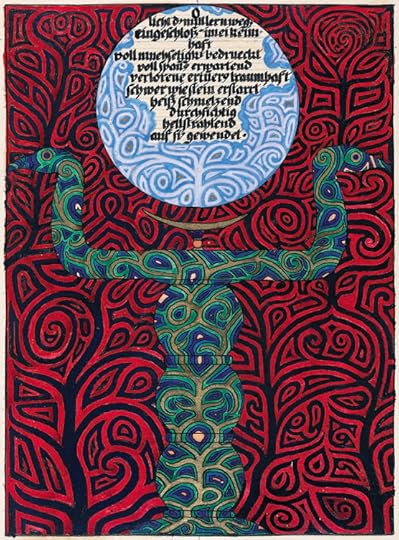
As I continue to the third volume I expect Robertson’s own magic will occupy center stage again… The ending of this novel with the exotic title, indicated that this could very well be the case as he seemed to be turning his back to Jungian lore.
Although the Red Book will still haunt me.

July 11, 2008
I wavered between demoting this to a 3 star (really 3.5) and keeping it at a 4, but I think it deserves a 4 even if it isn’t near my favourite of Davies’ work and is, I think, the weakest of the Deptford trilogy. We were first given an account of the small town of Deptford, and the players who would be the major cast of characters in the series, in Fifth Business under the guiding hand of Dunstan Ramsay. Now we see things from a different angle: David Staunton, the hard drinking criminal lawyer son of Deptford’s golden boy magnate Boyd Staunton, has come to a crisis. His father has just been found dead, possibly murdered, and this is the last straw of the many pressures on his life. After shouting out the query “Who killed Boy Staunton?!” in the theatre (at Magnus Eisengrim’s performance of the Brazen Head no less) he hurriedly bustles himself off to Zurich for psychoanalysis. From here we get his account of not only his own life but the lives of his father and Dunstan Ramsay (amongst others) as they intersected with his.
Perhaps it can be viewed as a strength, but in some ways I think Davies’ decision to couch this novel in the form of the psychoanalytical treatment undergone by David was perhaps more of a weakness. I think I prefer when his Jungian obsessions come in through the side door as it were, and this blatant explication of the Jungian method was perhaps a tad on the heavy-handed side. David is also no Dunstan Ramsay. Ramsay was certainly not always sympathetic, but David is downright unpleasant: a drunk with daddy issues whose many decisions in life seem to have all been calculated responses to the perceived slights visited upon him by others (especially his family). I’m being a bit harsh perhaps, but David certainly won’t be winning any personality contests. He is, it must be said, unwaveringly honest (with others and himself) and certainly he grows, as is the point of psychoanalysis, so he is far from an uninteresting character. Thus we are treated to a ring-side seat of David Staunton’s life. We see more of Boy Staunton than was the case in Ramsay’s reminiscences though even here he is more of an overarching shadow cast across David’s life than a fully realized person (indeed the more I think of it, the more Boy Staunton seems to hold a very special place in the Deptford trilogy: he is a central figure to the action who looms large in the lives of all of the other characters, but we never see things from his perspective or get a full picture of him as a real person as opposed to a foil for others). Ramsay is amusingly portrayed as the somewhat eccentric schoolmaster as seen by a child who may also share a deeper relationship with the child than either of them would want to admit. It is often a pleasure of serial works to be able to see the same characters and situations detailed in another work from a different perspective and that pleasure is on full display here. Characters from Deptford, both major and minor, are portrayed either with more or less detail than before, but certainly show other sides of themselves than we had previously been privy to. They in essence become more fully human, not to mention subtly transformed, from their first appearance to us.
I must admit that I by far enjoyed the final section of the book the most where we encounter old friends and some resolutions to outstanding questions are provided. This is not to say that David’s memoir of his life, as recounted to his analyst, is without interest, but he is certainly a character who lacks the flair and je ne sais quoi of Dunstan Ramsay. This book is a good read (I haven’t yet come across a dud by Davies) but even though Davies’ books can stand alone quite well I definitely recommend that you start your journey through the streets of Deptford (and Toronto) with Fifth Business.
Also posted at Shelf Inflicted
Perhaps it can be viewed as a strength, but in some ways I think Davies’ decision to couch this novel in the form of the psychoanalytical treatment undergone by David was perhaps more of a weakness. I think I prefer when his Jungian obsessions come in through the side door as it were, and this blatant explication of the Jungian method was perhaps a tad on the heavy-handed side. David is also no Dunstan Ramsay. Ramsay was certainly not always sympathetic, but David is downright unpleasant: a drunk with daddy issues whose many decisions in life seem to have all been calculated responses to the perceived slights visited upon him by others (especially his family). I’m being a bit harsh perhaps, but David certainly won’t be winning any personality contests. He is, it must be said, unwaveringly honest (with others and himself) and certainly he grows, as is the point of psychoanalysis, so he is far from an uninteresting character. Thus we are treated to a ring-side seat of David Staunton’s life. We see more of Boy Staunton than was the case in Ramsay’s reminiscences though even here he is more of an overarching shadow cast across David’s life than a fully realized person (indeed the more I think of it, the more Boy Staunton seems to hold a very special place in the Deptford trilogy: he is a central figure to the action who looms large in the lives of all of the other characters, but we never see things from his perspective or get a full picture of him as a real person as opposed to a foil for others). Ramsay is amusingly portrayed as the somewhat eccentric schoolmaster as seen by a child who may also share a deeper relationship with the child than either of them would want to admit. It is often a pleasure of serial works to be able to see the same characters and situations detailed in another work from a different perspective and that pleasure is on full display here. Characters from Deptford, both major and minor, are portrayed either with more or less detail than before, but certainly show other sides of themselves than we had previously been privy to. They in essence become more fully human, not to mention subtly transformed, from their first appearance to us.
I must admit that I by far enjoyed the final section of the book the most where we encounter old friends and some resolutions to outstanding questions are provided. This is not to say that David’s memoir of his life, as recounted to his analyst, is without interest, but he is certainly a character who lacks the flair and je ne sais quoi of Dunstan Ramsay. This book is a good read (I haven’t yet come across a dud by Davies) but even though Davies’ books can stand alone quite well I definitely recommend that you start your journey through the streets of Deptford (and Toronto) with Fifth Business.
Also posted at Shelf Inflicted

May 19, 2017
Manticore είναι ένα μυθικό πλάσμα με σώμα λιονταριού, κεφαλή ανθρώπου και ουρά με κεντρί. Ο δεύτερος τόμος της επικής τριλογίας του Ντέιβις, που συγκρίνεται με τον Μάγο του Φάουλς, ξεκινάει απο εκεί που σταμάτησε ο πρώτος, αλλάζει αφηγητή, συνεχίζει την μυθική αφήγηση του βίο των Καναδέζων πρωταγωνιστών, η ιστορία είναι αινιγματική όσο το μυθικό πλάσμα στο εξώφυλλο, και καταφέρνει να είναι καλύτερη από τον πρώτη.
Ο πρώτος τόμος ήταν ένα εντυπωσιακό βιβλίο, όπου ο πρωταγωνιστής Ράμσει, από το Ντέπτφορντ του Καναδά, γράφει ένα γράμμα λίγο πριν την συνταξιοδότησή του, στον διευθυντή του σχολίου του για να βάλει κάποια πράματα στην θέση τους. Γράφει πρωτίστως για να βάλει πολλά πράματα στην θέση τους μέσα του. Είναι μια ιστορία ενηλικίωσης, που μοιάζει να λέει πως το αληθινό παραμύθι είναι η καθημερινή ζωή γύρω μας και κάθε ένας μας είναι ο πρωταγωνιστής της δικής του ιστορία και κομπάρσος των αλλωνών. Την ιστορία πιάνει ένας άλλος χαρακτήρας, δίνει άλλο χρώμα και ήχο, κατά τι πιο σκοτεινό.
Ο Ντέιβις ξέρει για τι μιλάει όταν γράφει. Και αυτό είναι ένα τιτάνιο κατόρθωμα σε μια τεράστια ιστορία η οποία στηρίζεται τόσο στις θρησκευτικές και αγιολογικές αναζητήσεις του πρώτου τόμου, όσο και στις καταβυθίσεις στην επιστήμη της ψυχιατρικής θεραπείας του ταλαιπωρημένου και φθαρμένου Ντέιβιντ Στόντον, του δεύτερου τόμου. Οι διαφορετικές αφηγήσεις ενός καθηγητή ιστορίας, ήρωα του Α΄Παγκοσμίου πολέμου και ενός μεταγενέστερου πλουσιόπαιδου και μετέπειτα πετυχημένου δικηγόρου, είναι μελετημένες με εξωφρενική ακρίβεια αλλά και σκηνοθετημένες με αρμονία. Το βιβλίο είναι επικό, καλογραμμένο, αλλά πρωτίστως σκοτεινό. Ο Ντέιβις είναι κυνικός, σκληρός ρεαλιστής, και αν κάνει παραμύθι τις ζωές της κουστωδίας του είναι για να μας μάθει πως όλοι μας είμαστε αδυναμα πλάσματα, παραδομένα στις αδυναμίες μας. Οι ικανοί και έξυπνοι, αυτοί με τις αρετές, δεν είναι τέλειοι. Μπορούν να γίνουν δυνάστες, εγωκεντρικοί, υπερφίαλοι σε όσους του ξέρουν καλά.
Οι περισσότεροι συγγραφείς μυθοπλασίας τη σημερινή εποχή γράφουν για ό,τι τους αρέσει, με ό,τι παραστάσεις έχουν φτιάξει από βιβλία, ταινίες, αποσπασματικές ειδήσεις. Οι ιστορίες τους είναι ένα μείγμα από τα καθημερινά τους ερεθίσματα και εμπειρίες δεύτερου χεριού. Ανάθεμα κι αν ξέρουν κάτι παραπάνω από τον αναγνώστη όταν τον μεταφέρουν σε ένα αστυνομικό τμήμα ή στα επείγοντα ενός νοσοκομείου ή τα άδυτα κάποιο μοναστηριού. Υπάρχει μια μειοψηφία που κάνει σοβαρή έρευνα πριν το γράψιμο μιας ιστορίας και αυτούς μπορέι κανείς να τους εμπιστευτεί και να αναγνωρίσει τις σοβαρές του προθέσεις και επιδιώξεις. Και τέλος υπάρχουν εκείνοι οι λίγοι σαν τον Ντέιβις που φαίνεται να ξέρει τα πάντα, γιατί με κάποιον τρόπο έχει διαβάσει τα πάντα και ασχοληθεί με ό,τι γράφει. Από εκείνους τους ανθρώπους του καλλιεργημένους, του πνεύματος που λέμε. Δεν υπάρχει τίποτα σκονισμένο εδώ, μην φοβάστε. Τίποτα εξυπνακίστικο, τίποτα ακαδημαϊκό. Απλά διαβάστε και αφεθείτε στις λέξεις ενός ανθρώπου που φαίνεται να ξέρει.
Υ.Γ. Είμαι ήδη στα μισά του τρίτου τόμου.
Ο πρώτος τόμος ήταν ένα εντυπωσιακό βιβλίο, όπου ο πρωταγωνιστής Ράμσει, από το Ντέπτφορντ του Καναδά, γράφει ένα γράμμα λίγο πριν την συνταξιοδότησή του, στον διευθυντή του σχολίου του για να βάλει κάποια πράματα στην θέση τους. Γράφει πρωτίστως για να βάλει πολλά πράματα στην θέση τους μέσα του. Είναι μια ιστορία ενηλικίωσης, που μοιάζει να λέει πως το αληθινό παραμύθι είναι η καθημερινή ζωή γύρω μας και κάθε ένας μας είναι ο πρωταγωνιστής της δικής του ιστορία και κομπάρσος των αλλωνών. Την ιστορία πιάνει ένας άλλος χαρακτήρας, δίνει άλλο χρώμα και ήχο, κατά τι πιο σκοτεινό.
Ο Ντέιβις ξέρει για τι μιλάει όταν γράφει. Και αυτό είναι ένα τιτάνιο κατόρθωμα σε μια τεράστια ιστορία η οποία στηρίζεται τόσο στις θρησκευτικές και αγιολογικές αναζητήσεις του πρώτου τόμου, όσο και στις καταβυθίσεις στην επιστήμη της ψυχιατρικής θεραπείας του ταλαιπωρημένου και φθαρμένου Ντέιβιντ Στόντον, του δεύτερου τόμου. Οι διαφορετικές αφηγήσεις ενός καθηγητή ιστορίας, ήρωα του Α΄Παγκοσμίου πολέμου και ενός μεταγενέστερου πλουσιόπαιδου και μετέπειτα πετυχημένου δικηγόρου, είναι μελετημένες με εξωφρενική ακρίβεια αλλά και σκηνοθετημένες με αρμονία. Το βιβλίο είναι επικό, καλογραμμένο, αλλά πρωτίστως σκοτεινό. Ο Ντέιβις είναι κυνικός, σκληρός ρεαλιστής, και αν κάνει παραμύθι τις ζωές της κουστωδίας του είναι για να μας μάθει πως όλοι μας είμαστε αδυναμα πλάσματα, παραδομένα στις αδυναμίες μας. Οι ικανοί και έξυπνοι, αυτοί με τις αρετές, δεν είναι τέλειοι. Μπορούν να γίνουν δυνάστες, εγωκεντρικοί, υπερφίαλοι σε όσους του ξέρουν καλά.
Οι περισσότεροι συγγραφείς μυθοπλασίας τη σημερινή εποχή γράφουν για ό,τι τους αρέσει, με ό,τι παραστάσεις έχουν φτιάξει από βιβλία, ταινίες, αποσπασματικές ειδήσεις. Οι ιστορίες τους είναι ένα μείγμα από τα καθημερινά τους ερεθίσματα και εμπειρίες δεύτερου χεριού. Ανάθεμα κι αν ξέρουν κάτι παραπάνω από τον αναγνώστη όταν τον μεταφέρουν σε ένα αστυνομικό τμήμα ή στα επείγοντα ενός νοσοκομείου ή τα άδυτα κάποιο μοναστηριού. Υπάρχει μια μειοψηφία που κάνει σοβαρή έρευνα πριν το γράψιμο μιας ιστορίας και αυτούς μπορέι κανείς να τους εμπιστευτεί και να αναγνωρίσει τις σοβαρές του προθέσεις και επιδιώξεις. Και τέλος υπάρχουν εκείνοι οι λίγοι σαν τον Ντέιβις που φαίνεται να ξέρει τα πάντα, γιατί με κάποιον τρόπο έχει διαβάσει τα πάντα και ασχοληθεί με ό,τι γράφει. Από εκείνους τους ανθρώπους του καλλιεργημένους, του πνεύματος που λέμε. Δεν υπάρχει τίποτα σκονισμένο εδώ, μην φοβάστε. Τίποτα εξυπνακίστικο, τίποτα ακαδημαϊκό. Απλά διαβάστε και αφεθείτε στις λέξεις ενός ανθρώπου που φαίνεται να ξέρει.
Υ.Γ. Είμαι ήδη στα μισά του τρίτου τόμου.

May 17, 2017
“Be sure you choose what you believe and know why you believe it, because if you don't choose your beliefs, you may be certain that some belief, and probably not a very credible one, will choose you.”
― Robertson Davies, The Manticore

The second novel in Davies' Deptford Trilogy, The Manticore focuses largely on the life of Boy Staunton's son David. Like Fifth Business before, this novel contains amazing prose and a caste of characters that are not quite loveable, but amazingly human at the same time. The structure of the novel is largely a diary David Staunton keeps while undergoing Jungian analysis after the suicide of his billionaire father. This flashback analysis allows Davies to deal with an unreliable narrator by having the Jungian therapist (Johanna Von Haller) jump in occasionally to explain, uproot, twist, and interject architypes into the unrolling life of David Staunton, his relationship with his father, nurse, mother, sister, and early love. It also allows Davies to explore issues around the subconcious, Jungian architypes, myth, history, etc.
The third and final chapter of the novel exits the diary and brings in some of the characters from the series (Dunstan Ramsey, Liesl, and Magnus Eisengrim). I didn't quite like it as much as Fifth Business, but still adored it. I understand (I think) where Davies was going with the final act, but I'm not quite sure he squared the knot. Perhaps, it left a lot unsaid because, obviously, there is one more book. So, for now I'll tenatively leave it as 4-stars, but perhaps that will increase as I finish the trilogy.
― Robertson Davies, The Manticore
The second novel in Davies' Deptford Trilogy, The Manticore focuses largely on the life of Boy Staunton's son David. Like Fifth Business before, this novel contains amazing prose and a caste of characters that are not quite loveable, but amazingly human at the same time. The structure of the novel is largely a diary David Staunton keeps while undergoing Jungian analysis after the suicide of his billionaire father. This flashback analysis allows Davies to deal with an unreliable narrator by having the Jungian therapist (Johanna Von Haller) jump in occasionally to explain, uproot, twist, and interject architypes into the unrolling life of David Staunton, his relationship with his father, nurse, mother, sister, and early love. It also allows Davies to explore issues around the subconcious, Jungian architypes, myth, history, etc.
The third and final chapter of the novel exits the diary and brings in some of the characters from the series (Dunstan Ramsey, Liesl, and Magnus Eisengrim). I didn't quite like it as much as Fifth Business, but still adored it. I understand (I think) where Davies was going with the final act, but I'm not quite sure he squared the knot. Perhaps, it left a lot unsaid because, obviously, there is one more book. So, for now I'll tenatively leave it as 4-stars, but perhaps that will increase as I finish the trilogy.

December 8, 2009
The Manticore begins by betraying us. Dunstan Ramsay, that incorrigible saint-chasing old man who provided the heart and soul and voice of Fifth Business, is no longer our narrator. Instead, this is the story of David Staunton, the son of Dunstan's lifelong frenemy, Boy Staunton. At the end of Fifth Business, Boy dies, and now David has gone to Zurich seeking the wisdom of a Jungian analyst to make sense of his behaviour since his father's death. Partly an exploration of the psychology of Jung and partly a work of biographical fiction akin to Fifth Business, The Manticore is a journey into David's past and into his psyche.
The analysis is both more and less than a framing device. It allows Davies to depart from some of the entrenched conventions of the modern novel, rendering David's narration in the form of journal-like entries interspersed with script-like dialogue between himself and Dr. von Haller. The events intersect tangentially with those of Fifth Business, providing at times a different perspective on characters familiar from the first book. Probably the most interesting differences are David's thoughts on Ramsay himself, of course, as well as how David perceives his father's character. However, this is not just a retelling of Fifth Business; after all, David was a minor player in that book, barely on the reader's radar and notable only, really, because he happens to be Boy's son. The Manticore gives David his own history, fleshing him out as a person, and also gives him his own voice, one quite distinct from Ramsay's.
Though this is the "Deptford trilogy," the return to Deptford in this book is brief and not all that notable. The village is not depicted here so much as mentioned as a milieu for some of David's boyhood experiences with his grandfather and his ever-present nanny/housekeeper/maternal figure, Netty. Indeed, places and locations are much less prominent in The Manticore than they were in Fifth Business. I'll hazard that this is because David, telling this in the form of his analytic journey, is focusing on the people of his past, not the places. The characters, though always at arms-length from us, are much more important than where they are or what they're doing. And in this case, because we are interested in learning how David projects his own thoughts and feelings onto other people, the somewhat surreal quality of the other characters is not a problem but an advantage. This is one of the few times where a character is actually allowed to be an archetype rather than a three-dimensional person.
As von Haller guides David through his analysis, she points out how the people in his life have assumed various aspects within his conscious and unconscious mind. His sister, Caroline; Netty; his mother, Leola; his stepmother, Denyse; and his first and only love, Judith, have all at times carried the role of the Anima. His law professor, Pargetter, is the Magus, and onto Netty's brother David projects his own Shadow. The characters in The Manticore morph from people into Jungian archetypes before our very eyes.
I'm hesitant to comment on how Davies incorporates Jung, because all I've learned about Jungian philosophy has been through the Deptford trilogy. So it's entirely possible Davies has gotten something wrong. With that caveat in mind, however, I quite enjoy the Deptford trilogy as a vehicle for Jungian philosophy. I imagine alone the subject might be rather dry, whereas this is a kind of "case study" that provides more suitable material. Davies also includes a subtle tension between Jungian and Freudian methodologies: he overtly pans the latter at certain points, but one of the "subplots," if you will, concerns David's ongoing sexual abstinence. If The Manticore were written using Freudian analysis instead, this would likely be the centrepiece of the entire book. And while David's sexual life is important to understanding him, it's only one part of the puzzle.
I have to admit that I find Jung's psychology more appealing than Freud's, as much as I find any psychology appealing (which is not very). I mean, it asks us to look at the people in our lives in terms of archetypes and deconstruct how we project our desires upon them, interpreting them to fit into roles we define. This is very literary way of viewing the world, and hence appeals to me, a lover of literature. Archetypes are always very mythological, which recalls Ramsay's syncretism of history and myth and his obsession with saints. Just as, in Ramsay's view, history consists of repeating patterns of myth, each person's life consists of repeating patterns of archetypes, as we project these archetypes onto our new acquaintances. There's a very comforting dualism at work here between the psychology of the individual and the psychology of the society. Not being a student of psychology or well-versed in Jung's theories and his critics, of course, I don't know how well they stand up to further scrutiny. For the purposes of a novel, however, they are quite compelling.
For all his endorsement of Jungian psychology, though, I think Davies injects a healthy amount of psychological agnosticism into The Manticore as well. By that I mean, he rather slyly advocates for making one's own decisions and having the courage to analyze oneself when appropriate. He reminds us that Freud, Jung, Adler, et al all had to begin somewhere:
That's from Liesl, who reprises her role as sceptic and Devil's advocate. Jung's archetypes did not just spring forth from the head of Zeus fully-formed; no, he developed them over time through his own reflection and introspection. Hence, any psychology theory is not the end of the framework of one's analysis; it's only the beginning. It provides tools and training to start an individual down the long road, where the journey lasts a lifetime and the destination is always beyond the horizon.
If The Manticore has one flaw, it's that it's not Fifth Business. Such is my admiration for the first book in this trilogy: I have a hard time giving The Manticore five stars, though I think it's quite worthy of each and every one. I understand why Davies chose to depart from the voice of Ramsay in this book, and David is a competent replacement—but he's not Ramsay. He can't be. And though I know it's not rational, this not-being-Ramsay is a stumbling block in my enjoyment of this book.
But I got over it. I had to. The Manticore is both a companion and a sequel to Fifth Business: it revisits and continues events from the previous book, while providing a whole parallel biography that's rich in its own way. While it's not necessary for you to have read Fifth Business to read The Manticore, I don't see why you would skip the first book. Similarly, if you read Fifth Business it's possible to stop and never open this book—but in that case, I think you would be making a mistake. It's not that they are meant to be read together, but the books of the Deptford trilogy are like the movements in a single, encompassing symphony. Each is its own piece, exquisite, but it's the sum total of all three books that elevates them from excellent to truly remarkable. The Manticore builds upon the themes begun in Fifth Business, and all the while it tells us the story of another man attempting to make sense of the death of his father.
My Reviews of the Deptford Trilogy:
← Fifth Business | World of Wonders →

The analysis is both more and less than a framing device. It allows Davies to depart from some of the entrenched conventions of the modern novel, rendering David's narration in the form of journal-like entries interspersed with script-like dialogue between himself and Dr. von Haller. The events intersect tangentially with those of Fifth Business, providing at times a different perspective on characters familiar from the first book. Probably the most interesting differences are David's thoughts on Ramsay himself, of course, as well as how David perceives his father's character. However, this is not just a retelling of Fifth Business; after all, David was a minor player in that book, barely on the reader's radar and notable only, really, because he happens to be Boy's son. The Manticore gives David his own history, fleshing him out as a person, and also gives him his own voice, one quite distinct from Ramsay's.
Though this is the "Deptford trilogy," the return to Deptford in this book is brief and not all that notable. The village is not depicted here so much as mentioned as a milieu for some of David's boyhood experiences with his grandfather and his ever-present nanny/housekeeper/maternal figure, Netty. Indeed, places and locations are much less prominent in The Manticore than they were in Fifth Business. I'll hazard that this is because David, telling this in the form of his analytic journey, is focusing on the people of his past, not the places. The characters, though always at arms-length from us, are much more important than where they are or what they're doing. And in this case, because we are interested in learning how David projects his own thoughts and feelings onto other people, the somewhat surreal quality of the other characters is not a problem but an advantage. This is one of the few times where a character is actually allowed to be an archetype rather than a three-dimensional person.
As von Haller guides David through his analysis, she points out how the people in his life have assumed various aspects within his conscious and unconscious mind. His sister, Caroline; Netty; his mother, Leola; his stepmother, Denyse; and his first and only love, Judith, have all at times carried the role of the Anima. His law professor, Pargetter, is the Magus, and onto Netty's brother David projects his own Shadow. The characters in The Manticore morph from people into Jungian archetypes before our very eyes.
I'm hesitant to comment on how Davies incorporates Jung, because all I've learned about Jungian philosophy has been through the Deptford trilogy. So it's entirely possible Davies has gotten something wrong. With that caveat in mind, however, I quite enjoy the Deptford trilogy as a vehicle for Jungian philosophy. I imagine alone the subject might be rather dry, whereas this is a kind of "case study" that provides more suitable material. Davies also includes a subtle tension between Jungian and Freudian methodologies: he overtly pans the latter at certain points, but one of the "subplots," if you will, concerns David's ongoing sexual abstinence. If The Manticore were written using Freudian analysis instead, this would likely be the centrepiece of the entire book. And while David's sexual life is important to understanding him, it's only one part of the puzzle.
I have to admit that I find Jung's psychology more appealing than Freud's, as much as I find any psychology appealing (which is not very). I mean, it asks us to look at the people in our lives in terms of archetypes and deconstruct how we project our desires upon them, interpreting them to fit into roles we define. This is very literary way of viewing the world, and hence appeals to me, a lover of literature. Archetypes are always very mythological, which recalls Ramsay's syncretism of history and myth and his obsession with saints. Just as, in Ramsay's view, history consists of repeating patterns of myth, each person's life consists of repeating patterns of archetypes, as we project these archetypes onto our new acquaintances. There's a very comforting dualism at work here between the psychology of the individual and the psychology of the society. Not being a student of psychology or well-versed in Jung's theories and his critics, of course, I don't know how well they stand up to further scrutiny. For the purposes of a novel, however, they are quite compelling.
For all his endorsement of Jungian psychology, though, I think Davies injects a healthy amount of psychological agnosticism into The Manticore as well. By that I mean, he rather slyly advocates for making one's own decisions and having the courage to analyze oneself when appropriate. He reminds us that Freud, Jung, Adler, et al all had to begin somewhere:
Davey, did you ever think that these three men who were so splendid at understanding others had first to understand themselves? It was from their self-knowledge they spoke. They did not go trustingly to some doctor and follow his lead because they were too lazy or too scared to make the inward journey alone. They dared heroically. And it should never be forgotten that they made the inward journey while they were working like galley-slaves at their daily tasks, considering other people's troubles, raising families, living full lives. They were heroes, in a sense that no space-explorer can be a hero, because they went into the unknown absolutely alone. Was their heroism simply meant to raise a whole new crop of invalids? Why don't you go home and shoulder your yoke, and be a hero too?
That's from Liesl, who reprises her role as sceptic and Devil's advocate. Jung's archetypes did not just spring forth from the head of Zeus fully-formed; no, he developed them over time through his own reflection and introspection. Hence, any psychology theory is not the end of the framework of one's analysis; it's only the beginning. It provides tools and training to start an individual down the long road, where the journey lasts a lifetime and the destination is always beyond the horizon.
If The Manticore has one flaw, it's that it's not Fifth Business. Such is my admiration for the first book in this trilogy: I have a hard time giving The Manticore five stars, though I think it's quite worthy of each and every one. I understand why Davies chose to depart from the voice of Ramsay in this book, and David is a competent replacement—but he's not Ramsay. He can't be. And though I know it's not rational, this not-being-Ramsay is a stumbling block in my enjoyment of this book.
But I got over it. I had to. The Manticore is both a companion and a sequel to Fifth Business: it revisits and continues events from the previous book, while providing a whole parallel biography that's rich in its own way. While it's not necessary for you to have read Fifth Business to read The Manticore, I don't see why you would skip the first book. Similarly, if you read Fifth Business it's possible to stop and never open this book—but in that case, I think you would be making a mistake. It's not that they are meant to be read together, but the books of the Deptford trilogy are like the movements in a single, encompassing symphony. Each is its own piece, exquisite, but it's the sum total of all three books that elevates them from excellent to truly remarkable. The Manticore builds upon the themes begun in Fifth Business, and all the while it tells us the story of another man attempting to make sense of the death of his father.
My Reviews of the Deptford Trilogy:
← Fifth Business | World of Wonders →

February 22, 2026
Можна, звісно, не читати "П'яту фігуру" — перший роман "Депфордської трилогії" канадійця Робертсона Девіса, але я ніколи не зрозумію — навіщо?
"Мантикора" — зовсім інакша за змістом та темпом книга, але її стиль, як на мій смак, також досконалий.
Цього разу автор розповідає свою історію від імені сина Боя Стонтона, який зміг стати успішним адвокатом і справжнім багатієм навіть без допомоги та підтримки свого батька-мільярдера. Девід Стонтон має схильність до алкоголю і ця залежність, разом із страхами та непевністю, які загострюються після загадкової смерті батька, приводять його в терапію.
Девід може дозволити собі жити в готелі у Цюриху і щоразу платити десятки доларів за годинний сеанс психоаналітичної терапії за Юнгом у виконанні докторки Йоганни фон Галлер.
Я нічогісінько не знаю про цей метод, крім того, що він заснований на архетипах з міфічними назвами — Тінь, Аніма, Друг — і значно менше зациклений на сексі, на відміну від способу копирсання в свідомості, винайденого Зіґмундрм Фройдом, але читати про те, як Робертсон Девіс проводить цим шляхом свого персонажа — направду захопливо. Я дуже повільний читач, але з "Мантикорою" впорався лише за два дні, і взагалі дочитував роман у темряві з налобним ліхтариком.
На відміну від "П'ятої фігури", де персонажі часто перебувають в різних місцях Депфорда та всенького великого світу, Девід Стонтон здебільшого заводить читачів у лабіринти своєї пам'яті та свідомості.
Дивовижно, як історія, де практично немає якихось подій та пригод, яка складається лише зі спогадів, діалогів (нехай і дотепних та проникливих) з психоаналітикинею та щоденникових записів наприкінці книги, читається так добре.
Зустрівши у тексті роману згадку Бірнамського лісу з шекспірівського "Макбета", я отримав підказку, яку одноіменну книгу маю читати наступною. Нехай цей епізод стане дивним прологом до заключної книги трилогії — "Світу чудес". Залишається лише сподіватися, що вона вийде вже у цьому році.
"Мантикора" — зовсім інакша за змістом та темпом книга, але її стиль, як на мій смак, також досконалий.
Цього разу автор розповідає свою історію від імені сина Боя Стонтона, який зміг стати успішним адвокатом і справжнім багатієм навіть без допомоги та підтримки свого батька-мільярдера. Девід Стонтон має схильність до алкоголю і ця залежність, разом із страхами та непевністю, які загострюються після загадкової смерті батька, приводять його в терапію.
Девід може дозволити собі жити в готелі у Цюриху і щоразу платити десятки доларів за годинний сеанс психоаналітичної терапії за Юнгом у виконанні докторки Йоганни фон Галлер.
Я нічогісінько не знаю про цей метод, крім того, що він заснований на архетипах з міфічними назвами — Тінь, Аніма, Друг — і значно менше зациклений на сексі, на відміну від способу копирсання в свідомості, винайденого Зіґмундрм Фройдом, але читати про те, як Робертсон Девіс проводить цим шляхом свого персонажа — направду захопливо. Я дуже повільний читач, але з "Мантикорою" впорався лише за два дні, і взагалі дочитував роман у темряві з налобним ліхтариком.
На відміну від "П'ятої фігури", де персонажі часто перебувають в різних місцях Депфорда та всенького великого світу, Девід Стонтон здебільшого заводить читачів у лабіринти своєї пам'яті та свідомості.
Дивовижно, як історія, де практично немає якихось подій та пригод, яка складається лише зі спогадів, діалогів (нехай і дотепних та проникливих) з психоаналітикинею та щоденникових записів наприкінці книги, читається так добре.
Зустрівши у тексті роману згадку Бірнамського лісу з шекспірівського "Макбета", я отримав підказку, яку одноіменну книгу маю читати наступною. Нехай цей епізод стане дивним прологом до заключної книги трилогії — "Світу чудес". Залишається лише сподіватися, що вона вийде вже у цьому році.

February 6, 2021
Oy vey. Didn't enjoy this one as much as I enjoyed the Fifth Business. Yes, Davies is still a very good writer, witty, very deep one to that, Jungian psychology is really awesome thing and the time spent with this book wasn't really wasted, but... The main character nor his father didn't work for me as a center characters of the novel, no matter how hard the author tried I found them both pretty boring and what came with it their story unnecessary and this book unnecessary.
The dive into psychological side of the character and the seances at his shrink was what saved the book for me, but I couldn't care less for his daddy issues - it's the subject that makes me yawn and I prefer to avoid it in my reads if I have a chance.
But who knows, maybe someone with daddy issues will find here a key to his own problems?
Not really that bad, this book, but I wish I could read something else instead.
The dive into psychological side of the character and the seances at his shrink was what saved the book for me, but I couldn't care less for his daddy issues - it's the subject that makes me yawn and I prefer to avoid it in my reads if I have a chance.
But who knows, maybe someone with daddy issues will find here a key to his own problems?
Not really that bad, this book, but I wish I could read something else instead.

March 13, 2024
En un principio le había puesto 3 estrellas, pero nada, si ha sido una novela insoportable, lo tendré que sostener hasta el final, 2 estrellitas y va sobrada. Tampoco hay
♫♫♫ música ♫♫♫, no lo merece.
https://kansasbooks.blogspot.com/2024...
“Todo el mundo necesita su máscara. Los únicos impostores intencionales son aquellos cuya máscara es la de un hombre que no tiene nada que ocultar. Todos tenemos mucho que ocultar, todos hemos de ocultarlo por el bien de nuestra alma. ¿No encontró usted nunca algún desperfecto en su armadura?"
No suelo reseñar libros que me han disgustado porque entre otras cosas si empiezo algo que no me convence lo acabo dejando y tampoco me apetece malgastar energía innecesariamente, sin embargo, una vez empezada la Trilogía de Deptford, sigo con la idea de querer leerla completa por lo menos para tener una idea de conjunto a pesar de que esta Manticora me ha aburrido soberanamente, la he terminado a trompicones y aunque hay momentos interesantes, citas que merecen la pena destacarse, es la estructura y el estilo utilizado por Robertson Davies lo que me ha horrorizado por el peñazo que me ha supuesto su narración. No me podía creer, que después de "El quinto en discordía", Robertson Davies nos haya colado una obra en la que la mayor parte de ella es una narración autocomplaciente de parte de su protagonista, David Staunton, salteada de una conversación interminable y mecánica en la que supuestamente su psicoanalista lo escucha y le sirve como pie de réplica a esta narración. Dimes y diretes sin apenas profundidad psicológica en torno a un personaje externo de esta trilogía.
"Ser un cínico no es lo mismo que evitar la ilusión, pues el cinismo es otra clase de ilusión. Todas las fórmulas para hacer frente a la vida , e incluso muchas filosofías, son vanas ilusiones. El cinismo es una ilusión de las peores ."
La gracia la primera novela de la trilogía estaba en la forma en la que un objeto, una bola de nieve, enlaza la vida de tres hombres y de cómo los influye de por vida. Hasta aquí bien. Dunstan Ramsay es el narrador de esta primera novela y estaba firmemente enlazado a su amigo Boy Staunton, el que lanza la bola de nieve, y a Paul Webster, se podría decir la víctima de esta bola de nieve convirtiéndolo en un exiliado social. Cada novela estaría dedicada a uno de ellos, así que en Mantícora le tocaría el turno a Boy Staunton, el que lanza la bola de nieve y le putea la vida de por vida a Ramsay por su sentimiento de culpa eterno y agónico, y a Paul Webster, por dejarlo sin madre entre otras cosas; pero mi problema viene porque aunque sea una trilogía, no veo que esta novela SUME o APORTE ni siquiera argumentalmente nada a "El Quinto en Discordía." ¿Hay datos nuevos que completen la primera? ¿Se puede decir que Robertson Davies desarrolla los personajes dándonos una visión más en conjunto con respecto a la primera? En mi humilde opinión no. Esta novela ni suma ni aporta nada porque todo estaba ya en la primera de la trilogía, y toda esta Mantícora no es más que un chicle que se expande gratuitamente y que sirve como excusa a Robertson Davies para hablar sobre algo que le volvía loco, la corriente psicoanalista de Carl Jung.
"No me amedrentaban mis citas con la doctora von Haller, como a uno podrían amedrentarle un tratamiento doloroso, o demasiado exigente, de tipo puramente físico. Pero soy de naturaleza retentiva, soy propenso al secreto, y todas aquellas revelaciones eran contrarias a mi manera de ser."
En esta novela, David Staunton, el hijo del que lanzó la bola de nieve en su momento, ya con cuarenta y tantos años, ¿traumatizado por la muerte de su padre? se va a Suiza a que lo psicoanalice la Dra. Haller, una prestigiosa psiquiatra de la corriente junguiana, David, era un personaje totalmente secundario en la primera novela de la trilogía y aquí supuestamente y durante el psicoanálisis sale a relucir la relación con su padre, el lanzador de la bola de nieve y aunque se puede decir que es un viaje de autodescubrimiento del mismo David Staunton, para mí, Boy su padre, es aquí casi un personaje que no aporta nada porque ya lo habíamos conocido en "El Quinto en discordia", y aunque todo gire en torno a David ¿para qué querríamos conocerlo más a fondo??? La mayor parte de la novela se construye en torno a David y su psicoanalista, con contrarréplicas mecánicas, en la que ella es apenas un satélite que le sirve como excusa para las réplicas, y por otra parte, la narración del propio David, ahondando en su vida, no me aporta nada en relación a la primera novela de la trilogía porque realmente ya había estado todo ahí y David se convierte en un personaje estirado ad infinitum. El gran problema de Mantícora está, creo, en que no hay ninguna novedad, ningún centro neurálgico dónde sostenerse, David habla y habla y yo acabé agotada porque esto no me llevaba a ninguna parte con respecto a la primera novela. Hay una ausencia total de climax porque la narración carece de ritmo. Tanto David, como la doctora y como los personajes que surgen hacia el final no dejan de alargar un discurso que ya estaba en El Quinto en Discordia y cuya única novedad estaría en la excusa que tiene Robertson Davies para enrollarse en torno las teorías de Carl Jung. En definitiva, poco que ver con la primera de la serie (aunque Davies sigue cojeando estrepitosamente en los retratos femeninos, o sumisas o controladoras), pero intentaré leer el tercero de la trilogía porque necesito completar el cuadro.
“No prometo la felicidad No sé qué es la felicidad. Ustedes, las personas del Nuevo Mundo, están, cómo decirlo, enganchados a la diea dela felicidad, como si se tratara de algo constante, de algo que se puede medir, de algo que zanja y disculpa todo lo demás. De ser algo, la felicidad es un producto secundario de otras condiciones vitales, hy hay personas cuyas vidas distan mucho de parecer envidiables, e incluso admirables, que son realmente felices. Olvídese de la felicidad.”

October 5, 2016
Some good advice (at least for me) that I just found that I had underlined:
p. 64 - “I’ll give you a piece of advice that will last you all your life: never buy anything unless you really need it; things you just want are usually junk.”
p. 64 - “I’ll give you a piece of advice that will last you all your life: never buy anything unless you really need it; things you just want are usually junk.”

May 22, 2025
This is the second book of the Deptford Trilogy and it is almost as good as the first except that the lead in The Manticore,David Staunton, doesn’t quite have the charm of Dunstan Ramsay, the lead in the first book, Fifth Business. David Staunton is a criminal attorney dealing with some things in life that leads him to seek out a Jungian therapist in Zürich. The majority of the book is an account of those therapy sessions and the history that David recalls in the process. It might sound a little dull, but Davies fashions it all into a truly enjoyable reading experience.
I have only a passing familiarity with Carl Jung and his writing on archetypes, but the characters voice enough of the theory for it to become clear. As I take it, the archetypes that Jung discusses (e.g., Shadow, Anima, Magus, Friend, etc.) belong to a common, collectively unconscious, way of perceiving the world. The exact manifestation of these archetypes vary from person to person, but those manifestations cohere around the functions associated with the archetype and around the archetype’s mediating influence on our individual behavior. The Shadow, for example, is a manifestation of repressed, negative impressions of personality, often our own, that we project onto others where those impressions are safely objectified into objects and people that we can safely scorn without the turmoil of actually turning that scorn on ourselves. The other archetypes are also projections onto others that we use to manage our own lives.
The Jungian archetypes and their connection to a collective unconscious sounds a little too much like innate ideas to me. I tend to fall more in the empiricist camp when it comes to human understanding and I find it hard to believe that, given the diversity of human experience, that there are common archetypes, even if they do manifest differently to us as individuals. Nevertheless, even if the archetypes are fictions, I can see how they might have utility as focal points for reflection and I think this is point that comes through in the novel.
If anything, these archetypes are ways to make sense of people and events so that they don’t seem arbitrary (a theme throughout the books so far, starting with the arc of an errant snowball that opens the first book). Maybe a Jungian would say that what appears arbitrary in life are just patterns that rationalists and empiricists cannot see, but mapping those patterns to the play of archetypes imposes a kind of sense on them. However, the imposition of archetypes seems like it has the potential to do harm to the people that become the recipients of those projections. In making those projections on others we see them not on their own terms but on terms relative to our interests and needs. Maybe that’s all we can ever do — see the world through our eyes. However, if we take these archetypes, even if they are a fiction, perhaps they enable productive reflection that at least allows us to see that there is something about people and events that is different or in addition to what we are motivated to see. There is a strong connection here to Iris Murdoch’s concept of “moral vision” as an impediment to ethical action.
Maybe what I’m seeing in this book is a meditation on the power of fiction and on the recurring character types, and conventional story types, and familiar tropes that reveal elements of a shared or shareable experience. And focusing on what reoccurs and reasserts itself, aided by the innovation and novelty of fiction, we can still learn something. That has true transformative value.
The writing in both books of the trilogy has been delightful. Davies is witty and irreverent and has such clever and concise ways of making big points without ever interrupting the flow of the narrative to make a big point. And for as little as actually happens in the book, the plotting of those events and the pacing thoroughly kept my interest. I would have been happy with another hundred pages of this narrative and I am definitely eager to pick up a copy of the third book World of Wonders which focuses on Magnus Eisengrim.
I have only a passing familiarity with Carl Jung and his writing on archetypes, but the characters voice enough of the theory for it to become clear. As I take it, the archetypes that Jung discusses (e.g., Shadow, Anima, Magus, Friend, etc.) belong to a common, collectively unconscious, way of perceiving the world. The exact manifestation of these archetypes vary from person to person, but those manifestations cohere around the functions associated with the archetype and around the archetype’s mediating influence on our individual behavior. The Shadow, for example, is a manifestation of repressed, negative impressions of personality, often our own, that we project onto others where those impressions are safely objectified into objects and people that we can safely scorn without the turmoil of actually turning that scorn on ourselves. The other archetypes are also projections onto others that we use to manage our own lives.
The Jungian archetypes and their connection to a collective unconscious sounds a little too much like innate ideas to me. I tend to fall more in the empiricist camp when it comes to human understanding and I find it hard to believe that, given the diversity of human experience, that there are common archetypes, even if they do manifest differently to us as individuals. Nevertheless, even if the archetypes are fictions, I can see how they might have utility as focal points for reflection and I think this is point that comes through in the novel.
If anything, these archetypes are ways to make sense of people and events so that they don’t seem arbitrary (a theme throughout the books so far, starting with the arc of an errant snowball that opens the first book). Maybe a Jungian would say that what appears arbitrary in life are just patterns that rationalists and empiricists cannot see, but mapping those patterns to the play of archetypes imposes a kind of sense on them. However, the imposition of archetypes seems like it has the potential to do harm to the people that become the recipients of those projections. In making those projections on others we see them not on their own terms but on terms relative to our interests and needs. Maybe that’s all we can ever do — see the world through our eyes. However, if we take these archetypes, even if they are a fiction, perhaps they enable productive reflection that at least allows us to see that there is something about people and events that is different or in addition to what we are motivated to see. There is a strong connection here to Iris Murdoch’s concept of “moral vision” as an impediment to ethical action.
Maybe what I’m seeing in this book is a meditation on the power of fiction and on the recurring character types, and conventional story types, and familiar tropes that reveal elements of a shared or shareable experience. And focusing on what reoccurs and reasserts itself, aided by the innovation and novelty of fiction, we can still learn something. That has true transformative value.
The writing in both books of the trilogy has been delightful. Davies is witty and irreverent and has such clever and concise ways of making big points without ever interrupting the flow of the narrative to make a big point. And for as little as actually happens in the book, the plotting of those events and the pacing thoroughly kept my interest. I would have been happy with another hundred pages of this narrative and I am definitely eager to pick up a copy of the third book World of Wonders which focuses on Magnus Eisengrim.
June 17, 2019
If, like me, you have tended to give short shrift to the Jungian body of thought (one that you have never really made enough of an effort to "get" much less "comprehend " or "understand"--I used to be aware that there's an important difference between those two verbs, one which, I am certain, Mr. Davies could easily explain to me in etymological terms), then you are sorely in need of this book--as I was, and still am. My brain has always been attracted to Freud, but something else in me (dare I call it a heart?) is telling me to plunge into Jung for some reason. So I compromised and re-read this, whether instead or en-route-to, I dunno!
I first encountered the book in a third-year Engineering arts elective entitled Revolutions with a wonderful English professor named Stephen Bonnycastle (subsequently the author of the excellent introduction to literary criticism: In Search of Authority: An Introductory Guide to Literary Theory). As a budding rationalist myself, I completely identified with The Manticore's main character, one David Staunton, a high-flying criminal lawyer who has a big problem with alcohol and an even bigger one with himself--with his excessively rational take on the world, certainly, but also with his understanding of his all-too-human parents and the fixed and baleful roles they continue to play in his inner life, even after their deaths.
David, then, is a man sorely in need of taking a good long, hard look at himself, and the way that Davies has depicted David's journey through Jungian analysis, I just couldn't help following imaginatively along and kinda sorta analysing myself in the process--the man is just that good at sucking you in past all of his learning to the heart of the matter, the life lived and unlived, so that you not only walk a mile in David Staunton's shoes, you also can't help trying your own back on for a few hundred meters or so before slipping his back on again--and my, haven't they grown strangely comfortable in the process!
So I guess what I mean is that while there is a lot of love of wisdom in this book, there's thankfully not much potted philosophy in here per se (I mean, a la the dreaded, dreadful dreadnaught that is that alleged novel Sophie's World, with its interlocutors speaking whole paragraphs of third-hand thought as if it had just spontaneously appeared on their gilded tongues). Instead, what we've got is a compulsively readable lived philosophy of life, with a lot of the overt high-brow learnin' which was so successfully embedded in DaviEs's first ("Salterton") Trilogy ( Tempest-Tost, Leaven of Malice, A Mixture of Frailties) held much more firmly in check. Indeed, one particularly learned and Trickster-like character, Liesl, warns us to take Jung or perhaps even Davies himself with a certain un-pre-measured amount of salt:
This one is not as well-known as the first installment in the Deptford Trilogy, Fifth Business , but it was and now remains my favourite so far. Onward, then, to re-visiting the third volume in the series, World of Wonders
I first encountered the book in a third-year Engineering arts elective entitled Revolutions with a wonderful English professor named Stephen Bonnycastle (subsequently the author of the excellent introduction to literary criticism: In Search of Authority: An Introductory Guide to Literary Theory). As a budding rationalist myself, I completely identified with The Manticore's main character, one David Staunton, a high-flying criminal lawyer who has a big problem with alcohol and an even bigger one with himself--with his excessively rational take on the world, certainly, but also with his understanding of his all-too-human parents and the fixed and baleful roles they continue to play in his inner life, even after their deaths.
David, then, is a man sorely in need of taking a good long, hard look at himself, and the way that Davies has depicted David's journey through Jungian analysis, I just couldn't help following imaginatively along and kinda sorta analysing myself in the process--the man is just that good at sucking you in past all of his learning to the heart of the matter, the life lived and unlived, so that you not only walk a mile in David Staunton's shoes, you also can't help trying your own back on for a few hundred meters or so before slipping his back on again--and my, haven't they grown strangely comfortable in the process!
So I guess what I mean is that while there is a lot of love of wisdom in this book, there's thankfully not much potted philosophy in here per se (I mean, a la the dreaded, dreadful dreadnaught that is that alleged novel Sophie's World, with its interlocutors speaking whole paragraphs of third-hand thought as if it had just spontaneously appeared on their gilded tongues). Instead, what we've got is a compulsively readable lived philosophy of life, with a lot of the overt high-brow learnin' which was so successfully embedded in DaviEs's first ("Salterton") Trilogy ( Tempest-Tost, Leaven of Malice, A Mixture of Frailties) held much more firmly in check. Indeed, one particularly learned and Trickster-like character, Liesl, warns us to take Jung or perhaps even Davies himself with a certain un-pre-measured amount of salt:
Analysis with a great analyst is an adventure in self-exploration. But how many analysts are great? Did I ever tell you I knew Freud slightly? A giant, and it would be apocalyptic to talk to such a giant about oneself. I never met Adler, whom everybody forgets, but he was certainly another giant. I once went to a seminar Jung gave in Zürich, and it was unforgettable. But one must remember that they were all men with systems. Freud, monumentally hipped on sex (for which he personally had little use) and almost ignorant of Nature: Adler, reducing almost everything to the will to power: and Jung, certainly the most humane and gentlest of them, and possibly the greatest, but nevertheless the descendant of parsons and professors, and himself lead because they were too lazy or too scared to make the inward journey alone. They dared heroically. And it should never be forgotten that they made the inward journey while they were working like galley-slaves at their daily tasks, considering other people’s troubles, raising families, living full lives. They were heroes, in a sense that no space-explorer can be a hero, because they went into the unknown absolutely alone. Was their heroism simply meant to raise a whole new crop of invalids? Why don’t you go home and shoulder your yoke, and be a hero too?(284)OK, I'll go the rest of the way in my own shoes, then. Or most of it. There is always the next novel, after all!
This one is not as well-known as the first installment in the Deptford Trilogy, Fifth Business , but it was and now remains my favourite so far. Onward, then, to re-visiting the third volume in the series, World of Wonders

January 23, 2026
In my opinion The Deptford Trilogy #1, Fifth Business should be required reading before reading The Manticore. The Manticore is primarily a deep dive into the psyche of the narrator David Staunton (son of Boy Staunton) through Jungian analysis. Knowledge of the events of Fifth Business will give you a much better understanding. Skip this book if you're looking for a lot of action. David Staunton spends much of the book sitting down for analysis in a quest to find out who and what he is. I found Robertson Davies's Jungian Psychology 101 course fascinating and it also gave me a much better understanding of Fifth Business.

August 4, 2013
Me: You simply HAVE to read "The Manticore", by Robertson Davies.
Customer: What's it about?
Me: Well it's about this insufferable middle-aged lawyer who drinks to forget his fabulously wealthy upbringing. He is so unhappy he decides to undergo Jungian analysis in Switzerland for a year or so. The story is told via entries from his therapeutic journal.
Customer: I'll take eight!
I have decided that describing the premise of a Robertson Davies novel is pointless. That is unless, you want to deter someone from ever reading one of his books.
Therefore I won't even bother explaining what happens in this book. It's not about the external/concrete events with Davies--it's what his characters take away from the events.
Besides, this is the second book in a trilogy, so if you have read Fifth Business already, and are considering reading the second one, you'll already 'get' what makes these books so great.
As for the people complaining about how annoying David is at first, I have to say that they are missing the point of the entire book. He is reckoning with his whole personality, good and bad, and he begins at a very unhealthy place. Cut him some slack. It wouldn't be very interesting if he was totally fine when the book began and just stayed fine the rest of the novel.
I would recommend this book to anyone who liked Fifth Business, and especially to those who are somewhat familiar with Carl Jung.
Customer: What's it about?
Me: Well it's about this insufferable middle-aged lawyer who drinks to forget his fabulously wealthy upbringing. He is so unhappy he decides to undergo Jungian analysis in Switzerland for a year or so. The story is told via entries from his therapeutic journal.
Customer: I'll take eight!
I have decided that describing the premise of a Robertson Davies novel is pointless. That is unless, you want to deter someone from ever reading one of his books.
Therefore I won't even bother explaining what happens in this book. It's not about the external/concrete events with Davies--it's what his characters take away from the events.
Besides, this is the second book in a trilogy, so if you have read Fifth Business already, and are considering reading the second one, you'll already 'get' what makes these books so great.
As for the people complaining about how annoying David is at first, I have to say that they are missing the point of the entire book. He is reckoning with his whole personality, good and bad, and he begins at a very unhealthy place. Cut him some slack. It wouldn't be very interesting if he was totally fine when the book began and just stayed fine the rest of the novel.
I would recommend this book to anyone who liked Fifth Business, and especially to those who are somewhat familiar with Carl Jung.

November 3, 2024
Mantícora es el libro segundo de la trilogía Deptford del escritor canadiense Robertson Davies.
Un libro que puede leerse perfectamente sin haberse leído el primero.
Todo gira en torno a un solo personaje David, abogado penalista de éxito, heredero de uno de los hombres más ricos de Canadá, soltero, alcohólico y célibe.
Su padre ha muerto de manera violenta, el tiene un exabrupto en público que le hace cuestionarse su salud mental y vuela a Zurich para conseguir terapia.
El libro se vuelve un exhaustivo análisis de la vida de David, su relación con sus padres, con su hermana, la nana que lo crió, la mujer que le gustaba, su profesión, a través de una especie de diario donde vuelca su vida, pensamientos y formas de vivir, con una terapeuta que responde sus preguntas mientras le hace notar los simbolismos así como los dobles sentidos que existen.
La narración es fluida, se van encajando piezas en un rompecabezas que anticipamos quedará incompleto pero con cierto sentido que permita tener algún significado.
Hay muchas cosas que van quedando veladas ya sea por falta de información o por qué los protagonistas ya no existen, existe el juego de hombre contra hombre, entre el padre y el hijo, una lucha de poder que se impone por encima de cualquier sentimiento filial, una competencia de egos, todo embebido del profundo egoísmo y egocentrismo de hombres que buscan ser reconocidos públicamente más allá de encontrar valor en una familia o en valores más elevados.
Curiosa la manera en que se aborda la teoría de Jung, aplicada en esta inusual terapia, David se redescubre pero al mismo tiempo sigue sin saber quién era su padre, por qué murió como murió y si existe una suerte de cierre en su relación.
Hay muchos secretos que siguen subsistiendo pero que parecen ya no tener importancia, ya no existe este antagonismo, el padre murió bajo sus propios términos y no existe la posibilidad de una reconciliación, aunque David es un hombre roto, lleno de fantasmas y traumas acerca de la sexualidad, del amor y las relaciones en general, persiste en su intento de conocerse y saber si hay alguna suerte de redención o de desvío donde pueda recomponerse y tener una vida que signifique.
Es un libro ideal para los que nos gusta la idea de profundizar en la existencia individual, examinar a fondo por qué una persona es como es y pasar bajo la lupa toda una vida en búsqueda de aquello que no sabemos que nos falta.
La maestría del libro está en la agudeza, inteligencia y habilidad de artesano que tiene Davies para interesarnos en temas que en manos de alguien más serían superficiales y sin mérito propio.
Para los que leyeron el primer libro de la trilogía, les comento que no esperen en este segundo algo similar ya que no tiene la vivacidad ni la acción del primero, más bien es un libro lánguido dado a la introspección y al intento experimental de aplicar una teoría psicológica para mejorar la vida de un individuo que aparentemente lo tiene todo.
Un libro que puede leerse perfectamente sin haberse leído el primero.
Todo gira en torno a un solo personaje David, abogado penalista de éxito, heredero de uno de los hombres más ricos de Canadá, soltero, alcohólico y célibe.
Su padre ha muerto de manera violenta, el tiene un exabrupto en público que le hace cuestionarse su salud mental y vuela a Zurich para conseguir terapia.
El libro se vuelve un exhaustivo análisis de la vida de David, su relación con sus padres, con su hermana, la nana que lo crió, la mujer que le gustaba, su profesión, a través de una especie de diario donde vuelca su vida, pensamientos y formas de vivir, con una terapeuta que responde sus preguntas mientras le hace notar los simbolismos así como los dobles sentidos que existen.
La narración es fluida, se van encajando piezas en un rompecabezas que anticipamos quedará incompleto pero con cierto sentido que permita tener algún significado.
Hay muchas cosas que van quedando veladas ya sea por falta de información o por qué los protagonistas ya no existen, existe el juego de hombre contra hombre, entre el padre y el hijo, una lucha de poder que se impone por encima de cualquier sentimiento filial, una competencia de egos, todo embebido del profundo egoísmo y egocentrismo de hombres que buscan ser reconocidos públicamente más allá de encontrar valor en una familia o en valores más elevados.
Curiosa la manera en que se aborda la teoría de Jung, aplicada en esta inusual terapia, David se redescubre pero al mismo tiempo sigue sin saber quién era su padre, por qué murió como murió y si existe una suerte de cierre en su relación.
Hay muchos secretos que siguen subsistiendo pero que parecen ya no tener importancia, ya no existe este antagonismo, el padre murió bajo sus propios términos y no existe la posibilidad de una reconciliación, aunque David es un hombre roto, lleno de fantasmas y traumas acerca de la sexualidad, del amor y las relaciones en general, persiste en su intento de conocerse y saber si hay alguna suerte de redención o de desvío donde pueda recomponerse y tener una vida que signifique.
Es un libro ideal para los que nos gusta la idea de profundizar en la existencia individual, examinar a fondo por qué una persona es como es y pasar bajo la lupa toda una vida en búsqueda de aquello que no sabemos que nos falta.
La maestría del libro está en la agudeza, inteligencia y habilidad de artesano que tiene Davies para interesarnos en temas que en manos de alguien más serían superficiales y sin mérito propio.
Para los que leyeron el primer libro de la trilogía, les comento que no esperen en este segundo algo similar ya que no tiene la vivacidad ni la acción del primero, más bien es un libro lánguido dado a la introspección y al intento experimental de aplicar una teoría psicológica para mejorar la vida de un individuo que aparentemente lo tiene todo.

July 26, 2022
The Manticore is the second in the Deptford Trilogy by Robertson Davies, following Fifth Business. Given I had read Fifth Business in 2018 and I had not made any notes while reading it, as I typically do today, my first challenge was to refresh my memory of the plot and characters from Fifth Business. I started by looking at reviews on GoodReads, but as a community we are good at not revealing the entire plot so I eventually went to Wikipedia and got a decent plot summary there. I am curious as to what others do in a situation like this.
I was pleased to see how the plot in The Manticore takes up almost exactly where Fifth Business leaves off without feeling like just a continuation. Davies does an excellent job of connecting the two plots, refreshing the reader’s memory while avoiding providing just a summary from the first novel. Davies is actually able to enrich the plot from Fifth Business by providing insight into what happened from the perspective of characters that are central to The Manticore but were only peripheral to Fifth Business.
David Staunton, the son of Boy Staunton, and his relationship to his father, is the focus of The Manticore. The structure of the novel is quite interesting in that it is presented as a series of therapy sessions that David has with his psychiatrist, Dr. Johanna Von Haller. David engages in this therapy after realizing that he is not reacting well to his father’s death. The structure, however, was also in my opinion the only drawback of the novel in that there was a lot of discussion about David’s state of mind, thought processes and progress that detracted from the story.
The artistry of Robertson Davies is evident as there is little movement forward in time of the story that began in Fifth Business, and yet it feels as if an entirely new story has been related. While the reader is left hanging at the end of the novel and there is a desire to see what happens in part, there is no feeling of incompleteness, no dissatisfaction or frustration. There is even the hope that some of the remaining questions from part 1 might yet be answered.
I was pleased to see how the plot in The Manticore takes up almost exactly where Fifth Business leaves off without feeling like just a continuation. Davies does an excellent job of connecting the two plots, refreshing the reader’s memory while avoiding providing just a summary from the first novel. Davies is actually able to enrich the plot from Fifth Business by providing insight into what happened from the perspective of characters that are central to The Manticore but were only peripheral to Fifth Business.
David Staunton, the son of Boy Staunton, and his relationship to his father, is the focus of The Manticore. The structure of the novel is quite interesting in that it is presented as a series of therapy sessions that David has with his psychiatrist, Dr. Johanna Von Haller. David engages in this therapy after realizing that he is not reacting well to his father’s death. The structure, however, was also in my opinion the only drawback of the novel in that there was a lot of discussion about David’s state of mind, thought processes and progress that detracted from the story.
The artistry of Robertson Davies is evident as there is little movement forward in time of the story that began in Fifth Business, and yet it feels as if an entirely new story has been related. While the reader is left hanging at the end of the novel and there is a desire to see what happens in part, there is no feeling of incompleteness, no dissatisfaction or frustration. There is even the hope that some of the remaining questions from part 1 might yet be answered.

December 11, 2022
If this is a character study of the protagonist, then Robertson Davies has pulled out all the stops, for not only does he paint his character six ways to Sunday, but enlists a Jungian psychologist to assist, and places us on the couch alongside the patient.
David Staunton, a celebrated criminal lawyer in Toronto, has a meltdown in a theatre and starts shouting at the performers on stage, asking them who murdered his father. He then checks into a clinic in Switzerland to have himself analysed, for he feels his problems are more deep-rooted than stress and alcohol. As he submerges into analysis, a portrait of the man emerges: he doesn’t feel loved by his wealthy father who disinherited him, he has had sex only once in his life; his only love affair, a platonic one, was 20-something years ago to a Jewish woman that was doomed to failure; he drinks alcohol because it is his symptom not his disease, and took up the law due to an act of depraved vandalism he participated in as a teenager. More than anything, he is a thinker, not a feeler, in Jungian terms, his analyst, the attractive Johanna von Haller tells him. He promptly falls in love with her, but just like his previous romance, she remains inaccessible to him due to their professional relationship.
The novel is also a social commentary on the wealthy class in Canada, the one-percent who only have first world problems to deal with. Problems such as researching pedigree and finding out to one’s horror that a founding ancestor in Canada was a barmaid who had a child out of wedlock and fled to the colonies rather than sink into a life of prostitution and poverty back home. David also wonders whether this illegitimate strain continues into his generation and whether he is the love-child of his father’s best friend, Dunstan Ramsay (the central character in the first novel in this trilogy, The Fifth Business). And why did his father duplicitously introduce him to sex with a wealthy divorcee (remember that solo sex adventure?) to get him off onto becoming a man?
Given that this book was written in the 1960s, I was struck by the number of words that have now gone out of circulation for their politically inappropriate use: “Indians” (indigenous), “Hit the Nigger in the Eye” (a carnival game), “Orientals” (East Asians) among others.
With about eighty percent of this book being spent on the analyst’s couch, Davies gets to philosophize along the way:
“Is greater freedom another form of servitude?”
“Fanaticism is the overcompensation for doubt.”
“To be rich is to be a special kind of person. You have to discover your own truths and make your own rules. Those of the middle class will trip you up.”
While we spend a lot of time with David and Dr. von Haller, other characters are rather sketchily drawn, and this is one of the shortcomings of the book, for the focus on the Jungian analysis neglects other novelistic treatments. Magnus Eisengrim and Liesl appear only at the very end of the novel, and although the latter plays a pivotal part in David’s cure, the former is just a name. However, I’m told that Davies was saving Magnus for a starring role in Book Three of the trilogy.
And talking about the cure, Jungian style, David has to first navigate through identifying the archetypes in his life and interpreting his dreams with the help of Dr. von Haller. Therefore, we get to meet his Anima, Shadow, Friend, Magus, Troll, and Persona. Recognition and acceptance are the first steps towards healing and by the time he gets to this point, David has lost many of his rough edges. Finally, in a metaphoric journey through a cave in a mountain with Liesl for company, and which resembles a new birth, David emerges a new man, even coated in shit for having experienced Feeling for the first time in his life—aka fear—and lost control of his sphincter muscle!
Not all the answers in David’s life are revealed, but he has made a start. On to Book Three of the trilogy…
David Staunton, a celebrated criminal lawyer in Toronto, has a meltdown in a theatre and starts shouting at the performers on stage, asking them who murdered his father. He then checks into a clinic in Switzerland to have himself analysed, for he feels his problems are more deep-rooted than stress and alcohol. As he submerges into analysis, a portrait of the man emerges: he doesn’t feel loved by his wealthy father who disinherited him, he has had sex only once in his life; his only love affair, a platonic one, was 20-something years ago to a Jewish woman that was doomed to failure; he drinks alcohol because it is his symptom not his disease, and took up the law due to an act of depraved vandalism he participated in as a teenager. More than anything, he is a thinker, not a feeler, in Jungian terms, his analyst, the attractive Johanna von Haller tells him. He promptly falls in love with her, but just like his previous romance, she remains inaccessible to him due to their professional relationship.
The novel is also a social commentary on the wealthy class in Canada, the one-percent who only have first world problems to deal with. Problems such as researching pedigree and finding out to one’s horror that a founding ancestor in Canada was a barmaid who had a child out of wedlock and fled to the colonies rather than sink into a life of prostitution and poverty back home. David also wonders whether this illegitimate strain continues into his generation and whether he is the love-child of his father’s best friend, Dunstan Ramsay (the central character in the first novel in this trilogy, The Fifth Business). And why did his father duplicitously introduce him to sex with a wealthy divorcee (remember that solo sex adventure?) to get him off onto becoming a man?
Given that this book was written in the 1960s, I was struck by the number of words that have now gone out of circulation for their politically inappropriate use: “Indians” (indigenous), “Hit the Nigger in the Eye” (a carnival game), “Orientals” (East Asians) among others.
With about eighty percent of this book being spent on the analyst’s couch, Davies gets to philosophize along the way:
“Is greater freedom another form of servitude?”
“Fanaticism is the overcompensation for doubt.”
“To be rich is to be a special kind of person. You have to discover your own truths and make your own rules. Those of the middle class will trip you up.”
While we spend a lot of time with David and Dr. von Haller, other characters are rather sketchily drawn, and this is one of the shortcomings of the book, for the focus on the Jungian analysis neglects other novelistic treatments. Magnus Eisengrim and Liesl appear only at the very end of the novel, and although the latter plays a pivotal part in David’s cure, the former is just a name. However, I’m told that Davies was saving Magnus for a starring role in Book Three of the trilogy.
And talking about the cure, Jungian style, David has to first navigate through identifying the archetypes in his life and interpreting his dreams with the help of Dr. von Haller. Therefore, we get to meet his Anima, Shadow, Friend, Magus, Troll, and Persona. Recognition and acceptance are the first steps towards healing and by the time he gets to this point, David has lost many of his rough edges. Finally, in a metaphoric journey through a cave in a mountain with Liesl for company, and which resembles a new birth, David emerges a new man, even coated in shit for having experienced Feeling for the first time in his life—aka fear—and lost control of his sphincter muscle!
Not all the answers in David’s life are revealed, but he has made a start. On to Book Three of the trilogy…

January 9, 2015
Продолжаю переслушивать Дептфордскую трилогию и очень довольна; Робертсон Дэвис умный и не занудный, как жаль, что с авторами такое редко случается.

July 30, 2026
«Мантикора» Робертсона Девіса залишила в мене змішані враження. Найцікавішими для мене були початок і фінал, тоді як середина з довгими психоаналітичними розмовами місцями відчувалася надто затягнутою. Юнгіанські концепції цікаві самі собою, але роман не відкрив їх для мене з якогось нового боку.
Найбільше розчарувало те, що Девід так і залишається радше спостерігачем, ніж героєм, за якого хочеться переживати. Натомість історія Дептфорда, Мері Демпстер, Боя Стонтона, Пола та Дастана значно сильніша й емоційніша. Саме вона змушувала мене читати далі, тоді як внутрішні пошуки Девіда часто відходили на другий план.
Водночас фінал сподобався тим, що не намагається дати остаточні відповіді. Обставини смерті Боя Стонтона так і залишаються оповитими таємницею, а роман більше цікавить не істина як така, а те, як люди живуть поруч із власними версіями правди. Ця невизначеність добре працює на головну тему книги.
Та все ж мені хотілося значно більше часу провести не з Девідом, а з Полом чи Дастаном. Саме вони здавалися живими, неоднозначними й по-справжньому захопливими персонажами. Через це «Мантикора» для мене виявилася радше містком між першою і третьою книгами трилогії, ніж самодостатнім романом.
Найбільше розчарувало те, що Девід так і залишається радше спостерігачем, ніж героєм, за якого хочеться переживати. Натомість історія Дептфорда, Мері Демпстер, Боя Стонтона, Пола та Дастана значно сильніша й емоційніша. Саме вона змушувала мене читати далі, тоді як внутрішні пошуки Девіда часто відходили на другий план.
Водночас фінал сподобався тим, що не намагається дати остаточні відповіді. Обставини смерті Боя Стонтона так і залишаються оповитими таємницею, а роман більше цікавить не істина як така, а те, як люди живуть поруч із власними версіями правди. Ця невизначеність добре працює на головну тему книги.
Та все ж мені хотілося значно більше часу провести не з Девідом, а з Полом чи Дастаном. Саме вони здавалися живими, неоднозначними й по-справжньому захопливими персонажами. Через це «Мантикора» для мене виявилася радше містком між першою і третьою книгами трилогії, ніж самодостатнім романом.

June 26, 2013
I love the way that Robertson Davies chooses narrators--after Fifth Business, I would probably have continued using Dunstan Ramsey as a narrator (and indeed Davies returns to him in the third novel, World of Wonders). But my inclination would not have been nearly as interesting. Instead, by choosing Boy Staunton's son, David, as the focus, it gives this second novel a different tone.
This is probably as close as I will ever get to Jungian analysis--and I enjoyed a peek into the process. Davies is very much into myth and archetypes--Ramsey is obsessed with the interaction of myth and history and David learns his mythology through analysis (although Ramsey was one of his school teachers and he does retain some of that learning).
I appreciate myth, having read a lot of Greek and Roman mythology as a child. We lived in a farm community and received boxes of books from the University of Alberta as part of their Extension Program, devised so that folks like us with no local library could still get reading materials. As a child, the librarians chose my books (I remember how exciting it was when I was deemed old enough to receive a list of books and actually choose for myself what they would send). Whoever was in charge of sending children's books seemed to think that mythology was children's fare--perhaps not realizing how violent and truly odd some of those tales were. I thank that person, whoever they were, as mythological tales do make an excellent basis for a liberal arts education and they are largely overlooked in schools (or taught in such a sanitized version as to be virtually unrecognizable.
Davies' excellent books always remind me of those childhood days--long summer days, spent reading about Zeus, Posideon & Demeter, laying in the shade in the long grass, enjoying summer. Perhaps that is what inspired me to pick up this series again at this time of year.
This is probably as close as I will ever get to Jungian analysis--and I enjoyed a peek into the process. Davies is very much into myth and archetypes--Ramsey is obsessed with the interaction of myth and history and David learns his mythology through analysis (although Ramsey was one of his school teachers and he does retain some of that learning).
I appreciate myth, having read a lot of Greek and Roman mythology as a child. We lived in a farm community and received boxes of books from the University of Alberta as part of their Extension Program, devised so that folks like us with no local library could still get reading materials. As a child, the librarians chose my books (I remember how exciting it was when I was deemed old enough to receive a list of books and actually choose for myself what they would send). Whoever was in charge of sending children's books seemed to think that mythology was children's fare--perhaps not realizing how violent and truly odd some of those tales were. I thank that person, whoever they were, as mythological tales do make an excellent basis for a liberal arts education and they are largely overlooked in schools (or taught in such a sanitized version as to be virtually unrecognizable.
Davies' excellent books always remind me of those childhood days--long summer days, spent reading about Zeus, Posideon & Demeter, laying in the shade in the long grass, enjoying summer. Perhaps that is what inspired me to pick up this series again at this time of year.
May 23, 2025
Who killed Boy Staunton? David Staunton undergoes Jungian analysis to find an answer to the mystery of his father's death. With his therapist David recalls his relationship with his father and a lot of other things, such as his fascinating relationships with women. The stone in the snowball from Fifth Business returns as a focal point. I don't know if one should read the first part of the trilogy first, but this book helps explain some of the things from that book. Near the end is a claustrophobic scene beautifully rendered. A rather optimistic ending caps off a wonderful reading experience. Of course I will read the third part of the trilogy one of these days.


Read
September 18, 2022Nakon što mu je iznenada i neočekivano stradao otac, uspešni kanadski advokat Dejvid Stonton polako počinje da gubi razum. Svestan da će njegovo stanje biti sve gore, odlučuje se na potez očajnika – odlazak kod psihijatra. Zajedno sa psihoanalitičarkom Jahanom fon Haler, kroz pripovest o sopstvenom životu, od detinjstva do zrelog doba, zapravo se otiskuje na mitsko herojevo putovanje, na kome mu doktorka pomaže da uoči jungovske arhetipove Persone, Senke, Mudrog starca, Anime, da bi konačno došao do svog unutrašnjeg središta, do arhetipa Sopstva. Na kraju će, poput svakog heroja, morati da uđe u pećinu i ubije zmaja (ovaj put u obliku bauka), kako bi došao do blaga.
Iako je „Mantikora“ drugi roman u Detfordskoj trilogiji kanadskog autora Robertsona Dejvisa, može da se čita sasvim nezavisno od prve knjige „Marginalac“. Usudio bih se reći da je i poželjno da se čita kao samostalno delo, a meni je i ova knjiga mnogo bolja od svog prethodnika.
U pitanju je izuzetno lepo napisana knjiga koja mi se baš mnogo svidela. Odlagao sam druge stvari kako bi se posvetio njoj i što pre je pročitao. Naročito jer me arhetipovi i herojevo putovanje mnogo zanimanju. Velika preporuka!
Iako je „Mantikora“ drugi roman u Detfordskoj trilogiji kanadskog autora Robertsona Dejvisa, može da se čita sasvim nezavisno od prve knjige „Marginalac“. Usudio bih se reći da je i poželjno da se čita kao samostalno delo, a meni je i ova knjiga mnogo bolja od svog prethodnika.
U pitanju je izuzetno lepo napisana knjiga koja mi se baš mnogo svidela. Odlagao sam druge stvari kako bi se posvetio njoj i što pre je pročitao. Naročito jer me arhetipovi i herojevo putovanje mnogo zanimanju. Velika preporuka!

July 18, 2025
This second book of the Deptford Trilogy is centered on the son of one of the major characters from the first book of the Trilogy, The Fifth Business, and follows him as he tries to find psychological peace through Jungian analysis. The first two-thirds of the book are a diary kept by the protagonist during his treatment while the final third narrates what happens after a year’s worth of therapy.
Much of the book consists of reporting the dialog between the protagonist and a Swiss Jungian therapy doctor, and as such provides a sampling of how Jung’s theories of the unconscious mind work in practice. Dreams and myth are explored as a way to eventually arrive at a self who is “the archetype of wholeness and the regulating center of the psyche.” The Jungian analysis as portrayed in this book includes creating oneself first as an anima, then a persona, and finally one's own archetype which in this story ended up being a manticore.
Through the dialog with the doctor much of the protagonist’s past relationships with his parents is reviewed thus covering much of the material previously described in the first book of the series. The narrator of the first book was a friend of the protagonist’s father and maybe a lover of his mother prior to her marriage to his father. The protagonist’s sexual history is explored and the role his father played in it are explored. His unrequited youthful love of the girl who got away is told, as well as his frustration with his manipulative sister. A teacher and law professor also play important roles in his life.
After a year of analysis the protagonists meets by coincidence his father’s (and mother’s possible lover) from the previous book as well as the characters that are part of a traveling magic show. Thus the conclusion of the previous book is explored including the puzzled meaning of “the woman he knew and the woman that he didn’t know." There are three different interpretations given. The book concludes with a crawl into and out of a cave which I presume symbolically represents some kind of rebirth.
I found the book to be puzzling, strange, and not very enjoyable.
Much of the book consists of reporting the dialog between the protagonist and a Swiss Jungian therapy doctor, and as such provides a sampling of how Jung’s theories of the unconscious mind work in practice. Dreams and myth are explored as a way to eventually arrive at a self who is “the archetype of wholeness and the regulating center of the psyche.” The Jungian analysis as portrayed in this book includes creating oneself first as an anima, then a persona, and finally one's own archetype which in this story ended up being a manticore.
Through the dialog with the doctor much of the protagonist’s past relationships with his parents is reviewed thus covering much of the material previously described in the first book of the series. The narrator of the first book was a friend of the protagonist’s father and maybe a lover of his mother prior to her marriage to his father. The protagonist’s sexual history is explored and the role his father played in it are explored. His unrequited youthful love of the girl who got away is told, as well as his frustration with his manipulative sister. A teacher and law professor also play important roles in his life.
After a year of analysis the protagonists meets by coincidence his father’s (and mother’s possible lover) from the previous book as well as the characters that are part of a traveling magic show. Thus the conclusion of the previous book is explored including the puzzled meaning of “the woman he knew and the woman that he didn’t know." There are three different interpretations given. The book concludes with a crawl into and out of a cave which I presume symbolically represents some kind of rebirth.
I found the book to be puzzling, strange, and not very enjoyable.

July 31, 2018
David Staunton is a successful Canadian criminal lawyer and son of the recently deceased Boy Staunton, a rich and powerful magnate who has died in suspicious circumstances. David has arrived in Zürich, Switzerland shortly after his father's funeral to seek help from a Jungian analyst, following a nervous breakdown. The novel mostly consists of David's retelling of the course of his analysis, during which he goes over the events of his life from childhood to the present day, and also shares some of his dreams, which is where we come across the manticore of the title.
Having had a lifelong interested in psychology, I found this story quite compelling. Although I am by no means a Jungian specialist, it was clear that Davies was very thorough with his research, and that made the exchanges between David Staunton and his therapist completely plausible and also allowed allowed the author to use symbolism to great effect. While the story Staunton is recounting is filled with amusing incidents and humorous details, I failed to connect with it fully, which was slightly disappointing to me since I am such a fan of Robertson Davies, one of our great Canadian authors and a genius in his own right. However I am glad I read it and feel the story will stay with me and reveal to me various layers of meaning over time, and is definitely worth a second reading. Recommend.
Having had a lifelong interested in psychology, I found this story quite compelling. Although I am by no means a Jungian specialist, it was clear that Davies was very thorough with his research, and that made the exchanges between David Staunton and his therapist completely plausible and also allowed allowed the author to use symbolism to great effect. While the story Staunton is recounting is filled with amusing incidents and humorous details, I failed to connect with it fully, which was slightly disappointing to me since I am such a fan of Robertson Davies, one of our great Canadian authors and a genius in his own right. However I am glad I read it and feel the story will stay with me and reveal to me various layers of meaning over time, and is definitely worth a second reading. Recommend.

April 14, 2026
Add two stars to my rating if you are a Jungian.
"The Manticore" is the second novel of Robertson Davies "Deptford Trilogy" . It describes the analysis of David Staunton conducted in 1968 in Zurich by Dr. Johanna Von Haller, a Jungian psychiatrist. David Staunton is the son of Boy Staunton a major character of "Fifth Business" the first volume of the Trilogy. The death and possible suicide of David's father will provoke a crisis that will cause him to engage in a lengthy series of therapy sessions with Dr. Von Haller.
In the course of the "The Manticore", the reader will be introduced to a number of key Jungian archetypes such as the anima, the animus, the shadow, the mother and maiden. I think that Davies acquits himself extremely well in the daring task that he assigns himself of presenting Jung's concepts to the literary public. Do not read this novel if you have never read anything by Jung.
With a mere forty pages left in the novel, Dr. Von Haller decides to conclude the therapy sessions because in her view David has made sufficient progress that he will be able to analyze his behaviour and actions on his own going forward.
Before Staunton returns to Canada however he will have one more decisive encounter that is probably Jungian in nature. Before leaving for Canada, Staunton meets Dunstan Ramsay his old mentor from Deptford and protagonist of "The Fifth Business". Dunstan will introduce him to a mysterious Liesa Naegeli who will convince David to visit what Jung refers to as the collective unconscious. To this end she will take David into a cave where 70,000 years ago humans worshipped bears. While in the cave, David will have a vision of his Welsh grandmother who was unmarried when she gave birth to his grandfather. This vision will greatly assist David in resolving his psychological issues.
"The World of Wonders", which is the third novel in the trilogy, however, will raise the possibility that that Staunton's experience could have a different interpretation. "The World of Wonders" will introduce several ideas from Oswald Spengler's "Decline of the West." The protagonist of "The World of Wonders" will describe himself as a product of what Spengler refers to as the "Magian" civilization which is characterized by caverns and a psyche divided between spirit and soul. I personally find Davies to be unclear as to what he is talking about. I welcome any comments on this topic from my fellow GR members.
"The Manticore" is quite clever but I think that it will be impenetrable to anyone unfamiliar with Jung's key concepts.
"The Manticore" is the second novel of Robertson Davies "Deptford Trilogy" . It describes the analysis of David Staunton conducted in 1968 in Zurich by Dr. Johanna Von Haller, a Jungian psychiatrist. David Staunton is the son of Boy Staunton a major character of "Fifth Business" the first volume of the Trilogy. The death and possible suicide of David's father will provoke a crisis that will cause him to engage in a lengthy series of therapy sessions with Dr. Von Haller.
In the course of the "The Manticore", the reader will be introduced to a number of key Jungian archetypes such as the anima, the animus, the shadow, the mother and maiden. I think that Davies acquits himself extremely well in the daring task that he assigns himself of presenting Jung's concepts to the literary public. Do not read this novel if you have never read anything by Jung.
With a mere forty pages left in the novel, Dr. Von Haller decides to conclude the therapy sessions because in her view David has made sufficient progress that he will be able to analyze his behaviour and actions on his own going forward.
Before Staunton returns to Canada however he will have one more decisive encounter that is probably Jungian in nature. Before leaving for Canada, Staunton meets Dunstan Ramsay his old mentor from Deptford and protagonist of "The Fifth Business". Dunstan will introduce him to a mysterious Liesa Naegeli who will convince David to visit what Jung refers to as the collective unconscious. To this end she will take David into a cave where 70,000 years ago humans worshipped bears. While in the cave, David will have a vision of his Welsh grandmother who was unmarried when she gave birth to his grandfather. This vision will greatly assist David in resolving his psychological issues.
"The World of Wonders", which is the third novel in the trilogy, however, will raise the possibility that that Staunton's experience could have a different interpretation. "The World of Wonders" will introduce several ideas from Oswald Spengler's "Decline of the West." The protagonist of "The World of Wonders" will describe himself as a product of what Spengler refers to as the "Magian" civilization which is characterized by caverns and a psyche divided between spirit and soul. I personally find Davies to be unclear as to what he is talking about. I welcome any comments on this topic from my fellow GR members.
"The Manticore" is quite clever but I think that it will be impenetrable to anyone unfamiliar with Jung's key concepts.

May 30, 2014
It's probably blasphemy to be Canadian and attack anything written by Robertson Davies, but I'm going to do it anyway. (I've done it before; back in university, I argued that Tempest-Tost was a great failure of literature). The Manitcore is not a lousy book but it is massively underwhelming, especially given that it won the Governor's General Award back in 1972. Rumor has it this was an apologetic award, as in the Governor General was apologizing for not giving Davies the award for the far superior "Fifth Business" in 1970. One can only hope the rumor is true - or that 1972 was a really bad year for Canadian fiction.
The second book in Mr. Davies much-lauded Deptford trilogy (Fifth Business was the first), The Manitcore's primary weakness is its structure which is self-serving and diminishes any dramatic weight the narrative might otherwise have. David Staunton has traveled to Zurich to commence Jungian therapy following his father's suicide, thus commencing almost two hundred pages (at least in this edition) of patient / analyst psychobabble whose sole purpose is exposition. The analyst is a completely functionary character, the "wise doctor" who helps Staunton dive into his own soul. She has no personality of her own and as we never see her outside of the sessions, she never has a chance to become remotely human.
This seems to be a brutal mistake by Mr. Davies. Any story that presents a patient / analyst premise is essentially making the patient / analyst relationship the central focus of the narrative (consider Peter Shaffer's Equus, John Pleimeier's Agnes of God or even the film Analyse This). If the analyst is not going to be a character, then they have no business standing at centre stage. Sadly, there's nobody else to share the spotlight with David Staunton and this is essentially The Manticore's great weakness: it lacks a central relationship to drive the narrative. David Staunton talks a lot about the past, but he doesn't really want anything in the present. There is no urgency to his situation and so there is no tension driving the book forward.
If I'm using a lot of theatrical metaphors, it's because this book is begging to be a play: most of the book consists of dialogue (some of it is even written in play format). Although perhaps it's better that it didn't ever make it to the stage because, in the worst traditions of the theatre, Mr. Davies' cast of characters are all far too self-aware. They are loudspeakers for the author's own thoughts and rarely espouse any of their own. None of them seem to truly need anything for each other: they simply speak for no other reason than Mr. Davies has said they should speak.
All of this is unfortunate because when David finally shuts up - that is, when he simply tells his life story - the book is far more interesting. The life of privilege he was born into starts showing signs of unraveling right from an early age and much of his narrative consists of the way this unraveling becomes a permanent thing. Davies has a great deal of fun attacking the hypocrisies of characters pretending they deserve to live in "Toronto the Good" and David Staunton himself has the potential to be a fascinating character. But Mr. Davies' structure continues to undermine his own intentions, making for a book that is readable without ever being truly engaging.
The second book in Mr. Davies much-lauded Deptford trilogy (Fifth Business was the first), The Manitcore's primary weakness is its structure which is self-serving and diminishes any dramatic weight the narrative might otherwise have. David Staunton has traveled to Zurich to commence Jungian therapy following his father's suicide, thus commencing almost two hundred pages (at least in this edition) of patient / analyst psychobabble whose sole purpose is exposition. The analyst is a completely functionary character, the "wise doctor" who helps Staunton dive into his own soul. She has no personality of her own and as we never see her outside of the sessions, she never has a chance to become remotely human.
This seems to be a brutal mistake by Mr. Davies. Any story that presents a patient / analyst premise is essentially making the patient / analyst relationship the central focus of the narrative (consider Peter Shaffer's Equus, John Pleimeier's Agnes of God or even the film Analyse This). If the analyst is not going to be a character, then they have no business standing at centre stage. Sadly, there's nobody else to share the spotlight with David Staunton and this is essentially The Manticore's great weakness: it lacks a central relationship to drive the narrative. David Staunton talks a lot about the past, but he doesn't really want anything in the present. There is no urgency to his situation and so there is no tension driving the book forward.
If I'm using a lot of theatrical metaphors, it's because this book is begging to be a play: most of the book consists of dialogue (some of it is even written in play format). Although perhaps it's better that it didn't ever make it to the stage because, in the worst traditions of the theatre, Mr. Davies' cast of characters are all far too self-aware. They are loudspeakers for the author's own thoughts and rarely espouse any of their own. None of them seem to truly need anything for each other: they simply speak for no other reason than Mr. Davies has said they should speak.
All of this is unfortunate because when David finally shuts up - that is, when he simply tells his life story - the book is far more interesting. The life of privilege he was born into starts showing signs of unraveling right from an early age and much of his narrative consists of the way this unraveling becomes a permanent thing. Davies has a great deal of fun attacking the hypocrisies of characters pretending they deserve to live in "Toronto the Good" and David Staunton himself has the potential to be a fascinating character. But Mr. Davies' structure continues to undermine his own intentions, making for a book that is readable without ever being truly engaging.

January 25, 2012
Ah, Jungian psychology! I finished Hermann Hesse's Steppenwolf just before I read The Manticore and felt like Hesse was just beating me over the head with his Jungian psychology throughout the entire story. I was not a fan. And so when I realized that this book is also totally steeped in it, I got a little nervous. But I needn't have. Somehow, even though the entire first two-thirds of this book consists of a guy talking to his analyst, it still never felt anywhere near as heavy-handed as Steppenwolf did to me.
I think that part of it is just that I so love the way Davies writes (er...wrote, rather). I mean, two-thirds of an entire book about this guy talking to his analyst? It sounds mind numbing. And yet, I was not bored even for a second. And I think that's what I love most about Davies--he manages to make everything feel interesting and full of mystery and magic and importance.
I can't wait to read everything else this man ever wrote. I'm a little obsessed, I tell you.
I think that part of it is just that I so love the way Davies writes (er...wrote, rather). I mean, two-thirds of an entire book about this guy talking to his analyst? It sounds mind numbing. And yet, I was not bored even for a second. And I think that's what I love most about Davies--he manages to make everything feel interesting and full of mystery and magic and importance.
I can't wait to read everything else this man ever wrote. I'm a little obsessed, I tell you.

July 9, 2024
Tremenda basura de libro. Y aún así me lo he leído hasta el final. Diálogos impostados todo el rato. Un protagonista insufrible. Un cóctel molotov de clichés. Una prosa feísima y sin personalidad.
Esto es supuestamente lo mejor del tal Davies, o sea, que no voy a leerle más en mi vida.
Llegué a leer: "nunca le oí decir una palabra que me llevase a no pensar que el mundo pudiera ser un sitio mejor sin su presencia." Esta frase de 3 negaciones... Soy incapaz de entenderla y de captar su sentido, sólo haciéndome un croquis mental de cuántas veces se niega lo negado entiendo si hace una valoración positiva o negativa. Esto para mí es la esencia misma de escribir mal. Me recuerda a cuando en el Quijote dicen lo de que
Esto es supuestamente lo mejor del tal Davies, o sea, que no voy a leerle más en mi vida.
Llegué a leer: "nunca le oí decir una palabra que me llevase a no pensar que el mundo pudiera ser un sitio mejor sin su presencia." Esta frase de 3 negaciones... Soy incapaz de entenderla y de captar su sentido, sólo haciéndome un croquis mental de cuántas veces se niega lo negado entiendo si hace una valoración positiva o negativa. Esto para mí es la esencia misma de escribir mal. Me recuerda a cuando en el Quijote dicen lo de que
la claridad de su prosa y esas intrincadas razones suyas le parecían perlas, y más cuando llegaba a leer aquellos requiebros y cartas de desafíos, donde en muchas partes hallaba escrito: «La razón de la sinrazón que a mi razón se hace, de tal manera mi razón enflaquece, que con razón me quejo de la vuestra fermosura». [...] Con estas razones perdía el pobre caballero el juicio, y desvelábase por entenderlas y desentrañarles el sentido, que no se lo sacara ni las entendiera el mesmo Aristóteles, si resucitara para solo ello.

January 9, 2015
The second book of the Deptford trilogy deals with David Staunton, the son of the formidable Boy Staunton, the (initially sugar) tycoon already familiar from "Fifth Business." While a little inferior to FB, it is nevertheless a wonderful narrative. My main complaint is its rather inconclusive ending (though the scene in the bear cave provides a very substantial crescendo finale of sorts).
This is, in part, a book about Jungian analysis — but it is much more than that. The whole story of David's life unfolds before our eyes and the eyes of his analyst — and we see certain things that we know from FB from completely different angles; this is done very masterfully, without any cheap Rashomon effects. I look forward to reading "The World of Wonders".
This is, in part, a book about Jungian analysis — but it is much more than that. The whole story of David's life unfolds before our eyes and the eyes of his analyst — and we see certain things that we know from FB from completely different angles; this is done very masterfully, without any cheap Rashomon effects. I look forward to reading "The World of Wonders".

January 18, 2016
In the second volume of the acclaimed Deptford Trilogy, we switch narrators, from Dunstan “Boy” Staunton, to his son David. David is a successful lawyer but is a heavy drinker and is emotionally stunted. He travels to Zurich to receive therapy and to deal with his haunted past and the looming shadow of his, indomitable father.
David Staunton is a difficult main character and readers may find him cold and reserved, but in Davies, deft and crafty hands, he has created another sharp and inventive narrative. Smart, bold, prose and wonderful, bigger than life characters. Davies has become one of my favorite authors and I am looking forward to the final book in the trilogy.
David Staunton is a difficult main character and readers may find him cold and reserved, but in Davies, deft and crafty hands, he has created another sharp and inventive narrative. Smart, bold, prose and wonderful, bigger than life characters. Davies has become one of my favorite authors and I am looking forward to the final book in the trilogy.
Displaying 1 - 30 of 437 reviews