

What do you think?

Kriegstrilogie: Moskau - Stalingrad - Berlin
Der grosse Krieg im Osten.Mit dieser Roman-Trilogie schuf Plivier ein erschütterndes Dokument des deutsch-russische Krieges.Die Städtenamen Moskau,Stalingrad und Berlin bezeichnen die Hauptschauplätze dramatischer Geschehnisse und menschlichen Leidens
1739 pages, Hardcover
First published January 1, 1954
Ratings & Reviews
Friends & Following
Create a free account to discover what your friends think of this book!
Community Reviews
Displaying 1 - 2 of 2 reviews

Read
June 10, 2018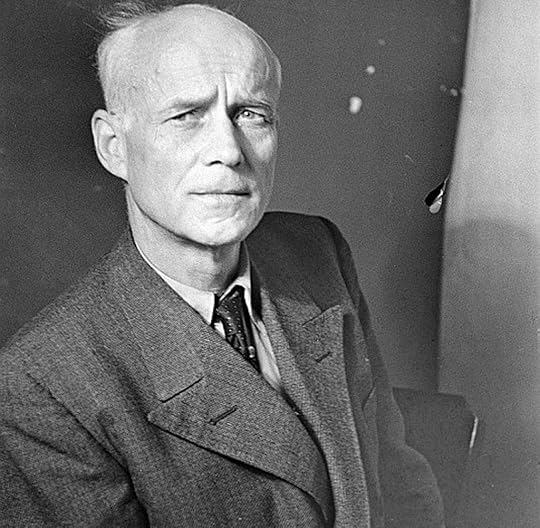
Theodor Plievier (1892-1955)
In Frontbreite betrat der Tod die deutschen Stellungen. ()
A son of the working class, Theodor Plievier was his own man from an early age. Rebelling against his parents' plans for his financial welfare, he left an apprenticeship at sixteen years of age and wandered through Europe until he became a merchant mariner in 1910. After a bar fight in 1914 he was impressed into the German Navy until 1918, where his miserable experiences reinforced his anarchistic leanings and provided him with the material for his extremely critical first novel, Des Kaisers Kulis (1929). Active during the November Revolution and in the anarcho-syndicalist movement, he was assured of a short and painful future when the Nazis came to power in 1933, but he and his wife managed to escape to the Soviet Union, where he wrote non-political adventure stories to be able to eat and avoid undue attention from the NKVD.(*)
He was in Moscow when the German army reached its outskirts in 1941 (he was one of the foreign authors evacuated at the last minute to Tashkent, an experience that yielded some memorable passages in Moskau), and after the collapse of the German 6th Army outside Stalingrad the Soviet authorities allowed him to interview German prisoners of war and gave him access to some of the Red Army's archives. This information he used to compose a harrowing account of the Nazi defeat at Stalingrad, the first completed portion of his excellent trilogy of World War II novels, Moskau (1952), Stalingrad (1945) and Berlin (1954) (all are available in English translation). Its German publication in 1945 tore away the veil of lies erected by the Nazi propaganda and revealed the extent of the disaster and betrayal to the German people for the first time.(**)

Anselm Kiefer, Die Meistersinger (1982)
I've read some military histories of the bitter struggle for Stalingrad earlier, but Plievier's text makes its desperate, murderous madness come to cadaverous life, expressed in a prose that occasionally attains notable heights of poetic intensity. The triptych's wing pieces - Moskau, relating the arc of events from the beginning of the invasion to the washing up of the spent Nazi tidal wave around Moscow's feet through the experiences of dozens of German and Russian characters, and Berlin, in which the first two thirds recount the horrors of a ruined Berlin's final two weeks as the capital of the Third Reich, whose civilian population's stunning suffering is told without any trace of euphemism, and the last third unexpectedly resurrects the first few years of the "Reconstruction" in the Soviet sector during which East Germany was stripped of its economic foundations (***) and the Nazi lies and oppression were replaced by the Soviets' - may not reach the same level of literary accomplishment as Stalingrad, but they are eminently readable and oftentimes gripping.
The vast canvas of this trilogy is laden with many, many characters, though a few are followed throughout each book like red threads that serve to unify the text,(4*) which proceeds in vignettes, flashbacks and brief stories of the subjective experience of the individual characters, punctuated by cinematic pans to the bigger picture and excerpts from letters, diaries, actual orders, the Soviet ultimatum to surrender... But these books are not collages like Ford Maddox Ford's WWI tomes; they are unified by Plievier's fervent and sometimes even florid voice. Compared to the enormous howl of rage at the pointlessness of all the quite deliberately excruciatingly detailed suffering this trilogy embodies, Remarque's Im Westen nichts Neues is a timid squeak.
() Across the breadth of the front death stepped into the German positions.
(*) His anarchist views were hardly compatible with the political atmosphere in Stalinist Russia. Nor was he comfortable in East Germany after the war: he defected during a lecture tour in West Germany, to which he also turned his back. He ended his days in the Tessin.
(**) It first appeared in installments in the USSR in 1943/4.
(***) The entire industrial infrastructure was dismantled and shipped to the USSR.
(4*) One main character, August Gnotke, makes his way through the entire trilogy in a series of transformations from SA man to noncommissioned officer in a Panzer Corps, to burnt out shell sent to a punishment brigade to die, to a tiny particle in the frenziedly boiling kettle of the Stalingrad encirclement, to prisoner of war tramping through the snowy wastes in rags without food or water, to coolie for the Red Army pushing across the Oder, on and on!
October 21, 2022
Er zijn van die boeken die je gelezen moet hebben, die ook ongelooflijk goed zijn geschreven, maar die zo diep zwart zijn dat je er depressief van wordt. Deze trilogie is er zo een. Geen sprankje licht. Geen spoortje hoop. Eén bak ellende. En toch ... als je geïnteresseerd bent in de ziel van een oorlog moet je dit gelezen hebben. WOII vanuit het perspectief van de Duitse soldaat. Bijna vergeten, onterecht.
Displaying 1 - 2 of 2 reviews