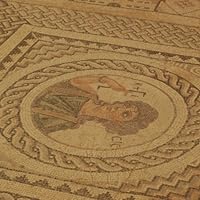
More than fifteen centuries after its fall, the Roman Empire remains one of the most formative influences on the history of Europe. Its physical remains dot the landscape from Scotland to Syria. Its cities are still the great metropolises of the continent. Its law and institutions have shaped modern practice, and its ideal of a united Europe has haunted politicians ever since. Fully illustrated and featuring more than sixty full- colour maps, this atlas traces the rise and fall of the first great multinational state. It looks at its provinces and cities, its trade and economy, its armies and frontier defences; follows its foreign ward and internecine struggles; and charts its transformation into a Christian theocracy and its fall in 476.
I'm a high school history teacher and I got hooked on this book (from my school's library) when I found I kept leafing through it and offering sections of it to my students.
In its favor, it has many great maps. It breaks down Roman history into easily understandable chunks and the chapter summaries do a good job at linking things all together.
On the bad side, this books seems stuck in a world that is too advanced for your average high schooler but too superficial to be viewed as a reliable source. It throws around a lot of advanced words ("internecine", "resounding", "elation", "capitulated", "maritime" and "redoubtable") that your average high schooler won't understand. Also, some of the maps are missing elements in their keys which, to your average adult reader, seem common sense. But to your average high schooler, who is just understanding what a key is... the lack of keys can be most unhelpful.
Overall, this isn't a bad book. As someone who has a more advanced understanding of Roman history, it was nice to see some maps and summary paragraphs, but I think much of the information is far above what your average high schooler can process.
This book serves a number of purposes. It is a useful companion to reading other books, as its maps are very helpful to understanding the region and its history. The book will also serve as good refresher in the future. To other readers, it may also serve as a good introduction to Roman history. All in all, I am glad I have this in my library.
The book's full of text to read, but it comes with images, pictures, maps, battle plans, charts and tables helping the readers understand the events in a clear and continuing geographical and chronological line.
Karttoihin ja kuviin perustuva Rooman historia on yksityiskohtainen, mutta selkeä. Karttojen visualisoinnit ovat hienoja. Kirja ei ehkä ole paras mahdollinen johdatus aiheeseen, mutta toimii täydellisesti oheislukemistona. Kuuntelen Michael Duncanin loistavaa History of Rome -podcastiä ja kirjasta on näppärä katsoa tapahtumien sijanteja.
I am a big fan of this book. It is more a work of reference than something to read in one go, but I still read it back to front because it gives such a good overview. I think it is the very best introduction to the history of the Roman Empire I read.
These Penguin historical atlases pack a lot into just over 100 pages. It may be a little superficial but as a companion to a more in-depth (and largely unillustrated) book or as a starter, it's really useful.
I love this style of book. They have a great approach to covering the era, giving you a sense of time and I feel that the maps add a lot of useful contexts. Always a lot of fun. I also read this mostly on trains in Italy during my honeymoon. I actually bought my copy at the Pompei giftshop.
Introduction to history of Rome with some maps - mostly of military campaigns - included. It doesn't have any infographic-style innovative maps of various aspects of ancient worlds, which was disappointment.
Simultaneously overly complicated (so many battle maps without explanation) and underexplained (terms and context for events). I don't think I'm the target audience for this book. I wanted to read this so I could better understand the Lindsey Davis mysteries set in first century Rome, but as it turns out, just reading her books with additional Googling is more helpful.
If you need the entire history of the Roman Empire reduced into a nutshell, with fantastic maps and photographs of archaeological ruins and busts, then this is the book for you! The history of Roman civilization is a huge topic to tackle, especially in the span of a semester. As a Classics minor, I had a difficult time remembering the major dates, people, and places figuring from 800 BC to 540 AD, from the origins in Rome, to fall of the Western Empire. The Atlas provides a visual depiction of the rise and fall of Rome. I personally like being able to see a broad depiction in order to better understand the major themes of a civilization. Scarre provides detailed maps of important places of expansion, as well as information on trade, literacy, and cultural life in different periods. The timelines are excellent; the timeline is broken down into The Roman State, Building and Construction, Literature and Philosophy, and Asia, Africa, and the Mediterranean. This book, however, cannot stand alone since it is a broad overview. It is a great companion to classical texts and textbooks on the Roman Empire. It is also perfect for a quick overview before an exam. For those simply interested the rise and fall of Rome, the Atlas provides a great overview with fantastic images.
i love atlases as a genre. the historical atlas subgenre is great, though it has certain risks because the historical summaries appended to the various maps, as well as the distillations that go into reducing historical forces to colorful abstractions, can leave something to be desired politically.
This book contains excellent graphic representations of the Roman Empire, including maps of various areas during different eras, battles and wars, timelines, etc. However, the text of the book is disappointingly vague. It makes a good supplement to books with more detailed text, such as Greg Woolf's Rome: An Empire's Story and Boatwright's The Romans: From Village to Empire.
This is one of my favorite guides to Roman History...and I've read quite a few! Great short write-ups on all the important events in Ancient Roman history and fabulous illustrations.