When Meet Me in St Louis was first released fifty years ago, it achieved instant success, becoming MGM's most popular film to date. Since then it has effortlessly retained its place in the pantheon of great musicals. But elegant and graceful though it may be, this was not the easiest of films to make. Gerald Kaufman has done extensive research in the records of MGM deposited in the University of Southern California. He recounts how successive teams of writers labored over the script, changing names, characters and storylines. He reveals the numerous delays in production, many due to the erratic behaviour of Judy Garland, who was absent for thirteen days of filming. That the film turned out so brilliantly is, in Kaufman's view, due largely to the credit of its director, Vincente Minnelli, who drew from an initially reluctant Judy Garland her most immaculate performance. An extended section of the book explores in detail Minnelli's contribution to the fluidity of the visual style and the richness of the decor.
I can’t see anyone under 60 who isn’t a diehard musical or Judy fan wanting to watch Meet Me in St Louis. These movies called “classics”, no longer popular entertainment, dwindle, like Dickens, like Laurel and Hardy, like so much stuff beloved by the rarefied distant claque of critics, into disregard, their voices increasingly hard to make out, and fewer and fewer people taking the trouble. What was familiar becomes outre. Bundled into the collective attic of Western memory, they will lie there in disregarded heaps for generations to come, dust softly falling upon them all.
“FAMILY PICTURE” ENDORSES VANDALISM AND SCAPEGOATING
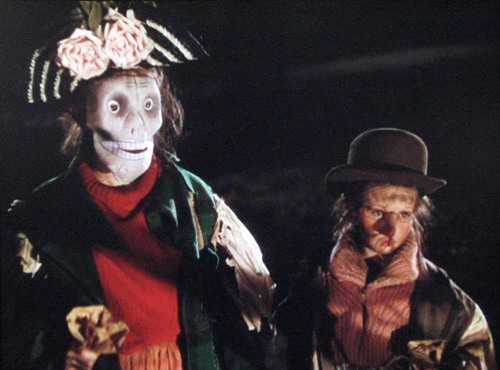
Seven-year old Margaret O’Brien (the kid that said to a director : “When I cry, do you want the tears to run all the way or shall I stop halfway down?”) elbows Judy Garland out of the limelight for long stretches of this movie. She’s one of the many things which strike a modern audience as strange, off-centre. Her performance as Tootie is so in your face it practically comes out of the back of your head. But then, who’s looking for naturalistic acting in this most unnatural movie. In the weirdest sequence, the kids all dress up for Halloween and have this conversation with adult family members:
"Wait till you see what we do to Mr. Braukoff. That'll be a caution, won't it, Tootie?"
"We'll fix him fine. It'll serve him right for poisoning cats."
"Does he poison cats?"
"He buys meat,and then he buys poison, then he puts them all together.He burns the cats at midnight in his furnace. You can smell the smoke."
"That's horrible. Are you sure?"
"Johnny Tevis smelled the smoke and peeked in through the window,and there was a box of dead cats. And Mr. Braukoff was beating his wife with a red-hot poker."
The adults are perfectly okay with fixing this guy for what is clearly a trumped-up charge from a blatantly extra-judicial process. “Fixing” consists of throwing flour in Mr Braukoff’s face when he opens the door (one kid helpfully says if you wet the flour before you throw it, it's harder to get off.)
So there’s that, then also there’s the sight of the neighbourhood kids feeding a bonfire with bits of furniture and garden fences without a hint of adult supervision. No health and safety concerns in 1904. If a kid fell in the fire & got 3rd degree burns… well, let’s not think about that. Surprisingly, I had to agree with the Hays Code, who made the objection in a letter dated 29 July 1943
In our judgement it will be unacceptable to show these youngsters throwing door mats and pieces of furniture they have stolen on Halloween Eve into a fire. Some other business should be substituted.
BAD MOTHER
Margaret and Judy Garland between them caused multiple delays to the production & pushed the whole movie 20 days over schedule. Margaret was taken away by her parents for 12 days. Her mother wrote to Arthur Freed the producer:
Margaret has been working almost steadily for the past year and a half going from one picture right into another… even days she didn’t work we still had to make a trip to the studio for publicity interviews, lessons, wardrobe fittings etc and I was beginning to be greatly criticised for allowing my child to work so hard
GREATNESS STRIKES WHERE IT PLEASES
This witty factpacked little book really shows the arbitrary nature of Hollywood movies & how remarkable it was that some of them, like this one, got made at all, let alone turned out well. For instance, the older sister is played by Lucille Bremer who nobody had heard of, even though her part has as many speaking lines as Judy. It was Lucille’s first movie. Why was she given…. Aww, you got there already. She was Arthur Freed’s girlfriend, and he was The Producer.
But what about the great songs? The three you probably remember are The Trolley Song, The Boy Next Door and Have yourself a Merry Little Christmas (the saddest Christmas song ever). These alone were written specially for this movie by a team (Hugh Martin and Ralph Blane) who never wrote anything remotely as good before or since. How random.
Kaufman's book has little of the analysis of MMSL that I expected. The majority of the book is about Minnelli's career as a director of MGM musicals; the few pages devoted to Judy Garland are negative and present an EXTREMELY uninformed discussion of her career (most significantly, that MMSL was the peak of her career!). Still, there were bits of decent analysis and information.
Not one of the better outings for this series. Kaufman is too excited by his access to MGM archives to judge whether what he reproduces is relevant and his analysis of the film itself is thin. Still, if we believe Kaufman's version, I suppose there is some consonance between Kaufman's scattershot approach and Minnelli's career.
The book was informative, but I'm not a big fan of Kaufman's writing style. The sentences didn't seem to flow very well. (Sometimes, I couldn't identify the subject of a sentence until the end of it.) The book was a bit slim by BFI standards; I polished it off in just three days.
Gerald Kaufman’s book on Minnelli’s great film “Meet Me in St. Louis” is a bit heavy in the auteur-admiration department, but it has a lot of well-researched detail on the picture’s troubled production history and fabled success in subsequent decades. An interesting account of an enduring classic.
This essentially functions as an hours worth of dragging on Judy Garland to hype Vincente Minnelli to tell us what we already know before going into this book. Meet Me in St. Louis is a perfect film.