At Delacroix' studio sale, held six months after his death in 1864, crowds and critics were astonished at both the abundance and the multi-disciplinary nature of the work on display, the life's vision of a man praised by Baudelaire for being the last great artist of the Renaissance period and the first of the Modern. But Delacroix himself was well aware of the position he wanted to occupy. Taking his cue from Rubens in both lifestyle and visual inventiveness, he took the order of classical composition and allied it to a universally appreciated symbolic and allegorical intent, producing from that marriage works of unmatched integrity and sensuality.From the spectacular Salon reception in 1824 to a work such as the major Scenes from the Chios Massacre (when the term Romantique was first applied to his style) through to the liberating and controversial carnality of The Agony in the Garden , Delacroix' genius in graphic design, in the liberation and reinvention of colour, and in the portrayal of bodies was never in doubt. His numerous sketchbooks attest to a personality committed to the most truthful results, in both his Goyaesque fantasias of horror, cruelty and sacrifice and in his huge historical canvases.Excessive, monumental, Byronic even, this Victor Hugo of the art world has proved profoundly influential, his technique studied by movements as diverse as Impressionism, Expressionism and the Abstract painters of mid-century. Leaving the self-indulgence of the Romantics far behind, the nobility of Delacroix' spirit will continue to speak to any and every age.
Gilles Néret (1933 - August 3, 2005) was a French art critic and historian, journalist and curator. He wrote extensively on the history of erotica.
He organized several art retrospectives in Japan and founded the SEIBU museum and the Wildenstein Gallery in Tokyo. He directed art reviews such as L’Oeil and Connaissance des Arts and received the Elie Faure Prize in 1981 for his publications. Since 1992, Néret was an editor for Taschen, for which he has written catalogues raisonnés of the works of Klimt and others, as well as the author of Erotica Universalis.
Nothing confuses me more than my children's frequent questions regarding "favourite" things.
"What is your favourite book, Mum?"
"Hmmm..."
Just as hard is the question:
"What is your favourite painting?"
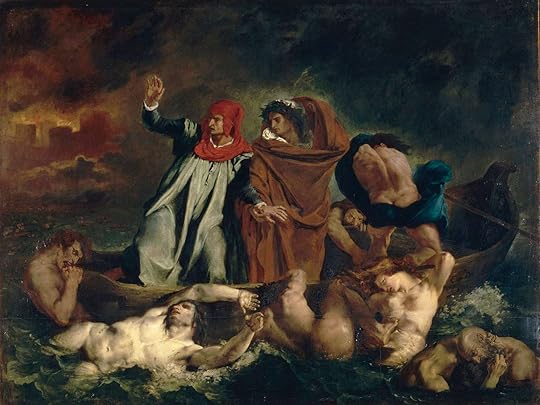
Obviously, neither question can be answered properly, but in both cases I had a spontaneous association in my head, a very first idea that came to mind. Regarding my favourite book, I think I opted for One Hundred Years of Solitude and Don Quixote, quickly followed by all the others. And when asked about my favourite painting, Delacroix' "La Barque de Dante" came to mind immediately, before all the others inundated my memory.
Why?
It was my first love affair with art, when I was a young university student spending some wonderful months in Paris. It happened to be the summer France won the World Cup (3:0 against Brazil - imagine the streets of Paris!), and it was also the year France celebrated Delacroix' bicentenary. The bookstores were full of books about his life and art, and the museums had special exhibitions.
Imagine my disappointment when I realised that "La Barque De Dante" was on loan (to Lille I believe), and that I had to wait until my next visit to see the early masterpiece which beautifully showed Delacroix' role as a successor of Rubens and an inventor of 19th century Romantic art.
The topic itself shows the ambitious translatio studii perfectly well. Dante, holding Vergil's hand on his way to complete the journey of The Divine Comedy, seeks support in the old master's knowledge and expertise. But that is only part of the message. The Aeneid may have inspired Dante, but he is about to let go, to embark on his own literary journey, creating a tale just as powerful as the Ancient epic.
That sounds like the young Delacroix in 1822! Inspired by Rubens, he sets out to paint those incredible masterpieces of social and artistic power, those studies of human expression brought to life in colour. "La Barque de Dante" is his first attempt to gain public recognition in the Salon of 1822, the start of the artistic journey which will leave Neo-Classicism under the reign of Ingres behind and ultimately lead to the different modern Isms of the late 19th century.
Ever since I first saw Delacroix' paintings and drawings, and read his Journal as well as Baudelaire's eloquent homage, he has had a special place in my heart, and I make a point of revisiting his house, a small museum, whenever I am in Paris. It is just around the corner of the literary cafés in Saint Germain des Près, in the heart of the Quartier Latin.
I guess the question my children asked me must remain unanswered, but Delacroix is among my most beloved artists for sure.
I hope they don't ask me about my favourite music next...
An easy reading book on Delacroix's life and oeuvre; belonging to Taschen collection, Néret doesn't quite follow the other studies, inasmuch there isn't an extensive pictorial analysis. Anyway, given that I didn't know a thing about Delacroix —who isn't certainly as much a popular artist as Van Gogh or Picasso may be—, I feel now closer to realizing how important he was, a figure that embodied the last of the Classicist strokes and the first of the Romantics, giving even, in his last paintings, landscapes pretty close to what Impressionism would be, or to what Turner had been doing for quite some time. An important figure in 19th Century art that broke through the chains of Classicism thanks to an absolute talent.