Dorothy Edwards (18 August 1903 – 6 January 1934), was a Welsh novelist of the early 20th century.
Edwards was from Ogmore Vale in South Wales. She was educated at Howell's School for girls in Llandaff and at Cardiff University. She was politically active, working for socialist and Welsh nationalist causes, but wrote in English. She was also a talented amateur singer. On 6 January 1934 she threw herself in front of a train near Caerphilly railway station. She left a suicide note stating: "I am killing myself because I have never sincerely loved any human being all my life. I have accepted kindness and friendship and even love without gratitude, and given nothing in return."
Edwards wrote a short story, "The Conquered," which was included in A View Across The Valley (an anthology re-claiming female Welsh nature writers).
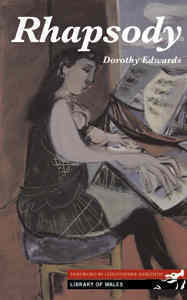
Dorothy Edwards was a Welsh author who is very little read or known these days. Rhapsody is a collection of her short stories. Edwards remained little known and out of print after her death in 1934, until Virago (bless them) published her only novel and this collection of her short stories in the 1980s. The edition I have in the recent Library of Wales edition has three extra stories. Dorothy Edwards committed suicide leaving a heart-rending note;
“I am killing myself because I have never sincerely loved any human being all my life. I have accepted kindness and friendship, and even love, without gratitude and given nothing in return."
She was born in 1903 and her father was a socialist and Independent Labour Party activist; a political tradition she followed. She read Greek and Philosophy at Cardiff University. I found out about her work when reading David Garnett’s book on his friends. The chapter on T E Lawrence mentions her. Garnett was a fan of her writing (as was Lawrence) and she stayed with him and his wife rent free for a time. Lawrence thought that her story A Country House was one of the best written in the English Language. Garnett also thought she was a brilliant writer. Christopher Meredith sums up well in his introduction to this edition;
"Fashion for re-readings according to various theories have helped critics to rediscover her from time to time, but I believe that Dorothy Edwards is a great deal more than an interesting literary case. She's an important, utterly original modernist. Whichever way you read her, she's the extraordinarily accomplished author of powerful and suggestive fictions."
Here’s the rub, where should this type of writer sit in the canon, if at all. Having just finished reading Rhapsody I can say that these stories stand up against any others I have read; Woolf, Mansfield, Chekov, Maupassant. I am astonished that Dorothy Edwards is so little known. The stories are fairly minimalist and usually written with a male narrator. There is a control and a holding back, desire is constrained and relationships incomplete, loneliness often a given. Edwards was interested in music and music is a recurrent motif and theme, often representing an undercurrent of passion. Meredith points out that a number of the stories refer to fairy tales, but in themselves they resemble fairy tales that are ironic with a menacing edge, covered by what seems to be a conventional English backdrop. Often outsiders or visitors arrive to disturb marriages and well established relationships. The emotional tensions between the characters is palpable’ the prose is stylised and often deliberately awkward. The movement and development of the stories often seems logical, but on reflection there is an underlying disturbance and all is not as it seems. The opening of A Country House illustrates this;
“From the day when I first met my wife she has been my first consideration always. It is only fair that I should treat her so, because she is young. When I first met her she was a mere child with black ringlets down her back and big blue eyes. She put her hair up to get married. Not that I danced attendance on her. That is nonsense.”
There is an odd construction here, although it may seem straightforward. There is nuance and almost menace and the narrator almost seems to be arguing with himself. On reflection I found that opening quite chilling. Edwards herself says; “you must be realist or you must invent a personal isolated odd universe composed exclusively of your own experience” I now feel the need to get hold of Claire Flay’s recent biography. She argues that Edwards uses the male narrators in the way she does in order to deconstruct their authority. David Garnett has had a good deal of say in how we have seen Edwards until recently as her biography has been written. He indicates that Edwards was not always comfortable with people and indeed her stories are more ice sculpture than ardent passion. There is a picture of her in the back of Rhapsody and it is haunting. Given her upbringing, it is not surprising that class is important element for Edwards, but not in the way you would expect. Her women are often marginalised, but Edwards examines and critiques their position and treatment in a highly original way. These stories deconstruct and explore; the endings are unusual and I was often left thinking “Did that just end?” The stories just stop, often it feels like mid-sentence. However they make you think and they stay with you. These short stories rank with the best I have ever read; they are haunting and are much more than they seem on the surface. These are a must read.
The writing itself is amazing, really breathtaking. Really felt I was there, could feel the breeze, smell the air, and see the trees and grass. Why isn't this authoress better known? She had amazing talent.
The stories themselves won't appeal to everyone. This is a book of short stories, but they do not have plots to speak of. We are introduced to characters, usually in the midst of something rather mundane, like a visit, then the story ends. People who like a hardcore plot to follow will obviously not like this. You will have to like thinking about the characters and their motivations, and guessing what might happen, to appreciate these stories.
As others have said in their reviews, there is a pervasive loneliness in all the stories that is hard to pin down. Most of the stories aren't sad but there is somehow a feeling of sadness and loneliness that is somehow portrayed though never discussed or described. Brilliant writing!!
Reminded me a bit of Alice Munro and Flannery O'Conner.
This short story collection was published in 2019 (the original in 1927) and I would’ve been the first person to rate and review it on Goodreads. A few pages into the third story, however, I concluded I could see what all the absence of any fuss was about. There was certainly nothing to rhapsodize about. (Did you see what I did there?) When I can’t rhapsodize, I tend to bail. And that is what I’ve done.
"I am killing myself because I have never sincerely loved any human being all my life. I have accepted kindness and friendship, and even love, without gratitude and given nothing in return." Cardiff Times 13th January 1934
So read the suicide note found on Dorothy Edwards' body after her tragic death in January 1934.
This fine collection of short stories amply demonstrates why, had she lived longer, she might have gone on to become the Welsh Chekhov. Each one is a finely crafted gem although none of them could count as cheery companions for a vacation trip. Indeed many of her characters evince the same eerie and unsettling sense of detachment from the circumstances of their own lives which she hints at in her suicide note quoted above. They are frequently consumed with a passion for music which seems to act as a surrogate for genuine emotional attachments. Their enthusiasm for the "life of the mind" seems to preclude and eclipse meaningful human relationships.
It was fashionable in the early 70's to evaluate artists and authors in terms of psychological diagnostic categories and many including Sylvia Plath and even Dylan Thomas were labeled as 'schizoid' by some literary critics of that era.. However flawed such critical practices may be the label does seem to throw some light on both Dorothy Edwards and many of her her characters.
In the first of these tales, the eponymously titled "Rhapsody", George Everett is introduced in the following terms:- "His face wore a curious expression, as if he were listening all the time to something intensely illuminating but scarcely audible, or as if he were experiencing some almost intolerably sweet emotion, and he seemed to be imploring you 'Please don't interrupt me for a moment; it will soon be over.' Later in the book after his wife's death his reaction to this tragic event is characterized thus:- " Everett behaved at her death very much as he had behaved when she was ill. He was vaguely sorry for her, but he did not altogether understand what was expected of him."
This collection, which includes three stories not published or excluded from the original 1927 edition, abounds with characters who are similarly emotionally crippled or repressed.
As Christopher Meredith says in his excellent introduction to this Parthian/Library of Wales edition:- " Fashion for re-readings according to various theories have helped critics to rediscover her from time to time, but I believe that Dorothy Edwards is a great deal more than an interesting literary case. She's an important, utterly original modernist. Whichever way you read her, she's the extraordinarily accomplished author of powerful and suggestive fictions."
In echoing these sentiments I can only add that as an avid fan of the short story genre these must rank amongst the finest I have read in many years.
For the morbidly curious the approximate site of her tragic death can be viewed in the Google Map linked below. Railway Terrace and the "Allotments" ( Community Gardens ) referred to in the "Cardiff Times" article linked above are still there. To the best of my knowledge there is no plaque to mark the spot. Perhaps there should be?
"I am killing myself because I have never sincerely loved any human being all my life. I have accepted kindness and friendship, and even love, without gratitude and given nothing in return." -- The suicide note of Dorothy Edwards, and the thing that caught my eye.
I read 'The Conquered' for class, and then decided to read more of her work. This is one writer I don't think you can truly understand without understanding that that was lying behind all her work -- a coldness, a holding back, an inability to give of herself... Many, most, all? of the characters of these short stories are this way. The stories are very perfectly formed; they make me think of sculptures very carefully and deliberately carved in ice. I think they will haunt me. They require thought, and unpacking, and even several reads, before you understand them. And they are well worth it.
I didn't enjoy them, as I usually do, by connecting with the characters -- Dorothy Edwards' work didn't lend itself to that. It was the ice sculpture perfection that intrigued me; the ideas that will haunt me, not the characters.
Beautiful! One of the finest collections of short stories I've read, Edwards seems to be barely known though on the evidence of these pieces her name deserves to be spoken of alongside Katherine Mansfield and Virginia Woolf, contemporaries of her. On the back cover of this Library of Wales edition Dan Rhodes refers to it as a "card-carrying masterpiece", an assertion with which I'd wholeheartedly concur. The tragedy is that having finished this collection I have now read exactly half of Edwards' published work - she had only written these stories and one novel before she took her own life at the age of just 31.
The sensation of Edward's short stories appeared to me only after I had put down this collection and turned it over in my mind. It is not the stories themselves that stand out--which typically involve the temporary stay of a stranger or distant relation in a pre-established rural family or location--no; what stands out are the perfect, evocative moments. I mean evocative in the sense that they are resonate in the mind as if they were experienced memories. The book appears as an assemblage of all these moments; of walks across rural landscapes; reading poetry in the woods in the evening; of musical performances.
The tone of the work is overall one of pessimism. If connections are made between the bookish, isolated intruders of a domestic scene--often through music, functioning as a metaphor for intimacy--then they are either damaging or short-lived; always the end of the story coincides with the end of a sojourn, and the departure from the location. These are interruptions, all too brief, in an otherwise settled way of life. Despite this, they are also life itself: people are at cross purposes, fail to understand one another, are cruel without meaning to be (or with seemingly any other avenue of conduct open to them) and fade from our lives far too quickly.
Perhaps a fitting collection then for an author whose life was tragically cut short at the age of thirty-one. That she didn't go on to fulfil what seems her staggering potential is to be mourned.
A wrongly overlooked Welsh modernist writer, whose stories are intricately-wrought tragedies of social isolation, repressed sexuality and dislocation. Each story is laden with subject and yields more with each reading. The recurring symbolism of music and gardens reveal characters’ inner anxieties and desires.
These stories are rich tapestries interweaving sexual longing, the vague malaise of isolation and truncated desires. There are recurring motifs of loneliness, classical music, gardens and emotional yearning. Stylistically, there is a detached quality to Edwards's writing, a feeling that it is somehow removed from or that it lurks just beyond the mundane or ordinary. This contributes to a dream-like, even vatic at times, characteristic in the prose. Forlorn figures haunt the text, despondency gradually intensifies as it bleeds in subtly from the periphery, and we are left with melancholic masterpieces.
Sadly, a neglected modernist writer who has much to offer readers.