

What do you think?

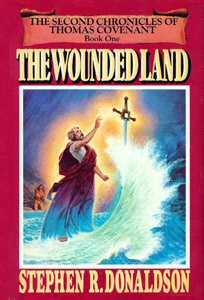
The Second Chronicles of Thomas Covenant #1
The Wounded Land
4,000 years have passed since Covenant first freed the Land from the devastating grip of Lord Foul and his minions. The monstrous force of Evil has regained its power, once again warping the very fabric and balance of the Land. Armed with his stunning white hold, wild magic, Covenant must battle not only the terrifying external forces but his own capacity for despair and devastation. His quest to save the Land from the ultimate ruin is as exciting and heroic as ever.
490 pages, Mass Market Paperback
First published June 1, 1980
About the author
Stephen R. Donaldson
143 books2,789 followersStephen Reeder Donaldson is an American fantasy, science fiction, and mystery novelist; in the United Kingdom he is usually called "Stephen Donaldson" (without the "R"). He has also written non-fiction under the pen name Reed Stephens.
EARLY LIFE AND EDUCATION:
Stephen R. Donaldson was born May 13, 1947 in Cleveland, Ohio. His father, James, was a medical missionary and his mother, Ruth, a prosthetist (a person skilled in making or fitting prosthetic devices). Donaldson spent the years between the ages of 3 and 16 living in India, where his father was working as an orthopaedic surgeon. Donaldson earned his bachelor's degree from The College of Wooster and master's degree from Kent State University.
INSPIRATIONS:
Donaldson's work is heavily influenced by other fantasy authors such as J.R.R. Tolkien, Roger Zelazny, Joseph Conrad, Henry James, and William Faulkner. The writers he most admires are Patricia A. McKillip, Steven Erikson, and Tim Powers.
It is believed that a speech his father made on leprosy (whilst working with lepers in India) led to Donaldson's creation of Thomas Covenant, the anti-hero of his most famous work (Thomas Covenant). The first book in that series, Lord Foul's Bane, received 47 rejections before a publisher agreed to publish it.
PROMINENT WORK:
Stephen Donaldson came to prominence in 1977 with the The Chronicles of Thomas Covenant, which is centred around a leper shunned by society and his trials and tribulations as his destiny unfolds. These books established Donaldson as one of the most important figures in modern fantasy fiction.
PERSONAL LIFE:
He currently resides in New Mexico.
THE GRADUAL INTERVIEW
EARLY LIFE AND EDUCATION:
Stephen R. Donaldson was born May 13, 1947 in Cleveland, Ohio. His father, James, was a medical missionary and his mother, Ruth, a prosthetist (a person skilled in making or fitting prosthetic devices). Donaldson spent the years between the ages of 3 and 16 living in India, where his father was working as an orthopaedic surgeon. Donaldson earned his bachelor's degree from The College of Wooster and master's degree from Kent State University.
INSPIRATIONS:
Donaldson's work is heavily influenced by other fantasy authors such as J.R.R. Tolkien, Roger Zelazny, Joseph Conrad, Henry James, and William Faulkner. The writers he most admires are Patricia A. McKillip, Steven Erikson, and Tim Powers.
It is believed that a speech his father made on leprosy (whilst working with lepers in India) led to Donaldson's creation of Thomas Covenant, the anti-hero of his most famous work (Thomas Covenant). The first book in that series, Lord Foul's Bane, received 47 rejections before a publisher agreed to publish it.
PROMINENT WORK:
Stephen Donaldson came to prominence in 1977 with the The Chronicles of Thomas Covenant, which is centred around a leper shunned by society and his trials and tribulations as his destiny unfolds. These books established Donaldson as one of the most important figures in modern fantasy fiction.
PERSONAL LIFE:
He currently resides in New Mexico.
THE GRADUAL INTERVIEW
Ratings & Reviews
Friends & Following
Create a free account to discover what your friends think of this book!
Community Reviews
Displaying 1 - 30 of 339 reviews

July 30, 2011
*** 2022 reread -
This is a book and a series that for 30 years I knew that I would read again.
When I reread the first in the series, Lord Foul’s Bane (first published in 1977) in February 2020, my memories of the book and my feelings about the reread, coupled with the negative attention the book has received over the years, sometimes rising to the level of vehemence, compelled me to write one of my longest and most detailed reviews. I felt that I needed to explain to readers what I found admirable in the book; but also I needed to realize for myself, and articulate in words, how that book moved me and why I liked it.
A couple of years later and I have reread the first trilogy and now I have reread the first book in the second series.
The Wounded Land, the first book in the Second Chronicles of Thomas Covenant (first published in 1980) was then, and now again, my favorite book in the collection of Stephen R. Donaldson’s books about The Unbeliever and White Gold Wielder.
So far.
Donaldson begins this second trilogy set some years after the events in the first. Readers will recall that time marches on differently in The Land. A few weeks back home between the first and second book resulted in forty years having come and gone for the healthy residents of the land. Years later in our world means that thousands of years have passed in The Land.
Most noteworthy here is that Covenant takes with him Dr. Linden Avery. Her inclusion, seemingly having been chosen by the creator of the land (the old guy in the bathrobe who prowls around Covenant’s village), provides an intriguing addition to the narrative.
When Thomas and Linden arrive in the Land, they see that much has changed. The essential and fundamental health of the Land (an imperative aspect of the earlier books) has been altered by the Sunbane. This is the part of the book I remembered most – every morning a “new sun” will rise and it will have an aura that describes what will happen under that sun. There is a desert sun where everything gets hot and dry, a fertile sun where grass and trees spring up immediately, a pestilential sun full of bugs, critters and disease. The visitors learn that this has been the new law of the land for centuries and Covenant travels to Revelstone to find out the extent of the changes and once there the mystery only gets more grim.
Linden, as a medical doctor (and with plenty of baggage of her own) gets to the Land, she is hypersensitive to the disease of the Land and her ability to “see” health or illness is an important element of this narrative. We also get to explore some cognitive dissonance as residents of the Land now have a very different understanding of right and wrong and Donaldson’s story provides an allegory for disinformation in our time.
Also noteworthy is the addition of the character Vain. This entity is “given” to Covenant by a long lost “ghost” of a friend and Vain is the culmination of the work of the Ur-Viles, demondim spawns who usually work with nefarious purposes.
We also get to see some descendants of characters from before and the diverse plethora of interesting characters made this an even more enjoyable read.
What I take away from this reading is, like the earlier books, this is very dark. Donaldson’s language is rich and textured, again drawing comparisons to Gene Wolf and here I saw elements of horror and an unmistakable influence from Lovecraft. I can also see where this would turn some readers away. While Covenant is slightly more heroic here than earlier, he is still an unlikable curmudgeon. But, he is our curmudgeon and his inchoate power (that gets much more screen time here) and his latent dangerousness makes this more appealing.
Still brooding and dark, this has more action and is less introspective and so has a broader appeal.
This is a book and a series that for 30 years I knew that I would read again.
When I reread the first in the series, Lord Foul’s Bane (first published in 1977) in February 2020, my memories of the book and my feelings about the reread, coupled with the negative attention the book has received over the years, sometimes rising to the level of vehemence, compelled me to write one of my longest and most detailed reviews. I felt that I needed to explain to readers what I found admirable in the book; but also I needed to realize for myself, and articulate in words, how that book moved me and why I liked it.
A couple of years later and I have reread the first trilogy and now I have reread the first book in the second series.
The Wounded Land, the first book in the Second Chronicles of Thomas Covenant (first published in 1980) was then, and now again, my favorite book in the collection of Stephen R. Donaldson’s books about The Unbeliever and White Gold Wielder.
So far.
Donaldson begins this second trilogy set some years after the events in the first. Readers will recall that time marches on differently in The Land. A few weeks back home between the first and second book resulted in forty years having come and gone for the healthy residents of the land. Years later in our world means that thousands of years have passed in The Land.
Most noteworthy here is that Covenant takes with him Dr. Linden Avery. Her inclusion, seemingly having been chosen by the creator of the land (the old guy in the bathrobe who prowls around Covenant’s village), provides an intriguing addition to the narrative.
When Thomas and Linden arrive in the Land, they see that much has changed. The essential and fundamental health of the Land (an imperative aspect of the earlier books) has been altered by the Sunbane. This is the part of the book I remembered most – every morning a “new sun” will rise and it will have an aura that describes what will happen under that sun. There is a desert sun where everything gets hot and dry, a fertile sun where grass and trees spring up immediately, a pestilential sun full of bugs, critters and disease. The visitors learn that this has been the new law of the land for centuries and Covenant travels to Revelstone to find out the extent of the changes and once there the mystery only gets more grim.
Linden, as a medical doctor (and with plenty of baggage of her own) gets to the Land, she is hypersensitive to the disease of the Land and her ability to “see” health or illness is an important element of this narrative. We also get to explore some cognitive dissonance as residents of the Land now have a very different understanding of right and wrong and Donaldson’s story provides an allegory for disinformation in our time.
Also noteworthy is the addition of the character Vain. This entity is “given” to Covenant by a long lost “ghost” of a friend and Vain is the culmination of the work of the Ur-Viles, demondim spawns who usually work with nefarious purposes.
We also get to see some descendants of characters from before and the diverse plethora of interesting characters made this an even more enjoyable read.
What I take away from this reading is, like the earlier books, this is very dark. Donaldson’s language is rich and textured, again drawing comparisons to Gene Wolf and here I saw elements of horror and an unmistakable influence from Lovecraft. I can also see where this would turn some readers away. While Covenant is slightly more heroic here than earlier, he is still an unlikable curmudgeon. But, he is our curmudgeon and his inchoate power (that gets much more screen time here) and his latent dangerousness makes this more appealing.
Still brooding and dark, this has more action and is less introspective and so has a broader appeal.

October 9, 2009
I started this book and found Thomas Covenant was himself, as we knew him in the first series..."woe is me! Life is unfair (to me), all is lost, there is no hope!" So I followed his example....I saved myself! Not again will I suffer through Thomas Covenant's eternal, endless self flagellation and self pity. I have traveled as far as I care to with the Unbeliever. Got through this one (or possibly suffered through this one [am I starting to sound like Thomas Covenant?] and went no farther.
My advice? RUN! Run far and run fast...flee! Save yourself! Get away, get away before it's too late! It could be like quicksand! Don't get sucked down!
I'm not a fan of Thomas (the world is unfair to me so everybody owes me) Covenant. (Did you pick up on that?) I read the first trilogy and I'll never, never, ever be able to get those wasted hours from my life back...alas. LOOK AT THAT! I AM STARTING TO SOUND LIKE THOMAS COVENANT!!!!
Yeah, I'm through, no more Thomas Covenant.
Learn from my example, save yourself. (Before it's too late.)
Did you get that I can't recommend this/these?
My advice? RUN! Run far and run fast...flee! Save yourself! Get away, get away before it's too late! It could be like quicksand! Don't get sucked down!
I'm not a fan of Thomas (the world is unfair to me so everybody owes me) Covenant. (Did you pick up on that?) I read the first trilogy and I'll never, never, ever be able to get those wasted hours from my life back...alas. LOOK AT THAT! I AM STARTING TO SOUND LIKE THOMAS COVENANT!!!!
Yeah, I'm through, no more Thomas Covenant.
Learn from my example, save yourself. (Before it's too late.)
Did you get that I can't recommend this/these?
September 23, 2023
The Second Chronicles set is every bit as fascinating and enthralling as the first.
June 1, 2016
Ur-Lord of Reason Imbroglio! Incoherent or just Incompetent? "Well, (scratches his head) I was trying to tell Covenant that he could let go of responsibility for other people's expectations and he (shakes head) just ... started running around in a circle shouting, 'I'm a GOLDFISH!' over and over again. Then Linden hissed at him, 'It's all my fault, but I can't help you. No I just wont! So, there!' and I'm left thinking, (lifts and spreads his hands) I gave up my whole village for this?" - Sunder - The Graveler's Chronicles
Unlike the first trilogy with its dark genius of holding up a mirror to endorse our society's rulership based upon psychopathic satanic depravity ... this volume has no such charms, and I'm left with reading 200+ pages of utterly incoherent drivel masquerading as a fantasy epic.
These 3 and a half books have taught me much, but now it's time to end the pain.
I literally can go no further. Reading this book is like stabbing my brain with a knife.
Noting that I brought the hard cover when it came out and read it in full, along with the rest of the 2nd Chronicles. I'm amazed at the difference in my experience of this story. While the book remains the same, this reader has changed enormously from the inexperienced and naïve youth I once was.
And for that - I'm entirely thankful.
Not Recommended, 1 'Incoherent,' star.
DNF'ed at 42%.
Unlike the first trilogy with its dark genius of holding up a mirror to endorse our society's rulership based upon psychopathic satanic depravity ... this volume has no such charms, and I'm left with reading 200+ pages of utterly incoherent drivel masquerading as a fantasy epic.
These 3 and a half books have taught me much, but now it's time to end the pain.
I literally can go no further. Reading this book is like stabbing my brain with a knife.
Noting that I brought the hard cover when it came out and read it in full, along with the rest of the 2nd Chronicles. I'm amazed at the difference in my experience of this story. While the book remains the same, this reader has changed enormously from the inexperienced and naïve youth I once was.
And for that - I'm entirely thankful.
Not Recommended, 1 'Incoherent,' star.
DNF'ed at 42%.

October 20, 2020
Dajem 5 zvezdica mnogim knjigama, jer na skali od 1 - 5 ne mogu da ih realno ocenim.
Elem, dobra knjiga. Uz Moc ocuvanja i najmracnija. Samo radnja ide i ide i ide i cesto je razresenje problema dosta diskutabilno objasnjeno. Donaldson je neke stvari u ovoj knjizi dosta lepo povezao oslanjajuci se na predhodne delove. Avantura se nastavlja a novi elementi su ukljuceni da je osveze pa je sve spremno za novu veliku borbu sa zlom, kako onim koje predstavlja Kletnik tako i onim koje u sebi nose ili misle da nose svi glavni junaci.
Elem, dobra knjiga. Uz Moc ocuvanja i najmracnija. Samo radnja ide i ide i ide i cesto je razresenje problema dosta diskutabilno objasnjeno. Donaldson je neke stvari u ovoj knjizi dosta lepo povezao oslanjajuci se na predhodne delove. Avantura se nastavlja a novi elementi su ukljuceni da je osveze pa je sve spremno za novu veliku borbu sa zlom, kako onim koje predstavlja Kletnik tako i onim koje u sebi nose ili misle da nose svi glavni junaci.

February 12, 2008
I just... can't believe I liked this so much as a teen. I gave this 4 stars originally, based on my recollection of my impressions from 25 years ago. I remember devouring these stories, and the images and ideas of a land being under the grip of a climate-changing blood curse were so impressive to me that I carried them with me throughout my life. That was the reason I was so excited when I came across this book in someone's give-away pile. I wanted to be impressed again and immerse myself in this fantasy.
Reading it now, though, with more reading experience under my belt (and 4 years of college English courses as well as a Master's degree in Linguistics), I cannot say that I was able to duplicate my original experience.
The worldbuilding is still impressive, the vast mythology carried over not only from the first trilogy but from the intricately worked-out history which goes back millenia and is, yes, reminiscent of Tolkien in its detail and depth. The author doesn't go the standard (and cliched) way of elves and dwarves, either, but has invented his own races and creatures, including Ravers, Demondim, and Coursers.
But look at this:
"The figure's eyes were like fangs, carious and yellow; and they raged venomously out of the flames. Their malignance cowed Linden like a personal assault on her sanity, her conception of life. They were rabid and deliberate, like a voluntary disease, telic corruption." (p. 60)
That's two words that exist only in a thesaurus, and three similes in as many sentences. You don't even need to search for passages like this. Open up to any page, and there will be six words you've never heard before, minimum, and so many similes you begin to wonder if anything has any actual attributes, or only exists as a comparison to something else.
That's point one that all but ruined the reading experience for me. Point two is, the utter uselessness and inertia of the main character, Thomas Covenant. I remember this bothering me the first time I read the books as well: Why doesn't he just do something? Why does he keep moaning about not being able to do anything? Why does he wander from one place to another, seemingly just to see the sights? It has something to do with him being a leper, and thus unable to take charge or have any influence on anything, because if he does, he will corrupt it. I never really understood this point, and it made the book feel like moving through molasses.
"Covenant's legs quavered as if they could no longer bear the weight of who he was. But he braced himself on the rocks, remained erect like a witness and a demand."
I just had to throw that out there, as it illustrates both Covenant's inaction and the omnipresence of those infernal similes.
Finally, everyone has pretty much the same character traits: serious, dramatic, and grim. There's very little to differentiate anyone, other than their assigned role (guide, female with sensory overload, bodyguard). This means that the most interesting character, and the only one whose fate interested me, was the mute, black orc-like creature, Vain. He never spoke, and in (not) doing so, distinguished himself from all the pathetic speech-making of the other characters, who all spoke in the same urgent, impassioned voice, as if delivering their lines at a staging of Shakespeare-in-the-park. See, now he's got me doing it with the similes.
All in all, a disappointing experience.
Reading it now, though, with more reading experience under my belt (and 4 years of college English courses as well as a Master's degree in Linguistics), I cannot say that I was able to duplicate my original experience.
The worldbuilding is still impressive, the vast mythology carried over not only from the first trilogy but from the intricately worked-out history which goes back millenia and is, yes, reminiscent of Tolkien in its detail and depth. The author doesn't go the standard (and cliched) way of elves and dwarves, either, but has invented his own races and creatures, including Ravers, Demondim, and Coursers.
But look at this:
"The figure's eyes were like fangs, carious and yellow; and they raged venomously out of the flames. Their malignance cowed Linden like a personal assault on her sanity, her conception of life. They were rabid and deliberate, like a voluntary disease, telic corruption." (p. 60)
That's two words that exist only in a thesaurus, and three similes in as many sentences. You don't even need to search for passages like this. Open up to any page, and there will be six words you've never heard before, minimum, and so many similes you begin to wonder if anything has any actual attributes, or only exists as a comparison to something else.
That's point one that all but ruined the reading experience for me. Point two is, the utter uselessness and inertia of the main character, Thomas Covenant. I remember this bothering me the first time I read the books as well: Why doesn't he just do something? Why does he keep moaning about not being able to do anything? Why does he wander from one place to another, seemingly just to see the sights? It has something to do with him being a leper, and thus unable to take charge or have any influence on anything, because if he does, he will corrupt it. I never really understood this point, and it made the book feel like moving through molasses.
"Covenant's legs quavered as if they could no longer bear the weight of who he was. But he braced himself on the rocks, remained erect like a witness and a demand."
I just had to throw that out there, as it illustrates both Covenant's inaction and the omnipresence of those infernal similes.
Finally, everyone has pretty much the same character traits: serious, dramatic, and grim. There's very little to differentiate anyone, other than their assigned role (guide, female with sensory overload, bodyguard). This means that the most interesting character, and the only one whose fate interested me, was the mute, black orc-like creature, Vain. He never spoke, and in (not) doing so, distinguished himself from all the pathetic speech-making of the other characters, who all spoke in the same urgent, impassioned voice, as if delivering their lines at a staging of Shakespeare-in-the-park. See, now he's got me doing it with the similes.
All in all, a disappointing experience.

September 1, 2012
Read in the depths of time... (not quite four thousand years ago, though.)
As I wrote in my brief notes about the 3rd book of the original trilogy, when Donaldson decided to continue writing about the Land and Thomas Covenant, he (and his publisher) were very upfront about it: "The Second Chronicles" bit doesn't try to slip one by you.)
As for the book, at first it was a surprise to see the deterioration of both the protagonist and the Land. The tone of this book (indeed all of the 2nd trilogy) is a bit "faster" with more action and immediacy. It also carries more "despair" (if that is possible) for the condition that the Land is in. It increases the drive of the books.
I liked the character of the Doctor from the start. A nice addition to the story line (and another thing that helps keep things moving along.)
As I wrote in my brief notes about the 3rd book of the original trilogy, when Donaldson decided to continue writing about the Land and Thomas Covenant, he (and his publisher) were very upfront about it: "The Second Chronicles" bit doesn't try to slip one by you.)
As for the book, at first it was a surprise to see the deterioration of both the protagonist and the Land. The tone of this book (indeed all of the 2nd trilogy) is a bit "faster" with more action and immediacy. It also carries more "despair" (if that is possible) for the condition that the Land is in. It increases the drive of the books.
I liked the character of the Doctor from the start. A nice addition to the story line (and another thing that helps keep things moving along.)

August 12, 2021
It's been a few decades since I read the 1st trilogy in of Thomas Covenant so I reread them and started on the 2nd trilogy. If you like grand fantasy this is a great series. If you like a horribly flawed main character, oh boy is this the series for you. Great fantasy world but way different than the Tolkien you might expect. very entertaining read. Very recommended
January 10, 2014
"I was wrong. As long as you have some idea of what's happening to you, 'real' or 'unreal' doesn't matter. You have to stand up for what you care about; if you don't, you lose control of who you are."
In this book, Covenant is transported once more to the Land, to find that 4,000 years have passed and Lord Foul holds the Earth in his grasp. Alongside Linden Avery, a doctor from his world, he struggles to find some semblance of the world he once knew and set things right.
This is the first book in the second Thomas Covenant trilogy and in every way it surpasses the last series! Not only was the story fantastic and creepy and thrilling! But even better than that are the characters and their development. Covenant has grown and changed so much as a character it was the most unbelievable transition to see, and so very rewarding as well. He has recognized his mistakes and weaknesses from the past and strives to do what is right this time around. Even though he is still not entirely likable, he is someone you can identify with because he is human and has his flaws.
"A man may be fated to die, but no fate can determine whether he will die in courage or cowardice."
Linden Avery completely blew my expectations away with how much I liked her right off the bat. Elena and Lena, the main female characters from the first trilogy, were deplorable. But Linden is strong, smart, and does what needs to be done. She obviously has feelings for Covenant, but she doesn't fawn all over him like her predecessors. I can't wait to see how she progresses as a character in the following books.
But the way she had lived her life had given her something more than lonliness and a liability to black moods. It had taught her to believe in her own strengths.
So overall, this book was great and instilled in me much hope for the remaining books in the Covenant series. Even though the first three books were not fantastic, the series just keeps getting better and better.
He did not intend to die. He was more than a leper. No abjections could force him to abide his doom. No. There were other answers to guilt. If he could not find them, he would create them out of the raw stuff of his being. He was going to fight. Now.
In this book, Covenant is transported once more to the Land, to find that 4,000 years have passed and Lord Foul holds the Earth in his grasp. Alongside Linden Avery, a doctor from his world, he struggles to find some semblance of the world he once knew and set things right.
This is the first book in the second Thomas Covenant trilogy and in every way it surpasses the last series! Not only was the story fantastic and creepy and thrilling! But even better than that are the characters and their development. Covenant has grown and changed so much as a character it was the most unbelievable transition to see, and so very rewarding as well. He has recognized his mistakes and weaknesses from the past and strives to do what is right this time around. Even though he is still not entirely likable, he is someone you can identify with because he is human and has his flaws.
"A man may be fated to die, but no fate can determine whether he will die in courage or cowardice."
Linden Avery completely blew my expectations away with how much I liked her right off the bat. Elena and Lena, the main female characters from the first trilogy, were deplorable. But Linden is strong, smart, and does what needs to be done. She obviously has feelings for Covenant, but she doesn't fawn all over him like her predecessors. I can't wait to see how she progresses as a character in the following books.
But the way she had lived her life had given her something more than lonliness and a liability to black moods. It had taught her to believe in her own strengths.
So overall, this book was great and instilled in me much hope for the remaining books in the Covenant series. Even though the first three books were not fantastic, the series just keeps getting better and better.
He did not intend to die. He was more than a leper. No abjections could force him to abide his doom. No. There were other answers to guilt. If he could not find them, he would create them out of the raw stuff of his being. He was going to fight. Now.
August 3, 2014
I have an odd relationship with this series. I read the first trilogy at the end of the '90s and really loved it. Now, so many years and changes later, I decided to jump into the second trilogy. I plan on finishing the series, but I'm not in a hurry; this is both a result of Donaldson's daunting vocabulary and his lumbering narrative style. Actually, I wouldn't say it is his narrative style that is drawn out and plodding, but his character Thomas Covenant. I can't stand Covenant. He is the center of the entire story, and yet a detestable, miserable, guilt-ridden bastard, for lack of a more polite description. Here is the original Philoctetes, complaining interminably because of his disease, a physical manifestation of his damned soul. He is riven by doubt, non-committal, hostile, manic and insufferably self-slanderous; hence his designation, "Unbeliever". And yet, I can't let him go. I care about him, deplorable as he is, and I must know what happens next. The question so often in my mind is whether it is Covenant's story, or the The Land itself to which I am most attracted. These books are not for everyone. Donaldson is not presenting a clever story set in a magical world that is entertaining for its own sake. Rather he presents a tortured psycho-drama that employs a magical world as its backdrop. It has been a long time since I read the first trilogy, so it wouldn't be fair to compare this first book in the Second Chronicles to them. I can say, though, that The Wounded Land is as slow and tortured as its main character, and his internal stultification is tedious to the point of exhaustion. Nevertheless, Donaldson keeps the reader moving, even if at the pace of a sur-jeherrin traversing a mire, and fleshes out the very original world of The Land such that one cares about what is happening. In a way, a reader's experience can be likened that of Covenant's, one who never asked to be transported into this bizarre world, but once there can do little but make his way as best he can.
May 12, 2013
This is the first book of the 2nd trilogy. If you could only read one of the books of the Chronicles of Thomas Covenant, I would suggest this one.
In the first trilogy, Covenant is at his most dispicable. This series takes place 10 years after his last ordeal, and he has changed quite a bit.
So has the land itself, 4000 years have passed here, and the world is drastically different. I would say the soul of the Thomas Covenant series is the land itself. It is alive, and the people who serve it are both humbled and exhaulted by it. I think most people who really love this series do so because of the land and the people that dwell there.
So, when we see what the world has become in the 2nd trilogy, I think we feel the ache of loss that Covenant feels with each new revelation. This land is now a pretty desolate place. There are no massive armies and lords to defend it. Practically all of its inhabitants serve Lord Foul one way or another. The natural beauty is all but destroyed by the Sun Bane, which is a great creation that never ceases to inspire dread. Donaldson is extremely clever here I think, the land is a character in it's own right in this series, in the 2nd trilogy he has given it another aspect that is equally interesting. More so I think, since the land seems to actively be causing harm to itself and its people, the antithesis of what it was before!
One of the things I really liked about this trilogy was how Thomas Covenant is ready to step up and be a hero. The TC of the 1st series had his reasons for acting the way he did, and in the arc of the whole series it has its place, but if he had not grown as a person in time for the 2nd trilogy, I think it would have become too much to continue. This Thomas Covenant is still a strange bird, but much more acceptable for someone who would like a more typical hero.
Even though Thomas Covenant is no long an anti-hero, I don't think any depth of character is lost. His depth of character never really depended on him being an anti-hero. He was an anti-hero because of the circumstances of his physical and mental condition. The events of the 1st trilogy changed him, and he's had 10 years to reflect on it and make peace with himself. All in all, it makes for a much more enjoyable read than the first trilogy. What can I say, it's more fun this way. He's not a muscle-bound sword wielding hero. But he does possess an awesome power and at last is not afraid to use it when he needs to.
This book also introduces Linden Avery to the series, and in a way, Linden is destined to become an even bigger part of these books than Thomas Covenant is. Fortunately she is a good character with an interesting past. I can't say she is as interesting as TC, but they make a good team.
I doubt anyone will read the blathering reviews I have been putting up here, but this is probably my last 5 star review for the Chronicles of Thomas Covenant. The first trilogy was complete and pretty much perfect in my view. I can't really fault the writing, or the character names, or anything else I have heard criticised becuase those concerns meant so little to me. The 1st book of the second trilogy fits in just as perfectly, but the next books, The One Tree and White Gold Wielder are a different story.
Still 5 stars for this one, it was awesome and I have probably read it more than any of the others.
In the first trilogy, Covenant is at his most dispicable. This series takes place 10 years after his last ordeal, and he has changed quite a bit.
So has the land itself, 4000 years have passed here, and the world is drastically different. I would say the soul of the Thomas Covenant series is the land itself. It is alive, and the people who serve it are both humbled and exhaulted by it. I think most people who really love this series do so because of the land and the people that dwell there.
So, when we see what the world has become in the 2nd trilogy, I think we feel the ache of loss that Covenant feels with each new revelation. This land is now a pretty desolate place. There are no massive armies and lords to defend it. Practically all of its inhabitants serve Lord Foul one way or another. The natural beauty is all but destroyed by the Sun Bane, which is a great creation that never ceases to inspire dread. Donaldson is extremely clever here I think, the land is a character in it's own right in this series, in the 2nd trilogy he has given it another aspect that is equally interesting. More so I think, since the land seems to actively be causing harm to itself and its people, the antithesis of what it was before!
One of the things I really liked about this trilogy was how Thomas Covenant is ready to step up and be a hero. The TC of the 1st series had his reasons for acting the way he did, and in the arc of the whole series it has its place, but if he had not grown as a person in time for the 2nd trilogy, I think it would have become too much to continue. This Thomas Covenant is still a strange bird, but much more acceptable for someone who would like a more typical hero.
Even though Thomas Covenant is no long an anti-hero, I don't think any depth of character is lost. His depth of character never really depended on him being an anti-hero. He was an anti-hero because of the circumstances of his physical and mental condition. The events of the 1st trilogy changed him, and he's had 10 years to reflect on it and make peace with himself. All in all, it makes for a much more enjoyable read than the first trilogy. What can I say, it's more fun this way. He's not a muscle-bound sword wielding hero. But he does possess an awesome power and at last is not afraid to use it when he needs to.
This book also introduces Linden Avery to the series, and in a way, Linden is destined to become an even bigger part of these books than Thomas Covenant is. Fortunately she is a good character with an interesting past. I can't say she is as interesting as TC, but they make a good team.
I doubt anyone will read the blathering reviews I have been putting up here, but this is probably my last 5 star review for the Chronicles of Thomas Covenant. The first trilogy was complete and pretty much perfect in my view. I can't really fault the writing, or the character names, or anything else I have heard criticised becuase those concerns meant so little to me. The 1st book of the second trilogy fits in just as perfectly, but the next books, The One Tree and White Gold Wielder are a different story.
Still 5 stars for this one, it was awesome and I have probably read it more than any of the others.
March 26, 2018
As the first book in the second trilogy of Thomas Covenant stories, it is time to fundamentally transform our understanding of The Land and all its residents. This is accomplished in three major ways, firstly by the introduction of a new character who can give us a glimpse of what Covenant looks like from the outside. Dr. Linden Avery feels like a well-developed character, which is impressive because she could have been dropped into the story with little explanation and it would have worked. Not only does she become privy to the relationship between Covenant and his wife, but she seems to have some trauma of her own that we don’t get to find out much about.
The presence of Covenant’s wife is another major departure from the previous novels, particularly because she turns up possessed by Lord Foul. The first three books keep our world and The Land completely separated, and even at the end there is a lingering question that Covenant may have dreamed the whole thing. Now, suddenly, there are cultists serving Lord Foul in our world, and even opening transition points. The possibility that Lord Foul might be able to affect our own world is something that could have dramatic implications later.
Finally, the nature of The Land itself has changed, although after three centuries have passed we might have expected some new developments. The residents of The Land now use iron nails instead of manipulating wood and stone by magic. The previously sage guardians of The Land have become evil, and there is something altering the sun. Also, for some reason Covenant is no longer able to see the magic potency of The Land, but Linden can. This last bit is not really explained, but the missing history is filled in and carries over directly into the next book. Whatever happens next is bound to be new, but it is impossible to say where this is going.
The presence of Covenant’s wife is another major departure from the previous novels, particularly because she turns up possessed by Lord Foul. The first three books keep our world and The Land completely separated, and even at the end there is a lingering question that Covenant may have dreamed the whole thing. Now, suddenly, there are cultists serving Lord Foul in our world, and even opening transition points. The possibility that Lord Foul might be able to affect our own world is something that could have dramatic implications later.
Finally, the nature of The Land itself has changed, although after three centuries have passed we might have expected some new developments. The residents of The Land now use iron nails instead of manipulating wood and stone by magic. The previously sage guardians of The Land have become evil, and there is something altering the sun. Also, for some reason Covenant is no longer able to see the magic potency of The Land, but Linden can. This last bit is not really explained, but the missing history is filled in and carries over directly into the next book. Whatever happens next is bound to be new, but it is impossible to say where this is going.
February 18, 2024
**** 3.8 STARS ****
A dark fantasy book with some great scenes and characters, despite it being my least favourite of the series.
With the introduction of Linden Avery in The Wounded Land, the first book of the second Thomas Covenant trilogy, we see The Land from yet another perspective - from many new perspectives in fact since Linden Avery is a great character who, much like Covenant, is dealing with her own demons, and what that means when she confronts a new world and many other strange things.
The first 30%, or so, of The Wounded Land was excellent. I always love when each of the Thomas Covenant books start And The Wounded Land has the best opening, so far. I thought this was going to be a high 4 star read by the third way mark. Unfortunately, the book kind of gets bogged down with a load of action scenes, after action scenes. I much prefer the characters when they are talking and philosophizing, as opposed to fighting. Perhaps that's just not Donaldson's strength when it comes to his writing; or maybe I just don't like action scenes as much.
Overall, whilst not my favourite, I am looking forward to rest of the series.
A dark fantasy book with some great scenes and characters, despite it being my least favourite of the series.
With the introduction of Linden Avery in The Wounded Land, the first book of the second Thomas Covenant trilogy, we see The Land from yet another perspective - from many new perspectives in fact since Linden Avery is a great character who, much like Covenant, is dealing with her own demons, and what that means when she confronts a new world and many other strange things.
The first 30%, or so, of The Wounded Land was excellent. I always love when each of the Thomas Covenant books start And The Wounded Land has the best opening, so far. I thought this was going to be a high 4 star read by the third way mark. Unfortunately, the book kind of gets bogged down with a load of action scenes, after action scenes. I much prefer the characters when they are talking and philosophizing, as opposed to fighting. Perhaps that's just not Donaldson's strength when it comes to his writing; or maybe I just don't like action scenes as much.
Overall, whilst not my favourite, I am looking forward to rest of the series.

February 14, 2023
Having read the first trilogy, I knew not to expect the standard fantasy trope or story however, what I was not expecting, was how different this book was from the previous ones. Thomas Covenant is still recognizable, but you can tell he’s been changed by the events of the previous books.
July 26, 2020
My mind was bifurcated whilst reading this etiolated and egregious novel in the Thomas Covenant series. I remember reading this and thinking the writing narrative gravid and acerbic when I was younger and loved it, unfortunately now I found it querulous and egregious ... simply it hasn’t stood the test of time. With some intransigence I struggled to page 52 of this eldritch but anodyne tomb. I found myself in a near constant state of abeyance, timorously awaiting the next word to look up in the the thesaurus. This filled me with an exigent need to stop reading at hast.
How hard was it reading that!... all those words in the first 52 pages, if the heavy writing wasn’t bad enough, Thomas covenant is so wrapped up in his own self loathing is actually physically painful to be part of.
And the bad dudes name is Kevin...FFS!! The book not going to the second hand book shop I’m going to burn it .
How hard was it reading that!... all those words in the first 52 pages, if the heavy writing wasn’t bad enough, Thomas covenant is so wrapped up in his own self loathing is actually physically painful to be part of.
And the bad dudes name is Kevin...FFS!! The book not going to the second hand book shop I’m going to burn it .

June 13, 2023
Thomas returned to his world after defeating Lord Foul, and is now considered a hero for saving the little girl from the snake bite. His lawyer fought the townspeople for him and has been able to keep his home Haven Farms.
There is a weird cult operating in his town and his ex wife Joan is possessed. He is trying to protect her, and to keep her hidden in his house, until he can figure out what to do with her.
When new doctor Linden moves into town, she is asked by her new boss to help Covenant, and find out what's going on with him, in his house. When she got to Haven Farms, Linden saved an old man having a heart attack who was standing in front of his driveway. When he revived, the old man told Linden she was "The Chosen One" then he walked away and disappeared.
The cultists kidnap Joan to sacrifice to Lord Foul, but Covenant takes her place. Linden witnesses this and runs to stop him, only to be transported with him back to the Land.
Thousands of years have passed in "The Land" but in Thomas Covenant's world only ten years have gone by.
Now back in the Land, Thomas and Linden have a great task. The Land is being destroyed by a renewed Foul who is using his Ravers and blood as his weapons. The Sunbane grows in power with blood, but the new people of the land voluntarily feed it thinking it is the only way to survive, thus speeding the Earth's destruction unknowingly.
The council has changed to "The Clave" headed by .
Covenant and Linden make many new friends, and start their quest to save the Land.
My opinion? The beginning, was poor. Donaldson didn't convince me why the new doctor got involved with Covenant. It should have been more developed. It seemed Donaldson was rushing to get the characters back to the Land. But I stayed with it, and once they hit the Land, I was engrossed. So I still gave 5 stars.
Content concerns: Blood, violence, suicide mentioned. No sex, mild cursing. Alcohol.
There is a weird cult operating in his town and his ex wife Joan is possessed. He is trying to protect her, and to keep her hidden in his house, until he can figure out what to do with her.
When new doctor Linden moves into town, she is asked by her new boss to help Covenant, and find out what's going on with him, in his house. When she got to Haven Farms, Linden saved an old man having a heart attack who was standing in front of his driveway. When he revived, the old man told Linden she was "The Chosen One" then he walked away and disappeared.
The cultists kidnap Joan to sacrifice to Lord Foul, but Covenant takes her place. Linden witnesses this and runs to stop him, only to be transported with him back to the Land.
Thousands of years have passed in "The Land" but in Thomas Covenant's world only ten years have gone by.
Now back in the Land, Thomas and Linden have a great task. The Land is being destroyed by a renewed Foul who is using his Ravers and blood as his weapons. The Sunbane grows in power with blood, but the new people of the land voluntarily feed it thinking it is the only way to survive, thus speeding the Earth's destruction unknowingly.
The council has changed to "The Clave" headed by .
Covenant and Linden make many new friends, and start their quest to save the Land.
My opinion? The beginning, was poor. Donaldson didn't convince me why the new doctor got involved with Covenant. It should have been more developed. It seemed Donaldson was rushing to get the characters back to the Land. But I stayed with it, and once they hit the Land, I was engrossed. So I still gave 5 stars.
Content concerns: Blood, violence, suicide mentioned. No sex, mild cursing. Alcohol.

March 27, 2019
4/10. Leído en 2004.
Por desgracia lo pillé de oferta y lo leí.
Por desgracia lo pillé de oferta y lo leí.
October 5, 2011
I've read thousands of books in English and Spanish and I put this book down after reading all but 80 pages and I refuse to pick it up again. Why? The self loathing that the characters express got old fast.
In the first trilogy, I understand it. Main character has a sickness that stains his soul, causing him to feel unworthy, causing him to deny feelings. Then, when he is transported to an alternate reality where his feelings overwhelm him he acts like a complete SOB.
But to continue such loathing for another trilogy is just too much. The writing lacks any dynamics. It's just, "I hate myself I'm going to hurt people" "I'm not worthy of love I always kill those that are stupid enough to love me" Every single paragraph is just filled with attempts to synthesize and regurgitate new words to describe the same old self loathing. Not worth your time.
In the first trilogy, I understand it. Main character has a sickness that stains his soul, causing him to feel unworthy, causing him to deny feelings. Then, when he is transported to an alternate reality where his feelings overwhelm him he acts like a complete SOB.
But to continue such loathing for another trilogy is just too much. The writing lacks any dynamics. It's just, "I hate myself I'm going to hurt people" "I'm not worthy of love I always kill those that are stupid enough to love me" Every single paragraph is just filled with attempts to synthesize and regurgitate new words to describe the same old self loathing. Not worth your time.

January 6, 2016
Adore, always have... I read this series when in high school. Mostly because my brother told my mom about it while I was listening, and when I said I was going to read it, he told me it was way above my head and even he had to keep a dictionary nearby to understand the vocabulary. I fell in love with the characters, and spent many a week eating up this series like dark chocolate brownies with homemade fudge buttercream icing. I don't know that I've ever loved characters as much, since. This set the bar for me when I was young, in terms of beautiful, descriptive, rich storytelling.

September 14, 2012
The second chronicles of Thomas Covenent, book one! This continuation of the beautifully magical tale returns Thomas Covenent to "The Land" but it's been harshly altered. Still a GREAT story and writing that always VASTLY expands your vocabulary!

December 12, 2019
It may not be necessary to have read the first Thomas Covenant trilogy before starting the second trilogy. ‘The Wounded Land’ (published in 1980) does fill in important key points from Covenant’s previous forays into the Land but you will be missing out on a great story and colorful background information by skipping the first three books. While ten years have passed since Covenant saved the Land from evil Lord Foul, somewhere between three-to-four-thousand years have gone by in the magical land. Unlike our Earth, science and technology have not progressed in the Land but the magic has been altered. Evil traditions have taken hold and the place does not look anywhere near as nurturing and healthy as in the first trilogy. Compounding the problem is that the people view their hellish existence as normal and eternal. Covenant comes to view the abomination covering the Land as his fault because of his and Lord Foul’s previous conflict which is covered in the first trilogy, ‘Lord Foul’s Bane’ (1977), ‘The Illearth War’ (1978), and ‘The Power That Preserves’ (1979).
Mr. Donaldson invigorates the second trilogy by introducing a strong female protagonist named Linden Avery as well as upsetting the very nature of what made the Land so appealing in the first trilogy. Both Covenant and Avery are both wrestling with their own inner-demons, especially feelings of guilt and inadequacy. There are frequent clashes between these two protagonists despite them pursuing the same objects. ‘The Wounded Land’ spends a great deal of time demonstrating how the Land has changed into a hellhole. The weather and how the sun act are beyond the laws of physics. It compels Covenant to go on a fact-finding adventure in an effort to understand what happened to the Land. The poor guy has more than his fair share of being used as a punching bag during his and Avery’s trek. Also the various evil creatures they encounter are worthy of a nightmare or two. The author has a penchant for using more obscure words in place of more common ones such as ‘descried’ instead of ‘spotted,’ ‘sempiternal’ instead of ‘everlasting,’ ‘refulgent’ instead of ‘shining brightly,’ and ‘roynish’ instead of ‘mangy.’ It is not a criticism of the author’s writing style. If anything, Mr. Donaldson’s books remind me of my limited vocabulary compared to more robust wordsmiths. If you happened to not be familiar with the few examples mentioned, you’ll probably need to use a dictionary on practically every page like I did. Fortunately, the novel includes a handy glossary at the end of the book with Land terminology as well as a map of the magical world.
Beyond an interesting exciting adventure, I like that Mr. Donaldson injects a fair amount of transcendental ruminations involving such things as free will, power, and the nature of evil. It also demonstrates how culture and even traditions continually evolve and, given time, the very opposite of what is right can be believed to be the proper way of things. The author’s Thomas Covenant fantasy series is adult intelligent reading with, unfortunately, no humor to relieve the tension. ‘The Wounded Land’ is not a standalone story. It also does not end on a cliffhanger but clearly many issues are left unresolved. It will require you to read all three large books. That’s okay by me. I’m eager to start in on the second installment in this trilogy ‘The One Tree.’
Mr. Donaldson invigorates the second trilogy by introducing a strong female protagonist named Linden Avery as well as upsetting the very nature of what made the Land so appealing in the first trilogy. Both Covenant and Avery are both wrestling with their own inner-demons, especially feelings of guilt and inadequacy. There are frequent clashes between these two protagonists despite them pursuing the same objects. ‘The Wounded Land’ spends a great deal of time demonstrating how the Land has changed into a hellhole. The weather and how the sun act are beyond the laws of physics. It compels Covenant to go on a fact-finding adventure in an effort to understand what happened to the Land. The poor guy has more than his fair share of being used as a punching bag during his and Avery’s trek. Also the various evil creatures they encounter are worthy of a nightmare or two. The author has a penchant for using more obscure words in place of more common ones such as ‘descried’ instead of ‘spotted,’ ‘sempiternal’ instead of ‘everlasting,’ ‘refulgent’ instead of ‘shining brightly,’ and ‘roynish’ instead of ‘mangy.’ It is not a criticism of the author’s writing style. If anything, Mr. Donaldson’s books remind me of my limited vocabulary compared to more robust wordsmiths. If you happened to not be familiar with the few examples mentioned, you’ll probably need to use a dictionary on practically every page like I did. Fortunately, the novel includes a handy glossary at the end of the book with Land terminology as well as a map of the magical world.
Beyond an interesting exciting adventure, I like that Mr. Donaldson injects a fair amount of transcendental ruminations involving such things as free will, power, and the nature of evil. It also demonstrates how culture and even traditions continually evolve and, given time, the very opposite of what is right can be believed to be the proper way of things. The author’s Thomas Covenant fantasy series is adult intelligent reading with, unfortunately, no humor to relieve the tension. ‘The Wounded Land’ is not a standalone story. It also does not end on a cliffhanger but clearly many issues are left unresolved. It will require you to read all three large books. That’s okay by me. I’m eager to start in on the second installment in this trilogy ‘The One Tree.’
February 10, 2016
More than anything that has gone before, the fourth installment of Donaldson's psycho-fantasy can be read and enjoyed in two ways - a dark, violent fantasy adventure or the frightening dreams of a man filled with guilt and illness trying to work through his nightmares with heroic effort. Covenant, by now, has accepted the Land as real in so far that he loves and cares for it and wants to save it. Set thousands of years after his showdown with alter-ego Lord Foul, Covenant returns to find all that he thought he'd acheived undone by Foul and the Land under the grusome spell of the Sunbane, an affliction that replaces weather with extreme, supernatural microclimatic changes, from extreme desert heat that dries the rivers in hours, to a sun of pestilence with rots everything in sight and throws up all manner of giant insects.
Covenant's new companion, Linden Avery, is battling her own demons and regrets and, as a doctor, becomes the perfect counterbalance to Covenant the leper now that the Land itself is unable to heal him. She develops quickly at the start in an action packed summoning sequence involving Covenant's wife, but then fades a little, perhaps aptly as she suffers a kind of slow, crucifying torture because she can sense the disease in the Land. Her role as potential savior is part of Donaldson's cleverness. Covenant is cursed by Foul's predictions, doomed to place the wild magic into his hands but still strives to battle his fate. Linden is billed as the Chosen who can heal the Land but is wracked by doubts, more melancholy than Covenant's in the first three books, that put her reliability as a heroine in peril.
As a dream sequence of two very troubled souls, The Wounded Land works brilliantly, perhaps even more so than the excruiciating crucifiction Covenant's went through in the previous book. Linden has to come to terms with the Covenant's past crimes and he himself has to face the dead as part of his grieving and retributive process. The cathartic ending in Coerci is an explosive release of all the tragedy that has gone before, a step towards redemption.
Like the psychological progress of his characters, Donaldson's doesn't make the adventures easy either. They are often in such dire straits that it take almost magical authorial invention to get them out of it, but Covenant's powers are so intricately tied to his personal struggles and internal battles that it rarely seems forced. Vain, a shadow creation gifted to Covenant with mysterious purpose, is a fantastically intriguing plot device and his presence, tredding a fine line between spooky and ridiculous, drives and create some of the book's best dramatic moments.
Sometimes the perils seem too great. There are hand sized mosquitos, mutants with snake arms, acid men, the return of the ravers (raving around as manifestations of Covenant's madness?) a monsterous Lurker and swarms of giant bees. But Donaldson's eloquent, wordy sometimes archaic style, his magical vocabulary, make it all seem real and important. The book closes with redemption still a long way away, vemon pulsing in Covenant's blood and a burning desire to keep reading their nightmare journey. 8
Covenant's new companion, Linden Avery, is battling her own demons and regrets and, as a doctor, becomes the perfect counterbalance to Covenant the leper now that the Land itself is unable to heal him. She develops quickly at the start in an action packed summoning sequence involving Covenant's wife, but then fades a little, perhaps aptly as she suffers a kind of slow, crucifying torture because she can sense the disease in the Land. Her role as potential savior is part of Donaldson's cleverness. Covenant is cursed by Foul's predictions, doomed to place the wild magic into his hands but still strives to battle his fate. Linden is billed as the Chosen who can heal the Land but is wracked by doubts, more melancholy than Covenant's in the first three books, that put her reliability as a heroine in peril.
As a dream sequence of two very troubled souls, The Wounded Land works brilliantly, perhaps even more so than the excruiciating crucifiction Covenant's went through in the previous book. Linden has to come to terms with the Covenant's past crimes and he himself has to face the dead as part of his grieving and retributive process. The cathartic ending in Coerci is an explosive release of all the tragedy that has gone before, a step towards redemption.
Like the psychological progress of his characters, Donaldson's doesn't make the adventures easy either. They are often in such dire straits that it take almost magical authorial invention to get them out of it, but Covenant's powers are so intricately tied to his personal struggles and internal battles that it rarely seems forced. Vain, a shadow creation gifted to Covenant with mysterious purpose, is a fantastically intriguing plot device and his presence, tredding a fine line between spooky and ridiculous, drives and create some of the book's best dramatic moments.
Sometimes the perils seem too great. There are hand sized mosquitos, mutants with snake arms, acid men, the return of the ravers (raving around as manifestations of Covenant's madness?) a monsterous Lurker and swarms of giant bees. But Donaldson's eloquent, wordy sometimes archaic style, his magical vocabulary, make it all seem real and important. The book closes with redemption still a long way away, vemon pulsing in Covenant's blood and a burning desire to keep reading their nightmare journey. 8

January 30, 2009
I've become strangely attracted to this series. Fine, it seemingly started as another Tolkien rip-off with magic rings, faux-Mordor (Mount Thunder... bleh), vargs, a wannabe-Sauron with his hordes of ugly monsters and other tosh, but it soon took its own path. And it didn't turn out bad. I'm too busy to write a novel-length review, but here are some points I enjoy:
1. The main character is an anti-hero. This makes the plot awesomely unpredictable, as the reader cannot be certain whether he'll mess it all up or actually manages to perform something good. Even till the fourth book, Covenant cannot fully master his powers, which leaves room for character development. While I often wanted to smash his teeth in in the first two-three books, he gradually manages to become softer and more sympathetic, and in this installment felt like much, MUCH less of a bloody selfish coward. Seriously looking forward to the continuity.
2. Giants. FINALLY someone depicts them as the wise, long-living characters they're supposed to be in the older Norse-Finnic mythologies, instead of the usual lumbering oafs too thick to separate left from right. While Saltheart couldn't be precisely called 'handsome', First of the Search (giantess) is at least described as beautiful. According to Kalevipoeg and other relevant folklore, the Nordic giants were 'the fairest of men', and I've truly wanted to see someone upholding this standard. I was slightly hopeful with Harry Potter when Madame Maxime emerged, but this soon turned into annoyance and yawning. Yup, moar of those damn gruesome, low-browed bumblers.
3. Language. Having a mother tongue a zillion times more complex and colorful than English, I often get bored with the latter's simpleness. I seriously don't understand this ongoing trend about calling anything even minutely out-of-ordinary 'dictionary raep'. In my opinion, that's just an indirect way of telling, "Whoa, that's, like, a big, scary word, like, jus' thar. I dun wanna, like, learn nuffin', like, new! Them dik-shu-naa-rees is fer, like, like, pussies." No wonder so many people in, ahem, a certain country don't even bother to learn to spell their one and only native tongue properly.
When I read, I want my brain to get a little bit of exercise. One such means is discovering new words and thus extending my vocabulary. Donaldson's frequent similes can get tiresome, but he at least has the guts to transform your gray, mundane English into something a dash more animated. It's lamentably hard to find authors that create works interesting in both ways: language and plot. I've ravened most of Tolkien, Pratchett, Waltari, and some other rare writers capable of this, and hopefully have found something of the sort now. Well, I'm not through yet, but so far I haven't headdesked or gnashed my teeth. Much. :P
It has its Sues, but so does A Song of Ice and Fire. Guess you never can get fully rid of them.
On the topic of colorful language: nope, don't recommend me Paolini. I don't want to find out once more how exquisitely, elaborately slanted Arya's sculpted eyebrows are. :P
1. The main character is an anti-hero. This makes the plot awesomely unpredictable, as the reader cannot be certain whether he'll mess it all up or actually manages to perform something good. Even till the fourth book, Covenant cannot fully master his powers, which leaves room for character development. While I often wanted to smash his teeth in in the first two-three books, he gradually manages to become softer and more sympathetic, and in this installment felt like much, MUCH less of a bloody selfish coward. Seriously looking forward to the continuity.
2. Giants. FINALLY someone depicts them as the wise, long-living characters they're supposed to be in the older Norse-Finnic mythologies, instead of the usual lumbering oafs too thick to separate left from right. While Saltheart couldn't be precisely called 'handsome', First of the Search (giantess) is at least described as beautiful. According to Kalevipoeg and other relevant folklore, the Nordic giants were 'the fairest of men', and I've truly wanted to see someone upholding this standard. I was slightly hopeful with Harry Potter when Madame Maxime emerged, but this soon turned into annoyance and yawning. Yup, moar of those damn gruesome, low-browed bumblers.
3. Language. Having a mother tongue a zillion times more complex and colorful than English, I often get bored with the latter's simpleness. I seriously don't understand this ongoing trend about calling anything even minutely out-of-ordinary 'dictionary raep'. In my opinion, that's just an indirect way of telling, "Whoa, that's, like, a big, scary word, like, jus' thar. I dun wanna, like, learn nuffin', like, new! Them dik-shu-naa-rees is fer, like, like, pussies." No wonder so many people in, ahem, a certain country don't even bother to learn to spell their one and only native tongue properly.
When I read, I want my brain to get a little bit of exercise. One such means is discovering new words and thus extending my vocabulary. Donaldson's frequent similes can get tiresome, but he at least has the guts to transform your gray, mundane English into something a dash more animated. It's lamentably hard to find authors that create works interesting in both ways: language and plot. I've ravened most of Tolkien, Pratchett, Waltari, and some other rare writers capable of this, and hopefully have found something of the sort now. Well, I'm not through yet, but so far I haven't headdesked or gnashed my teeth. Much. :P
It has its Sues, but so does A Song of Ice and Fire. Guess you never can get fully rid of them.
On the topic of colorful language: nope, don't recommend me Paolini. I don't want to find out once more how exquisitely, elaborately slanted Arya's sculpted eyebrows are. :P

June 26, 2009
Thomas Covenant the Unbeliever is back for another trilogy. Donaldson writes a good story, which manages to hold one's interest, perhaps because of the mcguffin of different suns, so that for the first half of the book one wonders what is going to happen next. When it seems that one is at last going to get an explanation, however, it turns out to be disappointing, and as bewildering as if there has been no explanation at all.
But Donaldson's style grates even more after three long books, with Covenant the leper clenching himself on almost every page, gagging on acid and chewing broken glass and other gory and distasteful activities.
Perhaps most annoying, from someone who is supposed to have an MA in English, Donaldson trips over his long words, and piles on the metaphors and adjectives until one wonders if he knows what they mean. He uses "inchoate" more as if he likes the sound than to add to the meaning, and uses "sojourn" several times when it seems from the context that a journey and not a stay is meant. If he uses relatively common words wrongly, one wonders whether he knows what he is talking about when he uses words like "incarnadine", "crepuscular" and the like, and then describes something as "livid green" in one sentence, and "iridiscent green" in the next, which is almost a total contradiction.
Like Covenant's clenching, Donaldson's malapropisms tend to become annoying.
But Donaldson's style grates even more after three long books, with Covenant the leper clenching himself on almost every page, gagging on acid and chewing broken glass and other gory and distasteful activities.
Perhaps most annoying, from someone who is supposed to have an MA in English, Donaldson trips over his long words, and piles on the metaphors and adjectives until one wonders if he knows what they mean. He uses "inchoate" more as if he likes the sound than to add to the meaning, and uses "sojourn" several times when it seems from the context that a journey and not a stay is meant. If he uses relatively common words wrongly, one wonders whether he knows what he is talking about when he uses words like "incarnadine", "crepuscular" and the like, and then describes something as "livid green" in one sentence, and "iridiscent green" in the next, which is almost a total contradiction.
Like Covenant's clenching, Donaldson's malapropisms tend to become annoying.

October 15, 2012
I read the first and second trilogies back in the 80s and reread them when I recently discovered yet a third trilogy at the library. "The Wounded Land" is the first entry of the Second Chronicles of Thomas Covenant trilogy. In the series, a leper, Thomas Covenant, is magically transported to The Land on several occasions to save it from the evil Lord Foul. Covenant's wedding ring is made of white gold, which doesn't exist in the Land, and so holds supreme magical power...power that could save the Land or destroy it.
I really don't know what to say about them. The stories are obviously compelling or I wouldn't have muddled my way through both trilogies - or reread them... But Donaldson is someone you definitely want to read with a dictionary/thesaurus handy. Though often compared to J.R.R. Tolkien's work, this is a superficial analogy. The Thomas Covenant stories read like a noir detective novel compared to Tolkien's lyrical and mythic style. Covenant's leprosy and guilt are a central theme and plot device, endlessly repeated, which can get tedious.
Still, I'm 2 books into the third trilogy - The Last Chronicles of Thomas Covenant - which is a confusing ride to say the least.
I really don't know what to say about them. The stories are obviously compelling or I wouldn't have muddled my way through both trilogies - or reread them... But Donaldson is someone you definitely want to read with a dictionary/thesaurus handy. Though often compared to J.R.R. Tolkien's work, this is a superficial analogy. The Thomas Covenant stories read like a noir detective novel compared to Tolkien's lyrical and mythic style. Covenant's leprosy and guilt are a central theme and plot device, endlessly repeated, which can get tedious.
Still, I'm 2 books into the third trilogy - The Last Chronicles of Thomas Covenant - which is a confusing ride to say the least.

September 14, 2019
Donaldson returns to his Thomas Covenant series with this, the first book of the second trilogy. Some things are different, some things are the same.
Some 4000 years have passed in The Land since the end of The Power That Preserves, so none of the supporting characters from the first series are still around. Thomas Covenant is no longer the complete arsehole that he was for most of the first trilogy, although he remains self-absorbed and often crippled by self-pity.
However, these changes, some of which are quite welcome, do not make the book easier to read that the earlier volumes. Donaldson continues to overwrite - I don't think the story would suffer much if it was a third shorter. In fact, the books of the second trilogy are longer than those in the first trilogy. And Donaldson continues his personal crusade to never use a common word when he can find an obscure word to use instead. Improving my vocabulary is a bonus to reading, but having to consult a dictionary 7 or 8 times a chapter does get a bit tiresome.
Despite all that, Donaldson remains a fine storyteller, and the world-building skills shown in The Land are first-class. Overall, the books are worth reading, even if they require some level of perseverance.
Some 4000 years have passed in The Land since the end of The Power That Preserves, so none of the supporting characters from the first series are still around. Thomas Covenant is no longer the complete arsehole that he was for most of the first trilogy, although he remains self-absorbed and often crippled by self-pity.
However, these changes, some of which are quite welcome, do not make the book easier to read that the earlier volumes. Donaldson continues to overwrite - I don't think the story would suffer much if it was a third shorter. In fact, the books of the second trilogy are longer than those in the first trilogy. And Donaldson continues his personal crusade to never use a common word when he can find an obscure word to use instead. Improving my vocabulary is a bonus to reading, but having to consult a dictionary 7 or 8 times a chapter does get a bit tiresome.
Despite all that, Donaldson remains a fine storyteller, and the world-building skills shown in The Land are first-class. Overall, the books are worth reading, even if they require some level of perseverance.

May 28, 2014
I was fully expecting to give this book less then 5 stars when I re-read it this time. I so thoroughly enjoyed the first series and my memory of the second series weighed on me.
However, despite this book being significantly different from the first three, I enjoyed it all the same. The plight of the land, the corruption of beauty, the twisting of lies and truth, have direct analogies to me of real life today.
The introduction of another character (Linden) from our world and two new characters from the Land (Sunder and Hollian) develop different themes of struggle, life, good, and evil. The twisted evil of Sunder being required to sacrifice his mother echoes of similar strife's in our world.
The capstone of this book is indeed the climax of the story - the redemption of the Unhomed by Covenant. This conclusion brought tears to my eyes of the love and devotion that Covenant has and had for the Giants.
However, despite this book being significantly different from the first three, I enjoyed it all the same. The plight of the land, the corruption of beauty, the twisting of lies and truth, have direct analogies to me of real life today.
The introduction of another character (Linden) from our world and two new characters from the Land (Sunder and Hollian) develop different themes of struggle, life, good, and evil. The twisted evil of Sunder being required to sacrifice his mother echoes of similar strife's in our world.
The capstone of this book is indeed the climax of the story - the redemption of the Unhomed by Covenant. This conclusion brought tears to my eyes of the love and devotion that Covenant has and had for the Giants.
This entire review has been hidden because of spoilers.

September 11, 2014
"The Wounded Land", in taking us back to The Land millennia after our last visit, brilliantly makes us experience the same loss that Covenant does when he returns. It seamlessly continues the story, although the second trilogy was not something Donaldson ever planned to write.
It's always a test for me of how much I come to care for the characters in any fictional work, and Donaldson does a marvelous job of developing empathy for characters that are flawed, incomplete, and/or incapacitated by their pasts. In other words, all too human.
The other thing I love about his writing here is the intrigue that he weaves into the story, making it unpredictable and sometimes maddening and yet delightful in its twists and turns.
The last chapters are both beautiful and haunting.
It's always a test for me of how much I come to care for the characters in any fictional work, and Donaldson does a marvelous job of developing empathy for characters that are flawed, incomplete, and/or incapacitated by their pasts. In other words, all too human.
The other thing I love about his writing here is the intrigue that he weaves into the story, making it unpredictable and sometimes maddening and yet delightful in its twists and turns.
The last chapters are both beautiful and haunting.
December 15, 2011
Great book, probably the most compelling so far (out of these first 4 books). While the main character still struggles with the fear of his power and the necessity of using it, he seems to be coming to terms with it. WOUNDED LAND does a good job of tying in with the events in the previous books, and keeping the reader's interest in where it's all leading.

January 15, 2016
What a change from the ending of last trilogy. Feel such a lost for the Land. But keeps you interested in the story, great continuation of the Chronicles.
Displaying 1 - 30 of 339 reviews