El abrecartas se inicia con las cartas que un amigo de infancia de Federico García Lorca le escribe al poeta, quien, aún vivo, inspira en la lejanía sus anhelos y sus sueños. A partir de ese primer episodio el lector seguirá el curso de lo que el propio Molina Foix llama «novela en cartas», una obra en la que cada capítulo forma parte de un único argumento desarrollado a través de unos protagonistas que en lugar de hablarse se escriben. Es también una ambiciosa novela-río subterránea en la que los últimos cien años de la vida española aparecen reflejados en el sugestivo entrecruzamiento de la Historia con las historias privadas de un grupo de víctimas, supervivientes, «vividores», apóstoles de la modernidad, muchachas «modernas» y «malditos». Esos hombres y mujeres se mezclan a su vez con ciertas personalidades relevantes –Lorca, Vicente Aleixandre, María Teresa León, Rafael Alberti, Eugenio D’Ors, entre otros–, figuras evocadas de esta poderosa sinfonía coral en la que lo íntimo se une a lo colectivo y la desolada tragedia de los perdedores queda a menudo resaltada por el humor grotesco de unos informes policiales que revelan en toda su siniestra palabrería la «prosa oficial» del franquismo.
Nació en Elche (Alicante), en 1946. Estudió Derecho y Filosofía y Letras en la Universidad Complutense de Madrid. Posteriormente se trasladó a Londres, dónde vivió ocho años, para obtener el graduado en Historia del Arte por la Universidad de Londres. Durante tres años ejerció como profesor de literatura española en Oxford. A su regreso a España, impartió clases de Filosofía del Arte en la Universidad del País Vasco.
Fue uno de los seleccionados por el editor y crítico catalán José María Castellet, en 1970, para la obra "Nueve novísimos poetas españoles”.
Ha recibido los premios Barral, Azorín, Herralde y en el 2007 el Premio Nacional de Literatura Narrativa. A partir de 1985 empezó a colaborar con el periódico "El País". Para la revista "Fotogramas" escribe críticas sobre cine y televisión.
Debutó en la dirección cinematográfica, con el largometraje "Sagitario" (2001), protagonizada por Ángela Molina y Eusebio Poncela. Su segunda película, “El dios de madera”, se estrenó en el verano de 2010.
Sus principales publicaciones narrativas son: Museo provincial de los horrores, Busto (Premio Barral 1973), La comunión de los atletas, Los padres viudos (Premio Azorín 1983), La Quincena Soviética (Premio Herralde 1988), La misa de Baroja, La mujer si cabezas y El vampiro de la calle Méjico (Premio Alfonso García Ramos 2002).
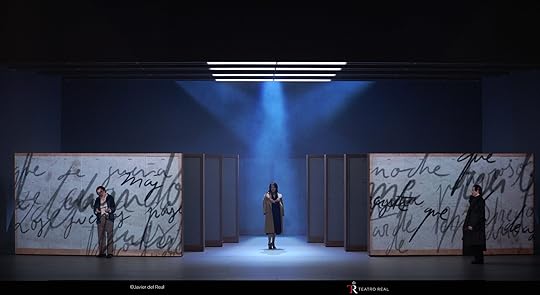
In the Teatro Real they are currently producing Luis de Pablo’s opera El Abrecartas (The Letter-opener), which is based on the eponymous novel written by Vicente Molina Foix (VMF). VMF worked in the libretto with the composer; they have cooperated in a couple of other operas and a song cycle together. I am going to the Real tomorrow to watch "El Abrecartas".
Sadly, Luis de Pablo, born in 1930, died last October, so that for just a few months he has not been able to attend the premiere of this opera. He has been highly innovative and a key figure in introducing contemporary classical music in Spain. One of his associations staged some music by Boulez before it was premiered even in Paris. With this opera he continued to defy the notion that Spanish is not a suitable language for opera.
The novel has been described, somewhat boastfully, as a “roman-fleuve”. Not exactly. It is epigrammatic instead. Along a succession of chapters, titled with the name of different characters, a selection of letters, usually between two people in each section, compose a literary mosaic. The succession of characters at first seems disconnected but eventually they coalesce together, and a braided structure becomes apparent. This structure is what I found the strongest point of the book since it often surprises the reader - brilliant, really. Gradually the dual meaning of the title, and the identity of the Letter-Opener, is revealed but this is a Spoiler that the reader would have to discover for himself.
The book begins with letters written in 1926 and finishes with those sent in 1999. It presents real and imaginary people, and given that the story unfolds over seventy years, we are dealing with two Spanish generations, (mostly intellectuals and writers) that revolve around the Civil War and Modern Times. Of the first group, the most striking among the real characters are the writers: García Lorca Federico, Vicente Aleixandre (Nobel Prize), Eugenio d'Ors, Miguel Hernández, María Teresa León (wife of Rafael Alberti). In the second group, VMF has included figures who belong to the current intellectual circles, such as Enrique Vila-Matas, Félix de Azúa and Enrique Múgica. The mixing of real and imaginary figures is highly successful. I found through my reading that I had to keep checking the various names in wiki.
The novel is tragic but at times humorous. Tragic and depressing during the dark years in the history of modern Spain, and humorous when recreating the ambiance of more modern intellectual circles, with a couple of witty instances when VMF introduces himself as discussed by third parties, and usually not under a benevolent light. The book asks for a printed version, since VMF has played with typography and other visual aspects of the text.
In my read I was fascinated in following what really is a chronicle of the cultural circles of Spain in recent history, but I also found some weak points. The second part somewhat dragged on (the opera stages the first half only), particularly as it comes too close to VMF’s own obsessions (film). The voices of the various characters were not differentiated making me feel towards the end that I was always reading VMF’s speech. Finally, I got tired, bored, with the “guerracivilismo” tone and unbalanced political stand. The Franco dictatorship is clearly on the foreground throughout the novel, but VMF forgets about the violence with ETA during the decades after the dictatorship had ended and a democracy had been restored (even though, Fernando, the brother of one of his personalities, Enrique Múgica, who was also a Socialist, was assassinated by the terrorist band).
I look forward to the opera, in which, I hear, Luis de Pablo has mixed various musical genres – from Serialism to more popular genres, such as the Paso Doble (evoking thus García Lorca’s writings). I may come back to this review after I have been to the Real.
******
******
Note after having watched the opera. Even though the musical work selected the first half of the novel, I found the adaptation of the complex structure and narrative to the stage was not successful. Without having read the novel or the plot summary, it was very difficult to follow - it appeared like a gallery of people along a succession of tableaux. And the ending did not conclude as it does in the book.
I talked briefly with VMF after the spectacle - about the difficulties of transposing the novel onto a libretto. Certainly not easy, but he seemed satisfied.
Si se usase el termina "Gran novela española" como se hace en América, sería una firma candidata. Retrata tantos aspectos del siglo XX español que sorprende lo ágil que resulta. Aprovecha el estilo epistolar para generar elipsis, desgranar información, provocar giros y encajar piezas con muchísima inteligencia. Me ha sorprendido muchísimo.
This novel is truly an amazing adventure through the lives of those who lived and died during the Franco years, as well as a brief glimpse into their life afterward. The novel is composed of letters. Each letter is a mini drama, a brief, intimate interlude. However, these isolated lives soon begin to overlap and coincide. Molina Foix is brilliant.
4,5. Un muy bonito recorrido del siglo XX español a través de cartas con historias más o menos interesantes, pero fieramente humanas cuando se entrelazan. Mención especial a la historia de Vicente Aleixandre y Andrés Acero.
El abrecartas en un libro de difícil catalogación. Aunque, en esencia, es una novela epistolar, pronto descubres que esa denominación se queda muy corta para todo lo que engloba. Hay algo más en las vidas anónimas que el autor describe, y que usa como medio para contarnos la historia contemporánea de España. Estamos ante una novela, que engancha por momentos, pero cuya lectura deja un poso agradable.
Es el primer libro que leo de Vicente Molina Foix, autor de esta obra, y tengo que reconocer que he quedado gratamente sorprendida. Foix es un buen escritor. Sin embargo, la estructura narrativa, en forma de cartas, desluce su buen hacer. Me explico. Al leer tantas cartas seguidas, el estilo de escritura tiende a unificarse, de tal manera, que parece que todas ellas están escritas por la misma persona, con diferencias nimias. Por el contrario, la calidad literaria del texto es enorme. La prosa puede variar de lo más vulgar a lo lírico en cuestión de páginas, el lenguaje, en ocasiones, puede resultar pomposo y pedante, y las descripciones (casi) brillan por su ausencia.
Al contener solo correspondencia, es complicado determinar de qué trata El abrecartas. Podríamos decir, que el autor utiliza el manido recurso de contar los grandes acontecimientos de la historia de España del siglo XX, utilizando personajes (reales o inventados) que vivieron en ese periodo, plagándolo, de paso, con múltiples referencias culturales, políticas y artísticas. Pero también podríamos describirla justamente al revés, es decir, como las vicisitudes de un conjunto de personajes que han sido derrotados por la vida, usando los sucesos de la historia solo como marco temporal y espacial de la trama. En cualquier caso, las historias se relacionan unas con otras, a veces de las formas más sorprendentes e inesperadas. Y, al ser una novela de cartas, no existe un final concreto. Pero el abierto y abrupto desenlace parece una forma un tanto chapucera de terminar.
En conclusión, El abrecartas, ha sido una lectura interesante y curiosa que permite profundizar un poco más en nuestro pasado reciente. Además recupera, aunque solo de forma literaria, el noble arte de escribir cartas. Algo más que olvidado en el mundo digital en el que vivimos…
Mientras espero esa llamada suya, le copio en esta tarjeta enviada para que la encuentre al regreso un verso de Vicente que él, además de escribirlo en un poema de la “La destrucción o el amor”, decía a menudo y me dijo a mí la última vez que nos vimos, en Madrid, el 23 de julio de 1937. “Vivir, vivir, el sol cruje invisible”. Pero yo no he vivido desde entonces más que en sombras, y el sol, si es que brilló, fue para mí tan invisible que ni le oí crujir.
Novela hecha de cartas que empiezan con las que un amigo de la infancia escribe a Federico García Lorca. A partir de ahí, se van cruzando las voces de poetas, filósofos, cineastas y políticos que retratan, de forma indirecta, la realidad histórica de España durante la Guerra Civil, la dictadura y los primeros años de la democracia. Una historia íntima y coral, con un final redondo y muy bien cerrado.
me ha costado pillarle el ritmo (sobre todo con el golpe de que el que pensaba que sería el protagonista muriese casi al principio del libro) pero después de eso... está tan bien estructurado y es tan original la manera de narrar las historias de los personajes... lo mejor, sin duda, los crossovers que unen a todos en una misma línea argumental
This entire review has been hidden because of spoilers.
An original and beautifully plotted epistolary novel tracing the lives of an ensemble cast of ordinary Spaniards trying to build their lives as artists and intellectuals in the shadows of great figures and poets throughout the horrors of war and dictatorship. The plot unwinds beautifully, with connections among the characters slowly becoming apparent.
Simplemente el mejor libro que he leído. Alguien sabe como puedo contactarme con el autor? Tengo preguntas que hacerle sobre algunos poemas que usa que no puedo encontrar el autor.
Es el primer epistolario que leo. Con pocas ganas lo empecé, me cautivó después, hasta el punto de no querer que terminará. Unicamente le sobran alguna carta hacia el final.
The ending, the ending is everything, knowing that a character without interest was the center of all the butterfly effects that happen to the other characters.
This entire review has been hidden because of spoilers.