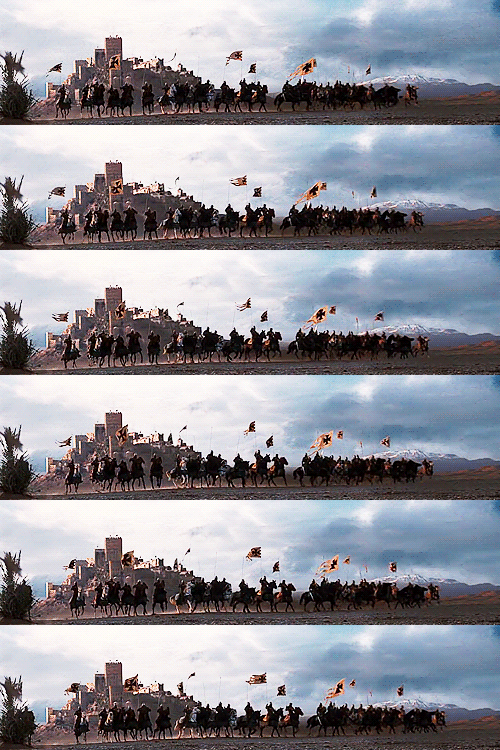
Giaceva sullo scaffale dal lontano 1992 (con che criterio compravo i libri che non leggevo, poi ?) e l'ho rispolverato dopo aver letto il mitico "Pendolo", che corona una plurisecolare storia di fissazione per i Templari. Come si sa un ordine militare/monastico che fungeva da truppa di elite durante le prime crociate e questo saggio - invero parziale - racconta nella prima parte la vicenda del processo che ha portato all'eliminazione anche fisica dell'ordine e dei suoi adepti. La seconda parte - più godibile - riepiloga la nascita del mito dei Templari. Il responsabile della svolta è stato un tale Ramsey, uno scozzese trapiantato in Francia, segretario di monsignor Fenelon, predicatore e pedagogo del delfino alla corte di Luigi XIV. Questo Ramsey ad inizio '700 ha la geniale idea di far risalire (con l'intento di legittimarla in Francia) l'origine della nascente massoneria ai cavalieri del tempio. I massoni, come si sa, credono in un dio laico, l' Architetto del Tempio, bell'e pronto quindi il nesso con il vero tempio di Gerusalemme, di cui i Templari hanno appreso i segreti dell'edificazione poi trasferiti carsicamente ai massoni. Immagino abbia concluso la sua argomentazioni con il celebre "coincidenze ?". Da quel momento ovunque siano sorte confraternite, società segrete di ogni tipo, la filiazione ai templari è sempre stato un must. Alchimisti/occultisti/santoni, che in base a disinvolte etimologie mettevano in relazione riti egizi, i druidi, la cabala ebraica, i vangeli apocrifi, promettendo il dominio di Superiori ed Arcane Verità. Ma loro, i Templari, c'entravano sempre, in un modo o nell'altro, troppo affascinante la loro immagine di mistici guerrieri che questi maghi Otelma o Wanne Marchi dell'epoca agitavano davanti agli aspiranti adepti di confraternite di cui si autonominavano Gran Sacerdoti, con una sequela di titoli ed appellativi degni delle somme cariche delle Giovani Marmotte. Il fenomeno conosce un'impetuosa crescita tra '700 ed '800, di pari passo con l'ascesa della borghesia, e questo mi sembra l'emblematico coronamento della vicenda:
I am returning to this remarkable account of the Templars myth and legend, and decided to write a few notes in the early stages.
In the first Crusades the vision of a Sion whose walls were built of diamond and lapis lazuli took men to the holy land, the ideals of indoctrinated self-importance and authority to kill in the name of god did not yield such a vision, just as they will not yield anything but bloodshed in the attempted rise of the caliphate.
"In the Holy Land today the stones of the city of Jerusalem - not the jasper pavements of the visionary city but the humble flags of the real one - can testify to a past and present in which poetic and religious visions have materialised in forms of physical violence."
The crusade still lives in men’s minds today: the writer learned this from a group of French Generals in Algeria who told him that the suppression of the Algerian nationalist rebellion was a Catholic Crusade. Just as in September 2001, George Bush warned Americans that "this crusade, this war on terrorism, is going to take a while." His use of the word "crusade," said Soheib Bensheikh, Grand Mufti of the mosque in Marseille, France, "was most unfortunate", "It recalled the barbarous and unjust military operations against the Muslim world," by Christian knights, who launched repeated attempts to capture Jerusalem over the course of several hundred years. The three Abrahamic houses of Judaism, Islam and Christianity have been involved in countess genocides, since the time of the Old Testament, when genocide against the Amalekites was sactioned and authorised. Genocide in the name of god is the dark consequence of a book that claims to hold the only truth, and as such was the root of the Koran and the Bible’s justifications for Genocide in the name of God.
If humanity continues to champion one barbarous truth over the next, are we ever walking to a darker image and reality of suffering inflicted by our own arrogance?
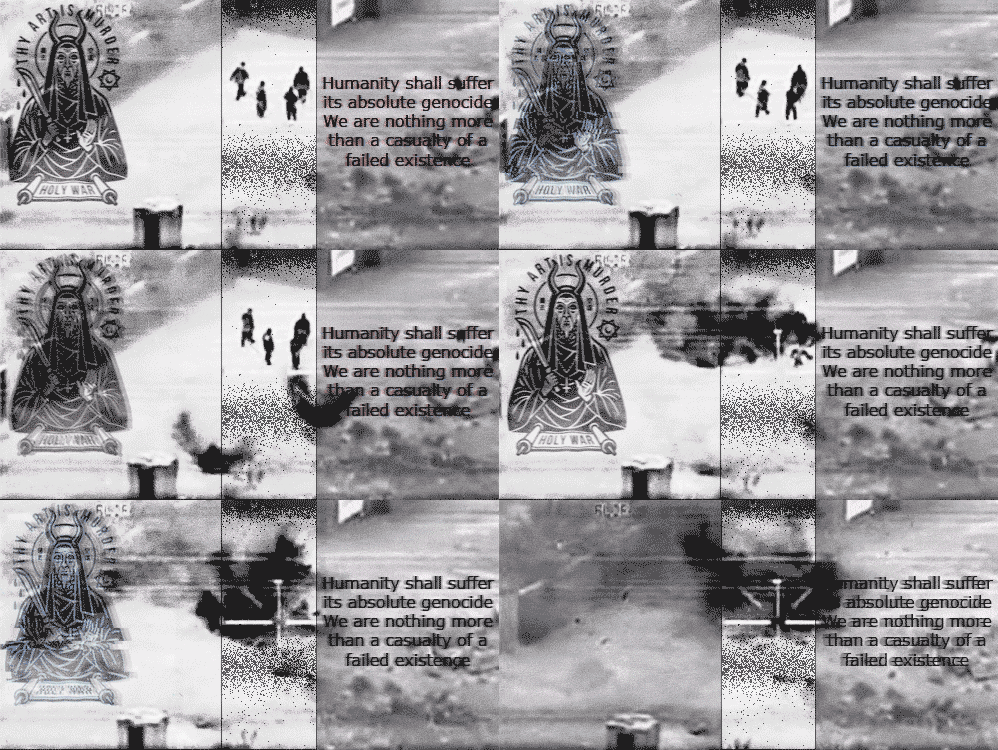
”It is well known that the taking of Jerusalem by the Crusaders in 1099 occasioned a terrible massacre of its inhabitants, in which the crusaders walked in blood,” to fulfil the prophecies of the book of revelation. How are the massacres in Mosul and Syria and their cruel medieval any less than a repeat of ignorance by a blindsided humanity, that thinks they will gain the favour of a merciful god by being unreasonably cruel to their fellow man.
When will humanity wake up from its anaesthetised state of indifference.
Wake up to the cruelty inflicted on children in the name of God – the child sexual slavery, the live organ trafficking, the mental slavery of fanaticism.
The writing is dry but the subject is fantastic! From the Knights Templar during the Crusades and their "extinction," to present-day Freemasons, who used myths about the Templars -- conspiracies, magic, lies, politics -- all bound together to at some times mean the exact opposite of a previous interpretation. All the secret knowledge and hidden treasures, and strange initiation rites, associated with the Templars and Masons -- much of it "made up" by men who might not have had all their marbles -- the whole thing makes me wonder how anyone could believe any of it!
I found this to be a bit of a tough read. The thesis is not overly clear, though appears to be able to be summed up in the idea that the Knights Templar were a religious military order that do not exhibit the characteristics of secret groups later ascribed to them during the romanticization process of myth-making into history. The author ties in several historical ideas and references without fully explaining their details or connections to the over-arching argument. The author's timeline of ideas seems somewhat murky, as he refers to ideas as theosophical in nature at a time prior to the canonic formation of such ideological structure. Often the more exotic ideas are dismissed out of hand in favor of increasingly benign, normal explanations without serious study into the historical evidence. Even the author's central interpretation of the Baphomet seems to completely miss the connection linguistically to Baal and the Aramaic roots that translate the term to "place of truth," which in turn connects to the Templar's head (ancillary sphere) or prototype of the Baphomet. The ending is rushed and the author slides over an incredible list of referential points (Crowley, OTO, Druids, Eliphas Levi, etc.) without fleshing them out. The history of the Templars in the first part of the book is helpful in understanding the origin and formations of the group as well as their function up to the trial, and how they were supported, funded, and protected by powerful entities. I would have liked further clarification about the charges and how the ideas of heresy followed the group, despite charges being accurate or not. Essentially, I would recommend finding other source material if you are interested in learning about the history and significance of the Knights Templar.
I have read many books on the Templar and after reading the first few chapters I've noticed so many errors I wonder if I should continue reading. The author is really out of his league.