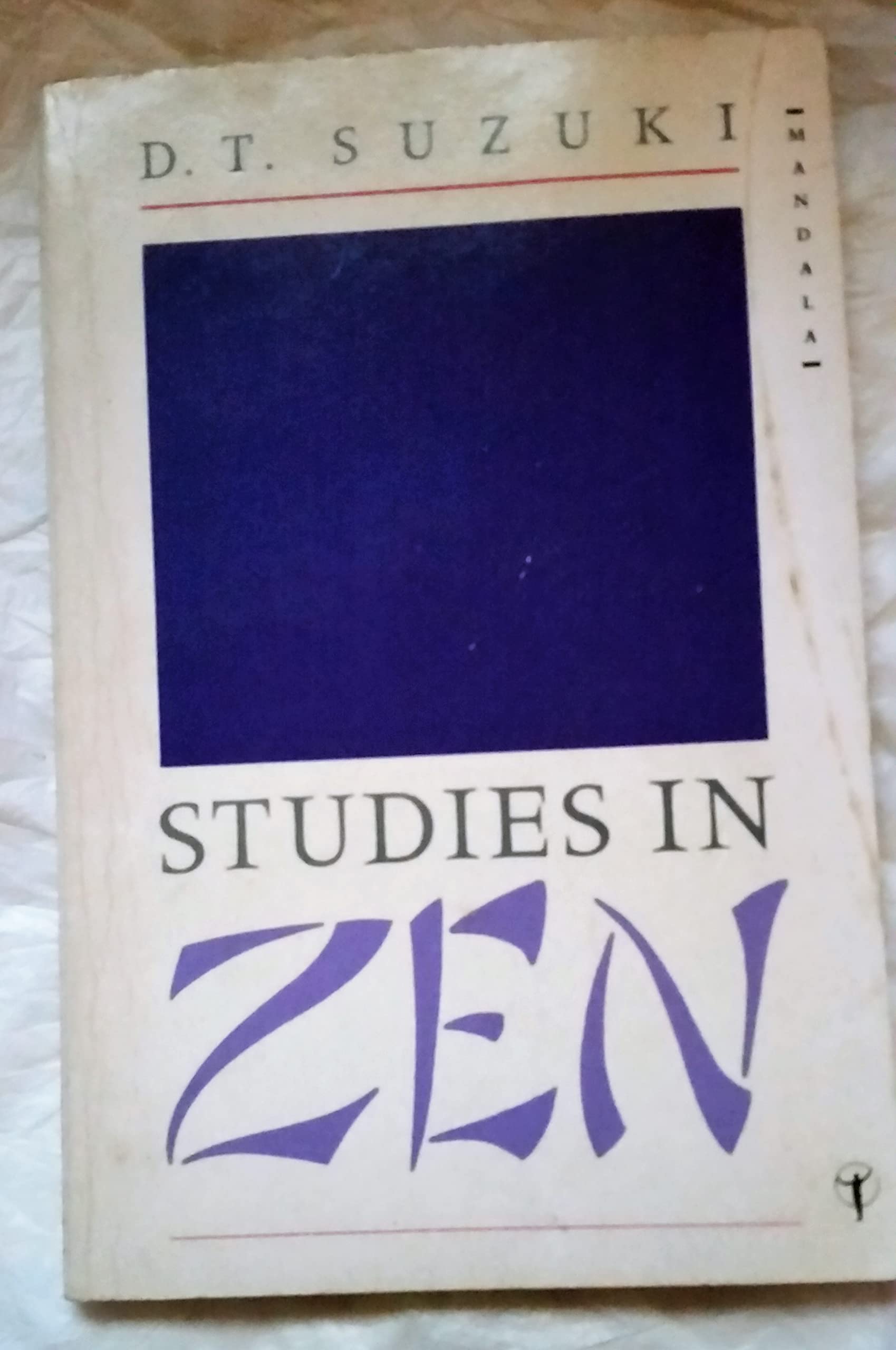
A Delta Book published by arrangement with Philosophical Library, Inc. [LCCN 5514253].Perhaps no branch of Eastern thought has so profoundly influenced contemporary Western culture as Zen Buddhism. Its most spectacular impact has been on Existentialism &, in a poorly digested & sadly misunderstood way, "beat" literature. But its more subtle presence has become progressively pervasive in Occidental philosophy & religion; it may yet achieve the "meeting of East & West". Studies in Zen is an important contribution to the interpretation of Zen Buddhism in the West.'Among the best contributions to the knowledge of living Buddhism that recent decades have produced'--C.G. Jung
Daisetsu Teitaro Suzuki (鈴木 大拙 貞太郎 Suzuki Daisetsu Teitarō; rendered "Daisetz" after 1893) was Professor of Buddhist philosophies at Ōtani University. As a translator and writer on Buddhism and Eastern philosophy, he greatly helped to popularize Japanese Zen in the West.
Having found so many more books read for the Philosophy of Religion course than remembered, I pulled out an old transcript and found the reason. Grinnell College's courses were generally four semester hour ones, but students were allowed to take some as "plus two" with the instructor's permission, in other words, with six hour coursework. I had done this for Schaick's and this in part accounts for all the books, mostly on mystical traditions, which were read but not discussed in class, and for my memory of many informal meetings with Paul, usually in the Forum, the college's student union.
Dr. Schaick, as mentioned elsewhere, was a physicist whose reading of Heidegger's Being and Time inspired a second Ph.D., this one in philosophy. Although Paul's enthusiasm got me to purchase Heidegger's tome at the bookstore, I didn't actually read it for a couple of years. Instead he had me read at least three books on Zen, two by Krishnamurti and maybe one or two collections of dry essays on the philosophy of religion (those may, however, have been in the course curriculum with Anselm and Otto). This all makes sense because Heidegger, from Being and Time onward, was a mystic much in the Zen sense.
And what is the "Zen sense"?
Zen Buddhism, as portrayed in the aforementioned books, is an anti-religion in that it either attacks or ignores the metaphysical conceits of Buddhism, focusing instead on clearing the mind of preconceptions so as to allow being to be. The practitioner thus becomes present in the moment, aware and in tune what what is to hand--a very practical aim. Of course, there is more to it than that in that "the moment" when stripped from preconceptions of such things as "my personal history" or of "world historical purposes" etc. is now timeless in this sense just as the practitioner is now not so-and-so, but the buddha-mind.
D.T. Suzuki is very good at giving the historical, sociological, theological and philosophical background to Zen as a means of contextualizing this anti-contextual practice, his rather dry academic discourse almost serving as a sort of koan pointing the way to its own transcendence. He is, however, dry and academic. For those who don't like that, try Shunryu Suzuki's (no relation) Zen Mind, Beginner's Mind.
I'm not sure this book is particularly easy to find, but it is also not the most exceptional work on Zen I've read. It is a simple and complex work. Some sections are dedicated to stories from the Zen tradition while others cover a basic understanding behind zen thought and practice. The depth of the text emerges in a long chapter that deals with concepts of the mind and intuition. Although this part of the book is clearly for people obsessed with attaining an intense analytical revelation of what zen means and how it is applicable, it is clear that knowledge of this sort is neither a means to enlightenment, or satisfactory explanation, but rather a pacifier for those that seek concrete answers to an ever changing world.
There was however, much to be gained in this work, especially on my own personal level. It came not so much as a revelation, but as a subtle transformation of what the Zen experience means to an individual. I had always been clear that the "pursuit" of Zen, was in many ways the act of letting go, and forgetting one's self. I did not however, understand why this letting go such a necessity. Suzuki was able to reveal that their are two types of thought that humans use in their day to day lives. The first is rational. We make decisions and choices based on well thought out cause and result scenarios. We use our perceptions to guide us through a world that makes sense. When the world does not make sense, we turn to belief. Belief in the unknown or unseen. We deal with these in many different ways, but there is always a twinge of doubt that circulates around belief. I did not make the connection that there is also doubt imbued in rational thought as well. I think therefore that there is another way of thinking that must exist. A way of thought that does not rely on systems penetrated by doubt. It is this experience or state that Zen attempts to achieve. For those that seek it, letting go of the two traditional modes of thought is both essential and almost impossible.
To convince oneself that neither rational thought or belief have the capacity to let us experience existence in its most immediate form and expression is terrifying, because we are unable to conceive of a state in which some other perception beyond what we know on a daily basis is possible.
What, however, is the point of such an endeavor. I will tell you this. Before zen you go to well for water, and after zen you go to the well for water. You will have the same choices to make, the same suffering to encounter. I believe, although I am a student of zen and not a regular practitioner, that the experience of zen is not a transformation, but an awakening to that which we are, and are not; an understanding of our place, and an annihilation of selfishness and doubt that causes us to debate the details of our lives, in fact our very lives themselves, as we attempt to do what is best for ourselves without the knowledge that we are without selves and without such senses of division, there is a calm and humorous beauty in the transcending fate of our calculating consciousness.
I read this a trillion years ago. I am currently reading it again and reminding myself of what I liked and didn't like in this. It contains seven essays arranged in chronological order; the opening essay is from 1906 and the last from 1953.
I am not a Zen master. I am, however, a philosopher. This has bearing because I want to inform readers of my comments that I bring to the collection of essays a critical and not unfamiliar eye. To that end, I believe Buddhism should not have "schools" or "sects." However, if I were to join a monastery - it would be a Rinzai Zen one.
That being said, I want to make a few comments about the author. Suzuki was an educated man. He writes with academic prowess and his assertions and explanations are high quality. He is at his best when he is working within the Zen tradition. In these essays (not to speak of his other work) Suzuki remains very respectful about traditions, while constantly trying to carve away all the extraneous matter and just work on the essence. The essays will be of interest to the more intelligent reader who is both new to Zen and who is a comfortable with it. Though I do not really see this influence in these books, the fact that Suzuki joined the Theosophist society always nags at me. To me, this is a negative to his judgment and intellectual path.
Suzuki is at his best when he is drawing out the meaning of koans and mondos. He is at his best when he is showing the reader the concepts of prajna and immediacy. However, the essays get wobbly when he does comparative religion. Not that he is incorrect, per se. But the influence of protestantism and William James, etc. saturates much of these sections and spoils the effort.
People who will NOT like this collection: hippies, pluralists, iconoclasts, floofy-types, people who view Zen as a "peace of mind" or a "emptying of the brain." Zen, as Suzuki presents it, has nothing to do with peace and dead-brain/no-mind. Zen is work and focus and lightning strikes of understanding. It is not antithetical.
Good, detailed analysis of Zen philosophy (such as it its). The book is somewhat repetitive at times, but it's definitely worth the read if you are studying Zen.