The Confederation of Wizards is forced to put aside its long-standing historical dispute with the inhabitants of Rovac. Instead, both must join together in a common cause, to prevent the utter destruction of their world. They face two the Swarms, and a power that turns living things to stone and brings rocks to life
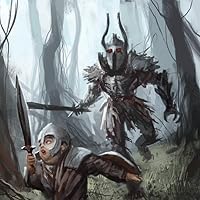
Miphon, Garash, and Phyphor, members of the Confederation of Wizards, join forces with Elkor Alish and Morgan Hearst, Rovac warriors and sworn enemies of the Confederation, to slay the wizard Heenmor and retrieve the death-stone he stole from the Dry Pit. Only nothing is ever as simple as it seems. Feelings of greed and jealousy taint the party. If they retrieve the death-stone, can any of them resist the temptation to use it?
The Wizards & The Warriors is the first of The Chronicles of an Age of Darkness and sets the stage for the rest of the saga. All of the characters seem like fantasy stereotypes at first but quickly develop well-rounded personalities. The death-stone is suitably horrible and the hidden resentment for Hearst Alish feels, as well as Garash's power-lust, simmer until the perfectly horrible moment for them to arise. By the end of the book, not one of the main characters is the same as when he started.
The supporting cast is also well done. Blackwood and Prince Comedo in particular. Ohio, who also appears in The Walrus and the Warwolf, is introduced... and later killed. Scenes from The Walrus and the Warwolf, as well as The Wordsmiths and the Warguild, were told from different angles. The writing is superb, a combination of dry wit and artistry.
I recommend The Wizards and the Warriors to all fantasy fans, particularly the ones that prefer shades of gray to the usual black and white worlds of fantasy. Where else can you read the line "Well... a leech has crawled up the eye of my penis."
I had never heard of Hugh Cook until Paizo's recent reprint of The Walrus and the Warwolf, which I later found out was the fourth (or possibly fifth if you are American) volume in his mammoth Chronicles of an Age of Darkness, his series from the 1980s, and my interest even then was only piqued because I noticed that China Mieville had written the introduction to that particular edition.
Chronicles of an Age of Darkness was originally slated as a 20 (!) book series to be followed by two more series of the same length for a whopping total of 60 (!) novels. Unfortunately, Cook's ambition surpassed his sales and Age of Darkness was cut short to 'just' the ten volumes. Unlike Wheel of Time or Game of Thrones though, these novels all work standalone and can be read entirely separately from each other. However, since there are a number of recurring bit-part characters, motifs, and 'easter eggs' for the loyal reader, I decided to start at the beginning with The Wizards and the Warriors and I wasn't disappointed.
A couple of things struck me within the first few pages. Firstly, this isn't small stakes fantasy or a bildungsroman like so many long-winded fantasy novels - the characters are almost comic book powerful, already established and influential before the narrative even begins. Kings and Princes will rise and fall, immensely powerful treasures will be fought for, world-changing deeds will take place, armies will march, cities will be destroyed and the very fabric of universe will be threatened before the book's end. Unlike most fantasy novels where the world map at the start is basically filled with a lot of tantalising names that will never re-occur in the actual narrative, in The Wizards and the Warriors the characters will criss-cross the world map until virtually every preposterous name has been visited and described (and probably destroyed).
Secondly, Cook unashamedly embraces the most D&D tropes of the genre: all-powerful wizards, decadent nobles, elaborate magic systems, ominous artifacts, dragons, savage warriors, devious henchmen and so on.
None of this on paper sounds particularly promising, but where I would say that Cook's genius lies is in the way in which he takes these elements and via some mysterious process of alchemy recasts them into something entirely new and special, baffling your expectations. In this sense, it evokes both the heady, breathless and yet unexpectedly clever pulp fantasies of Michael Moorcock and the wit and cynicism of Jack Vance's Tales of the Dying Earth.
Interestingly, although the story deals with big, world-changing events, a lot of these events are actually pushed to the margins of the narrative. The important battles are fought and main quests are completed unexpectedly in just a few paragraphs, Cook ruthlessly skipping to the bits of the story he is interested in. At times he is almost willfully anti-climatic, seemingly taking great relish in throwing totally leftfield obstacles in the path of his characters just to see if he can find a way to pull them out of the ensuing chaos. Chance seems to be the guiding factor in the narrative - random situations will embroil the characters from unforeseen directions and momentum is built as they struggle with their changing fortunes.
At other times, he will spend a chapter building up to the confrontation with the Big Bad Guy, only to pull the rug away at the last second, resolving the confrontation in a sentence or two and then spending the whole of the next chapter painting a little vignette of the characters fishing or something. I can see how this would be frustrating for many readers (and probably explains why he could only garner a cult following), but it is actually in these quiet moments between characters, where they reflect on their pasts and are troubled by their doubts and the terrible things they have done because they thought they were right thing to do at the time, that the book really shines and is elevated beyond the standard fantasy fare. From this perspective, the book is less about pulp adventure and more about examining the hero myth, the idea that certain people because of their abilities find themselves thrust into impossible, no-win situations and must make decisions that ultimately harm the very people who relied on them in the first place. It is Cook's skill in juggling both the underlying themes and maintaining the excitement of the pulp adventure that really showcases his talents.
I think he is up there with the likes of Moorcock, Abercrombie and Vance in that regard. I wouldn't recommend this unreservedly, however. I have a suspicion that he is a "fantasy writer's writer" i.e. if you are coming to fantasy fresh with no preconceptions, you may not totally appreciate what he is trying to do. Also the narrative is very pulpy, very unstructured, and will frustrate some in the way it occasionally seems to be just a sequence of adventures that Cook pulled off the top of his head until his editor told him he had hit the word-limit. Structurally it is not particularly ambitious. However, in my opinion, its novelty and the thematic consistency allow him to get away with it.
Overall though, I would absolutely recommend this to anyone that is looking for a fairly radical take on the genre, but which is still firmly rooted in its traditions and tropes.
Let me start by saying this is a really gritty fantasy book. This has been on my to-read list for quite some time, and the seemingly innocent and even cliche title of the book intrigued me once I learned through reviews that this book was anything but innocent and cliche.
As Hugh Cook's entourage of wizards and warriors toil and languish across a vast and dreary landscape of dragons and mountains in search of an elusive foe, Cook has no problem with killing off main characters at the drop of a hat in a way that makes George R. R. Martin's famous series look like child's play. Entire cities and armies are wiped out of the plot in a matter of sentences. It's really quite impressive. While most fantasy authors love their armor and swords and gauntlets and lengthy descriptions of soldiers and battle plans, Cook basically said screw it, if I want to resolve a battle in two sentences, I will.
It's really quite impressive and gutsy. I wish more authors wrote fantasy like this. Cook's characters are rude, impatient, anxious, imperfect, brave at times and cowardly at others. Basically, they feel like real people placed in a fantasy world, vs. fantasy characters in a fantasy world. The book is by no means perfect, and due to Cook's plotting and style it can be very hard to follow at times, but overall this was an entertaining romp through a fresh new world and I look forward to reading more from this rather obscure and underrated author at some point.
With a title like _The Wizards and the Warriors_ I would normally have steered clear of this book for the foreseeable future. I’m not overly snobbish, I think, but it just brings to mind so many B-movies of the fantasy genre from the late 70’s and early 80’s starring has-beens or never-will-bes that I wouldn’t have expected much of it and would certainly not have desired to plow through 500+ pages of what I would have at most expected to be mildly entertaining, and perhaps moderately wince-inducing, fluff. Of course the three Dans had to conspire against me and assure me in their reviews of Cook’s work that there was much more to this tome than that. Turns out they were right.
I vaguely recall seeing some of Hugh Cook’s books in the “Chronicles of an Age of Darkness” series on the shelves back in the day with their less than inspiring North American version covers. I was never tempted to pick them up, more’s the pity. The first one at least has turned out to be a great read. We start off in very familiar territory (for a fantasy reader anyway): the three wizards Phyphor, Garash, and Miphon are seen in mid journey, hard on the tracks of one of their wizardly confreres. It appears that this malcontent, Heenmor by name, has appropriated the Deathstone, an artifact of unknown abilities and great power, from the forbidden Dry Pit and must now be brought to heel and divested of this danger to the world’s very existence. On their journey these wizards will come across two members of the fabled Rovac warriors, Elkor Alish and Morgan Hearst, who will join them in their journey despite the longstanding and bitter enmity between the two groups. So far so predictable, right? Luckily Cook manages to take the story in directions that are not exactly to be expected. Aside from the tension between the warriors and the wizards we see that even amongst the small group of spellcasters mutual dislike and mistrust is the rule. The party is seemingly set to tear itself apart before it even gets started and the thought that these miscast compatriots could work together long enough to stop a threat of the magnitude of Heenmor and his Deathstone is an unlikely chance at best. The conflicting aspects of the overarching world-threatening peril with the bickering & gritty characters have allowed Cook to create an interesting amalgam of the epic high fantasy with significant elements of the ‘low fantasy’ sword & sorcery genre in an almost seamless mixture.
Regardless of the novel twists and turns of the plot itself (we will cover most of the major continent of this world as we follow the questing group in the ups and downs of their journey which morphs from one goal to another as chance and fate step in to keep events anything but predictable) I really found myself drawn to the characters. As has been noted in other reviews they start out as relatively stock character types with whom readers of the genre will be more than familiar, but as we follow them, and most importantly share with them the small day to day experiences that make up the bulk of their ‘heroic quest’, we begin to see who they really are as people. Some, like the fairly traditional driven swordsman and leader of men Elkor Alish, or the puerile and depraved Prince Comedo remain mostly true to type (though with distinct streaks of darkness and glimmers of complexity), while others like the conflicted “hero” Morgan Hearst, the prosaic and thoughtful huntsman Blackwood, or the humane and philosophical wizard Miphon show us sides that reflect a truly well-rounded humanity. Add to this the sheer invention of Cook’s imagination and his ability to take tropes and ideas that are part of the stock-in-trade of the fantasy genre and do something new and interesting with them (oh, those magic bottles!) and you have a real winner on your hands.
It’s unfortunate that these works didn’t garner greater attention while Cook was still alive, but perhaps things will change now. They certainly deserve a wider reading audience and given that there are ten books in the series there is (if the first book is any indication) lots of good reading awaiting the prospective reader. In addition it seems that Cook took advantage of his projected long series to write many of the subsequent volumes covering the same events, but from the point of view of another character and even in a completely different mode. Thus we will be able to see things with a much more holistic view than is normally the case in some fantasy works: the hero of one tale may prove to be a villain in another and events seen through the lens of an epic fantasy quest may look very different when we see them as part of a picaresque farce. I for one am looking forward to continuing on in Cook’s imaginative world and hear (from those crazy Dans again) that I’ve got a lot of fun to look forward to.
A really weird book that I liked but also had a lot of problems with. First of all, this book is very original and has lots of weird stuff that any fantasy fan would love (giant bugs, people riding on walking mountains, a wizard stronghold that looks like an M.C. Escher painting). Fans of Song of Ice and Fire books will also be pleased to know that Cook wasn't afraid to maim and kill main characters. Everyone is in mortal danger in this book.
Now for the problems: Like many of the fantasy novels from this era, this book has A LOT of walking. Most of the book is people journeying from place to place and Cook wasn't great about making it very exciting.
Cook was awful with names. We have a lake named Ouija, a guy named Ohio (was he channelling Duncan Idaho with that one?), and a city of sages called Veda.
This is a book desperately in need of a strong central plot. The main plot resolves itself maybe halfway through the book and the rest of the book is Cook just throwing random shit at his characters as they wander the land.
People don't often behave like normal, sensible people. For example, there is an evil wizard that they can't kill because he is guarded by a killer snake. The best idea that anyone can come up with is that someone should sacrifice their life to distract the snake while someone else tries to stab the wizard. I thought "maybe arrows don't exist in this world" but nope, later in we find out that this world has both bows and crossbows. I guess everyone is just dumb?
Speaking of Cook not being afraid to kill characters, he oddly enough chooses to kill most of his sacrificial main characters off screen and barely mentions them again.
I am sure there are more things that bugged me but you get the gist. And, despite my issues with this book, I still found it pretty fun.
I remember reading this series a few years after release, having picked them up in a good second hand bookstore. At first I assumed it would be standard fantasy fare and only bought book one because I was low on alternatives - but, despite the cover art and blurbs that suggested that the publisher only wished it were standard fantasy fare, I was hooked by the author's refusal to observe genre conventions. In fact the series is subversive of the genre, although this may be due to Cook's own unique view rather than deliberate. It is as far as you can get from the usual "Book X in the award-winning ABC fantasy series" - Cook avoided the trap of taking himself too seriously and the effect is to help take the books out of any conventional pigeon hole. He also saw the series as extending far beyond the 10 that were published, and so envisaged a mighty canvas which he then set about filling in, in detail. The stories interlock, to a greater or lesser extent, but the point of view of the current protagonists take precedence, so even towards the end of the series when you know what went on in an episode already seen from another point of view, there is freshness and new insight to be found.
Hugh Cook was, it seems to me, a one-off, a real original and the cancellation of the series was a loss that has become much more apparent in retrospect. This is an author who deserves to be better known and appreciated and his death was a sad loss to the world of fiction.
I probably would have first read this first book by what was to become my favourite author for many years (and who is still up there in the top three) almost thirty years ago now. On first attempt I did not get into it, but at the time the high point of my reading tastes was David Eddings. I took it away on holiday with me a few months later and with then ended up reading half the book in a single night. Without a doubt, Cook changed my perspective on fantasy in specific and literature in general. I have re-read not only this volume, but the others in the series many times in the years since and at every opportunity recommended this book and the whole series to anyone whose tastes I think run this way. To be fair, the five star rating here is at least partially due to my personal experience with this book, a dose of nostalgia, and the excellent way in which Chronicles develop and come together. Re-reading this most recently, and for the first time since I started using Goodreads and keeping a record of my opinions and thinking more critically about the way in which things are written, I have to admit that if I were to come across this book today having already read the three authors mentioned above, I would probably only give this four stars, as there are some problems.
This was the first book I read in which I found fantasy to really have an element of gritty realism. Fantasy is overburdened with boys with swords and birthmarks, mysterious destinies, prophecies which are all too predictable, bad guys who are really not at all nice, good guys who are so upstanding and happy endings all round (except for the bad guys, who are usually undone by own the evil ways). Pulpy, pulpy, pulp, pulp. It was following this formula which made Eddings' first work of the Belgariad such an enormous success (and later meant that anything else he wrote was entirely derivative of his first books and lacking in any merit whatsoever). I do not mind a bit of pulp from time to time (in fact I quite like it when I am in the mood) and it can be very satisfying if it written well and has a few original elements in it. However, while you might feel at first with Cook's work that you are just getting another classic dose of pulp, that is not the case.
Cook, for me at any rate, was one of the first authors to make a fantasy world seem real, to seem dirty, to seem like it could actually be real - without happy singing peasants who always love the good prince, and wise venerable wizards who are always on call to defeat the vile forces of evil, and in which everyone is either on the side of justice or a vile and dreadful villain (often of some green-skinned race). Ever since Tolkien, people have been carbon copying his work, again and again, and the great details which he added to Middle Earth have been steadily lost, even as the general shape of his story has remained intact. Cook's world is one with wizards to be sure - but they happen to be known better as 'pox doctors' to the local peasantry, who frankly do not like the prince very much as he is a rather vile specimen. They are not depicted particularly pleasantly either, being the types who who would happily rape their sisters given half the chance, and so the setting goes on. This is very much a book where the heroes are not so obvious and they are much more grey than black or white. Neither are the major villains of the piece utterly detestable, nor are the heroes really actually that heroic. Lighter grey and darker grey. They have their faults and their reasons and they are thrust into circumstances and deal with greater issues as best as they can and in different ways.
The writing as well is quite excellent. It is fast paced and it is witty and it leads you off in a direction and then turns things around and breaks your expectations. There are so many excellent lines and scenes, so many witticisms and ways in which Cook plays with our expectations. Even on this, a more mature and many times re-read I laughed out loud and there were passages to delight. Cook turns the genre on its head and while this is not a comedy or a farce, it has those elements in excellent proportion and balance. The characters and the world and all the more real for it, and yet the setting is without a doubt high fantasy.
Here as well we follow more than one character's perspective. There is no single main character who we know, for sure, must survive to the end of the book to see all come out well. This is something we are much more familiar with these days, but at the time it was very new (again at least to me). The world as well is a wonderfully realised place, nations which are more than just names on a map. Politics and history which are immersed in and thrown into to. Rather than spending time filling us with background and giving exposition, Cook just shows us and lets us find out through context, and when it is important we will come to find out about these details and when it is not, we are left with glimpses and images of things around the edge. The story plays out in a much greater world with great events taking place, and to be sure this is one element which is important, vital even, but this is not the whole story. We are very much left with the feeling that not only is the world a much larger place than we are shown but it is a lot older and with much more history than we are privy to.
Cook breaks the trilogy mold with this series and is perhaps one of the first real writers of epic fantasy. Yet despite the fact that this is a series of ten books (and was planned to be much, much longer), the books are separate threads, different facets of a much greater whole. The Chronicles of an Age of Darkness are a story of a period of time in a world, an entire planet, with different cultures and customs and peoples and backgrounds. In The Wizards and the Warriors we are shown some of one continent and the events which occur, while of huge import are just one small part of a much bigger tapestry. In some ways one can read these books in any order (with the possible exception of the last which ties the others together), it is generally much better to read them in the order written. From time to time in the later volumes there are some overlaps between one or more of the books, often giving very different perspectives of the events or shedding new light on what we had seen before.
On the negative side and in the interest of full disclosure for those who are coming across this series for the first time and with wide exposure to a lot of more modern and very well written fantasy, the first and second halves of the book do not match quite so well. The first half is relatively slow paced, but the events of latter half move rapidly and with much less detail. The tone and consistency of the book changes quite a bit and Cook shifts his style to show us set piece scenes which keep the story moving, but does not bother wasting time in filling in blanks which are not necessary to the overall story. In some ways this is a great thing, as so many authors feel the need to drag out events and spend time concentrating exactly on how characters get from A to B or throwing in inconsequential events to full pages as they plod towards a finale, seeking more difficulties for the protagonists to overcome. Cook here takes his time where he has to in the earlier stages of the book, acquainting us with the characters, the situation and the plot - and then later once we have those things, he moves us quickly along. These are things I can appreciate and it perhaps shows a elegance in style in making sure we read what we read to read. On the other hand, it might also come over as the ending of the book being rushed or leaving us with a feeling of some disappointment that we did not spend more time in certain places or learning how the characters did deal with the situations they encountered. Perhaps this is the result of this being Cook's first novel. Perhaps there was a deadline he was striving to make or a word count limit and he was forced to do some ruthless editing. I am not sure, and it is this, more than anything else which bring this down to four stars from five, though still I think it had a certain effectiveness.
A great book, by an amazing author who has now sadly passed away, this book also has the distinction of making it clear exactly what the phrase "You can't have your cake and it" actually meant, something which in my younger years never made any sense to me. I recommend this to anyone who really loves fantasy (not only just reads a lot of it) and who is interested in exploring this genre as a form of literature as well a source of enjoyment. This has both. Go and find a copy - out of print, but not dreadfully difficult to find. With any luck something like the Gollancz Gateway initiative of republishing out of print works in electronic format will soon see these gems made much more widely available.
Great anti-high fantasy with characters who can be brutal, venal and sometimes quite bitchy - the point being they feel like real people rather than idealized slabs of marble or boring every men. Not many female characters running around in this book but I've ordered a slab of futher books in the Chronicles series to hopefully get some great female characters as well.
As far as I can tell each book stands on its own with characters from one book sometimes making appearances in other books - which is just to my taste, not really liking series that go on forever, usually with great swatches of the books not doing anything but place-holding.
The ending of the book was slightly odd. Cook is far more interested in character development than great balmy battles. As a result the ending seems more of tying up of loose ends that the author wasn't really that interested in. Except for the final scene, which truly made me smile for the character involved.
Anyone who is really interesting in checking out this book should start off by listening to Star Ship Sofa's podcast #150, which features Paul Di Filippo but has a fact article on Cook by Dan Rabarts and the short story 'Heroes of The Third Millennium' afterwards.
Here is the link to that. I put it separately just in case the Goodreads gremlins see fit to strip out the info.
The text on the back of this musty old paperback reckons that this is perfect for fans of David Eddings. I know there wasn't much else around at the time, but that's a bit ripe. The Belgariad was cosy found family fantasy in its time, and even my old dad enjoyed it. He wouldn't have reckoned much to Hugh Cook's take on fantasy: grim before grimdark, dirty and dishonourable, yet still sparking with a punkish wit and laughing at futility and matters of philosophy. This is a book that lets us know a donkey's name and taste in music before having the creature roasted by a dragon. The pacing feels off towards the end, the final obligatory questing jaunts around the continent sped through in order to reach a final personal confrontation. But a decent and distinctive - some may say distinctly underappreciated - alternative argument to David Gemmell's more martial Drenai books.
Like, it would seem, many people in this list, I read 'The Walrus and the War-Wolf' from Paizos' re-print, then came back around and bought the whole 'Chronicle of and Age of Darkness' set, which I plan to read though.
First most prosaic thing that comes to mind is the lack of a map in the Paizo version of Book 5. If there was ever a series which needed maps, and ideally, footnotes, end-notes, timelines etc etc, it’s this one. 'Wizards and Warriors' does have a map and it makes the read a LOT easier.
This book is about a LOT of things but the main through-line is that it’s about love, the plot driven by the friendship between two warriors (who read like the villains of a previous series of books we never got to see), and the agony of their moral development.
That's interesting because Book 5, Walrus and War-Wolf, is also driven by love and by the slow moral development of a teenage piece of shit. And also has a theme of unrecognised friendship between two dangerous badasses.
THE CYNICISM AND SINCERITY
Cook writes his world with great cynicism and seemingly anarchic indifference but he writes the human heart with great sincerity. A key difference to Vance who tends to write both his world and his hearts with ironic distance. Cook, though is an eternal anglo and so the most vital emotions are often, very often, seen side-on and shown tacitly, rather than occupying the central field and main narrative drive of the scene, chapter or story.
It’s no wonder normal people didn't really like these books because that is not how popular art is meant to be made. It might be how literature is done, or comedy and satire, but if you want a big audience for an heroic tale then you generally the emotions of the story-drive are the emotions of the scene, or at least only one or two layers deep.
To be clear; I really like this book and I think I will like this series, but Cook is an odd one and I am not surprised he didn't really strike a cord with others.
THE WORLDBUILDING AND THE WAINSCOATING
The bones of this world are buried deep in Vance, D&D and possibly Wolfes Book of the New Sun. Magic and apparent Fantasy over the bones of a post-post-post apocalyptic world, with all the extra species and strange interdimensional tech and apparent magic and so on actually being degraded forms of super-science. There are tunnels and forgotten black site research dungeons everywhere. The languages and ethnogroups have been turned over a bunch of times but it certainly seems that fragments of the magical speech are the old scientific speech
In book 5Drake just straight up finds an abandoned space ship at one point.
But not just the background of the world but the precision of the power distributions, what powers various people have, their qualities and how these interrelate in the scene of immediate action - all of these REEK of Dungeons and Dragons and of either a deliberate importing of its core concepts or a second hand assumption of them through some other medium.
Some cases in point;
Wizard Powers vs Warriors; the first Wizards we meet are *potentially* incredibly destructive & can hurl fireballs about, but in-effect, over the long term, not that great, and very vulnerable. They have to store up capacity over time, can burn it all quickly, and once this is done they go back to being just an old man - so their power as direct damage dealers is somewhat crappy. In military situations they blow their load, kill a bunch of guys and then are useless. They can also be stabbed in the back, poisoned, tricked, imprisoned etc, relatively easily. Their greatest power is the threat of their destructive potential, not its use. Like a political, their power lies in what they *might* do. As soon as they have done it, they are less powerful.
The 'Death Stone' which, as soon as anyone gets their hands on it, they start thinking they can conquer the world with it - has hard limitations on the conditions of use, recharge, range, etc, that actually strongly limit it in many real life circumstances. It would actually be very hard to take over the world with this stone, its powers are dangerous but, like the wizards, highly conditional and limited.
The personal qualities of the main cast balance out so neatly you can nearly feel the stats whirring behind them.
Godlike spirits are somewhat real but highly focused to location and difficult to manage (they also seem pretty fucked up).
Likewise the economies, agricultural bases, cultures, power systems, trade routes etc, are all carefully organised and invented, not improvised - everything fits together. The great salt road exists because pirates decimate nearby shipping, because there are handy pirate islands here and here, so...
While the objects of the world-plan can be whimsical, the logic of their working-out is not. Mountains may walk but if they do, agriculture will be destroyed.
All of this crafts the world towards a very un-naturalistic sense of dramatic functionality. Power systems and methods interrelate, but everyone is vulnerable somewhere and has reason to be afraid. Plans fail and fools betray, chaos ensues Wizards guard their backs. This schema would function both as an RPG, (no wonder China Mieville did an intro for 'Walrus and War-Wolf'), but also serves as a means of generating and sustaining story.
THE POINTILLISM AND THE PRETENSION
In Cooks modernist or seemingly absurdist plotting, vital and dramatic moments are always swinging out of left field, or happening in the wings, or we are being informed of them as happenstance. in a way this absurdism of fate and plot is more true to life.
(His Grand Battle scene is more like an actual Grand Battle than most I have read in fantasy; a scene of careful and relentless planning and politicking and persuasion and perception, agonising organisation, then a grand contest of mistakes and limitations, of who can make the fewest mistakes and who can exploit the others mistakes first and best.)
Anyway, more true to life *in some ways*, but there is a reason popular authors do not write that way - where the core emotional strand of the story is like a thread running through the background, foreground, off-screen, subtext or overtext of each individual scene, where the question of 'what exactly is the core of this story about' is very highly up in the air or at least not completely obvious for large parts of the book.
I can only really say 'The Wizards and the Warriors' is about love and moral growth because I have read 'The Walrus and the Warwolf', and by the end of the story, *that* is about love and moral growth.
If I read more and different books in this series then I might suddenly realise that 'Wizards and Warriors' was about something completely different.
Cook seems like a highly intelligent planner, but still I don't read this harum-scarum bouncing around of characters, scenes and points of view, the time-skips and crim-skips, the leisurely fishing scenes with demi-relevant monster sightings, as pure planning. Its.. just his vibe. It just seems to be how he thinks and how he is happy addressing and imagining things, like a big bird or mad mosquito, racing around the 'plot' and diving at it from this direction and that before racing away to come at it again from another, stranger point of view.
THE INTELLIGENCE AND THE INTERLACEMENT
Ahead of its time... or BEYOND IT!!!!!
The first four or five books are, while part of a sequence, set at least partially concurrently. Has anyone done or imagined anything like this on such a scale?
Other reviewers have mentioned; Cook just missed the internet. If his stuff had been coming out a decade later it would have had a House-of-Leaves style fandom dedicated to tracking and tracing all the character interactions across this scene and that, from this timeline to that.
(The D&D-esque powers and tools add to and utilise this - the bottles and death stones and magic swords being like bookmarks or hyperlinks that show one plot bounding into another.)
The Grand Plan surely is the most obvious thing you are selling here and the most notable achievement, but it isn't really sold. People are dumb and don't understand what to look for unless you very explicitly say LOOK FOR THIS HERE. I dream of a re-issue of the series with massive notes, maps, footnotes, indexes, timelines etc. This ridiculous complexity is part of the art and should be framed.
In January 2026, a group of Hugh Cook fans began republishing his 10 book series, Chronicles of an Age of Darkness.
This is noteworthy since these novels were basically out of print and weren't available in e-book or audio. Untangling them from copyright limbo was no small feat.
In August, these fans, operating as Zenphos Press, published the first audio edition of The Wizards and the Warriors. The first novel in the series.
I was lucky enough to snag an early copy via the r/hughcook sub.
The narrator, Morgan Scott, is also a fan, and does an excellent job, you can feel that this is a labor of love for him.
Originally published from the mid 1980s to the early 90s, Chronicles of an Age of Darkness stands out as a critique of the heroic fantasy tropes so common in that era.
While other novels in the series use humor as part of this deconstruction, The Wizards and the Warriors is deadly serious. It is not Pratchett's The Color of Magic. It is more like Saving Private Rian. Working within the format of a heroic tale, exposing its dirty underbelly.
Cook takes the wizards and the warriors, two major examples of toxic masculinity and exposes the folly in their quest for power.
I originally learned of Cook's novels in the early 2010s. As a blind person I had to use a synthetic voice to listen to them.
Cook had a website on the early internet where he published the full text of, The Wordsmiths and the Warguild, the second book of the Chronicles. After reading that I had to resort to bootleg e-book versions scanned and uploaded by fans.
I'm very glad this series is finally getting a proper audiobook edition.
This is my original 2013 review:
Hugh Cook inserts some reality into his Fantasy.
While the setting is fantastic, Cook makes sure to break our expectations of a regular fantasy adventure, with his less than heroic heroes and less than clear path to ultimate goal.
My favorite scene is a battle where we first hear about the general's well laid plans and then watch them crumble in the face of reality. So many books place a brilliant commander in charge and then you watch his brilliant plan unfold like clockwork. Hugh Cook is way beyond that kind of fantasy.
I'm cheating and using this reveiw for all Hugh Cook's Chronicles of an Age of Darkness. Take almost every fantasy cliche and trope you can think of and give it to Eddings or Jordan and you get 'The Belgariad' or 'The Wheel of Time'- entertaining enough but otherwise souless pap. Give them however to Hugh Cook and you get your tiny mind blown. He turns everything on its head like no other author before or after him. Wizards, magic bottles, monsters and heroes are used in such a fresh imaginative way that you are glued to the story page by page. Humour pervades every book to a varying degree and one of the great disappointments in life is that he never finished the whole set as he saw them- though luckily each book can be read as a stand alone novel, rewarding fans with nods, winks and links akimbo, otherwise complete reads in themselves. I cannot recommend these books enough- even if you are not a fantasy fan; believe me these books will nothing like you expect and I think represent a truly unique literary experience
What an amazing book. A much smarter book than you'd expect from a Wizards and Warriors fantasy novel. The author keeps playing with your expectations of the narrative - and crushes them time and time again. But it's never a deus ex machina, a plot twist for the sake of a plot twist, it's always built into the narrative. Villains become heroes, heroes become villains, the strong are revealed to be weak, the wise to be fools, and fools become kings. All with an exceptional insight of human nature, society and history. Definitely a must-read.
I was utterly ignorant of this book, series, or even author before this past year, when the news that Hugh Cook’s Chronicles of an Age of Darkness would be reprinted. But when I learned that it went against the grain of the then-current fantasy trend of clear Good against Evil seen in Shannara, Belgariad, etc., but long before the Grimdark of the 90s/00s came to be, I wanted to at least read the first novel. It reads like an alternate reality of those later tropes but in an earlier form from 1986 (40 years ago, for those who find math difficult). The Wizards and the Warriors kept the focus on character despite the abundance of wizards and magical artifacts, but was dragged down by its inconsistency in tone, pacing, and focus. Overall the book was enjoyable but I am not itching to read the next one, let alone nine more.
Initially the novel starts off with a touch of dry humor here and there. As the book progressed, however, I found the humor to drop off and only rarely rear its head again. The pacing as well suffered from threats or subplots being introduced much too suddenly or, conversely, resolved without fanfare. One antagonist is built up only to be dealt with off-page through no actions of the protagonists. This happens repeatedly to other characters or subplots, such as the aftermath of the Melski encounter or the entire Farfalla kingdom. (I know there are further novels that could potentially cover these but in this one book they feel tacked on.) Valarkin and Ohio join the main group of protagonists and feel equally important, well-written, and naturally integrated until they are unceremoniously removed from the story. (Also, I know this book is 40 years old, but of all the modern day names to pick back then, why did he pick Ohio... At least his brother wasn’t the pirate Skibidi.)
But these issues stand out because Cook, to the great benefit of the novel, stays focused on character to drive the story forward. Giving wizards and warriors an explicit in-fiction reason for hating each other lent verisimilitude to the age-old magic vs. brawn debate. I liked how Cook had our main heroes subvert expectations of what a wizard (meek and empathetic) or a warrior (insecure and frightened) and even a peasant should be. Hearst, Miphon, and Blackwood all had believable and clear motivations for their actions. Most of the supporting cast as well have their own agency and goals, even if they are a bit under-explored.
Through all this though Cook is able to find fascinating magic items to flesh out, something that in a worse-written story might have been the sole focus. The green bottle with hidden depths, the fire trench, the mad jewels in a box, and even the death-stone that drives the whole plot (literally, at the end of the novel) were all written through the experiences/desires/knowledge of the protagonists and whatever situation they were currently in. Cook focused on how good and evil people can use these powerful magic items to further their own goals not to simply introduce a “cool magic item” from a D&D campaign (although they obviously could have been). Of course, to balance this, the warriors have their own codes, war-cries, and swords with history that play significant part as well. Peace and balance between seemingly opposed ideologies may be the best way forward after all.
Three wizards team up with a bunch of warriors to hunt down another wizard. Oh, right, and most everybody in this book is a son of a bitch of some shade or another.
A lot of Bofurs and Bimburs and names that would appear in Discworld as a parody. The equal to the quantity of names is the quantity of travel, 80% of this book might be people walking. Lots of inventive uses for magic, including walking, talking mountains.
A lot more people should know about this author. I'll read the rest of this series of 10 books, at the very least. I just hope we're done with the Rovac warriors. I hate the stupid pricks.
I love these books, after finding the 4th book in a second hand book shop and being intrigued by title and cover, I read it and that was it, I had to track down all ten! Which I did. And am now starting at the start. This book was not quite as madcap’d as book 4 but i loved it still, and love the way cook tells a story. These things are such a breath of fresh air from boring, slow, plodding, predictable Morden fantasy books, I love ‘um. 4.5
It's good! I got the entire 10 book series of the recent re-release by Zenphos Press (POD). I randomly heard about him on a reddit post announcing the re-release. He's a bit of a forgotten SF/F author who sadly passed before finishing the planned 60(!) book series.
This first volume has a lot of the typical fantasy trappings of the era, swords and sorcery, a heroes quest, a big bad but Cook introduces his own spin on it especially towards the second half. He introduces some interesting ideas (rocks are alive, the shrinking bottles, the way languages are translated in weird ways). The perspective varies; sometimes very intimate other times at a bird's eye view of things. Looking forward to reading the next book in the series.
Amazing book! :D The Wizards and the Warriors is the first book in the Chronicles of an Age of Darkness :D
The book is told in a manner of a storyteller telling the tale rather than the traditional third of first person perspective! :D This means that the book will leap around between characters at an extreme pace but in a way that actually works and will leave you at times laughing or grimacing along with characters as you get the other characters reactions to what someone has done in the book! :D This works extremely well with the style of this book :D
There is a lot of humour, action and pathos throughout the book :d One line for example that explains gangrene as 'the unfortunate habit if the enemy failing to sterilise their weapons before battle' gives a perfect example of the humour involved :D The book has much in the way of character interaction and friendships being formed between characters and former friends becoming enemies which makes for a rich tapestry :D When also combined onto the almost crazy pace of adventure throughout the book there is hardly a paragraph that goes by that doesn't have some quest altering events associated with it :D
The Wizards and the Warriors is certainly an unusual take on Fantasy in terms of it narrative style but at the same time it has many familiar elements but given a markedly different twist! :D The world it is set is described vividly and the characters are handled in a very three dimensional way with some characters striving to good while others are irredeemably evil with no pretexts for their actions! :D Lol Though for both character types this does lead to some very funny scenes when their motivations lead down a sticky path! :D
The Wizards and the Warriors is a brilliant book, epic, funny and full of adventure! :D Highly recommended! :D
This entire review has been hidden because of spoilers.
Compared to books 2 and 4 (which I read previous to this one), this opening volume of the Chronicles is riddled with slow spots that interrupt the otherwise-hectic pace of story. The fact that he is juggling multiple perspectives may be a contributing factor in this regard. I wonder if Cook was still getting his feet wet as a fantasy writer.
Cook's fearsome imagination is again in full gear, and some scenes will stay with me for life. Cook also tugs the story this way and that with little warning or build-up. Sometimes, I had to re-read a sentence to make sure that events had, indeed, taken the sudden turn that Cook sprung on the story. He certainly doesn't hesitate to wreak havoc in the world that he concocted for this tale.
I was absolutely surprised by this book, saved from obscurity by some fans and well known authors who wouldn't let it be forgotten.
Every time you end a chapter anything could be happening by the next but it never feels random, or at least only random in the way life can feel.It's strength is it's characters. They suffer and change and go through a trilogies worth of story in 600 pages.
This is Sword and Sorcery at it's best and I can't wait to read the other nine books.
I bought this book as a sort of wildcard, not knowing anything about the story or the author so I had no expectations going into it. When I started, I enjoyed the story set up, the history and the quest, it seemed promising.
However, I can't say I enjoyed this book. It is true that the story features a reasonably interesting magic system and dragons, it also had many twists and turns, even unexpected deaths, character foibles and brutality. However, where it failed for me was in making me care about the world and the people in it. The way the characters are written is dry and lacks emotion, making most of them unlikable. The author refers to what is obviously a vast world that has much lore, but shares so little of it. People and places encountered were uninteresting and felt only like plot devices, with few exceptions. Whole cities discarded are without more than a moment of consideration. For a story where characters travel so far through so many lands, I know almost nothing about the world or its actual people.
The result? I was not invested in either the characters or the world they were trying to save. Despite the decent, yet sparse smattering of humour, this felt like a long book, with those twists and turns only making it seem more tedious rather than more interesting.
Lastly, keeping in mind that this book was written in the 80s, I do have to note that the women are spoken of mainly as little more than vessels to men's needs. Rarely do they appear in a scene or have names, never mind any dialogue. When we finally get a female character in this book that isn't just someone's wife, she has the title of Kingmaker, I.e. uterus for Kings.. She had a name and was even given some dialogue, which mainly consisted of asking the heroes for help. The main character thinks of her firstly as the owner of attractive lady bits and then, after having made himself familiar with those bits, as a cunning, plotting, would-be assassin. . Again, especially for this kind of thing, I always say that you should keep in context when a book was written, so I hadn't expected much, but I hadn't expected so little.
In conclusion, as much as it does make me sad, I cannot recommend this book. I did give it 2 stars due to how imaginative some aspects of the book were and for the fact that the general world history seemed to be well thought out.
This is book one of a 10 book series. However, it is also stand-alone. Each book revolves around a different main character. This is a sweeping book. Kingdoms fall, dragons are slain, mountains moved, and main characters die pretty regularly. It is gritty, it is raw, with mean people doing mean things. This is not a fight between good and evil. It is men doing what they have to get ahead, often by horrific means.
It is also a diamond in the rough. There is some repetition of information, some background material that should have been explain is not gone into detail - What was the Empire of Wizards, what were the Days of Wrath? - a lot of time describes the characters traveling, but then skimps out on important events. Hearst stealing the death stone of Alish is one example.
Overall, I loved this novel. I bought when it was first appeared in the United States, under the title Wizard War, and reread it multiple times over the years. It is brutal fantasy, but well worth the journey. The characters feel real, their motivations are understandable, and their actions have meaning.
One of the best SF Fantasy book I read. I first read it in the early nineties and then again more recently and liked it even more. Through the story you really get to know the Wizard and warrior characters such as Elkor Alish and Morgan Hearst, as they go on a quest to save the world from being invaded by 'the swarm'. Forced to work together when the Wizards and Warriors have no liking for each other, there seems to be no 'good guys' as all the characters have realistic flaws which make this a story of harsh realities in a fantasy world setting. The first of ten great fantasy stories by Hugh Cook.
There's a lot that's good here. Interesting cosmology, biology, history, and culture revealed in tantalizing details. Good prose, even some verse that is quite nice. The book as a whole lacks a unifying narrative arc. The author is clearly influenced by Fritz Leiber, and it's as if Cook read Lieber fix-ups and decided that's what a novel should be like. It's episodic, and though it has a substantial narrative thread linking episodes, it lacks an overall shape, and there are jarring tonal shifts from broad satire to high fantasy. But the author has a formidable imagination, and his talent is evident here, so I'm very curious to see how this author and his world develop in later volumes.
Quirky and resolutely its own thing. The setting is imaginative and the characters grow and twist in interesting ways. Cook's pacing is occasionally odd, with some rushes and jumps, but that helps make the book engaging--Cook knows where he wants his focus to be, so he only bothers with the parts of the story that really interest him. Definitely worth a look.
The idea of power accumulation has stuck with throughout my gaming years. What a brilliant rationale for wizard immortality this book provided. Here, it is not a goal but a consequence of the way spells are powered.
I read this book as a teenager and loved it. I would like to read this book and the others from Hugh Cook again as an adult to find if my thoughts on it will change.
The Wizards and the Warriors by Hugh Cook is a spellbinding and captivating fantasy novel that transports you to a realm filled with magic, adventure, and complex characters. This lesser-know 1986 fantasy gem was the first book is a projected 6o volume epic. However, with Cook’s untimely death in 2008, we have the first 10 volumes to enjoy and savour. Wizards and Warriors deserves more recognition for its rich world-building and imaginative storytelling. It is a book that is far removed from any Tolkien imitators. It is such a shame that more people will not get the chance to read this now out of print book, but there are still copies on the second-hand market.
The story takes place in several continents, each with its own distinct history and ethnic groups. It feels like a traditional quest narrative, however, Cook writes a diverse cast of characters, who are introduced in the style of a D&D character card. Each character has their own unique magical abilities and personal motivations. Talking about magic, the bottle magic is such cool idea, an entire world within a bottle. Cook skilfully weaves together multiple storylines that intersect and diverge, keeping you engaged and eager to discover how these characters fates are intertwined in this and future books in the series.
The characters in Wizards and the Warriors are multifaceted and undergo significant development throughout the story. You will find yourself forming deep connections with characters like wizards, Miphon and Garash. Phyphor, the enigmatic and morally ambiguous wizard, and the Rovac warriors Elkor Ailish and Woodsman Morgan Hearst. As they form an unlikely alliance to capture the malcontent, Heenmor by name, who has appropriated an artifact called the Deathstone from the forbidden Dry Pit. Heenmor must be brought to heel and divested of this danger to the world’s very existence. Luckily Cook manages to take the story in unexpected directions. It was great reading about the tensions between the warriors and the wizards. Cook skilfully brings some great interactions between a small group and their mutual dislike and mistrust of each other is played out brilliantly. Their growth and evolving relationships provide emotional depth to the story. There is also the occasional bits of humour and moments where I was chuckling to myself.
The standout aspect of this book is Cook’s world-building, what at first appears to be a generic fantasy world, is much more if you read a little deeper. He has created a vibrant and intricate world filled with magical creatures, ancient prophecies, and a wide array and cultures. The attention to detail in describing the various lands, cities, and magical systems adds depth and authenticity to the story. Cook keeps you guessing with plot twists and turns, and unexpected revelations and one or two surprising alliances. Whilst the story can be slow paced at times, especially in the setup of the early chapters, it is worth persevering with as the story gradually builds into a great ending. Cook’s prose is easy to read but you need to pay close attention due to the abundance of characters and subplots, and intricacies of the story. If you appreciate a challenging and layered narrative, this will be a minor hurdle rather than a hindrance to your reading experience.
Wizards and the Warriors is a hidden gem in the world of fantasy literature. Cook’s imaginative world-building, well-crafted characters and intricate plotting make for a rewarding reading experience. If you’re a fan of epic fantasy this book is well worth the journey into a different type of magical realm. I hope you become just as enchanted by its spell, like I was. This is a book that I will treasure and I’m glad that I have rediscovered it. The best of all, I have another nine volumes to read.