

What do you think?

Haitian Vodou: An Introduction to Haiti's Indigenous Spiritual Tradition
MP3 CD Format Haitian Vodou is a fascinating spiritual tradition rich with ceremonies and magic, songs and prayers, dances and fellowship. Yet outside of Haiti, next to no one understands this joyous and profound way of life. In Haitian Vodou , Mambo Chita Tann explores the historical roots and contemporary practices of this unique tradition, including discussions
● Customs, beliefs, sacred spaces, and ritual objects
● Characteristics and behaviors of the Lwa, the spirits served by Vodou practitioners
● Common misconceptions such as "voodoo dolls" and the zombie phenomenon
● Questions and answers for attending ceremonies and getting involved in a sosyete (Vodou house)
● Correspondence tables, Kreyol glossary, supplemental prayer texts, and an extensive list of reference books and online resources
Well-researched, comprehensive, and engaging, Haitian Vodou will be a welcome addition for people new to Haitian spirituality as well as for students, practitioners, and academics.
● Customs, beliefs, sacred spaces, and ritual objects
● Characteristics and behaviors of the Lwa, the spirits served by Vodou practitioners
● Common misconceptions such as "voodoo dolls" and the zombie phenomenon
● Questions and answers for attending ceremonies and getting involved in a sosyete (Vodou house)
● Correspondence tables, Kreyol glossary, supplemental prayer texts, and an extensive list of reference books and online resources
Well-researched, comprehensive, and engaging, Haitian Vodou will be a welcome addition for people new to Haitian spirituality as well as for students, practitioners, and academics.
1 pages, Audio CD
First published January 1, 2012
Ratings & Reviews
Friends & Following
Create a free account to discover what your friends think of this book!
Community Reviews
Displaying 1 - 19 of 19 reviews

May 25, 2013
putting vodoun in a historical and cultural context is the most apparent strength of this book. but then, the writer is an academic, and it shows clearly in her style and the concepts she chooses to discuss. I would recommend it to anyone who wants to get an idea just what Haitian vodoun is as well as to those interested in the history of vodoun, Haiti, and the relation between these two.

November 15, 2014
If you bought this and it is your first book about Vodou, it's not the worst thing you could read. However, I would never recommend it to any one. But if you are a suburban middle class housewife, this Martha Stewart Magazine style presentation is probably just the book for you. Her attitude is condescending; although, a white American nagging others about cultural appropriation is always highly suspect. But if you need your daily dose of caucasian guilt, this book is probably just for you. I have read about the history of Haiti since 1994- her 38 pages at the beginning could have easily been reduced to 20-25 as much of what she wrote in these pages was unnecessary and boring. There are about a handful of worthwhile statements in this book; the fact that they seem to contradict a few of her more obnoxious statements is probably lost on her.
April 19, 2017
Worth reading for the thorough timeline of the brutal history of Haiti alone (which makes up about a 1/3rd of the book) , this is probably the closest most non-Haitian outsiders will come to the inner-workings of Vodou. While the author is just that, she's a legit mambo, and claims to have been grated permission for publishing this book by higher-ups in her religion, something I can respect. I can't make the call on how true some of this information is, but it's a great read (and actually written quite well) that feels pretty sincere. Would love something more official, but almost every book out there on Vodou is written by some goofy reject from the new age movement. This is most likely due to the fact that a lot of what's involved isn't to be told, let alone sold, but historically, white people generally don't grasp what that means.
September 12, 2013
Explained in a simple, thorough way....this could easily be used as a text for academical explorations of Haitain vodou.

January 25, 2014
Great book--very detailed, knowledgeable without being preachy, and an EXCELLENT glossary and in-text explanations of Kreyol words and phrases.

February 3, 2015
Introduction
This book reminds me of something that C.S. Lewis wrote in his preface to The Screwtape Letters:
“There are two equal and opposite errors into which our race can fall about the devils. One is to disbelieve in their existence. The other is to believe, and to feel an excessive and unhealthy interest in them. They themselves are equally pleased by both errors, and hail a materialist or magician with the same delight” –C.S. Lewis
This book describes such “unhealthy interest” as Lewis mentions. Vodou is a religion run amuck with interest in possession and interactions with a countless array of spirits. I have chosen to read this book only because I have visited Haiti a number of times and witnessed the proliferation of Vodou temples. I’m reading to gain a broader understanding of the Haitian people that I’ve come to know and love.
Vodou was hewn in the fires of some of the worst evil ever inflicted on the face of this planet in the form of human slavery. Vodou is a fusion of elements from Africa, Catholicism, and the Taino (indigenous peoples of the West Indies). These cultural influences were pounded together into the contorted shape that constitutes Vodou today.
What is Vodou?
The main focus of Vodou is to cause practitioners to be possessed, to communicate with the possessors, and to serve the entities that possess people. These spirits are referred to as Lwa (lo-WAH or luh-WA). This book gives these so-called Lwa every characteristic that Christians would associate with demons.
The book was written by Mambo Chita Tann, a Vodou Priestess. Chita Tann is quick to point out that Vodou is not a body of “beliefs” but a body of “practices” centered around possession. The author actually uses the word “cultic” to describe Vodou.
The author defines Vodou as an ancestral magical practice and not a religion. Magic is defined as effort put forth by a Vodou Priest or Priestess to gain the employment of the spiritual world to assist in the physical realm. The author claims that if you ask a Haitian what his religion is, he will most likely reply that he is Catholic. The author suggests that Haiti is 90% Catholic, 10% Protestant, and 100% Vodou. She claims that Vodou is practiced by millions of people every day, inside and outside of Haiti.
The author specifically emphasizes that Vodou is something you “do”, not a creed that you “believe in”. If there is a belief system central to Haitian Vodou it is karma: that what you do is what you are - that what you give is what you receive - that like begets like – and that the Lwa reward their servants in proportion to what they receive from those servants. In cases where a Vodou Priest or Priestess is hired to do magic for a client that harms someone, the Haitians believe the consequences do not fall upon the magician, but rather the client.
How is Vodou Practiced?
The stated goal of Haitian Vodou is to serve these entities referred to as Lwa. The author emphasizes that Lwa are “served”, not “worshiped”. The Lwa are served by facilitating human possessions in order to converse with them and then doing as they direct.
There is an initiated Vodou priesthood that are called mambo (mom-BO) if they are women and houngan (Oon-GAHN) if they are men. The temple where Vodou ceremonies are held is called a hounfo (oon-FO) and is a compound, usually a large, single-room building, or open space outside, with a large clear space where songs and dances for the Lwa are held.
All Vodou temples have a central pole, around which ceremonies and dances revolve. The pole often has a concrete base that is used as an altar. The Lwa are said to climb down the pole and onto the floor. Once on the floor, the Lwa rise up through the bodies of their servants to share in the dance and appear in possessions. The pole is often decorated in an abstract striping pattern or with the images of two intertwined snakes.

Vodou Altar observed during recent trip to Haiti near Galette Chambon
Altars are usually covered with odds and ends like candles, paper images of the saints, bowls, cups, plates, bottles, food, flowers, goblets of water, oil lamps, roots, stones, weaponry, pieces of cloth, ribbon, or even the occasional human skull. Certain kinds of dolls are found on Haitian Vodou altars or doll parts, particularly doll heads, or a bottle with a dolls head inside.
Vodouisants also create talismans called wanga (WAHN-guh) consisting of objects tied together in a cloth or other ritual receptacles designed to harbor a spirit. Objects tied together in a cloth may contain herbs and all sorts of natural and manmade objects. Certain stones are considered sacred to the Lwa. Feathered sticks are used as invocation points and magical receptacles for sprits. Some are designed to be worn and others placed in certain locations.

Wanga observed in Haitian backcountry near Galette Chambon
What are Lwa & What do they do?
The Lwa of Haitian Vodou partake in the tangible world by possessing those that serve them. During possession, the Lwa take over the body of the servant and uses it to eat, drink, dance, offer advice, and interact with the practitioners in various physical ways. The practitioners encourage possession by offering the Lwa songs, dances, drumbeats, drinks, and other offerings they perceive the Lwa prefers.
The Vodouisants believe the soul of the person whose body is being used in possession is completely replaced by the Lwa during possession. They refer to the possessed person as a “horse”, as being mounted and rode by the Lwa. The author reports that Lwa can be physically hard on their horses and that it may take days to recover. The author reports that serving as a horse is not a desirable thing because the Lwa are not human, are very strong, and do physically taxing things to the horse. Being a horse can be a grueling and painful experience.
In fact, the author reports that some Lwa are so hard on their horses that some Haitians attempt to avoid possessions. But the author contends that once initiated into Haitian Vodou there can be no un-initiation. Quite amazingly, the author relates that occasionally a Lwa asks for a persons hand in marriage, which binds that person to a particular Lwa for life. The author says it ‘s impossible to ever divorce a Lwa. I’m certain that I (as will other Protestants) fully disagree with these contentions.
The author describes the onslaught of a possession as the body going rigid, slumping, staggering, falling backward, collapsing or trembling as in a seizure. This is referred to as the “crisis” stage, during which the soul of the person is pushed aside to make room for the Lwa. Vodou priests and priestesses purport to be able to identify which Lwa is coming simply by the contortions of the horse’s body. Then, as suddenly as the strange movements began, the person changes expressions, voice, body language, and mannerisms and the Lwa is greeted by its servants and presented offerings. Once the Lwa is finished with the horse, it departs.
There are thousands of Lwa that are organized into subgroups. The author refers to them as legions. There are four major divisions: Rada, Petro (Petro are also nicknamed Devils), Kongo, and Gede, which are generally acknowledged in all Vodou houses. Gede Lwa are considered to consist of lost souls who are not honored by their living relatives for whatever reason. The author suggests that the children of Gede may have become Protestants and so now refuse to honor Lwa.
The author reports that sometimes, in cases where an animal is to be sacrificed to Lwa, that the Lwa will come personally, via trance possession, to slaughter the animal itself. The author says some Lwa play with fire, eat flaming coals, spit up blood, stab themselves with knives, climb trees without using the horses hands, jump straight up and dangle from the rafters, eat flaming logs as if corn on the cob, set their hair aflame, drink gasoline, act loud and boisterous, wave machetes, mimic sexual intercourse, use vulgarity, eat food so spicy that it burns the skin to touch it, guzzle high-proof liquor, and smoke cigarettes backwards with the fiery end in the mouth. It seems readily apparent that Vodou is demonic possession run amuck.
Catholicism in Vodou
It is in very interesting that Catholic elements have persisted so much in Haitian Vodou. Some suggest this is simply a relic of Haiti’s colonial past, during which the slaves used the Catholic symbols of the saints to hide their true spiritual practices from their masters. Many suggest the slaves were pulling one over on their Catholic masters by creating the illusion they were praying to a Saint while really praying to a Lwa. For example, the use of an image of Saint Lazarus (an old man with a dog and a stick) represents the Lwa known as Legba Atibon, or Papa Legba. Papa Legba is considered the “keeper of the gate” who must first be called upon to open the gate in order for other Lwa to come.
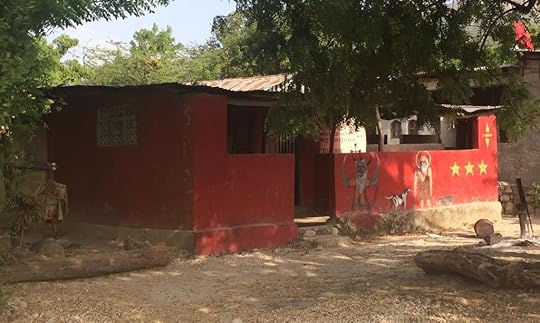
Haitian Temple I observed near Gallette Chambon depicting Lazarus or Papa Legba

Close up of the side of Vodou temple
Other Catholic saints that are linked to the Lwa include Papa Loko with the image of Saint Joseph, Danbala with Saint Patrick, Ayida-Wedo with the Virgin Mary, Met Agwe Tawoyo with Archangel Raphael, Bosou with Saint Luke, Mede with Saint Isadore of Seville, Simbi-Dlo with John the Baptist, Baron-you with Saint Expedite, Manman Brijit with Saint Helena, Brav Gede with Saint Gerard Majella and on and on. I expect it is quite difficult for Catholicism to condemn so many Vodou deities when it too has its own pantheon.
Vodou is two-faced; with an outward façade that conceals a more frightening esoteric interior. Nurtured by centuries of concealment by slaves, the demonology is concealed amidst the characters of Catholicism. Although slaves once used these characters as substitute symbols for the Lwa, such concealment is not necessary today. Hence, one must wonder if this is really religious fusion or a persisting mockery of Christianity?
As slaves, the Haitians sensed that the Catholic Saints must have been more powerful than their spirits, but after their revolution they believed they had succeeded in integrating the Catholicism of the white man into their notion of the Lwa, thereby claiming its power as their own. When the Revolution ended in 1800, the Vatican recalled its priesthood from the island. For the next 60 years, until the mid-1860’s, when the Church decided to return, there was no “official” Catholic teaching in Haiti and only the parts of Catholicism the people remembered remained. In essence, Catholicism persisted, but only in Haitian form and without the Catholic Church. Upon the return of Catholicism in the 1860’s, the church sanctioned anti-Vodou campaigns and engaged in the destruction of Vodou temples and their contents. Today, some Vodouisants are trying to remove the Saint images and purge Vodou of its Catholic influence.
One interesting thing is that Vodou temples and altars are closed during the time between Christmas and Epiphany. During this time the drums cease. No magic is done during Lent. Once Easter has passed, Vodou resumes, except that ceremonies are not held on Sundays.
The first part of a Vodou ceremony begins with the Catholic Prayer, the making of the Sign of the Cross, the recitation of the Lord’s Prayer, the Hail Mary, and the Apostle’s Creed. After this, the Vodou priest or priestess takes up the beaded gourd rattle and Catholic songs are sang, greeting in turn Bondye (the Vodou term for the most high God), the Blessed Virgin, Jesus Christ, and the body of saints.
After the Catholic opening, a second phase begins in which the Priestess uses a rattle and drumming to start a communal dance, during which the Lwa are said to come down the pole to dance with the practitioners and choose a horse. The person that is selected as the horse ceases to exist; and is replaced by the Lwa for the duration of the possession. Papa Legba is called to open the gate and then the order goes from the Rada Lwa to the Nago Lwa to the Petro Lwa and ends with the Gede Lwa.
Vodou has become entrenched by the evil inflicted through slavery. Catholicism, as brought to the island by the French and the Spanish, failed to accept and integrate the Haitians, largely out of racial prejudice, which served to cause the WORD to become distorted into a sorrowful misunderstanding of superstitious ritual.
About Twins
In Vodou, twins are considered to have special and potentially dangerous powers. They are held in a sacred light. Twins are considered to have considerable power which allows them to manage people through the stomach. A special ceremony called Manje Marassa (feeding the twins) is held at certain intervals.
Twins are believed to form a connection between the physical world and the world of the spirits. They are believed to live in both worlds. Some practitioners of Vodou believe twins to be even more powerful than the Lwa because of the union they symbolize.
A Brief History of Haiti
By the time of the French Revolution in 1789, there were eight to ten African slaves for every single free man in Haiti. Maroon colonies in the mountains, comprised of Taino descendants, mixed-race rebels, and newly escaped African slaves periodically raided plantations, freeing slaves and taking them back with them into the mountainous interior.
One of these maroon leaders was Makandal, who led slave rebellions from 1751 to 1757. Makandal’s most feared method of killing plantation owners was to instruct slaves to administer plant poisons to their food, to blow poisonous powders in their faces, or to scatter poisons where they might walk barefoot or otherwise touch. Makandal was captured by the French and burned at the stake in 1758. Makandal is recognized in Haitian Vodou as Lwa, as are other popular historical Haitians, including L’Ouverture, Dessalines, Boukman, and even Papa Doc Duvalier.

Statue of Makandal in Haiti
The author relates a history that Boukman, a maroon leader, was motivated to incite the revolution of 1791 at a Vodou ceremony in which he drank pigs blood to consummate a pact for freedom. Televangelist Pat Robertson contends that the slaves sold their souls to Satan at this ceremony in return for the power to overthrow their masters. Subsequently, violence broke out all over Haiti in which 4,000 slave owners were killed and hundreds of plantations burned. By 1792, the rebel slaves had complete control of Haiti.
Under their early ruler L’Ouverture, the Haitians continued to fight for freedom and even invaded the neighboring Dominican Republic. When L’Ouverture was captured and taken away by the French, one of his lieutenants, Jean-Jacques Dessalines took over in his place. Dessalines sought to purge Haiti of all former slave owners and conducted many executions. Dessalines remains a hero in Haiti and purported to be a Lwa.
Dessalines was murdered in 1806 after which Henri Christophe became King of the north and Petion, a mulatto, became ruler in the south. Petion died of yellow fever in 1818 and his successor, Pierre Boyer started a coup in the south that overthrew Henri and reunited Haiti in 1820. Boyer invaded the Dominican Republic again in 1821 and temporarily gained control of the entire island.
Boyer’s rule was followed by a long series of coups, assassinations, monarchies, dictatorships and meddling by foreign powers. In 1859, Fabre Geffrard became President. After a six year old girl was killed by Vodou practitioners in a gruesome fashion, Geffrard attempted to banish Vodou by destroying Vodou temples and objects. Vodou moved underground.
Pierre Nord Alexis, the illegitimate grandson of Henri Christophe, took power in 1902, with the assistance of the United States. He opened trade and permitted Americans to purchase land and run plantations and factories. A number of Presidents followed Alexis, often being deposed in violence.
In 1915, President Jean Vilbrun Guillaume Sam was dismembered by a violent mob, which paraded pieces of his corpse though Port-au-Prince. Such violence led U.S. President Woodrow Wilson to invade Haiti and the U.S. occupied Haiti for 20 years, from 1915 to 1934. After the U.S. departure, the unrest and disorganization continued with flash mobs of urban poor often appearing out of nowhere.
In 1937, a black medical doctor, Francois Duvalier, gained power. He was known as “Papa Doc”. Papa Doc studied and practiced Vodou. He formed a personal police force whose members mimicked Vodou symbols for Lwa and dressed like Lwa. This police force was greatly feared and came to be known as bogeymen. Many of the bogeymen were Vodou priests.
In 1959, Papa Doc seemed to suddenly change. He suddenly expelled nearly all of the non-Haitian Catholic bishops and was excommunicated by the church. However, in 1966 he managed to convince the Holy See to readmit him and let him appoint Haiti’s bishops, which he replaced with black loyalists of his own choosing.
In 1963, Papa Doc started appearing in public dressed like a Lwa known as Baron Samedi, with dark sunglasses, suit and using the strong nasal accent known to be emitted from this Gede Lwa. Duvalier’s bogeymen similarly donned sunglasses in emulation of their leader. The regime distributed a version of the Lord’s Prayer honoring Papa Doc in the place of God. The regime circulated an image of Jesus standing next to Papa Doc with a hand on his shoulder and a slogan: “Papa Doc: one with the Lwa, Jesus Christ, and God Himself.”
In 1971, Papa Doc died and was succeeded by his son Jean-Claude, known as “Baby Doc”, who lived as a playboy. In 1971, U.S. President Richard Nixon restored an aid program, but Baby Doc siphoned it off to fund his lavish lifestyle. In 1980, Baby Doc married Michele Bennett, the light-skinned granddaughter of Henri Christophe, in a lavish ceremony that cost the Haitian government $3,000,000. Due to the ensuing protest and violence over this event, U.S. president Ronald Reagan pressured Baby Doc to leave in 1986.
An outspoken black Catholic priest, Jean-Bertrand Aristide was elected in 1990 but was overthrown by mulatto general Raoul Cedras. In 1994, under Bill Clinton, the U.S. again invaded Haiti and Aristide was returned from exile. When his term ended, Rene Preval was elected. Aristide was subsequently elected to a second term in 2000, but was forced into exile again in 2004. In the ensuing chaos and violence, the Haitians appealed for international help and received it in the form of United Nations forces, which remain in Haiti today. In 2006, Preval was re-elected.
CONTINUED IN COMMENTS SECTION BELOW
This book reminds me of something that C.S. Lewis wrote in his preface to The Screwtape Letters:
“There are two equal and opposite errors into which our race can fall about the devils. One is to disbelieve in their existence. The other is to believe, and to feel an excessive and unhealthy interest in them. They themselves are equally pleased by both errors, and hail a materialist or magician with the same delight” –C.S. Lewis
This book describes such “unhealthy interest” as Lewis mentions. Vodou is a religion run amuck with interest in possession and interactions with a countless array of spirits. I have chosen to read this book only because I have visited Haiti a number of times and witnessed the proliferation of Vodou temples. I’m reading to gain a broader understanding of the Haitian people that I’ve come to know and love.
Vodou was hewn in the fires of some of the worst evil ever inflicted on the face of this planet in the form of human slavery. Vodou is a fusion of elements from Africa, Catholicism, and the Taino (indigenous peoples of the West Indies). These cultural influences were pounded together into the contorted shape that constitutes Vodou today.
What is Vodou?
The main focus of Vodou is to cause practitioners to be possessed, to communicate with the possessors, and to serve the entities that possess people. These spirits are referred to as Lwa (lo-WAH or luh-WA). This book gives these so-called Lwa every characteristic that Christians would associate with demons.
The book was written by Mambo Chita Tann, a Vodou Priestess. Chita Tann is quick to point out that Vodou is not a body of “beliefs” but a body of “practices” centered around possession. The author actually uses the word “cultic” to describe Vodou.
The author defines Vodou as an ancestral magical practice and not a religion. Magic is defined as effort put forth by a Vodou Priest or Priestess to gain the employment of the spiritual world to assist in the physical realm. The author claims that if you ask a Haitian what his religion is, he will most likely reply that he is Catholic. The author suggests that Haiti is 90% Catholic, 10% Protestant, and 100% Vodou. She claims that Vodou is practiced by millions of people every day, inside and outside of Haiti.
The author specifically emphasizes that Vodou is something you “do”, not a creed that you “believe in”. If there is a belief system central to Haitian Vodou it is karma: that what you do is what you are - that what you give is what you receive - that like begets like – and that the Lwa reward their servants in proportion to what they receive from those servants. In cases where a Vodou Priest or Priestess is hired to do magic for a client that harms someone, the Haitians believe the consequences do not fall upon the magician, but rather the client.
How is Vodou Practiced?
The stated goal of Haitian Vodou is to serve these entities referred to as Lwa. The author emphasizes that Lwa are “served”, not “worshiped”. The Lwa are served by facilitating human possessions in order to converse with them and then doing as they direct.
There is an initiated Vodou priesthood that are called mambo (mom-BO) if they are women and houngan (Oon-GAHN) if they are men. The temple where Vodou ceremonies are held is called a hounfo (oon-FO) and is a compound, usually a large, single-room building, or open space outside, with a large clear space where songs and dances for the Lwa are held.
All Vodou temples have a central pole, around which ceremonies and dances revolve. The pole often has a concrete base that is used as an altar. The Lwa are said to climb down the pole and onto the floor. Once on the floor, the Lwa rise up through the bodies of their servants to share in the dance and appear in possessions. The pole is often decorated in an abstract striping pattern or with the images of two intertwined snakes.
Vodou Altar observed during recent trip to Haiti near Galette Chambon
Altars are usually covered with odds and ends like candles, paper images of the saints, bowls, cups, plates, bottles, food, flowers, goblets of water, oil lamps, roots, stones, weaponry, pieces of cloth, ribbon, or even the occasional human skull. Certain kinds of dolls are found on Haitian Vodou altars or doll parts, particularly doll heads, or a bottle with a dolls head inside.
Vodouisants also create talismans called wanga (WAHN-guh) consisting of objects tied together in a cloth or other ritual receptacles designed to harbor a spirit. Objects tied together in a cloth may contain herbs and all sorts of natural and manmade objects. Certain stones are considered sacred to the Lwa. Feathered sticks are used as invocation points and magical receptacles for sprits. Some are designed to be worn and others placed in certain locations.
Wanga observed in Haitian backcountry near Galette Chambon
What are Lwa & What do they do?
The Lwa of Haitian Vodou partake in the tangible world by possessing those that serve them. During possession, the Lwa take over the body of the servant and uses it to eat, drink, dance, offer advice, and interact with the practitioners in various physical ways. The practitioners encourage possession by offering the Lwa songs, dances, drumbeats, drinks, and other offerings they perceive the Lwa prefers.
The Vodouisants believe the soul of the person whose body is being used in possession is completely replaced by the Lwa during possession. They refer to the possessed person as a “horse”, as being mounted and rode by the Lwa. The author reports that Lwa can be physically hard on their horses and that it may take days to recover. The author reports that serving as a horse is not a desirable thing because the Lwa are not human, are very strong, and do physically taxing things to the horse. Being a horse can be a grueling and painful experience.
In fact, the author reports that some Lwa are so hard on their horses that some Haitians attempt to avoid possessions. But the author contends that once initiated into Haitian Vodou there can be no un-initiation. Quite amazingly, the author relates that occasionally a Lwa asks for a persons hand in marriage, which binds that person to a particular Lwa for life. The author says it ‘s impossible to ever divorce a Lwa. I’m certain that I (as will other Protestants) fully disagree with these contentions.
The author describes the onslaught of a possession as the body going rigid, slumping, staggering, falling backward, collapsing or trembling as in a seizure. This is referred to as the “crisis” stage, during which the soul of the person is pushed aside to make room for the Lwa. Vodou priests and priestesses purport to be able to identify which Lwa is coming simply by the contortions of the horse’s body. Then, as suddenly as the strange movements began, the person changes expressions, voice, body language, and mannerisms and the Lwa is greeted by its servants and presented offerings. Once the Lwa is finished with the horse, it departs.
There are thousands of Lwa that are organized into subgroups. The author refers to them as legions. There are four major divisions: Rada, Petro (Petro are also nicknamed Devils), Kongo, and Gede, which are generally acknowledged in all Vodou houses. Gede Lwa are considered to consist of lost souls who are not honored by their living relatives for whatever reason. The author suggests that the children of Gede may have become Protestants and so now refuse to honor Lwa.
The author reports that sometimes, in cases where an animal is to be sacrificed to Lwa, that the Lwa will come personally, via trance possession, to slaughter the animal itself. The author says some Lwa play with fire, eat flaming coals, spit up blood, stab themselves with knives, climb trees without using the horses hands, jump straight up and dangle from the rafters, eat flaming logs as if corn on the cob, set their hair aflame, drink gasoline, act loud and boisterous, wave machetes, mimic sexual intercourse, use vulgarity, eat food so spicy that it burns the skin to touch it, guzzle high-proof liquor, and smoke cigarettes backwards with the fiery end in the mouth. It seems readily apparent that Vodou is demonic possession run amuck.
Catholicism in Vodou
It is in very interesting that Catholic elements have persisted so much in Haitian Vodou. Some suggest this is simply a relic of Haiti’s colonial past, during which the slaves used the Catholic symbols of the saints to hide their true spiritual practices from their masters. Many suggest the slaves were pulling one over on their Catholic masters by creating the illusion they were praying to a Saint while really praying to a Lwa. For example, the use of an image of Saint Lazarus (an old man with a dog and a stick) represents the Lwa known as Legba Atibon, or Papa Legba. Papa Legba is considered the “keeper of the gate” who must first be called upon to open the gate in order for other Lwa to come.
Haitian Temple I observed near Gallette Chambon depicting Lazarus or Papa Legba
Close up of the side of Vodou temple
Other Catholic saints that are linked to the Lwa include Papa Loko with the image of Saint Joseph, Danbala with Saint Patrick, Ayida-Wedo with the Virgin Mary, Met Agwe Tawoyo with Archangel Raphael, Bosou with Saint Luke, Mede with Saint Isadore of Seville, Simbi-Dlo with John the Baptist, Baron-you with Saint Expedite, Manman Brijit with Saint Helena, Brav Gede with Saint Gerard Majella and on and on. I expect it is quite difficult for Catholicism to condemn so many Vodou deities when it too has its own pantheon.
Vodou is two-faced; with an outward façade that conceals a more frightening esoteric interior. Nurtured by centuries of concealment by slaves, the demonology is concealed amidst the characters of Catholicism. Although slaves once used these characters as substitute symbols for the Lwa, such concealment is not necessary today. Hence, one must wonder if this is really religious fusion or a persisting mockery of Christianity?
As slaves, the Haitians sensed that the Catholic Saints must have been more powerful than their spirits, but after their revolution they believed they had succeeded in integrating the Catholicism of the white man into their notion of the Lwa, thereby claiming its power as their own. When the Revolution ended in 1800, the Vatican recalled its priesthood from the island. For the next 60 years, until the mid-1860’s, when the Church decided to return, there was no “official” Catholic teaching in Haiti and only the parts of Catholicism the people remembered remained. In essence, Catholicism persisted, but only in Haitian form and without the Catholic Church. Upon the return of Catholicism in the 1860’s, the church sanctioned anti-Vodou campaigns and engaged in the destruction of Vodou temples and their contents. Today, some Vodouisants are trying to remove the Saint images and purge Vodou of its Catholic influence.
One interesting thing is that Vodou temples and altars are closed during the time between Christmas and Epiphany. During this time the drums cease. No magic is done during Lent. Once Easter has passed, Vodou resumes, except that ceremonies are not held on Sundays.
The first part of a Vodou ceremony begins with the Catholic Prayer, the making of the Sign of the Cross, the recitation of the Lord’s Prayer, the Hail Mary, and the Apostle’s Creed. After this, the Vodou priest or priestess takes up the beaded gourd rattle and Catholic songs are sang, greeting in turn Bondye (the Vodou term for the most high God), the Blessed Virgin, Jesus Christ, and the body of saints.
After the Catholic opening, a second phase begins in which the Priestess uses a rattle and drumming to start a communal dance, during which the Lwa are said to come down the pole to dance with the practitioners and choose a horse. The person that is selected as the horse ceases to exist; and is replaced by the Lwa for the duration of the possession. Papa Legba is called to open the gate and then the order goes from the Rada Lwa to the Nago Lwa to the Petro Lwa and ends with the Gede Lwa.
Vodou has become entrenched by the evil inflicted through slavery. Catholicism, as brought to the island by the French and the Spanish, failed to accept and integrate the Haitians, largely out of racial prejudice, which served to cause the WORD to become distorted into a sorrowful misunderstanding of superstitious ritual.
About Twins
In Vodou, twins are considered to have special and potentially dangerous powers. They are held in a sacred light. Twins are considered to have considerable power which allows them to manage people through the stomach. A special ceremony called Manje Marassa (feeding the twins) is held at certain intervals.
Twins are believed to form a connection between the physical world and the world of the spirits. They are believed to live in both worlds. Some practitioners of Vodou believe twins to be even more powerful than the Lwa because of the union they symbolize.
A Brief History of Haiti
By the time of the French Revolution in 1789, there were eight to ten African slaves for every single free man in Haiti. Maroon colonies in the mountains, comprised of Taino descendants, mixed-race rebels, and newly escaped African slaves periodically raided plantations, freeing slaves and taking them back with them into the mountainous interior.
One of these maroon leaders was Makandal, who led slave rebellions from 1751 to 1757. Makandal’s most feared method of killing plantation owners was to instruct slaves to administer plant poisons to their food, to blow poisonous powders in their faces, or to scatter poisons where they might walk barefoot or otherwise touch. Makandal was captured by the French and burned at the stake in 1758. Makandal is recognized in Haitian Vodou as Lwa, as are other popular historical Haitians, including L’Ouverture, Dessalines, Boukman, and even Papa Doc Duvalier.
Statue of Makandal in Haiti
The author relates a history that Boukman, a maroon leader, was motivated to incite the revolution of 1791 at a Vodou ceremony in which he drank pigs blood to consummate a pact for freedom. Televangelist Pat Robertson contends that the slaves sold their souls to Satan at this ceremony in return for the power to overthrow their masters. Subsequently, violence broke out all over Haiti in which 4,000 slave owners were killed and hundreds of plantations burned. By 1792, the rebel slaves had complete control of Haiti.
Under their early ruler L’Ouverture, the Haitians continued to fight for freedom and even invaded the neighboring Dominican Republic. When L’Ouverture was captured and taken away by the French, one of his lieutenants, Jean-Jacques Dessalines took over in his place. Dessalines sought to purge Haiti of all former slave owners and conducted many executions. Dessalines remains a hero in Haiti and purported to be a Lwa.
Dessalines was murdered in 1806 after which Henri Christophe became King of the north and Petion, a mulatto, became ruler in the south. Petion died of yellow fever in 1818 and his successor, Pierre Boyer started a coup in the south that overthrew Henri and reunited Haiti in 1820. Boyer invaded the Dominican Republic again in 1821 and temporarily gained control of the entire island.
Boyer’s rule was followed by a long series of coups, assassinations, monarchies, dictatorships and meddling by foreign powers. In 1859, Fabre Geffrard became President. After a six year old girl was killed by Vodou practitioners in a gruesome fashion, Geffrard attempted to banish Vodou by destroying Vodou temples and objects. Vodou moved underground.
Pierre Nord Alexis, the illegitimate grandson of Henri Christophe, took power in 1902, with the assistance of the United States. He opened trade and permitted Americans to purchase land and run plantations and factories. A number of Presidents followed Alexis, often being deposed in violence.
In 1915, President Jean Vilbrun Guillaume Sam was dismembered by a violent mob, which paraded pieces of his corpse though Port-au-Prince. Such violence led U.S. President Woodrow Wilson to invade Haiti and the U.S. occupied Haiti for 20 years, from 1915 to 1934. After the U.S. departure, the unrest and disorganization continued with flash mobs of urban poor often appearing out of nowhere.
In 1937, a black medical doctor, Francois Duvalier, gained power. He was known as “Papa Doc”. Papa Doc studied and practiced Vodou. He formed a personal police force whose members mimicked Vodou symbols for Lwa and dressed like Lwa. This police force was greatly feared and came to be known as bogeymen. Many of the bogeymen were Vodou priests.
In 1959, Papa Doc seemed to suddenly change. He suddenly expelled nearly all of the non-Haitian Catholic bishops and was excommunicated by the church. However, in 1966 he managed to convince the Holy See to readmit him and let him appoint Haiti’s bishops, which he replaced with black loyalists of his own choosing.
In 1963, Papa Doc started appearing in public dressed like a Lwa known as Baron Samedi, with dark sunglasses, suit and using the strong nasal accent known to be emitted from this Gede Lwa. Duvalier’s bogeymen similarly donned sunglasses in emulation of their leader. The regime distributed a version of the Lord’s Prayer honoring Papa Doc in the place of God. The regime circulated an image of Jesus standing next to Papa Doc with a hand on his shoulder and a slogan: “Papa Doc: one with the Lwa, Jesus Christ, and God Himself.”
In 1971, Papa Doc died and was succeeded by his son Jean-Claude, known as “Baby Doc”, who lived as a playboy. In 1971, U.S. President Richard Nixon restored an aid program, but Baby Doc siphoned it off to fund his lavish lifestyle. In 1980, Baby Doc married Michele Bennett, the light-skinned granddaughter of Henri Christophe, in a lavish ceremony that cost the Haitian government $3,000,000. Due to the ensuing protest and violence over this event, U.S. president Ronald Reagan pressured Baby Doc to leave in 1986.
An outspoken black Catholic priest, Jean-Bertrand Aristide was elected in 1990 but was overthrown by mulatto general Raoul Cedras. In 1994, under Bill Clinton, the U.S. again invaded Haiti and Aristide was returned from exile. When his term ended, Rene Preval was elected. Aristide was subsequently elected to a second term in 2000, but was forced into exile again in 2004. In the ensuing chaos and violence, the Haitians appealed for international help and received it in the form of United Nations forces, which remain in Haiti today. In 2006, Preval was re-elected.
CONTINUED IN COMMENTS SECTION BELOW
February 27, 2021
I am so happy I found and picked up this book. I have been looking for a good introductory book on Haitian Vodou for decades and this totally fit the bill. This book gives a lot of great history and information on what Haitian Vodou is and isn't, a brief history of Haiti as a country and information on the Lwa who are served in Haitian Vodou. This is not a book that is going set you on your path to becoming a practitioner but it will give you a lot of really good basic information. I enjoyed the conversational and very authentic voice of the author and the large number of resources listed in the back. If you are trying to learn more about this way of life I highly recommend this as a good starting place.

March 26, 2017
An amazing and fun read. The author gives a basic history of Haiti, goes over all the basic aspects of Haitian Vodou and then ties it all together in the last few chapters. The only down side to this is that at time it can seem repetitive but all that really does is ensure you damn well know the subject through and through by books end. Definitely a must read and please don't skip the intro, it provides some much needed information.

stopped-reading
June 22, 2018I appreciate the opportunity to read this book. Technically I didn’t finish it, because a good chunk is about the specific gods of Vodou. (I flipped thru that part.) the first portion gives a brief history of Hispaniola—Haiti, specifically—and Tann explains her religion. At times it seemed like she was trying to make it palatable to westerners but that makes sense to me.

November 26, 2022
Great information, if a bit repetitive.
July 19, 2024
An introduction to the religion.

February 18, 2017
Good basic book on Haitian Vodou by a working Mambo. Great introduction to the misunderstood religion of Vodou.

January 8, 2015
A very good primer on the culture, practice and experience of vodou. Anybody curious about this often misunderstood religion can learn a great deal from this book. I was reading this for research purposes and while I still feel like I have many questions about the practical aspects of ceremony and ritual, I'm glad I have this grounding in the human element: where vodou comes from, what cultural forces shaped it along the way, how its practitioners feel about it.

August 17, 2015
Clearly a primer and very outside my experience, but very much written for people who don't have prior experience with this, and very gracious, willing to reveal, and willing to state clearly when and what it's withholding. I totally appreciated it. I also spent the day after reading it painstakingly drawing a picture of Ezili Danto, which means that something about it is very much working maybe. I wish it was much longer, but there's a good bibliography.

February 8, 2012
Very well written, Haitian Vodou is not a how-to book of spells or working with the Lwa. It is a good beginner book on the tradition with excellent chapters on Haiti's history, culture, and the evils of cultural appropriation.

March 14, 2012
Compelling read. How accurate is it when it comes to "real" Haitian vodou? I have no idea, since I'm neither Haitian nor a vodouisant of any kind, but I felt that after reading this, I had a much better understanding of the history of Haiti and how the religion evolved out of it.

February 10, 2018
A great source of information for the outsider or extreme beginner. Her facts are well layed out and to the point. Her history is well researched and the book is well written and easy to follow. Would definitely recommend this to anyone curious to know more on the subject.

May 20, 2014
Very informative book on Haitian Voodoo. I really liked the section on the history of Haiti.

June 22, 2015
A very well written and enjoyable insight into the history of Haiti and it's religious culture.
Displaying 1 - 19 of 19 reviews