Chinese revolutionary, first president and founding father of the Republic of China.
Sun is referred to as the "Father of the Nation" in the Republic of China (ROC), and the "forerunner of democratic revolution" in the People's Republic of China.
He co-founded the Kuomintang and formed an alliance with the communists.
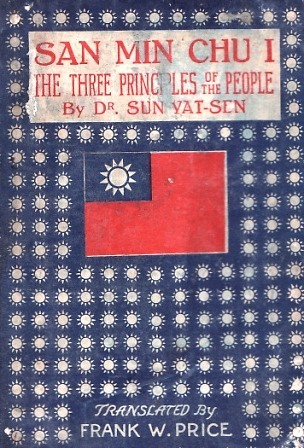
So thought-provoking to read, especially after nearly a century since it was written... Should be a must-read for those who wish to learn more about arguments against China blindly adopting a democratic system and just how far China has come in such a short amount of time.
An informative discussion of Sun Yat-Sen's beliefs for the restoration of the Chinese state and society. A good read for any students of history, historians, or historiographers.
Das Buch besteht aus 3 Teilen, die jeweils in "Lectures" unterteilt sind. Der Autor hält praktisch einen Kurs, eine Serie inhaltlich zusammenhängender Reden/Lektüren. Geschrieben wurde das Buch Anfang des 20. Jahrhunderts.
1. Das Prinzip des Nationalismus: Die Grundthese ist, dass es China im Vergleich zu anderen, erfolgreicheren Nationen an Nationalismus fehlt. Den gilt es zu erzeugen und zwar auf der "ancient morality: loyalty, filial devotion, kindness, love, faithfulness, justice, harmony, and peace".
2. Das Prinzip der Demokratie: Für eine funktionierende Demokratie in China braucht es "four controlling powers of the people: suffrage, recall, initiative, and referendum", außerdem "the five administrative powers of government: legislative, judicial, executive, civil service examination, and censorshop".
3. Das Prinzip der Lebensgrundlage: Die Lebensgrundlage muss das "Zentrum des ökonomischen Sonnenystems" sein. Dazu gehört eine theoretische Auseinandersetzung mit dem Marxismus genau so wie spezifische Untersuchungen von Nahrung und Kleidung.
Leider ist dre Druck schlecht, die Sichtweise allerdings interessant.
Krásna kniha plná analýz filozofie a riešení problémov medzivojnovej rozpadnutej Číny, niektoré ideály pre buď demokraciu alebo ekonomiku ktoré sú v nej prekladané stále sú nezískane v našich končinách. Analýza marxizmu bola čudná, autor moc nemá rád západnú filozofiu.
lectures from an incredibly influential man, sun yat sen has a pretty apparent agenda promoting his 3 principles to a general audience. in his nationalism lectures, he has quaint if vulgar notions of race, nation, & chinese culture in an attempt to promote national self-determination. he advocates building up a national identity starting from the family unit & overthrowing foreign econ & political domination. he would've benefitted from a fanon i think. in his democracy lectures, he repeats tired tropes about equality of opportunity vs outcome & the inevitable spread of democracy. interestingly, he argues for more direct democratic measures in the right of recall, initiative, & referendum, but with a powerful state bureaucracy behind it. in his livelihood lectures, he says that the principle is basically socialism & hes quite positive about the russian revolution. it should be noted that the soviets were supporting him at this time. he critiques marx, but by usually presenting a simplified account of his ideas, then making objections that marx did in fact consider & discuss pretty extensively. he discusses agriculture & the plight of the peasants, the evils of the capitalists & landlords, & argues for improving the welfare of workers, the nationalisation of certain sectors, extensive land reform & a georgist land value tax, large infrastructure projects, & protectionism to develop domestic industries. its thought-provoking, if sometimes frustrating due to his oversimplifications, to read this, esp when considering the state of china & the KMT at the time & sun yat sens legacy today
I often found myself agreeing with his ideas, especially regarding nationalism and the people’s livelihood. Very sound critique on western values, that there is no unit between the individual and the state.
Yet I have a few remarks:
First off he critiques western political philosophy for studying old texts by Plato, but leaves out that the Chinese have been doing the exact same thing with Confucius.
Secondly, I don’t agree with his right to recall government, especially when he says that the majority of the people are type III and neither perceive nor understand. Additionally, he emphasizes giving full control to the government, like he did the taxi driver despite not knowing what they are doing. I believe that the type III people he is talking about would not have the trust and restraint to let the government pursue governance they don’t understand or that seems (but is not) contrary to their interests. With the power to recall, the government would never be able to be the ‘strong’ government he calls for.
I cant help but wonder how China would have looked if Sun Yat-sen had lived longer, as Chiang Kai-shek did an abysmal job of realizing Suns ideas. Sun realized China’s potential on the world stage, and it is interesting to see that some of his ideas (strong government, capable rulers) have been implemented by the CCP.