Jump to ratings and reviews
Rate this book

O sofá

Rate this book
Condenado por decreto divino a reencarnar sucessivas vezes como um sofá, o narrador deste livro tem de sustentar e dar apoio, literalmente, a diversos tipos de aventuras amorosas e sexuais, presenciando cenas que vão do alegre ao trágico. De quebra, compartilha com os leitores as mais variadas histórias de sacanagem, além de desmascarar a falsa virtude, a hipocrisia, o instinto, a vaidade, a fantasia e outros tantos vícios humanos. Ele só vai encontrar a libertação quando acomodar o casal perfeito, isto é, duas pessoas verdadeiramente apaixonadas.

Com este ponto de partida e uma ambientação digna de As mil e uma noites, Crébillon Fils dá estocadas de aparente imoralismo e impertinência, conduzindo a trama a um desfecho surpreendente. Mas antes de chegar até ele, o leitor vai entender uma das mais famosas máximas do autor – a de que o libertino é, antes de tudo, um impotente – e será levado a uma nova idéia de libertinagem.

Junto com Teresa filósofa, de Boyer D’Argens, O sofá é um dos mais importantes clássicos libertinos do século XVIII.

254 pages, Mass Market Paperback

First published January 1, 1742

9 people are currently reading
285 people want to read

About the author

Claude Prosper Jolyot de Crébillon, dit Crébillon fils, was a French novelist. Born in Paris, he was the son of a famous tragedian, Prosper Jolyot de Crébillon, dit Crébillon père. He received a Jesuit education at the elite school Louis-le-grand. Early on he composed various light works, including plays for the Italian Theatre in Paris, and published a short tale called Le Sylphe in 1730. From 1729 to 1739 he participated in a series of dinners called "Le Caveau" (named after the cabaret where they were held) with other artists, including Alexis Piron, Charles Collé, and Charles Duclos.

The publication of Tanzaï et Neadarne histoire japonaise (1734), which contained veiled attacks on the Papal bull Unigenitus, the cardinal de Rohan and others, landed him briefly in the prison at Vincennes. His novel Les Égarements du cœur et de l'esprit was published in 1735 and was although he continued to edit it in 1738, it was never finished. Publication of Le Sopha in 1742 forced him into exile from Paris, which lasted several months.

Around 1744 he entered into a romantic liaison with Lady Henrietta Maria Stafford, daughter of a Jacobite chamberlain, and they were married in 1748. A son born in 1746 died in 1750. Despite financial hardship, they lived harmoniously until her death in 1755. Meanwhile, he published La Nuit et le moment (1745), Ah quel conte and Les Heureux Orphelins (1754). Inheriting nothing from Henriette, he was forced to sell his large library in 1757 and eventually found steady income as a royal censor (like his father) in 1759. In 1768 and 1772 he published his last two novels, Lettres de la duchesse de au duc de and Lettres athéniennes .

Ratings & Reviews

What do you think?
Rate this book

Friends & Following

Create a free account to discover what your friends think of this book!

Community Reviews

5 stars
13 (13%)
4 stars
21 (21%)
3 stars
34 (34%)
2 stars
18 (18%)
1 star
12 (12%)
Displaying 1 - 15 of 15 reviews
Profile Image for Warwick.
Author 1 book15.4k followers
May 12, 2017
So I've been reading this novel in early-modern French which is narrated by a sofa. You heard – a sofa. And this sofa, uh…gets excited when women sit on him:

Une simple tunique de gaze, presque toute ouverte, fut bientôt le seul habillement de Zéïnis ; elle se jeta sur moi nonchalamment, Dieux ! avec quels transports je la reçus ! Brama, en fixant mon âme dans des Sopha lui avoit donné la liberté de s'y placer où elle voudroit ; qu'avec plaisir en cet instant j'en fis usage !

A simple gauze robe, almost completely unfastened, was soon the only thing Zéïnis wore; she threw herself down upon me – Gods! with what transports I received her! Brahma, when confining my soul to sofas, had given it the freedom to position itself within them wherever it wished; with what pleasure I made use of that at this moment!
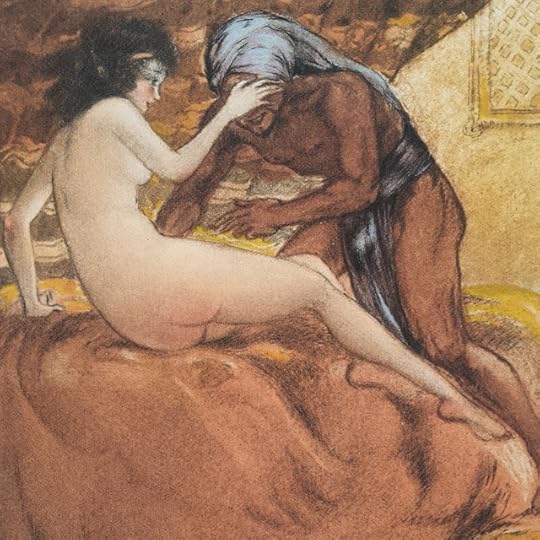

Yikes. Our setting here is the Mughal capital of Agra, in the court of a king who is introduced as being the grandson of Shahryar and Scheherezade from the Thousand and One Nights. However, the book has about as much to say about medieval India as a copy of the Beano – the society described is a sketch of Louis-Quinzian Paris, and the setting is just a flimsy bit of Orientalist stage-dressing which allows for the improbable set-up. Amanzéi, a vizier, is recounting the story of his previous incarnations, when his soul was condemned by Brahma to pass into a sofa and remain there until two virgins consummated their relationship on him.

Basically it's the same old story of boy meets girl, boy loses girl, boy undergoes metempsychosis, boy gets upholstered, girl sits on boy, that we've seen a thousand times before. When are novelists going to come up with some new plots?


Illustration by Louis Icart, 1935

By today's standards, the action, which must once have been racy, seems pretty tame – the English translation is published by Olympia Press, which I feel is bound to disappoint some of their regular, macintosh-clad clientele. The bulk of the novel is made up of conversations about sex and seduction between actual or potential lovers; to that extent it resembles other works of libertine fiction like Dangerous Liaisons or Sade's Philosophy in the Bedroom. But it precedes them and the whole tradition owes (I gather) a lot to Crébillon fils.

I have to admit, I found much it quite depressing. Underlying all of these scenes is the assumption of a colossal gulf between what men want from relationships and what women want; there is no possibility of real union between the sexes, no hope of mutual understanding except, perhaps, between the most ‘degraded’ individuals who no longer want anything except a temporary flare of physical excitement. The ideal of seduction presented here is almost indistinguishable from rape, thanks to the social mores which make it necessary for a woman, however keen, to resist as strongly as possible for the sake of her reputation. Women in this book worry, after sex, that they didn't fight hard enough, while men reassure them that they did; it's kind of horrific. Everything is wrapped up in deception, dissimulation, hypocrisy.

Les femmes accoutumées à nous cacher sans cesse ce qu'elles pensent, mettent sur-tout leur attention à nous dissimuler les mouvemens qui les portent à la tendresse, et telle a peut-être à se vanter de n'avoir jamais succombé, qui doit moins cet avantage à sa vertu qu'à l'opinion qu'elle en a sçu donner.

Women who are used to constantly keeping what they think hidden from us devote all their attention to disguising any gestures that might lead them into tenderness; a woman can, perhaps, congratulate herself on never having succumbed, who owes this advantage less to her virtue than to the opinion she caused to be had of it.


Crébillon, allowing us to see this hypocrisy, must be assumed to share at least some of our distaste for its consequences. Nevertheless, rather too much pleasure seems to be had in the humiliation of one ‘fallen’ woman; I feel the same way about the fate of Merteuil in Laclos, but at least there you feel she partly had it coming. Here it just comes across as gratuitous. Not for the first time, you can't help suspecting that male novelists do love the chance to lay into these women under cover of satire.

And although the book takes detours to ridicule religious and courtly hypocrisy as well, it's definitely women, scoffed at for founding their virtue ‘less on privation than on repentance’, who bear the brunt of the satire here. Modern readers are instead struck most forcefully by the extreme paucity of options they had for controlling their lives. This makes the book more fascinating, perhaps, as a historical document, but it does make it harder to enjoy as a story, still less as a ‘moral tale’, as Crébillon describes it. And the moral of the tale is this:

s'il est vrai qu'il y ait peu de héros pour les gens qui les voient de près, je puis dire aussi qu'il y a pour leur sopha bien peu de femme vertueuses.

if it is true that there are few heroes to those who see them up close, I can say also that, to their sofas, there are very few virtuous women.



Not something you're likely to be able to let fly at a dinner party, but a fair summary of this weird and wonderful book all the same.


(An etymological note. )
Profile Image for Zadignose.
307 reviews179 followers
Read
July 2, 2025
A witty, entertaining novel with a unique premise, this book brings to our attention all the hypocrisies, deceipts, and cruelties of love and sex, as well as their sincerities and tenderest moments. Mainly told from the point-of-view of a soul reincarnated into a series of sofas. It does, perhaps, dwell a bit longer than necessary upon the humiliation of one fallen woman... but then, she does commit the capital crime of deceiving a man named ZADIG, who I'm sorry to say is portrayed as a fool in love, too constant, too devout, too self-blinding to know how he is abused (which makes him rather unlike anyone I know personally... ahem!)

Many indiscretions are described rather discretely... at least by what I assume to be modern standards. It doesn't commit the crude blunders of the excessively vulgar "erotic" works of today, and while it insinuates quite a lot, it doesn't get much more graphic than a description of a man struggling with impotence thus: "He was brisk without fire, profuse in praises, constant in admiration; but has a lover no other way to express his desires than by praises?" and a bit later "Although Mazulim was not now in quite so pitiable a condition, he was not yet in one to be congratulated upon..."

But anyway, an imaginative reader can extract meaning from such banter as "'Oh, Zuelika,' he added, 'your taste is so good; tell me, what do you think of my ceiling?'" with the implication that she is now in such a position as to view the ceiling. I do wonder what kind of more complex punning may have gone on in the original French.

It may well be that this book was once appreciated for it's potential to titillate rather than for its wit, whereas a more jaded reader today may be insensitive to the former while being oblivious to the latter. (On the other hand, the work could offend modern feminist notions if certain attitudes expressed by characters are taken to be the ideology of the author himself. But it seems to me the author presents a series of morality plays in which his own perspective is absent, and the reader himself or herself is responsible for approbation or censure.) But in its day, the book was enough to get its author exiled for its satire which could scandalize the French royalty.

The author also has an entertaining self-effacing quality, as seen in the way he titles his chapters. E.g., Chapter II: Will Not Be To Everybody's Taste. Along the way, he engages in some self-criticism regarding his own tale, pointing out what could be perceived as flaws, though his ability exceeds what he humbly claims, and he also slips in a bit of meta-authoring by teaching us a bit about different ideas on how a story could be told (the story is being told to a rather foolish grandson of Scheherazade and Sharyar of the Arabian Nights, and he frequently interrupts, while his more clever first wife the Sultana, and the former-sofa exchange ideas on the art of story telling.)

This clearly is the work of an erudite author of a philosophical bent who is well aware of--and a part of--the tradition of wits and clever story tellers.


This book should be revived and appreciated.
Profile Image for Marie.
71 reviews
Read
March 22, 2025
"Ihre Erzählungen waren wirklich etwas ganz anderes"
Profile Image for Czarny Pies.
2,831 reviews1 follower
August 13, 2015
Ce roman libertin fait un clin d'oil au Mille et une nuits. Le protagoniste, un courtier qui s'appelle Amanzéi raconte au sultan Schah-Baham (petit-fils de Shéhérazade !) temp ou il a été transformé en sopha comme punition pour ses debauches. Le mauvuais sort ne sera rompu qu'à la condition que deux personnes se dépucellent.

Comme il fallait s'y attendre il y a bien d'accouplements qui se font sur notre protagoniste qui ne se rencontre pas la condition necessaire pour que le sort soit brisé. Finallement deux adolescents mais fin aux supplices de notre héros.

Est-ce une satire sur la société francaises du dix-huitième siècle ou une serie de contres grivoises. C'est à vous de decider.
Profile Image for Ali.
31 reviews1 follower
June 29, 2014
What can I say about a book where furniture gets "excited" and has a perverse interest in being saton by a pretty girl? It made me look at chairs, couches, even tables everywhere quite differently!!
I remember texting passages of the novel to friends. It's funny, and it's short. Read it ;)
Profile Image for Thomas.
574 reviews99 followers
December 27, 2016
this book is cool in theory and has some good jokes("chapter 1: the least tedious in the book"), however the translation reads a bit clunky and there's a part that goes on for too long and is kind of dull.
Profile Image for Rosa Ramôa.
1,570 reviews85 followers
May 10, 2016
Brilhante...

Erótico*

"Enrubecendo pelo que sentia, queimava de vontade de sentir mais; sem imaginar novos prazeres, desejando-os"...
Profile Image for Helen.
213 reviews7 followers
April 27, 2022
Written in the C18 by Crébillon fils but I have a pink folio English translation edition from 1950s it is basically a story within a story about a Sultan’s official telling the story of when Brahma had him as a spirit inhabiting society sofas in India, as part of his reincarnation until true love’s first embrace occurs on him! So courtier Amanzei tells his tale and the Sultan and Sultana interrupt, the sultan having demanded story telling for his amusement.

The chapter headings are funny insults about what’s in the chapter ie “in which there are many things to find fault with” or “which contains a receipt against enchantment” etc

This edition also has an interesting intro about the story and some “saucy” picture plates - although one is shamefully dated depicting an African servant in caricaturish way, when all other people are drawn stylised and natural.

The story is a lot of euphemisms that confuse, and convoluted conversations and witticisms of women trying to be coy and men trying to seduce them. The story is better at the beginning than as it goes on it gets a bit bogged down by the too-and-fro or man Nasser and woman Zuleika who are proclaiming their love to each other but she was tricked into it and he is pretending - and it’s all a little distasteful.

I got a bit confused by all the I hate you I love you do you love me I love you I adore you you hate me say you love me I love you but should hate you etc.

Amongst all the - what seems like - free love and promiscuity there is an underlying power play that is quite disturbing. A sexism and desire to bring a woman down… women are not as in control as they think. It’s concerning, but the author draws attention to the perfidy and shameful behaviour in both sexes. He isn’t praising their behaviour but condemning it.

There is some amusement in this book but because of the euphemisms it’s not that sexy and because of all the back and forth of conversation gets bogged down. “Love” involves a lot of falling on knees and timidly taking a hand or looking into her eyes or falling on her breast… but it’s clear a lot more happens.

The introduction and preface are interesting and give historical background to the book and story, the book being rather scandalous at the time and taken to be thinly veiled commentary of Parisian society in c1740s
Profile Image for Sebastián Gómez.
8 reviews
June 21, 2020
It expounds on the eternal cruelties of love, how the discussions about modesty, inmodesty, correspondence of love and deceit have not changed all that much compared to today. Beautiful language on some parts, loved the poetic avoidance of making sexual encounters literal.
Profile Image for Amandine.
450 reviews63 followers
July 22, 2011
Roman libertin qui n'est pas sans rappeler, à raison, Les Bijoux Indiscrets de Diderot écrit plus tardivement dans le siècle. Ce ne sont pas les "bijoux" des femmes que Crébillon fait parler, mais un courtisan dont l'âme fut emprisonnée dans les sophas durant une vie antérieure. Libre de voyager de l'un à l'autre, il a ainsi surpris de nombreuses scènes privées et érotiques, depuis la chambre délabrée d'une pauvre courtisane au somptueux palais d'une jeune princesse, en passant par la "petite maison" d'un libertin. Il relate ces scènes sous forme de contes au sultan, friand de ce genre littéraire, mais auditeur dissipé : il ne se prive guère d'interrompre fréquemment le narrateur pour le reprendre, le prier de supprimer ses "dissertations" qui l'ennuient, etc. Ces interventions sont assez agaçantes à mon goût, mais aèrent néanmoins le récit qui tire en effet parfois quelque peu en longueur.

Si l’œuvre de Diderot m'avait amusée, je lui préfère néanmoins de loin celle de Crébillon: moins philosophe et plus léger, le ton de celui-ci me convient davantage. Les anecdotes érotiques rapportées par le narrateur sont agrémentées de discussions sur l'amour, notamment, et révèlent surtout la face cachée de la société du temps: bien plus que par l'amour ou la vertu, les personnages sont menés par l'hypocrisie, la luxure, et surtout la vanité.
Je déconseille cette œuvre à ceux qui y recherchent uniquement un récit érotique: le langage de Crébillon est voilé, délicat, souvent à double entente, et certainement pas cru comme peut l'être celui d'autres œuvres libertines du même siècle. Pour les amateurs du libertinage et de ce style d'écriture à double entente, c'est un véritable régal de lecture.
Displaying 1 - 15 of 15 reviews

Can't find what you're looking for?

Get help and learn more about the design.