Jump to ratings and reviews
Rate this book

Oeuvres de Philon d'Alexandrie #23

Philo: On the Decalogue. On the Special Laws.

Rate this book
The philosopher Philo was born about 20 BCE to a prominent Jewish family in Alexandria, the chief home of the Jewish Diaspora as well as the chief center of Hellenistic culture; he was trained in Greek as well as Jewish learning. In attempting to reconcile biblical teachings with Greek philosophy he developed ideas that had wide influence on Christian and Jewish religious thought.

The Loeb Classical Library edition of the works of Philo is in ten volumes and two supplements, distributed as follows. Volume Creation; Interpretation of Genesis II and III. On the Cherubim; The Sacrifices of Abel and Cain; The Worse Attacks the Better; The Posterity and Exile of Cain; On the Giants. The Unchangeableness of God; On Husbandry; Noah's Work as a Planter; On Drunkenness; On Sobriety. The Confusion of Tongues; The Migration of Abraham; The Heir of Divine Things; On the Preliminary Studies. On Flight and Finding; Change of Names; On Dreams. Abraham; Joseph; Moses. The Decalogue; On Special Laws Books I–III. On Special Laws Book IV; On the Virtues; Rewards and Punishments. Every Good Man Is Free; The Contemplative Life; The Eternity of the World; Against Flaccus; Apology for the Jews; On Providence. On the Embassy to Gaius; indexes. Supplement Questions on Genesis. Questions on Exodus; index to supplements.

672 pages, Hardcover

First published January 1, 15

2 people are currently reading
29 people want to read

About the author

Philo of Alexandria

341 books57 followers
Philo (20 B.C.–50 A.D.), known also as Philo of Alexandria (Greek: Φίλων ὁ Ἀλεξανδρεύς, Hebrew: ידידיה הכהן Yedidia Hacohen), Philo Judaeus, Philo Judaeus of Alexandria, Yedidia, "Philon", and Philo the Jew, was a Hellenistic Jewish Biblical philosopher born in Alexandria.

Philo used philosophical allegory to attempt to fuse and harmonize Greek philosophy with Jewish philosophy. His method followed the practices of both Jewish exegesis and Stoic philosophy. His allegorical exegesis was important for several Christian Church Fathers, but he has barely any reception history within Judaism. "The sophists of literalness," as he calls the literalist Jews,[1] "opened their eyes superciliously" when he explained to them the marvels of his exegesis. He believed that literal interpretations of the Hebrew Bible would stifle mankind's view and perception of a God too complex and marvelous to be understood in literal human terms.

Some scholars hold that his concept of the Logos as God's creative principle influenced early Christology. Other scholars, however, deny direct influence but say both Philo and Early Christianity borrow from a common source. For Philo, the Logos was God's "blueprint for the world", a governing plan.

The few biographical details concerning Philo are found in his own works, especially in Legatio ad Gaium ("embassy to Gaius"), and in Josephus. The only event in his life that can be determined chronologically is his participation in the embassy in which the Alexandrian Jews were sent to the emperor Caligula at Rome as the result of civil strife between the Alexandrian Jewish and Greek communities. This occurred in the year 40 CE.

Ratings & Reviews

What do you think?
Rate this book

Friends & Following

Create a free account to discover what your friends think of this book!

Community Reviews

5 stars
6 (46%)
4 stars
0 (0%)
3 stars
6 (46%)
2 stars
1 (7%)
1 star
0 (0%)
Displaying 1 - 2 of 2 reviews
Profile Image for Yann.
1,413 reviews392 followers
September 26, 2016


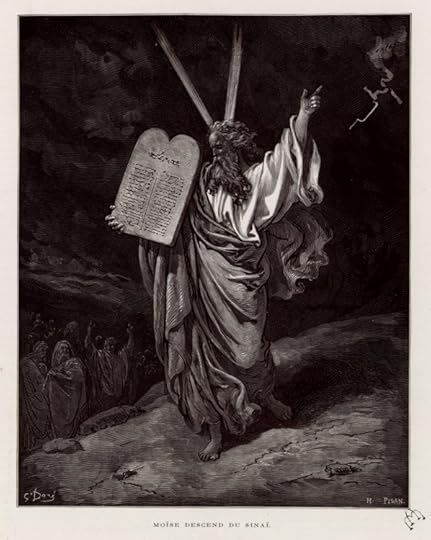
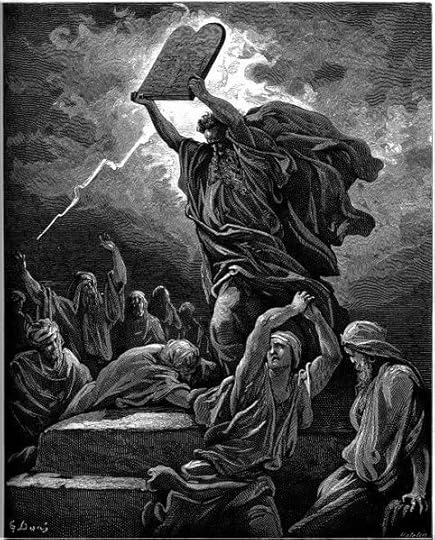
Après une série de livres dédiés aux patriarches, Philon aborde maintenant le décalogue, c'est-à-dire les dix commandements écrits par Dieu sur le mont Sinaï et donnés à Moïse, avant que ce dernier, par dépit, ne les brise, constatant l’idolâtrie du veau d'or à son retour. Philon se livre ici à un commentaire de ces dix lois, d'un point de vue évidemment moral, mais aussi à la lumière (ou l'obscurité?) d'une exégèse allégorique variée, qui commence, comme pour la Genèse et les sept jours, par une analyse touffue du nombre dix. Les considérations numérologiques autour de la décade sont si abondantes qu'il faut à Philon mettre un terme à ses élucubrations et à sa faconde intarissable, afin de ménager la patiente attention du lecteur, et passer à des considérations moins arides et moins austères que des équations qui passent pour des raisonnements.


Les dix commandements peuvent être regroupés en deux ensembles de cinq; l'une relative à la prescription d'aimer Dieu, et l'autre qui commande d'aimer son prochain:

Tu aimeras l'Eternel, ton Dieu, de tout ton cœur, de toute ton âme et de toute ta force. (Deutéronome, 6.5)


Tu aimeras ton prochain comme toi-même. (Lévitique, 19.18)


Dans les livres suivants, dédiés au classement des différentes lois et autres interdits commandés dans le Pentateuque, Philon se base sur le décalogue comme une catégorisation de ces dernières. Un commentaire intéressant, mais Philon, dans son enthousiasme, se laisse souvent aller à une intolérance désagréable et pénible, en particulier à l'égard des Gentils, qui empêche d'apprécier pleinement la lecture de ses commentaires.
Profile Image for Justin.
282 reviews19 followers
November 26, 2012
This is Volume 7 of Loeb's series on Philo of Alexandria: "On the Decalogue. On the Special Laws, books 1-3."
Displaying 1 - 2 of 2 reviews

Can't find what you're looking for?

Get help and learn more about the design.