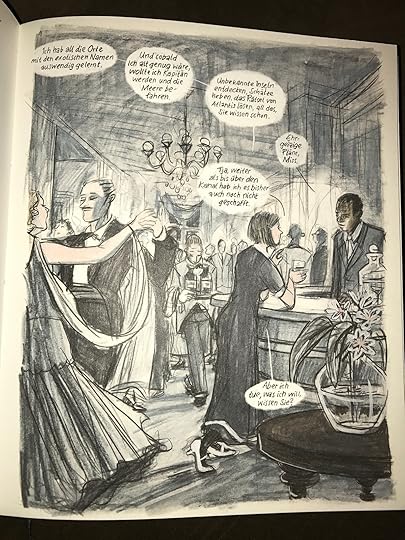
'Irmina' is a fictionalised biography of the author's grandmother, and it's a fascinating and rather different look than I expected at the Nazi era. Irmina is a German working and training in London a few years before World War Two, at the rise of the Nazi party. She meets Howard, the first black man to attend Oxford University, and their differing backgrounds, aspirations and motivations are a large foundation for their friendship-almost-relationship, and also their separation. It's told in three parts, in beautifully drawn pages, with many stunning 2-page spreads of city scenes. The whole graphic novel is drawn in a messy but enchantingly detailed style, coloured in melancholic greys and browns that mirror Irmina's mood throughout, but for one specific colour in each part (Part 1: blue, 2: red, three: green) which really highlight certain things, and like with the red in part 2, have some scary connotations about what Irmina is choosing to ignore.
The story though, started well, with strong scenes and dialogue that really allowed me to get a feel for the characters and their attitudes and emotions. Yelin is very good at drawing facial expressions and presenting moods in her scenery. I really enjoyed the first part and had high hopes for the rest of the story. However, I did feel a bit let down by later parts. They felt rushed and more summarised, with large time-skips and less obvious character development through certain events or interactions, and instead more through a sense of the years piling on and the mood gradually sinking into a kind of bitterness. The later parts were much more specifically about the political changes going on in Germany and through the war, than character development and interaction. As important as the historical context is, I'm not sure it should have been prioritised so much over story and characters, but needed to be blended more. There are glimpses of the horrors happening in Berlin to Jewish shopkeepers, the propaganda, the rumours and ignored knowledge of what was really happening. And these are important and valuable, but I think the heavy focus on trying to show what was going on while Irmina tried to ignore it and protect her son from it made the story suffer in terms of its characterisation and scene-crafting. I wanted to know more about how Irmina got together with her husband when they didn't seem to have much of a connection to each other, and more about her relationship with her son and friend. I also wanted some kind of parallel of what Howard was experiencing or thinking during part 2, from the perspective of someone with very different goals in life, but still living in places where what was going on in Germany during the war was very relevant. Really, I think I just wanted to know more about Howard, full-stop. I think, in a sort of life-being-wasted way, the rushed-ness sort of worked, as it reflects Irmina's mood well, but it took the rich story and character development established in the first part and then became more vague. I definitely just wanted more in there and felt the second and third parts were weaker in comparison to the first part because of that.
I liked what the ending tried to achieve though, and the contrast of Howard's happy old age to Irmina's bitter and depressed one, and how realistic it felt that Irmina would believe that meeting Howard again might change her life somehow. That strong sense of regret felt very true to her, and true to the story-seeking people we are: we want to live happy endings, and for things to have happened or been lost for a purpose, for life not to pick up briefly and then to go back to its regular ennui, we want to be changed and we want to feel, especially if we've not allowed ourselves to feel for a long time. And this graphic novel certainly carries a weight of those complex emotions with it. It's an unusual look at the life of ordinary Germans during a complicated time, and the conflicts and regrets that come with hindsight.
The commentary and analysis at the end of the graphic novel is also important to read, I think. It analyses some of the scenes and draws out details that I certainly missed, and added more to the historical context and intended characterisation of Irmina, as well as expounding a little on the source material that this story is based on.
It's really the artwork that stands out for me though. It's a truly beautiful graphic novel, with a lot of care gone into not only telling a story in pictures, but filling it with history and atmosphere and so many details you'll probably notice something new every time you read it. The cover itself is beautiful, too, and wonderfully conveys that comparison between the life Irmina could have had, and then did have, with the reflection showing the darker realities of Irmina's life. It's not something immediately noticable, but it's clever artistic layouts like that and the little emotional nuances that go with them that really show how talented Yelin is as an artist.