”Indian Summer” was the first of Italian comic book legends Hugo Pratt and Milo Manara's collaborations. I ended up enjoying this significantly more than their later team-up ”El Gaucho”, even if I didn't learn as much from it, on account of ”Indian Summer” taking place in Massachusetts and ”El Gaucho” taking place in Argentina which is much less overexposed in international popular culture than the United States are.
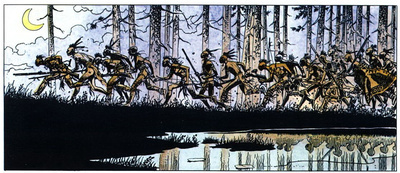
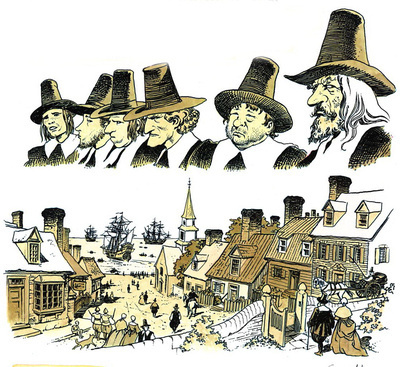
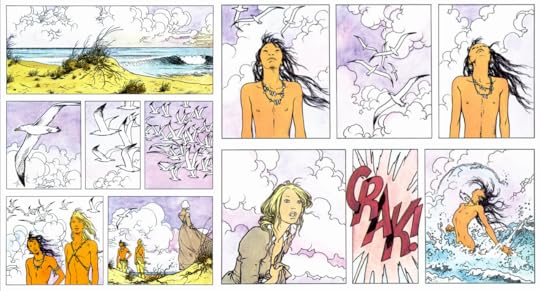
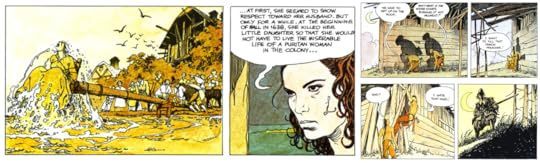
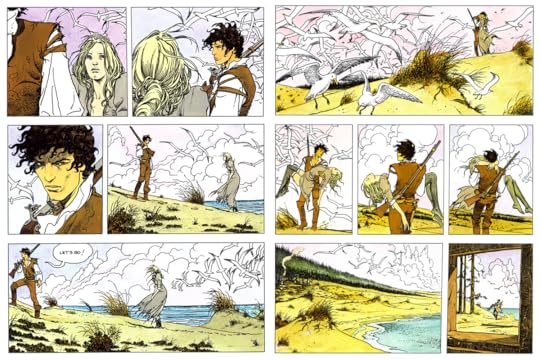
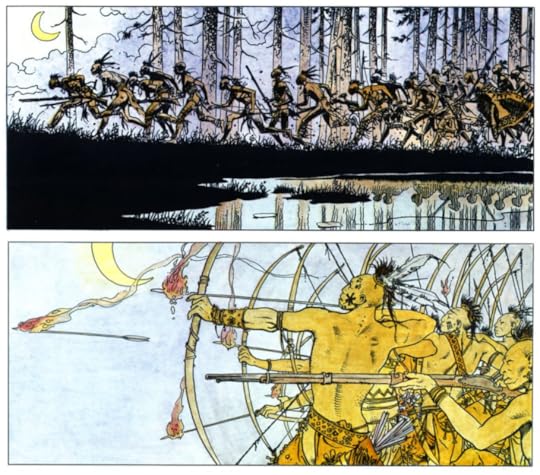
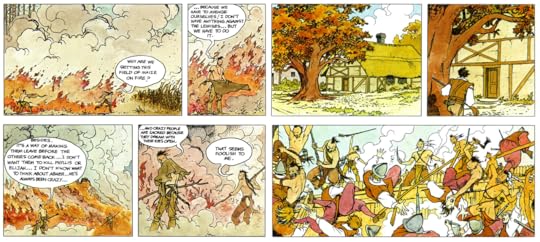
Like ”El Gaucho”, ”Indian Summer” is a combination of erotica with serious character-driven historical drama, this time centered around a conflict between English colonists and a local Native American tribe in Massachusetts during the 17th century. The plot begins when a woman named Sheva from the colony New Canaan is raped on the beach by 2 of the Native Americans - one of whom is actually a Dutchman who went native. A young man from the village named Abner then kills both of the assailants, despite being one of the few members of the colony who are on more or less positive terms with the tribe, which ends up triggering a full-scale war. This turns of events gives artist Milo Manara the opportunity to draw lots of epic and intricately choreographed battle scenes later on. The only person capable of defusing the conflict is Abner's mother, a hermit witch known only as ”the Devil Woman”. She used to be the servant of Pastor Black, the late father of New Canaan's resident Solomon Kane-style Puritan witchhunter Pellegrino Black, before being branded with an L in the face (after Adam's renegade first wife Lilith) and expelled from New Canaan after having an affair with Squando, the tribesman who happens to be Abner's best friend. However, Pellegrino Black then does everything in his power to prevent any truce between the settlers and the natives, as that would require him to face responsibility for his own bad decisions in the past... which still end up coming back to haunt him throughout the story.
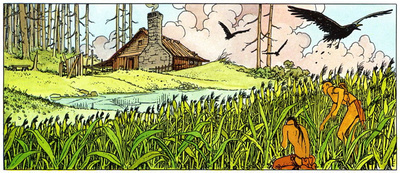
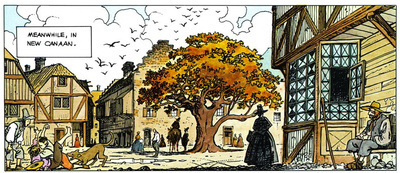
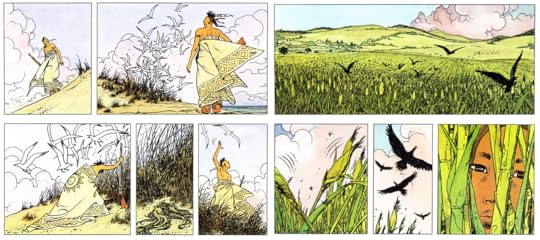
The overall impression of ”Indian Summer” is something like a cross between ”The Scarlet Letter” and ”The Last of the Mohicans” filtered through a sensibility halfways between the better Spaghetti Westerns of the 1960's and the more ambitious Italian exploitation films of the late 1970's and early 1980's. Throw in an attractive Native American woman into the cast of characters, get Laura Gemser in the role, and I can 100% imagine Joe D'Amato directing a film adaptation of this during that era. The art is absolutely gorgeous with an impressive attention to capturing picturesque New England landscapes, looking positively psychedelic during scenes set at the twilight of either dawn or dusk, in large part thanks to Milo Manara's influence from early 20th century Art Nouveau style. Both Manara's artwork and Pratt's script also show an extraordinary level of attention to historical accuracy and period detail. However, Milo Manara's one weak point remains: All the women in a story who are meant to be considered attractive by the reader, he draws the exact same way just with different eye/hair/skin colour! (notice that the women who are meant to be considered ugly show a wide variety of body and face types) The plot also feels significantly better thought out and less cluttered than in ”El Gaucho”, being more of a slow burn narrative focusing on fewer characters and getting further into backstories and inner emotional lives than ”El Gaucho” firing off as many ideas as Pratt could think of in as short a space.
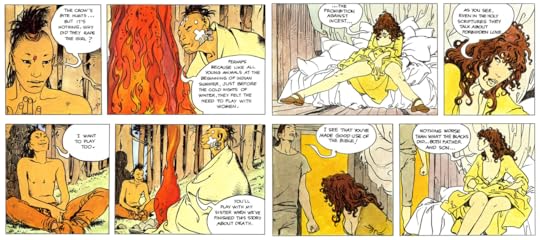
Another interesting fact about ”Indian Summer” is that as much of the nudity is meant to be disturbing as titillating, with some scenes clearly intended as both at the same time! More importantly, there is a clear philosophical point to this, since the story is full of deliberate values dissonance: Most of the characters constantly do things that are abhorrent to a typical modern reader, but at least acceptable if not outright required according to their respective cultures' moral codes, with this being a recurring theme in the story. For example, the most genuinely erotic of the sex scenes in the story is between 2 blood relatives. Something that 17th century Massachusetts Puritans did not consider inherently harmful, despite in almost every other aspect following a much stricter sexual morality than most modern people do!
Likewise, I found it noteworthy that none of the factions come across as morally clean by the authors' standards, not as collective entities – but several of the characters do as individuals. (Squando, Abner, The Devil Woman, as well as a couple more) I am pretty sure there is a point on Pratt and Manara's part in that.
If you're interested in a combination of serious historical fiction with exploitative sleaze and gorgeous artwork, ”Indian Summer” is definitely a worth a read, but people outside that extremely specific audience should probably approach with caution. I myself loved it.