Indonesian Ferry Sinks. Peruvian Bus Plunges Off Cliff. African Train Attacked by Mobs. Whenever he picked up the newspaper, Carl Hoffman noticed those short news bulletins, which seemed about as far from the idea of tourism, travel as the pursuit of pleasure, as it was possible to get. So off he went, spending six months circumnavigating the globe on the world's worst conveyances: the statistically most dangerous airlines, the most crowded and dangerous ferries, the slowest buses, and the most rickety trains. The Lunatic Express takes us into the heart of the world, to some its most teeming cities and remotest places: from Havana to Bogotá on the perilous Cuban Airways. Lima to the Amazon on crowded night buses where the road is a washed-out track. Across Indonesia and Bangladesh by overcrowded ferries that kill 1,000 passengers a year. On commuter trains in Mumbai so crowded that dozens perish daily, across Afghanistan as the Taliban closes in, and, scariest of all, Los Angeles to Washington, D.C., by Greyhound.
The Lunatic Express is the story of traveling with seatmates and deckmates who have left home without American Express cards on conveyances that don't take Visa, and seldom take you anywhere you'd want to go. But it's also the story of traveling as it used to be -- a sometimes harrowing trial, of finding adventure in a modern, rapidly urbanizing world and the generosity of poor strangers, from ear cleaners to urban bus drivers to itinerant roughnecks, who make up most of the world's population. More than just an adventure story, The Lunatic Express is a funny, harrowing and insightful look at the world as it is, a planet full of hundreds of millions of people, mostly poor, on the move and seeking their fortunes.
Carl Hoffman is the author of five books. The Last Wild Men of Borneo was an Amazon Best Books of 2018, a finalist in the Banff Mountain Book Competition and long listed for an Edgar Prize. Savage Harvest was a New York Times Editor’s Choice, a NY Times best seller, a Washington Post notable book of 2014, was shortlisted for an Edgar Award and has been translated into eight languages. The Lunatic Express, was named one of the ten best books of 2010 by The Wall Street Journal. He is a former contributing editor to National Geographic Traveler and Wired magazines and has traveled on assignment to some eighty countries.
Decades ago, I met a French-Canadian girl in Mexico City who hitchhiked by herself from Panama City to Mexico City. I was also traveling through Mexico by myself but I was amazed by her courage as a young woman to travel in an area that was considered to be quite dangerous at the time. Her response was that the only disturbing thing on her trip was being picked up by male drivers who spent the entire ride lecturing about both the danger and the immorality of traveling on her own.
As a lone traveler myself, I found that non-travelers exaggerate the dangers. With a few safeguards and conventional wisdom the dangers can be controlled. Yet the very possibility of hazards is part of the lure to the adventure traveler. Carl Hoffman took that to the extreme by traveling the globe and purposely picking those modes of transportation that are the most dangerous. Whether it was buses that regularly went over a cliff in Bolivia, ferries that regularly capsized in Bangla Desh, or trains that were regularly mobbed and robbed in Africa, Hoffman rode them. Hoffman intentionally throws out the safeguard. When he cannot be persuaded not to take a dangerous bus route in South America, he is told to at least do not travel at night. So he changes his plan and travels at night. Truly insane!
While the plain lunacy of this stunt makes for fascinating reading, the real message lies in the people he met on the way. No matter how dangerous the travel, Hoffman found kind and decent people who helped him and took him under their care. The other message in this book is that what we see as crazy and dangerous is the main mode of transportation for the great majority of the world. This was not "adventure travel" for them but the necessary way to travel and make a living. Things we take for granted while traveling like privacy, safety, and comfort is something out of their reach. The success of this book is to place the reader into this world and makes them realize that this is the norm for the most of Earth's inhabitants. Yes, read this for the escapism of travel but Hoffman does not allow you to lose sight of the social and political message in this highly readable and enjoyable book.
Meh. I suppose this wasn't horrible, but it got ponderous - the premise is that the author is going to ride/sail/fly on the riskiest transportation in the world, those with the greatest death rates - tries to pose it as some sort of adventure tourism, but finds out that these modes of transport are hardly skydiving - people take them because there really aren't any alternatives - and further the people he meets along the way are pretty decent and certainly don't think of themselves as adventuresome. Anyway, this death wish stuff gets old, and particularly obnoxious with a silly actuarial calculation of the likelihood of dying on the trip - if he take it a thousand times he has a 50% chance of dying on the trip. (Big deal - it would take him a lot longer than any ordinary lifetime to repeat this a thousand times - but dying of heart failure or a stroke or whatever old people die of is nowhere near as interesting, is it?) I also am annoyed by the author finding a magic friend in each locale, someone who speaks perfect English, who takes him home for supper - this succession of friends is not memorable, and even the author concedes at the end that his relationships with them are superficial. Further, this guy's bio sounds like he should have some experience, but he goes into a total panic when, horrors, he can't find anyone in a small Chinese city to speak English with him and lead the way! (Word to the wise - get the hotel clerk, who does speaks some English, to write out in Chinese what is wanted - a train ticket to Hohhut.) Finally, from personal experience, I can assure you that none of the ATMs on Columbia Road dispenses $100 bills - all $20s, just like everywhere else in the US.
Porque bebido demascado tequila Because he drank to much tequila
You have to either be crazy or drunk on tequila if you wanna take a trip with this man. Here’s kind of an example of his trip through the mountains in Peru by bus. The mountain road is very narrow and trucks that are coming down from the mountain have to squeeze between the buses. Some buses have actually gone off the edge. This means that people have been killed. And as for the bus. Whoa! At night, the cockroaches come out of the curtains, probably out of all the crevices that they can find and they fall on people they crawl over you. Only the women can use the restroom, but every 10 hours the bus will stop and let the men off to use the bathroom, which bathroom is in the street. Young boys, who can’t hold their urine that long urinate out of the window. I wonder how much ends up back in the bus? This whole trip that he took was just suffering. And he took a train a through India, People crowed ln. You only had standing room some got on the roof of the train others hang on to whatever they could on the outside of the train. Many more deaths a year. And it goes on and on and on.
Note :
I wish to thank my husband for helping me by writing out the song. It’s not easy for me to do since I can’t see. And I have to say that I took the liberty of changing the last sentence of this song.
The author left much to be desired--his writing didn't flow for me and I had no sympathy or feeling for him at all. Repetitive vocab and themes in each chapter (it was miserable/dangerous/smelly/crowded on the bus/plane/train/boat but I felt alive/connected to the world, etc. etc) made it hard for me to care, not to mention that he glossed over familial issues and never gave a resolute answer for how things ended or changed with his wife and family. Might not matter to all readers, but it mattered to me and I was expecting some sort of catharsis which never happened. Rarely do I find a travel-themed book I don't like, but I would not recommend this one.
2.1⭐ Disappointing, would be my one word summary. The premise was interesting but the product was too superficial and self-centered to be valuable, in my opinion.
Carl Hoffman had traveled on a sketchy airline in Africa while on a writing assignment. He'd also read the same news items as the rest of us about the plunging buses, crashing planes, derailing trains and sinking ferries of the Third World. From this was birthed Hoffman's high concept, he would seek out these "Most Dangerous" methods of transport and write about them. This book is not journalism but a travelogue by a kind of disaster tourist.
Hoffman's theme is that in poor countries poor people travel poorly: in badly serviced, overcrowded, uncomfortable vehicles; on dangerous routes. Because they often must do this to make a living, he sees it as noble. Europeans and North Americans also commute or relocate great distances to work but because it's relatively low risk he's uninterested. To his credit Hoffman acknowledges this admiration ( and motivation for the book) is fuelled by his own adrenaline addiction.
He argues that the cost cutting, overcrowding and risk taking is necessary to make transportation affordable in poor countries. He largely ignores the underlying reasons behind the situation, the lack of knowledge of better alternatives and mostly, the endemic corruption that siphons money away from maintenance, infrastructure and regulation. When he does mention corruption, it's low level. He considers it a major revelation that Kenyan bus operators must pay daily bribes to police in order to operate ( having failed to notice it for himself despite spending a day on the buses). There is an interesting description of how some Latin American countries deal with bus safety. Being unable to effectively regulate bus companies, governments require them to publish their fatality records, putting the onus for safety on the traveler.
There is some interesting information and some good description in the book but they're overwhelmed by Hoffman's constant ( and repetitive) recounting of his feelings at any one moment. The return doesn't justify the effort in the reading, again, in my opinion. There's also a contrived and calculated element to this book that turned me off. "The Cynical Express" would be another possible title.
It reminded me of another high concept book, John Stackhouse's "Timbit Nation," in which the author set out to discover Canada's soul, by hitchhiking (partly) across the country. In both cases the books turned out to be more about the process of writing them and about the authors, than about the people along the way. -30-
I'm sure that anyone who has "travelled rough" anywhere in the Third or even Developing World* has at least several similar stories to share,** but The Lunatic Express - Carl Hoffman's epic "hold my beer" response - definitely puts all of us to shame, if only in terms of sheer volume. I mean…goddamn.
While I appreciate some friends' comments that this was more memoir than travelogue, I think that was his intent, a Conradian exploration of both the outer world and inner soul, (and indeed "Carl Hoffman" is a key character in all his books, whether deep in the heart of Papua New Guinea, or deep in Red State America attending an endless string of Trump rallies).
Officially, the "Lunatic Express" is a century-old term referring to the "impossible" railway built by the British to connect Lake Victoria to the Kenyan port of Mombasa, and which featured in the under-appreciated 1996 film "The Ghost and the Darkness." But it is also a perfect description of both this book and its author's epic, if self-flaggelating, quest. When not off on any of his insane adventures, Hoffman (author of the equally great The Last Wild Men of Borneo: A True Story of Death and Treasure and Savage Harvest: A Tale of Cannibals, Colonialism, and Michael Rockefeller's Tragic Quest for Primitive Art) lives here in nearby Washington, DC - I'm really gonna have to look for him at local book signings, or DC's annual National Book Fair, because this is one crazy sumbitch I would really like to have a beer with. ____________________________
* And just why do we talk about the First World and Third World - at least previously, before the term (rightfully) became politically incorrect - but rarely if ever the Second World?
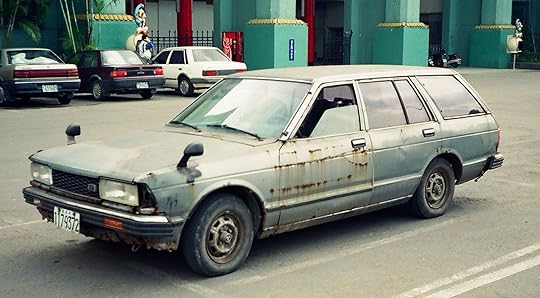
** I don't want to bore anyone with stories (my lovely wife, reading over my shoulder comments "well, that will be a first!"), but I thought it would be fun to at least include the below photo, which is the only car I owned (in Taiwan) between 1978 and 1993:
Here in the U.S. we take it as our due that we have clean, comfortable, reliable, safe modes of public transportation. How rare and fortunate is that circumstance, as I learned from this book.
Carl Hoffman spent five months traveling around the world seeking out the most notoriously unsafe means of conveyance and braving their discomforts as a passenger. Bad enough that these boats, trains, buses and planes have made news by killing hundreds, sometimes thousands of people. They're also crowded, stinking, unsanitary, vermin-infested, uncomfortable, and extremely noisy. Not to mention often painfully SLOW, so you get to be miserable for as long as possible!
This trip wasn't just a lark or a chance to show off, although Hoffman does admit to a thread of the daredevil thrill seeker in himself. He wanted to call attention to the fact that the people who ride these conveyances have no choice. There are no alternatives.
In India, people risk their lives daily just to travel to and from their jobs. The trains are so overcrowded that there are several deaths EVERY DAY as people fall off or are shoved off by other passengers.
In Indonesia, overloaded ferry boats sink, drowning hundreds, sometimes thousands. In one instance, Hoffman counted only 13 life rings and NO life boats on a ferry carrying hundreds and hundreds of people.
Nearly 3,000 people PER DAY die on roads in Latin America---roads declared the most dangerous in the world by the World Health Organization.
Sure, we're heavily regulated here in the U.S. with regard to safety measures. It may seem excessive at times, but the alternative is appalling. Dying on public transportation is a reasonable expectation in much of the world.
This is a superbly written, fast-paced, honest story. Carl Hoffman is a long-time journalist, so he knows how to keep things right and tight and moving moving moving. None of the long boring descriptions common to many travel accounts. He also shares the gradual personal transformation that took place on his journey. People around the world received him affectionately and shared their meager rations with him. He contrasts this with the selfishness and rudeness that is sadly becoming the norm here in the America.
I enjoyed the travelogue aspects of this book and getting educated about the appalling standard of travel in other countries. There's no such thing as "safe" travel anywhere, but in an unregulated environment, it is a total nightmare.
But I was frankly repulsed by the writer's willingness to subject others to emotional and physical duress... and outright danger... because of this self-centered quest for a thrill ride. OK, maybe he's estranged from his wife, but that doesn't justify inflicting months of emotional distress on her, his friends and family, or especially his kids. And to bring a college age daughter along for a dangerous and tortuous bus ride through South America? Unacceptable. I wonder what his wife had to say about that? And how do you justify hiring a guide to take an unnecessary, frivolous bus ride through a Taliban held area, when you know that guide will likely be killed if/when you are taken hostage?
The author complains about self-centered white "world-travelers," insisting upon their comfort and Anglo/American oriented luxury while in the middle of squalor. Yet he fails to see how he's being even more outrageously self-centered.
At least the luxury seekers aren't putting other people's lives at risk!
I'm in agreement that travel for its own sake is a worthwhile endeavor... expanding your world view beyond that of your culture, that's commendable.
The writer was obviously working through a King Kong sized mid-life crisis through this phase. I hope he got through it (the book doesn't indicate he has). To his credit, he doesn't spare himself criticism. Then again, he doesn't recognize all the ways in which he SHOULD BE self-critical.
As to the travel, the cultural revelations and observations are very interesting, but he paints the Third World poor as angelic, generous, selfless and all happy-to-be-here-even-though-we-have-nothing. Americans, on the other hand, (especially on his return trip, perhaps an emotional low point) he portrays as universally fat, unappreciative, ungracious, selfish and boorish. That's just too broad a brush in my book. I think human beings are largely cut from the same cloth, even though we are economically, socially and geographically different. We all can aspire to be something better. We all can be base idiots. We can all be selfless or selfless, gracious or boorish.
So what I took away from this book is that you've got to find grace and peace wherever you are... and find it with the people you happen to be with... even if that's your fellow Americans or, god forbid, your own family. I guess in that sense, I really got something out of this. But it hardly seemed to be the writer's intent. He finds peace, but only as an outsider looking in. This all results in kind of a depressing read.
A round-the-world trip, using the most dangerous methods possible. It's when the book is describing the conditions traveling this way that the book is at its most fascinating. The speeding, teetering buses, the overcrowded ferries, all fascinating. It was the author himself who gave me pause. On more than one occassion, he criticizes tourists who refuse to travel in anything less than (comparable) luxury as self-indulgent. This may be so, but how is his trip any less so? At the beginning of the book, he writes that a friend calculated his survival odds as 50/50, and he actually brings his daughter on one leg of the trip. While the information he provides is itself valuable and very interesting, he himself is not so much.
Its an amazing travelogue.Its a book about how poor people travel.Its a book about those risks each commuter takes in his daily life.The only thing missing is the photographs.Thats why I rate it as a four star book.
1. I love to travel. I love the timelessness of travel, and I love seeing how people live in this world. 2. I love the random conversations and interactions that come from travel. They get me out of my little life and make me re-think my assumptions. 3. I am too old and rigid for the kind of travel Hoffman does. I am no longer enchanted by looking out bus windows at 1700 foot drop-offs, and I no longer want to think about wearing shoes with thick enough soles to navigate Indonesian train bathrooms. I remember what sloshed around in there.
Hoffman travels around the world, using all public transportation that actually transports the public. He rides commuter trains, local buses, inter=island ferries, and, when given a choice, he seeks those with terrible safety records (which he happily publishes at the beginning of each chapter). He meets people, makes friends, sleeps in places where cockroaches rain from the ceiling.
But he's right: the saddest travel in the world is on an American Greyhound bus. Somehow, there's none of the romance or charm of an Indonesian ferry or an African train. The people aren't glorious or hopeful or friendly or helpful or generous, as so many were in his trek around the world: they're just downtrodden and sad.
I'm glad he wrote this book. I learned a lot from it, including the fact that vicarious travel has its virtues.
More in-depth self-analysis and self-discovery than mid-life crisis, via an insane trip around the world. I enjoyed the passages in India, Bangladesh and Afghanistan the most, where I felt the author really connected with people rather than just experienced a dangerous method of transportation in a solitary but group experience. A passage that resonated with me from his time in Bangladesh: "We ate with our hands, Fardus urging me on and on, displaying a hospitality and generosity that felt overwhelming. Again, I had so little to offer; nothing, in fact, but myself. As always, my feelings were complex. Part of it looked idyllic: a quiet village, closeness of family and town, a place where you could be known and loved by everyone. And part of me know the idea terrified me. It was the fundamental struggle of my life, between being connected and being separate, between being part of a group and being alone."
Self-involved man strives to torture his wife and kids by choosing to travel by the most statistically dangerous mass transit available in various third world countries so he can feel connected by having “meaningful” interactions with strangers (thanks to his English-speaking/American identity/white skin).
His adventure is a raging mid-life crisis, but an ordinary reality for all the other transit riders.
No big lessons or surprises here. Just whiny, self-aggrandizing talk. Pass!
I heard Carl Hoffman on Rick Steve's Travel podcast and thought it might be a fun read. I had a difficult time enjoying it once I discovered the author was a middle aged man with three children he left behind and a wife he was estranged from. At the back of the book it details when he left on this 159 day adventure that according to an experienced actuary had a 50% chance of death. That was hard to swallow but I read on trying to ignore this fact and the angst in the hearst of his loved ones that may not see him again.
Hoffman, who was a contributing editor of the National Geographic Traveler, was fairly well-traveled to odd spots before he began this adventure. He sought out the way the average person in the developing world travels, by buses, boats, and trains, to explore the lives closer to the ground than impersonal airline travel.
He admits that a fundamental struggle in his life has been between connections and being separate. He was recommended to read East of Eden by Steinbeck and said it was all about "men's complex stunted emotional lives..." and he was hit by how checked out he'd been for so long. For Hoffman risk taking is obviously a very powerful aphrodisiac. What he discovered was that almost everywhere he traveled he met people with much a different need for alone time and personal space. People with much less material wealth had much more connection to family and community and much more willingness to share what little they had. He ran into great poverty but people seemed much happier and possessed a peace he'd never uncovered in his own life.
By the time he got to Kabul I was a bit bored with his lust for risk and began to question his putting others at risk by hiring them to be his fixer and guide in the most dangerous places. Certainly if he wanted to risk him own life that seemed difficult enough for a family man but to risk the lives of others in difficult economic circumstances, to me that seemed irresponsible. What about their children and families?
Having said that, his book was an armchair traveler's look into modes of transportation they likely would avoid as it wouldn't be likely they'd have the luxury of time to take such a journey and likely they'd come to their senses before setting out on such a wild ride. I guess there were some things I wanted to know more about that he didn't include like what he carried along the way and how he thought he was safer with a concealed knife he likely didn't have the nerve or skills to use.
I did relish the fact when he got back to his hometown of Washington DC he called his wife, waking her up, to ask her to come and get him the last leg of the trip and she told him to take a cab! Right on sister.
I sensed he married too young and had too many unresolved deep family issues that kept him on the run that likely wouldn't go away after this 6 month journey across many continents.
This was our book group selection for August. It was actually a perfect read for me, since I love to read travel-themed books during the summer. Carl Hoffman decides to travel the world and attempt to take the worst/most dangerous modes of transportation. As Westerners, we cannot fully appreciate the ways that the average person in the rest of the world travels. As “average” Americans, our closest travel comparison might be the crowded city bus or possibly a Greyhound bus across the country. The fact is that people all over the world take transportation daily that we would find completely unacceptable. They have no choice: either it is necessity that compels them to use these forms of transport (they must get to work or earn a living) or it simply is the only mode of transportation available (either financially or literally). Frankly, I found the descriptions of some of the travel conditions distasteful. Having the smell of food, sweat, feces and other odors is just beyond what I can bear. I know I’d have a hard time with the whole “personal-space” thing as well. But Western cultures in general are individualist, whereas non-Western cultures are often collectivist. Hoffman points this out several times when he says that HE was the oddball for travelling alone; everyone else travelled with family or with others. It also explains why these folks are more tolerant of the conditions (odors, personal space, where to sit, etc) than Westerners are. Collectivism considers “what’s best for the group?” and individualism asks, “what’s best for me?” For modern affluent people, travel often means tourism; comfort, space, cleanliness and food are priorities. For the poor of developing nations, travel means work, family and opportunity; just getting there cheaply is all that’s the priority. Carl Hoffman’s adventure led him to some pretty deep soul-searching; I understand his dilemma. Some of us can settle in one place and be content, and others must always search for their bliss. I hope he finds what makes him happy. I’d recommend this book to anyone who would like to experience a taste of travel the way the “rest of the world” travels…without actually having to endure it. 3 stars
Ich habe vermutlich den Fehler gemacht das Buch auf deutsch zu lesen, der Schreibstil war so gar nicht meins, aber evtl ist dies der Uebersetzung geschuldet.
Trotzdem habe ich das Buch verschlungen, da es mich wieder zurueck auf/in meine eigenen Reisen mitgenommen hat. Die Situationen in denen sich der Autor wiederfindet, sowohl die zwar oberflaechlichen, aber ins Herz gehenden Begegnungen, die Tiefpunkte voller Dreck, Einsamkeit und Unruhe, als auch der Kulturschock bei der Rueckkehr in eine westliche Gesellschaft, haben mich meine Reisen in Gedanken erneut intensiv durchleben lassen, fast war mir als ob ich wieder die feuchte schwere Luft schmecken und den warmen Dreck auf der Haut spueren koennte.
Noch einen Stern Abzug allerdings fuer die oft oberflaechlich bleibende Erzaehlung. Die Schwierigkeiten enden meist mit dem Ausstieg aus dem Transportmittel. Aus Erfahrung weiss ich das das Rumirren dann oft erst beginnt, Verstaendigungsschwierigkeiten, das Verhandeln der Zahlungsmodalitaeten und die Suche nach einem Platz zum Schlafen werden wenn ueberhaupt nur am Rande kurz angeschnitten.
Zu guter Letzt hat mich das Buch leider auch etwas traurig hinterlassen da mir ein weiters Mal bewusst wurde, wieviel mir als Frau verwehrt bleiben wird, die Chancen dass ich als Frau ohne Begleitung jemals so sorg- und arglos wie der Autor Ziele wie Bangladesh oder Afghanistan bereisen kann stehen schlecht, allein meine Erfahrungen in Indonesien wichen diesbezuglich deutlich von den seinen ab.
Fazit: Praedikat Lesenswert fuer alle die sich ihren Hunger auf die Welt bewahrt haben, fuer alle die sich erinnern oder im Schutz des heimatlichen Lesesessels angenehm gruseln und staunen moechten. Meine Empfehlung waere aber die Originalversion zu lesen.
The author seeks out dangerous transportation in developing countries. He tries to convince us that there's an element of emotional or spiritual growth to all of this. But I found myself unconvinced and asking why do this? In spite of his reflections on the experience, it still struck me as mainly backpacker bragging about the most spectacular budget travel adventures.
I probably should give this book another try as I've traveled buses in very remote places... But I can't get over the authors cavalier attitude toward repeatedly leaving his family. He strikes me as overwhelmingly selfish and his aire of carefreeness was just too much fr me to get past. So arrogant.
So by the end of this book, the author realizes that he embraces travel and other people in order to escape his life with wife and family..... big surprise. I realized this from the first chapter. When the narrator is not appealing, the book is always going to be horrible.
DNFd because if I wanted to watch a man in midlife crisis I’d go to the gym. After getting to the part (early on) where he drags his teenage daughter along with him on HER vacation, this after acknowledging how dangerous his travels are and how he’s made peace with it, I threw the book across the room and immediately googled to see if this narcissistic author was still married. No surprise to anyone who has read even a chapter of this book, he and his wife divorced sometime around when he came home from this ego journey he was on.
I enjoyed this much more than I thought I would. It's like a modern adventure story. So kinda sorta like Robinson Crusoe or stories of hiking the Himalayas, but in 2010 and (I suppose) less dangerous, but still not something you'd (at least I'd) wanna do yourself. Which is why it's great to read it, so you feel you know what the people and places and food and smells are like ... Without having to eat the food or smell the smells. As a gluten-free, plant-based vegan extremely sensitive to smell, I appreciated that.
Also the author came across as really sincere. Which is strangely rare for some reason(s).
Daily travel for the developed world is a relatively safe endeavor for most commuters. When newspaper articles kept popping up about how unsafe transportation in many nations is, Carl Hoffman decided that this would be an excellent experience to write about. So, he packed his bags and set out across the world to experience the world’s most dangerous modes of transportation. His journey took him to South America, Asia, Africa, and North America where he took planes, trains, automobiles, and ferries that would at the very least give most of us pause and would send most of us fleeing in the opposite direction. What he finds on his journey is an amazing demonstration of the goodness of people and a special connection that would not have otherwise been made had he not lived like the locals.
The book starts off with Carl Hoffman traveling to Cuba by plane—not just any plane--a fairly ramshackle and unsafe feeling plane. Well, I obviously knew that he survived his trip so I felt like I could roll with his adventure through the streets of Havana before he moved onto South America. By the time Peru rolled around, I wondered how many pages would either be ghost written or blank because I was truly terrified. You see, the roads in Peru are not good roads, AND they happen to hug some wicked cliffs. In fact, the introduction to one of the sections on Latin America included a news story of a bus that had disappeared of a 1,600 foot gorge. I have a small fear of heights…ok…a BIG fear of heights. My stomach is actually feeling a little tingly and weak just thinking about that section because I cannot even imagine being in a bus on sketchy roads that hug cliff faces. I was really glad when the Latin America section was over and Mr. Hoffman moved on to Africa.
Each section is preceded by a news story of some terrible transportation accident or physical dangers from people that might do others harm. It sets up each trip he takes as harrowing even though he is just a passenger. Every section was unsettling and dangerous, but the people he meets in each place transcend the danger and make the journey an interesting and worthwhile experience. If anything, the book helps restore some faith in humanity as complete strangers open up themselves and at times their homes to Hoffman. I found that beautiful and was thankful to see that despite language and cultural differences, there is a common humanity that people can exhibit especially when they have so few material things to give. This was my favorite thing about the book as Hoffman traveled around the world. It was a rare moment when his willingness to share the experience of the traveling poor wasn’t rewarded with an act of kindness. Even in places where the camaraderie was in short supply, there was usually a small incident that showed how wonderful people can be.
I also really enjoyed how candid Carl Hoffman was about his experience and his motivations to take the trip. It was more introspective and raw than I was expecting, and it made me enjoy the book that much more. I think it must be so difficult to express some of the internal trials that we all go through as human beings, but Hoffman shared a part of himself that I wasn’t expecting and his honesty was refreshing. The trip was as much about discovering where he was in his life as it was about discovering the world’s most dangerous transportation.
There was one thing I found lacking in the book. The map in the Kindle edition is not very easy to examine. I was lucky enough to have a paper copy that I could look at as well. While that was disappointing, it didn’t spoil my enjoyment of the book in the least. It was an amazing journey all-around and it made me look at travel in a whole different way. I can’t say that I would be willing to travel in a broken down truck with no heat in the cold desert of Mongolia, brave a war torn country like Afghanistan, or sleep on a ferry that I shared with thousands upon thousands of roaches, but it definitely makes me want to embrace more experiences that might cause some personal discomfort but will open the world to me in ways which I never expected. I enjoyed every moment of the book and highly recommend it if you are looking for a book about really off the beaten path travel.
**Note of Disclosure: I purchased my copy of The Lunatic Express for my Kindle, but I did receive a copy of the book from the author, Carl Hoffman, for a giveaway on my blog.
Carl Hoffman, the author, decides to travel the globe and decides to do it in the most dangerous ways possible. Surprisingly the most dangerous are those that on paper would seem the safest. Taxis, commuter trains and airplanes.
The author searched for the most treacherous of these and set off on the adventure of a lifetime. You takes trains in Africa. Boats in Asia and buses and cabs everywhere. What he discovers is that most people in the world if you join them openly and honestly are kind to their fellow traveler.
He also finds in under regulated societys "where life is cheap", this same kindness extended to the fellow traveler is not extended by the owners of the various methods of conveyance. Boats sink and hundreds sometimes thousands drown. In Kenya the commuter buses are death traps. In India local trains that he rides kill two or three people everyday.
Space is at a premium and it's not uncommon to sleep sharing your neighbors warmth. The holds of the ships he embarks on are crammed with humanity. Still he and his fellow travelers press on realizing that for most of the world's population this is their travel reality.
Too poor to afford cars but not so poor that they have nowhere to go. They battle their way into their cheap seats. They suffer what for us in the United States would seem intolerable. Poor santitaion, no space and little to no care paid to their personal safety.
The portraits of the people he meets are really the best part of this book. The author finds the dignity in most of the people he meets and seems genuinely appreciative of the many people who extend a hand of friendship. Some are returning home after long absences and some are starting out fresh to see the world. Others are grinding their way through the day. His relationship with the drivers in Kenya is particularly well told.
The author seemed to have had some things going on in his personal life and alludes to possible failings in his family life. I thought these should have been left out of the book because they detracted from the overall story and since they were never resolved they became a distraction that the story really didn't need.
I'd highly recommend this book to anyone who likes to travel a bit off the beaten path. I'd also recomend this book to anyone who likes to read about interesting people in a well written manner. The facts of the tragedies of the routes he travels mesh well with those who circumstance dictates must follow in thier footsteps.
1) What did his family say? 2) Why is it marketed as being all about dangerous transportation?
Okay, honestly, both of these are to some degree answered: there's no real discussion of what his family thinks, but we can infer that his wife first worries and then .
And while I understand that there was risk involved in many of the modes of transportation he chose, it's also true that it would be just as accurate to call this The Everyday Express: Discovering the World... via its Most Heavily Used Buses, Boats, Trains, and Planes, or something to that effect. In some sense I think that would have been a lot more interesting -- focusing on the 'danger' factor makes for a good tag line and in theory ups the tension, but...well, he wrote the book. You know already that he came out of it fine.
(Also? Mate, I'm sorry, but wake up and smell the white privilege.)
I don't mean to rag on the book overmuch. The writing was solid, and it makes for a good quick travel read; I admire (and envy) his chutzpah. I just really, really wanted better hard facts. Telling me that x people died traveling on y boat doesn't tell me nearly as much as it would if I knew how many people rode the boat in the first place. The appendix mentions "attached tables" that explain the actual risk involved, but where, please are the tables? I am curious! I want to see!
So, all in all, too much emphasis on the shock factor; not enough self-awareness; fun read.
Whenever my friends or family think that by traveling to Africa and Asia for work I am doing something risky, I should hand them this book. I have a hard time relating to someone who chooses the overcrowded Indonesian ferry, speeding Andean bus or rickety Afghan airline because he wants to experience the hardest possible means of travel. But the author is very honest about the psychological complications underpinning his travel decisions. Why should we choose to wall ourselves away from the gritty just because we're among the 10% who have the means to do so? Why shouldn't we test our mental strength by cramming into a crowded, dangerous vehicle where no one speaks our language for days on end?
One angle of the book was hard to swallow. At one point, the author mentions that our domestic airlines may be a chore to fly, but they almost never crash thanks to government regulations and adequate enforcement mechanisms. But at the end of the book, he is basking in the collective goodwill he experiences among the poor in developing countries -- how wonderful to be able to sleep soundly in tough surroundings, knowing that your new friends will keep you safe and expect nothing in return -- and bashing Americans' individualism. There is a strong strain of national disgust in much of development work, a belief that the poorest countries retain some innate goodness and truth that we've lost in our quest to become rich. As much as I can't stand the inequities around us, I don't believe things are this black and white.
While I quite enjoyed this book and flew through it, I found it to be a bit uneven at first. I felt as if it started off slow and unsteady- his journey down to South America via the Chinatown bus and then a notoriously bad airline via Toronto was glossed over in just a few sentences. It took a while to build up momentum... this happened slowly throughout his journey through South America, and for me at least didn't really pick up until his arrival in Africa. That's when things really started to come together, detail-laden, a really story as opposed to some detail here, a glossed over experience there. For instance, I wish he'd spent more time describing his leg of the trip he took with his daughter in a bit more depth and detail.
What I felt added a lot to the book, despite the occasional unevenness, was the fact that this particular tale was so personalized. Sometimes in nonfiction it seems the injection of too much personality can hinder the tale; in this case, it was very much enhanced by it. While primarily an account of traveling the world via its most inexpensive and dangerous methods, it felt very much like a memoir of this particular time in the author's life. His connections to his unfamiliar surroundings and strange people are particularly enjoyable to read about.
"The Lunatic Express: Discovering the World . . . via Its Most Dangerous Buses, Boats, Trains, and Planes","Carl Hoffman", "Hoffman seems to be drawn away from his home for long periods of time to travel. He is bored at home and thrives on the excitement of dangerous places. This time he chose to travel by the planes, ferries, trains and buses which had a record of the most accidents and deaths.He seems most content when squeezed in awful means of transport with masses of people. On the railway in Siberia he remarks that he is not experiencing danger, crowding and dirt, and is disappointed. Sometimes he wants to get away from crowds for solitude, but then has a need to get back into over crowded transport. He is fortunate to be befriended by the poor he meets along the way, who provide him with food, visits to their homes and tours, never seeming to want anything in return. One thing he doesn't seem to miss much is home, although he feels he should, and feels disconnected from it. His travel through Africa, South America, Asia where he encounters the way the poorest of the poor live and travel is informative. He was very impressed by the kindness of those he met along the way. I think he was the most lonely when he arrived back in Canada to take the bus into the USA and experienced the rudeness and arrogance of fellow travelers and Greyhound conductors."
So I have NO idea why this book has such a mediocre rating, given that I laughed my way throughout most of it. What a fun read!! I'm a sucker for a good travelogue, and I love reading about crazy adventures like this one! This is probably because I would never have the guts (or maybe part stupidity?) to travel in the fearless and, fair to say, reckless way that the author did, nor will I probably ever get to see some of the amazing places he has.
So it's part curiosity that led me do read this one, with a big chunk of envy thrown in. Here is a man who decides it would be awesome to travel using the world's worst and most dangerous methods of transport. What he ends up with is one helluva adventure, as well as an interesting tale to share with his readers.
Very well written (he's a journalist), interesting and insightful, this book quickly escalated from a decent 3 to an interesting 4 to an awesome, I-will-reread-this-one-day 5! Not only does the author share his experiences while embarking on this strange mission, but also does quite a bit of reflection on what it is he's doing and why. His opinions on the notion of "traveling" and how it means such different things to people around the world made this an entertaining yet touching read. I'm honestly surprised its rating doesn't average higher...really enjoyed this one.
Now I am all about making the transport part of a trip fun and interesting, but this book was totally extreme. Maybe I didn't read it to clearly either but did the author want to leave home or not? Did he care about his family? Sometimes it seemed like it and sometimes not. I did like that a lot of it took place inside his head as you don't have to talk to every single person that crosses your path as a lot of books like this may tend to do, at least on the page. I am a total introvert and it was nice to see that you didn't have to communicate with everyone to make a good story.
The author wrote about his travels around the world (not seeing anything, just transport. Pointless much?) on the most dangerous forms of transport that locals have to take everyday. It was a sort of suicide mission in those respects that of course, he survived. I liked that idea, but I didn't like that he put himself in those types of danger voluntarily when he had a family. It's like, did he not care about them? It didn't seem like he did. It's one thing to end up in those situations accidentally or for an article to make a point, but none of that came across in the book. It seemed more like, I'm board, lets jump off a building with no parachute and see what happens! Something was a miss.