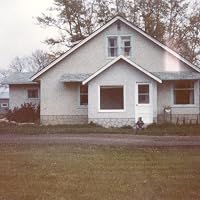
I finished this 4 days ago and am still thinking about Emma, wondering if she or a member of her family ever crossed paths with members of my family. Surely the Marcelin siblings must have known my grandparents - Marcelin is not that large. I worked in the bank in Blaine Lake, did I ever speak to any of her nieces or nephews? She lived at 435 Ave G South and I lived at 431 Ave S South - she died when I was 6. And just to cap it off, I signed my mortgage papers at the last law office she worked at in Saskatoon. I found the Duhkobor history in the first few chapters very interesting. It definitely answered why my Dad used to call me and my siblings "little Dhukobors" when we got out of the bath and streaked to our bedroom for our pajamas. He would have been in his 20's when the protests were happening and would therefore have been familiar with their preferred protest method. I had never heard of Emma or her story before, but I feel so sorry for her. She suffered such heavy losses at a young age, then she was so far from home and all support and was easily influenced by corrupt people who preyed on her naïveté. She was arrested and convicted as a spy, when in her early 20's. Some people would not be able to achieve their employment goals after being released from prison, but Emma eventually worked in 2 prominent law offices - one owned in part by the father of a future Premier of Saskatchewan (Emma mentored Ray Hnytyshyn through law school while she worked as a legal secretary in his Dad's office), then moved on to a law office partnered by John Deifenbaker, former Prime Minister of Canada. This book was written in the early 1980's, when many of the people in Emma's life were still alive and provided interviews and pictures to the author. Sadly, Emma passed away in 1974, at the young age of 54, leaving many questions unanswered.
I had this book for a while before I decided to read it as part of my 'bus readings'. I met June Callwood once or twice and liked her style - easy to read, with vivid descriptions, and making ordinary lives shine as they should.
It so happened that the first chapters on the Doukhobors were extremely interesting, especially connected to some other readings about the Doukhobors and their quarantine in Halifax harbor I was going through at the same time. The scenes later in the book about Doukhobor women in jail are particularly hilarious too. It is hard not to like rebels for my generation.
Then it became more intense as we go through the life story of Emma herself, possibly (but not certainly) a Konkin to become a Voykin by marriage, and I can easily understand how someone young who faced the loss of a baby and the loss of a husband due to poverty and no public health system can look at the USSR and marvel at the fact being proletarian and poor is no hindrance in the Soviet Union - whatever one thinks of the USSR literacy, health programs, technological and engineering progress, and of course fortitude and resilience to face fascism would make anyone look forward to work with the Soviet system, particularly if you spoke Russian sang Russian songs, and considered that to be a large and important part of your identity.
Let us not forget the Soviets paid the heaviest price to win WW2 by having to fight a relentless 4 years of Great Patriotic War. Whether Sokolov actually had sex with Emma will never be known to anyone but them, but my guess would be that he did - it is known today to have been a favorite NKVD (KGB) technique to make agents espouse the cause on an unconditional emotional level, whether the handler was male or female, and Emma's infatuation with Sokolov and his wife is obvious, strongly suggesting an emotional-sexual connection of some sort with Emma in a somewhat submissive and dazzled role, but fully enjoying it.
After all, years later, she would certainly have a healthy sex life with Louis Sawula, her Ukrainian husband. Not to mention playing card games with the men and being able to drink some of them under the table. I sense everywhere, that there is a deep well of emotional Emma under the surface Emma. i sense that Sokholov may have tapped into that well, and that this was probably why she 'spied' as a natural thing to do for someone so close, possibly never realizing of course that she was being played like a keyboard.
What exactly Emma passed on to the Soviets is unclear and will probably never be known: from the book, it all seems unconsequential, and would lead to believe that she really didn't pass on anything important - but obviously if she had we wouldn't know it. We may even imagine that, as cipher specialist, she would have been watched very carefully, and not only by Canadians. I tend to think that there is a lot more we'll never know. Her sentence looked short for a 'real' spy, long for someone who had apparently not given that many 'secrets' to anyone. Why the RCMP seemed to keep putting pressure on any employer she might have had is rather distateful once she paid her jail dues - it is like they simply wanted to destroy her and never believed she wasn't an awful 'traitor'.
In 2021 there is no need to tell us the RCMP is far from having had a stellar behabior in many cases, but then there probably still was some respect for what they were supposed to incarnate.She did find work again after that, and in environments where nobody was ultimately bothered by her being a threat to confidentiality. She was a loving wife and ended her life in a decent, lower middle-class environment far from the dire poverty of her beginnings, and would probably have made better than just a legal secretary if she had had the chance, however good she was at it.
What the book makes clear is the fact that, between a highly professional British system for anti-spy surveillance (Gouzenko will be interrogated at Camp X by the M15, and the Canadian services in this book look pretty much like the Keystone Cops to say the least, with a few playing more sadistic jailers to compensate, I guess) and a new and still 'cowboyish' US system obsessed with anti-communism, Canada is viewed as a transitional battleground by many, just as it will be years later with djihadists. The government clearly wants to make a statement and a case, resorting to extreme heavy artillery with the War Measures Act and the lifiting of civil rights, not so much, supposedly, for what someone like Emma may have shared (unless of course she shared stuff we'll never know about) but about the fact a Canadian trusted by three countries may actually be a 'traitor' and share secrets.
Emma serves as a warning: do not breach your oath even though you do not share secrets with an enemy. It is hard, though, not to feel sorry for Emma as the sacrificial lamb in this, when we think that in Britain Philby and his friends were fully enjoying their status as Soviet spies, sharing freely whatever came from their own government, Canada, or Washington - none of them to spend one day in jail because of it. Underneath it all might be a somewhat sexist view : driven more easily by their emotions, women may spill secrets more easily than men. Which is of course...bs. Oh yes, it also shows a Canada so different then, and not only about prices, and a Liberal party clearly high on patronage when it came to nominations and abuse of the Old Boy's network.
I am not going to 'reveal' everything, but the last chapter (14) raises many questions. There has always been a hint that Emma was not the daughter of her 'official' Konkin father, and this seems to be made clearer as her supposed father leaves her an inheritance - besides the fact she doesn't look like the other Konkins. Much is made of the fact she's a strongly religious woman most of her life (although there are times when she will clearly lose faith in the world) but the Doukhobor faith is both very emotional and based upon pillars certainly quite different from others - and you gradually get the impression there is clearly a personality under the 'social' Emma which is profoundly different from the one everyone sees.
She finally got to go to Russia and the Soviet Union, but here the tale gets muddled. What happened there? Did she meet one of the Sokolovs, even getting her picture taken with her? Did she discover a side of herself that she always wanted to live by, more than the other? Emma is clearly someone who lived her life between two worlds, and the Anglo-Canadian one was definitely not the most important one for the private side of her. Did she really become an alcoholic as she came back from the USSR? Going to Russia was not unusual for many people of Russian or Soviet origin in the Canadian West. She may not have known the intellectuals who thought communism was the solution to all of Canada's ills, but she certainly knew many Russians in folk music groups, Canada-USSR friendship societies, and the like.
A character who might in the first chapters look like a 'mousey' little woman with nothing special to her, comes out much more complex as we follow her story, and yet we would love to know more, because there is a feeling that some dimensions of her are just not explored in the book, and maybe they couldn't. Why, for instance, did she start - and stop - painting, even considering a career as an artist after she would get out of jail?
With hindsight, of course, some items in the book seem surprising. The Canadian PM afraid to offend Stalin by mentioning that some people in Soviet embassies abroad might have been spying. We tend to wonder if this is for real, but since MacKenzie King had, after all, met Hitler in the 1930s and decided he was a naive German Joan of Arc, everything is possible. Now we know that very little was decided about Soviet policy abroad without the OK from the Moscow Kremlin. We also know that, had Gouzenko not been able to defect, he might well have ended his career in a gulag somewhere, and this was quite possibly the fate of several of the persons denounced by the Canadian investigation, including Sokholov. Had Emma, in the USSR, when she finally went there, discovered that there were two sides to the country she would have loved to live in?
With hindsight still, some items are not surprising, though. The fact you should never trust governments blindly, because there may be many reasons why governments do things, and sometimes secretly, that do not take the individual person into account, despite all the claims that democratic governments work for the better good of all. The fact you should never trust police forces, because even when they interrogate you, they lie to get you to talk, and rarely have to asnwer for what would be for any of us highly improper behavior. We now know Canada has many faces, and in some cases unsavoury ones, like any country. Maybe the real wisdom is to be a Doukhobor, after all. When pressured to do something you do not want, take your clothes off, and start chanting.
Who was the 'real' Emma? Certainly not a 'communist' ideologue or a Westmount millionnaire Marxist, but certainly an apparently plain but lovely woman, but also a very bright one who shone and eben exceeded standards both as a ciber specialist and as a legal secretary, a creative one who could have been a significnt visual artist, someone who could have been part of a Russian folk group with her first husband, and a woman who had deep emotional scars and many dreams she was possibly never able to share.
Except that...June Callwood has, through the magic of this book, biopic, documentary, detective and spy novel, shared as much of Emma as we may be able to get to. Going back to the 1930s and the 1940s, discovering archives...and big gaps in archives, interviewing people in the 1980s. If you Google Emma Voykin you won't find much. She was no Mata-Hari with the sexual glitter of that well-known, although quite inefficient, German spy. If anything, she was a working girl, poorly paid, who was nabbed not so much for revealing huge secrets - no Uranium in diplomatic pouches for her - but simply for not respecting her oath to the Canadian government, an even more sensitive issue since her minister was also the prime minister, desperately trying to disassociate himself from her. I found some info on her on a Sandy Hill webpage, and that was it. I found pictures that showed her a lot less 'plain' than the book makes her at times.
Through this book I shared the life struggles, failures, disappointments and small successes of a fascinating character, at the crossroads of so much in so few years after all, since she died in her 50s. I just hope that she was, in whatever Doukhobor paradise that may exist, reunited with the baby who died at birth, and that the hospital protocols of the day did not even lend her the right to hold the body, still warm but still so close to her mother, to say goodbye.
Thanks to those who fought, starting with the CCF and Saskatchewan, for a universal health program that would ensure that no mother was denied a Caesarean if it avoided her baby to die of strangulation with its umbilical cord. Thanks to the Soviet Union for having developed high standards of public health and not just a medicine for the rich. Thanks to all those who have made Canada more social, more humane, more open to new dimensions ensuring equality and enabling Emmas to reach their full potential.
Isn't what June Callwood does the very aim of literature, make sure we do not forget people, and not necessarily kings, queens and princesses - there's Hello Canada for that - but ordinary people, in all their complexity, in all their difficulty to tell us how they really feel, something that the writer may, despite cultural and other differences, lead us to experience.
3 1/2 stars. My July NF book is an old one and it was time to read it again and pass it along. Callwood writes and interesting story about a little known Canadian woman, Emma Woikin, born a Doukhabor on a farm in Saskatchewan who became a cipher clerk in Ottawa and was accused and jailed as a Russian spy. Her story was a sad one and it is my belief after reading this book that Emma was unjustly jailed. I enjoyed this peek into the past and it was an interesting read
June Callwood is an excellent author. She begins this book with a history of Doukhobors in Canada and I found this very I interesting as I'd read nothing about them before. I did start to wonder when she'd start talking about Emma but eventually she got down to her in the third chapter. Emma was raised as a Doukhobor in Saskatchewan between the two World Wars, being the youngest of a family of 5 children. Her childhood is very happy but she has a tragic life as a young wife. Her baby dies tragically and soon after, her husband commits suicide. She is lucky to have much family support and lives with her brother and wife for a while. Finally though, recognizing she is too slight and delicate for farm work, he pays for a typing course for her. She got a low paying job in Saskatoon but finally moved to Ottawa where her intelligence and work ethic wins her supervisory office work for the federal government. It is the days of WWII. Everything is changing and uncertain. Emma makes friends in many governments departments which eventually lead to aquaintances in the Russian embassy. She is approached about sharing Canadian documents for money. At first she turns the offer down but finally agrees and delivered papers 4 times in different ways. She does it out of loyalty to the people whom she thought were her friends but also, out of a romantic view of Russia as her family's original homeland and the country where she wouldn't have lost her child and husband if they had been living there. It all falls to pieces when a Russian embassy employee defects to Canada and informs on all the Canadian government employees who were smuggling information through the Russian embassy, a spy ring of 12 or 14 people. The court cases cause havoc in the news for months. Emma was sent to Kingston Women's Prison for 3 years. Her prison experience was bad enough for a vulnerable, impressionable young woman but her life after prison is the time that tested her beyond her endurance. This book is a revealing commentary on wartime Canada, on prison life, and on the life of one young woman's life when she is removed from the protection of a supportive family at a vulnerable time in her life. The author diverts from the main topic a little too often, describing Emma's brothers' lives, as an example. However, these stories were also interesting to me because I'm interested in people's stories from the past. Thus is a book to make people think and is very successful at that.
It was very interesting to read about my family members history, considering they were a Russian spy. I feel like I need to go see some of these places now in Saskatchewan to get more of a feeling where some of these events took place.