The Earl of Rothingham was a rake, an unrepentant rake. All of Regency England declared him so after the Prince of Wales requested him to marry his mistress--Lady Elaine Wilmot--and he refused.
But the Earl was not a cruel man. And when, while riding in the country woods one day, he came upon a lady in distress his heart was touched. The lady was Syringa Melton-- young, innocent and ethereally beautiful. Hard times had fallen on her family and she was forced to give up her most cherished possessions.
Out of kindness and pity, the Earl brought Syringa to London to start a new life. But it was a grave mistake. Lady Elaine was waiting for Syringa--waiting to trap her in a bitter and treacherous web of jealousy, intrigue and near-death.
A dramatic novel of embittered passions and noble love by the world's best-loved writer of romantic fiction.
Born in 1901, Barbara Cartland started her writing career in journalism and completed her first book, Jigsaw, when she was just 24. An immediate success, it was the start of her journey to becoming the world’s most famous and most read romantic novelist of all time. Inspiring a whole generation of readers around the globe with her exciting tales of adventure, love and intrigue, she became synonymous with the Romance genre. And she still is to this day, having written over 644 romantic fiction books. As well as romantic novels, she wrote historical biographies, 6 autobiographies, plays, music, poetry and several advice books on life, love, health and cookery – totalling an incredible 723 books in all, with over 1 billion in sales. Awarded the DBE by Queen Elizabeth II in 1991 in honour of her literary, political and social contributions, she was President of the Hertfordshire branch of the Royal College of Midwives as well as a Dame of Grace of the Order of St John of Jerusalem and Deputy President of the St John Ambulance Brigade. Always a passionate advocate of woman’s health and beauty, she was dubbed ‘the true Queen of Romance’ by Vogue magazine in her lifetime. Her legend continues today through her wonderfully vivid romantic tales, stories that help you escape from the day to day into the dramatic adventures of strong, beautiful women who battle, often against the odds, eventually to find that love conquers all. Find out more about the incredible life and works of Dame Barbara Cartland at www.barbaracartland.com
But the story was hugely entertaining and the OW both got their comeuppance, so I didn't feel like penalizing it with a low rating.
His *official* mistress, who's been set up in a small house, is a ballerina named Michelle while his *unofficial* mistress is an aristocratic widow named Lady Elaine. Lady Elaine doesn't have a significant widow's portion, so the H's been paying her bills. Luckily, he's super rich after travelling to North America and the East and investing in a lot of trade and shipping ventures.
Elaine's determined to marry him, so she leverages her friendship with Mrs. Fitzherbert ( the Prince of Wales' mistress ), to get the Prince to make that suggestion to the H. But the H's not a moron who'll let Prinny decide the course of his future:
“I am yours to command, Sire, where my service, my sword and my fortune is concerned,” he said. “But as regards marriage, I must beg your leave to choose my own bride.”
The Prince of Wales shook his head.
“Mrs. Fitzherbert will be disappointed.”
“And so unfortunately will Lady Elaine,” the Earl added.
And when Lady Elaine begs him to marry her, he replies with mocking chivalry:
“You want me and – I want you,” she said her voice deep with passion. “Oh, why – why will you not marry me?”
“You are too attractive to be shackled to only one man,” the Earl answered and she knew that he mocked her.
And, he visits his official mistress, Michelle, right after leaving Elaine's house. But he's there to dump Michelle, because she's been banging some impoverished actor and that offends him:
He put his fingers under her chin and turned her face up to his.
“I have an aversion to anyone keeping my bed warm when I am not in it.”
“Do you think I could take another lover when you ’ave been so kind, so very kind and generous to me?” Michelle asked. “Hélas! Just ’ow could you think such a thing of me? ’Ow can you imagine I am such a low creature?”
“I think you protest very eloquently,” the Earl said with a sarcastic note in his voice. “And I should suggest to your friend that the next time he visits you he should be careful not to leave his gloves behind. Such forgetfulness is so easily misconstrued.”
So, it's kinda hypocritical of him to get mad at Michelle for cheating on him, when he's also involved with Lady Elaine. But I guess the circumstances are different, since he's the one paying her to be exclusive and not vice versa.
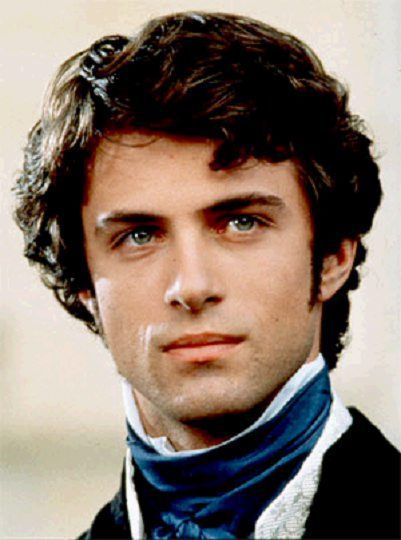
This is the H, the Earl of Rothingham:
Anyway, after he dumps Michelle, he sets off for his country estate ( that he's not visited in a decade ) where he ends up meeting the heroine, Syringa.
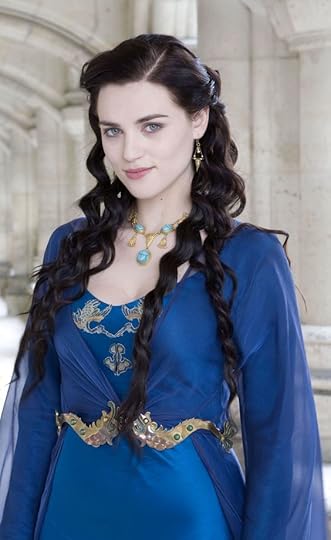
This is the heroine, Syringa:
Syringa is about to become homeless, because her father owes money to lots of folks and tradesmen. Soon, the house and its contents will be auctioned off. Syringa is most upset at the thought of losing her horse, Mercury. The H finds the girl, in the Home Woods, crying and petting Mercury.
He's immediately enchanted with her and wants to make her happy once again. After this one meeting, the H sends his representative to the auction and the latter purchases everything ( including Syringa ! ) on the H's behalf. Syringa's drunk father had added her to the auction, before blowing his brains out.
The H then takes it upon himself to act as Syringa's guardian. The heroine doesn't want to go to London for the season, but she agrees out of gratitude for all that he's done for her, her nanny and the horse. In London, the scheming Lady Elaine, realizes that the H has become more relaxed and seems happier than he'd ever been before.
She figures out the reason for this, and the H's lack of interest in her, when she visits his townhouse and meets Syringa. Lady Elaine's jealous and peeved when she observes the mutual affection between the MC's.
This sly, viperous OW even devises a plot to frame Syringa for theft and have her thrown into Newgate prison. She hasn't given up on coaxing the H to marry her and she persuades his loser cousin ( next in line to the earldom ) to assist, by reminding him that he'll no longer be the H's heir, if the latter marries Syringa and sires a son.
The most frustrating part of this story, is that Syringa is so naive that she practically walked into the trap with a glowing smile. If it hadn't been for the heroine's nanny, the H wouldn't have known that Elaine and his cousin had been up to no good.
The poor heroine suffers for a few days, in Newgate prison, before the H turns up to save her. She'd traded an item of jewellery for a private cell. But the cruelty of the guards, the screams of the other inmates, the rank odours and the inedible food combined to make the experience extremely traumatic for the heroine.
The H ensured that Elaine and his greedy, ambitious cousin were punished. He banished both to the continent and it's implied that life would be extremely hard for them, since they'd have little money to live on. Elaine had been living off of her lovers and the cousin was bankrupt and owed gambling debts.
If either, or both, ever returned to England, the H would have them imprisoned in Newgate. I really wish they'd been thrown into Newgate, so they could bask in the grime, starvation and cruelty. But I understood why he wanted to avoid creating a scandal that would tarnish his ( and the heroine's ) name.
It was great to imagine Lady Elaine having to become a professional courtesan somewhere in Europe. A crappy human being like her, deserves to have to survive by her wits, especially after what she'd done to Syringa.
Safety: There's a fade to black sex scene between the H and Lady Elaine, at the beginning of the novel. That's before the H met the heroine. There are, as usual, no sex scenes and the MC's just exchange cute, passionate kisses.
This entire review has been hidden because of spoilers.
This was okay. I think i must have read this years ago when I was a teen gobbling up every Barbara Cartland I could get my hands on, as many details were familiar.
Its one of the cookie cutter ones, the only thought I had at the end was that, since this was set in 1790, I was hoping the villain and villainess had fled to France only to be caught up in the French Revolution and get guillotined as well.
That would have been a great epilogue to this tale.
Reviewed for THC Reviews The Ruthless Rake is a short, stand-alone historical romance that’s set in the Georgian time period. Our hero, Ancelin Roth, the Earl of Rothingham, is an unrepentant rake who is also known to be ruthless in business. One day, while riding at his country estate, he comes upon Syringa, a lovely young woman who is in distress over having to sell her beloved horse after her family has fallen on hard times. Charmed by her sweetness and innocence, Ancelin sends an agent to the sale where all Syringa’s possessions are to be auctioned off with instructions to bid on everything, which unexpectedly ends up including Syringa herself. When he returns to the country a few weeks later to find the young woman he’s now responsible for practically starving, he takes her to his home to care for her. After briefly toying with the idea of making her his mistress, he instead chooses to take her to London and give her a season in hopes that she’ll find someone to marry. But in the big city, the naive Syringa is deceived by Ancelin’s jealous mistress, who along with his cousin, comes up with a devious plan that sends Syringa to jail and could result in her being hanged for theft if Ancelin doesn’t learn the truth and get to her in time.
After his father frittered away the family fortune, Ancelin spent a great deal of time in India while a distant relative managed the estate at home. He’s only recently returned to England, and the first couple of chapters of the books well establish him as the ruthless rake of the title. He has at least two mistresses, one of which he’s about to dump, he has no interest in marriage and plans to live it up until old age, and he associates with people who lead decadent, dissolute lifestyles. In an attempt to rebuild the family’s coffers, he’s become ruthless in business and he’s known to dismiss employees without giving it much of a thought. Then he meets Syringa and he begins to change. He can’t help feeling sorry for the beautiful young woman who is about to lose everything, but at the same time, she’s unlike any woman he’s ever met before, sweet, kind, loving, and generous. Although Ancelin tries to tell himself that her problems are none of his concern, he nonetheless sends an agent to bid on everything. Then he accidentally ends up in possession of the woman herself. When he discovers that she and her old nanny have been starving, he takes them under his own roof to care for them. Ancelin considers making Syringa his mistress, but deciding that he can’t sully an innocent, he pretends she’s his ward to give her a London season. However, he didn’t count on his mistress, Lady Elaine, being a jealous shrew who deceives Syringa. When Lady Elaine makes false accusations against Syringa, Ancelin thinks the young woman has duped him, but when she disappears, he sets out to learn the truth, only it might be too late. Ancelin may be a ruthless rake, but Syringa changes him for the better, opening his eyes to many things he might not have thought of before. I was a little disappointed in him for believing the worst of her when Lady Elaine makes her insinuations, but given the type of women (and people in general), he’d been hanging out with it, I suppose it made sense. He more than made up for it with his grand romantic gesture at the end.
Syringa is the stereotypical Barbara Cartland heroine, sweet, innocent, and naive. Her mother died several years earlier, and ever since, her father has been an emotional mess, drowning his sorrows in drinking and gambling. He’s run up so many debts, that his creditors have grown tired of waiting for payment and now everything they own is to be auctioned off, including Syringa’s beloved horse, Mercury. Ancelin comes upon her one day in the woods, while she’s lamenting this fact to Mercury and speaks kindly with her about it, which raises her spirits. After their encounter, she thinks never to see him again, until she discovers that he’s the one who bought everything, including her, after her father made a drunken declaration, putting her on the auction block, too. Ancelin is incredibly kind to her when he discovers that she and her nanny have had little to eat in the weeks since the auction, as the creditors took all the proceeds, leaving nothing for food. Syringa is thrilled to be living at his country estate that she’s loved since childhood, and although she’d rather stay there than go to London for a season, she feels it would be inconsiderate to turn down his generosity. While in the city, she meets Lady Elaine and the earl’s cousin, who push her to do something that makes her uncomfortable, but she naively follows along so as not to be rude, leading to disaster when she ends up in Newgate accused of theft. Admittedly Syringa is basically a Mary Sue, which is not uncommon for this author. She’s sweetness personified and pretty much perfect in every way, only wanting what’s best for others while trying not to offend anyone. I know many romance readers don’t like heroines like this, but I have a soft spot for them, even though, in Syringa’s case, her naivete is perhaps taken a little too far.
In my late teens and early twenties, I devoured Barbara Cartland stories like candy, and adored nearly every one. More recently, I haven’t read very many, but I occasionally like to take a walk down memory lane with one of these little romances. Over the years, I’ve discovered many other authors who write much more complex stories that feed my intellect in exciting ways, but sometimes, it can still be fun to read something sweet and uncomplicated. Barbara Cartland stories are kind of like the Hallmark rom-coms of the book world, nice little feel-good romances that leave me with a smile. For this reason, I think I tend to hold them to a different standard when it comes to rating them. The Ruthless Rake is admittedly not a perfect story. The author has a tendency to go into somewhat tedious descriptions of certain things that tend to slow the pace. The characterizations and plot aren’t very deep either and everything happens with little thought going into it, but at the same time, I couldn’t help but find it rather charming. Syringa is adorable in her innocence. Ancelin, while certainly flawed, becomes the proverbial knight in shining armor, coming to her rescue in more ways than one. Then the finale of the story gave me all the feels. All the planning and effort Ancelin put into giving Syringa the wedding ceremony and wedding night of her dreams was chef’s kiss perfection, swoon-worthy romance at it’s best. So I couldn’t resist bumping the rating up a little for that. Overall, this was an enjoyable read that reminded me of all the reasons I unapologetically loved Barbara Cartland in my youth.
Ce livre était un mélange de choses que j’ai aimé don’t Sylvie je l’ai trop aimé et aussi le comte et des choses que j’ai détesté la partie avant dernière du livre était horrible lady Elaine je ne pourrai jamais t’aimer 😑
The Earl of Rothingham was a rake, an unrepentant rake. All of Regency England declared him so after the Prince of Wales requested him to marry his mistress--Lady Elaine Wilmot--and he refused.
But the Earl was not a cruel man. And when, while riding in the country woods one day, he came upon a lady in distress his heart was touched. The lady was Syringa Melton-- young, innocent and ethereally beautiful. Hard times had fallen on her family and she was forced to give up her most cherished possessions.
Out of kindness and pity, the Earl brought Syringa to London to start a new lift. But it was a grave mistake. Lady Elaine was waiting for Syringa--waiting to trap her in a bitter and treacherous web of jealousy, intrigue and near death.