This work has been selected by scholars as being culturally important and is part of the knowledge base of civilization as we know it.
This work is in the public domain in the United States of America, and possibly other nations. Within the United States, you may freely copy and distribute this work, as no entity (individual or corporate) has a copyright on the body of the work.
Scholars believe, and we concur, that this work is important enough to be preserved, reproduced, and made generally available to the public. To ensure a quality reading experience, this work has been proofread and republished using a format that seamlessly blends the original graphical elements with text in an easy-to-read typeface.
We appreciate your support of the preservation process, and thank you for being an important part of keeping this knowledge alive and relevant.
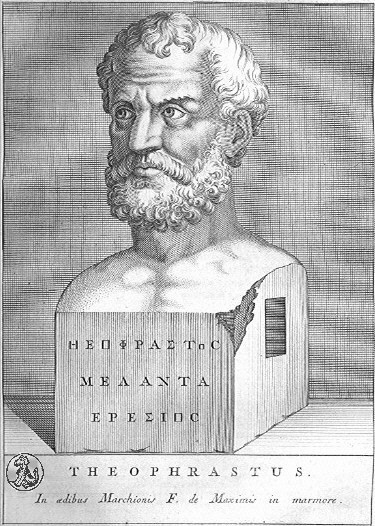
Theophrastus (Greek: Θεόφραστος; c. 371 – c. 287 BC), a Greek native of Eresos in Lesbos, was the successor to Aristotle in the Peripatetic school. He came to Athens at a young age and initially studied in Plato's school. After Plato's death, he attached himself to Aristotle. Aristotle bequeathed to Theophrastus his writings and designated him as his successor at the Lyceum. Theophrastus presided over the Peripatetic school for thirty-six years, during which time the school flourished greatly. He is often considered the "father of botany" for his works on plants. After his death, the Athenians honoured him with a public funeral. His successor as head of the school was Strato of Lampsacus.
The interests of Theophrastus were wide ranging, extending from biology and physics to ethics and metaphysics. His two surviving botanical works, Enquiry into Plants[2] and On the Causes of Plants, were an important influence on medieval science. There are also surviving works On Moral Characters, On Sensation, On Stones, and fragments on Physics and Metaphysics. In philosophy, he studied grammar and language and continued Aristotle's work on logic. He also regarded space as the mere arrangement and position of bodies, time as an accident of motion, and motion as a necessary consequence of all activity. In ethics, he regarded happiness as depending on external influences as well as on virtue and famously said that "life is ruled by fortune, not wisdom."
2300 години по-късно Теофраст е все така актуален... Тиртам от Ерезос, наречен още Теофраст (божествено говорещия), ученик на Аристотел, ръководител на перипапетическата школа и автор на 240 трактата. Забавна биография, нали? Не може да се оплаче, наистина е живял в много интересни времена. Уви, почти цялото му творчество е загубено. Едно от 3 оцелели произведения е "Характери".
Всъщност смята се, че е не бил труд сам за себе си. Мненията по въпроса са разделени между пояснителни образи към по-голям трактат по етика и упражнение по стил. Това не намалява стойността му. Ако е било трактат по етика (на което залагам аз), явно се е отнасял до отрицателните качества на човечеството, защото в книжката (spoilers!!!) няма нито един положителен (характер).
الوقح، الفضولي، البخيل، المتذمر، المرتاب، النمام، المتسلط،الصفيق، المتباهي،الجلف، كثير الكلام، المتطاير،المداهن، المرائي والكثير من الشخصيات الأخرى هي موضوع هذا الكتاب.
يصف ثيوفراسطوس سلوك وطباع هذه الشخصيات كما تعامل معها في عصره، وعلى الرغم من مرور ألفي سنة أو أكثر إلا أن هذه الشخصيات مازالت موجودة بنفس صفاتها هذه، مشكلة الكتاب الوحيدة كونه يصف سلوكها فقط ولم يتعمق أكثر من ذلك في كل شخصية، لكنه يظل كتاب جيد جدًا وخفيف.
Теофраст (ок. 372-287 пр. Хр.) е известен като наследник на Аристотел в перипатетическата школа, която ръководи до смъртта си. Според Диоген Лаерций, Теофраст е автор на 240 съчинения, но до наши дни са оцелели само три: „Характери“, „Изследване на растенията“ и „Причините за растенията“.
"Тази книжка може да бъде четена и без уводни думи. Независимо, че е написана преди 2 300 години, тя е съхранила въздействието си като малко книги от античността. И ако безсмъртието търпи категоризация, „Характерите” биха попаднали в най-неабстрактната и най-невисокомерната категория — те са безсмъртни живо, с непосредствеността на всекидневната реч и на реалните човешки жестове." ~ Богдан Богданов
Nakon 2300 godina izuzetno živ i aktuelan katalog negativnih ljudskih naravi; kao neka pijaca crtica iz antičke svakodnevice. Neki od opisanih tipova su: izmišljač lažnih vesti, ulagivač, gunđalo, neotesanac, preuslužnik, tvrdica, brbljivac, cicija, razmetljivac...
Teofrast je rođenjem Sapfin komšija sa Lezbosa, najpre Platonov pa Aristotelov učenik. Izuzetno svestran, čuven je po svom proučavanju biljaka (opisao oko 500 vrsta), ali i proučavanju meteorologije, fizike, logike, kao i retorike i književne teorije (nažalost, njegovo delo „O stilu” nije u celini sačuvano. Međutim, čini se da je ponajviše vešt i pažljiv posmatrač koji dobro uviđa šaru nekog delovanja. I počesto je u svojim zapažanjima živopisan i duhovit. Kao primer navodim odlomak iz XIV glave – o tupavcu: „U teatru poslegledanja predstave zna sam ostati i zaneti se u dubok san. Ako posle obilne večere po noći mora ustati radi sebe, u polusnu tumara okolo i susedovo štene ga ujede. A tu su i egzotični detalji – odlomak o tipu „udvarač”: „Prirodno, on zna i majmuna držati i nabaviti kakvu čudnovatu pticu i sicilijanske golubove, kocke od gazelinih koščica i okrugle flašice za pomast iz Turije, uševelj savijene štapove iz Sparte, ćilim s utkanim Persijancima, on ima svoje malo peščano rvalište i igralište za loptanje.” Sve u svemu – koji antički dendi! Majmun se, inače, zaista koristio kao ljubimac, a „ušivelj” znači cik-cak. (I još jedan zanimljiv detalj vezan za ljubimce – psi su u antici imali svoje nadgrobne spomenike!)
Odličan prevod i odlične napomene Petra Pejčinovića! (Stavljam hrvatsko izdanje jer nema srpskog, a nisam gudrids bibliotekar, avaj.)
I don't have a lot of thoughts on this one, it was an interesting read and I got some good information from it. Would recommend. The audiobook on librivox was also nice.
Reviewed on 4th November 2025
DISCLAIMER-All opinions on books I’ve read and reviewed are my own, and are with no intention to offend anyone. If you feel offended by my reviews, let me know how I can fix it.
How I Rate- 1 star- Hardly liked anything/ was disappointed 2 star- Had potential but did not deliver/ was disappointed 3 stars- Was ok but could have been better/ was average / Enjoyed a lot but something was missing 4 stars- Loved a lot but something was missing 5 stars- Loved it/ new favourite
Ένα έργο εξαιρετικά επίκαιρο παρά το γεγονός ότι η συγγραφή του έλαβε χώρα γύρω στο 317 π.Χ. Ο σκοπός του Θεόφραστου, κατά ρητή αναφορά του ιδίου, είναι να αφήσει ένα έργο διδακτικό για τις επερχόμενες γενιές.Περιγράφει με εύστοχο και ταυτόχρονα γλαφυρό τρόπο 30 τύπους χαρακτήρων μέσα από το πώς διάγουν οι χαρακτήρες αυτοί την καθημερινότητα τους.Σαγηνεύει η σύντομη έκταση των κεφαλαίων που δεν στερείται, όμως, πληρότητας και ουσίας. Ένα πολύ ευχάριστο κείμενο το οποίο διαβάζοντας το, άθελα του ο αναγνώστης, συνδέει με τους περιγραφόμενους χαρακτήρες πραγματικά πρόσωπα και καταστάσεις. Προτείνω να διαβαστεί την ίδια περίοδο με το "Ιδού ο άνθρωπος" του Ανδρέα Λασκαράτου.
كتاب طبائع الشخصيات للفيلسوف اليوناني ثيوفراسطوس تلميذ أرسطو وخليفته .. اكتفى بذكر عدة طباع سائدة للشخصيات وطريقة تصرف كل منها ، دون تحليل أو دراسة الأسباب والدوافع الكامنة وراءها .
Théophraste (-371, -288) est un philosophe grec lesbien qui a étudié à Athènes, puis s’y est fixé après un retour temporaire sur son île, ayant pris la succession d’Aristote dans l’école qu’il avait ouverte sur le mont Lycabette : le Lycée. Il est l’auteur d’une grande quantité d’ouvrages scientifiques et moraux dont seuls quelques-uns ont pu être sauvés des injures du temps, mais il en est un qui est plus particulièrement célèbre en France par le fait que La Bruyère(1645-1696) en a fait une traduction, il s’agit des Caractères. Le traducteur de la présente édition daube à plaisir sur cette version, fort inférieure à l’original par le fait que La Bruyère ne savait pas assez de grec. Je trouve un peu rude, car La Bruyère a conservé l’esprit du texte, et a transporté dans nos mœurs ce qui était désuet pour ses contemporains. Mais assez sur ce sujet.
Les Caractères sont composés de quelques dizaines de portraits très court décrivant un trait de personnalité par les marques qu’en donnent le comportement. Le côté incisif et juste rend la lecture aussi plaisante qu’agréable. J’ai manqué m’étouffer de rire à la lecture de certains d’entre eux, car c’est bien dans la nature des ridicules d’avoir cet effet. Les travers qui sont ainsi peint au naturel reviennent, avec quelques nuances, au bavardage, à la fausseté, à l’impudence, à la ladrerie, à la sottise, à la lâcheté, à la flatterie. J’y ai retrouvé, en plus serré, beaucoup de ces leçons sur lesquelles Plutarque s’est étendu dans ses œuvres morales. Certaines circonstances nous plongent parfaitement dans la vie antique, mais le plus grand nombre pourraient être transposées telles quelles à notre époque. Ça pique ma curiosité pour découvrir les quelques autres ouvrages de Théophraste que nous avons, en particulier sa Métaphysique.
AAAAA ÞAÐ FYNDNASTA SEM ÉG HEF LESIÐ! Þeófrastos hatar bara mannkynið og er að skrifa um allar týpurnar sem hann hatar. Þetta hljómar líka eins og þetta sé mjög persónulegt hjá honum, hann er bara að skjóta á alla. Forngríska BurnBook'ið. Meira svona!
"يمكن تعريف الوقاحة بأنها عدم الاكتراث بالسمعة الطيبة في سبيل (الحصول على) كسب حقير. أما الوقح فهو ذلك الذي: يذهب لشراء اللحم ويُذكِّر الجزار بالمعروف الذي سبق أن أسداه إليه، ويقف بجانب الميزان محاولاً أن يلقي فيه بقطعة من اللحم أو على الأقل بعظمة للحساء، فإذا نجح في ذلك كان بها، أما إذا فشل فإنه يخطف من المائدة (شيئاً من) المصارين، وينصرف لحاله وهو يضحك." . قد تعتقد يا صديقي أن هذا الوصف يعود لشخص وقح ربما يكون يعيش في بلدتك أو تعرفه بشكل ما، ولكن هذا تعريف الوقح الذي كتبه (ثيوفراسطوس) حوالي عام ٣٠٠ ق.م، مما يدل على أن شخصية البشر لم تتغير تغيراً كبيراً عبر القرون الطويلة. . كتاب خفيف ذو مقدمة دسمة لمترجم الكتاب والكاتب الكبير (عبد الغفار مكاوي) فكانت المقدمة خير تعريف لظروف وتوقيت كتابة (ثيوفراسطوس) للكتاب والمشاكل التي قابلت المترجمين أثناء الترجمة وذكر أيضاً كيف كان تأثير هذا الكتاب على العديد من الأدباء والمؤلفين المسرحيين بخاصة كتاب (الكوميديا).
ثيوفراستوس عالم وفيلسوف إغريقي تتلمذ على يد أرسطو وخلفه في رئاسة مدرسة المشّائين ولد في جزيرة لسبوس اليونانية وقصد أثينا طلباً للعلم، فاستمع أولاً إلى أفلاطون ثم تعرف إلى أرسطو وصار أشهر تلامذته , وهو الذي أطلق عليه لقب «ثيوفراستوس» (أي: المتكلم الإلهي)، أما اسمه الحقيقي فكان تيرتانوس وقد ألَّف ثيوفراستوس كتب في علم الطبيعة وعلم النبات وعلم المنطق وعلم السياسة، وفي الشعر والميتافيزيقا وغيرها. لم يبق لنا من آثاره غير أقلّها . وقد صنّف فيه النباتات حسب أشكالها وطرائق نموها"History of Plants "و من اهم كتبه اما الكتاب الاخر هو "طبائع الشخصيات " الذى يعتبر محاكاة للواقع الاثينى نقل من خلاله صورة لما كانت عليه اثينا فى نهاية القرن الرابع ق.م ويحتوى الكتاب على ثلاثين نمطا من الانماط البشرية المرذولة ذات السلوك المعيب و من المفترض ايضا وجود عدد مماثل من الشخصيات الفاضلة و التى لم ترد فى الكتاب
Една наистина вечна книга, в която чрез кратки сатирични текстове са показани негативните типажи от времето на Теофраст, а и от нашето време. Въпреки че днес по-скоро бих казал, че тези характери съществуват във всички нас и само от нас зависи кой от тях ще се проявява. И дали изобщо щес е проявяват или ще се проявяват само ненаписаните (или недостигнали до наше време) положителни характери.
Когато четеш книгата, няма как да не правиш връзка с хора, които познаваш. Или с такива, които си гледал по медиите, или си чел текстовете им. Характерно за времето е, че много неща се променят, а в същото време нещата остават непроменени в същината си. Променят се външните черти, а вътрешното почти не се изменя. Така е и с тази книга.
Давам четири звезди единствено поради намесата на Богдан Богданов в текста. Това не е оценка за превода, там съм в мътни води. Но доста ме подразниха всички бележки под линия (няколко на брой), в които се казваше: следващите няколко изречения са от друг характер, но като логика преводачът смята, че мястото им е тук.
Ами аз пък като читател бих искал да знам как звучи оригиналния текст на Теофраст, който е с толкова дълъг живот. И въобще не искам да знам каква е логиката на мислене на преводача. За мен това е кощунство...
A book about the kinds of characters you might find in ancient Athens (or, more probably the kind of characters you might encounter in the comic theatre). It was fun to stroll around the city and imagine these social faux pas taking place here 2000 years ago.
I liked almost everything about this book. The content is fresh and diverting even though it's 2300+ years old. The text is nicely presented and the endnotes are really helpful. So what's not to like? Well, I am afraid I just didn't quite like the illustrations...
3 stelle per la semplicità, 4,5 per la sua importanza: a volte ripetitivo, ma brillante e propedeutico come nessun altro a Menandro. Si legge in un pomeriggio ed è piacevole per fare due risate.
Théophraste m'a fait bcp rigoler + trop marrant de voir que bcp de choses tournent autour du droit (procès, arbitrages, prêts, cautionnements) +références à une culture disparue touchant
تيرتاموس او ثيفوفراسطوس بيحلل وبيوصف 30 نوع من الشخصيات القذره في عهده والي لسا موجدين وبنقابلهم بشكل يكاد يكون يومي بنفس المواقف الي هو حكاها من 2000 سنه الممتع في الكتاب مش محتواه لان لو على المحتوى فهو اقل من المتوسط لكن الممتع انك بتقرا فكر اتكتب من اكتر من 2300 سنه لواحد كان تلميذ ووريث ارسطوا ومن اهم تلاميذه إراسيستراتوس الي اكتشف الدورة الدموية في المركز الطبي بمكتبة الاسكندرية ايام عزها واصدقائه بطيلموس الاول ملك مصر
Доста от описаните характери са стигнали непокътнати и до наши дни. Въпреки че писанието звучи хумористично - човек се чуди да се смее ли, да плаче ли...
Сигурно е само, че чрез тези запазени антични текстове човек може да се огледа в хората от преди повече от 2000 години и да разбере, че не сме се променили толкова, колкото е трябвало.
Theophrastus, a Greek philosopher and pupil of Aristotle, was born around 372 BC, died around 287. When Aristotle was forced to retire from Athens in 323, Theophrastus became the head of the Lyceum, the academy Aristotle had founded. Under Theophrastus the enrollment of pupils and auditors rose to its highest point.
According to the Encyclopedia Britannica, Theophrastus was one of the few Peripatetic philosophers who fully embraced Aristotle’s metaphysics, physics, physiology, zoology, botany, ethics, politics, and history of culture. "His general tendency was to strengthen the systematic unity of those subjects and to reduce the transcendental or Platonic elements of Aristotelianism as a whole." He was a prolific writer and his works, many lost, include Inquiry into Plants, Growth of Plants and treatises attributed to him on fire, winds, signs of weather, scents, sensations, and other subjects. His Charaktēres, written around 320 BC, consists of thirty "brief and vigorous character sketches delineating moral types derived from studies that Aristotle had made for ethical and rhetorical purposes."
Pamela Mensch, a translator of ancient Greek literature, has now produced her version of Theophrastus's Characters: An Ancient Take on Bad Behavior. These include the Dissembler, Flatterer, Yokel, Sycophant, Newshound, Miser, Busybody, Vulgar Man, Social Climber, Coward, and twenty more.
Theophrastus's observations are—with small adaptions—as appropriate today as they were 2,300 years ago: "The Talker is the sort who plumps himself down next to someone he doesn't know and starts praising his own wife; he goes on to describe the dream he had the night before, and then relates in detail what he had for dinner,"
"The Busybody is the sort who stands up and promises what he can't deliver. In court when it's agreed that his argument is just, he overdoes it and loses his case."
"The Shameless Man is the sort who, after shortchanging someone, goes back to ask him for a loan."
"The Tactless Man is the sort who comes to solicit advice from someone who's busy. He serenades his sweetheart when she's down with a fever. He approaches a man who's just had to forfeit bail money and asks him to post bail for him."
The book includes a useful Introduction and endnotes by James Romm, professor of classics at Bard College, that puts the author into an historic context. Romm points out that unlike every other ancient Greek author whose work survives, Theophrastus observes the Athenians' "food, their clothes, their purchases, the decor of their homes. He notices objects we never hear of elsewhere, like the spurs worn by the Social Climber to show he's wealthy enough to ride in the cavalry . . . ."
Aside from Theophrastus's delightful comments, the book is a lovely object to hold, a delight of book design by Don Quaintance. And it includes apt illustrations of each character by Andre Carrilho, a designer, illustrator, and caricaturist from Lisbon. Characters would make a splendid gift for the right person. (I wouldn't give it to someone who will see herself in it.) It would make a good gift for oneself if only to remind yourself what you don't want to be.
كتيب لطيف لخص فيه ثيوفراسطوس أنواع الشخصيات القبيحة بذكاء و دقة بالغتين و بأمثلة عملية من واقع بيئته.
من المعروف ان ثيوفراسطوس عاصر أفلاطون و تعلم على يده ثم تعلم عى ي تلميذه أرسطو -المعلم الأول- ثم تسلم استذة المدرسة المشائية لأكثر من ثلاثين عاما بعد وفاة أرسطو .... و كتب العديد من الأعمال ... و ألاحظ دقته الشديدة في التفريق بين الإنسان الشحيح و البخيل و الخسيس من جهة .... و المتباهي و المتكبر و المرائي و المداهن من جهة ....و الثرثار و كثير الكلام و المغتاب من جهة .... بالأمثلة التي لازالت شديد الواقعية حتى بعد مرور أكثر من 2300 سنة على كتابة الكتيب ...
بل أنني لم أنفك عن أضع شخصيات مثالية قابلتها في حياتي كمثال حي على كل صفة من الثلاثين صفة القبيحة المذكورة في الكتاب .... و أعجب من كم التوافق بين توصيف هذه الشخصيات من وجهة نظر ثيوفراسطوس و بين ما أراه من هؤلاء الاشخاص في الواقع .... و كأن الأرواح تتناسخ من عصره حتى الآن!
إنه مصدر جيد لدراسة النفس البشرية .. بطريقة ما يستطيع الكتاب أن يثري فراستك عند التعامل مع الناس و يقلل من تعميماتك بكثرة القوالب ؟ فليس كل من وصفك بالحسن مرائي أو متملق .... وليس كل من وصفك بالقبح وقح ! هناك احتمالات أخرى.... فالحكم من موقف واحد لا يكفي ....
أريد أن أذكر في النهاية نقدي الشخصي عن أن تسمية هذه الصفات بأنها طبيعة شخصية ليس دقيق .... حيث قد يكون الشخص فضولي أحيانا و متكبر أحيانا و خسيس أحيانا و لا تلازمه هذه الصفات طوال الوقت بل في مواقف معينة و مع أشخاص معينين فمن الأبدا أن يفهم من الطبائع أنها تذهب و تأتي و ليست ثابتة في كل المواقف ....
Having read La Bruyère's Caractères wanted to complete the circle by reading Theophrastus as well.Despite the depiction of characters seeming rather naive and simplistic by today's standards even to a non-expert such as myself,this fella from the island of Lesbos shows a great skill observing others.What's most important is that he manages to give perhaps the best account of every day life in antiquity I have so far read.Rich in detail and illuminating,one gets a full picture of Athens,in his case,during the last third of the 4th century BC.Two things that are funny.This was probably not his intention.No scholars have underlined enough how interesting it is to read his vivid portrayal of people's customs,habits,celebrations,peculiarities.Twas helpful to read an edition with extended footnotes.
The philosopher Theophrastus was a pupil of Aristotle and supposedly the teacher of Menader, which places him as an important link between philosophy and drama. His Character Sketches are thirty little glimpses into character “types” who lack virtue. It seems to be partly a handbook on how to avoid being morally dubious (i.e., a collection of “don’t be that guy” sketches), but also a forerunner to the literary character sketches that would be taken up in English by Jonson, Eliot, and Faulkner, among many others. These could be read as a self-help guide, a rendering of moral philosophy, or just an amusing collection of characters one might adapt for literature. And these sketches were pretty amusing. I laughed out loud at some point in almost every instance.
This edition included drawings of each character by 19th century illustrator Francis Howell, which ranged from whimsical to offensive.
There is a great deal more of Theophrastus’ extant writing --mostly on botany, physics, and ethics -- which I may read one day. This book was good enough for me to keep him on my radar as I dig deeper into ancient literature.
Завдяки книзі “Memo” Крістофера Воглера дізналась про “Характери” Теофраста. Книга написана приблизно 319 р. до н.е., а людські пороки незмінні, тому їх влучний опис давньогрецьким філософом завжди буде актуальним. Книга написана лаконічно, з іронією і гумором, тонко підмічені усі деталі характерів та поведінки різних людей. Цікавий був той дядько Теофраст: так і уявляю як він ходить по ринку з блокнотиком, спостерігає за людьми і все нотує:) І не дивно, що ця книга стала основою для типів персонажів у багатьох творах, виставах та фільмах. Крім того, у книзі є багато пояснень та коментарів, що дає краще розуміння тих часів.