Will be shipped from US. Used books may not include companion materials, may have some shelf wear, may contain highlighting/notes, may not include CDs or access codes. 100% money back guarantee.
Dr. James McLeod Steele Jr. is a Professor of History and Theory of Architecture at the University of Southern California School of Architecture. His work focuses on the key issues that effect architecture and urban planning.
BV Doshi is a prominent figure, if not the leader, in the space of Indian Architecture and the modernist movement that wants to be India at its soul. The book is one of the better compilations of Doshi's work that I have seen. As an Architect, I found it very informative and visually attractive. It has all the relevant architectural drawings that one needs to understand the work of Doshi over time.
The book collects almost all major achievements with an opinion by Doshi himself. All the other notable (but not famous) works have been compiled at the end as a timeline. I will recommend this book to all architects and a must for Indian architecture students who want to get a grasp of what Indian Modernism could mean; though I as an architect, would always want them to have their own definitions.
Read alongside my Southeast Asian Architecture History class, which served to supplement the traditional typologies discussed in it. I knew Doshi for his Husain-Doshi Gufa, so his strict modernist oeuvre ended up surprising me. I did not guess that for most of his work, he (mostly) adhered to the monumental, unornamented dictums of modernism, as learned from his masters Corbusier and Kahn. Regardless, I appreciated the breadth of work discussed in this and listed down my learnings from each below. I particularly appreciated the embodied spirituality Doshi applies to his work (regardless of the facetiousness of his increasingly imaginative essays). On a pragmatic note, I appreciate the material explorations in his work--gives me ideas on what works and what doesn't. I also enjoyed Steele's writing. His discussion on each work is comprehensive while being critical and venerative (in fair and equal turns). He also intersperses the works with their historical precedents (whether it be traditional vernacular or Corbusier), as well as Doshi's personal essays regarding the works -- which is a really wonderful way to structure a book on an architect's work.
NOTES:
Introduction: Synthesis, not rejection of western influence Work replete with mythological and visionary allusions reminiscent of the rich story-telling tradition in India Doshi on his western education: ‘even though I learned from great masters, I was nevertheless educated outside myself. This is why I have tried to become a son of the soil, to go back and see what it’s really like to cast off the skin as a snake would and become again.” Structural quality, hierarchy, and amplification Spatial refraction: inner volune seems to expand exponentially
Mythical sense: transform the function of a space by ritual use
Deconstrucivists proposed the deliberate antithesis of the human subject, who was decentred by the interrogation os social institutions that it instigated
Built forms which generate holistic experiences which finally become institutions
His architecture assumes a collective will and, like a self-fulfilling prophecy, creates one through its physical presence.
Orientation: north -> lord of wealth, south -> lord of death, east -> lord of light, west -> lord of the wind
Institute of Indology: convectice effect, cross-ventilation using subterranean levels and courtyards. Housing ancient manuscripts. Learning from Corb’s Cultural myopia regarding tokenizing cultural elements and inappropriateness of concrete, as well as car-centrism
School of Architecture: funnel-shaped entrance to direct breeze, Outdoor classrooms to keep cool during heat. Brick instead of concrete but brick still suffered
Gujarat State Fertilizers: to create pattern of old communities, less rigid intermixing of housing types and siting, interesting nodal/branchlike street planning with priority on courtyards, narrow pedestrian walkways invoke pol, used local brick
Indian Institute of Management: Linked by major structure inspired by Fatehpur sikri, monumental yet airy staircase
Madya Pradesh Electricity Board: 16 interlocking octagons, works on a hilly, rocky site. “This is not Gropius turning his mentor inside out, but an instance of the unhesitating use of a system with full confidence in its logic.” Continuous covered circulation sangath: Beautiful vaulted roofing draining into waterfalls, Golden section and platonic circle, “saturated thoughts on what architefture for a place should be”, wage costs for ceramics
Aranya low-cost housing: research on the dynamics of squattler settlements. No evidence of any activity from NGOs concerned with community participation, Yunus bank, Good intention gone astray: to allow architectural considerations to outweigh an awareness of social dynamics, “If only slum resettlement projects were simply architectural problems capable of being overcome with good design”. On chandigarh and dacca: significant as they are, they do not offset the arrogance of the assumption that cities such as them can be built in the first place
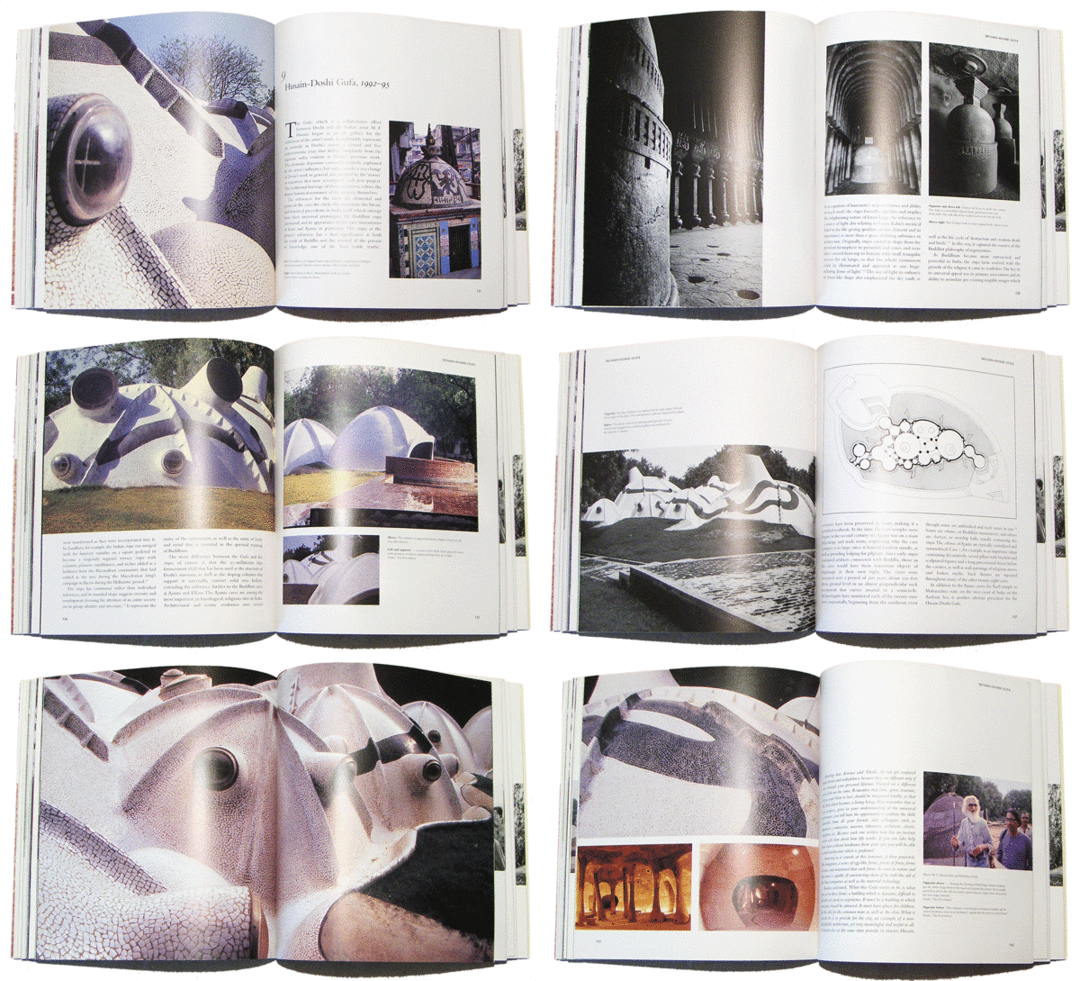
Husain-Doshi Gufa: Inspired by Stupa and Neem tree grove in Ayurveda (interconnected toirtoisesnwithbdifferent-sized shells and mouthsnopening in different directions), natural slope was retained
The Revelation: “If you can take help from them without hindrance from your ego, you will be able to build architecture which is profound.” The almost miraculous conception of the Gufa: tribals reciting prana, Husain feverishly painting his cobra, the rain out of season. A contract established between the structure and Kurma.
National Institute of Fashion Technology: Sorr of modern step well. Sunken court transitions into amphitheater. I do not like the actual structure however, too white and anachronistic. Kund: saucer-shaped rainwater store. Beautiful long sequential plan of the Adalaj step well.
Diamound Bourse: Minimize exposure to sun, funnel effect. Similar to a diamond cave. Ancient mine, mythical rock “ratna” found on site
Conclusion: Wall-court-house-court-wall sequence. On institutions: “There is a sad paradox in the fact that the very institutions that Doshi is fostering, especially the management institutes he has designed, may help to accelerate the disintegration of the community by promoting the same scenario of industrialization tuat has nowbeen played out in thw west. On mythical space: it is significant that there are no single memorable monumental interior spaces.
Words: ameliorative
This entire review has been hidden because of spoilers.
There are at least three publications with extended coverage of Balkrishna Doshi's work: William Curtis's 1988 book, a+u no. 322 97:07, and this book, which appears to be the most recent at 20 years old and also appears to be the longest.
Covered projects include the Institute of Indology, the School of Architecture, the Gujarat State Fertilizers Corporation, the Indian Institute of Management, the Madhya Pradesh Electricity Board, Sangath, the Gandhi Labour Institute, Aranya Low-Cost Housing, the Husain-Doshi Gufa, the National Institute of Fashion Technology, and the Bharat Diamond Bourse. These eleven projects are covered with mostly color photos, plans, elevations, sections, and sketches. The photos tend to focus more on the building exteriors and liminal spaces. Written analysis accompanies the graphic coverage. An annotated list of projects and a bibliography complete the coverage.
The Husain-Doshi Gufa, now known as the Amdavad ni Gufa, receives the most coverage in Steele's book.
Unlike some monographs, Steele not only discusses Doshi's successes, but also lessons that have been learned through the years. Examples of how Doshi has taken what was learned from Le Corbusier and Louis Kahn and tailored it to the Indian environment abound. Steele also discusses, with examples, how Doshi has reinterpreted traditional Indian architecture.