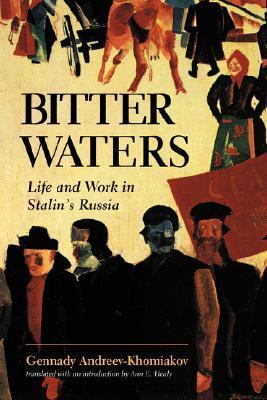
One dusty summer day in 1935, a young writer named Gennady Andreev-Khomiakov was released from the Siberian labor camp where he had spent the last eight years of his life. His total assets amounted to 25 rubles, a loaf of bread, five dried herrings, and the papers identifying him as a convicted “enemy of the people.” From this hard-pressed beginning, Andreev-Khomiakov would eventually work his way into a series of jobs that would allow him to travel and see more of ordinary life and work in the Soviet Union of the 1930s than most of his fellow Soviet citizens would ever have dreamed possible. Capitalizing on this rare opportunity, Bitter Waters is Andreev-Khomiakov’s eyewitness account of those tumultuous years, a time when titanic forces were shaping the course of Russian history.Later to become a successful writer and editor in the Russian émigré community in the 1950s and 1960s, Andreev-Khomiakov brilliantly uses this memoir to explore many aspects of Stalinist society. Forced collectivization, Five Year Plans, purges, and the questionable achievements of “shock worker brigades” are only part of this story. Andreev-Khomiakov exposes the Soviet economy as little more than a web of corruption, a system that largely functioned through bribery, barter, and brute force—and that fell into temporary chaos when the German army suddenly invaded in 1941.Bitter Waters may be most valuable for what it reveals about Russian society during the tumultuous 1930s. From remote provincial centers and rural areas, to the best and worst of Moscow and Leningrad, Andreev-Khomiakov’s series of deftly drawn sketches of people, places, and events provide a unique window on the hard daily lives of the people who built Stalin’s Soviet Union.
This book stands out from other Soviet memoirs that I have read primarily for it's seemly positive undertones. That is not to say that the author is pro-Soviet, he is not by any means. He is deeply anti-communist, and spends 8 years in the Gulag, but this particular book does not focus on that. Despite numerous challenges, he always finds people who are willing to help, which makes the period of the Stalin terrors seem a bit less extreme than it is usually shown. It is an interesting book.
Surprisingly--if not entirely uplifting--not entirely depressing, either, considering the subject. More people I could honestly care about than Quiet Flows the Don!
He becomes more thoughtful as the work goes on, trying to explain or understand what a government like the USSR does to the psyche of those who live and try to work in it. Especially the longing of humans to do work, and the despondency that comes with inability to do it well or reap any kind of rewards, even simple things like the ability to pay your workers good wages.
I never thought I'd get so emotionally invested in a lumber mill.
I felt bittersweet reading this memoir. Some of Andreev’s descriptions of the provincial life were very touching to me, and I loved his friendship with Nopesdov. He was unapologetically anti-communist and anti-Stalin, but he was still able to present a pretty balanced picture of what life was like as a worker during the Soviet era. I thought some of his description of the day to day operations of his factory were a bit dry, but it was interesting nonetheless. As other commenters have noted, this book is not as depressing as one might expect from a soviet memoir.
The first-hand peek into Stalin's Russia was very cool. Though it's a shame that socialism as a whole is lumped into Stalin's socialism, at the time, it was the only reality for them. The translation on this was beautifully done and I'd be interested in looking into Andreev-Khomiakov's other works.
I read this book twenty years ago as part of a Russian history class. It gave some really good insights into life under Stalin, particularly how officials fudged statistics in order to meet quotas set by the central government. The book offers a case study on why you should be leery of statistics from authoritarian governments.
I'll give this 5 starts because it is well written and accounts of 1930's Russia are rare and to me very interesting, because Stalin did so many nasty and irrational things.
He was truly the most evil person of the 20th century.
BUT, I don't believe this is really non fiction, more like a non fiction novel where the author takes many accounts and creates a composite that is more interesting and easier to write.
At no time in this book, or in any of his other writings does he tell what 2 cities he lived in after getting out of the gulag.
Also he uses pseudonyms for many of the characters, even those who were killed in WW2. The protagonist Neposedov especially seems like a composite.
He says almost nothing about the 8 years in the gulag, Nothing about his time in the army or being captured, being a POW, or how almost alone, he was able to avoid being sent back to Russia at the end of the war. Where he certainly have been murdered because he was a POW. Too bad he died in 1984, he hated the communists and just missed seeing them get the boot by a couple of years.
Excellent. Gennady M Andreev-Khomiakov a young writer is sentenced to a tenner for unspecified anti-revolutionary behavior. In prison he becomes familiar with accounting and upon release in 1935 he manages to get employment is several industries and rises in a dysfunctional system due to his competence. This brief memoir from release through the early months of the Great Patriotic War is perhaps the best description of Soviet economics, corruption, society and relationship to the regime I have read. His explanation of the economic system is lucid and his expression of the feelings of the people to the regime is interesting. Gennady is a gifted writer and his views on the Bolshevik system and the plight of the people are well worth reading.