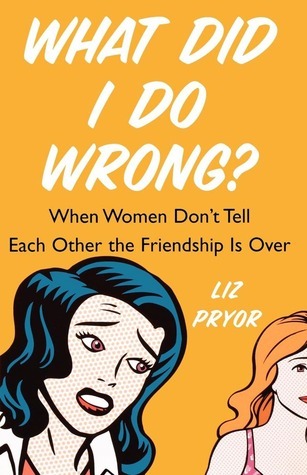
It happens without warning, and it hits you with devastating force. Your closest girlfriend, the Ethel to your Lucy, the Thelma to your Louise, cuts you off completely. No more late-night phone calls, no more afternoon e-mails, no more catch-up lunches and dinners. She has decided for whatever reason to move on with her life and has left you to figure it out on your own. The experience can be as painful and confusing as a sudden breakup with a significant other, and you replay scenes from the friendship and wonder what you did wrong. Until now, women had to endure the heartache of losing a friend all alone, without the social support and understanding that accompanies, say, a romantic split-up -- and to make matters worse, they don't even have their best friend's shoulder to cry on. But What Did I Do Wrong? gives you that sympathetic shoulder and a resource -- and some answers -- that you can rely on. After author Liz Pryor had gone through a number of these breakups herself, she set out to discover why they were happening, how to help herself -- and others -- get through them...and how to prevent them from happening again. Through personal interviews and her popular website, www.lizpryor.com, Pryor collected hundreds of stories of friendships with which you will identify. Now she draws on those stories to explore the dynamics of friendship breakups in a candid, intimate way, revealing the patterns, the warning signs, and some ways to put a friendship right or help it change to meet your or your friend's changing life. She also explains how to end a friendship -- if you find that you need to do so -- in ways that honor both parties' feelings and your history together. Like the best kind of girlfriend -- one who really will stay friends forever -- Pryor blends plain, old-fashioned, feminine good sense and good humor with genuine empathy for the thousands of women who live with the confusion that lingers after an ended friendship -- for women of all ages, races, and backgrounds. What Did I Do Wrong? validates your feelings and inspires you to be more forthright and compassionate with new and old friends. It might even lead you to reconnect with a lost one. In the end, you will be moved and uplifted by the many stories of strong friendships, broken friendships, and renewed friendships that make this book a treasure of women's wisdom and experiences.
Every woman has that friend who is nothing but toxic, who we feel we want to cut out of our lives but we just don't know how to. This book not only tells you how, but tells you repeatedly not to feel bad about not wanting to be friends with a selfish, manipulative cuntface. Good reading!
It was refreshing to read a book that focuses attention on female friendships. It is ingrained in our minds through movies and books that woman are supposed to have lifelong best friends. "Best Friends Forever" from childhood bracelets, secrets shared across sleeping bags, and trips to the pool and mall, to first boyfriends, college, and future families. There is such an extensive amount of time and emotion invested in friendships such as these, but like romantic relationships, they too can undergo strains, challenges, and ends. The conclusion of a friendship can be just as heartbreaking, or even more, than the end of a romance based on the lack of closure. Not all friendships are lifelong, nor are they perfect. The problem was, there was no discussion about how to properly cut ties with a friend. It feels awkward, stressful, annoying, depressing, angry, and like a failure, all depending on which side you're on. When people say, "My boyfriend and I broke up," there is an understanding of how to feel for that person. Why shouldn't the loss of a friendship invoke the same response? Liz Pryor finally answered the call, got the ball rolling. By saying that this swirling of feelings and confusion is valid, she captures the female spirit through a compilation of stories- uncomfortable, beautiful, and heart-wrenching (Gram's story!).
I appreciate Liz's familiar writing style. While never claiming to be an expert, it makes her observations and suggestions feel real and from the heart. Her personal stories woven throughout gave the book a nice reference point and backbone.
Through her journey in story-collecting, it is clear that communication during the breakup is problematic. Where's the how-to guide when you need it? By using avoidance, a woman may think she won't be hurting her friend's feelings (as opposed to coming right out and stating the troubles). On the other hand, the 2nd friend often knows she is being avoided and is hurt that the first friend won't just talk to her. A reoccurring suggestion throughout the book was to write a letter. This was the only point that I have uncertainty about. While a letter may be perfect for some breakups, it isn't for everyone or every situation. I know that Liz never came out and said that this was the be-all and end-all fix, but I would have liked to see if anything else may have surfaced as being effective. On more than one occasion, I've poured my soul into a letter to a friend to attempt to reach closure, only to receive no response.
Personally, I still wonder, "What did I do wrong?" regarding my own friendship breakup in the fall/winter of 2009. I know a breakup would have happened eventually with her, but I continue to wonder about her- how she is now, how everything happened so quickly, how things could have happened differently. It's reassuring to know that other women have shared in these feelings of regret or vulnerability and that it's just as complicated for them as well.
Thank you Liz for warmly and honestly shining a light on the crack in the BFF mystique!
As most of us have, I've been on both sides of the dynamics of "ending a friendship," so this compilation was important to me. The thing I gleaned the most from is that when one divorces a husband/breaks up with a boyfriend, etc., she garner MORE support and friendship from unlikely sources than when one has to break up with a friend... It's not spoken of, it's not supported, it's looked upon as a sign of weakness, it feels shameful, and on and on. Even checking this book out felt "wrong" somehow.
And why is this? Unfortunately, that is what I was interested in learning more about. This piece is good in the true-life case studies of budding friendships/lifelong friendships & terminating friendships, but doesn't discuss that mysterious aspect. I was left wanting more in this regard. I also felt that the book lacked in development and descriptions about how these break-ups affected mutual friends.
Things I've learned: 1) No one likes to admit they are wrong. Pride comes before the fall. 2) Most importantly, when a friendship ends without confrontation, it's not because its intended, it's likely that the other party does not want to hurt the receiving end any more than then know they will. 3) Confrontation/writing letters doesn't seem to be the answer any more than avoidance and falling off the radar does. There is no "good" way to do it. You must just be at peace with your decision or find a way to make peace with the decision. 4) There is no right way to do it, but we certainly should be able to discuss it out loud with other loved ones. It hurts. Usually for both parties. And sometimes for families. A few of these stories were very hard to read :( 5) Don't take the rejection/disappointment/decision out on your spouse.
But again, my question is Why? Why is the end of a friendship perceived as a sign of weakness? A couple of years ago, I vowed to not allow these things to define me, but show me that I continue to grow and change and accept responsibility. No one is always going to be right. No one is always going to be wrong. As I mentioned before, having been on both sides, in the end, I have to do what is right for my psyche first.
For me, the most important line in the book came on page 72. If any friends who have been "dumped" by a girlfriend read this review, take solace in the following quote from Pryor: "Most of the women who decide to end a friendship have been toying with the idea well before they actually start leaving, so by the time they do begin their quiet departure, they are already emotionally detached." <----that's why it seems to hurt so badly for the receiving end, and the other party remains to appear completely unaffected. They just began the detachment slowly and with time, as opposed to the feeling that the recipient has that a bandaid has been ripped off.
All in all, interesting book, but again, lacking those strong pieces I mentioned earlier left me unimpressed with the whole view.
I really don't know why I felt compelled to pick up this book, but it wouldn't leave me alone in the library, so I got it, and then I couldn't stop reading it. I hope this isn't foreshadowing that I'm about to lose a good friend--I don't think I could take that right now.
I guess what I really couldn't resist was finding out why people do this, even though I actually know what happened the two times it's happened to me. But of course, the author can't really tell you that specifically. Just generally, it's often as simple as someone getting annoyed or growing apart and being too much of a coward to say something or try to fix it, and then also being too much of a coward to admit they don't want to be friends any more. So basically, this book is the He's Just Not That Into You of (former) BFFs, except it's not funny at all, just sad.
Also, the edition I read had this subtitle: What to do when you don't know why the friendship is over, which is something I wanted to know. But, disappointingly, the author didn't really offer any good answers to this. The best she seemed to be able to come up with was writing the other person a letter so you can get closure. Meh.
I guess it is a bit comforting to know that people mostly do this stuff because they think it will hurt the other person's feelings less than telling the truth--at least they mean well. But they're wrong.
Also, this book made me realize how many times I've done this myself. I can only think of two people I ever really decided I didn't want to be friends with any more, and one was in 6th grade, and the other seemed to be pretty mutual by the end. But there have been a lot of other times when I've just flaked out, not because I didn't like the other person any more, but because I was overwhelmed with my own stuff and couldn't deal. This book made me realize those people probably thought I didn't like them any more, when it wasn't that at all. Now I feel bad. :(
Why is it that a breakup with a boyfriend, even a relationship that lasted only a couple of months, gets more support than the ending of a friendship between two women? With a boyfriend, there is acknowledgment that the relationship is over and then the comforting you receive from friends and family, allowing a sense of closure. An ending of a close female friendship barely gets a nod, if it’s in fact acknowledged at all.
I’ve had many “What did I do wrong?” moments. And for years I thought I was alone as one best friend after another disappeared from my life. It has gotten so bad that I’ve chosen not to start any more friendships and have been without a best girlfriend for several years now. It is such a painful experience. For the receiver, the pain of not knowing why a friend left can cause years of gut-wrenching sorrow. So this book was very life-affirming for me and it’s begun a healing process which is long overdue.
But this book has made me recognize that I have also been the initiator of a friendship ending. Well, kinda. In my case, the woman I’ve been trying to get out of my life has never quite gotten the hint. It’s been literally 20 years of me not returning phone calls and claiming to be busy. She’ll stop calling me for 6 months or so and just as I start thinking I’ve finally gotten rid of her, up she pops again, ringing my doorbell, calling a dozen times a day. After reading this book I realize that I’m doing the same thing to her as others have done to me. And why haven’t I realized this before now? Because many women, for whatever reason, use avoidance to end friendships. There are no socially acknowledged guidelines for ending a friendship. We women do not talk about it.
The author uses her own breakups as well as a bunch of stories from women who have both been dumped and done the dumping. The writing style is engaging and the stories are both excruciatingly painful and healing to read. If you've been through this, know that you are not alone and there are women who have been through way worse!
I’ve been through it all: the mutual drifting away of two friends, no hard feelings on either side; the abrupt confrontation that seems to come out of the blue, in my case my best friend one day randomly declared “I can’t be your friend anymore” with absolutely no explanation as to why; the inexplicable drifting away, where a long-time best friend gradually stops returning phone calls and always claims to be busy until eventually you never hear from them again; and the (for me) most puzzling, the sudden disappearance of a really close friend, best friends one day and fall off the face of the earth the next.
I mentioned to a friend that I was having problems with a friend I had from childhood and that I thought it was really time to end the friendship, but I didnt know how. She said that while she had never read this book herself, she thought it would relate.
First off, this book is story after story of how to end a friendship. It doesnt really offer much advice except in a few random situations. But there was a passage that really disturbed me, then another shortly after.
Around page 102 or 103, Liz talks about being in a situation where she "just didnt want to be friends with someone" She basically snubbed and alienated the person who was offering her friendship. So she said four years later, when she reconnected with the woman through her daughter's school, she was surprised that the woman snubbed her and talked about her to her friends.....well DUH. You hurt her feelings by refusing to be her friend and you expect any less? Well apparantly queen bee liz pryor thinks that this warrants confrontation and she phoned the person and basically demanded she be nice to her and claims it worked. If someone phoned me after treating me this way and demanded I be cordial, that person would get a restraining order and an earful. She really had some nerve and I have a feeling she was probably labeled "psycho" by many woman after this incident.
She then goes on to talk about a boyfriend breakup, which fyi, shouldnt even be in the book, which is supposed to be about women. She claims she was madly in love then one day wasnt anymore and she and her mother determined that she needed to leave him and that she nearly caved to his crying. wow. So basically instead of working on a relationship, she bailed because he didnt interest her. Yet another story about how Liz is a narcissistic witch who treats people badly and blames them.
From the book, I have learned that Liz Pryor is a mean girl. If you want to be a mean girl, this is your book. If you left highschool behind years ago, leave this book on the shelf.
This was one of our Book Club reads a few years ago and prompted some entertaining discussion. Seems we all had a story to tell. If you were ever the recipient of a friendship that ended and left you wondering why, this book is for you. I am still horrified over some of the real-life narratives mentioned here about women who were jilted by their so-called friends. One woman was accidentally butt-dialed, and happened to overhear her two best friends talking about her in a negative way for 20 minutes, after they had just dropped her off home. She confronted them about it the next day, and they were mortified. You just can't bounce back from an encounter like that! The author also gave advice for how to end a friendship the RIGHT way - and I think that's what it comes down to in the end. Just be civil and considerate and treat them the way you would want to be treated.
After being dumped by my long-time best friend recently, I was looking for anything to help me make sense of the situation and my feelings. Through story after story, I came to realize I was not alone in my feelings...and I also learned some things about myself. This book really, really helped me gain some peace and closure so I could move on. I still feel extremely sad and ashamed, and honestly...guilty for my part in the break-up. But I am no longer angry or frustrated and I can say that I have a kind of resignation about the situation with the feeling that I am able to move forward with my life without my bestie by my side. They say people come into your life for a reason, a season, or a lifetime. And truthfully, I thought she was my "lifetime" friend...but my life is still better for having known her.
Ironically, I am a Women's Studies major, but I don't understand women. Nor have I ever connected truly with any of them, despite lifelong proclamations of "Best Friends Forever!," a sentiment that, I promise you, never comes true.
I have depression, something that, admittedly, has constantly come between me and my ability to hold a friendship. This book doesn't address that, but I picked it up anyway, hoping that some light would be shed on why, quite honestly, at least half of women suck.
Liz Pryor is, mercifully, no doctor or specialist. Instead, she's a regular human who has lost a few friends to the phenomenon of the non-ending. What I realized after reading this book is that much like some of us enter into relationships believing that love will conquer all, we also enter into female friendships believing that history and a past together will trump all. At least, I have always believed this. After reading this book, I know I can't believe it again. I suppose I wouldn't have anyway, because I've had plenty of friends show me that four or six or eight years of knowing each other isn't enough for them to give me a reason for their exit or to hand me some kind of closure.
I have high exacting standards for how people should behave in certain situations which, I suppose, is in part the reason why I don't have a lot of friends. I am very grateful for this book, though I was appalled at many of the stories in it (and, sometimes, Liz's own behavior). Apparently, women are aggressively passive aggressive. So many of the friendships Liz writes about ended without warning or explanation on the part of the person doing the avoiding. It's sad that so many of us were brought up to be so meek and non-confrontational. I may over-explain myself every single time (and that has its own downside- have you been called manipulative every time you turn around?), but I am proud that the people who come and go in my life always know my reasons and feelings.
I think it's a truth rarely acknowledged that it is hard to be a female with female friends. I don't know that many people, until Liz and this book, have ever recognized the true complexities of female friendship. Cosmo magazine talks about my besties all the time, and I'm like, "What besties?!"
Liz has done powerful work with this book, and it helped me feel a lot better about my own struggles with the fellow members of my sex. Most importantly, I now understand that often things have to end, and it hasn't always been my fault. Looking back on many friendships, it was often for the better. It's taken a long time to truly acknowledge that. I really recommend this book if you are also struggling with ending a friendship (for the love of God, don't avoid!), or, if, like so many of us, you have experienced one too many mysteriously vanished friendships in your life.
I enjoyed this book in a voyeuristic sort of way. Like rubber-necking at the scene of an accident, it was hard to look away from these stories of the end of female friendships. But other than that, What Did I Do Wrong has little to offer. Nutshell - honesty is the best policy, and sometimes it's easier to write a letter than tell someone you're done with them in person. At least then there's a bit of closure.
"Friendship" is not defined. The relationships noted here run the gambit from grew-up-together to met-at-parents'-night-and-hit-it-off. Regardless of how the friendship started, it seemed universal that these women went from zero to sixty in mere seconds - talking on the phone several times a day, seeing each other several times a week, morning, noon, and night. Yikes -- no wonder they burn out. Give people the chance to miss you occasionally! The author refers to most of the women in the book as friends. Having so many friendships that require the time to talk daily and get together frequently, especially when one has a job and a family, can't possibly be sustained. No wonder some women start feeling pressure and bow out.
Pryor and her subjects seem to think that we must always maintain that sororal passion... until we don't. All or nothing. I picked up this book because I've been growing apart from an old friend, and have started pulling away. As I read these women's stories, they kind of ticked me off. They're spending every day together, then all of a sudden they aren't speaking. What's up with that? I realized that I don't need to cut my friend off; we just need to set up new boundaries and expectations. We're busy adults, and that's okay. We don't have much in common anymore, but we do have history, and we can still be on the edges of each other's lives even if we are no longer central.
So maybe this book did help a wee bit, if not in the way the author intended. At least I realized I don't have the mental energy - or even the desire - for the drama of a cold-shoulder break-up. But I can replace tediously long phone calls with occasional texts of the "I saw this and thought of you" variety. And that's okay.
Recently, I've started to think deeply about enduring friendship and in particular, women's friendships. Women's friendships are often deep and connected, lives get entangled, but oftentimes, friendships abruptly just end. These friends often make us who we are and it's difficult to come face to face with the fact that most friendships have an expiration date.
This topic just fascinates me. The more I read on this topic, the more I understand that the notion of a "BFF" is somewhat of a myth in our culture. Pryor suggests that when a boyfriend-girlfriend/marriage ends, there's a finality that is seen and understood in the wider context of society, but nothing similar exists when a woman's friendship ends and since there is nothing that marks the end of a friendship, it's often a vague undercurrent rippling just below the surface of women's lives.
What struck me as I read this book was that a longtime intense friendships can quickly fizzle out leaving one person bewildered while the other person does a vanishing act. This kind of behavior is just perplexing and after reading several women's stories and anecdotes in this book, I came away none the wiser except that quietly dissolving a friendship is more common than I had previously thought. Women often just walk away. Some of the stories in this book made me think that friendship is like a light switch. On any given day, one of the parties can simply switch off the light and escape into the night. It's just not something that gets talked about much. More perplexing to me is that it seems that a long history with a friend doesn't guarantee that there won't be phase out either. Sometimes, the women in this book had good reasons for wanting to leave a friendship, but sometimes, the friendship was just over.
So, what's going on here? Do women's lives just end up on different trajectories? Is there a graceful way to exit a friendship where there is some finality for all involved? I don't know the answer to that, but this book did make me want to be extra choosy about who I let into my life.
The book left me feeling “meh”. In a vastly under studying, talked about topic, friendship between women and how they end, this book had me excited to learn something new. Turns out more often then not women leave their friends behind through avoidance, while I agree there is a better way, the book mostly focused on that. There weren’t many positive stories or stories that had a good outcome making me think we are all doomed to either being the left or the leaver and feeling terrible for the rest of our lives. There was some helpful advice and it was good to know that it’s a common practice among women and happens often, or so it appears... especially if you have children and are involved with in a school system apparently, but I probably could have gathered this information in 15 minutes from the website. Always a good reminder though, be kind.
I cannot rate this book. That’s not what it’s about.
I read it because this has happened too many times to me. 3 of my best friends have ghosted me and just cut me out of their lives in the past 10 years. And it hurts. A lot. And makes me question myself and think “what more could I have done” and of course “what is wrong with me?”
So I read this to feel some validation and acknowledgment for how hard it is when friendships are suddenly over. It’s like a breakup. There’s grief and all the emotions that come with it.
There were some good points to think about. But overall, just nice to acknowledge that I’m not the only one who is going through this.
This was very helpful in terms of giving voice to an experience I've had of being dumped by female friends. It also forced me to acknowledge that I have dumped friends -- both female and male. I thought the most valuable thing about this book was that it gave voice to an experience for which we don't really have conceptual categories in our culture. The notion is that friendships are supposed to last forever, and when they don't, there's no real language to talk about it, and no way to articulate how painful that can be. Until I read this book, I had pretty much decided there was simply something very wrong with me that made me not friend material, and I'd given up on ever having any close friends. I was just aiming to keep cordial relationships with acquaintances. What I realized after reading this book is that we all change, and relationships change. That something changes later doesn't negate the validity of the relationship now.
The stories were all quite helpful, though honestly it seemed to me that some of the relationships had broken because they had boundary problems in the first place (really? grown women who talk to each other multiple times a day, every day? Maybe that's my cultural bias, but that strikes me as pretty unsustainable and immature).
Although the author makes a stab at trying to talk about how to end the friendship better (send a letter or not? renegotiate the terms?), in the end, that wasn't very successful. The stories supported my own experience: that when a friendship is over, it's over. The biggest contribution this book makes is to give voice to those stories and that pain.
This book is an exploration of how women end, or to be more accurate, don't end their friendships. The initial point of the book is that women tend to simply trail off into avoidance when friendships are over, rather than having a real confrontation moment that solidly defines, and respects, the friendship's ending. What the author shows is that the "avoidance" types of endings ultimately result in more pain and confusion, than if the conflict had not been avoided.
The book is comprised of essentially two parts. There are a variety of women's stories, telling how they and their friends fell apart and what occurs in the situation. Then there is a great deal of practical advice, which seems to hinge upon two things. First, that writing letters that do not attack the person but do address and honor the ending of a friendship seem to work effectively, and that women should do a greater job listening to their intuitive cues so that they do not end up deeply embroiled in friendships with people they will later have to break it off with to start. The advice is light, however, and the author is always nuanced, pointing out that what might work for some may not work for others.
I found the book a great meditation on how women should work harder to respect their friendships with their peers and think about them more seriously from the start. It was lacking a bit on practical advice, however. I would recommend it generally to someone suffering from a friendship "breakup."
I'm so glad this book exists. The one downfall is that it was written in 2006 before social media took hold of our social circles and introduced new issues.
Friendship breakups are some of the hardest grief to endure, especially because it's disenfranchised grief--there's not much support. There are more questions than answers and often you are left reeling. This collection of stories from other women is truly healing. It also makes a case for honoring our friendships, including ending them with sensitivity and grace--ie facing it head on with a real conversation rather than pretending you were never close friends.
I was surprised to stumble on this book on a library shelf. I'm left with a lot to think about, like a much-needed conversation with a friend. It makes you feel less alone reading so many stories.
"The companions of our childhood always possess a certain power over our minds which hardly any later friend can obtain." -Buddha
"The day I decided would not be around her anymore, she became a memory waiting to be forgotten."
"For some, admitting to a broken friendship has become like admitting to a failed marriage. Over the last two decades, a myth of lifelong friendship has emerged, even as the ideal of a lifelong marriage has, sadly, become an unrealistic reality for many people." -Dr. Jan Yager
"However I decide to end this friendship, I am free from judgment. I only have myself to answer to."
"Your pain is the breaking of the shell that encloses your understanding."
I think the topic of this book was interesting. I agree with the author that our society does not talk about the ending of friendships between women and there isn't any etiquette or expectations established for ending a friendship. Reading this book made me feel a little melancholy as I read about these failed friendships and thought about friendships that have ended or changed in my life. Although many friendships were described I didn't feel like there were any solid solutions for dealing with an "unending". I also felt that the author and her associates live a very different lifestyle from me. I am probably not a great friend but I don't have time to worry about whether I could be a better friend. If I had a full-time nanny- I may worry about it more.
Liz Pryor shows a lot of potential with her considerate writing and ability to collect interesting stories. Perhaps I expected something more prescriptive from this book; I thought it would offer more solutions, while seem the author lingers long on the problems. From the beginning, we are given the premise that there should be blatant spoken/written closure to every ended friendship, and I never felt completely onboard with Pryor about this. However, it is easy to read and comforting. Better organization and editing would make this book pop.
This book was an interesting insight into female friendships. I’m what’s known as a serial friend dumper. I don’t tolerate disrespect and catty behavior, so I just ghost. It’s really not the right thing to do, so I wanted to read this book from the “dumpee’s” perspective on how to handle conflict in the right manner. When I find a truly good friend, I’m dedicated. I can at least get points for that, right?😂
Super fast read that really doesn't give many answers but has a lot of stories to make it identifiable. Published before Facebook became so prevalent I think that would make it really interesting to research in the advent of social media. Also, the author speaks of her husband so lovingly it makes me wonder why they got divorced.
extremely good. has the added benefit of being a book that I needed at this exact time in my life, after going through a friend breakup with someone who has defined me more than most. As someone who doesn't pretend to be an all-knowing guru, Pryor interviews these women with endless empathy, allowing them to speak their truth and holding space for them to come to their own conclusions about the friendship.
Many of these are very insightful. Pryor goes on her own journey with a friend who she left, who she thought, for years, she wouldn't be able to connect with. In this, and in so many other stories, I am uplifted in my own life. These stories taught me that even though 2, 3, or 10 years goes by, the receiving party may still hold you in high regard and be waiting for you with open arms once forgiveness hits.
So. Yeah. This book was quite emotional at times. The descriptions of these women and their friendships could be described as borderline gay in a lot of instances; however, these feelings resonate hard with me, as I feel incredibly passionate about the friends I have let into my life, some who I've known for years. I, for one, have been the 'receiver' and the 'initiator' as it were on an equal number of times; Liz points out pretty astutely that the receiver usually prefers to have an explanation than none at all, and that, as a way of cognitively protecting themselves from any guilt or sense if wrongdoing, the initiator of the friend break-up may have a front of dismissiveness that hides their true feelings. In all things, a lesson that the receiver may have to learn is the art of letting go, especially for someone who didn't want to give you the time of day; the initiator has to come to terms with what it means to end w friendship, and what it means when you don't treat it with the level of empathy that person deserves. With so many stories of people who reunited together, this book was a hopeful one; though conflicts may look ugly in the moment, with distance and time and even maybe maturity, a friendship still may be able to start back up again.
Some lessons I took away from reading this -
1- being confrontational may feel scary, but it's better to do this and not be avoidant; being avoidant seems to me a very female-centric trait, something that I fall victim to as well, though I have seen instances of avoidance in conflict between male & female friends, and male and male friends, as well.
2- still, while confronting the brunt of the issue, you never want to accuse the other person, but simply approach them with empathy; tell them how you felt in a situation, instead telling them what they did wrong and expecting them to change their behavior based on that
3- If you feel the need to get out of a situation, and you think that the only want to solve things is by dissolving it, some distance instead may be required; the solution may be just spending some time apart, and navigating the friendship in a different way, instead of breaking ties completely & forever.
4- things don't have to last forever, even if you're the initiator of the breakup.
And while all of these instances were between women, these lessons also carried through with so many of the people in my own life. I have queer friends and friends with men both; and while I do see the author's perspective of these 'long, enduring friendships with women', it feels very limiting, in a way. But, yknow. I'm not going to fault the book for keeping things focused, and, well... majority of my friend group breakups HAVE been with women, so... it's fine 😅
Anyway. The biggest thing I appreciate about this book was not just the wide breadth of stories in here but also the author's empathy with all of these women. She looked at things in a very insightful way, understanding when she didn't have all the details in a situation and believing in the truth of all of these friendships. Even if they didn't work out in the end.
(may edit this review to list more takeaways later)
If you're considering reading this book, see if you're looking for a set of solid advice on dealing with lost friendships or sympathizing with stories of other women who went through the same things. If you're okay with the latter, then you might like this book.
Long Review:
This book has stories. Lots of it. With descriptions that are unnecessary for one to understand the answer to the question, "What did I do wrong?".
The author could have cut down the descriptions on things such as the dresses worn by the women she's interviewing, their living space and how cute their children are, her relationship troubles with men and so many more personal biases and details that distract from the main objective of the book.
The book talks about how pointed avoidance, newly set boundaries, intentional ignorance from the friend who's moving away, and distances that herald the death of a friendship are very heartbreaking. It shows various different examples of how women of all backgrounds and ages go through this pain.
However, for all the anecdotal research the author has done, I would have liked to read more about what the author inferred from these stories and what could be the ways in which this could have been avoided or methods to reduce the impact of it.
I'm skeptical that this book has covered friendships between women of color or different sexualities. For most parts, it was about friendships between white women.
What I did like about this book were ironically, the same stories. Some of them were pretty impactful, especially the Gram chapter. The quotes mentioned in between were interesting and thought-provoking.
It's a book that requires patience to hear similar repeated stories and expects readers to put in the work and infer whatever they can from the stories.
Like all the women in this book, I have suffered through abrupt ends to friendships and also distanced myself from others.
Once, I received a "goodbye I can't stand you anymore" end of friendship letter after the woman spent our last meetings telling me a story about a woman who wanted to end a friendship and asking if she should tell the other why or not. Instead of talking to me about what she didn't enjoy about our "friendship", she made up a story and used that as an excuse to email a "you're too negative and I can't stand it anymore".
It left me feeling dupped and horrible, especially because I had never heard of a similar experience with anyone I knew.
I agree that it's a common woman thing to not tell the other person what is annoying about their personality or interactions, waiting until things blow up or to the point when you never want to see the person again. And I think that's the main reason we don't share why we're breaking it off, we don't want to risk losing our nerve and remaining stuck in it.
This book is essentially about a self-involved person who couldn't take being dumped and gathered validating interactions to make herself feel better. There is no answer to "What Did I Do Wrong?" for others here.
When she talks about the great friend she had, she only talks about the experiences the friend supported her through, never about how she supported her friend. Nothing about who this friend was as a person, her dreams and goals, etc. and it leads me to believe the interactions were pretty one sided.
My humble advice is send break up letters to the other if you feel the need, but unless it's filled with compassion and understanding, and a real desire to fix things for the future, don't send it.
Better yet, tell the other what's wrong before it becomes endgame.
Some of these friendships sound a bit intense - I mean for example this “These two women had been very close friends for more than fifteen years. They spoke numerous times a day, saw each other weekly..”
Phew.. What could possibly go wrong?? Is it just me or does that sound unsustainable?
I really don’t like the idea of writing a Dear John type letter to your friend you no longer want to be friends with for ‘closure’. I think it’s always good to leave the door ajar rather than close it permanently, if you liked someone enough to be friends with them at one stage in your life who’s to say you might not be friends in the future? Surely friendships wax and wane? Some friends go years without speaking then reconnect others just slip away. We’re all human, we all have the capacity to disappoint or annoy those close to us, sometimes just a bit of time away from someone reminds me how great they actually are..On the flip side, I’d prefer a friend that I’ve pissed off to avoid me for a bit rather than a) tell me at length about all my shortcomings b) write me a bullshit brush off letter informing me that they want to leave this friendship but thanking me for the mountains that we have climbed together before congratulating themselves on doing the right thing. I mean really - what an absolute crock..
Perhaps this is a British/American thing but I really didn’t agree with this book.
Interesting read though. A bit like eavesdropping on juicy conversations about relationship dilemmas during a bus journey - but with the bonus of getting to hear the whole story.
I stumbled across this book in my local library, read the title, and sighed "wow this is the exact book I needed to find." I quickly found myself absorbed in it. I never expected it to really hit me as deeply as it did. You know those moments when you're reading a book and you're just getting goosebumps from reading something that you are thinking or NEED to hear. It's true, there aren't many books out there that tackle the ending of female friendships. I understood all too well the avoidance and the sudden coldness and the silent treatments. I struggle with it to this day. And this book truly made me look at myself and the girl friends that I've had that I've lost over the years. I believe reading this has really altered my view (positively, of course) and provided for me a better self awareness of what it really means to be a friend and honoring friendships whether they need to end or they are lifelong. I loved all the stories and examples used, and the author just spoke in a way that just made me go "aha!" or burst into tears because she just hit the nail on the head. If any women out there have felt the devastation and the depression and the guilt or shame or embarrassment that comes with losing friends, this book is the one for you.
During the first half of this book, I could not relate to dumping a friend or being dumped by a friend, so I saw it as a great look on the importance of women’s’ friendships. I set out to further deepen my current friendships or rekindled friendships that had fallen aside from lack of time and energy. To me, these were not falling outs but just life had caught us up in marriages, children, graduate school, and work promotions. I loved the idea that female friendships were so much stronger than male relationships that this could possibly be the reason that women lived longer than men. Now, the second half of the book made me more paranoid that I had been ditched or was in the process of a friend ditching and was not seeing the signs until now. I did not enjoy reading and almost stopped but thankfully, Liz pulled it all back together with a rekindled friendship from the beginning of the book. I need that happy ending in this world where things are hard enough and endings can be brutal. An emotional roller coaster of a book but I’m glad I tried it. The many antidotes from different women, both dumpers and dumpees, reveal the different ways of dealing with pain and loss. Even discussed it with a female friend.
I had read another book by this author and I really liked the style of her writing. Although entirely different from the first book, this was was also a good read. This is a book about female friendships that end. The author tries to figure out why our friendships with women differ from our other friendships and has included many stories of women and what happened to them when they were either let go as a friend or they were the ones trying to end a friendship. She doesn’t have all the answers but it was interesting to hear about others experiences. The saying “make new friends but keep the old” doesn’t apply here but the author does try to give some ways to make the ending more civil. Some friendships are just not meant to last and that’s okay.
This is not an ultimate guide of knowing what to do when a friendship unexpectedly ends and you’re left picking up the pieces. So if that is a big deal for you, this is not the book for you. However, if you can find yourself to be open minded about the topic of friendship in general, this book is an invaluable resource. It may not be an ultimate guide to getting over the friend that broke your heart, but it explains some of the different ways the friendship goes about. The ways that two methods of handling can both lead to wanted and unwanted or unexpected results. It opens the path of understanding how and why women and society have learned this destructive pattern of behavior. With that knowledge, how do you intend to change the way you view friendship?