Does infinity, as an object of experience instead of a mathematical abstraction, daunt the human mind? Are we complacent and secure, knowing the riches of the galaxy are always there for the taking? Is contemporary life already sated by too rich a diet or novelty? Is it conceivable that the Institute wields more power over the human psyche than we suspect? Or is there current a feeling of frustration and staleness, the conviction that all glory has been won, that all meaningful goals have been achieved?
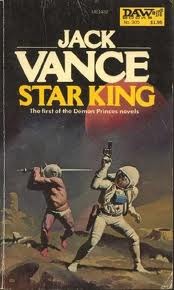
Jack Vance deserves his title of Grand Master of speculative fiction, easily crossing the genre borders between science-fiction and fantasy. Who needs psychedelic drugs when you can go on a bizarre, dangerous and exuberant trip through the galaxy simply by reading one of his novels? The first one of his Demon Princes series showcases the author at his best, combining space opera adventure with subversive essays on ethics and on the relationship between the individual and the state. The constant tonality of his opus remains a bittersweet view of decadent humanity balanced by an undeniable passion for the diversity of life, a thread that can probably be traced back through Jack Vance memoirs as he remembers the hardships of his youth in the aftermath of the Great Depression.
“Over a span of four or five years, I developed from an impractical little intellectual into a rather reckless young man, competent at many skills and crafts, and determined to try every phase of life.”
Another signature move by Mr. Vance is to grab the reader’s imagination right from the opening paragraphs, with irreverent twists on genre expectations. The current space-opera starts not with an inter-galactic war but with two ‘locaters’ meeting by chance on a remote planet that is the private property of one entrepreneur, a tavern owner named Smade.
A ‘locater’ in the terminology of the Oikumene galactic region is a solitary navigator who searches for undiscovered, inhabitable planets. They are described by the author as ‘scholar, poet, wastrel in equal parts’
Q: Do you ever get lonesome, Mr. Smade?
A: Not with three wives and eleven children.
Q: Whatever impelled you to settle here? A rather dismal world, on the whole, isn’t it?
A: Beauty is in the eye of the beholder – I don’t care to run a vacation resort.
Q: What kind of people patronize the tavern?
A: People who want quiet and a chance to rest. Occasionally a traveler from inside the pale or an explorer.
Q: I’ve heard that some of your clientele is pretty rough. In fact – not to mince words – it’s the general belief that Smade’s Tavern is frequented by the most notorious pirates and freebooters of the Beyond.
A: I suppose they occasionally need rest too.
The Beyond referred to in the interview is short for of ‘beyond the pale’ or the galactic space outside the control of the Oikumene, or the ‘civilized’ portion of the human colonization of space. Inside the rule of law is guaranteed by the IPCC or The Interworld Police Coordination Company, ‘a strictly commercial proposition’, a rather sharp and poignant commentary on the ease a police state can creep up on a permissive society. The Institute is a faculty that obtain a monopoly on scientific research. Another company controls the technology that permits fast travel between stars, but that is getting ahead of the story when I didn’t even finish with the introduction to the series.
To Smade’s Tavern in the July of 1524 came Kirth Gersen, representing himself as a locater. His boat was the standard model leased by the estate houses within the Oikumene, a thirty-foot cylinder equipped with no more than the bare necessities: in the bow the monitor-autopilot duplex, a star-finder, chronometer, macroscope, and manual controls; midships the living quarters with air machine, organic reconverter, information bank, and storage; aft the energy block, the Jarnell instersplit, and further storage; Gersen’s personal disguise was no more than well-worn clothes and natural taciturnity. Smade accepted him on his own terms.
Putting aside for the moment the temptation to develop my review on the theme of hard-science versus social studies and on Vance positioning towards the softer aspects of science-fiction, let us focus instead on the character that will guide us through all five episodes of the series: Kirth Gersen. He is a dark horse with a nonchalant attitude towards torturing and killing other people, preferring to follow his own code with little regard for established notions of good and evil. In other words, a typical amoral, adventurous and amusing Vance hero.
“Uncertainty hurts more than ignorance.”
“You can’t believe that a man is the better for ignorance?”
“Cases vary,” said Gersen, in as easy and light a manner as was natural to him. “It’s clear that uncertainty breeds indecision, which is a dead halt. An ignorant man can act. As for right or wrong – each man to his own answer. There never has been a true consensus.”
Teehalt smiled sadly. “You espouse a very popular doctrine, ethical pragmatism, which always turns out to be the doctrine of self-interest.”
The conversation partner for Kirth Gersen is a stranger who introduces himself as Lugo Teehalt, a fellow ‘locater’ who has just returned from a very interesting expedition. Gersen becomes an avid listener when this Teehalt starts complaining about his sponsor, a dangerous character known in the underworld as Malagate the Woe. In one dark corner of the tavern, the presence of a rarely seen and inscrutable Star King seems to add to the ominous vibe of their conversation.
Teehalt has deep scruples about revealing the location of the idyllic planet he discovered to Malagate, afraid that the sponsor will only abuse and destroy its pristine beauty.
On the turf in front of the ship Teehalt stood entranced. The air was clear and clean and fresh, like the air of a spring dawn, and utterly silent, as if just after a bird call.
This uncharted, unexplored new planet is not only Earth-like but inhabited by a strange race of ‘dryads’ that may or may not be intelligent, but seem to have created their own symbiotic ecosystem with other life forms that resemble trees and earthworms. Teehalt is afraid all of this knowledge will be lost when Malagate will transform the planet into a gangster’s paradise of shady enterprise and cheap entertainment.
“Something ordained, stately, ancient – like the tides, or the rotation of the galaxy. If the pattern were disturbed, if one link were broken, the whole process would collapse. This would be a great crime.”
Gersen tries to figure out where he comes into the story when goons sent by the crime lord manage to eliminate Teehalt. Still, Gersen has his own agenda that involves Malagate, and the secret revealed by Teehalt might have just offered him a means to track and destroy his secret enemy.
>>><<<>>><<<
This was a rather elaborate way to introduce the plot, captured as I was by the beauty of the presentation. Let me try to make it easier: Gersen is a space version of the Count of Monte Cristo, a man with a secret identity and a private fortune that is driven by a quest for revenge against a group of criminals who destroyed his family. Malagate is the first name on his hit list. Meeting Teehalt was just a convenient coincidence.
Five pirate captains destroyed certain lives and enslaved others who were precious to us. Revenge is not an ignoble motive, when it works to a productive end.
After the fateful meeting at Smade’s Tavern, we are offered the background story for Keith Gersen, a man of many abilities in dirty fighting and deceit. I will leave it to the reader to discover the particulars of his quest. What stands out in this first novel, even when compared with other Jack Vance works, is the willingness of the author to condense the action/adventure parts in order to leave space for rather lengthy essays in the style of his friend Frank Herbert that are included at the beginning of each chapter and are used either to expand the worldbuilding or to debate the merits of certain moral quandaries.
What is an evil man? The man is evil who coerces obedience to his private ends, destroys beauty, produces pain, extinguishes life. It must be remembered that killing evil men is not equivalent to expunging evil, which is a relationship between a situation and an individual. A poisonous spore will grow only in a nutrient soil. In this case the nutrient soil is Beyond, and since no human effort can alter the Beyond (which must always exist). You must devote your efforts to destroying the poisonous spores, which are evil men. It is a task of which you will never see the end.
Personal revenge is presented in terms of a general fight of good versus evil, but knowing Jack Vance this distinction is rarely easy to make. The actual plot of the novel combines a murder investigation (of Teehalt in the first chapter) with the series-spawning quest for revenge from Gersen and with the occasional drift into romantic entanglements. There is as usual for Vance a self-awareness of the hero’s limitations that translates into ironical, humorous conversations and clever uses of deceit to get out of thorny situations.
The whole fabric of the story is supported by the baroque excesses of geographical and social elements of the world-building. I was not surprised to read in the biographic notes that Vance cited P G Wodehouse, Clark Ashton Smith and James Branch Cabell among his influences. The language may seem old fashioned to the modern reader, but I personally find the formal, careful phrasing and the richness of the vocabulary among the best features of the Vance universe.
Binktown must be seen to be believed, and even then the hard of belief depart incredulous. [...]
What elaborate magnificence, what inspired scrimshaw, what intricate, inventive, farcical, wonderful applications and misapplications of likely and unlikely materials! [...]
The magistrates are assassins; the civil guard arsonists, extortioners and rapists; the elders of the council, bordello owners. But civic affairs proceed with a punctilio and gravity worthy of the Grand Sessions at Borugstone, or a coronation at the Tower of London.
Pausing the lecture in order to re-read some favorite passage can reveal literary Easter eggs, like anagrams of the names of author’s friends hidden among the fictional essay authors or the occasional humorous self-reference:
There are also those who, like the author, ensconce themselves on a thunderous crag of omniscience, and with protestations of humility which are either unconvincing or totally absent, assume the obligation of appraisal, commendation, derogation or denunciation of their contemporaries. Still, by and large it is an easier job than digging a ditch.
I must say, Jack Vance makes writing a literary adventure story seem like a piece of cake (and I know he dug a lot of ditches in his lean years), packing an epic scope in less than two hundred pages. I know some authors who can go on for almost a thousand pages and include less ideas and more popcorn. I also know that I can hardly wait for the next Demon Princes instalment.
>><<<>>><<<
Before I go, I deliberately said as little as possible about the Star King from the opening chapter. But, considering the title of this first novel, I would suggest he, she, it or whatever this creature is, might hold the key to resolving the mystery:
... As men have traveled from star to star they have encountered many forms of life, intelligent and not intelligent (to emphasize a perfectly arbitrary and possibly anthropomorphic parameter). No more than half a dozen of these life forms merit the adjective ‘humanoid’. Of these half dozen, a single species closely resembles man: the Star Kings of Ghnarumen.
>>><<<>>><<<
And, if Goodreads will allow me the wordcount before chopping down the review, I would like to include a final quote that is much too long to use effectively as a prop, but one that I consider relevant to the theory that the more a science-fiction writer imagines the distant future, the more he is actually commenting on present day trends.
Humanity many times has had sad experience of super-powerful police forces. As soon as (the police) slip out from under the firm thumb of a suspicious local tribune, they become arbitrary, merciless, a law unto themselves. They think no more of justice, but only of establishing themselves as a privileged and envied elite. They mistake the attitude of natural caution and uncertainty of the civilian population as admiration and respect, and presently they start to swagger back and forth, jingling their weapons in megalomaniac euphoria. People thereupon become not masters, but servants. Such a police force becomes merely an aggregate of uniformed criminals, the more baneful in that their position is unchallenged and sanctioned by law. The police mentality cannot regard a human being in terms other than as an item or object to be processed as expeditiously as possible. Public convenience or dignity means nothing; police prerogatives assume the status of divine law. Submissiveness is demanded. If a police officer kills a civilian, it is a regrettable circumstance: the officer was possibly overzealous. If a civilian kills a police officer all hell breaks loose. The police foam at the mouth. All other business comes to a standstill until the perpetrator of this most dastardly act is found out. Inevitably, when apprehended, he is beaten or otherwise tortured for his intolerable presumption. The police complain that they cannot function efficiently, that criminals escape them. Better a hundred unchecked criminals than the despotism of one unbridled police force.