KRAZY ! Folle entreprise, en effet, que la biographie d'un des auteurs les plus influents mais aussi les plus secrets de la bande dessinée. Influent ? Des auteurs phares comme Will Eisner, Charles Schulz, Patrick McDonnell, Bill Watterson ou Chris Ware ont abondamment commenté leur dette envers Herriman, et Krazy Kat a été classé premier, en 1999, par le Comics Journal, des 100 meilleurs comics américains du XXe siècle. Mais son rayonnement, traversant le monde des lettres et des arts, dépasse largement le cercle de la bande dessinée.
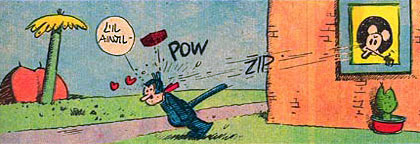
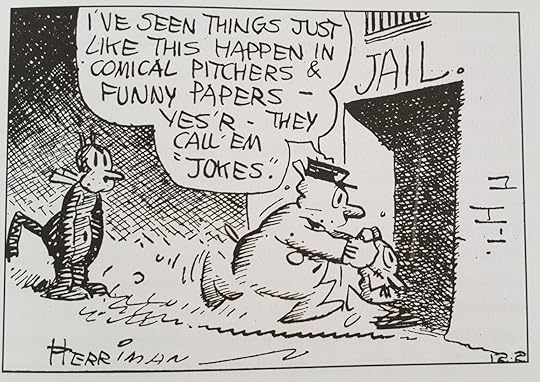
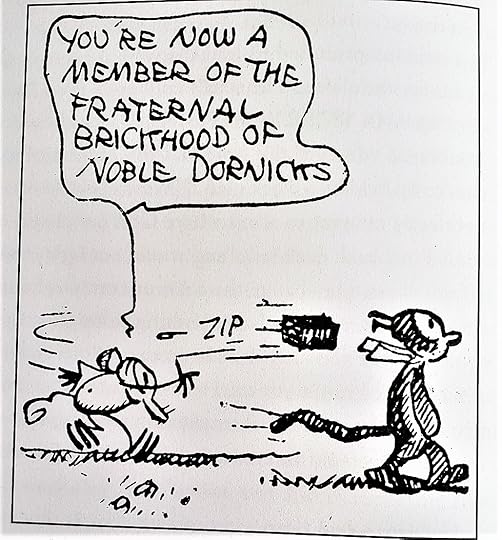
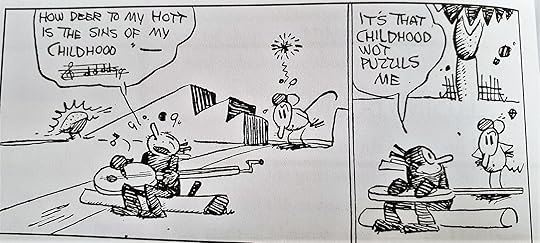
For thirty-one years in the middle of the 20th Century, George Herriman's anarchic daily comic strip "Krazy Kat" was part of American humor -- and art. Herriman delighted in absurd sight gags, non sequiturs, and dazzling but simple backgrounds often based on the Monument Valley rock formations he so loved. Many strips conclude with a brick hurled by Ignatz the angry mouse, which a lovelorn Krazy (mis)interprets as a sign of love. Yet so kinetic a strip nonetheless gave Herriman's cast opportunity to launch into panegyrics based, in part, on Shakespeare and New Orleans' "Yat" dialect. Here Krazy Kat sings the blues:
Something's the metta with me, I know not why or widda I ain't sick and I ain't well Wot it is I cannot tell Yet go I tidda, or come I hidda
KRAZY: GEORGE HERRIMAN, A LIFE IN BLACK AND WHITE by Michael Tisserand is an impressive achievement. The author takes us back to late 19th Century New Orleans, a stew of races and cultures that might be better understood today as more "pressure cooker" than "melting pot." George Herriman's forebears were accomplished artisans and small-business owners, yet when the distinctive American apartheid known today as "Jim Crow" raised its ugly head, with its dislocations and prohibitions, Herriman's Creole family encountered such difficulty that it emigrated to the new boom town of Los Angeles, and from that point on Herriman self-identified as "White" or "Caucasian."
Even so, Herriman's "mixed" racial heritage never entirely left him. Among his white fellow newspaper cartoonists, he identified himself as Irish or Greek, yet was teased about his highly curly ('kinky') hair to the point that he rarely removed his hat. Tisserand shows how racial concerns show up in Herriman's earlier works, especially sporting cartoons that criticized the "color bar" that kept African-American prizefighters from contending against the whites in the early Twentieth Century.
It is not too surprising that, since this is a biography of Herriman, nearly half the book elapses before Herriman takes "Krazy Kat" and friends from a side (usually vertical) panel running as part of a "domestic comedy" strip called THE DINGBAT FAMILY into its own prominence, in 1913. From that point on, Herriman played gleefully (and, some would say, subversively) along the lines of racial identity, gender (Krazy is usually a "she," sometimes a "he" and sometimes a neuter "sprite,") and societal expectations. (So ardent is Ignatz the Mouse's love for Krazy that when his brick-throwing gets out of hand, 'Offisa Pupp' has to step in to restore order, frequently playing the heavy.)
"Krazy Kat" was never a top-running strip, and its experimentalism seemed odd in a genre increasingly devoted to conventional action serials and domestic "sitcoms" like LITTLE ORPHAN ANNIE and BRINGING UP FATHER. However, the Kat was beloved by intellectuals and artists of all stripe. Woodrow Wilson was said to fortify himself with that day's "Kat" feed before stepping into contentious cabinet meetings. Cultural critic Gilbert Seldes praised the strip in the DIAL magazine, strengthening the idea that American art forms like comic strips and jazz provided as much art as "high" (Euro-derived) art and music. Poet E.E. Cummings was so in love with the strip that he volunteered to write the first introduction to the first book of printed "Kat" kartoons. Current cartoonists like Art Spiegelman and Patrick O'Donnell ("Mutts") acknowledge their debt to Herriman.
Despite Krazy Kat's low ratings (one poll in the Chicago TRIBUNE actually voted the strip out), it found a friend in the cartoon syndicates owner, media mogul William Randolph Hearst. (Despite Orson Welles' ogreish portrayal as "John Foster Kane" in the movie CITIZEN KANE, it seemed "the Boss" appreciated humor and those who could draw it.) Thus Hearst kept "Krazy" in his stable, and Herriman employed, until the artist's death in 1944. (At that time, the Kat ran in only about twenty newspapers; BLONDIE in nearly a thousand.)
Author Michael Tisserand has done a tremendous job of researching not only George Herriman's complex racial heritage but his life through those who knew him as a shy, almost painfully modest man who fell in love with the Navajo country of Arizona, its buttes and bluffs, and the fondness he held for the Navajo people that they returned, in kind, to him.
I'd like to give this very satisfying work five stars, but I can't quite, for two reasons: (1) next to nothing is said about the third member of the Krazy-Ignatz structure, the aggressive bulldog "Offisa Pupp." Even as a stock figure, the Pupp's place in this comic cannot be disputed. Also, (2) I thought it was a shame that this book contains no reprints from allied or competing cartoonists -- and "Krazy" her/himself appears only in black and white, not the desert tints Herriman lovingly applied to his enduring Sunday panels.
One bit of publicity I read lately claims that KRAZY KAT is "in the tradition of Peanuts." But that reverses cause and effect. PEANUTS is in the tradition of KRAZY KAT, as are MAUS, MUTTS, and numerous other strips whose liberated spirit and psychological flights of fancy trace straight from KRAZY KAT.
George Herriman's Krazy Kat is one of the supreme American cultural achievements of the first half of the 20th century. If you've never immersed yourself in it, you probably have no idea what I mean, but the enigma of its art and story line kept people enthralled for decades. Who on earth could have created such a world?
George Herriman, like many another early newspaper cartoonist, came out of the sports page, where illustration ruled in the days before photography became ubiquitous: the camera might not be able to catch the knockout punch, but the cartoonist could recreate it at his leisure. If they were lucky, cartoonists could develop characters and try a daily comic strip for the newly-created comic pages.
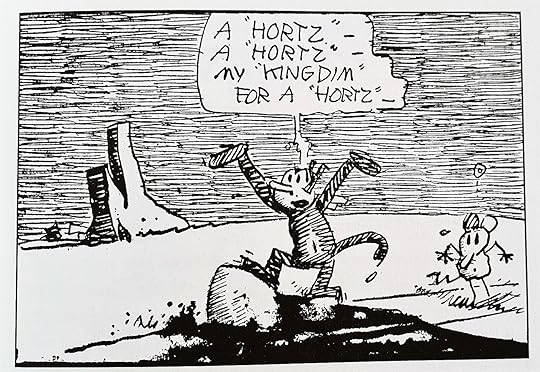
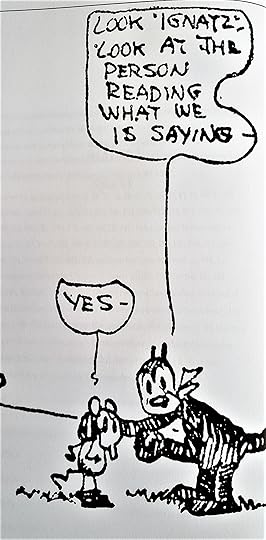
Herriman was one of them, and Krazy Kat was just one of his strips, but it was like no other. It had serious fans among the artistic elite, as well as the general public. P.G. Wodehouse was a fan. The gag was simple: the Kat lived in a dream-like state, awaiting the gift of love from Ignatz Mouse in the form of a brick tossed at his/her head, an act the policeman Offisa Pupp tries to prevent. The Kat speaks a bizarre dialect of Herriman's invention. The landscape, inspired by that of the Southwest, changes from panel to panel.
One thing his fellow cartoonists -- most of whom held him in awe -- noticed was that Herriman wore a hat at all times. His friends joked about his hair, and that and his dark complexion got him nicknamed the Greek. But he wasn't: Tissserand proves that he was a full-blooded Creole from New Orleans, which opens up a lot of the mysteries of the strip. Apparently he lived in fear that someone would reveal his secret, and he kept his distance from his relatives in the South.
Several questions remain unanswered: Tisserand walks away from the question of Herriman's possible use of marijuana, although it's quite possible he used it on his extended visits to Arizona. I always wondered if the arty crowd in Sedona ever mixed with his crowd, and Tisserand seems unaware of their existence, although Max Ernst was one of their leading lights. And, of course, the eternal mystery of the Kat's gender remains...a mystery.
The book is great at evoking the world of the newsroom in the early 20th century, and the fluid lines between the fine art world and the mundane world of comics (one of Herriman's friends and fellow cartoonists was one of the organizers of the 1917 Armory Show in New York). Herriman eventually settled in Los Angeles, where he did his comics in an office in Hal Roach's studio, the Lot Of Fun, so there's some classic Hollywood material here, too. Herriman was pretty much of a recluse, though, so there's just so much to be learned. It's amazing Tisserand got what he did. Very glad I read this.
Biographies where you learn something completely new about their subjects are pretty rare, because few people (well, me!) pick up a bio of somebody completely familiar. However, I was stunned to learn that George Herriman, creator of Krazy Kat, was an African-American (by the laws of his day) of Creole descent who successfully passed as white in his adulthood. This book is a stunner. Herriman suffered a great deal of tragedy in his life, including ill health. Although his work is considered seminal, Krazy Kat ran in a relative few of the Hearst-owned newspapers. (As an aside, can somebody digitize the Chicago American, ASAP?) Despite his own troubles, so many people benefited from Herriman's charity and generous spirit. Probably the best biography I have read in many months! (less)
A friend lent me this one. I've always liked what Krazy Kat I've seen, and I've been curious about Herriman since I learned he was African-American. Tisserand spends a lot of time teasing that out: Herriman was apparently from a New Orleans "free people of color" family, who moved to Los Angeles and passed for white thereafter. No one seems to have questioned this, though Herriman was known as "the Greek" for his darker skin, and teased about his kinky hair, which he always covered with a hat. And racial (or at least color line) implications re-appear throughout his comics.
I didn't know that he was also, in his way, a gender pioneer. Krazy Kat was always randomly gendered. Here's Herriman, talking to Frank Capra in 1924, "I fooled around with [Krazy's gender] once; began to think the Kat is a girl--even drew up some strips with her being pregnant. It wasn't the Kat any longer, too much concerned with her own problems--like a soap opera. Know what I mean? Then I realized Krazy was something like a sprite, an elf. They have no sex. So that Kat can't be a he or a she. The Kat's a sprite--a pixie--free to bust into anything."
Herriman himself was amazingly self-effacing and low in self-esteem (his phrase "inferiority complexion" may be one of his references to his hidden racial background). His life story is fascinating, and Tisserand does a fine job of following threads into not just race and gender, but the history of boxing, Herriman's fascination with the American southwest, and much more.
It made me want to go find and read more of the comic strips.
George Herriman is a terrible subject for a biography: a shy, self-effacing homebody with a happy marriage and a steady, productive career who enjoyed going out for enchiladas and taking vacations in Arizona. No swashbuckling artiste or world-historic statesman, Herriman was just a cartoonist from Los Angeles. He knew movie stars and newspaper bigwigs, all of whom invariably said that they knew him as a quiet, quirky man who loved animals and had a knack for languages. In one obituary, he was called a saint for his compassion and humility--the author probably forgot that the lives of saints are boring up until the part where they get fed to the lions. Nobody today would be talking about Herriman, who died back in 1944, if it wasn't for the fact that he was the mind behind Krazy Kat, the greatest cartoon strip in American history.
This isn't an exaggeration. Herriman is a great cartoonist the same way Dickens is a great novelist or Miles Davis is a great musician; he can be matched but never bested. Even Charles Schulz, the more popular candidate for the Great American Cartoonist, admitted to kopping a few techniques from the Kat. And if the emphasis is strictly on the greatest American cartoonist, Herriman's strip wins by an American mile: The Peanuts could live in a dozen countries, and anybody learning English could get the gist of Schultz's strips; but KK could only happen between the mesas of Coconino County, and even Canadian readers, I think, would struggle to make sense of Herriman's pidgin of American English, New Orleans Yat, and New York Yiddish. More importantly, Krazy Kat is funny as hell, and strange, and sad, and charming. Herriman could say anything he wanted with his comics, and he used it to talk about love, mystery, death, and wonder without straying from the four-panel comic formula: a mouse throws a brick at a kat. That's what makes it art, and that's what makes it good.
Still, Herriman's life was hardly interesting by itself. This was, in many ways, by design: too much attention might reveal that George the Greek, as he was known, was actually a Creole passing as white. His entire life is bracketed by the era of Jim Crow laws, which would have destroyed the opportunities he had--good schooling, unrestricted travel, a respectable middle-class career--because his parents moved the family away from New Orleans and hid their black heritage. Herriman kept the secret well: the discovery of his birth certificate, which listed him as "Colored," was news to his own granddaughter. So Herriman's life isn't dramatic on its own, but the times and places he moved through, how they shaped him, and how they may have felt to a man in such precarity, are more than enough to supply a biographer.
That biographer is Michael Tisserand, and his book, Krazy: A Life in Black and White is a respectable study of a great artist and an even better survey of American life and culture. His biographical method always puts Herriman in the middle of his time and place: with Tisserand, we see the cultural history of postbellum New Orleans, the freewheeling macho culture of newsrooms in the early 1900s, the racial hysteria in early American boxing and Jack Johnson, the growth and development of early Los Angeles, and, of course, American comics. Every biographer does this to some extent, but only sometimes as a conscious effort. The downside of this is that Krazy is a long book, full of names, figures, and places that repeat just a little too much. Fifty pages could be cut with no great loss to the narrative, and I had to take a few breaks from the book to avoid the tedium of hearing about yet another description of a minor boxing bout in 1908 that Herriman cartooned.
But Tisserand's ecological approach was probably necessary, not only because a more stylized approach might distract from the style of the subject, and not only because Herriman was more observer than actor in his lifetime, but also because few eras are as unfamiliar to early 21st century Americans as their own country in the early 20th century. How often do you hear about middle-class black communities in 1870s New Orleans? Why isn't Jack Johnson as celebrated as Muhammad Ali? Did you know that the debate over Cubism was so widespread in 1913 that Teddy Roosevelt felt compelled to speak on it? Why have I never heard of Tad Dorgan, or the Archy & Mehitabel poems of Don Marquis until now? Amateur Americanists will scrutinize Tisserand's bibliography more than the the biography itself, and come back with treasures.
They might also come away with a strong urge to collect the entire print run of Krazy Kat after reading about its sweet, lovable creator. They might also note, with the agony familiar to bookworms of limited finances, that the complete run printed by Fantagraphics will cost them several hundred dollars. They might think about buying it anyway; what good's a koin if it doesn't buy a kat?
KRAZY KAT - popkulturelle & Früh=Geschichte des Comics, surreal, anarchisch … Ach, was freue ich mich auf diese Herriman-Bio!
KRAZY ist - komisch:
- anarchisch:
- künstlerisch=sentimental:
- FW=isch:
- klassisch gebildet:
- sich seiner Herkunft bewußt:
- meta / beckettsch:
(Richtig, das ist noch nicht die Rezi, sondern eine Appetitanreger für die, die vor 100 Jahren noch keine Comics gelesen haben und KRAZY KAT & IGNATZ nicht kennen)
[Update] Check this out. I'd like to attend this author appearance 10 AM Saturday at Decatur Library, thanks to AJC Decatur Book Festival: https://www.decaturbookfestival.com/s... [My earlier review:] Here is an important biography of one of our greatest American cartoonists: and there is so much that seems unreported before. Early on: family history affects Herriman's whole career, as his New Orleans, Louisiana creole heritage is full of American irony. And late: after a long, happy life, few attended the great artist's memorial service. This book makes me miss the volumes of Krazy Kat reprints I used to have. Fortunately, there are sporadic copies in libraries now. Part of the ironies documented here: Krazy was never simply male or female, simply black or white. Herriman's coded, playful language and allusive art portrayed American roots in comedy and the most poetic of great newspaper comics. Read Herriman's work, and until you, do, read this great biography! See who if author Michael Tisserand will return to the Atlanta area: maybe via SCAD, or Emory, next time. Highest recommendation.
Too dry, too much the worst stereotype of a history or biography. Massively researched and noted, but all external details so far. Nothing of Herriman's inner life. Not that I want Tisserand to make it up, if there were no journals or letters or whatever to work with, so be it.
But I'm not interested in Krazy Kat. I don't "get" Herriman's cartoons. They're not funny to me, I don't understand what the point of them is. Nor am I interested in a detailed year by year, month by month chronology of where he lived, where he worked, and with who, that's devoid of any emotion, and that's all this seems to be so far.
The depiction New Orleans at the end of the 19th century was interesting, and suggests why Herriman's family left for LA and why he passed as white for the rest of his life, but again, so far, just implied, suggested.
So I'm setting this back on the shelf for now. Maybe I'll come back to it someday. Maybe there's some feeling in here at some point, but I couldn't care less about all these details.
Krazy Kat is likely my favorite comic strip, which makes Herriman one of my favorite cartoonists. This biography fills a huge gap in my understanding of how such a unique, sustained, mind-blowing work of art was accomplished - and yet, much mystery remains. Herriman was as much of an enigma as his creation, and the depths of his inner life still aren't fully illuminated, not by a long shot. That said, Tisserand does an incredible job with the limited material at his disposal, and succeeds in painting a tremendous portrait of the milieus where Herriman grew up, lived and worked. It's a unique life, viewed primarily from the outside, in greater detail than we've yet seen, but with many dark corners remaining. A must-read for any lover of classic comics.
Nice to learn more about someone and, it turns out, they're even nicer and kinder than you already expected, the lil' dollin. Very interesting that the ket was so commercialized, with dolls and toys and animated features. <- apparently none of which captured the true kat spirit (sp'rit[e]?)
(It was a little odd to have so many strips and photos described rather than shown (though some of the photos are at the midway point), I guess private collections, find 'em yourself, slash/ don't want to clutter the text too much? I dunno.)
Note! IF you're intimidate by the size of this book, the last 100 or so pages are notes, references, and a few interview transcripts. So yeah, it's big, but it's not that big.
Many (all?) have the opportunity to decide the level of ethnicity we are. These are always painful choices. Yet George Herriman made some of the most difficult. When he was 10, Herriman's family of origin left New Orleans and moved to California where some family members continued to live as black people and where George in young adukthood made a conscious decision to pass as a white man.
His comic art shows me numerous times his New Orleans background, his ethnicity, his social isolation. I cannot believe that others with similar backgrounds did not recognize. They had to have. I have no idea of the implications. And I do not want to imagine them. Too painful.
What I do want to consider is other aspects of Herriman's art. For all its simplicity, the comic strips--and much of the book is also about other comics that Herriman wrote--contain elements of/references to Dante, Cervantes, and Shakespeare. Despite these high browelements and references, the comics are overall mid brow. The Krazy Kat comics have a simplified background indicating desert by which Harriman seems to contribute to the dry humor, belie the depth of meaning.
Krazy Kat informed elements of a variety of comic writers, including Charles M. Shulz who wrote Peanuts and Theodore Seuss Geisel (Dr. Seuss).
At least one famous politician consulted Krazy Kat in his everyday routine: Woodrow Wilson.
This bookwas difficult for me to read. I kept reading disconnection and pain. But I did not stop. Maybe that means something.
Why I Think Anyone Interested In Cartoons May Enjoy This
Truth is, this book does not really fit into my “Books for Boys” format but it was just so good I wanted to give it some space in review form. So I fixed the section heading above to reflect that. While the book is sold and set up under the premise of exploring George Herriman’s questionable ethnicity (he could *not* have been ‘openly’ black and done what he did with his life in the era he did it) and how it connects to his main legacy’s genderfluidity (I discovered this book via a New Yorker article discussing just that), it is so much more than that. In fact, this book should serve as a primer to the history of cartooning and even the rise of animated cartoons for anyone interested in either.
Even deeper than that, Tisserand dives into American history such as the rise in prominence of New Orleans (where Herriman is originally from), the birth of Los Angeles (and ultimately Hollywood), and the racial barriers in boxing (and ultimate crowning of the first black heavyweight boxer Jim Johnson). While this feels like a grandiose adventure for the biography of a humble cartoonist, Tisserand makes it all fit together seamlessly. Whenever he feels the reader needs more context to understand the gravity of a situation or Herriman’s involvement, he goes just far enough down the “background info” rabbit hole to set the context but pulls the reader back before he or she gets lost on a tangent.
To give an example of just *how* thorough Tisserand is in this biography, the text of the book (hardcover) is 439 pages. His notes, bibliography, and index run from page 447-545. Even more amazingly, there is so much background info surrounding Herriman’s rise to “prominence” that the introduction of Krazy Kat, Herriman’s main legacy, didn’t even come around until halfway through the book, even though there are Krazy comics sprinkled throughout the book (as well as other Herriman works from throughout his career). Another nice element to the writing is that, though it’s obvious Tisserand thinks very highly of Herriman, it falls far short of a hero worship biography. He presents Herriman, to the best of his ability, as his contemporaries saw him (which, at times, was almost hero worship itself).
Content/Appropriateness
It’s a biography about a cartoonist. Spoiler: he dies in the end. From a content standpoint, it’s more than appropriate for anyone who would want to learn more about the history of cartooning in America (with some side lessons on racial relations in the early 20th century as well). Tisserand writes matter-of-factly about minstrel shows and blackface and other common vaudeville entertainment in the time period and does a good job of reserving judgement, only discussing it when it is relevant to Herriman himself, who lived as a white man even if he had some black heritage.
As any in depth non-fiction work can be, the language and context is deep and complex, much like Herriman’s work itself. Tisserand does a fantastic job of making century-plus old stories feel accessible to the reader so I would think an interested high schooler would be able to handle this book without much issue.
I became a fan of "Krazy Kat" when I stumbled on my first collection of the strips in Partick McDonnell's and Karen O'Connell's book, "Krazy Kat: The Comic Art of George Herriman." I'd always loved comics -Charles Shulz's "Peanuts" was and is a favorite- but I'd never seen anything like "Krazy Kat" before, strangely arranged panels, characters that spoke in dialect, language that was more like poetry than prose. The work was beautiful. I was smitten with the Kat.
A few years ago, Fantagraphics finished its reprints of Krazy Kat, each one preceded by a scholarly essay, examining some aspect of the groundbreaking strip. One of those essays revealed something I hadn't known. Herriman was born an African American in New Orleans. To escape the racism of the American South, Herriman's father moved the family to Los Angeles. Here the family could reinvent itself...as white.
This is the nugget upon which Michael Tisserand builds his biography of Herriman, "Krazy: George Herriman, a Life in Black and White." He shows us how Herriman coded his identity into his work as a cartoonist, starting from the earliest days when he made strips that patterned themselves after minstrel shows all the way through "Krazy Kat" where he dealt with the ambiguity of living a hidden life.
Tisserand's biography is especially relevant today when race hate is still, unfortunately, part of the American landscape. Herriman was born into an exceptional time in the U.S. Even in the late 19th century, the South was still smarting from the Civil War, and racist Whites took their resentment out on Blacks. Sound familiar?
When you read "Krazy Kat" from this perspective, much comes into focus. The strip, already layered and nuanced enough to garner fans like T.S. Eliot, E.E. Cummings, and P.G. Wodehouse, also is a sort of autobiography. In one strip Krazy enters a beauty parlor a black Kat and emerges as a white one. She speaks in a sort of Yiddish/African-American dialect. Herriman never assigned Krazy a gender, instead, he considered her a "sprite," neither here nor there, and therefore able to be anything he wanted Krazy to be.
Krazy is, in fact, an American character, a fringe dwelling observer who can tell-it-like-it-is, a character of great sympathy who stoops to greet a worm. Krazy is Thoreau, Whitman, Dickinson. At times Krazy's dialect is Shakespearean, at others, it's the Blues. I want to read all the strips again.
Herriman's story is tied up with so much more: the birth of newspaper comics, the birth of Hollywood. Tisserand brings the rough and tumble world of the early 20th century to light. He also shows us that, in "Krazy Kat," George Herriman created one of the true works of uniquely American art. Tisserand puts it in even sharper focus by giving us the life a man who was both conflicted and committed, who cared deeply about his art but always questioned himself. It's a remarkable work of scholarship, and well worth your time.
I'd been wanting to read this pretty much since I first saw it was coming out. And thanks to a pretty deep discount on the Kindle version I took the plunge. I'm really happy to see that we are starting to get full-fledged biographies of comic strip creators (see also Schulz & Peanuts by David Michealis). Now if we could just get some of the great comic book creators (Kirby for Pete's sake).
The background in this one was fascinating. That Herriman was a creole passing as white is pretty well established. The danger to his career had that become known is pretty clear. Equally interesting were the looks at early comics greats who are now largely forgotten. And the absolutely huge craft of sports cartooning that is also largely forgotten. Watching along as Herriman strove to have that breakout strip that would put him with the likes of Bud Fisher and Rudolph Dirks. This is particularly compelling since Herriman's influence has clearly outstripped both of those luminaries. I was generally familiar with Herriman's non-Krazy Kat strips, but it was interesting to see their history laid out.
I also like that where he could, Tisserand busted myths...but was happy to say when there simply wasn't enough evidence to confirm or bust certain assertions. It's clear that Krazy was not a terribly popular strip with the general public or with newspaper editors, though it was a darling of the literati. But it did last from 1913 to Herriman's death. And there's no indication it was kept on life support by Hearst himself as has been frequently asserted.
As to Herriman himself he comes off as generally a nice mild-mannered man who was a consummate professional and seems almost oblivious to the genius of his work.
Princess Fuzzypants here: Before there was Garfield or Heathcliff or any of the other animal superstars of the comics, there was Krazy Kat. Many of the most auspicious names cite George Herriman and his Krazy Kreations with being the influence and the spark that ignited their creativity. Included in that list is Charles Schultz, Stan Lee and Walt Disney. In fact, the earliest rendition of MIckey Mouse is clearly related to Ignatz, Krazy's primary foil. Herriman, a quiet spoken, kind and generous man who "passed" as white in an era of discrimination, could be an anarchist when it came to his strip. He did other successful strips during his time with the Hearst organization and others but it is Krazy Kat who lives on. With it's unique language and stark backgrounds, it set a standard for the time. The sexually ambiguous Krazy's love/hate affair with Ignatz Mouse which ended inevitably with a brick gave great joy to his/her fans both young and old. Herriman himself, who never considered his work special, was equally loved and revered. But both he and Krazy Kat eventually ran out of steam. He would have marvelled at the revivals that Krazy Kat enjoyed over the decades. This book is an affection telling of their story. There is nothing Krazy about it. I give this five purrs and two paws up.
Outstanding, and overdue, biography of cartoonist George Herriman, one of the most important, and least appreciated, artists in 20th century popular culture. His long-running comic strip "Krazy Kat" was a dazzling combination of low gags, inspired word-play, whimsy, and surrealism that remains an influence on cartoonists to this day. If I have a criticism of the book is that it's too short. I wouldn't want to give up any of the details of his life, but I would have liked more discussion, and analysis of the work. Still, a fine book, worthy of it's subject.
I was somewhat familiar with Krazy Kat, but knew nothing about Krazy's creator. An interview on NPR with the author led me to this biography of George Herriman. The book is long and detailed but very readable. Herriman was a man with many secrets, but his comic strip depicting animals with wry and philosophical ways was decades ahead of his contemporaries and competitors. The book has a number of panels from the series, but not nearly as many as I would have liked. No matter; Fantagraphics publishes 13 two-year collections of the strips, and I plan on reading them all.
A titanic achievement in comics scholarship. Until this book, George Herriman was a notorious enigma. No one seemed to know anything about him. Tisserand has performed a spectacular feat of archival detective work; he has uncovered the history of the Herriman family, and has traced the influences that helped Herriman create his unique and unclassifiable style.
I happened upon this extraordinary book via the six degrees of separation theory that links us to anything and everything in life. Michael Tisserand, the author, called me in the midst of this book project because he found that his protagonist, cartoonist George Herriman, had dedicated a painting to my grandfather, Arthur "Frenchy" Escallier, of Temecula, California, based on a one-day quail hunting trip. My grandfather died in the 1940's well before my birth in the 1950's, but I gave what little information I had of Arthur and my family tree. When I stumbled upon this book, almost six years later, I was intrigued to see what Tisserand had accomplished with such an obscure subject matter.
The subject of this book, George Herriman's Krazy Kat comic strip, is anything but obscure. From page one, I was sucked into a vortex of African-American and Civil War history that culminated in New Orleans, Louisiana, Herriman's birth place. It took Tisserand almost 500 pages to tell this charming and talented man's story, every single word is necessary to tell this incredible story of a man who changed the way we view comics and art, in general. Page after page after page is a chronology of American society 100 years ago. Readers will learn about the cultural trends in art, music, drama and newspapers, specifically in New York and Los Angeles, that still affect who we are as a nation today.
This sweeping view of American history is only one layer of the story. There is another poignant layer that gives Tisserand's book heart and soul. It's about a simple, humble man who lived his life for his friends and family; a man who never believed he was a genius, nor did he believe that he deserved to be well-received and famous. George Herrriman simply loved drawing Krazy Kat, Ignatz the mouse and Officer Pupp. Because of his excruciating shyness, he could show his intellect and sense of whimsy to the world without being in the spotlight. He was able to address issues of race, acceptance and what makes life worth living through his characters. I literally laughed and cried throughout this book because I wanted George to realize his worth, if only through my imagination.
The third, and most important, layer of this true tale is that George Herriman's work was the catalyst for all major comic strips and artists we know today. Walt Disney, Ted Giesel of Dr. Suess fame, Charles Schulz of Peanuts fame are just a few of the greats who gave Herriman credit for their work. (Even before Tisserand mentioned their inspirations, I could see all of them in his Krazy Kat cartoons presented in the book. I also wondered about Popeye and Feliz the Cat; sure enough, those cartoonists mentioned Harrimen as a role model.) The surrealist artists of the 20th century were inspired to think out of the box because Herriman had the stones to push past the status quo in his work. The Beat Generation of greats, Jack Keroac, Ken Kesey, Alan Ginsberg, cite references to Krazy Kat as their template of thought. I was astounded at how far this sweet man's influence permeated our society, then and now.
Michael Tisserand researched the hell out of Herriman and his work, and it shows. I appreciate a smart writer who does smart work. The result is always magical. I am over the moon that my grandfather, of Pechanga Indian and French ancestry, knew George Herriman, of African American and European ancestry. I can easily picture them speaking French in hushed tones, and then laughing uproariously about the simple things in life. It's all there in Herriman's delightful work.
When I was a kid (we're talking 1960's here), I remember being introduced to "Krazy Kat" as a series of TV cartoons and thinking that there was something interesting going on here, but I really didn't get it. Those thoughts basically lay fallow until this biography came out a few years ago, when it immediately went on the TBR list. My thoughts on having finished this work? As for the book itself, Tisserand is almost too careful of a writer at the start, as he lays out the family history that George Herriman was so careful to keep obscure, as having roots in the Free Black community of New Orleans would certainly have aborted the young man's aspirations to being a commercial artist. Once you get into the meat of the book, dealing with Herriman's career as a cartoonist, Tisserand treats those cartoons as a "text" to try and draw out truths about Herriman, and there's a strong argument to be made that said cartoons were a way for Herriman to vent what he was really feeling.
Apart from dealing with Herriman as an artist, Tisserand also explores the ins and outs of his subject's life, with the most interesting point being how Herriman struck up a relationship with the Navajo community; outside of the company of his immediate family and artistic peers, they seem to be the people Herriman felt most at home with.
Michael Tisserand’s Krazy: A Life in Black and White is a wonderful gift to comics scholarship. It’s a meticulously researched and sensitive portrait of a great American artist and the milieu in which he lived and worked. In a world where things that were worth a damn got more notice than they do in ours, there would be shelves full of prose dedicated to the inimitable, sublime Krazy Kat. Until we live in that city on the hill, we find ourselves lucky to have Tisserand’s exhaustive tome to tide us over.
George Herriman’s career began in the first great rush of creativity in the genre he came to dominate, and the world of those pioneering newspaper artists is beautifully recreated in Krazy’s pages. The hard drinking, prank loving gangs of ink-spattered sports moving merrily from boxing match to opera box to minstrel show, the oversized personalities and madcap humor of this word come to life in Tisserand’s hands. We follow his working life from his early days doing sports and editorial cartooning, through the rubble of numerous abandoned and cancelled strips, and into the lush, mysterious paradise of Coconino County.
Herriman worked his entire career, trying every stylistic fad and quirk of genre, seeking a blockbuster smash like Mutt and Jeff or Barney Google, and he created numerous characters and strips in that quest. And although his drawings are some of the greatest to ever grace newsprint, his humor and dialog always sharp, it wasn’t until he began Krazy that his work began to achieve its greatest heights. The dizzying language, the stunning page designs, the dreamlike textures, all of the things that make his Kat the greatest of comics. Tisserand is the first writer to set Herriman’s career in context, and try to find a path through it all to his masterpiece.
We see George make himself into a great artist, and we see him grow as a man. From the protracted adolescence of the smoke-filled newspaper bullpens, he becomes a husband and a father. In correspondence and interviews we are given a real view of a complex man, an intelligent, curious, and passionate artist who loved chile con carne, Navajo art, and his scottish terriers.
Too, we follow his his life from his humble origins as a New Orleans Creole tailor’s son, to California where he began the lifelong project of passing for white. While it seems that Herriman never let any anxiety at being discovered stand in the way of anything he wished to achieve, his complex feelings about this issue arise again and again in his work. Since Herriman’s birth certificate - describing him as colored - was found in the 1970s, much has been conjectured about the role that race played in Krazy Kat. Tisserand has done an exhaustive close reading of the corpus, and shows that not only did Herriman repeatedly make race a central consideration of his strip, but that he had a lot to say about it, again and again until his death.
The great questions about Krazy Kat will never be answered. It’s the kind of great work that generates more mystery the more you consider it. And there are questions we would have asked its creator that we will never be able to. Michael Tisserand has done aficionados of Herriman a great service in this book, one that gives us a glimpse of perhaps what manner of man he might have been, this curious, concealing, self deprecating genius.
By junior high I was obsessive about what was then maybe called "alternative cartoons." The alternative comics, especially Art Spiegelman's Raw, led in turn to a fanaticism about the anarchic early newspaper strips that inspired many of the later freaky cartoonists. Weirdos like R. Crumb and Chris Ware explicitly referenced the early newspaper dudes as their ancestors. I spent many hours combing through the stacks at Half Price to find reprints of newspaper strips by Winsor McCay, EC Segar, Cliff Sterrett, and especially, the sui generis George Herriman. Herriman's Krazy Kat--especially in its first decade or so--is almost impossibly wild, beautiful, and weird. It was said that folks like Gertrude Stein and ee cummings collected and traded strips that they'd had carried over from the US. No other newspaper cartoonist ever pushed the boundaries of art, language, and subject to the extremes that Herriman comfortably, daily reached.
Yet Herriman himself was famously "self-effacing" and reticent. He famously always wore a hat; he avoided photographs and despised talking about himself. His medium was considered disposable. Not much really seemed to be known about him, based on my limited juvenile researches. Long after his death Herriman's birth certificate was located, and it came to be believed that he was a New Orleans Creole, raised in LA, and likely was partly black, a fact he had had to hide during his life, instead choosing to pass as a white man of ambiguous ethnicity. But even this point seemed to have only a shaky factual basis. Around 2002, I remember trying to find the Treme home his family was said to have lived in at the time of his birth in 1880, hoping that the city of New Orleans would have erected some sort of remembrance, only to find that the block no longer existed and had been swallowed up by the Iberville projects. It seemed indicative of Herriman's own desire to efface his past.
So Tisserand's biography is something of a miracle. Tisserand has finally answered the questions about Herriman's ancestry and family: Herriman was indeed the son of a (mostly) free black middle class Creole family that chose to relocate to Los Angeles in 1890 to pass as white and escape the encroachments of Jim Crow as reconstruction waned. Given the immensity of the interests in keeping this history secret, it seems like a miracle to have unraveled this story. And Tisserand has masterfully done so with the help of stunning genealogical research. Tisserand's biography is also enlightening on two other questions that always bothered me - First, the author links Herriman's racial story to many of the themes in Krazy Kat, eg, the mysteries of identity, etc. (While Tisserand is strong at linking Herriman's family history to the strip, one weakness of the biography is that the analysis of the cartoons stops there. There is sadly no trenchant interpretation or literary analysis of Krazy Kat.) Second, the biography illustrates how active and appreciated Herriman was in the newspaper and "sporting" worlds of New York and LA. Herriman was not an isolated, unrecognized genius. He had many friends and admirers.
This likely is not a book that will convert the uninitiated into the cult of Herriman. But, for those of us already in too deep, it feels like a long sought resolution.
I first heard about George Herriman during my introduction to comics studies class during undergrad, and I immediately fell in love with Krazy Kat. It was a simple premise — the mouse threw bricks at the cat, the cat was in love with the mouse and viewed the bricks as a sign of affection, and the police dog was in love with the cat and kept going after the mouse because the mouse was hurting the cat. Such a simple story, and yet so many complexities. Race is a theme touched upon in many of the Krazy Kat strips, and gender within the comic is fascinating because Krazy’s gender isn’t static; in most strips Krazy’s gender is unspecified, and in a few “he” or “she” pronouns are used, and it’s never really implied that one is “more correct” than another, bringing into question both gender and sexuality of the characters. This book takes these and other themes found in the strip and Herriman’s other works and delves into how they relate to Herriman himself.
Herriman is a complex person who in many respects was very private about himself, and Tisserand did an excellent job of exploring Herriman’s life using what was available. Krazy Kat is Herriman’s most well-known work, so I appreciated the time that was spent covering his background and his other works that preceded Krazy Kat that hadn’t gotten so much attention. Some people seem to have found that this made the book too long for their taste, but I really liked this because it really shows how an artist of Herriman’s caliber got started in his career and centered him in his story rather than his work. I know Krazy Kat and I knew a little about Herriman already from my studies, and this book supplemented what I already knew with a rich story of Herriman’s life.
The writing in this book was also very smooth; while the book is a bit on the longer side for a biography, it flows well and is an easy and engaging read. I really enjoyed this book, and I’d recommend it to anyone who is interested in biographies about artists, comics, and complex human beings. Well worth reading.
Michael Tisserand spent ten years studying George Herriman after viewing Masters of American Comics, a special exhibition at the Milwaukee Art Museum in 2006. https://mam.org/exhibitions/details/c... Carrying his son through that exhibition, Tisserand read the panels aloud to him, which, he discovered, lifted the dialogue off the page and brought to life such early comics as Krazy Kat. (That was a terrific exhibition at MAM eleven years ago. Part of the fun came from seeing the actual panels and storyboards with corrections pasted on as well as printers' marks and instructions in blue pencil.)
Tisserand talked today about Herriman and the new biography with dozens of book lovers at Milwaukee's best indie bookshop. An interesting and well-done presentation. Catch it if you can this week at bookshops in Wisconsin, Iowa and Minnesota, http://www.michaeltisserandauthor.com...
Among other tidbits, Tisserand told how Jelly Roll Morton was part of Herriman's extended family. But because he was born after Herriman's family moved to Los Angeles, the two never met, although Jelly Roll appears in at least one of the comics. They were both New Orleans-born Creoles. Herriman passed for white, and that secret conflict inspired an ambiguity that played out in his comics. Before sports photography, Herriman's early drawings illustrated boxing stories, which featured blacks and whites on the card a hundred years ago.
A Life in Black and White, the subtitle of the book, works two ways. This is a story about about comics and illustrating in the days of black-and-white drawing for newspapers. Also, the subtitle refers to Herriman, born as a Creole in New Orleans before the family resettled in Los Angeles.
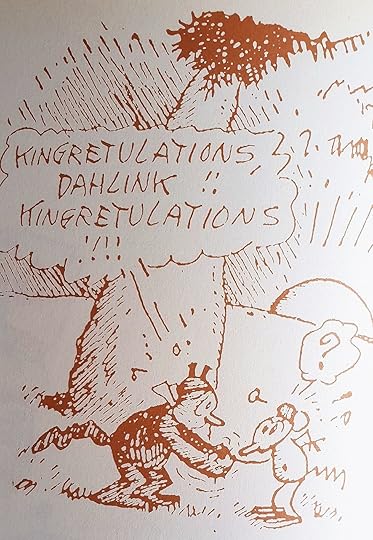
Been doing a little research on the intersection of the comic strip and American consciousness in the early 20th century, when newspapers and radio ruled what most people knew. It led me to this gem of a biography about George Herriman. To be honest, neither the comic or the man were on my radar before, though I recall seeing the cat and the mouse with the brick. Apparently brick-throwing, a trademark of Herriman's that would reappear in plenty of other artist's cartoons, was an actual childhood memory of a riot he witnessed in New Orleans. Random curiosity about the people behind the instruments sometimes rewards, as this person had the sort of curious life that could make anybody interesting, even if beyond his utterly personal comic his life was more or less devoted to an ordinary and happy one. Something about the early strips are clean of market research, and prone to carry a heavier load of the artist's fancy and personality. My impression is Herriman was a sort of Dan Piraro of his time, surreal and very subtly indirect but reaching for the quick of things... loaded with personal references and world play from a century ago his language, especially sly twists on slang, can be more cryptic than Elizabethan prose. It's great to encounter a missing link, and this completely unknown piece of history is so clearly an influence on the "Looney Tunes" rerun world I grew up with. How clearly you can see all the artists that grew up with Herriman, the landscapes and capers that inspired Dr Seuss and Roadrunner, the weird character of Krazy coming though in both the lisp of Sylvester the cat and the schmoozing of Pepe Le Pew, always calling his mouse Dahlink.
The artist's is a tale of the western sort, where a person remakes themselves by relocating to the 'new city' Los Angeles or in his case, falling for the Southwest wilderness. The world is full of stories, I am glad I ran across this one.
When I was much younger and a countercultural sort of teenager I was really into "underground comics." Everybody into underground comics loved Robert Crumb, of course, the daddy of them all, but there was anther group of cartoonists who put out a series (very shortly) called Air Pirates Funnies. The Air Pirates collective was composed of five folks (the most famous, and most instigative, was Dan O'Neill, who drew the Odd Bodkins strip for the SF Chronicle at the time, as well) but the one of their group I dug most was a guy named Bobby London. It was only a few years later when after I found a large book with a collection of Herriman's comics of Krazy Kat did I discover London had cribbed almost his entire style off Herriman...from the spare, and strange backgrounds, to the locations ("Coconino County") to the characters (his Dirty Duck, which was run in the National Lampoon for some time as well as being its own book) was modeled on one of Herriman's characters... So that when I discovered Herriman (by way of London) I realized myself, there was way way more to the artist than just met the eye... And this book goes deeply into Herriman's personality. A tragic life in the end, but he did have some fun along the way. And many, many artists claim him for their own as "the greatest cartoonist of all time."
The author's done tremendous research, and he's a good enough writer that I was carried along in the narrative quite nicely. That said, it's clear that Herriman's life was largely his work, without the personal and/or professional twists and turns that make for truly compelling biography. I think the best way to experience Herriman's life, all these decades later, would be a biography roughly half as comprehensive PLUS a real sampling of his Krazy Kat work, the best of which simply could not be reproduced in a standard biography like this one (because of size and color considerations). I won't mention here the most interesting thing about Herriman's personal life; suffice to say the author does a fine job with it, but is limited by the fact that Herriman seems to have said nothing about it (he did refer to the matter obliquely in his work, as Tisserand points out many times).
Worth a read for any Krazy Kat fans. The research behind Tisserand's book is great. A little uneven on presentation though.
For example, spending extended time describing Krazy Kat cartoons in prose is not really worthwhile. Tisserand obviously had access to the strips, (he reproduced many panels throughout the book), so why not simply include the relevant panels when you're talking about them instead of attempting to describe them--which is more or less impossible?
Also the book didn't seem particularly well structured. Lacked a bit of narrative cohesiveness. And the amount of time spent on some time periods (e.g., Herriman's pre-Kat days) seemed to often outweigh their importance to the reader.
But, as I say, a nice work of biographing and definitely worth a read to people who love Herriman!
Interesting exploration into the life of George Herriman the creator of the most surrealistic and important comic strip in American history KRAZY KAT. The surreal, intellectual, literate universe of a strangely genderless cat and a brick throwing mouse and a policeman dog who live in a weird mashup of Southern Western environs contains subtle and overt meanings to Life and existentialism and love. But most of all are the hidden refeences to being something that you hide from others ... namely the fact that creator Herriman passed as a white man his entire life when, in fact, he was a of black heritage. The book is informative, but overly so in all the shenanigans that Herriman and his fellow cartoonists and newspapermen in the 20 and 30s were involved in and performed.
I was tempted to give this a two star rating, but felt bad about that given all the interesting information in the book. My chief complaint is that for a book about a seminal figure in cartooning, there is a serious lack of his work included. There are many verbal descriptions of key cartoons/illustrations, missing an opportunity to bring new fans to George Herriman's work. Krazy Kat is so charming in its way, and this was a great chance to introduce new fans to his work.
The amount of research is prodigious, and it seems every bit of it is in the book. A more rigorous editor could have pared this down to make the book a bit more enthralling and bring the illustrations to life in the reader's mind.