Lynne is a young woman who once dreamed of being an artist, but whose promotion to supervisor at an insurance call centre in Glasgow is sucking the soul out of her. When Lynne hands a fiver to a homeless man on the street in town one day, she is shocked to recognise Angus - her former art teacher on whom she once had a crush. What on earth could have reduced him to life on the street In a gesture of uncharacteristic rashness, she invites him home. So begins The Glasgow Coma Scale. Set against the gentrification of Scotland's second city, this is a taut, ticklish, tender and truly unexpected story of art, of the city, of feelings, and about the redemptive power of an unconventional kind of love.
Neil D.A. Stewart was born in Glasgow in 1978 and lives in London. He was educated at the University of Glasgow and holds an MA in Creative Writing from the University of East Anglia. He is the arts editor of the online magazine Civilian and works as a freelance proofreader for Tate Publishing. The Glasgow Coma Scale is his first novel.
Be warned - The Glasgow Coma Scale is neither an uplifting nor inspirational read. When I picked this up in the bookstore, I was expecting more of a romantic element, but I didn't get it - and in hindsight I'm glad Neil D.A. Stewart didn't go down that road.
The story follows two characters - Lynne, who originally dreamed of being an artist but has ended up working in a dead-end call centre job, and Angus, her ex-teacher at The Glasgow School of Art who (as a result of certain circumstances) has ended up jobless and homeless. The two meet one day, and Lynne (still harbouring a crush on Angus) invites him to stay with her. What follows are the trials and tribulations of two very different personalities, and how they attempts to maintain a very unusual life together.
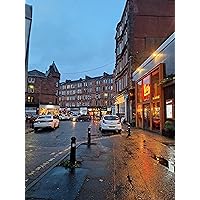
What I loved about this book was ultimately the setting - it's rare I read a book set in my own city, and I loved the familiarity of it all, being able to envision every pub, shop, and street clearly in my mind. I even pictured the character of Angus in my mind as the musician Aidan Moffat!
Angus was a very well-drawn out character - with the strong Glasgow dialect and his stubborn-ness and refusal to be anything but himself, I loved reading about him. I enjoyed Lynne's character less - although I felt that she again was realistic, there was only so much of her self-loathing and acquiescence I could stand. They did make quite the odd pairing.
The ending left me with mixed feelings - I felt that Stewart ended the book the best way he could, but it left me feeling empty and cold. I believe this was intentional, but sometimes we want to escape from reality and The Glasgow Coma Scale forces you to confront it head on.
A rewarding debut novel from Neil D.A. Stewart, and I'll definitely be looking out for more of his work in the future.
Lynne Meacher lives in Glasgow, where she went almost as an impulse, looking for a new life. What she has found is life in a small flat, a job she loathes in a debt collection office – where she is promoted, but lacks the respect of her colleagues, especially the sneering Struan, and the ending of a long term relationship with Raymond, leaving her lonely and missing his daughter, Siri, who she rarely sees. So, when she stumbles across a homeless man who turns out to be Angus Rennie, who taught her when she attended the School of Art, she immediately invites him home. Angus reminds her of a time when she had hoped for a meaningful career and when she had idealised the sharp talking lecturer. The crush she once had on Angus becomes alive again, although she soon realises that, for him, Lynne is simply providing a safe haven.
Over a period of months, we follow Angus and Lynne as they try to come to terms with the lives they have found themselves in and try to find their place in it. Can Lynne stop feeling sorry for herself and find happiness? Can Angus; battered, lost and unwilling to compromise, rediscover his love for art and get back on his feet?
Although Lynne is from England, much of the speech is in broad Glaswegian and I found some of it quite beyond my understanding. I do love Scottish accents and I adore many crime series set in Scotland, so I have no idea why I found this so difficult, but there was a lot of slang that I simply didn’t get and the changing from one dialect to another was quite difficult to read. Also, neither Angus or Lynne are very sympathetic characters. However, as the book progressed, I was glad that I kept reading and, by the end, I wanted to know what happened to the characters. Not, perhaps a wonderful read, but a debut that certainly shows promise.
I received a copy of this book from NetGalley for review purposes.
In the last few years, it's seemed much literary fiction, jaded, unable to generate real emotional punch, has turned either to cynicism or wallowing in a morass of sentiment. So it's really refreshing to come across a novel like Neil D.A. Stewart's 'The Glasgow Coma Scale' which is powerfully affecting without even a trace of mawkishness. It's the tender story of two feckless losers: Lynne, a former art student, trapped in the slough of a dead-end call-centre job; and Angus, her former teacher, and once a radical artist, who's lost his muse and his job, and is living on the streets.
The writing is mostly taut, controlled, but with wonderful moments of epiphany where it is looser - passages of heightened language that poetically mix the sublime and the demotic. Angus, and some of his associates, speak Scots, and words from this tongue add a rich spice to the novel. Some of these words will be unknown to 'sassenachs', but are always clear from the context and the framing. I also really enjoyed the way that many of these characters are 'bletherers' - Stewart stands against the modern literary novel orthodoxy of 'terse dialogue looks convincing on the page, so I'll stick to that...' These people ramble, and it's a joy to follow the tangled threads of their conversations.
There's a subtle fury to this novel about the way the conditions of modern life tend to stifle beauty, not just in art, but in every aspect. Recommended to anyone who likes to be challenged and genuinely moved by their reads.
This book is saturated by a really unpleasant fixation on bodily functions. You'll just be starting to forget about it, lulled into complacency by a nice bit of prose, when suddenly thrust through the scene is laser focus on sweat, balls, boogies, ejaculate, etc. and you're reminded how utterly disgusting human beings are.
A huge amount of the book is written in very committed phonetic accent, so that'll give some readers problems.
Also it's a pointless non-story mostly about an aggressively vulgar asshole, so I wouldn't bother.
This put me very much in mind of Christopher (before he became a Chris) Brookmyre, when he was at the top of his game, as well as James Kelman. Stewart certainly has a sound ear for the Glesga patter which gives an air of authenticity and conviction about the characters, though of course this risks alienating some readers outside the West of Scotland, but of course that’s what bold writing can do.
Stewart captures the gritty realism and sneaky beauty of Glasgow, with some lovely observation and cutting realities. I’m always a fan of short, punchy chapters that keep the story moving along at a good pace and he does that well in here. This is a dark and murky story, but at times the prose can be so clean and sharp. This story addresses many social and political issues, making a series point about how easy it is to fall through the cracks of a system and get forgotten about and left behind.
This was a really engaging story, with some lovely writing and clever angles, though I have to say I was very disappointed with the ending, which seemed flat, vague and anti-climactic, which was a real shame.
'Preternatural sensitivity to all around you: where'd that come on the Glasgow Coma Scale? Like you'd woken from darkness and just carried on, scoring fifteen, sixteen, seventeen, kept on gaining consciousness, insight, couldn't stop waking up'.
I picked this up as a refreshing alternative to other fictional portrayals of Glasgow: as a place mired in crime, seldom interesting except when violent. As the reviews have suggested, it really is a love letter to Glasgow - but a complicated, sometimes bitter one.
It was hard not to sense an underlying political agenda within this narrative; students, artists, independence voters - any one with an idealistic cause - are universally depicted as contemptible, wishy washy individuals. It would have been nice to see this narrative display the courage of its convictions. I was left wondering whether these were the author's thinly whitewashed sentiments, or whether such depictions were intended to represent the jaded misery of the book's protagonists. Either way, without clarification, they missed their mark with me.
This book has some spectacular moments, and some really fresh lines (see above). Lines that made me snort with laughter, wince with empathy, and really sit up to take notice. But regrettably, this is a first novel and it shows. Sometimes overwritten, others underwritten, a stern editorial hand would have helped the book to cut a little deeper.
I received a copy of this book via NetGalley, my thanks to the publisher.
Sadly, no matter how much I tried I could not finish this book. I had two main issues with it:
1. The Glaswegian Scottish accent and slang being used frequently but also only by certain characters which made no sense as the book is set in Scotland. It's cumbersome on the brain to have to read and decipher what each word being said means and it interrupts the flow of the book in a really negative way. I'm of Scottish descent so I can't imagine how much harder it would be for readers on the other side of the world. It doesn't enhance the book or make it more authentic, it sadly detracts the readers attention away.
2. Nothing much was happening up to the point where I have up, lots of words but nothing really happening. I hate giving really bad reviews but this for me was just boring and confusing, disjointed almost.
I'm not sure who might enjoy this book, I tried to stay very open minded but I just could not read another word. Seems I'm not the only one either. Shame. 1 star :-(
Great characters - I absolutely loved Lynne she was so dull and realistic! I loved how selfish and calculating Angus was. BUT I really loved the way they used each other.
Plot - started very well and then stalled. To be fair I think that the plot was realistic and I enjoyed that. Life is full of people like Lynne and Angus and quite often their lives don't make for page-turners. What Lynne did, taking Angus in, was out of character and the rest of the book is basically the story of the consequences of her impulsive act of "charity".
The book wasn't what I was expecting at all - it was better, subtle and biting.
I wasn't too fond of the author's choice to write Angus' speech in what I must assume is a Glasgow dialect. It was distracting to try to decode (ie "ah" for "I" and "tae" for "to") and unnecessary.
Purple prose and doesn’t do justice to practical or psychology issues about homelessness and relationships. It doesn’t feel honest or insightful in that respect.
the beginning was great and interesting but it started to get not necessarily boring but i lost interest not even 100 pages into the book.
it’s rare that i say this but i think this story would have worked better as a novella with at most a 100 pages.
i liked the idea of someone finding out someone they knew years ago became homeless and wants to help them get back on their feet. that in itself would have been a good story to tell, going in either direction of it working or not. but just a person seeing another needing support and trying to offer it would have been a good story.
but the rest became boring and repetitive pretty fast, sadly. there is apparently an amount of time i am willing to hear or bad a job, a position or an entire group of people are before i want to skim read or stop entirely. there is also apparently an specific number attached to how often i want to hear about a particular mean worded ex-teacher talking down on other peoples work.
overall? this book had potential but it didn’t get there. and for being under 300 pages it was too long for what as actually said.
Yeah so this book was not great. It was hard to get into and I struggled to keep reading. Not much of a story line and the end wasn’t that crash hot either.
All I can say is yay its over and there is book number 1 done for my 2019 reading challenge
Usually I choose books to read purely from the cover art, but the Glasgow Coma Scale is a rare exception. For those unaware, the GCS is the universal medical measure of a person's level of consciousness, and curious to see how somebody would write a book about it, this gem came home with me from the library.
Spoiler alert: there are no comas, patients, nor hospitals involved in Stewart's tale of rediscovery, desperation, and flawed humanity. The title appears to refer primarily to its setting of Glasgow, Scotland. Angus is a brilliant but fallen artist, Lynne a former student of his who could never quite follow his footsteps but has forged a life for herself in the office. Their unexpected reunion and subsequent awkward mess of emotions and nostalgia and unspoken truths and desires is at the same time beautiful in its simplicity and painfully stagnant, I found myself hating them both and yet was screaming inside for them to just do something and make everything work out.
The Glasgow Coma Scale takes its mundane subject matter and does nothing to make it less mundane, making it difficult for me to give this one the 5 stars, but Stewart's investment into his two broken characters renders it a touching and worthwhile read regardless.
As much as I wanted to like this book with Glasgow being my favourite city. I got totally scunnered of it and gave up around about p160. Even though this was not a true story, I find it hard to believe anyone would take a homeless person to live with them on impulse. Angus was Lynne's old teacher that had fallen on hard times. Yes she knew him but she could easily have put herself in danger as he was an alcoholic. As the story progressed it was cringeworthy reading her romanitic notions towards Angus even though he wasn't interested. Staying up late like the wronged wife if he was out with his pals. His dialogue was spot on. I enjoyed his banter, taking the piss out of Lynne's uptight nature. The reason I gave up on this book was because I couldn't stand Lynne. It may have had something to do with the fact that she reminded me of someone I used to hang around with who was a bit anal and self absorbed.
Couldn't wait for this to end. On a positive note, the Glasgow dialogue played well in my ear. However, we learn little about the characters other than one gives too much while the other takes. Plot, well, it was tedious.
It’s difficult to know how to review this book. Nothing that happens in it is remotely believable, but not in a belief-suspending, fantasy-fiction kind of way. Lots of elements of the narrative just feel convenient and totally far-fetched. A woman meets her ex-teacher who is homeless, and invites him - right then and there on Sauchiehall Street - to live with her, whereupon he stays for 6 weeks. She buys him clothes and gives him money, all the while hoping he will fall in love with her, which of course, he never does.
He is an alcoholic but seemingly he just carries on drinking right throughout, until he just decides that scene is not for him any longer after a fairly pointless chapter where he gets drunk in a bar, introducing all the characters he used to hang around with on the streets, only for most of them never to appear in the book thereafter. I felt like this was a superficial surface-dive into the subject of addiction without ever really exploring it properly. It came across as ignorant, unrealistic and unnecessary, but could have been used to interesting effect to explore a issue that is prevalent in the west of Scotland in greater depth.
Then when things get too much for them both, he looks to move out and the final chapter sees him in some kind of residential home for the mentally ill, despite the fact no mention of mental illness has been made at any previous point. This residency appears to be being bankrolled by his friend, with whom he had been staying, but he just assumes it is a free place to stay, as if that is completely normal and happens all the time! No attempt is made to explain why he’s now in a home. The ending is incredibly disappointing for this reason, not to mention out of step with the rest of the book. It feels like it has been clumsily tied together with weak threads, which is unfortunate, because the book overall, in spite of all I’ve said, is actually very enjoyable and engaging. I like the depictions of Glasgow - my favourite city - and the way the dialect is put across. I like the characters and their interplay, even though I don’t believe any of it.
There are also some excellent, tightly composed, passages of prose that are a joy to behold. Stewart’s use of description of scenes is first class and puts you very much in the frame, even if you don’t know the city well, you can get a feel for the sights, sounds and sensations - which I feel is really the main point of this novel.
As a story, it is weak; as a commentary exploring interpersonal relationships, it is interesting; as and ode to Glasgow and Glaswegian people, it is very, very good.
Found this book a bit disappointing. The plot holds promise, and it did raise issues for me about the homelessness we see in today's Britain and the conflict one feels many times in a day walking through any city centre in Britain just now. The plot follows Angus (homeless) and Lynne (in a dead end job) who cross paths a few years after respectively teaching and studying at Art School. Lynne sets about helping Angus, who is ambivalent about her motives and what "rescue" means for him. So I found that story line interesting and challenging which is why I kept reading the book. The major flaw for me was that neither character grabbed me entirely. Angus I found to be a most unlikeable character and also Lynne though to a lesser degree. I found it hard to maintain empathy with either. Also Lynne's feeling for Angus was based on a very brief one night while they were both at Art School. I found that quite unbelievable. However it does challenge you to think about charity given with strings attached. Unfortunately I found the attempts at humour didn't work for me. So all in all hard to recommend.
Unfortunately didn’t like this book at all. I’d picked it up as the cover/title had enticed me, seeing as my mother’s side of the family is from Scotland (specifically from Glasgow). However I didn’t find the book to be interesting or engaging. Lynne was weak and conflicted, and it seemed as though she could never make up her mind about anyone or anything.
Angus was highly unlikeable, seeing everything in life as a free ride (obviously he’d gone through some struggles, but still seemed to be complacent and nonchalant about the chaos and lack of direction that his life was taking - even right up to the end of the book. I wouldn’t recommend this book as it didn’t really have much conflict either; it was more just an account of Lynne and Angus’ time together.
Sorry but huh? Again my down fall of not putting a book down when I start. I just got so lost. No clear train of plot. I mean the title is mentioned once and it’s not even a major presence like it’s not really contributing to the story as a whole. From the gist of it lynne has weird daddy issues probably a second personality somewhere Raymond could’ve been explored more as should all of the characters like the weird kid at the end? Would’ve been cool if it was the dude in the hospital “on the Glasgow coma scale” but nope. Not what I expected. No for me at all despite Glasgow being my place of creation 🤷♀️
Maybe 3.5 I enjoyed the book until the last chapter. The ending seem to let the rest of the book down for me. Sometimes I found the Glaswegian voice interesting I soon got into the way of it but some words were totally indecipherable for me. I think after watching so many TV and Movie programs st i this part of the world it has become easier. Also I have been to the Horseshoe bar and had a great time so enjoyed reading about it.
This is an interesting story with an intriguing pair of central characters. Despite this, we never really connect with them on any emotional level. Their motivations are never fully dealt with & especially the character of Lynne hasn't been given enough development. This could have been a more impactful read if the author had taken the time to develop these characters more fully.
This was a great read I got it from a monthly subscription box called Book and a Brew where for a charge of £13 a month you will receive a book and a packet of tea what is better than books and tea
The Glasgow Coma Scale. When I’d first said about the name of the book I was reading to someone, they’d outlined to me that ‘The Glasgow Coma Scale’ was actually a thing... and a book with such a title should definitely have referred to this a lot more. I can certainly see in a sense how the whole book can almost pertain to the concept, so I will give it a certain artistic credit.
The book itself is, by all means, a readable book. The main body of the book, from maybe halfway through Chapter 2 to the end of Chapter 14, is where the main decency of the book really shines. The start of the book, wherein Alison does encounter Angus for the ‘first’ time, is much too rushed, and it would probably have been nice to hear more about this ‘first’ encounter (those who have read will understand why I’ve placed first in inverted commas). Similarly, the ending, and the whole reasoning for it happening, the motivation behind it, with the boy walking didn’t really relate to the rest of the story. They could have both been much more transparent, and did, albeit only very slightly, deplete the book a little.
I did enjoy reading this book, without a doubt, and the uses of art and painting as imagery, the uses of direct locational references, accent and dialect, and, to a reasonable extent, the employment of nostalgia from time to time, did make the book a good read. There were some themes which begged to be explored more - for instance, the constant remarks of how much Alison loves Angus, or the impact that Alison’s behaviour had on Angus, or indeed the impact of smaller, external characters - Rose, China, the man who took Angus to the pub (though the name escapes me for the time being) - could definitely have brought much more literary wonder to the book.
For what it is worth though, as someone living in Edinburgh at the moment, this book does make me want to Glasgow, it does make me think differently about some things, and it is - it has to be said - a relatively well written book.