The Exiles have become unhinged from time. They are heroes from different realities whose own timelines have become compromised. The lives they once knew are gone. To return to their worlds, they must travel together from one alternative universe to another, each time completing a mission to set right what went wrong.
Antony J. L. Bedard is an American writer and editor who has worked in the comic book industry from the early 1990s through the present. He is best known for his work at CrossGen Comics, where he was under exclusive contract, and for his run writing Marvel Comics X-Men spin-off Exiles.
Covers Exiles #38 to #58: Using all of the scope of the Marvel multiverse to create a compelling ongoing drama including a few close escapades with the actual X-Men! Great stuff! Includes a superlative 'Hyperion gone rogue' first half and a wonderful male Submariner, Namora! A solid 8 out of 12., Four Stars.. also there's no way I've only read this once, I need to check my records! 2018 read
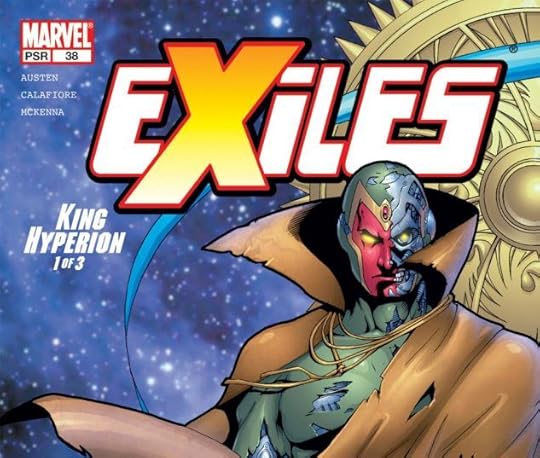
Hyperion (38-40). Austen's "Weapon X" story that leads things off is quite good: at times moving and ruthless. Unfortunately, he’s also got some horrible dialogue [7/10].
Nocturne (41-42). Jim Califiore's background on Nocturne should have been good, but unfortunately is badly written: very wooden, with terrible pacing. Seeing now that he's the artist who created Nocturne, and that he has no other writing credits, I'm not surprised [3/10].
Hyperion (43-45). Chuck Austen’s last story on Hyperion, Weapon X, and the Exiles is probably his best ... so of course he leaves. It’s a bit sad to see Weapon X gone, but at least Austen keeps pushing on the secret of the Time Brokers. [7/10]
Earn Your Wings (46-48). Not a lot seems to happen during Tony Bedard's first story, about Beak, but it opens interesting new directions, questioning the role of the TimeBroker and leaving Nocturne behind to do something on 616. it’s overall a good resting story that introducing interesting new characters [7/10].
Mission Impossible (49). The Impossible Man one-off is somewhat funny, but very shallow [5/10].
The Big M (50-51). The Big M is a nice sideways take on an Exiles story [7/10].
Living Planet (52-53). The "Living Planet" story starts slow, but has a good ending, and again has fun, ominous foreshadowing about the TimeBroker [6/10].
Rube Goldberg (54). The Rube Goldberg one-off is quite funny, though a bit less-so on a reread when it’s not as surprising. Always the problem with humor. [8/10].
Bump in the Night (55-57). The Kulan Guth three-parter is a nice touch-back to one of the first Marvel alternate realities, and a good story to boot [7/10].
Talking to Tanarq (58). The final story, with Tanarq, is a good conclusion to the volume, referring back nicely to Alpha Flight continuity and offering up some interesting repercussions [7.5/10].
First off, just want to say how much I REALLY adore these "ultimate collection" books. It's most bang for your buck content wise, and I've gotten most of mine fore a good price on e-bay.
I felt like with this volume they took a really awesome title that was getting almost to big to be contained in one series and brought it back down to a good, straight story. The split story telling with Weapon X really pays of early on and, as I said, once that is done you have a smoother story. And, again once that was done, I felt like I was enjoying everyone on the team throughout the rest. Yes, even Beak. There's something goofy and out of place about him but I get the feeling he's going to be important. If he ends up NOT being important and is just awkwardly along for the ride, well... I might change my mind about him. But all of that is left to be seen in a later volume.
The length of the story arcs in this volume were also much steadier than in past volumes. Each world they jump to has a good 2-3 comics worth of time devoted to it which gave time for more nuanced story telling about these alternate dimensions they traveled to. And I enjoyed how a lot of the worlds in this volume weren't just crazy what if's but were what if's that involved many of the crazier or more obscure of marvels back history. The stories with living planet and the impossible man? Those were both stories that were amazing to see here but would have felt hockey or stupid in the main stream universe.
And the biggest development I suppose plot wise is that the group is finally, FINALLY questioning who the time broker is, what's his real deal, and if they really have to be doing this at all.
Tony Bedard had a slightly weaker start to his run than Winick, but it feels like this was just him attempting to get the voices of the characters down. His issues really pick up steam and he eventually reveals the "secret origin" of the Exiles, which gave the team a different drive. Honestly, I would have been perfectly alright with the series continuing with its original creative direction, but it went the way that it did.
Another fantastic volume. More of the same, but with something like this that's what you want. Every adventure the Exiles get in is interesting, sometimes fascinating, often heartbreaking, and most of all, a fabulous tour through the world of Marvel comics and especially Marvel mutant comics. What ifs, logical extensions, and horrifying decisions abound in what might be one of my favorite comic book series.
Volume 3 is the first volume not to be written by Judd Winick. The book doesn't suffer though, Tony Bedard is a very good writer and tells some entertaining stories. I especially like this volume because it contains one of my favorite single issues of comics in which the Exiles save the world by purchasing a cheese danish.