Death is not the end... You are a knightly warrior, returning to your ancestral castle having been away for a number of years fighting a crusade against the forces of darkness in the Mauristatian principality of Bathoria. You are just within sight of home when you are struck down by a band of murderers. Driven by the need to know why you have been killed, and on whose orders, you rise again as a ghost. This is where your adventure begins, as you set out to solve the mystery of your own murder. All that follows occurs during the course of one night.
Librarian Note: There is more than one author in the Goodreads database with this name.
Steve Jackson (born 20 May 1951) is a British game designer, writer, and game reviewer, who is often confused with the American game designer of the same name.
Along with Ian Livingstone, he is the creator of the Fighting Fantasy books. The US Jackson also wrote three books in the Fighting Fantasy series, which adds to the confusion, especially as these books were simply credited to "Steve Jackson" without any acknowledgement that it was a different person.
This book was ok, well balanced and all but not thrilling. Maybe I'm just used to too much quality from Jonathan Green. His Bloodbones stands as one of my favorite Fighting Fantasy titles, and Howl of the Werewolf is also great. Night of the Necromancer has a nice premise but feels a little dull at times. It could have had a lot more atmosphere than it actually does. It's not a bad book. But neither is it thrilling unfortunately.
Man, I was obsessed with Fighting Fantasy gamebooks as a kid, I mean I was religious about them for years. Then as the years passed I turned towards reading novels and computer games and just generally grew up (a bit)…, but the childhood thrill of Fighting Fantasy stayed with me mainly because I collected them and once started couldn’t stop. Night of the Necromancer was one of the new adventures published long after FF’s 80s hay-day…I say new I just checked the publishing date and it was 2010 so now I guess it could be considered classic? Anyway, as lockdown got boring after a couple of months I decided to pick up a gamebook for the first time in probably coughthirtyyearscough and have some retro nostalgia fun.
Night of the Necromancer is straight away a unique prospect in that you play as the recently deceased. Returning from a campaign against the forces of darkness you are ambushed and killed within striking distance of your castle home, Valsinore. Now stuck between the living world and the Lands of the Dead you must battle to uncover who ordered your death and take revenge or face a fate worse than death.
The undead setting gives NotN a distinctive playability, usually in fighting fantasy gamebooks once you die its game over but being an undead spirit allows the player to essentially restart, like a game save, to change tact and approach difficult opponents or challenges in a more victorious manner. As a spirit the player can acquire certain otherworldly abilities, from moving objects to possessing hosts that are useful in finding physical items, pass through doors and discover unusual methods of tackling the books challenges on the path to victory. NotN’s unique playability allows the use of stronger opponents, some with distinctive attack patterns, giving combat more depth and edge and even if an opponent(s) seem undefeatable you can always ‘die’, restart and find a new approach. Be careful though sometimes the multi-layered progression route can have drastic consequences down the line as not every option can be taken, not every ability gained or location visited and sometimes there is a price to pay even for making the right decision. Overall NotN has excellent replay value.
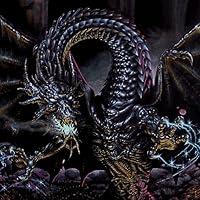
Night of the Necromancer has the iconic and nostalgia inducing black and white aesthetic though slightly updated with a smooth modernity and the gothic illustrations spread throughout brings a tormented world to life. A linear narrative keeps the action centred on the quest for vengeance and visits many eerie horror drenched locations, dank tombs, spooky woods, haunted towers, creepy villages and a disconcertingly quiet castle as the truth is sought. Illustrations of demonic creatures, ghastly ghouls and nightmarish knights all feature heavily and are ably complemented by vivid narrative that offers the player an immersive gameplay experience. It is classic Fighting Fantasy.
Gameplay is balanced but the overall challenge is difficult to master. Attention to detail needs to be taken as there are tricky riddles that could stump younger players (and some older ones who were rushing). Be aware that not finding the answers to these riddles does lead to game over. However, if by chance the player stumbles upon the right configuration of supernatural abilities and magical items (not as easy as it looks as whichever path you choose, a juicy titbit or magical item will be missed) the endgame and final boss can become a little underwhelming, but at least Night of the Necromancer can be defeated not like some near impossible classic FF (coughCreatureofHavoccough).
Overall Night of the Necromancer’s distinctive setting, multi-option playability and balanced difficulty makes a fine addition to Fighting Fantasy for both old hands and new blood, but for me the massive nostalgia hit from playing felt like a great way to pass time during lockdown.
As a huge fan of the original F&F books by the legends that are Jackson & Livingstone, I’ve always been a little wary of these newer titles in the series. Mainly because, although the Jackson & Livingstone names are plastered all over them, they are not actually written by them at all. (A little sly I feel, that the authors name is not on their covers. Or, that it doesn’t say something along the lines of “presented by…” or the like?) That said, after picking up a few of the newer titles, the non-green spines as it were, I thought I would give one a go and see how it compares… and… it was good! Jonathan Green, the author of this title, did a really good job of keeping the same look and feel of the older titles. The story is unique in the way that you play as a recently deceased warrior returning to his castle to fight off an evil Necromancer, which is a pretty cool concept for a game book. The art work is well done and feels like the old-style illustrations, which really helps to get you back into the feel of the F&F books. Overall, this is a good story and fun to play through. Feels like a good fit into the F&F world and is definitely a nice one to add to the collection. (If only they released it in the old green spine style!)
Jonathan Green hit the difficulty sweet spot with Howl of the Werewolf, and I feel that since then he's rather overcorrected - culminating in this book which feels almost insultingly easy. It gives a bunch of extra lives that could make for a nice gimmick, but the book's pretty easy even without them, what with the lack of instadeaths and a whole lot of valid options in almost every situation, so when you combine those, it just gets too much.
And then it did throw an unavoidable instadeath where you absolutely need to have collected one bit of information like from an Ian Livingstone book, and I got mental whiplash from it, it felt so far out of place.
Apart from that, though, it's mostly okay. There's a good plot with some intrigue, the writing's okay as we've come to expect from Green, and the art's good. Another big missed opportunity with the ending, though:
A very interesting book, a good undead theme with good ghostly special skills and great exploration. I greatly enjoyed the storyline and would rate it among the higher tier for fighting fantasy.
What holds this book back for me is the balancing, I disliked the will stat, as with the often harsh penalties on will and skill for failing a will test, and given how quickly you can hit your first test and only have a 50:50 chance of success (I failed) means you can easily rack up a chain of will test fails and a impassably low will score, I ended up playing loose with the rules at this point to keep playing. There are plenty of opportunities to raise will, but it just felt the penalty balancing was off.
Still, very enjoyable, and I as usual loved the Martin McKenna page illustrations, he is missed in more recent books.
I remember reading this years ago and my eyes were opened to this more mature and thematic approach to Fighting Fantasy with more advanced mechanics. Jonathan Green is a special author in the Fighting Fantasy series for making such bold choices for his gamebooks that really make them stand out amongst the crowd. I think despite the freshness Green brought to the series, this one does feel too long unfortunately and it starts to drag after a while. However, overall it’s actually pretty good.