The fullest, most textural, most accurate--most human--account of Oscar Wilde's unique and dazzling life--based on extensive new research and newly discovered materials, from Wilde's personal letters and transcripts of his first trial to newly uncovered papers of his early romantic (and dangerous) escapades and the two-year prison term that shattered his soul and his life.
Simply the best modern biography of Wilde. --Evening Standard
Drawing on material that has come to light in the past thirty years, including newly discovered letters, documents, first draft notebooks, and the full transcript of the libel trial, Matthew Sturgis meticulously portrays the key events and influences that shaped Oscar Wilde's life, returning the man to his times, and to the facts, giving us Wilde's own experience as he experienced it.
Here, fully and richly portrayed, is Wilde's Irish childhood; a dreamy, aloof boy; a stellar classicist at boarding school; a born entertainer with a talent for comedy and a need for an audience; his years at Oxford, a brilliant undergraduate punctuated by his reckless disregard for authority . . . his arrival in London, in 1878, already noticeable everywhere . . . his ten-year marriage to Constance Lloyd, the father of two boys; Constance unwittingly welcoming young men into the household who became Oscar's lovers, and dying in exile at the age of thirty-nine . . . Wilde's development as a playwright. . . becoming the high priest of the aesthetic movement; his successes . . . his celebrity. . . and in later years, his irresistible pull toward another--double--life, in flagrant defiance and disregard of England's strict sodomy laws (the blackmailer's charter); the tragic story of his fall that sent him to prison for two years at hard labor, destroying his life and shattering his soul.
Lover of life, unflagging raconteur, bon viveur, magic but tragic, a towering figure (he was 6 foot 2, same as Michael Caine, Sean Connery and Bill Clinton), endlessly arrogant, always endearing, the funniest man, the saddest man; I think he thought the world owed him a living just for being Oscar, and when I say living, I mean a suite in the best hotel in London and a bottle or three of champers and a decent plate of oysters every night with several handsome young men around to spoon them into his face. He reminds me of that Tiny Tim song
If I only owned the Pennsylvania Railroad And if Tuesday Weld would only be my wife If I could only stay sixteen forever Then I know that I'd be satisfied with life.
(Tuesday Weld was a hot movie star in 1967).
OSCAR THE INFLUENCER
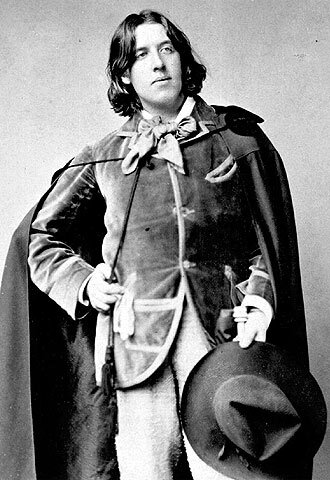
He floated out of Oxford University and in London he became an art groupie, collecting friendships with the Pre-Raphaelites, insinuating himself everywhere, he stood out with his large presence and wildly eccentric clothes and he was kind of ridiculous, but he embraced it. He knew everyone, people like Lilly Langtree, the Paris Hilton of the time, and people like James Whistler, the fierce painter, it was all one big jolly circus. Men were a bit iffy with him, but women loved him, he was excellent at flattery and interior decoration. Was he affected? Was he a buffoon? Was he a sham? At this point – you’d have to say yes. As for instance, he decided to self-publish a little book of poetry, as one does, and a friend asked him what he had been doing one particular day. He said
I was working on the proof of one of my poems all morning and I took out a comma.
What about in the afternoon?
In the afternoon, I put it back in.
He hadn’t written anything yet, a few poems, and he was tinkering with a play but it was a tragedy about some ancient Greek stuff, nobody was interested. With no regular employment, he had, as one ungracious observer put it, nothing else to do but to “trot around London and jump down people’s throats”. But he was ubiquitous. Someone else said he was
More talked about and paragraphed than any other male individual not being a murderer or a statesman
And this is how he became like a tiktok influencer for the 1880s.
SOME ALLITERATION
An extraordinary burst of alliteration on page 191
The achievements of 1891 were gratifying : he had been parodied in Punch and Patience, had published poems and been presented to the Prince
I think our author was channelling Whistler, later quoted on p358
He dines at our tables and picks from our platters the plums for the pudding he peddles in the provinces
But we’re jumping ahead.
THE BEST THINGS IN LIFE ARE FREE
But none of this made any money. What to do? And then one of his friends, a lawyer, suggested lecturing. It seems that Americans had a thirst for intellectually-inclined lecturers – why not have a go in New York? And that’s what happened – I knew nothing about this part of Oscar’s life. I thought he was a playwright! But that came much later. First he was a lecturer and his chosen subject was : interior decoration. Of course! What an obvious moneyspinning enterprise! Why did he not think about it before!
Well, it was a tremendous success, and Oscar spent 9 months crisscrossing the USA telling them all about aestheticism, whatever that was. He gradually learned that they liked his jokes, so he began to put more in. He would get full houses. 1000 and more ! He was packing them in. And now he found he had his own groupies. Students would turn up – on one occasion 60 young men all togged up in black wigs, wide neckties of every hue, knee breeches with black stockings, and carrying lilies or sunflowers, all of which was a parody-homage of Oscar’s own self-parodying affectations. (Did he wear such ridiculous gear? Yes.)
MME MARIE FONTAINE’S BOSOM BEAUTIFIER
The name Oscar Wilde was considered to lend distinction to a product. He was co-opted into promoting everything from cigars to kitchen stoves. Wilde’s portrait was even used on a trade card for “Mme Marie Fontaine’s Bosom Beautifier” – a product that would “in every instance, where the instructions are faithfully followed, enlarge and beautify the bosom, in both old and young ladies…[where] the bosoms have become soft and flaccid, from whatever cause, its use will restore them, rendering them firm and hard.
YOU CAN’T PLEASE EVERYBODY
Amrose Bierce was not a fan. He wrote in March 1882 :
That sovereign of insufferables, Oscar Wilde, has ensued with his opulence of twaddle and his penury of sense. He has mounted his hind legs and blown crass vapidities through the bowel of his neck to the capital edification of fools and foolesses. He has tossed off the top of his head and uttered himself in copious overflows of ghastly bosh The insufferable dunce has nothing to say and he says it – says it with a liberal embellishment of bad delivery, embroidering it with reasonless vulgarities of attitude and gesture and attire. There never was an impostor so hateful, a blockhead so vile, a crank so variously and offensively daft.
Hey Ambrose, 140 lectures for paying customers in 130 different towns and cities, 15,000 miles covered, they couldn’t get enough of Oscar, so I think you lost that argument.
MARRIED WITH CHILDREN
When he got back home he got married and had two sons within two years. But wait, wasn’t Oscar gay? Yes he was, but unfortunately for his wife, he seems only to have realised it after he was married for a couple of years. After that he wasn’t home a great deal. On one occasion poor deserted Constance complained he hadn’t been home for months and he replied that he was sorry but he had forgotten the house number.
So he started doing his lecturing in England, expanding into fashion, and getting absurd audiences – 5000 in Glasgow for instance. Started writing book reviews, bits and pieces for the magazines, still nothing substantial. Got his first actual salaried job, as editor of a woman’s magazine. It didn’t last long.
Finally in 1890 he actually wrote something we’ve heard of. He had his portrait painted, as one does, and regarded it solemnly. What a shame, he observed. This portrait will always look young and beautiful, while I will age and grow ugly. It should be the other way round.
Shazam! So he wrote The Portrait of Dorian Gray and it was published in a magazine, at that point it was around 80 pages long. Sensation ! The magazine sold out – everyone mad for Dorian Gray. Finally Oscar is launched on a literary career. He expands the story to novel length, and out it comes as an actual novel, and…… nobody bought it. So strange!
So he came to the age of 35 and… still no comedy plays!
A BOOK OF TWO HALVES
This is a very long book. You could call part one the Rise and part two the Fall. In detailing the thirty plus years of social climbing and extravagant time-wasting, Matthew Sturgis goes overboard. We do not need to know about all these parties and tete a tetes and assignations and weekends at Bernie’s and who ate what larks tongue in aspic and if Ellen Terry could be persuaded to back this dead donkey of a Greek tragedy. The first half of this book is half great and half draggy and some scissors were needed but were not to be found. In the second half we want all the detail we can get. The second half is a very sorrowful powerful tragic series of events which has all the page turning qualities of a true crime drama.
HUBRIS
The catastrophic law suit against the Marquess of Queensbury, his boyfriend’s father, coincided with Peak Oscar – at that very moment he had a play already running in London (An Ideal Husband) and had just opened a new one (The Importance being Earnest). This was February 1895 and he was King of London. Within three months he was in Pentonville prison serving two years and his name was a synonym for the horror of total humiliation and abasement.
He sued his boyfriend’s father because this guy had denounced him as a sodomite (a very 19th century word) and wanted his son to have nothing to do with him. So Oscar wanted to prove in court that he wasn’t a sodomite. Even though, of course, he was. So this was very reckless of Oscar, and his friends told him he was playing with fire, and he thought well, this old fool can’t prove anything, so if we just deny it all, what can he say. He can’t say “I saw you at it”.
But what happened was that the Marquess and his lawyers had located a whole group of rent boys that Oscar had …. rented…. In recent years, and got them up on the witness stand one by one, and they each told their tales in totally graphic detail, and Oscar’s case was destroyed. And their testimony was forwarded to the director of public prosecutions by the gleeful triumphant marquess, and the DPP issued a writ against Oscar and it was all downhill from there.
TWO PERFECT OSCAR QUOTES
Due to their imperfect education the only works we have from women are works of genius.
On the Bible :
When I think of all the harm that book has done I despair of ever writing anything the equal of it.
It took me two years to finish Sturgis' biography on Oscar Wilde, and I can't even tell you why. I had soooo many problems in the beginning, I couldn't really get into the narrative and Sturgis' detailed exploration of Wilde's childhood got on my damn nerves, and so I constantly put the book down, ignored it for months on end ... until I told myself to SUCK IT UP this year, and then I proceeded to read this entire mammoth in five days. Like, what?
I actually ended up enjoying and appreciating this biography, and ultimately, I am happy that I chose this one over the Ellmann one, since it's more modern and doesn't shy away from exploring Oscar's homosexuality (and also his somewhat questionable relations to younger prostitutes).
This is only a biography for people who really wanna know it all. Like I said, it's detaaaaailed. Every single year of Oscar's life is dissected meticulously. I really loved it for the parts I was interested in (like Oscar's publication of Dorian, his work on his society plays, his relationship with Bosie, his time in prison and its aftermath) but it was a real drag for the parts I was less interested in.
ANYWAYS, HERE'S THE USUAL COMPILATION OF NOTES I FOUND MOST INTERESTING:
- pictures of Oscar as a child and teenager => he was literally the cutest but also looked like the biggest shithead - the first of his letters to survive (and the only one from his schooldays) was written by him on 5 September 1868, when he was 14 years old; it was a letter addressed to his mama, in which he, among other things, wrote: “The flannel shirts you sent in the hamper are both Willie’s, mine are one quite scarlet and the other lilac…” - Oscar reaaally disliked cricket as a schoolboy and even wrote rhymes about his distaste for this particular sport - when a man sneered at Oscar’s poetic efforts in front of him, Oscar proceeded to slap him across the face (honestly A MOOD) - picture of Oscar at Oxford, aged 22 => he looked DASHING (see p.60) - At a dance held by the Alfred Masonic lodge, Oscar impressed young Florence Ward with his soulfulness. She confided to her diary: “He tried to puzzle me by asking me such questions as “whether I found the world very hollow?”” - Wilde at Magdalen: “I’ll be a poet, a writer, a dramatist. Somehow or other I’ll be famous, and if not famous, I’ll be notorious.” - Wilde had a reputation within the college for subverting authority - Wilde began hosting “Beauty Parties” (as he called them) to which only the daughters of dons - suitably chaperoned - were invited - Oscar paid his brother Willie to wear a beard in order that they should not be mistaken for each other => Oscar wanted to be unique (LMAO) - When Oscar proposed to a girl named Charlotte and she turned him down, he said: “I am so sorry about your decision. With your money and my brain we could have gone so far.” (I AM SCREAMING!) - Wilde - ever the notorious aesthete - was early on parodied in magazines, most notably Punch, appearing variously as ‘Oscar Wildegoose’, ‘Drawit Milde’ or ‘the Wilde-eyed Poet’. - Wilde: “To disagree with three-fourths of the British public on all points is one of the first elements of sanity, one of the deepest consolations in all moments of spiritual doubt.” - When the theatrical manager wanted him to make some changes to the text, Wilde added: “But who am I to tamper with a masterpiece?” (LMAO calling his own work a masterpiece is so Oscar.) - Wilde on America: “They speak of smoking as if it were a crime. I wonder they do not caution the students not to murder each other on the landings.” - Wilde once broke down during an American lecture due to stress and bc the schedule was too tight - in America, Wilde met Whitman and came away from the meeting with a clear understanding that Whitman was attracted to other men (“I have the kiss of Walt Whitman still on my lips.”) => which is where the conspiracy theories come from that the two of them fucked - Wilde made a special detour to visit Jefferson Davis, the defeated commander-in-chief of the Confederate States, on his plantation near Biloxi, Mississippi. YIKES (Oscar also had a Black servant during his stay in America which he sometimes referred to as his “slave” => SOMEBODY SLAP MY SON, THANK YOU!) - Wilde wanted his Black valet to travel with him but was informed that a Black man wasn’t allowed to drive in a whites-only car in the American South => Wilde was shook - Wilde toured America for nine months, giving a total of 140 lectures in 130 places - in New York, Wilde visited the room where Poe had written “The Raven” (SOMETHING I WOULD DO) - Wilde to his mother’s friend about his endeavour to write two plays: “It sounds ambitious but we live in an age of inordinate personal ambition, and I am determined that the world shall understand me.” - Wilde: “Success is a science. If you have the conditions, you get the result.” - Wilde had, for short period of time, a pet snake which he “twisted around his neck” (HELLO BRITNEY!) - Sturgis: “The beauty of ugliness was a paradox Wilde wanted to explore, not explain.” - when Wilde’s first play (VERA) proved to be a failure he broke down exclaiming: “Kelly, Kelly, my first play!” - Constance’s love letters to Oscar (after their engagement) are really something else, she literally called him her “hero” and “god” … she also wrote that she’ll never be jealous because “I will hold you fast with chains of love and devotion” …. WELLL WE ALL KNOW HOW THAT TURNED OUT - their honeymoon began in Paris (THIS IS WHAT I DESERVE tbh) - there is only one letter from Oscar to Constance that survived and it’s so beautifuuuul: “O execrable facts, that keep our lips from kissing, though our souls are one. […] I feel incomplete without you.” - Oscar painted the front door of their house white to make it stand out from the neighbours… the neighboured weren’t having it AT ALL - Wilde: “To be great is to be misunderstood” - Wilde: “Nothing is good in moderation. You cannot know the good in anything till you have torn the heart out of it by excess.” => WHY ARE ALL HIS QUOTES SO PROPHETIC? It’s a tragedy, man - his books were published in normal and in special editions, e.g. on hand-made paper and a signature of the author (=> do any of these editions survive??? I want one lmao) - when talking about his society plays: “Indeed, the story is rather like my own life - all conversation and no action. I can’t describe action: my people sit in chairs and chatter.” - all references to mistresses and prostitution had to be removed from Dorian (by request of the publisher) - On Dorian, John Abdingten Symonds said: “If the British public can stand it, they can stand anything.” - A reference to Basil and Dorian walking back from the club “arm in arm” was cut, along with another to Lord Henry placing his hand on Dorian’s shoulder - Lord Alfred Douglas had read Dorian a dozen times and was anxious to meet its author - Wilde’s core message in Lady Windermere’s Fan: “It is not for anyone to censure what anyone else does, and everyone should go his own way, to whatever place he chooses, in exactly the way that he chooses.” - Wilde constantly seeking out young male prostitutes (aged 17) still makes me soooo uncomfortable … also the way he talks about these boys (and men) is pretty dehumanising and disgusting (“Our little lad has pleasing manners. We must see more of him.” EWWWW lemme go puke real quick) Oscar also totally abandoned Constance and the children when he went on his sexual rampages with Bosie … “To the suggestion that he might return home, he replied that he had been away so long that he had forgotten the number of the house.” (SON YOU WILL CATCH THOSE HANDS!) - Sturgis didn’t shy away from explicitly detailing the sexual practices Wilde engaged in with other men … Richard Ellmann could never - After an altercation with Queensberry (Bosie’s father), Wilde claimed to have replied: “I don’t know what the Queensberry rules are, but the Oscar Wilde rule is to shoot at sight”, before demanding that Queensberry leave his house => HOLY FUCKING COW! - Queensberry to Wilde: “If the country allows you to leave, all the better for the country, but if you take my son with you, I will follow you wherever you go and shoot you.” - Wilde was humiliated at court when all of his sexual escapades were laid bare by the witnesses, some accounts were so graphic as to be “unreportable” - Constance wanted to divorce Oscar in order to ensure that her children were financially secure should she die - it’s still so frustrating to read that Oscar went straight back to Bosie after his imprisonment, and basically lied to Constance’s face vowing to her that “he would kill him” if he ever saw him again — BESH BYE … he told Ross: “My going back to Bosie was psychologically inevitable: […] I cannot live without the atmosphere of Love: I must love and be loved, whatever the price I pay for it…” - When Constance learned that he went back to Bosie, she said: “Had I received this letter a year ago, I should have minded, but now I look upon it as the letter of a madman who has not even enough imagination to see how his trifles affect children, or unselfishness enough to care for the welfare of his wife.” => HONEY YOU DESERVED SO MUCH BETTER !!! - Wilde and Bosie then continue their sexual rampages in London - Wilde to Bosie: “When I came out of prison / some met me with garments and spices / and others with wise counsel. / You met me with love.” => HONEY HOW ARE YOU SO BLIND??? The toxicity of their relationship is reeeaally hard to handle - Douglas admitted to himself at the time that he had lost his desire for Wilde - something I found most fascinating is that during Oscar’s lifetime The Ballad was by far his mot successful book => HOW COOL IS THAT? It’s also by far my favorite piece of literature from him!! - in exile, Oscar defiantly proclaimed and indulged his homosexual tastes: “A patriot put into prison for loving his country loves his country; and a poet in prison for loving boys loves boys.” - Wilde travelled to Genoa and visited Constance’s grave (at least he had the decency to do that … it’s the bare minimum for me chile) - as time went on, Wilde’s relationship to Bosie became strained again, when they fought Bosie told him he was behaving like “an old fat prostitute” - Wilde: “If another century began and I was still alive, it would really be more than the English could stand.” - Bosie after Wilde’s death in a poem called The Dead Poet: “I dreamed of him last night, I saw his face / All radiant and unshadowed of distress, / And as of old, in music measureless, / I heard his golden voice and marked him trace / Under the common thing the hidden grace, / And conjure wonder out of emptiness,” - When De Profundis was published posthumously, Douglas – who by then had married, converted to Roman Catholicism and developed and abhorrence of his homosexual past – launched a libel action against the publishers … in court, Bosie described Oscar as “the greatest force of evil that has appeared in Europe in the last three hundred and fifty years.” => THE AUDACITY but it’s also oddly specific LMAO
I don't often read biographies but when I saw that Matthew Sturgis' recent book on Oscar Wilde has been shortlisted for this year's prestigious Wolfson History Prize I thought this would be a great opportunity to learn more about Wilde's life. Sturgis' extensive biography is deliciously comprehensive and draws upon a lot of recent research and untapped material about Wilde to give a really authoritative, well-rounded understanding of this infamous, irresistibly flamboyant and brilliant writer. I've previously read Wilde's most famous fiction as well as several of his plays (I even acted in a production of Lady Windermere's Fan) but I knew little about the trajectory of his life. I was only aware that he was a famous wit whose health and success went into sharp decline after he was tried and imprisoned for gross indecency with men. For instance, Rupert Everett's recent film 'The Happy Prince' is a really sympathetic depiction of the melancholy later years of Wilde's life. Sturgis documents in detail Wilde's family life and many social connections, his rise to fame and the gradual formation of his writing craft, the way his aesthetic principles connected to the expression of his sexuality and, of course, Wilde's tragic downfall from social darling to condemned sodomite. In doing so he has created a masterful portrait of Wilde capturing the rare flame of his brilliance and the gross injustice of his persecution.
The definitive Oscar bio to date. Well written and engrossing. The author paints the clearest picture we have of the complexity of Oscar Wilde. Highly recommend it.
This is one of the best biographies I have read in a long time. I have always been a fan of Oscar Wilde. The Picture of Dorian Gray is one of my favourite books of all time. That being said, I didn't know too much about his life. Matthew Sturgis does an incredible job fleshing out who Oscar was from birth to his death. I loved being a bystander in Victorian society as Wilde reached his fame and ultimate demise. Sturgis goes into the minutiae of Wilde's life so if you do not enjoy reading highly detailed biographies, this may not be the book for you. If you do, you will not be disappointed. The enigma that is Oscar Wilde is brought to life in this well-written biography. Highly recommend!
I'm rereading this because the book I wanted to read - After Oscar - was lost by Amazon. To be fair, they've sent me a replacement copy, which arrived today. Already halfway through this book, I'm going to finish it and then read After Oscar. And actually it works quite well - first a biography of Wilde, then a book about what happens after Wilde's death. If the latter is as good as the former, I'll be well pleased. Because Sturgis book is a fine piece of work. Meticulously researched and brilliantly written, the chapters just fall away. It's a problem with Wilde - highly intelligent, cultured, author of some fantastic works - but also conceited, spendthrift and utterly irresponsible. It feels wrong to make a moral judgement - he without sin, etc. - but the way he treated his wife and children, and the way he treated some of his lovers, leaves a bad taste. As for Lord Alfred Douglas...a contemptible individual with very few redeeming qualities. And yet all this is what makes the story so fascinating. And Sturgis tells it so well. There's just the right balance between the literary and the biographical. And the level of detail for both is first rate. Anyway, back to to it. Dorian Gray has just been published and Wilde's star is on the rise. Of course, nemesis always follows hubris...
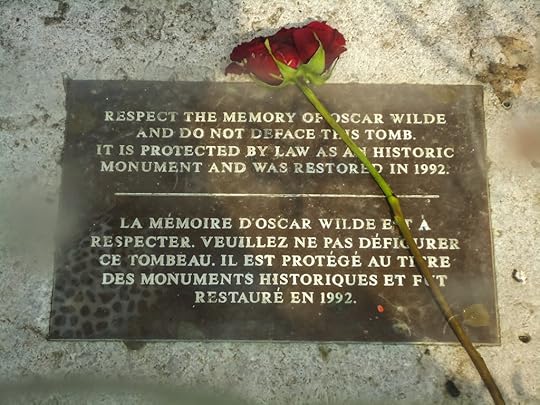
A remarkable book about a remarkable figure. What's particularly impressive is how comprehensively Sturgis covers the years after Wilde's release. Usually with modern biographies they pack everything in at the beginning and get scantier and scantier as the years unfold and the word count increases. But not here. One gets a real sense of the despondency, profligacy and tragedy of Wilde's final few years. I'm still not sure about Wilde as a person - all that banging on about the nobility of Uranian love, his obsession with duchesses. Even so, he didn't deserve the barbarity of the English legal and class system. Nor did he deserve Jacob Epstein's hideous tomb, which looks like some Soviet-era brutalist monstrosity.
When I was sixteen, I was obsessed with Oscar Wilde. In retrospect, I realize it was because he was the first queer person that confirmed for me that queerness had a history- those were the days before internet access, before I was really aware of my own sexuality - I just felt a connection I couldn’t yet name. At that time, I read everything I could find about him, including books I got via interlibrary loan and bookorders ~from abroad (which weren’t impossible but much more of a deal than nowadays). A lot of what I read went over my head, especially his essays about aestheticism - but yeah, I was definitely the one person in my town who knew most about him. But then I didn’t read much about him for the next twenty years.
So reading this was a curious mix of getting new information and feelings of nostalgia. One thing that has definitely changed is the ease with which one can talk about homosexuality. I remember doing a short presentation on him during English class (*voluntarily* because I was a nerd) and saying that he was gay, which my 60+ year old English teacher wasn’t a fan of. I guess part of reading this was a curious kind of therapy? Hah. Anyway. That ease makes understanding Wilde a little easier.
I think this book does a great job of presenting Wilde‘s life as a whole. I mentioned this before, but being older really put his life much more in perspective for me. It was surprising to see the amount of pages used for his life before he realized/ acted on his homosexuality. I had known he had been to the United States, but the impact he hadn’t quite registered for me.
Overall, the author finds a balance between sympathy for his subject and showing his bad sides. I would have liked some more context for Wilde’s (and his friends’ and lovers’) pursuit of underaged boys. Then again, his focus on Wilde rather than the context is what I liked most of the time (I remember Ellmann going off on aestheticism, for example, and Sturgis manages to give an idea of what it’s all about without going into too much detail).
I think if you’re interested in Oscar Wilde and willing to read ~700 pages, this should be a great starting point. It was fun to read, and while I see Wilde more critically now than I did when I was younger, it was good to reconnect with that part of myself. In fact, I will be another book about Wilde next.
Very difficult to rate. It´s impressively researched and well documented,that would make it five stars. But.. there is such a thing as a surfeit of unnecessary detail which ultimately,causes it to drag. Paradoxically, even as you get bombarded with fact after fact,you don´t get any insight into the complex man that Wilde was. Many reviewers have pointed out that for such an interesting, clever and fascinating man as Oscar, this book ends up being borderline boring,and I agree. It also takes forever (more than half the book) to get to the most interesting parts of his life (as a writer,and as a man). So,impressive research, but a disappointment.
It's no secret that I adore Oscar Wilde, so this new biography went straight to my TBR the second I spotted it. Drawing on fresh, very thorough research and previously unavailable material, this is a wonderfully comprehensive examination of the life of a fascinating personality.
When I heard Matthew Sturgis was writing a biography of Oscar Wilde, my initial reaction was “Why?”. Surely everything had already been said? I have two whole bookcases full of books about Wilde and his work and his circle of family and friends, including three volumes of my own. For many years, Richard Ellmann’s Oscar Wilde (1987) in its bright green dust-jacket was seen as definitive, but the meticulous work of scholars over the decades then identified a whole string of errors and omissions. I was very conscious when putting together my little book Wilde for Haus (2005) that Ellmann’s coverage of the writer’s two years of life after his release from prison was relatively concertinaed and, more seriously, more uniformly downbeat than some of the reality recounted in Wilde’s prolific correspondence of the time. Ellmann was himself near death as he struggled to complete his book (for which he was posthumously awarded a Pulitzer Prize). So, yes, more than 30 years on perhaps it was time for a truly definitive biography of Oscar Wilde. Given the immaculate research and elegant text of Matthew Sturgis’s Walter Sickert (2005) I should have been confident that Sturgis was the right man for the job. And indeed with his Oscar (Head of Zeus, £25) so he has proved to be. It is a massive work, full of detail not readily available elsewhere, especially not in a single place. There is illuminating coverage of Wilde’s lecture tours to America, for example, and by resisting the temptation to enter into critical analysis of the plays, poems and essays, Sturgis keeps the focus firmly on the man, his doings and his creative environment. Unlike many books on Wilde, moreover, this is neither hagiography nor a hatchet-job. Wilde’s literary importance as well as his significance as a social former ahead of his time are given due weight, as is Wilde’s championing of the “Uranian” lifestyle and his unbridled pursuit of comely youths after he went into exile. One sees both the light and dark sides of the playwright and watches how his character changes, first with growing arrogance and self-centredness during his heady rise to success and then acquiring a degree of humility and self-awareness through the almost redemptive horrors of prison life. The tumultuous relationship with Lord Alfred “Bosie” Douglas of course figures large, but for all its intensity and disruptiveness, it was only one aspect of a very complex and extremely social life. So Sturgis’s book is what is sometimes popularly referred to as a “warts and all” biography. There are moments when Wiled’s emotional cruelty to his wife Constance or unfair criticism of devoted friends such as Robbie Ross make the reader recoil. But Matthew Sturgis avoids much overt moralising about this, instead letting the facts speak for themselves. I have always been a fan of Oscar, but after reading this book I feel I know him much better, seeing his weaknesses more clearly as well as his strengths. Because the book is so hefty I suspect many people will find it challenging to read straight through over a short period of time; I actually deliberately lingered over its reading for months. It was far too big and heavy to carry around so it became the book on the side table in the sitting room that I picked up and got back into whenever I sat in the comfortable armchair at its side. Knowing the main lines of the story pretty intimately, this was not an instance of wanting to know what happens next when reading the book, but rather I savoured each chapter slowly and with relish. Not perhaps what a book reviewer should normally do, but in this case well-justified and thoroughly rewarding. Quite simply this is a magnificent achievement by Matthew Sturgis, a monument to Oscar Wilde fitting to the 21st century. The book now sits in one of my Wilde bookcases and I know it will be consulted frequently as the authoritative source on a unique figure in the modern literary world.
This is a fascinating book – densely written, but how else can one do justice to the life and career of Oscar Wilde? It's full of wonderful anecdotes right from the start, and unlike many other biographies it takes the trouble to document many of the little details of Oscar's early life in Ireland as well as his life in exile in France during the last three years of his life.
As with his biography of Aubrey Beardsley, Sturgis has really tried to get under the skin of his subject and understand his psychology, warts and all. The result is that we see Oscar not just as a writer, wit, raconteur, celebrity and gay martyr but as a rounded human being – generous and kind-hearted, always willing to see the best in people until disillusioned, but at the same time egocentric and vain, with an addictive streak that leads him to extremes. His extravert personality and wit attracted enemies as well as friends even at the height of his success, and those enemies were only too ready to gloat when his predilection for pleasure in life led him not only into serious debt but also, in the case of his pursuit of (homo)sexual experience, into conflict with the law. The details of his ongoing wrangle with the Marquess of Queensberry, father of his lover Lord Alfred Douglas, and the legal case that ensued (leading to Oscar's eventual conviction for gross indecency and sentence of two years' imprisonment with hard labour) are already well documented– but Sturgis paints them for us afresh and does not attempt to excuse the 'extraordinary vanity' which led the doomed man to resist all attempts by friends and family to smuggle him out of the country to safety.
Not only Oscar's personality, but also those of his close friends, in particular his lover Bosie (Lord Alfred Douglas) are brought vividly to life in this biography. His mother, Lady Jane Wilde, is also given her due as a presiding influence on his character. However, there is one exception, in my view an unforgiveable one – Oscar's wife, Constance (nee Lloyd, later Holland) is all but written out of the story. Although a woman of some importance in her own right, a journalist and author of children's stories, a proto-feminist and political campaigner as well as the mother of Oscar's two sons Cyril and Vyvyan, Constance is given barely a voice and Sturgis accepts with only the mildest of demurs her brother Otho's assertion that his sister was in complete ignorance regarding her husband's homosexuality; I've elaborated in more detail on this omission in my author blog, so won't bang on about it here. There's also absolutely no mention in the epilogue of the fates of Oscar's two sons following his demise, or of Vyvyan Holland's autobiography 'Son Of Oscar Wilde', or (with the exception of one brief footnote) of Oscar's grandson Merlin Holland, a noted biographer of his grandfather who is still living – a fact that leaves me wondering whether there's some sort of feud going on between Sturgis and Oscar Wilde's descendants!
Oh, and there are also a few editorial glitches – most notably the claim that, having died on 30 November 1900 Oscar's funeral took place 'on the morning of 3 November' – so it's only four stars out of five from me.
"Basil Halward is what I think I am. Lord Henry is what the world thinks me. Dorian is what I would like to be - in other ages, perhaps."
The man, the myth, the first modern celebrity in western culture. This book is all-encapsulating when it comes to Wilde's eventful life and the rich literary, academic and philosophical scene he took part in or often even generated himself. I feel I have come to know him better and understand the tortured artist behind the works. Reading about where his ideas come from or even coming upon an account at a dinner party where he relays a story that sounds an awful lot like the bare bones of The Importance of Being Earnest was a wonderful way to uncover his literary career. It became almost like a treasure-hunt for which works I could identify before Sturgis would inform me of the published title.
I am in awe with Sturgis' work. He has managed to relay the most complex ideas and interactions with the greats in Wilde's contemporary scene of academia and philosphy. It is a very impressive feat to even be able to mimic the undefinable nature of Aestheticism in how the movement came to be and grew in Wilde's circle. He takes the unbiased stance, as any biographer should, in all events, no matter how damning a picture they paint of the author. The book changes in pace, from extensive philosphical discussions that require close reading and lots of thinking to painting a very vivid and lively picture of Wilde according to the descriptions of others in his company.
The quote I chose struck me immediately. Wilde confessed that, much like Basil, he too put a little too much of himself into The Picture of Dorian Gray. I often wondered where we could find Wilde himself in the scene of the novel. Though I do not think Wilde was ever naive enough to be Basil, I would agree that Lord Henry is not a fair casting either. He was, however, doomed to be misunderstood. Especially considering he so enjoyed misunderstanding at the start...
I’m speechless, I’m sobbing, I feel empty inside. I feel like I just watched Wilde live before my eyes, and to finish this book marks the end. What a great tragedy. Thank you for your service, Matthew Sturgis. This is the most comprehensive and well-researched biography of Wilde, without a doubt. Robbie Ross, the man that you were. Oh to have such a devoted friend. The comfort in the knowledge that they’re together in eternal rest is small but profound. Literally cannot stop crying.
Mathew Sturgis description of the life of Oscar Wilde and the Victorian era is both: vivid and also accurate... Fully saturated with details and facts, handsomely rendered and enveloped in a wonderful prose... I specially appreciated the fact that Sturgis has sown throughout his book Wildes awesome witticisms!!!
Indeed a tragic life about a man with an exceptional spirit and his time far ahead... What a pity he died much to young...
For some a genius, for others the most powerful force of evil in his time... But read for yourself, and you will discover behind the colorful facade a mere human being suffering and with an excellent and beautiful mind!
Here's a book about one of the most interesting and funniest men ever, and yet I found this book tedious. Noting new in it and what there was didn't capture Wilde at all.
Overlong! Not as good as the previous biography of Wilde that I read. This is one is very thoroughly researched and the author has gone to great pains to read everything about Wilde that he could. It seems perhaps a strange complaint - but I found it too detailed and at times it dragged for me. The description of the American tour would be an example where some of the detail could have been happily left out.
It occurred to me that maybe I was the wrong person reading it and that the book is intended for those who do want to study everything there is to know about Oscar Wilde. My interest is more casual and comes from a desire to know about his life and how he became the kind of writer he was. It struck me that his life became quite tragic.
A well-balanced, perceptive, sympathetic and readable biography. This will probably become the standard Oscar text. Slightly let down by too frequent typos, a few in primary quotations.
The book deserves five stars for how meticulously researched it is, but my rating reflects the level of my enjoyment. The book is a dense and thorough examination of Wilde’s life.
Exhaustive biography of Oscar Wilde, with careful documentation of his downfall, trial, conviction, imprisonment, and sorry life afterwards. He was his own worst enemy; difficult to imagine the attraction of Lord Alfred Douglas, a monster, at best. Sad.
Non è una biografia, è LA biografia di Wilde. È recentissima e completa e non penso possa temere rivali tra tutte le precedenti. La combinazione di un argomento estremamente coinvolgente di per sé e la maestria dell'autore dà un risultato stupefacente. Wilde attira parecchio l'attenzione e la curiosità senza bisogno di preamboli, almeno secondo la mia esperienza, ma cercherò comunque di mettere in rilievo ulteriori motivi di interesse nella sua vita: •È un "figlio delle stelle", nato a Dublino da uno dei più importanti chirurghi d'Irlanda, William Wilde, uomo dagli eclettici interessi culturali, e da Jane Francesca Elgee, una donna di notevolissime capacità intellettuali, poetessa, patriota e dotta. Oscar assorbe dalla sua serena e amorevole cerchia familiare straordinari stimoli culturali, frequenta sin da piccolo scienziati, politici, uomini di lettere; si abitua a discutere e smontare le idee; mutua dalla sua terra un carattere solare, un'ironia rilassata, una mentalità gioviale e "pagana", lontana dal superficiale snobismo inglese e dalla pruderie vittoriana. •Tra gli scrittori dell'Ottocento è uno dei più eminenti, originali e brillanti classicisti; a dispetto dell'immagine posteriore di fatuo esteta ha avuto una mente geniale, coltissima, straordinariamente dotata, unita a spiccate doti sociali e relazionali e alla finezza caratteriale. È stato davvero un pensatore incisivo ed eloquente. Tutti i più importanti personaggi che l'hanno conosciuto, spesso brillanti a loro volta, sono rimasti stupiti dal suo talento. La forza di una autentica cultura ha posto le basi del suo successo e gli ha aperto le prime porte, facendolo spiccare nel panorama intellettuale inglese e non solo. •Ha avuto un rapporto con il pubblico e la fama particolarmente complesso e dal sapore eccezionalmente contemporaneo. Fu uno dei primi casi di "famous for being famous"; la sua esposizione mediatica è iniziata con grande anticipo rispetto alla maturità artistica, cosa che gli ha valso la diffidenza, il biasimo e il rancore di molti, così come un'attenzione più o meno costante e la possibilità di una vita mondana in ascesa. È stato entusiasmante per me seguire le sue pericolose e sfacciate acrobazie: la rivendicazione arbitraria del ruolo di capofila dell'Estetismo basata su chiacchiere furbe, il riciclo continuo di idee anche altrui incessantemente potenziate e raffinate, lo sfruttamento a suo vantaggio dell'acre satira dei giornali borghesi contro gli esteti, l'energica attività di critica artistica e letteraria, lo sfiancante giro annuale di conferenze in tutti gli Stati Uniti (non sarebbe fuori posto oggi in una TED Talk) e poi la lenta affermazione come poeta e scrittore. Wilde ha camminato sempre sul labile confine tra sensazionalismo e autenticità del genio, sia a suo vantaggio che a suo detrimento. •L'importanza da lui rivestita nel mondo omosessuale e nella sua storia; la persecuzione da parte del marchese di Queensberry e la sua successiva incarcerazione hanno segnato la sua immagine e hanno suscitato un clamore eccezionale, portando alla luce l'ipocrisia e la crudeltà della morale vittoriana; nonostante le contraddizioni e le complessità del caso la fermezza di Wilde nell'affrontare lo scandalo e la condanna è stata ammirevole, ha ispirato coraggio e, a mio avviso, segna l'apice della sua forza morale. La sua sfida aperta contro le convenzioni ha esposto un mondo in fermento, che veniva tollerato a patto che fosse nascosto e soffocato; il rifiuto del compromesso denota una lucida fedeltà a se stessi, base di tutte le rivendicazioni. •È lo scrittore che più di tutti accosta volutamente Arte e Vita, in parte per presa di posizione teorica, ma da questa biografia ho capito quanto ci sia di vero e autentico in questo accostamento. L'amore dell'arte, della gioia, del piacere, unito a un carattere ingombrante e affamato di protagonismo non gli hanno permesso inizialmente di separarsi dalla sua vita concreta, dagli stimoli e dai contatti sociali e questo dà in parte ragione del ruolo preponderante della vita nella sua teoria artistica e nella sua attenzione. Ma è vero, almeno per lui, che la "Vita imita l'Arte": il suo intelletto e le sue creazioni teoriche hanno sempre preceduto il suo coraggio di mettere in pratica i principii, ma sotto la frivolezza e il paradosso è sempre emersa in lui l'urgenza di vivere secondo le sue idee e le sue inclinazioni, cosa che gli è costata tremendamente tanto. Persino la doppiezza delle sue opere e dei suoi personaggi ha tanto del suo animo. Il cantore della falsità e dell'ipocrisia è stato paradossalmente uno degli artisti più sinceri del suo tempo; dietro la caricatura dell'incoerente e cinico dandy si cela un personaggio dotato di opinioni e convinzioni forti e personali su tutto, che dice la verità fingendo, posando ed esagerando. Per giunta c'è davvero, per ironia della sorte, un certo fascino estetico, non meramente tragico, negli eventi della sua storia e nella loro distribuzione e simmetria. •È stato un uomo e artista generoso, divertentissimo, terribilmente contorto, a tratti crudele. La sua scrittura ha uno stile inconfondibile e porta la sua firma in ogni minimo dettaglio; la sua audace intelligenza, l'ironia, il rovesciamento delle convenzioni, il paradosso e l'uso raffinato del linguaggio hanno avuto un'influenza grandiosa su tutta la cultura del suo tempo: ovviamente sulla letteratura, ma anche sull'arte figurativa, sull'abbigliamento, sull'arredamento, sulla vita sociale, sulla morale. Frasi e aneddoti di Wilde circolano ancora a bizzeffe. Per quanto riguarda Sturgis ho apprezzato la sua grande obiettività: nasconde la sua voce il più possibile sotto una mole di documenti che vengono sia citati direttamente nel testo, tra virgolette, fusi con naturalezza alla narrazione, che riportati con approfondimenti nelle migliaia di note. Le fonti sono principalmente la corposa corrispondenza epistolare di Wilde, quella della cerchia dei suoi conoscenti sia con lui che quando fanno semplicemente riferimento a lui, biglietti, testimonianze orali, conti, articoli di giornale, atti processuali; in misura minore le sue opere e quelle che lo citano o si occupano di lui. L'uso della produzione letteraria di Wilde è limitato, si impone l'ottica dello storico, che procede con ordine e predilige i fatti e gli eventi, sui quali si innestano i discorsi e le parole, vitali per ricostruire il percorso di Wilde; Sturgis si preoccupa anche di espungere i numerosissimi miti e i falsi aneddoti. La sua intelligenza si vede anche nella capacità di far aderire la scrittura alle varie fasi: nella prima parte i capitoli sono più lunghi e il tono è più neutro e oggettivo, anche perché la documentazione è più limitata; dopo l'esordio letterario di Wilde il racconto si fa più critico e acuto, pur restando posato e schietto. Sturgis non gioca a fare lo psicologo, resta empatico e comprensivo in tutte le circostanze, ma non cade nell'elogio vuoto; dà solo piccole e particolari sfumature interpretative agli eventi, sempre supportate dalle fonti, sa sottolineare sia i meriti che gli errori e le meschinità di Wilde senza calcare la mano, riconosce ironizzando quando egli inganna, esagera, finge o è ingiusto; il commento diretto è ridotto all'osso e riguarda perlopiù dei particolari. Tutti i rapporti interpersonali di Wilde sono descritti e precisati in modo molto approfondito e chiaro; la quantità enorme di schermaglie verbali divertenti con i suoi contemporanei è riportata e commentata nel dettaglio e contribuisce a rendere allegra e spassosa la lettura. Non è sicuramente stata una facile impresa, nei dettagli più oscuri la tentazione di censurare e mistificare è sempre stata forte, persino negli ultimi decenni, e in ogni caso certi aspetti risultano conturbanti anche per il lettore contemporaneo. Pare che un altro merito sia stata la sua capacità di ridimensionare lo schema interpretativo banalizzante di ascesa-punizione-rovina, in gran voga sin dai primi anni dopo la morte di Wilde; l'autore corregge gli eccessi di tale visione e pur delineando nel dettaglio il percorso inesorabilmente rovinoso dello scrittore evidenzia gli elementi di continuità tra le varie fasi della sua vita: più che distrutto e in preda al rimorso e alla rovina, Wilde appare un uomo piegato e infine tristemente e ingiustamente isolato, ma sempre presente a sé stesso e determinato nelle sue convinzioni. Lo stile è lineare e scorrevolissimo. Assolutamente consigliato per gli appassionati.
It's an old familiar tale, that of Oscar Wilde. A man famous for being famous, in the manner of today's reality stars, for his wit in ladies' drawing rooms who was then lampooned in newspaper cartoons and musicals such as Gilbert And Sullivan's "Patience," he then truly launched into the limelight with a lecture in the United States, attending a voodoo ceremony in Louisiana and meeting Walt Whitman in New Jersey along the way and achieving a spectacular lecture in a silver mine out West under the threat of death. Then back to Britain where his comedies on stage became the hit of the season before writing his scandalous novel "Dorian Gray" along with his equally scandalous play Salome about the woman who danced (and disrobed) for the head of John The Baptist. It seemed that he was everyone's darling. Women loved him. Men more so adored him.
Then Fate intervened. Egged on by his lover Lord Alfred Douglas, he sued Douglas's father, the Marquess's of Queensbury, for having called Oscar a sodomite in public amid a cavalcade of other threats. The Marquess countered by blackmailing and presenting in court Wilde's many male lovers, in due course sending Oscar Wilde to prison for the perfectly consensual "Love That Has No Name" (as Alfred Douglas dubbed it). What followed were the lonely years of prison that broke Oscar's body and mind and spirit and will. What followed were the years spent in exile on the Continent through which two more great works would emerge from Wilde's pen, "The Ballad Of Reading Gaol" and "De Profundis." What followed, too, was more cruel treatment at the hands of Alfred Douglas. And what followed in the end was Oscar Wilde's eventual death, a broken man.
I enjoyed reading this biography thoroughly and took time out along the way to familiarize myself with some of Wilde's lesser known works via the Internet. It was a joy and pleasure especially with its telling details of Lord Alfred Douglas's misbehavior along with that of his father. I would recommend this book to Wildeans everywhere and I look forward to reading more biographies by this author.
This was a really great biography, written from the perspective of a historian rather than that of a literary critic. Very well annotated - the last 120 pages or so are notes. If reading authors like Ron Chernow or David McCullough aren’t your thing, you may not enjoy this “warts and all” presentation of Wilde’s life. Personally, I was surprised by what an irresponsible, lazy, mooch he seems to have been. 😂 But I love his writing nonetheless.
Used this bad boy to write my thesis. Big and bulky, full of loads of information. Didn't read it cover to cover (god bless indexes) but still did my best.
What more can be said about one of the greatest writers and most legendary wits, Dublin’s own Oscar Wilde? Well, quite a lot as it seems. Author Matthew Sturgis lived and immersed himself with Oscar Wilde for seven years in preparing his biography OSCAR WILDE: A LIFE. As it turns out, the most recent compendium to deal with the subject of Oscar Wilde was way back in 1987 from late writer Richard Ellmann. Sturgis indicates in the Preface & Acknowledgements that we have learned so much more about the great Wilde over the past thirty years that it just begged for another exploration of his life and work.
As a fellow Irishman, I have grown up on Oscar Wilde and his work. Later in life, I came to fully appreciate his many famous quips and they have not lost any of their luster in present day. You can probably pass by an Irish or British pub and see written on the chalk board outside one of his many quotes such as: ‘Work is the curse of the Drinking Classes.” The challenge in writing a review of a seven-hundred-page book on Wilde is to not have it end up sounding like a book report. Any worthwhile book report on this tome would be dozens of pages long. As such, I have captured some of the key points in Oscar Wilde’s life in addition to some of the updated material that is presented in this biography. Oscar Fingal O’Fflahertie Wills Wilde was born on October 16, 1854, in Dublin. He grew up on what he referred to as English table talk, listening to all the various educated guests his parents entertained in their home. He came to consider ‘that the best of his education in boyhood was obtained from this association with his father and mother and their remarkable friends.’ At the end of January 1864 Oscar and his older brother were sent away to boarding school. Oscar was extremely bright but somewhat distant child --- slight, imaginative, independent, and dreamy, he drifted to the edge of things.
Long summer holidays were spent at Moytura, their Dublin home. It was there that Oscar, under his father’s instruction, learned to be not merely an Irishman but a countryman and a Celt. Back at school, Oscar took to English literature and read Sir Walter Scott, Jane Austen, Thackeray, Stevenson, and Dickens. He also had an extreme fondness for poetry through reading Shakespeare and particularly enjoyed Elizabeth Barrett Browning, Tennyson, and Whitman.
Wilde matriculated in 1871 at Trinity College Dublin where he excelled in Greek and history. He had an eye for comic detail. Oscar shared his mother’s gift for dramatic overstatement, as well as her delight in shocking bourgeois sensibilities. He studied at Oxford. ‘My very soul seemed to expand within me to peace and joy,’ he would remember. ‘Oxford was paradise to me.’ He later had opportunity to travel with one of his favorite instructors, Professor Mahaffy, and a few other scholars. Their travels took them to Italy and eventually Greece, which Oscar just loved.
After graduating, Oscar took his own hand at writing poetry and won the Newdigate Prize in 1878 for his poem ‘Ravenna’. He travelled to London is search of rubbing shoulders with other literary types. He loved the London stage and fell for such great actors as Sandra Bernhardt, Lily Langtry, and Ellen Terry. He sought out more experienced writers to mentor with, such as James McNeill Whistler, who he had a love/hate relationship with.
In 1882, Oscar set off on a tour of the United States which kicked off in New York City where the many reporters were eager to grill ‘the great English exponent of Aestheticism.’ While visiting Philadelphia, Oscar took a side-trip to a town across the water called Camden where he was able to meet one of his heroes in person --- Walt Whitman. He was particularly taken by the American South, seeing a bond between the southern Confederacy and the Irish: both had risen in arms to achieve ‘self-government,’ and both had been defeated. While in that region he even met with Jefferson Davis at his plantation. On the flip side of that encounter, Oscar also spent time in the New York/Long Island Region and at one point got to meet former U.S. President and leader of the Union forces in the Civil War, Ulysses S. Grant.
Oscar had denied his own love life and urges until he returned to London and began writing again. It was here that he met the first love of his life, Constance Lloyd, whom he courted and eventually married and had a family with. She called Oscar her ‘hero’ and ‘God.’ However, her brother Otho was not so enamored with Oscar and had heard inklings of his proclivities for the same sex. Though married, he took on his first male lover and most enduring friend --- Robbie Ross, who was only seventeen when they met.
Oscar loved children and the feeling was mutual. He loved spinning tales for groups of children and went on to write many famous fairy tales such as The Happy Prince and The Selfish Giant. He found his first big fiction breakthrough with the classic tale, “The Canterville Ghost.” He was frequently, and not unfavorably, compared to Dutch writer Hans Christian Andersen. As his reputation and fame grew, so did talk in certain London circles about his time spent in the company of several young men. Perhaps his biggest success on the fiction front was when he released the classic novel, “The Picture Of Dorian Gray,’ which saw world-wide fame.
The next thing for Oscar to conquer was the stage, which he had always loved. His first big play was entitled “Lady Windermere’s Fan” in 1892, and it would be the start of several successful plays that are still performed today. Following that were such famous stage plays as “A Woman Of No Importance,” “The Importance of Being Earnest,” and “An Ideal Husband.” All this success would not be enough to prepare Oscar Wilde for what came next. The Lord Queensbury, taking particular exception to Wilde’s relationship with his son, went after him in the courts on the grounds of indecency. Wilde feared Queensbury’s campaign against him.
Oscar Wilde survived the first court battle, but it would be the second one at the Old Bailey, which included Wilde being put on the stand, which saw the jury come back with unanimous Guilty verdicts. The Judge sentenced him to maximum of two years of hard labor. Upon doing his time, Oscar set off on a self-imposed asylum to France. Though in the company of some of his long-time male companions, Wilde still sent for Constance and his children to join him --- this request being denied due to Constance’s health issues. Unfortunately, Oscar himself found himself beset by health issues and passed away in Paris on November 30, 1900.
All of this tremendous detail was deftly put together by Matthew Sturgis and, of course, goes far deeper than I am highlighting here. I am proud to say that Oscar Wilde’s wit and incredible body of work is still quite relevant today. A statue of him stands in Dublin, a bit of a triumph as for many years his hometown spurned his name due to the indecency and sodomy allegations. Thankfully, it is splendid work like that of Sturgis that will hopefully lure more readers to the classic output of Oscar Wilde!
I was so drawn in by Oscar Wilde’s story. He was objectively not a great man. He seems to have worked harder at portraying himself as an artist than at actually writing. His sexual life was not merely immoral but predatory. Yet I found him fascinating. His intense pursuit of celebrity and image is so relevant to life today. His story can easily be read as that of a man who gained the whole world yet forfeited his soul. But it’s also a story of the complexity of human beings as fallen image bearers. I’m drawn to the instances of real kindness and generosity in the midst of Wilde’s very selfish life.
As a biographer, Sturgis shows immense restraint in his interpretation of Wilde’s life. It would be easy to use Wilde’s biography mainly as an opportunity to draw morals (either to the left or to the right). Although sometimes I would have liked more commentary, I appreciated the opportunity to simply read Wilde’s story.