His dream was to build magnificent steamboats to ply the rivers of the American frontier. But when Jean Talon began his journey westward, he stumbled upon a deadly conspiracy involving a young woman’s search to find her missing brother, and a ruthless band of renegades. Led by the brazen Baron Torville, this makeshift army of opportunists is plotting a violent takeover of the Louisiana Territory. Jean swears to find a way to stop this daring plan. If he doesn’t, it will not only put an end to all his dreams; it will change the course of history—and destroy the promise of the American frontier.
Louis Dearborn L'Amour was an American novelist and short story writer. His books consisted primarily of Western novels, though he called his work "frontier stories". His most widely known Western fiction works include Last of the Breed, Hondo, Shalako, and the Sackett series. L'Amour also wrote historical fiction (The Walking Drum), science fiction (The Haunted Mesa), non-fiction (Frontier), and poetry and short-story collections. Many of his stories were made into films. His books remain popular and most have gone through multiple printings. At the time of his death, almost all of his 105 existing works (89 novels, 14 short-story collections, and two full-length works of nonfiction) were still in print, and he was "one of the world's most popular writers".
Louis L'Amour, of course, is a quintessential American popular novelist and short story writer, the leading name in the modern Western genre, an author whose phenomenal sales the world over are generally conceded to reflect his genuine ability as a storyteller. He's also my wife Barb's favorite writer. So it's perhaps surprising that this is the first of his novels that I've read. However, it definitely won't be the last!
This is not, in terms of length, one of L'Amour's major novels. One of the longer works, because of the larger scope, would probably have been more textured and allowed for more character development. However, for this read I wanted a shorter work. I also wanted something that's not part of a series, though according to the Goodreads entry this one is. That designation can be a bit misleading, though; according to Barb, the Talons and Chantrys, like the Sacketts, are large extended fictional families that the author often recurs to, in one area or generation or another, but the individual books are mostly themselves essentially free-standing. Here, our hero occasionally makes some passing reference to his great-grandfather, the founder of his family line (who no doubt has a book or books devoted to him!); but this story can certainly be read independently. This is also not really a "Western," despite L'Amour's identification with the genre (and I didn't "shelve" it as such). He wrote similar tales of two-fisted adventure in other settings, both historical and contemporary; this is the former, with most of the plot taking place well east of the Mississipi and probably none of it any further west than present-day Missouri. Also, our time-frame is 1821, well before the era of westward expansion that forms the typical Western setting. (If our characters here pack guns, they're flintlock rifles or pistols, not Colts; and nobody's into cattle-punching.) It also has elements of the mystery or espionage thriller; the British officer in the Goodreads description above was trailing a British felon and Army deserter who's conspiring to seize the Louisiana Territory and set himself up as dictator of it.
As I noted above, I think this novel might have been better at longer length, with more development. Sometimes the hero's reflections have a bit too much repetitive angst over his course of action; Tabitha Majoribanks, while she's a smart, brave and strong-willed heroine, can come across as a bit too arrogant and bossy; and I felt the ending was too rushed. Also, while L'Amour mostly did his historical homework (a hallmark of his writing), I did catch him in a couple of slight errors in the dating of actual events that are mentioned in passing. That's why this wasn't rated as a four-star read.
It did, however, earn a solid three, meaning that I did genuinely like it. L'Amour has a good writing style, one that serves to move the flow of events without calling attention to itself; he's a capital storyteller, and the book's a page-turner. His characters are mostly vivid, and Jean (Anglicized as John) Daniel Talon is the kind of hero who commands my respect. Another strength of the book is the fact that L'Amour clearly values what someone (I think T. S. Eliot) has called "the permanent things" --the verities that truly matter for human life and society. So I'm delighted to finally have made his acquaintance as a novelist (I'd read his short story, "The Gift of Cochise," which I highly recommend, some years ago), and look forward to someday reading some of his more substantial works!
A tale of a young man named Jean Talon that is heading from Quebec, Canada down south to United States in hopes to get employed in a shipyard as a ship builder.
But when he stumbles upon a dying man who tells him who stabbed him, he will have to watch every step as the man is a known killer and will stop at nothing to get what he wants - in this case to take over the power in Louisiana territory by any means necessary.
A beautiful young lady follows along on his journey south, in pursuit of her missing brother who went on an expedition but never returned.
*******
A daring story full of turns and twists keeps you entertained from start to finish and keeps you guessing who is plotting against who and who are the good guys and who are not.
Again, very well hashed our story and a mystery of a missing young man to boot, so definitely a worthy read.
This is another fine story of the American frontier by Louis L'Amour.
When L'Amour writes, I feel the bite of the wind on my skin, smell the wet, broken grass at my feet, and feel the mud suck at my feet as I creep through swamp, forest or plain with his characters.
L'Amour's men are strong, steadfast, just, unyielding in the face of danger, and clever. They are quick to think and act, and often ponder the philosophy of law and order, justice, and history. His women are beautiful and intelligent.
This story is another fine one, where a young Talon, descended from a pirate, takes a detour from pursuing his fortune to help a beautiful young woman and to save his new country from a plot to steal the Louisiana Purchase by a rogue Baron Torville.
This was a typical L'Amour book - the hero was invincible, the woman was beautiful and it was impossible to overthrow the bad guy...until the last pages of the book. I enjoyed reading this book, but I didn't feel it was up to L'Amour's standards. The hero was too good. Hew was a shipbuilder, but was also good with a rifle, good at wrestling, good at fighting and stronger than anyone else. The woman was supposed to be a savvy business woman and yet insisted on puting herself in a position in which she has to be rescued. The ending was anticlimax - once the main villain was dead all the other badies just disappeared, even though the conspiracy was supposed to have been manned in several important cities. In my opinion, it was not one of his better novels.
L'Amour (can we call him: Louis the Love?) is a fantastic adventure writer. This story takes place in the early 19th century with people, good and bad, flooding west into the newly aquired Louisiana Purchase. Our hero gets wind of a plot to seize the new territory and is beset by thugs and assassins as he moves west. It's simple, clear, and entertaining.
The first 3/4 of the book set up a pretty interesting story and characters. L'Amour novels generally don't have long and drawn out endings, but this one probably had the most abrupt ending of any book I've eve read. This is a rare book that probably should have been 100 pages LONGER.
Student Name: Mason Marquette Date Submitted: Book Title: Rivers West Lexile: 760
Personal Response I liked the book Rivers West. I liked it because it is full of action and easy to visualize. There is always something happening in the book, and you do not ever want to put it down. I like how it deals with guns and the outdoors. You never know what is going to happen next because the book is not predictable. It is cool that in most of the author's books they talk about other characters he has written about and other stories of his.
Plot Summary The book first started with Jean finding a dying man in the swamp. He then met the pirate man that he would travel the rest of the way with. Next, he found Mrs. Majoribanks and they went towards Pittsburgh. Jean got beat up and the man and his daughter found him. He then got split up from them when they took the boat. He traded for a canoe and saved the boat. They then went to stop Macklem from trying to take over the Louisiana territory. Finally, he saved Miss Marjoribanks and stopped Macklem.
Recommendation I recommend this book to anyone who is in high school or older. Boys or girls could read this. It has some romance if you are into that and a lot of action. If you like westerns this is a good book for you. I recommend you read this book because it is very good.
Characterization There was a lot of characterization in this book. Jean Talon changed from the start of the book to the end because at the start he did not care about anyone else. Once he met Mrs. Majoribanks he liked her and tried being nice. All he wanted to do was to build a boat at the start but in, the end he went with the girl. He was a big tough guy that just wanted to work but in the end, he was a gentleman.
Rivers West is among my favorites of the ten or so L'Amours I've read. He wrote it in 1973, and once again he has shifted the action away from the West - this time the story involves shipwright Jean Talon's journey from Quebec down to Pittsburgh and beyond. Jean is a young man who was schooled in the shipbuilding trade by his father, and who packs the muscles that come with daily heavy labor. He's heard that there is good work for tradesmen in Pittsburgh. As he travels on foot through swampy land in upstate New York, he finds a man near death from a stabbing. Before he dies, the man tells Talon of a plot afoot to seize the huge and largely unpopular chunk of land that is the Louisiana Purchase. In this regard, Rivers West has an opening quite similar to L'Amour's The Man from Skibbereen. A little further southward, Talon encounters a young woman, Tabitha Majoribanks, who has assumed her father's large trading business, one that depends greatly on activity in the Louisiana Territory. She is searching for her brother who works the territory and has uncharacteristically gone silent. Based on small clues he learned from the dying man, Talon believes that the same evil man is probably behind the murder and Charles Majoribanks' disappearance, and he abandons the shipbuilding job he has been offered to help Miss Majoribanks find answers.
Although Rivers West in my opinion outshines most of L'Amours other works, there are some issues. The sequence of the action is awkward in places. There is dialogue that is missing obvious questions that a sensible person would ask. But this is one of his more interesting plots, another tale in which his hero prefers to solve disputes with his fists instead of with guns, and some of his best overall writing:
"When a man came into Pittsburgh, Cincinnati, or Lexington then, he found himself meeting folks from all over who talked of only one thing: the West. Everybody had either been west or was going there. They talked of Indians, buffaloes, game, but more than anything else they just talked about the land, the prairies, and the mountains."
"Many men have information, but few know how to use it to advantage." A good line, one that reminded me of the wonderful line uttered by The Man With No Name in A Fistful of Dollars: "A man's life in these parts often depends on a mere scrap of information."
And finally, a Native American being asked about the influence of the White Man's coming:
"It is easier now, with the white man's pots? Easier to boil food? Easier to hunt with his gun?"
He looked at me. "Easy is not good," he said bluntly.
Typically very good story by L'Amour...if any drawbacks, I suppose it ended rather abruptly, possibly could have used an epilogue. If there are more stories with these characters, I would enjoy reading them. I was very interested in the use of a frontier Pittsburgh, PA since I am from this area of Pennsylvania. It is rare that I do not thoroughly enjoy stories by L'Amour.
"Rivers West" (1975) is a L'Amour adventure novel set along the Mississippi River and Louisiana Territory frontier in 1821. Jean Talon, a Canadian-born Frenchman, is heading west to seek a livelihood building ships when he comes across a dying English officer and then spends the night in a roadside tavern with some suspicious characters. In his pockets the dying English officer had a warrant for the arrest of one Baron Torville, a deserter and scoundrel who Talon now thinks might have had something to do with the officer's murder, and perhaps also the mysterious circumstances surrounding a beautiful 19-year old girl's lost brother.
Those familiar with L'Amour's writing might agree that his later stories (I'd mark those in the 1974-1987 era) don't hold up as well as his earlier classics, testing and pushing the boundaries of authenticity and immersion, and also getting sidetracked in what I call his "preachy anecdotes" phase. "Rivers West" has a bit of that but because it is a short adventure novel it mostly glides by without too much trouble.
Verdict: Where "Rivers West"s shorter format gives this novel a break-neck speed and fun plot, it suffers a bit in character and believability. L'Amour keeps adding wave after wave of new characters into this one who share some of their stories and then step aside. That makes for an easy read with a fun adventure plot and heroic protagonist, but doesn't hold much of a connection for this reader.
Jeff's Rating: 2 / 5 (Okay) movie rating if made into a movie: PG
My first pulp western! I enjoyed it. The first-person narration of hyper-masculinity had the hilarious result of sometimes coming across unintentionally homo-erotic. The narrator was always talking about the impressive buff build of himself and half the other blokes he came across. Interestingly, in terms of action/heroic stuff this novel was focused more on wrestling (yes, wrestling) than gunfighter scenes. Indeed, the narrator went on so much about his own massive muscular endowment that I started to picture him as Conan the Cowboy. The viewpoint was slightly racist toward American Indians ('I grew up with 'em, I have no problem with 'em, even though a lot of 'em will scalp you as likely as not if you don't keep an eye on 'em' etc.) - which was surprising considering the date of publication. This particular tale was very French-Canadian/French-American oriented with the American's typical habit of investing anything European with an aura of gravitas and automatic integrity. An interesting little cast of characters - light on landscape and general setting, expecting readers to bring their studio-erected western locale with them, I suspect. I resonated with some of the views of masculinity and good craftsmanship and so on, but by no means without qualification - and would out and out reject some of the values. Anyway, I look forward to checking out more from L'Amour. (See what I did there?)
Pulp reads of the very best kind. The Talon family is one of 3 family lines that Louis L'Amour began and as I understand intended to write sagas on. Young Mr. Talon begins his life as any good hero should, helping someone in desperate need; and like all true heroes stepping square into the middle of trouble. This book is based in the early times of our great country (yes I am a patriot). It is based loosely on a known plot of the time to use the natives to wrest a portion of the United States away and create a kingdom. Enough spoilers; read and enjoy
Jean Talon dreams of building steamboats in the American West. Renegades and a deadly conspiracy could put an end to his plans unless he can stop them. He tries to prevent the theft of the Louisiana Purchase whilr protecting a young woman. Another well written tale by L'Amour.
Jean Talon has left Canada to make his fortune as a shipbuilder in the American west. It is 1821, although there is at one point a reference to James Madison running for a second term. In his travels he comes upon a dying man who has been waylaid.
Soon he is traveling with Jambe-de-Bois, a peg leg. Talon does not really trust him. He thinks their meeting was planned. They come to a town and find Miss Majoribanks, who is looking for her brother, and a fellow named Macaire. Talon realizes horses would ease hi travels and agrees to fight in a wrestling match and bets on himself. He succeeds and buys three horses.
They are all traveling to Pittsburgh, where Talon seeks employment. The others intend to go on to St. Louis. Two more join their party, a Miss Higgs and Calgary Butlin.
They arrive in Pittsburgh. Talon sees Stephen Long’s steamship, The Western Engineer. Miss Majoribanks buys the boat and hires Colonel Macklem to captain it. Believing Miss Majoribanks to be in great danger, Talon turns down a job to build a ship, and instead rides horseback to Saint Louis.
He arrives ahead of the Western Engineer and seeks out information on her brother. Macklem and Miss Majoribanks arrive and they are all invited to a reception. That evening, on the way, Talon is waylaid and tossed in the Missouri.
Not a western. It is really an adventure and travelogue. It made me wonder when steamships began. I have a biography of Robert Fulton. Have to read it soon. Like others I have read, the story builds, the pace quickens, and it ends all too fast.
If you know the name Louis L’Amour, you know he is arguably the most prolific author of Westerns, having sold over 200,000,000 copies of nearly one hundred titles from the Forties to the Eighties. If you know me, you know that formulaic fiction is not my usual fare. But I’m on vacation, and this book was free for the taking.
What makes it unique, in my mind, is the fact that despite it’s being a western, the action never moves further west than St. Louis, the frontier of the 1820’s. When a Pittsburgh-bound Quebecois shipwright discovers a murder near the American border, and is befriended by a pirate, adventures ensues as they make their way through New England for the first half of the book. Despite the many fisticuffs, the sassy ingenue who is especially fetching when angry, and the treasonous villain who covets the entire Louisiana Purchase, this is fun historical fiction. I enjoyed the tavern scenes, the sensitive portrayal of the Indians and pioneers, and the sprinkling of French. This is a quick read (151 pgs.) that would appeal to all ages.
Rivers West was my first Louis L'Amour book, but I found it captivating. I've only read one other Western so I can't compare this work to other books in the genre. My favorite quote from the book was on page 4: "All that was long ago, and a mill does not turn upon water that is past, nor does a ship sail with the winds of yesterday. I had my own name to make. The story of that pirate Talon...well, that was his story."
L'Amour kept an interesting pace and balanced description and dialogue well. I forgot I was reading several times, which I believe is one of the greatest compliments you can give an author. Several details in the book reveal the author's in-depth knowledge of the time period and read with the ring of truth. I didn't know until the "About the Author" section at the end of the book that L'Amour was a professional boxer in real life, but it made sense because his fight scenes were picturesque.
If you are looking for a short enjoyable read from a master storyteller, you are not likely to be disappointed with this book.
An early story in the Talon series, telling the tale of an early 19th century Canadian shipbuilder looking to work on steam boats in newly-formed Pittsburg. On his way, he encounters a variety of characters, including one that dies in his arms and leaves him a mystery.
This book suffers a bit from the same problem early history L'Amour books do where its a bit stilted and archaic in the language, and it doesn't flow as well as, say, Sackett's Land. There's a lot of sudden exposition as if something occurred to L'Amour mid sentence, and the plot is simple but presented with great complexity.
The female character changes very suddenly about halfway through the book, going from kind of annoying, elitist spoiled brat to a suddenly mature, intelligent woman without reasonable cause. Also the ending was incredibly abrupt, like a page count had been met and it was time to wrap things up. A disappointing book overall.
Wanted to try a western frontier novel and chose this one by Louis L'Amour at a fleemarket for a few dollars.
It's a fast action moving story of Jean Talon (from Quebec) as he makes his way towards the western frontier town of St-Louis only to be caught up in a larger plot. The stongman Talon plays the hero. I found the fight sequences detailed and fun. There was a little french-canadian angle to it that made me smile. Like this statement at the beginning of the book "I had no taste for drinking with strangers about, and there was an air in his place I did not like." There's something about French Canadian culture (maybe just a minority thing) where we'd rather drink and let loose among friends and are a little hesitant to befriend strangers.
Not an epic of literature, but a fun book with plenty of action.
One cannot read a story by America's primer teller of tales without getting swept up in the action. This story takes place shortly after the Louisiana Purchase during a time when no one was sure how vast the land was. The story starts in Canada and ends somewhere on the Missouri. It has all the elements of a good story, hero and villain and a monstrous great fight at the end. It is a story you won't want to put down and wish it would go on and on. Read and enjoy Louis L'amour story, if it is your first,it won't be your last.
It’s fun, enjoyable enough, I didn’t have to think too much, the hero is muscle bound, really good at fighting somehow, and the villain is really villainous.
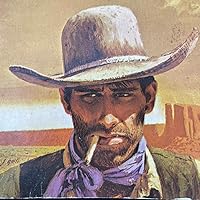
Honestly half the appeal of these books for me is the simplicity, as well as the beautiful cover art of the 70’s bantam paperback editions, and the smell of the old yellow pages.
I’ll probably read a few more, especially over winter when I’m no longer in the “the west”
Also shout out to Bob Coughlin, who owned this book over 40 years ago, according to the signature inside the cover
This is the first book in a trilogy. It features a young man by the name of Jean Talon who goes south from French Canada, and who encounters some conspirators. He also meets those who wish to stop them, and he becomes embroiled in a plot. It was a quick read, and is set in the 1830s or so. Characters and plot were thinner than the Lonesome Gods. Some thoughtfulness here and there. It was entertaining.
Well I knew no one was perfect. I love L'Amour for his colorful descriptions and his caharacters. He is not this shot them up kind of author. Well, here is a book about a trip west in the year 1821. You have a Talon, the family plays and important role later. He fails to develop his characters well and he leaves you hanging on descriptions. There is not much there. This is my least liked L'Amour book to date.
In Rivers West Mr. Jean Talon is traveling from Canada to Mexico to find a new life. He is the perfect example of what an American should be as he was honest, loyal, and hardworking. He bravely travels through the wilderness on the United States Frontier.The plots in the book transfer very smoothly one from another and the reader always knows exactly what’s going on. I highly enjoyed this book and I’m sure that anyone that enjoys reading action packed books will enjoy Rivers West.
Canadian Jean Talon travels west to build boats and make money on the western rivers. Along the way, he comes across a dying British officer who shares a secret about a conspiracy/plot to take over the newly acquired Louisiana territory. Wow! An action-packed adventure along the Missouri/Mississippi when Talon hooks up with an old pirate, fur trader, British officer...and a beautiful woman. Is there a love interest later? Find out. Historical fiction and a great read.
Louis L'Amour is always a good read, but I think I prefer his classic westerns.
The steamboat was a nice departure from the usual, but I didn't really like the girl and the plot just seemed too fantastic (the bad guys are planning on taking over the entire Louisiana purchase?!?). It also ended really abruptly.
A very good novel adventure. great plot twists and a super climax. I loved for the protagonist is for a change the huge physical specimen that many of his men have to submit too. from Canada to New Orleans and along the Missouri River we are carried by boats horses and feet. I think one has to love these characters.
A fast paced adventure on the rivers going west. Talon makes good friends that help him and he is always in a scramble. But he's the hero and he's got the brains and the brawn to tackle even the most evil villain there is. A great read, unputdownable, Mr. L'Amour!