Jump to ratings and reviews
Rate this book

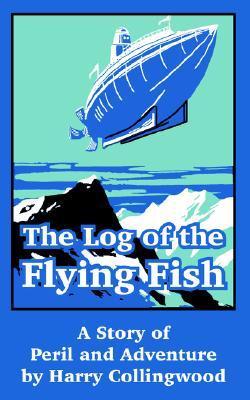
The Log Of The Flying Fish: A Story Of Peril And Adventure

Rate this book
A story of aerial and submarine peril and adventure, originally published in 1887 -- adventures in the air and under the water of Professor Heinrich von Schalckenberg's airship/submarine built from the super-light metal (aethereum) he has discovered. Aethereum is a very light metal that looks like polished silver and has one hundred times the strength of the best steel. This is used to build the Flying Fish, a 600 foot long metal cylinder, sixty feet in diameter at the middle, which travels 120 miles-per-hour through the air and 150 miles-per-hour underwater. In this first novel of three (the others are With Airship and Submarine and The Cruise of the Flying Fish) the ship is used for salvage of various naval wrecks; an expedition to a warm sea in the North Pole, where they discover a herd of mammoth on an island; an expedition to Africa to locate unicorns and the site of King Solomon’s Ophir; and finally a trip to Mount Everest.

432 pages, Paperback

Published September 1, 2004

10 people are currently reading
33 people want to read

About the author

Harry Collingwood

171 books5 followers
William Joseph Cosens Lancaster

1851-1922

Ratings & Reviews

What do you think?
Rate this book

Friends & Following

Create a free account to discover what your friends think of this book!

Community Reviews

5 stars
4 (16%)
4 stars
5 (20%)
3 stars
8 (33%)
2 stars
5 (20%)
1 star
2 (8%)
Displaying 1 - 8 of 8 reviews
Profile Image for Robin.
258 reviews4 followers
October 31, 2011
I don't know if I can accurately portray how disturbing and bad this story is.
Four affable gentlemen, one German and three proper English, go on a journey to the deeps, to the skies, and to the island in the north pole. Nothing goes wrong. Everything is to be gained.
These men have a great time huntin' and killin' while smoking "the weed" and searching for treasure and untouched lands.
This story is horrendous on level with Mark Twain's feeble airship stories, with a much worse dialectical text that is thankfully dropped on short order.

The Flying Fish flips between attempts at science-fiction - with guesses to future technology that were way off the mark - to attempts at fantasy, where facts that had to be known at the time were terribly distorted. Short ventures in the story are spelled with random potshots at people and organizations the author has an obvious dislike for - that pertains to the story not at all, fascinating visions of lost ships and lands that divulge the fact that somewhere in his head the author did have an imagination, and, of course, the shooting of random whales and mammoths. They even hunted unicorns.

As an airship fan, and a fan of late 19th and early 20th century fiction, I was compelled to read this story to the end. I can see where it would be a stepping stone for later fiction writers, and so perhaps in his time Collingwood was showing some small bit of imagination, but in today's stories this piece would fall far past the bottom of even the lowliest steam punk author's lists.
This entire review has been hidden because of spoilers.
Profile Image for Mark Butler.
26 reviews3 followers
May 1, 2018
I first read this around 50 years ago when I was a kid and I never forgot it. It literally introduced me to Science Fiction and as memories of most other things in my childhood have faded, I still remembered the excitement of the Flying Fish and my dreams of flying it. Eventually I tracked down an old hardbound copy and re-read it. To my great pleasure it still reads quite well and I enjoyed it a lot.

1887 was a time when the English adventurer was master of the world. He was expected to calmly smoke his cigarette in the face of charging lions and rescue damsels in distress before afternoon tea. The flying fish was piloted by just such adventurers, from Sir Reginald Elphinstone who was described as having "freely exposed himself to all known sources of peril" to Cyril Lethbridge, "a successful gold-seeker, and almost every thing else to which a spice of adventure could possibly attach itself."

As for the Flying Fish herself, the author was an engineer and gave considerable thought to how things would work. His auto-pilot using a compass needle and tiny magnets around the edge connected to the rudder is a marvelous design for the technology of the times. Many of the concepts are ahead of his time and actually used today, such as pumping air "into" a submarine, and the central concept that permits the ship to float - that vacuum is lighter than air - is workable, given the incredible super-light "aethereum" metal that he has to work with.

So, once they get the Flying Fish built, the four intrepid adventurers set off for the North Pole, making several discoveries and have an astonishing set of adventures. Following that, they head to deepest Africa to make a fantastic discovery and then on to ancient Ophir, where they are waylaid by a wily native king and discover a group of white women in captivity. Following the successful completion of the adventure, the men head for Mt. Everest, in order to be the first ones to summit it. There follows a rather unique disaster and subsequent adventure.

If you are looking for great characterizations or sparkling dialog, this is not the book. The people are there simply to give a reason why the ship goes places. No attempt to flesh them out to be real people is made, not even when encountering white women captives in deepest darkest Africa, who themselves are not given much space. If you are looking for a book filled with descriptions of fantastic foreign (to 1887 readers) lands and interesting encounters aboard an astonishing but well-thought out ship, then you may want to give it a whirl, returning if only briefly to a time when men wore dinner jackets to the parlor each night to discuss over a snifter the results of the days big-game hunting.
Profile Image for William Bentrim.
Author 59 books75 followers
January 26, 2019
The Log of the Flying Fish by Harry Colllingwood
This story had the feel of old time SciFi. The Victorian aspect gave it the H.G. Wells feeling. The Flying Fish is a dirigible made of a mysterious metal alloy and powered by an equally mysterious element. As much of the older SciFi, there is no attempt to make either of those facts’ probable. The ship is built and staffed by four English gentlemen and their two man servants. The story is their trips abroad.
The story suffers somewhat by the overly wordy descriptions and the attitudes and language of the supposed Victorian time period. I cringed as they slaughtered animals for sport but that was normal for the time period depicted.
It was an interesting story but not gripping.

571 reviews113 followers
June 21, 2010
A somewhat antisocial scientist-engineer invents a miracle metal, both lighter and stronger than anything that has preceded it. With his small circle of wealthy investor and brave adventurer friends, he builds some new-fangled transportation infrastructure while ranting extensively against unionized labor. And no, it's not Ayn Rand.

This late 19th century novel is hailed as one of the first examples of the fantasy genre, and it is reminiscent of later adventure-exploration novels like The Lost World. The novel mostly chronicles the adventures of its protagonists in their combination submarine-plane, whose technical details the engineer-author Collingwood has given a good deal of thought, even if most of it is fairly unrealistic. Character development and deeper reflection are basically nonexistent.

As a travel story the novel is of limited interest. As a little slice of 19th century thinking, though, it's fascinating. Our German professor quickly dispenses with any misconceptions we might have about his fondness for the working man (fortunately, the attempt at conveying a German accent only lasts through the first chapter):

You would be perfectly justified in such an expegdation if the Bridish workman was the steady, indusdrious, reliable fellow he once was. Bud, unfordunadely, he is nod the same, zo var ad leasd as reliabilidy is concerned. You gannod any longer debend ubon him. Id is no longer bossible to underdake a work of any imbordance withoudt the gonsdand haunting fear that your brogress will be inderrubted—berhaps ad a most cridical juncture—by a ‘sdrike,’ The greadt quesdion which, above all others, do-day agidades the British mind is: ‘Do whadt cause is the bresendt debression of drade addribudable?’ And, in my obinion, gendlemen, the answer to that quesdion is thad id is very largely due do the consdandly recurring sdrikes which have become almosdt a habid with the Bridish workman. The ‘sdrike’ is the most formidable engine which has ever been brought indo oberation do seddle the differences bedween embloyer and embloyed; and, whilst I am willing to admid thad in certain cases id has resulded in the repression and redress of long-sdanding oppression and injusdice, id has been used with such a lack of discrimination as do have almost ruined the drade of the goundry. With the invention of the ‘sdrike’ the workman thoughd he had ad lasd discovered the means of enriching himself ad the expense of his embloyer, or of securing his fair and righdful share of the brofids of his labour, as he described id; and, udderly ignorand of the laws of bolidigal egonomy, recognising in the ‘sdrike’ merely an insdrumend for forcing a higher rade of wages from his embloyer, he has gone on recklessly using id undil the unfordunade gabidalist, finding himself unable do produce his wares ad a cost which will enable him do successfully gompede with the manufagdurers of other goundries, has been gombelled to glose his works and remove his gabidal and his energies to a spodt where he gan find workmen less unreasonable in their demands.


The unionist isn't the only target of the Flying Fish's crew's sights, though. The four don't meet any animal that they can't imagine better off skinned, stuffed, and displayed in their homes. It's for science, see? The last remaining woolly mammoths, mythical unicorns, wolves, bears, sharks...from the first moment they step out of their ship, the travellers' immediate response is that if it moves, they probably ought to shoot it.

They also move through life with all the racial sensitivity for which 19th century Britain was known; landing somewhere in the Central African Republic, they're immediately on their guard. There's gold somewhere, and those pesky savages are standing in the way of it.


The inhabitants were, as far as could be seen, fine stalwart specimens of the negro race, evidently skilled in the chase and, presumably, also in all the arts of savage warfare; but it was not very easy to form a reliable opinion upon their habits and mode of life, as whenever the Flying Fish appeared upon the scene they invariably took to their heels with yells of terror and sought shelter in the thickest covert they could find.


Well, then. Of course, eventually our travellers have to interact with the locals, and what better way than to put them to work?


The amount of work performed was, as might naturally be expected, nothing approaching to that which would have been accomplished in the same time by the same number of white labourers; indeed, a gang of half a dozen good honest hard-working English navvies would have accomplished fully as much per diem as the fifty women who laboured among the ruins.


The novel fails to resolve one mystery for us though: what would the exchange rate be if those white English workers were in a union?
Profile Image for Edward Lengel.
Author 28 books126 followers
November 4, 2011
I enjoy old-fashioned adventure tales, but it's difficult to read this one without anxiously hoping for the slaughter of the four "adventurers" who shoot every animal in sight as they hack and slash their way through the world of the 1880s. Racism, sexism, arrogant imperialism--you name it, it's all here; but if you can put it aside, there are moments of genuine excitement, especially toward the end during the perilous descent from Mount Everest.
Profile Image for Erica Castellanos.
16 reviews1 follower
May 20, 2012
I have to say I enjoyed it, up until the very end. It ends so abruptly! But it is a good example of its time & genre, I enjoyed seeing the author's vision of things imaginary to him which are, in my day and age, commonplace and well-known--for example, going 150 mph, or what the peak of Everest is like. One should know what they're in for when opening this book; if you are one of those people, then have at it.
2 reviews1 follower
July 9, 2013
The previous reviewers do an acceptable job describing this book but fail in one important aspect. The book is a creature of the time it was written and they judge it by our standards of today.

It is an excellent adventure story and I would suggest, a precursor to Steampunk. For that alone its worth a read.

There is one other volume in this series, With Airship and Submarine.

Plenty of daring-do and maidens rescued.
Profile Image for Beverly Warembourg.
19 reviews1 follower
June 29, 2011
Not my cup of tea. I guess I was expecting something else. It's basically a tale of 4-5 guys travelling in a far-fetched device for both sea and air. I thought it was going to have more of a sci-fi or fantasy feel to it, but it wasn't. Probably would be an okay movie, but didn't enjoy it as a book.
Displaying 1 - 8 of 8 reviews

Can't find what you're looking for?

Get help and learn more about the design.