Jump to ratings and reviews
Rate this book

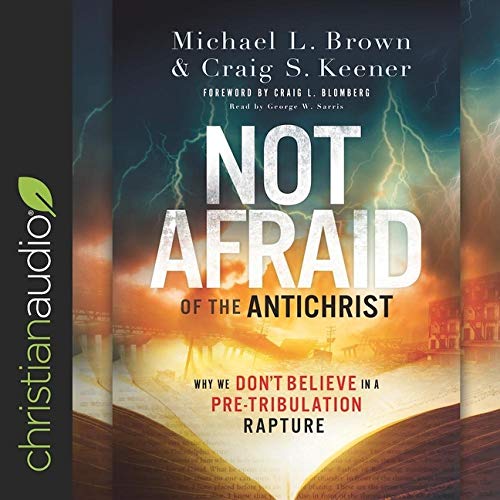
Not Afraid of the Antichrist Lib/E: Why We Don't Believe in a Pre-Tribulation Rapture

Rate this book
Despite the popular theology of our day, Christians should not expect to get out of experiencing the tribulation or the end times. Nowhere in the Bible does the Lord promise us this, say Michael Brown and Craig Keener, two leading, acclaimed Bible scholars. In fact, they say, Jesus promises us tribulation in this world.

Yet this is no reason to fear. In this fascinating, accessible, and personal book, Brown and Keener walk you through what the Bible really says about the rapture, the tribulation, and the end times. What they find will leave you full of hope. God's wrath is not poured out on His people, and He will shield us from it--as he shielded Israel in Egypt during the ten plagues. So instead of taking comfort in what God hasn't promised, take comfort in the words of Jesus: He has overcome the world, and we live in his victory.

Audio CD

First published January 1, 2019

256 people are currently reading
277 people want to read

About the author

Michael L. Brown

142 books192 followers
Michael L. Brown (born March 16, 1955) is a Messianic Jewish Old Testament scholar, professor, activist, itinerant speaker, and author who has preached in numerous countries and written twenty books. He is the founder and president of ICN Ministries. His writings have been translated into more than a dozen languages. He was married to Nancy Gurian on March 14, 1976 and they have two daughters, Jennifer and Megan, and four grandchildren.

Ratings & Reviews

What do you think?
Rate this book

Friends & Following

Create a free account to discover what your friends think of this book!

Community Reviews

5 stars
153 (46%)
4 stars
118 (35%)
3 stars
47 (14%)
2 stars
11 (3%)
1 star
3 (<1%)
Displaying 1 - 30 of 65 reviews
Profile Image for Christopher Lewis Kozoriz.
827 reviews272 followers
October 7, 2021
"Why are we not afraid of the Antichrist? Because greater is the Spirit who dwells in us than the spirit of antichrist that is in the world (see 1 John 4:1-6, especially verse 4)." (Michael L. Brown & Craig S. Keener, Not Afraid of the Antichrist)

The authors in this book believe there's very little evidence in the Bible for a pre-tribulation rapture; meaning, believers will not go through the Great Tribulation the Bible speaks about, but instead will be raputured or taken out of this world and will be taken to Jesus in the heavens. They instead believe that believers will go through this Great Tribulation, but just as the Israelites were protected when the great plagues came upon Egypt, believers will also be protected and God will be with them through it all. They share many scriptures to support this and dissect the scriptures that pre-tribulationists use to support their teaching. They say in this book that there are many good Christians who believe we'll not go through the Great Tribulation and this book is not to be used to label them as heretics.

As we are currently living in a time where people are either forced or coerced to take vaccines against their will by the government, wear masks, limit freedom of movement, limit church services or cancel church altogether, my favourite teaching in this book was on the mark of the beast spoken of in Revelation 13:16-17:

"And he causes all, the small and the great, and the rich and the poor, and the free men and the slaves, to be given a mark on their right hand or on their forehead, and he provides that no one will be able to buy or to sell, except the one who has the mark, either the name of the beast or the number of his name."


The authors say, "The mark in Revelation that commands the most attention on the popular level today is the mark of the Beast (see Revelation 13:16-18). But whatever this mark might or might not mean for the future (speculations abound), it has a lesson for us today. Followers of the beast conform to his ways, recognizing that they cannot prosper in this life without being part of his system (see Revelation 13:17). Their concern is not with promised hidden manna or fruit from the tree of life (see Revelation 2:7, 17; 22:2, 14, 19), but only with getting ahead in life."

Today, we must fix our eyes on Jesus and persevere to the end through all the evil that is coming upon the earth, and we'll be saved. Come Lord Jesus!
Profile Image for Joel.
58 reviews10 followers
May 20, 2019
This was an interesting read as I had very different expectations for what the book would cover. The book is aimed at dispelling beliefs about a rapture (i.e. escapist doctrine), and does so by considering the scriptures that have been used to suggest one. In this regard it functions like a systematic eschatology/theology.
.
Unfortunately there were points where I couldn’t tell the difference between one of the author’s views and the dispensationalist views that he was critiquing. This was because they still exhibited a reading of apocalyptic materials that is concerned with a distant future as being the time of tribulation with a chief antichrist type figure. A mode of interpretation that becomes less common upon jumping into the more popular commentaries for those texts (Cf. 2 Thess, Revelation, Mark 13...)
.
With that being said the book also has a twin purpose of awakening western Christians to the idea that persecution/tribulation is a reality that many outside of the West already face daily and have been doing so for quite some time. The authors both provide remarkable testimonies about their own experiences of persecution in Asia and Africa. In light of this they argue that the goal of the scriptures in question is not about escaping tribulation, but rather to provide strength through it.
.
If you are looking for something to read that can provide an alternative to the often default “left behind” view regarding the “end times,” then this book will be a helpful beginning. Even more so, if you are looking for a book that can open your eyes to the experiences of non-Western churches and the shape of their expectations for future vindication, then this book is equally helpful.
Profile Image for Jacob Aitken.
1,687 reviews417 followers
January 23, 2024
Michael L. Brown and Craig S. Keener, Not Afraid of the Antichrist: Why We Don’t Believe in a Pre-Tribulation Rapture (Chosen, 2019).

Introduction

For those of us who come from a covenantal and amillennial background, what relevance does a book on the rapture have? For one, Reformed people probably need a refresher course on verses pertaining to the Lord’s return. It is one thing to ridicule the more extreme versions of dispensationalism, it is another thing to be as familiar with these verses as they are. Moreover, this is an excellent book to give to your dispensational friend or relative. Lay dispensationalists are not going to read Meredith Kline or O. Palmer Robertson. They might–just might–read a book by two leading premillennialists.

Summary

The authors’ key argument is this: whenever the New Testament speaks of the return of Christ, it does so in a way that does not allow the return to be separated into two phases, an invisible rapture and a final, visible return of Christ. Indeed, believers are encouraged to look for the return or even “manifestation” of Christ. None of this allows a secret rapture.

Strengths

Keener and Brown make a nigh-irrefutable case that the verses teaching a pretribulational rapture actually do not teach that. The final chapters dealing with missions are very good.

Weaknesses

Leaving aside the issue of the millennium, the book, assuming a postribulational rapture, suffers from weaknesses within that system. For example, Revelation 19 shows us that Christ is returning with his saints. This seems to support the posttribulational view. However, these saints are already clothed, presumably with resurrected bodies, yet on the posttribulational view they do not get these bodies until Christ’s return.

Aside from exegetical issues, the authors claim that the persecuted church is the ideal church. I understand why they said this. They want to impress upon pretribulationalists that the church could be persecuted. It will not be raptured out. With that said, claims like “the persecuted church is the ideal model” are both wrong in terms of church and wrong with respect to Hebrews 11. Sometimes the church experiences success, sometimes persecution. In fact, to say this is the ideal model sets the average American Christian up for failure. If a Christian is getting the means of grace, then that Christian is experiencing the ideal model. Anything else goes beyond scripture.

Conclusion

The authors make a good case against the pretribulational rapture. The only other qualm I have, and one a sharp dispensationalist will make, is the authors did not address the argument, at least not in any detail, is the distinction between Israel and the church. That is the whole point of the pretribulational rapture. They could say, “Yes, some of our proof texts are ambiguous, but if there is a distinction between Israel and the Church, and God cannot deal with both at the same time, then one must have a pretribulational rapture.” Of course, I think the dispensationalist is wrong, but the reason for the pretribulational rapture has nothing to do with fearing the Antichrist.
Profile Image for José & Cecilia.
25 reviews
February 6, 2022
"La promesa de Jesús a la Iglesia no es quitarla del sufrimiento de la tribulación, sino protegerla en medio de ella. Este libro sin duda, nos ayuda a profundizar y comprender esta tremenda verdad."
Profile Image for Sarah.
165 reviews19 followers
February 6, 2019
My previously pretrib family has recently changed our position on the timing of the rapture (because of studies my dad [a pastor] has done on Matthew 24). We had been quite staunchly pretribulationalists before, but had always had some doubts and questions about certain implications and assumptions of the position. In our study through the book of Mathew at our church, we were forced to change our position, as it was not biblical.

I was curious at what Brown and Craig had to say about the topic in their book "Not Afraid of Antichrist". Both authors believed in a pretribulation rapture, and then changed their mind after a closer look at the Scriptures. They do a pretty good job of showing the unbiblicalness of the position, and demonstrate from various passages of Scripture that 'pretribbers' are connecting dots that should not be connected.

They explain that there is no significant difference between the various mentions of the coming of the Lord. They all contain similar details (even if all do not say every single detail every time they are mentioned).

They also attack the notion that saved Israel is not a part of the Church/body of Christ. I really appreciated that, as that was one of the things that really held me in the Pre-trib position. As Brown and Craig point out, ethnic Israelites can be a part of the church and still be used uniquely as an ethnic group, by God, and distinguished from Christians of other ethnicities, within the body of Christ.

While there were several points that I agreed with that are brought up in the book, there several things that I didn't really like about it.

Let me go into some detail: First, one, or both of the author's take's issue with Clarence Larkin's assertion that, Christianity, overall, has failed to keep pace with heathenism, had failed to convert the world and that Larkin assumed that converting the whole world was therefore not God's purpose. The author writing that chapter seemed to think that that was absurd. But I don't see how, biblically, that is absurd, because we are told that the way to salvation is narrow, and that few find it, or follow it. And even Christ asked if He would find faith on the earth when He comes (Luke 18:8).

But here's a weird thought that just occurred to me: Maybe there will be the greatest amount of saved people, more than any previous era, DURING the Great Tribulation age. We remember that Revelation 7 talks about a multitude that no one can number, from every tribe, tongue and nation. That multitude came out of, and apparently passed through, the Great Tribulation. Sounds like a huge (and I mean, HUGE) number of Gentiles saved during the tribulation. A multitude of saved Gentiles will be on the earth during the tribulation….Which really is another point against the "There's no church mentioned during the tribulation" argument. Anyway, so perhaps, while there may not be great Evangelistic success before the tribulation…perhaps there will during it? And during the Millennium (It sounds as though whole nations come to Christ then). But I still have a problem with how one's thinking that the majority of people will not come to Christ could be thought an unbiblical idea.

Another problem I had was that one, or both of the authors, think that the seventieth week of Daniel is not future. I don't quite understand how they could think that. "The idea that a whole church age must be inserted between the 69th and 70th week of years is a perfect illustration of how the Pre-Trib reading of Scripture must be imposed on the text rather than read out from the text." Though I agree that there is no evidence of the Scripture dividing the 2nd coming of Christ into two parts (Thus making 3 comings of Christ altogether), I would argue that the passage of Daniel itself divides the 69th and 70th week, and that it doesn't take a lot of juggling to think there might be a gap in there.. The " to the end desolations (or wars?) are decreed" part sort of hints to me at an indeterminate period of time. Besides, it sounds like the same King who will end the sacrifices and offerings, "exalt himself above every other god" (the abomination - see (See Daniel 8, 11-12,), and this King, Christ (Matt 24:15-on), and His Apostle Paul (2 Thess 2), both directed us to view as a man yet to come, an abomination yet to happen. And Christ specifically referred back to the books of Daniel. I don't see why we would divide the Lawless One, the Abomination of desolation into many parts/people even thought their details seem to make them the same person/abomination. That seems mighty close to what we ex-pretribbers did when we divided the 2nd Coming of Christ even though it appeared to be the same event.

This book also expresses uncertainty as to whether the Man of Lawlessness, whom Paul speaks of in 2nd Thessalonians, is a historical figure or a future one. They lean toward him being the future Antichrist. But I don't know why they have any doubts at all. Neither Antiochus Epiphanes nor Titus (Or Vespasian, or the Romans standards..etc.) fit the description of the the Man of Lawlessness/ Abomination of Desolation. I don't remember recorded history saying that they exalted themselves ABOVE EVERY OTHER GOD, nor did they claim to be God(the God of the Old and New Testaments) Himself as the lawless one does (perhaps by declaring himself to be Jesus Christ). Perhaps they declared themselves as gods over some of the other 'gods', but, if I remember correctly, they still worshiped other gods. But, regardless of what or who they did or didn't worship, I know for certain that NONE of them were the Abomination/Man of Lawlessness because Paul tells us that that man will be killed by "breath of His (Jesus')mouth" when He comes again (2 Thes 2:8). The Lawless One has not come and gone because our Lord Jesus Christ has not yet returned to kill him, nor has He gathered us to Himself to meet Him in the air along with our resurrected bretheren (1 Thess 4). The Lawless One is not yet history, he is still yet to come.

I'm probably rambling on too much. I'll end with one last point: One of their main arguments is that tribulation is supposed to be a norm for Christian, something they ought not fear. Tribulation is something that the church is, pretty much, promised. So why would we think that "GREAT" tribulation would be something we could not face?

While I agreed with those arguments, as someone who recently came out of the pretrib rapture position myself, I didn't feel that those arguments would have moved me at all. I would have said something like, "We don't fear the great tribulation, but we do fear the wrath of God! We don't want to be on earth while it is being poured out". Now, the authors do address this later on, but most of their argument seemed to assume that Pre-trib rapture folks fear the AntiChrist (and the tribulation), which is probably why the book was given the name that it has. That premise/title would probably have made me turn away from the book because I would have thought they were missing my whole point. But, as Brown and Craig were Pretribbers themselves, they probably know other Pretribbers who are afraid of the Antichrist and the Great Tribulation, and that may have been how they themselves thought.

Perhaps I would have found the book more compelling if it were more along the lines of "Not Afraid of the Wrath of God"…but that could give the wrong impression, how about, "Not Destined for Wrath: Why the Church will be on earth during the Great Tribulation". That would certainly make me look twice!

It was okay, and has several points that would probably give pretribbers pause, but not necessarily a book that I would recommend.

Many thanks to the publisher for sending me a free advanced review copy of this book(therefore, some of the content in the final publication may change)! My review did not have to be favorable.
12 reviews2 followers
August 9, 2025
An interesting read if seeing a different perspective from the dispensational view of the Pre-Trip rapture. Also a biblical treatment on suffering and tribulation in the life of the believer.
Profile Image for Christiane.
21 reviews
October 16, 2019
Embora um pouco repetitivo em algumas partes (dado que são dois autores, que se intercalam), apresenta uma argumentação detalhada de por que a visão dispensacionalista (infelizmente, amplamente aceita e ensinada como A Verdade no meio evangélico brasileiro e americano - vide Left Behind) em relação à volta de Cristo, 'arrebatamento secreto', tribulação, fim dos tempos e etc não corresponde àquilo que as escrituras ensinam (não no NT e menos ainda em relação ao plano global de salvação que perpassa toda a Bíblia). Absolutamente necessário que esta 'teologia' desenvolvida em 1830, pelos irmãos de Plymouth (Inglaterra) - que contorce e distorce o que realmente foi dito nas escrituras e ensinado por 18 séculos de cristianismo -, seja desmistificada em favor daquilo que a Palavra realmente ensina.
Profile Image for Jon Håversen.
106 reviews6 followers
October 8, 2023
En virkelig god bok om endetiden! Ser også at den er kommet på norsk - les den!
10.6k reviews34 followers
July 12, 2023
TWO PROMINENT AUTHORS STRONGLY REJECT ‘PRE-TRIBULATIONALISM’

Authors Michael l. Brown and Craig Keener wrote in the Preface to this 2019 book, “Even though it has been decades since either of us has believed in the ‘Left Behind’ (escape before the final Tribulation) idea, we never divide from others over the subject… At the same time, we are convinced that this teaching is not found in Scripture, and we believe it is important for God’s people to have a right understanding of what the future holds… What if you change your beliefs because of this book? Holding the ‘right view’ does not put us in a position spiritually superior to those who differ… where we differ, we do so as brothers and sisters. Moreover, we also resist a fear-based theology that would try to scare anyone with tales of the coming Antichrist. The same promises that helped believers endure fiery trials in centuries past will help us endure fiery trials right until the end of the age.” (Pg. 14-15)

Later, they add, “Much of the rest of this book will survey texts used to defend pre-Tribulationism, showing how all of them are out of context… Our hope is not a halfway, secret return of Christ to earth and a secret Rapture of which Scripture offers no mention. Our hope is out Lord’s glorious return…” (Pg. 25-26) They outline, “This book challenges the premise of Left Behind theology: the idea that Christians will be raptured out of the world before the final period of tribulation. The biblical hope is that we will be resurrected when Jesus returns at the end of the age, establishes His rule and transforms the world.” (Pg. 29)

They note, “let us look at 2 Thessalonians 1:5-10… Does this passage divide Jesus’ return into two stages? For that matter, can you find ANY passage that explicitly does so?” (Pg. 31-32) They continue, “Since explicit biblical justification for pre-Tribulational claims is missing, the best that pre-Tribulationalism can do is construct secondary arguments… These are arguments such as, ‘The Church will not go through God’s wrath,’ even though the term used for wrath in “ the supporting texts normally refers to something other than the Great Tribulation. (Pg. 36)

They recount, “More then four decades ago Arthur Katterjohn self-published … ‘The Rapture---When?’ … he poses 31 questions to anyone who wants to affirm a pre-Tribulational Rapture of the Church… Pre-Tribulationalism says the Rapture will come before the Tribulation. Can you find even a single Scripture that explicitly SAYS this?... Matthew 24, Mark 13, and Luke 21 are explicit about any unexpected coming only AFTER the Tribulation. Can you find any explicit reference to a coming BEFOREHAND in these passages?... Can you find any explicit justification for … Two classes of believers (the Church, spared tribulation, and believers converted during the Tribulation, who must endure it).” (Pg. 33-35)

Michael Brown recounts that after reading Dave MacPherson’s book, ‘The Incredible Cover-Up,’ he wondered, “Why was it that… I could back up everything I believed with Scripture, but when it came to the Second Coming, I had to read other books? Why did I not just get this from the Word?... I asked myself, ‘Does the Bible distinguish between a secret Rapture, immediately before the Tribulation, and a visible Second Coming, at the end of the Tribulation?... It did not take long to conclude that there was no such thing as a pre-Trib Rapture.” (Pg. 45-46)

Craig Keener recalls, “My starting question was: If I had not been taught about this subject either way, would I ever guess on my own that Jesus was coming before the Tribulation? Or would I simply assume that He is coming once, at the end of this age? … the Bible seemed crystal clear. From then on I determined that would never accept something just because my church said it was true… I quickly began to learn that nearly all of the mainstream Bible-honoring scholars I respected at that time… were post-Trib… this observation opened my up to appreciating biblical scholarship.” (Pg. 49-50)

They note, “dispenationalists understand [Dan 9:24-27]… [as] the first 69 weeks culminating with the death of Jesus… but … the seventieth week is still future, meaning there is roughly a 2,000-year gap between the sixty-ninth and seventieth weeks Is there the slightest hint of such a scenario in Daniel 9?... Is there any indication that the first 483 years are consecutive while the last seven years are separated by two millennia? Absolutely not… It is part of their interpretive grid … which puts the entire Church age in a parenthetical category. Once the Church is removed from the scene, the clock begins ticking again… All this without the slightest hint in the text.” (Pg. 75-76)

In response to the objection, “the return of Jesus has two phases to it: the Rapture and the Second Coming,” they observe, “Unfortunately, the New Testament authors did not make that distinction, using the identical vocabulary for both of the alleged phases of the Lord’s return.” (Pg. 101) They propose the alternate: “There is one Second Coming, and it has different aspects to it. First, Jesus appears in the clouds for the entire world to see, accompanied y His angelic hosts… Next, we are caught up to meet Him in the air. They, we descend to earth together with Him as He defeats His enemies and establishes His Kingdom on earth… the Second Coming… includes both the Rapture and the Lord’s arrival … at the end of the Tribulation period.” (Pg. 107)

They note, “What about concerns that once the Tribulation begins one could simply count down seven years until the end?... Our Lord said that no one knows the day nor the hour, including Himself at that time… the only coming whose hour is said to be unknown is the only return of the Lord that the Bible mentions: His coming at the end, after all tribulation. So the Bible is explicit that we CANNOT count down to the time of the end.” (Pg. 130)

They argue, “The coming… depicted in Matthew 24 is no secret removal of believers; it will be as visible as lightning, from one end of the sky to the other… many pre-Tribulationalists will say: … ‘We simply believe that He ALSO comes BEFORE the Tribulation, to take His saints out.’ Interestingly, here, as elsewhere, no such before-the-Tribulation coming appears in the text’s chronology. Here, as elsewhere, no one would think of it happening if they had not been taught to assume it.” (Pg 144-145)

This book will appeal to Evangelicals looking for critical views of the Pre-Trib position.
Profile Image for Kenneth.
1,142 reviews65 followers
June 27, 2024
The authors of this book are Evangelical Christians who concluded that the idea of a rapture of the church, i.e. of all true Christians before a seven year Great Tribulation, which would end with the Second Coming of Jesus and his defeat of the Antichrist, was not to be found in the Bible. To get this rapture from scripture can only be done by cherry picking verses or even splitting some of them up. That said, Christians have always faced at least the possibility of persecution - we see it happening not only to the early church in Roman times, but in today's world in places like Nigeria, in the predominantly Muslim countries, in parts of India and in North Korea and China. Our calling as Christians is to be prepared for whatever may come, to live godly lives - to be ready for whenever Christ will come again. No one knows when that will happen, and they affirm that it will sooner or later. They also, however, make the point that Christians should respect each other regardless of our views of the end-times.
Profile Image for JD Hormann.
18 reviews1 follower
January 19, 2023
Going into the book, I already had an understanding of pretrib eschatology, and was eager to see an argument or evidence from a post trib perspective of what the scripture says. All the questions presented, all the information given, was easily debunked with scripture. They writers claimed that most pretrib views get their belief from other writings, and other sources rather then the Bible, which shows no evidence of a pretrib. As this is my first book I’ve read outside the Bible concerning eschatology, that would be false. I have come to my conclusion of pretrib by reading the Bible and placing many scriptures together to allow the alignment to level out and make sense. I was disappointed that there counter arguments included words like “possibly” or “could mean” or “not known”.

With that being said, I was disappointed to walk away with no strong argument, understanding, or clarity with post trib eschatology. Some good points were made, but in the end, the Bible is clear in my eschatological view and their input changed nothing.
Profile Image for Jared Donis.
325 reviews58 followers
November 1, 2022
This was a quick and fascinating read. Like many, I took the ‘Left Behind’ theology for granted, and this was a huge myth-buster for me (not that Christ’s return is a myth). Keener and Brown show that the biblical and theological argument for pre-tribulation rapture of believers is convoluted, and that the truth is much simpler and logical than what pre-trib subscribers had made it.

I am convinced. The church, in her entire history, had never escaped persecution, tribulation and martyrdom. Why would it be any different for the coming Great Tribulation?

I enjoyed the book. Its simplicity, the pastoral tone in each chapter, especially in the last 3 or 4 chapters, the authors’ sense of humour…

The down side is, they repeat themselves on several occasions. Apart from that, it was inspiring to read a collaborative work from two brilliant professors of theology.
Profile Image for Don.
1,564 reviews21 followers
June 7, 2020
love today
Profile Image for Ben K.
116 reviews10 followers
July 15, 2020
Biblical eschatology is for many of us one of the most difficult theological topics to understand. Many of the key biblical texts in these debates are obscure and cryptic, and do not seem to explicate as much as we would like. Yet these texts are fiercely and confidently argued from every position. Dispensationalists present their pre-trib, pre-mil position as emerging from a plain reading of the text. And on the other side, authors like Craig Keener and Michael Brown argue with the same force.

In this book, Brown and Keener confront one particular issue in the eschatological debates: belief in a pre-tribulation rapture of the church. While these men are both accomplished scholars, the book is written for a popular audience. As such, they avoid technical arguments, and they also try to make the book personal and to bring out why this issue is important for our Christian lives today.

In the first part of the book, the authors share their own personal stories of how they "left behind” (pun clearly intended) their pre-tribulational theology. Part two contains the meat of their biblical arguments against a pre-trib rapture. Here they engage with key texts from both testaments to argue that Jesus returns for his followers after the tribulation. Part three offers some application and engages with the question of how Christians should face the reality of tribulation today in light of Jesus’ second coming.

For the most part, I found the author’s biblical arguments convincing. Their case is that the New Testament texts only refer to one coming of Jesus, not one coming in two parts. Nowhere in the Bible do we see any explicit mention of Jesus removing his church before the tribulation. To explain one passage as referring to the rapture and another as referring to his final coming as dispensationalists do requires use of a pre-supposed interpretive grid. In other words, pre-tribulational theology imposes a theological system on the text rather than drawing it out from the text.

What bothered me was the tone of their presentation. While the authors explicitly tried to be respectful and affirming of pre-tribbers as brothers in Christ, many of whom they agreed are very godly people, they presented their case in a very cocksure manner, promoting their view as obvious and clear when you honestly look at the text. “Can it get any clearer?” they asked at one point (p. 116). I am inclined to agree with their arguments, but this tone is not going to convince anyone holding to another position. Many dispensationalists also believe that their interpretation is painfully obvious from a plain reading of the text.

There were also a few jabs that I felt went too far. In one section (p.187) they described the dispensational system of interpretation as “cult-like.” While they emphatically denied (twice!) that they were not comparing Pre-Tribbers to a cult, they proceeded to say “It is cult-like to discount the clear testimony of hundreds of Scriptures because of a questionable system of interpretation.” What is this statement if not a comparison to cults? When you say something is “like” something else, that is the very definition of a comparison. These kinds of statements did nothing to advance their case, and only served to make the other side look bad.

Another thing that weakened their case is that they did not engage directly with or cite many specific pre-trib sources. Granted, this is not an academic work, but many works of this type thoroughly cite their sources for the sake of academic integrity. Instead of engaging with things pre-tribbers have actually said, the authors frequently summarized or hypothesized arguments from the other side in their own words with no citation. Statements like “pre-Tribbers could say…” (p. 84) or “I imagine a pre-Tribber might have an angle where they could argue…” (p. 89) made me wonder whether they were simply setting up straw men.

Despite these complaints, there was much to learn from this book. The authors clearly know their stuff. I came away with a better understanding of how dispensational theology goes hand in hand with pre-trib theology, and overall I did find their case for a post-trib understanding compelling and convincing. I only wish the authors had not resorted to the same kind of polemical, cocksure writing that I have observed is so typical of dispensational writing on the same topic.
Profile Image for Jim Locke.
11 reviews2 followers
July 4, 2020
This is a very helpful book for which I’m most grateful. I’m a product of many years of dispensational premillennial teaching which was forcefully taught in the church I attended for many years. Even then, and as a young pastor in years following, I was troubled by what I considered more than one element of forced exegesis in the pretribulational rapture argument. Most troubling to me was the presentation of a divided, two-staged, coming of Christ, which, for the life of me, I simply couldn’t grasp from a simple reading of the relevant New Testament texts. This idea seemed, to me anyway, a clear embrace of two comings of Christ, something I simply couldn’t draw out of the biblical texts no matter how hard I tried.

In addition, I kept remembering a phrase which I also was taught early on as a primary principle of biblical hermeneutics: “If it’s new, it probably isn’t true.” And, relatively speaking anyway, the pretribulational rapture view is a “new” position in church history, hardly (if ever) to be found prior to its introduction to the eschatalogical landscape around 1830. As the authors indicate, very few would actually arrive at a pretribulational conclusion from a simple reading of Scripture; instead, the view must be packaged and presented for most people to even consider it a viable approach to biblical eschatology. And sadly, many if not most believers today have formed their opinions of the end times according to what others have written or said about them (especially due to the Left Behind hysteria of several years ago) rather than as the outgrowth of a careful study of God’s Word.

In a clear, compelling, and accessible way, Brown and Keener deal with the major issues surrounding the rapture/tribulation debate. Each of the major texts are presented and thoroughly discussed, and virtually all of the representative considerations are addressed: the wrath of God; affliction/persecution and its relation to the church (both now and later); the timing of scope of Christian resurrection; the question of immanence as it relates to the Second Coming; the relative absence of the rapture in Revelation; and much more.

Frankly, I found the book to be hugely liberating. It not only affirmed my leanings toward a single coming of Christ (and rapture of the church) at the end of the period known as the Great Tribulation, but helped me better understand the reasons why such a view was not only the historic position of the church for its first 1800 years, but why it’s still the most biblically logical and defensible position today. Having said that, the authors humbly and correctly state that these are challenging issues which should neither divide believers nor represent a test of fellowship. Believers should be united around the certainty of the Second Coming, and eagerly share the gospel so that others are ready to meet the Lord whatever may happen, whenever and however it happens.

Add this book to the panoply of solid reading material related to the eschaton and may the Lord give you wisdom and humility to live with readiness and eagerness in these last days.
Profile Image for Nathan.
352 reviews10 followers
December 27, 2021
A good and gracious defense of post-tribulationalism contra pre-tribulationalism by two outstanding Bible teachers and scholars. They share their own stories, both having moved from pre- to post-trib positions through careful study of eschatological texts in context. Their arguments are simple (not erudite or overly technical) and Scriptural (argued from the Scriptures themselves). They are thorough (they address specific questions rigorously, arguably becoming too repetitive), but not comprehensive (they don't try to tackle every possible question). Finally, they are both Global/Historical (in perspective, to help western Christians see the our relative comfort is not the norm) and pastoral (to call believers to faithfulness in discipleship and witness in the face of persecution).

This book is targeted at a very specific shift of viewpoints: from pre-tribulationalism to post-tribulationalism. As such, it's focus is rather narrow. It does not tackle the entire system of dispensationalism, for instance, except as it pertains to this particular question. I would recommend it along with several others: Not As A Thief: A Historic Premillennial Perspective on the Rapture by Reginald Kimbro, and A Case for Historic Premillennialism: An Alternative to "Left Behind" Eschatology edited by Craig L. Blomberg and Sung Wook Chung. I would also highly recommend Keener's commentary on Revelation in the NIV Application Commentary series. Beyond his exact eschatological framework, Keener is a scholar of New Testament literature of the first rank, and has produced not a few noteworthy commentaries: Matthew (2), John, Acts (2), Romans, 1 & 2 Corinthians, Galatians (2), 1 Peter. If you are reading this review because I wrote it, then a heads up about Keener: he is Arminian, Charismatic, and Egalitarian. I have not found him at all off-putting in any area where I disagree with him, though, and I still very highly recommend his writings. Brown is Charismatic and Arminian; he has debated on the same side of the table with and across the table from James White on various issues, and is probably best known for his apologetic engagement with Judaism via his shows/podcasts/YouTube channel: Ask Dr. Brown and The Line of Fire.

As their title indicates, they see a significant impetus toward Pre-Tribulationalism in fear regarding either the Antichrist or the Tribulation (usually understood as 7 years before Christ's return to earth). In my own exposure, the fear of Antichrist or the Tribulation was not a significant talking point, though it might be occasionally brought up as a rhetorical jab at non-adherents: "Well, you can go through the Tribulation if you want to, but I'm planning to go up in the first wave." However, both these authors are from a more Charismatic Christian scene, and I could imagine that given the greater frequency of prosperity ideologies in Charismatic circles, particularly in the more comfortable West, such fears could play a more important role.
511 reviews5 followers
August 2, 2023
This is a book by two fine New Testament scholars on what the Bible says about Jesus' second coming and how to live in light of that future event. Scriptures about the second coming (e.g., Matthew 24 and 1 Thessalonians 4) combine to picture glorified believers rising to meet Jesus, then descending with him to judge the nations and rule the earth.

The authors refute the notion of a pre-tribulation rapture, which only has become popular within the last 200 years. This model, popularized in the "Left Behind" novels, divides the second coming into 2 stages. In the first stage, Jesus comes secretly to whisk his followers away to heaven. Then, after a "great tribulation" of 3.5 or 7 years occurs on earth, he returns with his followers to judge the nations and rule the earth.

The authors point out a number of problems with this "two-stage" scenario, which is not taught explicitly in scripture. One main one is that in times of trial, God has not removed his people from the earth, but rather protected them where they are. A consistent message of the New Testament is that Christians are called to a life that includes suffering and persecution, not to a total escape from these things.

The book concludes with a discussion of how to live as Christians in light of the second coming, and with a description of our future hope. I found the book to be inspiring and edifying.

32 reviews
March 30, 2024
Despite the exceedingly terrible cover, Michael Brown and Craig Keener present the church with an awesome book (which isn't a surprise knowing them). I've not subscribed to an eschatology that includes pre-Tribulation Rapture nor Dispensationalism for years and years now, but I have recently found myself confronted with people and groups that do hold those beliefs deeply and as a matter of course—could there be any alternative? Keener and Brown are great examples of rigorous thinkers and solid biblical theologians who are also Charismatic/Pentecostal. They are also great examples of Charismatics/Pentecostals who aren't Dispensational in their eschatology (instead, their eschatology is biblical).

Roughly the first half of the book refutes pre-Tribulation Rapture, and the second half is encouragements to the church in light of the biblical expectation that those who follow Christ will have troubles (tribulations) in this world. I already agreed with nearly everything in the first half, though I learned lots of new little tidbits along the way. And my heart and faith were encouraged in every page of the second half.

I think this book should be widely read in places Pentecostal churches and in churches that care about the End Times, but I would also say the message of Revelation—that Christ has overcome the world and will reign, so persevere—is a message for every Christian, and this message is pervasive and so well articulated in *Not Afraid of the Antichrist.*
Profile Image for Tom Burkholder.
379 reviews4 followers
March 22, 2019
In the book Not Afraid of the Antichrist, authors Michael L. Brown and Craig S. Keener try to convince people that the rapture of the church won’t happen until the end of the tribulation. I find it interesting that their change of doctrinal theology was not spurred by Biblical discovery but by their interaction and first-handed experience with the persecuted church. This is their starting point. So I wonder what is next. They prayed for people that have not been healed therefore healing is not for today? Biblical theology is not dictated by our experiences.
Also it concerns me that “All Scripture translations, except where specified otherwise, are the authors’ own.” To me that is an immediate red flag when the translations of Scripture used are not mainstream translations that have endured countless questioning. No doubt there is no perfect translation but to write a book about a controversial issue and then use your own translation of the Bible to prove it?
I would not recommend this book. I received a copy of this e-book from the publisher via NetGalley in exchange for an honest review.
Profile Image for James Uscroft.
235 reviews3 followers
January 3, 2025
"Will Fafnir Swallow Odin Before Or After?..."

As an Atheist, that's how ridiculous it sounds hearing Christians argue over "The Pre-Tribulation Rapture" and other details of 'The Second Coming.' However, the reality is that the idea of all #TrueChristians being bodily taken up into Heaven and leaving the rest of us to suffer for 7 years is indeed theological Fan-Fic which has no scriptural basis whatsoever. (No different from the modern concepts of Satan, Hell, 'The Anti-Christ' and even 'The Holy Trinity.')

But although its mildly interesting to hear two old, white, Christian, American men explain the absurdity of "The Rapture" in minute detail; hearing them clutch their pearls over the inevitable "Persecution" which they'll suffer, romanticising the genuine, horrific persecution of Christians in other parts of the world and sermonising about how American Christians should embrace and revel in it had me rolling my eyes like slot-machines. And as they explained how this particular Christian belief is B.S, I couldn't stop thinking "Come On... Keep Going... Follow The Logic Train To The End!" xD
Profile Image for Philip Brown.
890 reviews23 followers
June 6, 2019
In many ways I feel like the topic is an unnecessary one: This issue seems fairly cut and dry to me as I don't see a pre-tribulational rapture taught anywhere in the text of Scripture. But, I like Michael Brown, and have heard good things about Keener, so I thought I'd have a little dabble. The book does exactly what it says in the title, and if that's what you're looking for, it'll do the job. I will say that many of the texts they use to prove their case (2 Thess 1 for example) cut as much against premillennialism as they do pre-tribulationism, so I certainly hope they follow their train of thought through to its logical end. ;) I think my main disappointment (relatively minor) is that the mood of the book was somewhat informal (I think at one point Michael Brown writes, "Boom!" after what he deems to be a clincher argument), I suppose as a means to making the book accessible?. I don't know why, but that kind of bugged me. 3 Stars
24 reviews
August 28, 2019
I don't have time for an extended review. I will say I came away from the book impressed by the authors' commitment to Christ. I found their devotion to Him inspiring and challenging. I found much of their argument for a post-tribulation rapture to be fair and even handed. They fairly present problems with a pre-tribulation understanding of the rapture. I think at times they were blind to some faults in their own approach, but I don't think these were major. I thought the attempt to compare pre-tribulation believers to cult followers was a little much and undermined some good will. (The authors say they really don't mean to make the comparison, but then they do anyway.) I also thought the book could have used some editing. To me, it felt long-winded and repetitive at times. This was my biggest issue with the book. I didn't come away thinking their position must be the right one. But, they did make a very credible case that will lead to more thought.
Profile Image for CJ.
43 reviews
Read
August 22, 2024
If you're used to reading Keener, this may not be what you expect. If you already know what the Bible does and does not say about tribulation and that the most popular rapture theology was concocted extra-biblically, there isn't much here for you. However, if you would like the validation, you'll definitely find it here.
I think this book is, ideally, for those who were raised on pre-trib rapture teachings. For those who have been steeped in it and do not realize it's unbiblical, this book will be compelling and most likely all they need to dig in and separate truth from tradition.
It is easy to read and, rather than theology, it just reads like two guys sharing their personal stories as they moved from being taught one thing to realizing that the one thing contradicted the Word of God.
It was an enjoyable book, an easy read, and the authors come across as kind, honorable towards the Father, and loving towards their neighbor.
Profile Image for Sam.
489 reviews30 followers
September 4, 2020
A good biblical rebuttal to the pre-trib rapture approach.

We are in this world to influence others for Christ. Living long because we are afraid to die is still living according to this world’s values.

Many Christians use the idea of a pre-tribulation rapture to avoid persecution or their nation’s judgment.

A pessimistic eschatology! If the return of Jesus is near, the collapse of society is inevitable and imminent, it’s very bad and very near. We can only win many lost souls. This pre-trib rapture approach does not have a full-fledged great commission approach to make disciples! How should disciples live, as the salt of the earth and light of the world? The slave trade would never have been abolished in England if this pessimistic end times theology would have been believed.
Profile Image for Keith White.
129 reviews3 followers
September 25, 2024
Over the course of many years having grown up with the run of the mill everyone believes . . . there is no other right belief of dispensational premillenialism, I had found other valid interpretations. This book is not an attack on that belief but rather an appeal to consider some Biblical viewpoints that are often overlooked today. Perseverance is necessary p. 206. p. 210 persecution is the Church's default setting. And the focus of hope p. 218.

Let us focus on doing the work we were assigned to do by the Head of the Church—Jesus Christ and not on everything that seems to be "fulfilling" prophecy to the detriment of our spiritual duties. Let's not sit around and wait for the Lord's return. Let's Occupy until He comes.
Profile Image for Patrick.
50 reviews
January 2, 2020
Brown and Keener come together beautifully in this concise, albeit thorough, accounting of their "post-trib" eschatology.  No matter your opinion on the subject, if you have any interest at all in eschatology, this is a must read.  Written for the average reader, you will find each page easily understood.  Despite not being purely academic in nature, the authors make an incredibly well-prepared, studied, and scripture-founded case for their beliefs.  The incredible credentials and overwhelming knowledge of the authors is made palatable through a winsome and approachable writing style that makes this book a great choice for all. 
Profile Image for Duk.
65 reviews
September 4, 2024
It’s not that I disagree with the authors of this book, it’s that I find them extraordinarily long winded and self indulgent. This could have been shortened to half the length and still adequately explained the subject matter. As it is, I’m exhausted having been beaten soundly over the head for hours on end with redundant arguments and quote after quote after endless quote on supportive scriptural verse. I can’t figure out if the authors were trying to convince me.. or themselves.. or if, more likely, I was not at all their intended audience. This work seems aimed at biblical scholars with opposing points of view.

After reading this, I am quite put off by any further discussions on biblical doctrine and will likely also set aside my Bible for a week or two. Not exactly the desired outcome for their audience, I’m sure. I’m left feeling quite tired and sullen.
Profile Image for S. Runyan.
125 reviews2 followers
December 17, 2024
Excellent, engaging, and inviting. The book really drives home the point using logic as applied to sound interpretive practices of the Scriptures. The Authors are able to explain their perspectives from a position of understanding, having once taken to the doctrine of Pretribulationism and also convey a sense of authority in their objective understandings of not only what the Scriptures DO say but by what is also absent from them as well. They are able to do this without leaning on an argument of absence too much; they simply show that the Pre-trib argument has no actual presence in the Scripture, whereas the Post-trib very plainly does.
Profile Image for Eric Rodrigues.
222 reviews12 followers
March 23, 2025
I wrapped this up tonight and I'd probably give it a 3.5/5. It started stronger and got weaker as the chapters went on. 

Overall there wasn't as much substance as I anticipated. And while I will say that I personally lean more towards a post tribulational view, reading this book really just cements the reality that as much as we know - we're really just spitballing haha. No man knows the hour, and it's a great reiteration that you should be vigilant and ready at all times. 

Every day matters because it could be the last, whether by rapture or by death, so theres such a huge necessity to be right with God for yourself, and evangelize for others.
135 reviews6 followers
June 7, 2020
A good popular-level critique of the pre-tribulational rapture doctrine. Note that the authors hold to a post-tribulational/premillennial view, and they advocate for it in the book. If you disagree, you'll still benefit from the critique itself.

I gave it three instead of four stars because the writing is *very* informal. (As someone else noted below, one of the authors even drops a 'Boom!' at the end of a certain line of reasoning.) So while I appreciated the content, the mode of presentation was poor, and at times, annoying to read.
Displaying 1 - 30 of 65 reviews

Can't find what you're looking for?

Get help and learn more about the design.