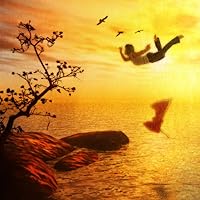
"On a frosty winter's day, Francis - the sweet, generous, responsible eldest child of the Harrelson family - dies in a car accident on an ice-covered highway, and Wolf Boy is born." "The earth doesn't rumble, no angels descend, and the sun doesn't weep. Nothing, in short, to signify the deep change that each member of the Harrelson household will undergo. Parents Gene and Helen turn away from each other and look inward, losing themselves in private fantasies. Ten-year-old Crispy devises elaborate strategies for her escape from the suffocating clutch of the Harrelson home and into the waiting arms of pop star Marky Mark." But the heart of this family portrait is younger brother Stephen, who, along with his quirky and creative friend Nicole, crafts an alternative reality in which their comic book hero, Wolf Boy, battles the forces of evil, champions the powers of good, and fights to keep his family intact. Through Wolf Boy, Stephen finds an outlet for his grief and a concrete expression for his place in a family spiraling out of control and for all the natural yearnings and hopes of a typical thirteen-year-old. Wolf Boy's adventures are featured throughout the book, introducing a graphic-novel subplot that adds humor and visual interest and stretches the limits of the conventional novel.
Once, on a flight between New York and Chicago, I was approached by an author who left first class to berate me for her book receiving universally poor reviews and who informed me that I was to be held personally responsible for the miniscule sales numbers her title achieved since I “set the tone which led to her lampooning.” Well, I defended myself as valiantly as possible. But, in the end, it was a fellow passenger listening to our exchanges that produced a copy of the book, offered it to the author, and asked for a refund. The cabin roared with laughter but, I didn’t find the experience the least bit amusing.
Kuhlman’s, Wolf Boy, a plaintive review of the year in the life of the Harrelson family immediately following the unexpected death of their eldest son and sibling, Francis, chronicles the movements of the characters as they deal with grief. Gene, the father, has engaged himself in some sort of extramarital affair that, other than a few pseudo-amorous romps in his carpentry shop, isn’t much talked about or developed by the author. Was this Kuhlman’s intention? One can only wonder. Helen, Gene’s wife, distraught at receiving too many death certificates, the result of a computer glitch in the County Clerk’s office, travels to said office and viciously attacks an employee there with a stapler. Though Helen subsequently complies with a court order to undergo grief therapy, she remains smug and unapologetic and even gloats over the assault. Not the way adults behave – grief notwithstanding. The fact that the couple’s marital woes pre-exists Francis’ death makes the reader even less sympathetic towards the pair – if that were possible. This leaves the surviving children, Crispy and Stephen, ten and 13 years of age respectively, the daunting task of persuading the reader to continue with the narrative. Crispy attempts to run away from home – to see a Marky Mark concert, leaving Stephen to shoulder the yoke of this story alone. Stephen does the best he can, creating a superhero called Wolf Boy to help him cope with the loss of his brother and, I’m tempted to say, his family’s abandonment in helping him carry this tale.
Wolf Boy managed to raise more than a few eyebrows the week a copy arrived at our offices. Not so much owing to its synopsis, but its comic book inserts; which ostensibly puts serious-minded, well educated adults (particularly women) on notice that this work, understandably a graphic novel, may not be for them. If my characterization of the novel sounds flat, it’s because the novel is essentially flat; flat and colorlessly written. Perhaps this was intentional since the book’s central character is a 13 year old. Again, one can only wonder. However, Kuhlman’s decision to employ third person narration as opposed to Stephen’s first person, causes lines such as, “He [Stephen] sat up to speak and then remembered he could talk while lying down…” painful to read.
The work is not without its pluses. The superhero comic strips are simple and naively drawn. This is to the author’s credit since in the novel the strips are actually produced by Stephen. Also, the postmortem sightings of Francis are eerie and well depicted.
It pains me to say that as debut novels go, Wolf Boy is less than impressive. But, that’s okay since authors tend to ripen with time. Perhaps if Kuhlman did more to illuminate the characters’ segue through the various stages of their grief and not merely chronicle their movements, a deeper emotional connection to them and a more profound appreciation for their experience could have been harvested by the reader. Is a graphic novel depicting superheroes the best way to convey the greatest sorrow known to humankind, namely the loss of a child or sibling? I don’t know. For a small segment of the reading populace it may be. Suffice it to say, if I met Kuhlman on a flight between New York and Ohio, I wouldn’t seek a refund. Something tells me there’s grander work ahead.
I enjoyed the comics which are interjected into this novel and the concept about the main characters brother dying and him using comics as a way of coping. I have to admit I wasn't crazy about the religious aspect of the novel, but I'm not a religious person, so some might like that but knowing nothing really of religion it just wasn't my thing. Kuhlman did a good job of describing grief within the family and it was a quick and enjoyable read.
Losing any family member in an auto accident would be terrible, but losing the big brother you've idolized for all of your 13 years is impossible to conceptualize. The task of coming to terms with such a loss is what faces the protagonist of Kuhlman's debut novel, set in early '90s Illinois. The book follows the Harrelson family as they struggle to keep living in the wake of the their golden-child Francis' death at age 19. The bulk of the story revolves around Stephen, an engagingly clever and imaginative13-year-old, although ample time is given to 9-year-old Crispy, their parents Gene and Helen, Stephen's next-door neighbor girlfriend Nicole, and Francis' college girlfriend. While the temptation must have been strong to concentrate on Stephen and his story, it's greatly to Kuhlman's credit that he's able to take us into the heads of all these other characters and come to care about each and every one.
As with so many families subject to such tragedy, the four remaining members cope by drifting apart into their own worlds. The barely communicating parents start sleeping in separate bedrooms. Ever-distant Gene spends more and more time sitting in his furniture shop with the blinds down and the "Closed" sign on the door. Meanwhile, Helen robotically goes through the motions of life until driven to a satisfying act of violence which leads to some long-overdue introspection. Crispy retreats into television and fantasies of being swept away by Mark Wahlberg (at that time he was a preteen idol known for his awful band and his Calvin Klein abs, I mean ads). However, it's Stephen we spend the most time with, as he has visions of his brother over the course of the year and tries to understand why he died. His main outlet is a quasi-autobiographical superhero comic-book he writes, Nicole illustrates, and they self-publish together. In what might be considered a gimmick (not by me, however), parts of these comic books appear in the novel, adding another layer to the storytelling and providing a particularly effective window into Stephen's grief.
In general, I tend to stay away from novels and films about tragedy and dysfunctional families. There are enough tough things to deal with in our own lives that I'm not particularly keen to use leisure time to grapple with fictional representations of even more. However, this is one of the few such works I can wholeheartedly recommend. Yes, it's very sad to see this family slowly fall apart, and the parents are especially painful figures to follow. But it's also hard not to root for Stephen to make it though the hard times and realize happiness with Nicole. There's a lot of gentle humor and sweetness that never gets cloying, and Kuhlman's simple, straightforward prose sets just the right tone. A very solid first novel about a very tough topic, skillfully handled. If you like Mark Jude Poirier, John McNally, or Tom Perrotta, check this out.
As reviewed by me on June 21, 2006: I've stopped reading at page 25 for the night, before I give myself a tear-enduced headache, which as you may know, are pretty much impossible to get rid of after they've been gotten. I've physically winced at a few overly sentimental turns of phrase already (like seriously gut-churning stuff), but I think I'm going to like it overall -- if i can get through it, I mean. I'm not particuarly sad that his brother died because his brother, so far as I can see, is a literary cliche -- the (mushroom-obsessed) golden boy, and I never met the guy, even fictionally. But it's sad in that way that all things about death are. Because they make you sad about life. And they make you fear your own, they make me miss my dog while he's at my feet. Probably the only truly gut-wrenching, face-melting, flesh evaporatingly sad excerpt on mourning I've ever read is in You Shall Know Our Velocity! by Dave Eggers. And then you find out it was all bullshit, anyway. Crying's all fun and games until someone gets a migrane.
*from page six: As he often did when nature was putting on a show for him, Stephen started thinking about God, or at least the god of design. Even though the Bible, from what he knew of it, never spoke of this, Stephen believed that an artistic god existed -- maybe not in heaven minding the store but somewhere -- who insisted on things like patterns on each snowflake, despite the fact that plain old flaked ice would be simpler and more efficient. This same god drew unneeded yet dazzling designs on butterfly wings and turtle shells, painted stripes on tigers and zebras, and dabbed freckles on Nicole's face and arms. He went crazy on peacocks, could have done a little more with hippos.
SO BASICALLY: Overly sentimental writing, but a few really great moments that make up for it.
This book was actually pretty cool. I remember the first time I got this book was when I was in middle school. I needed a book that I was supposed to read for reading logs and since I’m not much of a reader I didn’t really have that many books to read. So I stopped by a nearby bookstore and just picked up any book that looked cool and caught my eye. I happen to find this one and since then I’m very glad I did. I saw other people’s reviews though and I saw that not many people enjoy this book. I respect their opinion but I myself, enjoyed it alot. It was well written and the storyline was very interesting. I got so into the book that I actually felt really bad for the main character, Stephen, after he got a phone call notice that his big brother, Francis, was now claimed to be dead. After his loss he put his expression and thoughts into writing, creating a comic he and his friend calls “The Adventures of Wolf Boy”. I really liked how Evan Kuhlman, the author of the book, added in the comics linking to the main story of Stephen. That was really creative and original for I haven’t yet seen a book that also did that. So props to him for that idea. So if you are thinking of reading this book, I really recommend that you do. I promise you that if you take your time to read it and get into it, then you will enjoy it. But I will understand if this isn't your kind of book for everyone does have different tastes.
This book was not as good as I had hoped, but not a bad effort for a first novel. The story itself is fairly uninspired; it is about a teenager, Stephen, who loses his older brother to a car accident and must continue living his life. He is surrounded by sadness and depression, feeling isolated from the rest of the world. His parents don't help int this regard as each of them seems to draw deeper into their own little worlds. The really interesting thing about this novel, though, are the graphic novel excerpts smattered througout. To help deal with his grief Stephen begins writing a comic book which his girlfriend draws. The comic is about a family of superheroes and their adventures. This too would be nothing too special, or out of the ordinary for a novel like this, but the comic that Stephen and his friend are creating appears throughout the novel, making this more than just prose. The balance of the prose and the graphic art is good, but as I was reading it I found myself caring less about Stephen and more about Wolf Boy the comic book he was creating. Anyone looking for a nice synthesis of graphic art and prose would do well to check this book out.
Kind of a sad tale, but interesting look at a family that experiences the death of their "golden child", Francis, and how the two younger, neglected, children [Stephen and Crispy:]--and the parents [Gene and Helen:]--cope with the loss: the look-alike younger brother creates a comic book, which appears within the novel, called "Wolf Boy" {who, you guessed it, represents the younger brother, whose quest is to get in touch with God about resurrecting his brother}. What I didn't like was the fact that everyone in the book, even the children [except the youngest daughter, Crispy:] are ALL fairly comfortable with the use of the "F" word; either in their private thoughts or out loud. EVENTUALLY, the parents snap out of it, and finally notice their neglect of their two, youngest children.
I'd like to see more novels like this one, and it gains a lot of credit just by trying something rare--including comic book pages in the narrative. I read this book thinking it was for eighth-graders, and maybe that was the wrong assumption. The comic book pages are crackling with absurd humor. Not anything a thirteen-year-old could really create, but I can't blame the Fraim brothers for wanting to show off their talent. In comparison the 'main' narrative is much more conventional. I wonder at how everyone shares the same sense of humor with no hard feelings, and how a pair of thirteen-year-olds have such a strong even-keeled relationship, but maybe I'm just a grouch. It is a feel-good story with enough quirks to stay interesting.
I picked this book up at a used book store and gave it a chance. I'd like to give this book 3.5 stars because it kept me going until the end. Two things are odd about this book - the genre is unclear and the writing is stilted. I thought I was reading a YA book about losing a loved one, but I would not recommend this one to a young adult - too vulgar. Still, I loved the idea of writing graphic novels to deal with grief. Also the perspectives changed throughout the book- I liked that because I could get a glimpse of what different people deal with. I will say this - I bought this book because I think it's interesting to read YA perspectives on grief and loved the book The Last Invisible Boy - I just now made the connection that they are both by Evan Kuhlman!
There were things I really enjoyed about Wolf Boy (the comics tucked in between chapters, the kookiness of the younger teenagers, the semi-local setting in nearby Illinois) and things I really didn't have much patience for (the mother's various episodes, the religious stuff, the little sister). Kuhlman does a great job drawing the reader in, but once I'd been drawn in I wasn't sure I wanted to stay. An interesting idea (using comics to deal with loss) but ultimately just an ok read.
Took me a bit to get back around to this, but I'm so glad I did. Tracing the different responses of four family members to the loss of the eldest son in an auto accident, it's reminiscent of Disobedience, Ordinary People, The Ice Storm and the Fantastic Four in its depiction of a quartet of strong personalities falling apart and coming together in grief. Beautifully done; I had originally thought it YA, but it's really adult literary fiction featuring young adults.
What a poignant, creative read! This book describes how a family, particularly 14-year-old Stephen, copes with the grief of losing their 19-year-old brother and son. Stephen copes with the loss of his beloved brother by creating Wolf Boy, a teenage comic book superhero who possesses the strength he needs to rebuild his world. Wonderfully imaginative and incredibly compelling! Great book!
A debut novel that tackles the interesting task of combining a graphic novel with a standard novel. The protagonist (Stephen)'s brother dies in a car accident and deals with his grief by creating a comic book with his friend and love interest Nicole. It is well done as far as combining the two styles; however, the writing is a little bit trite and melodramatic.
I will give it this: I did not think the mix of graphic novel and novel would work as well as it did. The sequences blended incredibly well and the family's reactions to the death of Frances were remarkably true-to-life. However, there were some pieces that bordered on sentimental-tear forcing. But all-in-all pretty darn good.
I wish Wolf Boy could have helped me read the book. The book comes with some comic illustrations which first grabbed my attention. I loved the idea of a comic created by the protagonist that mirrored his his and represented his struggle to under life. Or more specifically the untimely death of his older brother.
A slow-paced and sad tale about a family dealing (or not) with death. I slogged through this and found the perspectives for each grieving character finely drawn and therefore excruciating. This book is so deeply about grief that reading it will either depress you or make you grateful that you're not living it. Well written and sympathetic characters will make you finish this.
The book was pretty boring in my opinion, I'm unsure why I finished it. I will say however that Kuhlman did a good job portraying the family after a tragedy. I found it very realistic and easy to relate to.
I had high hopes for this book, but I really couldn't get into it withing the first couple chapters. I may give it another go later on, but at this moment, it's not upbeat enough for my summer reading pleasure.
Some lovely twists here and there, and a well-formed sense of place and time. The comics conceit was an interesting idea, but it doesn't add much to the experience of reading. Agreed on what appears to be the consensus: a pretty promising first novel.
A fantastic story about loss and the ways we deal with it. This is the tale of a young boy who loses his brother in a car accident and how it shapes him. It features a pleathera of amazing characters and characterizations.